Adhyaya 91
महाभिष-गङ्गा-दर्शनं वसूनां शापकथनं च (Mahābhiṣa Encounters Gaṅgā; The Vasus Explain Their Curse)
Upa-parva: Śaṃtanu–Gaṅgā Upākhyāna (Mahābhiṣa–Vasu-śāpa Episode)
Vaiśaṃpāyana recounts the prior life of King Mahābhiṣa, an Ikṣvāku-descended ruler famed for truthfulness and ritual accomplishment (aśvamedha and vājapeya), who attains heaven. In Brahmā’s court, Gaṅgā arrives and a wind displaces her garment; the assembly averts its gaze, but Mahābhiṣa continues to look, marking a lapse in restraint. Brahmā censures him and ordains human rebirth with the prospect of regaining higher worlds thereafter. Mahābhiṣa selects Pratīpa as father, setting the dynastic precondition for Śaṃtanu. Gaṅgā, reflecting on the event, encounters the Vasus traveling in diminished condition; they report a curse by Vasiṣṭha incurred through a concealed offense committed during twilight worship. Unable to reverse the ṛṣi’s pronouncement, they request Gaṅgā to become human, bear them, and cast them into her waters immediately after birth to shorten their terrestrial term. They identify Śaṃtanu, Pratīpa’s son, as the human agent (“kartā”) for their incarnation and offer a share of their collective potency for a singular, exceptional son—while noting that this son will not generate further progeny. The chapter closes with the Vasus departing after formalizing the compact with Gaṅgā.
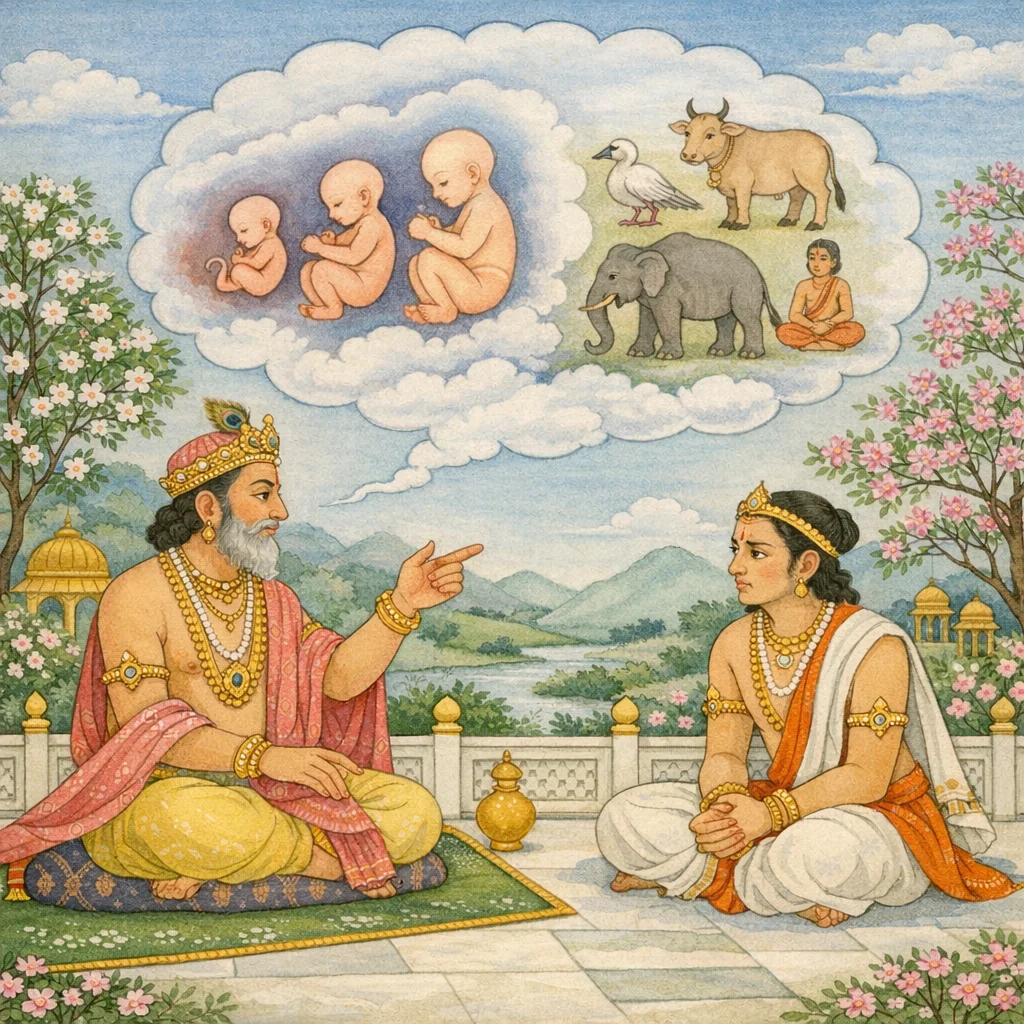
Chapter Arc: Nandana-like celestial ease is pierced by a hard truth: Yayati declares that even in heaven, companionship is conditional—when merit is spent, even gods abandon the soul as humans abandon the poor. → Ashtaka, shaken, presses Yayati: how does one become ‘kshina-punya’ (merit-exhausted)? Where do such beings go, and by what distinguishing law are destinations assigned? Yayati answers not with comfort but with the anatomy of rebirth—how life enters the womb, grows by subtle causes, and returns again to embodied knowing. → The moral calculus is spoken plainly: the doer of merit goes to auspicious wombs; the doer of sin to painful wombs—down to insects and crawling forms. The grandeur of heaven collapses into the stark wheel of karma and yoni. → Yayati turns the inquiry from fear to practice: he warns against self-advertising piety—‘I give’, ‘I sacrifice’, ‘I study’—as a subtle danger, and points instead toward the refuge known by the wise (the puranic, inner support), by whose association one attains higher peace here and after death.
Shlokas
Verse 1
(दाक्षिणात्य अधिक पाठके १ श्लोक मिलाकर कुल २४ श्लोक हैं) अप बछ। है २ >> नवतितमो< ध्याय: अष्टक और ययातिका संवाद अद्टक उवाच यदावसो नन्दने कामरूपी संवत्सराणामयुतं शतानाम् | कि कारण कार्तयुगप्रधान हित्वा च त्वं वसुधामन्वपद्य:,अष्टकने पूछा--सत्ययुगके निष्पाप राजाओंमें प्रधान नरेश! जब आप इच्छानुसार रूप धारण करके दस लाख वर्षोतक नन्दनवनमें निवास कर चुके हैं, तब क्या कारण है कि आप उसे छोड़कर भूतलपर चले आये?
Aṣṭaka said: “O foremost king of the Kṛta Yuga, able to assume forms at will—after dwelling in Nandana for a hundred myriads of years, what reason led you to abandon that celestial grove and come down to the earth?”
Verse 2
ययातिरुवाच ज्ञातिः सुह्त् स््वजनो वा यथेह क्षीणे वित्ते त्यज्यते मानवैर्हि । तथा तत्र क्षीणपुण्य॑ मनुष्य त्यजन्ति सद्यः सेश्वरा देवसड्घा:,ययाति बोले--जैसे इस लोकमें जाति-भाई, सुह्ृद् अथवा स्वजन कोई भी क्यों न हो, धन नष्ट हो जानेपर उसे सब मनुष्य त्याग देते हैं; उसी प्रकार परलोकमें जिसका पुण्य समाप्त हो गया है, उस मनुष्यको देवराज इन्द्रसहित सम्पूर्ण देवता तुरंत त्याग देते हैं
Yayāti said: “Just as in this world, whether one be a kinsman, a friend, or even one’s own relative, people abandon him when his wealth is exhausted; so too in the other world, when a man’s merit has run out, the hosts of gods—Indra included—cast him off at once.”
Verse 3
अष्टक उवाच तस्मिन् कथं क्षीणपुण्या भवन्ति सम्मुहाते मे5त्र मनो5तिमात्रम् | कि वा विशिष्टा: कस्य धामोपयान्ति तद् वै ब्रृहि क्षेत्रवित् त्वं मतो मे,अष्टकने पूछा--देवलोकमें मनुष्योंके पुण्य कैसे क्षीण होते हैं? इस विषयमें मेरा मन अत्यन्त मोहित हो रहा है। प्रजापतिका वह कौन-सा धाम है, जिसमें विशिष्ट (अपुनरावृत्तिकी योग्यतावाले) पुरुष जाते हैं? यह बताइये; क्योंकि आप मुझे क्षेत्रज्ञ (आत्मज्ञानी) जान पड़ते हैं
Aṣṭaka said: “How is it that, in that heavenly state, a person’s merit becomes exhausted? My mind is utterly bewildered about this. And what is that distinguished abode—whose realm is it—into which exceptional men, fit for non-return, attain? Tell me this truly, for you appear to me to be a knower of the Self.”
Verse 4
ययातिरुवाच इमं भौम॑ नरकं ते पतन्ति लालप्यमाना नरदेव सर्वे । ते कड़्कगोमायुबलाशनार्थ- क्षीणा विवृद्धिं बहुधा व्रजन्ति,ययाति बोले--नरदेव! जो अपने मुखसे अपने पुण्य-कर्मोंका बखान करते हैं, वे सभी इस भौम नरकमें आ गिरते हैं। यहाँ वे गीधों, गीदड़ों और कौओं आदिके खानेयोग्य इस शरीरके लिये बड़ा भारी परिश्रम करके क्षीण होते और पुत्र-पौत्रादिरूपसे बहुधा विस्तारको प्राप्त होते हैं
Yayāti said: “O king, all those who, craving praise, proclaim their own meritorious deeds with their own mouths fall into this earthly hell. There, worn down by harsh toil merely to sustain this body—fit to be devoured by vultures, jackals, and crows—they undergo depletion and yet, through sons and grandsons, spread out into many further extensions.”
Verse 5
तस्मादेतद् वर्जनीयं नरेन्द्र दुष्ट लोके गर्हणीयं च कर्म । आखा्यात॑ ते पार्थिव सर्वमेव भूयश्वेदानीं वद कि ते वदामि,इसलिये नरेन्द्र! इस लोकमें जो दुष्ट और निन्दनीय कर्म हो उसको सर्वथा त्याग देना चाहिये। भूपाल! मैंने तुमसे सब कुछ कह दिया, बोलो, अब और तुम्हें क्या बताऊँ?
Verse 6
अष्टक उवाच यदा तु तान् वितुदन्ते वयांसि तथा गृथ्रा: शितिकण्ठा: पतज्जभा: । कथं भवन्ति कथमाभवन्ति न भौममन्यं नरकं॑ शृणोमि,अष्टकने पूछा--जब मनुष्योंको मृत्युके पश्चात् पक्षी, गीध, नीलकण्ठ और पतंग ये नोच-नोचकर खा लेते हैं, तब वे कैसे और किस रूपमें उत्पन्न होते हैं? मैंने अबतक भौम नामक किसी दूसरे नरकका नाम नहीं सुना था
Aṣṭaka said: “When, after death, birds—vultures, the blue-necked birds, and other winged creatures—tear at them and feed upon them, how do those beings come to be again, and in what manner are they reborn? I have never before heard of any other hell called ‘Bhauma.’”
Verse 7
ययातिरुवाच ऊर्ध्व॑ देहात् कर्मणा जृम्भमाणाद् व्यक्त पृथिव्यामनुसंचरन्ति । इमं भौम॑ नरकं ते पतन्ति नावेक्षन्ते वर्षपूगाननेकान्,ययाति बोले--कर्मसे उत्पन्न होने और बढ़नेवाले शरीरको पाकर गर्भसे निकलनेके पश्चात् जीव सबके समक्ष इस पृथ्वीपर (विषयोंमें) विचरते हैं। उनका यह विचरण ही भौम नरक कहा गया है। इसीमें वे पड़ते हैं। इसमें पड़नेपर वे व्यर्थ बीतनेवाले अनेक वर्षसमूहोंकी ओर दृष्टिपात नहीं करते
Yayāti said: “Having obtained a manifest body that arises and grows through one’s own actions, beings, once they emerge from the womb, wander openly upon this earth among sense-objects. This very roaming is called the ‘earthly hell’ (bhauma-naraka). Into it they fall, and once fallen there, they do not look upon—nor take heed of—the many heaps of years that pass away in vain.”
Verse 8
षष्टिं सहस्राणि पतन्ति व्योम्नि तथा अशीतिं परिवत्सराणि । तान् वै तुदन्ति पतत:ः प्रपातं भीमा भौमा राक्षसास्तीक्षणदंष्टा:,कितने ही प्राणी आकाश (स्वर्गादि)-में साठ हजार वर्ष रहते हैं। कुछ अस्सी हजार वर्षोतक वहाँ निवास करते हैं। इसके बाद वे भूमिपर गिरते हैं। यहाँ उन गिरनेवाले जीवोंको तीखी दाढ़ोंवाले पृथ्वीके भयानक राक्षस (दुष्ट प्राणी) अत्यन्त पीड़ा देते हैं
Aṣṭaka said: 'Some beings remain aloft in the sky-world for sixty thousand years, and others for eighty thousand years. When their allotted span there is exhausted, they fall down to the earth. As they plunge in that dreadful descent, terrifying earth-born rākṣasas with sharp fangs torment them severely.' The verse underscores the moral fragility of heavenly enjoyments: without sustaining merit and right conduct, even long celestial residence ends in painful downfall.
Verse 9
अष्टक उवाच यदेनसस्ते पततस्तुदन्ति भीमा भौमा राक्षसास्तीक्ष्णदंष्टा: । कथं भवन्ति कथमाभवन्ति कथंभूता गर्भभूता भवन्ति,अष्टकने पूछा--तीखी दाढ़ोंवाले पृथ्वीके वे भयंकर राक्षस पापवश आकाशसे गिरते हुए जिन जीवोंको सताते हैं, वे गिरकर कैसे जीवित रहते हैं? किस प्रकार इन्द्रिय आदिसे युक्त होते हैं? और कैसे गर्भमें आते हैं?
Aṣṭaka said: “By what sin do those fearsome, earth-born rākṣasas with razor-sharp fangs torment beings as they fall? How do such fallen beings continue to exist after the fall? In what manner do they come to be—how do they take form and become embodied—and how do they enter the state of being in the womb?”
Verse 10
ययातिरुवाच अस॑र॑ रेत: पुष्पफलानुपृक्त- मन्वेति तद् वै पुरुषेण सृष्टम् । स वै तस्या रज आपसद्यते वै स गर्भभूत: समुपैति तत्र,ययाति बोले--अन्तरिक्षसे गिरा हुआ प्राणी अस्र (जल) होता है। फिर वही क्रमश: नूतन शरीरका बीजभूत वीर्य बन जाता है। वह वीर्य फूल और फलरूपी शेष कर्मोंसे संयुक्त होकर तदनुरूप योनिका अनुसरण करता है। गर्भाधान करनेवाले पुरुषके द्वारा स्त्रीसंसर्ग होनेपर वह वीर्यमें आविष्ट हुआ जीव उस स्त्रीके रजसे मिल जाता है। तदनन्तर वही गर्भरूपमें परिणत हो जाता है
Yayāti said: “The vital seed (semen), mixed with the residual fruits of past deeds—likened to ‘flower and fruit’—follows on according to what is fashioned through the male. Entering the woman, it comes into contact with her menstrual essence; and the embodied being, having entered that seed, there becomes established as an embryo.”
Verse 11
वनस्पतीनोषधीक्षाविशन्ति अपो वायु पृथिवीं चान्तरिक्षम् चतुष्पदं द्विपदं चापि सर्व- मेवम्भूता गर्भभूता भवन्ति,जीव जलरूपसे गिरकर वनस्पतियों और ओषधियोंमें प्रवेश करते हैं। जल, वायु, पृथ्वी और अन्तरिक्ष आदिमें प्रवेश करते हुए कर्मानुसार पशु अथवा मनुष्य सब कुछ होते हैं। इस प्रकार भूमिपर आकर फिर पूर्वोक्त क्रमके अनुसार गर्भभावको प्राप्त होते हैं
Aṣṭaka said: “Living beings, taking the form of water, enter trees and medicinal plants; they pass into water, wind, earth, and the mid-space. According to their deeds, they become all forms—four-footed creatures and two-footed humans alike. Thus, arriving upon the earth, they again attain the state of conception in the previously described order.”
Verse 12
अष्टक उवाच अन्यद् वरपुर्विद्धातीह गर्भ- मुताहोस्वित् स्वेन कायेन याति । आपसद्यमानो नरयोनिमेता- माचक्ष्व मे संशयात् प्रब्रवीमि,अष्टकने पूछा--राजन्! इस मनुष्ययोनिमें आनेवाला जीव अपने इसी शरीरसे गर्भमें आता है या दूसरा शरीर धारण करता है। आप यह रहस्य मुझे बताइये। मैं संशय होनेके कारण पूछता हूँ
Aṣṭaka said: “O king, tell me this clearly. When a being comes to enter the human womb, does it arrive bearing the very same body it had before, or does it assume another body? I ask because I am beset by doubt, and I seek to understand the hidden truth of how embodied life takes birth.”
Verse 13
शरीरभेदाभिसमुच्छूयं च चक्षु:श्रोत्रे लभते केन संज्ञाम् एतत तत्त्वं सर्वमाचक्ष्व पृष्ट: क्षेत्रज्ञ त्वां तात मन्याम सर्वे,गर्भमें आनेपर वह भिन्न-भिन्न शरीररूपी आश्रयको, आँख और कान आदि इन्द्रियोंको तथा चेतनाको भी कैसे उपलब्ध करता है? मेरे पूछनेपर ये सब बातें आप बताइये। तात! हम सब लोग आपको क्षेत्रज्ञ (आत्मज्ञानी) मानते हैं
Aṣṭaka said: “When the embodied being enters the womb, by what means does it obtain its distinct bodily supports, along with the faculties such as sight and hearing, and also consciousness itself? Asked by me, explain this entire truth. Dear sir, we all regard you as a knower of the Field (kṣetrajña), one who understands the Self.”
Verse 14
ययातिरुवाच वायु: समुत्कर्षति गर्भयोनि- मृतौ रेत: पुष्परसानुपृक्तम् | स तत्र तन्मात्रकृताधिकार: क्रमेण संवर्धयतीह गर्भम्,ययाति बोले--ऋतुकालनमें पुष्परससे संयुक्त वीर्यको वायु गर्भाशयमें खींच लाता है। वहाँ गर्भाशयमें सूक्ष्मभूत उसपर अधिकार कर लेते हैं और वह क्रमश: गर्भकी वृद्धि करता रहता है
Yayāti said: At the proper season for conception, the vital wind draws the semen—mingled with the woman’s generative fluid—into the womb. There, the subtle elements take hold of it according to their own specific functions, and in due order the embryo is nourished and grows within the womb. The passage frames conception as a lawful, orderly process governed by natural forces rather than mere chance, underscoring the ethical idea that embodied life arises through a regulated cosmic arrangement.
Verse 15
स जायमानो विगृहीतमात्र: संज्ञामधिष्ठाय ततो मनुष्य: । स श्रोत्राभ्यां वेदयतीह शब्दं सवै रूप॑ पश्यति चक्षुषा च,वह गर्भ बढ़कर जब सम्पूर्ण अवयवोंसे सम्पन्न हो जाता है, तब चेतनताका आश्रय ले योनिसे बाहर निकलकर मनुष्य कहलाता है। वह कानोंसे शब्द सुनता है, आँखोंसे रूप देखता है
A being, when it is born and has taken on a fully formed body, comes to rest upon consciousness and, emerging from the womb, is called a human. Here in the world it apprehends sound through the ears, and it perceives form through the eyes. In this teaching, Aṣṭaka points to embodied life as defined by awakened awareness and the functioning of the senses—an ethical reminder that human status carries responsibility for how one uses perception and understanding.
Verse 16
प्राणेन गन्धं जिह्लयाथो रसं च त्वचा स्पर्श मनसा वेद भावम् | इत्यष्टकेहोपदहितं हि विद्धि महात्मनां प्राणभृतां शरीरे,नासिकासे सुगन्ध लेता है। जिह्लासे रसका आस्वादन करता है। त्वचासे स्पर्श और मनसे आन्तरिक भावोंका अनुभव करता है। अष्टक! इस प्रकार महात्मा प्राणधारियोंके शरीरमें जीवकी स्थापना होती है
Aṣṭaka said: “By the vital breath one apprehends fragrance; by the tongue, taste; by the skin, touch; and by the mind, inner states and intentions. Know, O Aṣṭaka, that in the bodies of great-souled living beings the self is thus established and made operative—through these faculties—so that experience and moral awareness become possible.”
Verse 17
अष्टक उवाच यः संस्थित: पुरुषो दहांते वा निखन्यते वापि निकृष्यते वा । अभावभूत: स विनाशगमेत्य केनात्मना चेतयते परस्तात्,अष्टकने पूछा--जो मनुष्य मर जाता है, वह जलाया जाता है या गाड़ दिया जाता है अथवा जलनमें बहा दिया जाता है। इस प्रकार विनाश होकर स्थूल शरीरका अभाव हो जाता है। फिर वह चेतन जीवात्मा किस शरीरके आधारपर रहकर चैतन्ययुक्त व्यवहार करता है?
Aṣṭaka said: “When a person dies, he is burned, or buried, or cast away and carried off. Thus, once the gross body is destroyed and becomes non-existent, by what self—on what basis—does that conscious being continue to perceive and act thereafter?”
Verse 18
ययातिरुवाच हित्वा सो$सून् सुप्तवन्निष्टनित्वा पुरोधाय सुकृतं दुष्कृतं वा । अन््यां योनिं पवनाग्रानुसारी हित्वा देह भजते राजसिंह,ययाति बोले--राजसिंह! जैसे मनुष्य श्वास लेते हुए प्राणयुक्त स्थूल शरीरको छोड़कर स्वप्रमें विचरण करता है, वैसे ही यह चेतन जीवात्मा अस्फुट शब्दोच्चारणके साथ इस मृतक स्थूल शरीरको त्यागकर सूक्ष्म शरीरसे संयुक्त होता है और फिर पुण्य अथवा पापको आगे रखकर वायुके समान वेगसे चलता हुआ अन्य योनिको प्राप्त होता है
Yayāti said: “O lion among kings! Just as a man, still breathing, leaves behind the gross body as though asleep and roams in a dream, so too the conscious self, with indistinct utterance, abandons this lifeless gross body, takes up the subtle body, and—placing merit or demerit before it—moves with the speed of the wind and attains another womb (another mode of birth).”
Verse 19
पुण्यां योनिं पुण्यकृतो व्रजन्ति पापां योनिं पापकृतो व्रजन्ति । कीटा: पतज्जाश्ष भवन्ति पापा न मे विवक्षास्ति महानुभाव,पुण्य करनेवाले मनुष्य पुण्य-योनियोंमें जाते हैं और पाप करनेवाले मनुष्य पाप-योनिमें जाते हैं। इस प्रकार पापी जीव कीट-पतंग आदि होते हैं। महानुभाव! इन सब विषयोंको विस्तारके साथ कहनेकी इच्छा नहीं होती। नृपश्रेष्ठ) इसी प्रकार जीव गर्भमें आकर चार पैर, छः पैर और दो पैरवाले प्राणियोंके रूपमें उत्पन्न होते हैं। यह सब मैंने पूरा-पूरा बता दिया। अब और क्या पूछना चाहते हो?
Aṣṭaka said: “Those who perform meritorious deeds go to meritorious wombs, and those who commit sinful deeds go to sinful wombs. Thus, sinful beings become worms and insects. O great-souled one, I do not wish to elaborate at length on all these matters.”
Verse 20
चतुष्पदा द्विपदा: षट्पदाश्न तथाभूता गर्भभूता भवन्ति । आखूयातमेतन्निखिलेन सर्व भूयस्तु कि पृच्छसि राजसिंह,पुण्य करनेवाले मनुष्य पुण्य-योनियोंमें जाते हैं और पाप करनेवाले मनुष्य पाप-योनिमें जाते हैं। इस प्रकार पापी जीव कीट-पतंग आदि होते हैं। महानुभाव! इन सब विषयोंको विस्तारके साथ कहनेकी इच्छा नहीं होती। नृपश्रेष्ठ) इसी प्रकार जीव गर्भमें आकर चार पैर, छः पैर और दो पैरवाले प्राणियोंके रूपमें उत्पन्न होते हैं। यह सब मैंने पूरा-पूरा बता दिया। अब और क्या पूछना चाहते हो?
Aṣṭaka said: “Thus, embodied in the womb, beings come to birth as four-footed, two-footed, and six-footed creatures. I have explained all this completely and in full. Now, O lion among kings, what more do you wish to ask?”
Verse 21
अष्टक उवाच किंस्वित् कृत्वा लभते तात लोकान् मर्त्य: श्रेष्ठांस्तपसा विद्यया वा | तन्मे पृष्ट: शंस सर्व यथाव- च्छुभाललोकान् येन गच्छेत् क्रमेण,अष्टकने पूछा--तात! मनुष्य कौन-सा कर्म करके उत्तम लोक प्राप्त करता है? वे लोक तपसे प्राप्त होते हैं या विद्यासे? मैं यही पूछता हूँ। जिस कर्मके द्वारा क्रमशः श्रेष्ठ लोकोंकी प्राप्ति हो सके, वह सब यथार्थरूपसे बताइये
Aṣṭaka said: “Dear father, by doing what does a mortal attain the highest worlds? Are those worlds gained through austerity, or through knowledge? I ask you this—tell me truly and in full: by what course of action may one, step by step, reach the auspicious and श्रेष्ठ (excellent) worlds?”
Verse 22
ययातिरुवाच तपश्न दान॑ च शमो दमश्न ह्वीरार्जवं सर्वभूतानुकम्पा । स्वर्गस्थ लोकस्य वदन्ति सन््तो द्वाराणि सप्तैव महान्ति पुंसाम् । नश्यन्ति मानेन तमो5भिभूता: पुंस: सदैवेति वदन्ति सन्त:,ययाति बोले--राजन्! साधु पुरुष स्वर्गलोकके सात महान् दरवाजे बतलाते हैं, जिनसे प्राणी उसमें प्रवेश करते हैं। उनके नाम ये हैं--तप, दान, शम, दम, लज्जा, सरलता और समस्त प्राणियोंके प्रति दया। वे तप आदि द्वार सदा ही पुरुषके अभिमानरूप तमसे आच्छादित होनेपर नष्ट हो जाते हैं, यह संत पुरुषोंका कथन है
Yayāti said: “Austerity, generosity, tranquility, self-restraint, modesty, straightforwardness, and compassion toward all beings—these, the wise declare, are the seven great gates by which a person enters the heavenly world. Yet the sages also say that these very gates are continually ruined when a person is overcome by the darkness of pride.”
Verse 23
अधीयान: पण्डितं मन्यमानो यो विद्यया हन्ति यश: परेषाम् | तस्यान्तवन्तश्ष भवन्ति लोका न चास्य तद् ब्रह्म फलं ददाति,जो वेदोंका अध्ययन करके अपनेको सबसे बड़ा पण्डित मानता और अपनी विद्याद्वारा दूसरोंके यशका नाश करता है, उसके पुण्यलोक अन्तवान् (विनाशशील) होते हैं और उसका पढ़ा हुआ वेद भी उसे फल नहीं देता
Aṣṭaka says: One who studies the Veda yet, imagining himself a great scholar, uses his learning to destroy the reputation of others—such a person’s meritorious worlds are not lasting. Even that sacred knowledge (brahman, i.e., the Veda) does not yield its true fruit to him, for learning divorced from humility and goodwill becomes ethically barren.
Verse 24
चत्वारि कर्माण्यभयंकराणि भयं प्रयच्छन्त्ययथाकृतानि । मानाग्निहोत्रमुत मानमौनं मानेनाधीतमुत मानयज्ञ:,अग्निहोत्र, मौन, अध्ययन और यज्ञ--ये चार कर्म मनुष्यको भयसे मुक्त करनेवाले हैं; परंतु वे ही ठीकसे न किये जाये, अभिमानपूर्वक उनका अनुष्ठान किया जाय तो वे उलटे भय प्रदान करते हैं
Aṣṭaka said: “There are four acts that, when rightly performed, are meant to make one fearless; but when done improperly, they instead produce fear. These are: the fire-offering (agnihotra) performed with pride, silence (mauna) observed with pride, study (adhyayana) pursued with pride, and sacrifice (yajña) undertaken with pride.” The verse warns that sacred disciplines lose their protective, purifying power when corrupted by vanity; ritual and restraint become sources of anxiety and downfall when they are used to inflate the ego rather than to uphold dharma.
Verse 25
न मानमान्यो मुदमाददीत न संतापं प्राप्तुयाच्चावमानात् । सनन््तः सतः पूजयन्तीह लोके नासाधव: साधुबुद्धिं लभन्ते,विद्वान पुरुष सम्मानित होनेपर अधिक आनन्दित न हो और अपमानित होनेपर संतप्त न हो। इस लोकमें संत पुरुष ही सत्पुरुषोंका आदर करते हैं। दुष्ट पुरुषोंको “यह सत्पुरुष है' ऐसी बुद्धि प्राप्त ही नहीं होती
Aṣṭaka said: “A wise person should not become excessively elated when honored, nor fall into distress when insulted. In this world, it is the truly good who honor the good; the wicked do not even gain the discernment to recognize, ‘This is a virtuous person.’”
Verse 26
इति दद्यामिति यज इत्यधीय इति व्रतम् । इत्येतानि भयान्याहुस्तानि वर्ज्यानि सर्वश:,मैं यह दे सकता हूँ, इस प्रकार यजन करता हूँ, इस तरह स्वाध्यायमें लगा रहता हूँ और यह मेरा व्रत है; इस प्रकार जो अहंकारपूर्वक वचन हैं, उन्हें भयरूप कहा गया है। ऐसे वचनोंको सर्वथा त्याग देना चाहिये
Verse 27
ये चाश्रयं वेदयन्ते पुराणं मनीषिणो मानसमार्गरुद्धम् । तद्वः श्रेयस्तेन संयोगमेत्य परां शान्तिं प्राप्तुयु: प्रेत्य चेह,जो सबका आश्रय है, पुराण (कूटस्थ) है तथा जहाँ मनकी गति भी रुक जाती है वह (परब्रह्म परमात्मा) तुम सब लोगोंके लिये कल्याणकारी हो। जो विद्वान् उसे जानते हैं, वे उस परब्रह्म परमात्मासे संयुक्त होकर इहलोक और परलोकमें परम शान्तिको प्राप्त होते हैं
Aṣṭaka said: “That supreme Reality which is the refuge of all, ancient and primordial, and before which even the mind’s pathways come to a halt—may that be your highest good. The wise who truly know It, entering into union with that Supreme, attain the highest peace both here in this world and after death.”
Verse 90
इति श्रीमहाभारते आदिपर्वणि सम्भवपर्वणि उत्तरयायाते नवतितमो<ध्याय: ।। ९० || इस प्रकार श्रीमह्या भारत आदिपव॑ीके अन्तर्गत सम्भवपर्वमें उत्तरयायातविषयक नब्बेवाँ अध्याय पूरा हुआ
Thus, in the Śrī Mahābhārata, within the Ādi Parva and specifically the Sambhava Parva, the ninetieth chapter—concerning the episode of Uttarayāyāta—comes to its conclusion. (This is a colophon marking the end of the chapter rather than a spoken narrative verse.)
Frequently Asked Questions
The chapter centers on self-restraint versus impulse in a sacred setting: Mahābhiṣa’s continued gaze at Gaṅgā after a breach of decorum becomes an ethical lapse with karmic and institutional consequences, illustrating sabhā-maryādā as a Dharmic constraint.
Ritual merit and royal excellence do not exempt one from accountability; Dharma is situational and includes control of attention and conduct. Additionally, the narrative frames curses/boons as ethical governance mechanisms that translate cosmic order into historical causality.
No explicit phalaśruti is stated here; the meta-function is genealogical and ethical framing—explaining how rebirth directives and curse-resolution contracts generate the conditions for subsequent Kuru succession developments.