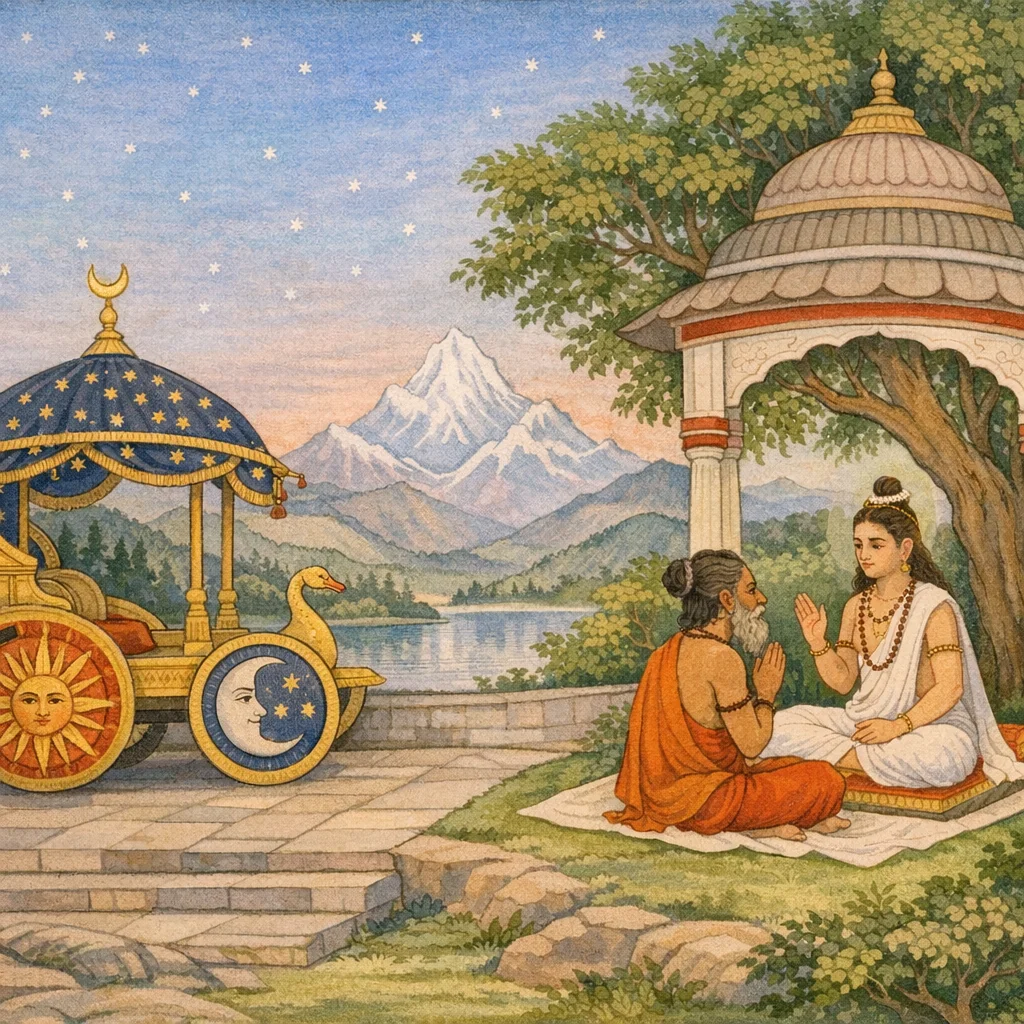
रुद्ररथ-निर्माणवर्णनम् / Description of Rudra’s Divine Chariot Construction
Adhyāya 8 unfolds as a question-and-answer dialogue. Vyāsa asks Sanatkumāra to explain the “devamaya” (divinely constituted) chariot fashioned by the celestial artisan Viśvakarman for Śiva’s purpose. Sanatkumāra, invoking Śiva’s lotus-feet, describes it as an integrated cosmogram: “sarvalokamaya,” made of all worlds, golden, and universally approved. Its parts are mapped to cosmic regulators—the right and left wheels/sections are Sūrya and Soma, with sixteen lunar spokes (kalās) and ornaments of stars and nakṣatras. The twelve Ādityas are set upon the spokes, the six seasons form rim and nave, and realms such as the antarikṣa become structural elements. Mountains of setting and rising, Mandara, and Mahāmeru serve as supports and bases, showing the chariot’s stability as the cosmic axis. Through technical enumeration, the chapter portrays Śiva gathering the cosmos into a single vehicle for righteous, dharmic action.
Shlokas
Verse 1
व्यास उवाच । सनत्कुमार सर्वज्ञ शैवप्रवर सन्मते । अद्भुतेयं कथा तात श्राविता परिमेशितुः
Vyāsa said: “O Sanatkumāra—omniscient one, foremost among Śiva’s devotees and of noble understanding—dear child, I have heard this wondrous account as it was proclaimed concerning Parameśvara, the Supreme Lord Śiva.”
Verse 2
इदानीं रथनिर्माणं ब्रूहि देवमयं परम् । शिवार्थं यत्कृतं दिव्यं धीमता विश्वकर्मणा
“Now, tell me of the construction of that supreme, divine, god-wrought chariot—made for Śiva’s purpose—crafted wondrously by the wise Viśvakarmā.”
Verse 3
सूत उवाच । इत्याकर्ण्य वचस्तस्य व्यासस्य स मुनीश्वरः । सनत्कुमारः प्रोवाच स्मृत्वा शिवपदांबुजम्
Sūta said: Having thus heard Vyāsa’s words, that lord among sages—Sanatkumāra—remembered Śiva’s lotus-feet and then began to speak.
Verse 4
सनत्कुमार उवाच । शृणु व्यास महाप्राज्ञ रथादेर्निर्मितिं मुने । यथामति प्रवक्ष्येऽहं स्मृत्वा शिवपदाम्बुजम्
Sanatkumāra said: “Listen, O Vyāsa, great sage of lofty wisdom—O muni—to the account of the construction of the chariot and the other implements. According to my understanding, I shall explain it, having first remembered the lotus-feet of Lord Śiva.”
Verse 5
अथ देवस्य रुद्रस्य निर्मितो विश्वकर्मणा । सर्वलोकमयो दिव्यो रथो यत्नेन सादरम्
Then, for Lord Rudra, Viśvakarmā—exerting careful effort with reverent attention—fashioned a radiant, celestial chariot, wondrously made as though it embodied all the worlds.
Verse 6
सर्वभूतमयश्चैव सौवर्णस्सर्वसंमतः । रथांगं दक्षिणं सूर्यस्तद्वामं सोम एव च
That chariot pervades all beings, shines with golden splendor, and is approved by all. Its right wheel is the Sun, and its left wheel is indeed the Moon.
Verse 8
शशिनः षोडशारास्तु कला वामस्य सुव्रत । ऋक्षाणि तु तथा तस्य वामस्यैव विभूषणम्
O noble one of excellent vows, the Moon’s sixteen rays are the ornaments of His left side; likewise, the lunar mansions (nakṣatras) are adornments upon that very left side.
Verse 9
ऋतवो नेमयः षट् च तयोर्वै विप्रपुंगव । पुष्करं चांतरिक्षं वै रथनीडश्च मंदरः
O best of brahmins, the seasons and the six felly-segments (nemi) are indeed among them; and likewise Puṣkara, the mid-space (antarikṣa), Rathanīḍa, and Mandara, the mountain.
Verse 10
अस्ताद्रिरुदयाद्रिस्तु तावुभौ कूबरौ स्मृतौ । अधिष्ठानं महामेरुराश्रयाः केशराचलाः
The Western Mountain, Astādri, and the Eastern Mountain, Udayādri, are both remembered as the two “Kuberas,” the supporting flanks. The great Mount Mahāmeru is their base, and the Keśara mountains stand as its supporting ranges.
Verse 11
वेगस्संवत्सरास्तस्य अयने चक्रसंगमौ । मुहूर्ता वंधुरास्तस्य शम्याश्चैव कलाः स्मृताः
For Him, speed itself is the year; the two courses of ayana (the solstitial paths) are the meeting of the cosmic wheels. For Him, the muhūrtas are only brief intervals, and the kalās are remembered as mere instants—thus His transcendence over time is taught.
Verse 12
तस्य काष्ठाः स्मृता घोणाश्चाक्षदंडाः क्षणाश्च वै । निमेषाश्चानुकर्षश्च ईषाश्चानुलवाः स्मृताः
For him, the measures of time are said to be: kāṣṭhās, ghoṇās, akṣa-daṇḍas, and kṣaṇas; likewise nimeṣas, anukarṣas, īṣās, and also anulavas are declared.
Verse 13
द्यौर्वरूथं रथस्यास्य स्वर्गमोक्षावुभौ ध्वजौ । युगान्तकोटितौ तस्य भ्रमकामदुघौ स्मृतौ
The very sky was the canopy (varūtha) of his chariot; its two banners were Heaven (svarga) and Liberation (mokṣa). And for him, the pair called Yugānta and Koṭita were renowned as bestowers of wondrous, desire-fulfilling effects.
Verse 14
ईषादंडस्तथा व्यक्तं वृद्धिस्तस्यैव नड्वलः । कोणास्तस्याप्यहंकारो भूतानि च बलं स्मृतम्
The īṣā-daṇḍa, the central beam, is known as the manifest principle (vyakta); its increase is called naḍvala. Its corners are said to be egoity (ahaṅkāra), and the elemental beings (bhūtas) are remembered as its strength (bala).
Verse 15
इन्द्रियाणि च तस्यैव भूषणानि समंततः । श्रद्धा च गतिरस्यैव रथस्य मुनिसत्तम
O best of sages, the senses themselves are the ornaments of that chariot on every side; and faith (śraddhā) alone is indeed its movement—its onward course.
Verse 16
तदानीं भूषणान्येव षडंगान्युपभूषणम् । पुराणन्यायमीमांसा धर्मशास्त्राणि सुव्रताः
At that time, the disciplines themselves became ornaments: the six auxiliaries of the Veda served as adornments, and the Purāṇas, Nyāya, Mīmāṃsā, and the Dharmaśāstras—O you of noble vows—stood forth as embellishing supports.
Verse 17
बलाशया वराश्चैव सर्वलक्षणसंयुताः । मंत्रा घंटाः स्मृतास्तेषां वर्णपादास्तदाश्रमाः
Endowed with strength, auspiciousness, and every defining mark, they are remembered as the “mantras” and the “bells”; and for them the syllables and metrical feet are said to be their very abodes (supports).
Verse 18
अथो बन्धो ह्यनन्तस्तु सहस्रफणभूषितः । दिशः पादा रथस्यास्य तथा चोपदिशश्चह
Moreover, Ananta—adorned with a thousand hoods—served as its binding support; the Directions became the feet of this chariot, and the intermediate directions as well.
Verse 19
पुष्कराद्याः पताकाश्च सौवर्णा रत्नभूषिताः । समुद्रास्तस्य चत्वारो रथकंबलिनस्स्मृताः
His banners—beginning with those named Puṣkara and others—were made of gold and adorned with jewels. And the four “oceans” associated with him were said to be the coverings (kambalas) of his chariot.
Verse 20
गंगाद्यास्सरित श्रेष्ठाः सर्वाभरणभूषिताः । चामरासक्तहस्ताग्रास्सर्वास्त्रीरूपशोभिताः
The foremost rivers—beginning with the Gaṅgā—appeared, adorned with every ornament. Their hands were engaged in holding yak-tail fans, and all of them shone in beautiful female forms.
Verse 21
तत्र तत्र कृतस्थानाः शोभयांचक्रिरे रथम् । आवहाद्यास्तथा सप्त सोपानं हैममुत्तमम्
Taking their appointed positions here and there, they adorned the chariot. Likewise, they brought forth an excellent golden stairway of seven steps.
Verse 22
लोकालोकाचलस्तस्योपसोपानस्समंततः । विषयश्च तथा बाह्यो मानसादिस्तु शोभनः
All around it were the ascending approaches and steps of the Lokāloka mountain; and beyond it lay the outer realm of objects—beginning with the mind—beautifully arrayed.
Verse 23
पाशास्समंततस्तस्य सर्वे वर्षाचलास्स्मृताः । तलास्तस्य रथस्याऽथ सर्वे तलनिवासिनः
All the nooses (pāśas) surrounding him were understood to be the Varṣa mountains on every side; and the lower worlds (talas) were, indeed, all stationed as the base of his chariot—together with all the beings who dwell in those subterranean realms.
Verse 24
सारथिर्भगवान्ब्रह्मा देवा रश्मिधराः स्मृताः । प्रतोदो ब्रह्मणस्तस्य प्रणवो ब्रह्मदैवतम्
For that cosmic chariot, the blessed Lord Brahmā is remembered as the charioteer, and the gods are said to be the holders of the reins. For Brahmā, the goad is the sacred syllable Praṇava (Oṁ), his presiding divine principle—by which the ordered course of creation is urged onward.
Verse 25
अकारश्च महच्छत्रं मंदरः पार्श्वदंडभाक् । शैलेन्द्रः कार्मुकं तस्य ज्या भुजंगाधिपस्स्वयम्
The syllable “A” became his vast royal parasol; Mount Mandara served as the side-staff that bore it. The lord of mountains became his bow, and the serpent-king himself became its bowstring.
Verse 26
घंटा सरस्वती देवी धनुषः श्रुतिरूपिणी । इषुर्विष्णुर्महातेजास्त्वग्निश्शल्यं प्रकीर्तितम्
The bell is Goddess Sarasvatī; the bow is the Veda itself in the form of sacred hearing (śruti). The arrow is mighty Viṣṇu, and Agni is declared to be the sharp iron tip (śalya) of that arrow.
Verse 27
हयास्तस्य तथा प्रोक्ताश्चत्वारो निगमा मुने । ज्योतींषि भूषणं तेषामवशिष्टान्यतः परम्
O sage, it is said that his horses are four—the four Nigamas (the Vedas). Their ornaments are the heavenly luminaries; and thereafter, the remaining details are described further.
Verse 28
अनीकं विषसंभूतं वायवो वाजका स्मृताः । ऋषयो व्यासमुख्याश्च वाहवाहास्तथाभवन्
That battle-host arose from poison; the winds were known as swift chargers. The sages too—foremost among them Vyāsa—became the bearers and carriers of the divine forces in that conflict.
Verse 29
स्वल्पाक्षरैस्संब्रवीमि किं बहूक्त्या मुनीश्वर । ब्रह्मांडे चैव यत्किंचिद्वस्तुतद्वै रथे स्मृतम्
In a few words I shall state it—what need is there of many statements, O lordly sage? Whatever exists anywhere within the cosmic egg (the universe), all that is remembered as being contained in that chariot.
Verse 30
एवं सम्यक्कृतस्तेन धीमता विश्वकर्मणा । सरथादिप्रकारो हि ब्रह्मविष्ण्वाज्ञया शुभः
Thus, by the wise Viśvakarman, the entire auspicious arrangement—beginning with the chariot—was perfectly fashioned, in accordance with the command of Brahmā and Viṣṇu.
Frequently Asked Questions
The chapter emphasizes the preparation for Śiva/Rudra’s campaign by detailing the construction of his divine chariot (ratha) by Viśvakarman, presented as a universe-constituted vehicle.
The chariot functions as a cosmogram: its components are correlated with luminaries (Sūrya, Soma), time-structures (six seasons), and divine collectives (twelve Ādityas), implying that Śiva’s action is the coordinated movement of cosmic order itself.
Key correspondences include Sūrya and Soma as right/left chariot-parts, lunar sixteenfold measures (ṣoḍaśa kalās/spokes), twelve Ādityas on spokes, six seasons as structural rims, and cosmic mountains (Udayādri, Astādri, Mandara, Mahāmeru) as supports/bases.