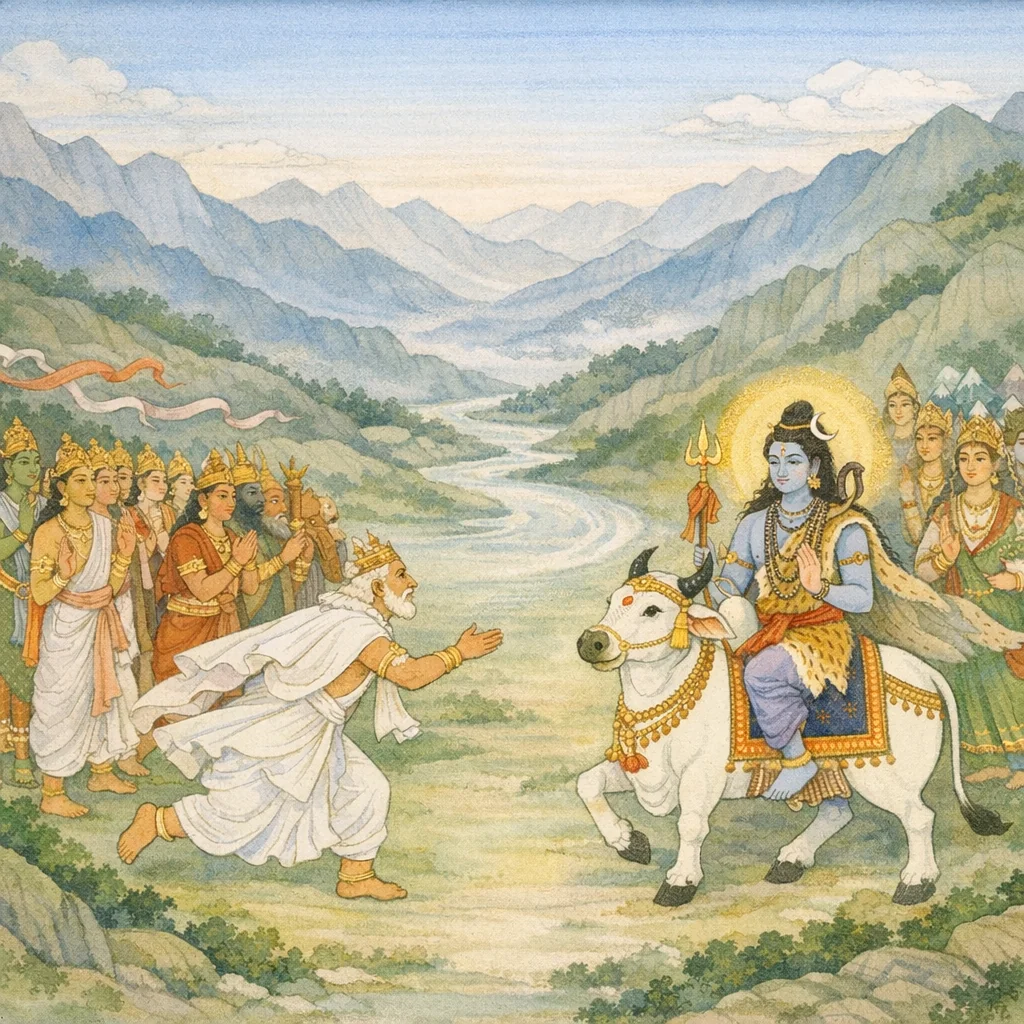
ईश्वरागमनं हिमवदादि-समागमश्च / The Arrival of Īśvara and the Assembly of Himālaya, Devas, and Mountains
Adhyāya 42 portrays Īśvara’s (Śiva’s) approach to the region of Himālaya and the ceremonial gathering that follows. Brahmā relates that Himālaya, hearing of Śiva’s arrival, rejoices and arranges an audience by sending mountains and brāhmaṇas ahead, while he himself hastens forth in devotion. The devas and the hosts of mountains assemble in a vast, orderly, army-like formation, sharing wonder and bliss; the meeting is poetically likened to the confluence of the eastern and western oceans. When Īśvara appears before them, Himālaya leads the reverence, and all mountains and brāhmaṇas bow to Sadāśiva. The chapter then offers a dense iconographic vision of Śiva—seated on Vṛṣabha, serene-faced, adorned and radiant, clothed in fine garments, crowned with jewels, smiling in pure splendor—affirming a darśana-centered theology in which sacred sight awakens devotion, humility, and cosmic harmony.
Shlokas
Verse 1
ब्रह्मोवाच । अथाकर्ण्य गिरीशश्च निजपुर्य्युपकण्ठतः । प्राप्तमीशं सर्वगं वै मुमुदेति हिमालयः
Brahmā said: Hearing that Lord Girīśa (Śiva) had arrived near his own city, Himālaya rejoiced, knowing the Lord to be the all-pervading Īśvara, present everywhere.
Verse 2
अथ सम्भृतसम्भार स्सम्भाषां कर्तुमीश्वरम् । शैलान्प्रस्थापयामास ब्राह्मणानपि सर्वशः
Then, having made all preparations, he set out to address the Lord; and in every direction he also dispatched the mountains and the brāhmaṇas.
Verse 3
स्वयं जगाम सद्भक्त्या प्राणेप्सुन्द्रष्टुऽमीश्वरम् । भक्त्युद्रुतमनाश्शैलः प्रशंसन् स्वविधिम्मुदा
Moved by pure devotion, Śaila went himself, eager to behold the Lord even at the cost of his life. His heart melted through bhakti, and as he went he joyfully praised his own destiny and providence.
Verse 4
देवसेनां तदा दृष्ट्वा हिमवान्वि स्मयं गतः । जगाम सम्मुखस्तत्र धन्योऽहमिति चिन्तयन्
Then, on seeing Devasenā, Himavān was filled with wonder. Thinking, “Blessed am I,” he went forward there to meet her face to face.
Verse 5
देवा हि तद्बलं दृष्ट्वा विस्मयम्परमं गताः । आनन्दम्परमम्प्रापुर्देवाश्च गिरयस्तथा
Indeed, beholding that power, the gods were struck with the greatest wonder; and the gods—as well as the mountains—attained supreme delight.
Verse 6
पर्वतानां महासेना देवानां च तथा मुने । मिलित्वा विरराजेव पूर्वपश्चिमसागरौ
O sage, the vast host of the mountains and the assembly of the gods, having come together, shone forth brilliantly—like the Eastern and Western oceans in their grandeur.
Verse 7
परस्परं मिलित्वा ते देवाश्च पर्वतास्तथा । कृतकृत्यन्तथात्मानम्मेनिरे परया मुदा
When the gods and the mountain-lords met together in mutual accord, they rejoiced greatly, feeling within themselves that their purpose had been fulfilled.
Verse 8
अथेश्वरम्पुरो दृष्ट्वा प्रणनाम हिमालयः । सर्वे प्रणेमुर्गिरयो ब्राह्मणाश्च सदाशिवम्
Then, seeing the Lord (Sadāśiva) before him, Himālaya bowed down in reverence. All the mountains and the brāhmaṇas too prostrated to Sadāśiva.
Verse 9
वृषभस्थम्प्रसन्नास्यन्नानाभरणभूषितम् । दिव्यावयवलावण्यप्रकाशितदिगन्तरम्
Seated upon Vṛṣabha, the bull, with a serene and gracious face, adorned with many ornaments—His divine limbs, radiant with beauty, illumined the horizons in every direction.
Verse 10
सुसूक्ष्माहतसत्पट्टवस्त्रशोभितविग्रहम् । सद्रत्नविलसन्मौलिं विहसन्तं शुचिप्रभम्
His form was adorned with exquisitely fine, well-woven silk garments; his crown shone with splendid jewels. Smiling gently, he radiated a pure, stainless brilliance—an auspicious saguṇa manifestation that draws the devotee’s mind into reverent contemplation of Śiva.
Verse 11
भूषाभूताहियुक्तांगमद्भुतावयवप्रभम् । दिव्यद्युतिं सुरेशैश्च सेवितं करचामरैः
His body was adorned with serpents as ornaments; every limb shone with wondrous splendor. Radiant with divine brilliance, he was attended by the lords of the gods, who fanned him with hand-held chowries.
Verse 12
वामस्थिताच्युतन्दक्षभागस्थितविभुम्प्रभुम् । पृष्ठस्थितहरिं पृष्ठपार्श्वस्थितसुरादिकम्
He beheld the Lord arranged in sacred order: the Imperishable Acyuta (Viṣṇu) standing on the left, the mighty sovereign on the right, Hari stationed behind, and the hosts of gods and other celestial beings arrayed along the rear sides—an ordered vision of the divine assembly around Śiva’s supreme presence.
Verse 13
नानाविधिसुराद्यैश्च संस्तुतं लोकशंकरम् । स्वहेत्वात्ततनुम्ब्रह्मसर्वेशं वरदायकम्
He is praised in many ways by the gods and other celestial beings—the Benefactor of the worlds. By His own free will He assumes a body; He is Brahman, the Lord of all, and the gracious bestower of boons.
Verse 14
सगुणं निर्गुणं चापि भक्ताधीनं कृपाकरम् । प्रकृतेः पुरुषस्यापि परं सच्चित्सुखात्मकम्
He is both with attributes (saguṇa) and beyond attributes (nirguṇa); He is compassionate and, through grace, becomes as though dependent on His devotees. He is supreme even beyond Prakṛti and Puruṣa, and His very nature is Being, Consciousness, and Bliss (sat–cit–sukha).
Verse 15
प्रभोर्दक्षिणभागे तु ददर्श हरिमच्युतम् । विनतातनयारूढं नानाभूषणभूषितम्
Then, on the Lord’s right side, he beheld Hari—the infallible Viṣṇu—seated upon Vinatā’s son (Garuḍa) and adorned with many kinds of ornaments.
Verse 16
प्रभोश्च वामभागे तु मुने मां सन्ददर्श ह । चतुर्मुखं महाशोभं स्वपरीवारसंयुतम्
O sage, on the left side of the Lord I beheld the four-faced Brahmā—radiant with great splendor—surrounded by his own retinue.
Verse 17
एतौ सुरेश्वरौ दृष्ट्वा शिवस्याति प्रियौ सदा । प्रणनाम गिरीशश्च सपरीवार आदरात्
Seeing those two lords of the gods—ever exceedingly dear to Śiva—Girīśa (Himālaya), together with his attendants, bowed down reverently.
Verse 18
तथा शिवस्य पृष्ठे च पार्श्वयोस्तु विराजितान् । देवादीन्प्रणनामासौ दृष्ट्वा गिरिवरेश्वरः
Then, seeing the gods and other celestials standing resplendent behind Śiva and at His sides, the Lord of the best of mountains (Himālaya) bowed down to them in reverence.
Verse 19
शिवाज्ञया पुरो भूत्वा जगाम स्वपुरं गिरिः । शेषहर्यात्मभूश्शीघ्रं मुनिभिः निर्जरादिभिः
By Śiva’s command, the Mountain (Himālaya), going before them as the leader, proceeded to his own city. Following swiftly behind were Śeṣa, Hari (Viṣṇu), the Self-born (Brahmā), along with sages and the hosts of the deathless gods.
Verse 20
सर्वे मुनिसुराद्याश्च गच्छन्तः प्रभुणा सह । गिरेः पुरं समुदिताः शशंसुर्बहु नारद
O Nārada, all the sages, the gods, and the others, proceeding together with the Lord, assembled in the city of the Mountain (Himālaya) and spoke at length, proclaiming many words of praise.
Verse 21
रचिते शिखरे रम्ये संस्थाप्य देवतादिकम् । जगाम हिमवांस्तत्र यत्रास्ति विधिवेदिका
Having installed the deities and the other sacred appointments upon that beautifully prepared summit, Himavān went to the place where the proper ritual altar (vedikā), arranged according to scriptural rule, was set.
Verse 22
कारयित्वा विशेषेण चतुष्कन्तो रणैर्युतम् । स्नानदानादिकं कृत्वा परीक्षामकरोत्तदा
Then, having a specially prepared four-sided arena made and furnished with battle-gear, he performed the rites of sacred bathing, charitable giving, and the like; thereafter, at that very time, he conducted the examination.
Verse 23
स्वपुत्रान्प्रेषयामास शिवस्य निकटे तथा । हिमो विष्ण्वादिसम्पूर्णवर्गयुक्तस्य शैलराट्
Then Himavān, the king of mountains, attended by a complete retinue that included Viṣṇu and the other gods, sent his own sons to be near Lord Śiva.
Verse 24
कर्तुमेच्छद्वराचारं महोत्सवपुरस्सरम् । महाहर्षयुतस्सर्वबन्धुयुग्घिमशैलराट्
Desiring to perform the excellent rites, preceded by a grand festival, the mountain-king Himālaya—filled with great joy, together with all his kinsmen—became eager to proceed.
Verse 25
अथ ते गिरिपु त्राश्च तत्र गत्वा प्रणम्य तम् । सस्ववर्गं प्रार्थनान्तामूचुश्शैलेश्वरस्य वै
Then the daughters of the Mountain went there; approaching and bowing to him, they voiced a supplicatory prayer—on behalf of themselves and their own companions—to Śaileśvara, the Lord of the Mountain.
Verse 26
ततस्ते स्वालयं जग्मुश्शैलपुत्रास्तदाज्ञया । शैलराजाय संचख्युस्ते चायान्तीति हर्षिताः
Then, by her command, the daughters of the Mountain returned to their own abode. Rejoicing, they informed the Mountain-King Himālaya, “They are coming.”
Verse 27
अथ देवाः प्रार्थनान्तां गिरेः श्रुत्वातिहर्षिताः । मुने विष्ण्वादयस्सर्वे सेश्वरा मुमुदुर्भृशम्
Then, O sage, hearing that the Mountain’s prayer had reached its conclusion, all the gods—Viṣṇu and the others, together with their own divine powers—became exceedingly delighted.
Verse 28
कृत्वा सुवेषं सर्वेपि निर्जरा मुनयो गणाः । गमनं चक्रुरन्येपि प्रभुणा गिरिराड्गृहम्
Having adorned themselves in fine attire, all the deathless ones—sages and Śiva’s gaṇas—set forth. Others too, along with the Lord, proceeded to the palace-home of the king of mountains, Himālaya.
Verse 29
तस्मिन्नवसरे मेना द्रष्टुकामाभवच्छिवम् । प्रभोराह्वाययामास मुने त्वां मुनिसत्तमम्
At that very time, Menā longed to behold Lord Śiva. Therefore, O sage—best among ascetics—she entreated the Lord and had you summoned.
Verse 30
अगमस्त्वं मुने तत्र प्रभुणा प्रेरितस्तदा । मनसा शिवहृद्धेतुं पूर्णं कर्तुं तमिच्छता
O sage, you went there at that time, impelled by the Lord, who—by His own will—desired to fulfill completely the purpose cherished in Śiva’s heart.
Verse 31
त्वाम्प्रणम्य मुने मेना प्राह विस्मितमानसा । द्रष्टुकामा प्रभो रूपं शंकरस्य मदापहम्
Having bowed to you, O sage, Menā—her mind filled with wonder—spoke: “O lord, I wish to behold the form of Śaṅkara, the one who removes pride and intoxication.”
Verse 42
इति श्रीशिवमहापुराणे द्वितीयायां रुद्रसंहितायान्तृतीये पार्वतीखण्डे देवगिरिमेलवर्णनं नाम द्विचत्वारिंशोऽध्यायः
Thus, in the holy Śiva Mahāpurāṇa—within the Second (Samhitā), the Rudra-saṃhitā, in its Third section, the Pārvatī-khaṇḍa—concludes the forty-second chapter entitled “The Description of the Divine Gathering at Devagiri.”
Frequently Asked Questions
Śiva/Īśvara arrives near Himālaya’s city; Himālaya, along with devas, brāhmaṇas, and mountain hosts, assembles to welcome him and offers collective praṇāma, culminating in Śiva’s darśana description.
The episode models darśana as a soteriological trigger: divine presence (sarvagata yet manifest) evokes bhakti, humility, and alignment of cosmic communities, implying that order and grace arise from right recognition and reverent reception.
Anthropomorphic Śiva as Sadāśiva seated on Vṛṣabha, adorned with ornaments and jewels, radiating purity and beauty—an iconographic template for contemplation and devotional visualization.