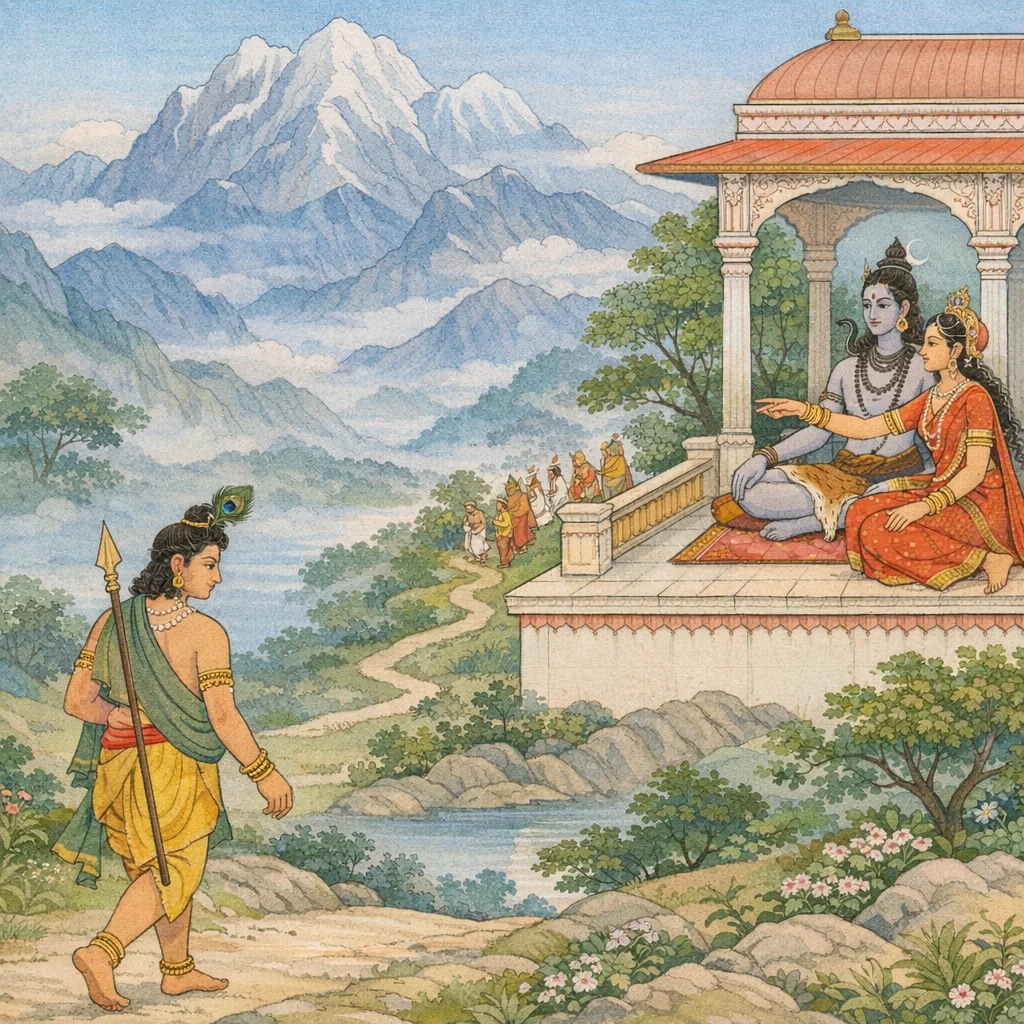
Kumārasya Krāuñcaparvatagamanam (Kumāra’s Departure to Mount Krāuñca)
Sūta continues the sacred narrative of Kumāra, emphasizing its power to purify sins. After returning to Kailāsa, Kumāra hears news regarding Gaṇeśa’s marriage from a celestial sage, which prompts him to depart for Mount Krāuñca despite his parents' objections. Pārvatī is deeply saddened by his departure, but Śiva consoles her and sends a delegation of devas and ṛṣis to persuade Kumāra to return. The chapter illustrates divine family dynamics as a means of cosmic governance and spiritual instruction.
Shlokas
Verse 1
सूत उवाच । अतः परं प्रवक्ष्यामि मल्लिकार्जुनसंभवम् । यः श्रुत्वा भक्तिमान्धीमान्सर्वपापैः प्रमुच्यते
Sūta said: “Now, next, I shall narrate the sacred account of the manifestation of Mallikārjuna. Whoever hears it with devotion and a steady, discerning mind is released from all sins.”
Verse 2
पूर्वं चा कथितं यच्च तत्पुनः कथयाम्यहम् । कुमारचरितं दिव्यं सर्वपापविनाशनम्
Whatever I have already narrated earlier, I shall relate once again. I will recount the divine life-story of Kumāra (Skanda), which destroys all sins.
Verse 3
यदा पृथ्वीं समाक्रम्य कैलासं पुनरागतः । कुमारस्स शिवापुत्रस्तारकारिर्महाबलः
When the mighty Kumāra—Śiva’s son, the destroyer of Tāraka—had traversed the earth and returned again to Kailāsa, the sacred narration continues from that auspicious moment.
Verse 4
तदा सुरर्षिरागत्य सर्वं वृत्तं जगाद ह । गणेश्वरविवाहादि भ्रामयंस्तं स्वबुद्धितः
Then the divine sage came and narrated to him everything that had occurred—beginning with the account of Gaṇeśvara’s marriage—guiding (and correcting) him according to his own discerning understanding.
Verse 5
तच्छुत्वा स कुमारो हि प्रणम्य पितरौ च तौ । जगाम पर्वतं क्रौचं पितृभ्यां वारितोऽपि हि
Hearing this, the divine Youth bowed to both his parents; and though they tried to restrain him, he still set out for Mount Kraunca.
Verse 6
कुमारस्य वियोगेन तन्माता गिरिजा यदा । दुःखितासीत्तदा शंभुस्तामुवाच सुबोधकृत्
When Girijā, Kumāra’s mother, was stricken with sorrow at being separated from her son, then Śaṃbhu (Lord Śiva), bestower of right understanding, spoke to her to console and instruct her.
Verse 7
कथं प्रिये दुःखितासि न दुःखं कुरु पार्वति । आयास्यति सुतः सुभ्रूस्त्यज्यतां दुःखमुत्कटम्
“Beloved, why are you sorrowful? Do not grieve, O Pārvatī. The son will surely return, O fair-browed one—therefore abandon this intense anguish.”
Verse 8
सा यदा च न तन्मेने पार्वती दुःखिता भृशम् । तदा च प्रेषितास्तत्र शंकरेण सुरर्षयः
When Pārvatī did not accept it and became deeply distressed, then Śaṅkara dispatched divine sages to that place.
Verse 9
देवाश्च ऋषयस्सर्वे सगणा हि मुदान्विताः । कुमारानयनार्थं वै तत्र जग्मुः सुबुद्धयः
All the gods and all the sages—together with their attendant hosts—filled with joy, went to that place with clear understanding, for the purpose of summoning the divine Kumāra.
Verse 10
तत्र गत्वा च ते सर्वे कुमारं सुप्रणम्य च । विज्ञाप्य बहुधाप्येनं प्रार्थनां चक्रुरादरात्
Having gone there, all of them bowed deeply to the Kumāra. After respectfully informing him again and again, they made their earnest request with devotion.
Verse 11
देवादिप्रार्थनां तां च शिवाज्ञासंकुलां गुरुः । न मेने स कुमारो हि महाहंकारविह्वलः
That Guru did not accept the gods’ supplication—charged as it was with Śiva’s command—for the Kumāra, shaken by great egoism, paid it no heed.
Verse 12
ततश्च पुनरावृत्य सर्वे ते हि शिवांतिकम् । स्वंस्वं स्थानं गता नत्वा प्राप्य शंकरशासनम्
Then, returning again to the presence of Lord Śiva, all of them bowed down; and, having received Śaṅkara’s command, they departed to their respective abodes.
Verse 13
तदा च गिरिजादेवी विरहं पुत्रसंभवम् । शंभुश्च परमं दुःखं प्राप तस्मिन्ननागते
Then Girijā Devī, through separation, became the cause for the arising of a son; and Śambhu too, in that time when the son had not yet come to be, fell into supreme sorrow.
Verse 14
अथो सुदुःखितौ दीनौ लोकाचारकरौ तदा । जग्मतुस्तत्र सुस्नेहात्स्वपुत्रो यत्र संस्थितः
Then the two of them, overwhelmed with sorrow and brought to helplessness, yet keeping the decorum of worldly conduct, went—moved by deep affection—to the place where their own son was staying.
Verse 15
इति श्रीशिवपुराणे चतुर्थ्यां कोटि रुद्रसंहिताया मल्लिकार्जुनद्वितीयज्योतिर्लिंगवर्णनंनाम पंचदशोऽध्यायः
Thus, in the Śrī Śiva Purāṇa—within the Fourth Saṃhitā, the Koṭirudra Saṃhitā—ends the fifteenth chapter, entitled “The Description of Mallikārjuna, the Second Jyotirliṅga.”
Verse 16
क्रौंचे च पर्वते दूरं गते तस्मिन्स्वपुत्रके । तौ च तत्र समासीनौ ज्यो तीरूपं समाश्रितौ
When he had gone far away to Mount Krauñca along with his own son, the two of them sat there, taking refuge in the form of divine Light—Śiva as Jyoti, the radiance.
Verse 17
पुत्रस्नेहातुरौ तौ वै शिवौ पर्वणिपर्वणि । दर्शनार्थं कुमारस्य स्वपुत्रस्य हि गच्छतः
Overcome with affection for their son, Śiva and Pārvatī would, at every sacred observance and festival, go to behold the boy—indeed their own son—solely for the joy of darśana.
Verse 18
अमावास्यादिने शंभुस्स्वयं गच्छति तत्र ह । पौर्णमासीदिने तत्र पार्वती गच्छति ध्रुवम्
On the new-moon day, Śambhu—Lord Śiva Himself—surely goes there; and on the full-moon day, Pārvatī unfailingly goes there.
Verse 19
तद्दिनं हि समारभ्य मल्लिकार्जुनसंभवम् । लिंगं चैव शिवस्यैकं प्रसिद्धं भुवनत्रये
From that very day onward, the one Liṅga of Lord Śiva—manifest as Mallikārjuna—became renowned throughout the three worlds.
Verse 20
तल्लिंगं यः समीक्षेत स सर्वैः किल्बिषैरपि । मुच्यते नात्र सन्देहः सर्वान्कामानवाप्नुयात्
Whoever beholds that Śiva-liṅga is freed even from all sins—of this there is no doubt—and attains all desired aims. In Śaiva Siddhānta, such darśana purifies the paśu (bound soul) and turns it toward Śiva, the Pati, who grants both bhukti (worldly fulfilment) and the path to mukti (liberation).
Verse 21
दुःखं च दूरतो याति सुखमात्यंतिकं लभेत् । जननीगर्भसंभूतं कष्टं नाप्नोति वै पुनः
Sorrow departs far away, and one attains the ultimate, unbroken happiness. Indeed, one does not again undergo the suffering that arises from entering a mother’s womb—the bondage of rebirth.
Verse 22
धनधान्यसमृद्धिश्च प्रतिष्ठारोग्यमेव च । अभीष्टफलसिद्धिश्च जायते नात्र संशयः
Wealth and abundance of grain arise, along with honor and good health; and the fulfillment of one’s desired aims is attained—of this there is no doubt.
Verse 23
ज्योतिर्लिंगं द्वितीयं च प्रोक्तं मल्लिकसंज्ञितम् । दर्शनात्सर्वसुखदं कथितं लोकहेतवे
The second Jyotirliṅga is declared to be the one known as Mallika. By merely beholding it, it bestows every happiness; it has been spoken of for the welfare of the world.
Frequently Asked Questions
Kumāra, after returning to Kailāsa, leaves for Mount Krāuñca despite parental restraint; Pārvatī grieves, Śiva consoles her, and devas with ṛṣis are sent to petition Kumāra to return.
Separation and return are used as a pedagogic template: grief becomes a site for Śiva’s instruction, while emissaries (devas/ṛṣis/gaṇas) symbolize ordered mediation—how divine will restores equilibrium without negating personal emotion.
Śiva appears as Śambhu/Śaṅkara in the role of the compassionate instructor and stabilizing sovereign; Gaurī appears as Girijā/Pārvatī embodying maternal devotion and affective bhakti refined through Śiva’s counsel.