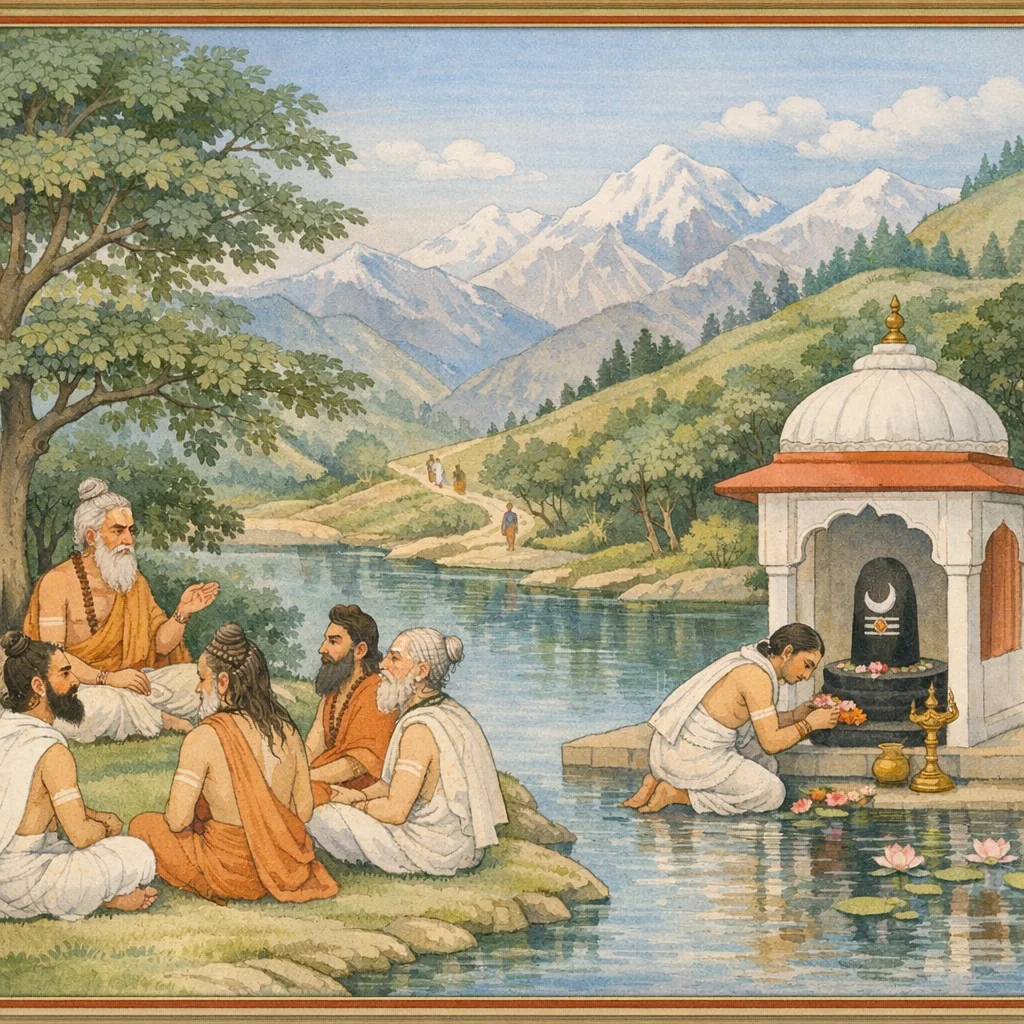
उत्तरदिग्देशस्थ-शिवलीङ्गमाहात्म्य (Māhātmya of Northern-Region Śiva-liṅgas)
This adhyāya is cast as a question–response: the ṛṣis ask Sūta to describe the sin-destroying (pāpa-nāśaka) māhātmya of Śiva-liṅgas in the northern region (uttarā diś). Sūta agrees to speak concisely (samāsataḥ) and begins listing sacred sites in a tīrtha-catalog pattern—naming a kṣetra such as Gokarṇa and its purifying power, identifying a specific liṅga like Candrabhāla, recounting its provenance and installation tradition (brought by Rāvaṇa and esteemed comparable to Vaidyanātha), and attaching a clear rite and fruit: bathing at Gokarṇa and worshipping Candrabhāla leads to Śivaloka. The narration then adds further entries, such as the Dādhīca-liṅga at Miśrarṣivaratīrtha, installed by the sage Dadhīci. Implicitly, the chapter presents a Śaiva understanding of sacred place, where holiness is authenticated by narrative lineage, ritual practice, and the promised transformative result.
Shlokas
Verse 1
ऋषय ऊचुः । सूतसूत महाभाग धन्यस्त्वं शिवसक्तधीः । महाबलस्य लिंगस्य श्रावितेयं कथाद्भुता
The sages said: “O Sūta, son of Sūta, greatly fortunate one! Blessed indeed are you, whose understanding is devoted to Śiva. You have caused us to hear this wondrous account of the supremely powerful Liṅga.”
Verse 2
उत्तरस्यां दिशायां च शिवलिंगानि यानि च । तेषां माहात्म्यमनघ वद त्वं पापनाशकम्
“O sinless one, please tell me the sanctifying glory of those Śiva-liṅgas in the northern direction—a glory that destroys sins.”
Verse 3
सूत उवाच । शृणुतादरतो विप्रा औत्तराणां विशेषतः । माहात्म्यं शिवलिंगानां प्रवदामि समासतः
Sūta said: “O brāhmaṇa sages, listen with reverence—especially regarding those (Liṅgas) situated in the northern region. I shall now relate, in brief, the greatness of Śiva’s Liṅgas.”
Verse 4
गोकर्णं क्षेत्रमपरं महापातकनाशनम् । महावनं च तत्रास्ति पवित्रमतिविस्तरम्
Gokarṇa is another sacred holy region that destroys even the gravest sins. There, too, lies a great forest—supremely pure and vast in extent.
Verse 5
तत्रास्ति चन्द्रभालाख्यं शिवलिंगमनुत्तमम् । रावणेन समानीतं सद्भक्त्या सर्वसिद्धिदम्
There stands the unsurpassed Śiva-liṅga known as Candrabhāla. Brought there by Rāvaṇa with true devotion, it bestows every spiritual attainment.
Verse 6
तस्य तत्र स्थितिर्वैद्यनाथस्येव मुनीश्वराः । सर्वलोकहितार्थाय करुणासागरस्य च
O best of sages, He abides there as Vaidyanātha, the ocean of compassion, solely for the welfare and benefit of all the worlds.
Verse 7
स्नानं कृत्वा तु गोकर्णे चन्द्रभालं समर्च्य च । शिवलोकमवाप्नोति सत्यंसत्यं न संशयः
Having bathed at Gokarṇa and duly worshipped Chandrabhāla, Śiva the moon-crested Lord, one attains Śiva’s realm—truth, truth indeed; there is no doubt.
Verse 8
चन्द्रभालस्य लिंगस्य महिमा परमाद्भुतः । न शक्यो वर्णितुं व्यासाद्भक्तस्नेहितरस्य हि
The glory of the Chandrabhāla Liṅga is supremely wondrous; indeed, it cannot be fully described even by Vyāsa, who is exceedingly affectionate toward devotees.
Verse 9
चन्द्रभालमहादेव लिंगस्य महिमा महान् । यथाकथंचित्संप्रोक्तः परलिंगस्य वै शृणु
The glory of Mahādeva’s Liṅga—He whose brow bears the moon—is indeed immense. It has been described only in some measure; now listen to the account of the Supreme, transcendent Liṅga.
Verse 10
दाधीचं शिवलिंगं तु मिश्रर्षिवरतीर्थके । दधीचिना मुनीशेन सुप्रीत्या च प्रतिष्ठितम्
That sacred Śiva-liṅga, known as Dādhīca, was established at the excellent holy ford called Miśrarṣi-vara-tīrtha by the great sage Dadhīci, with heartfelt devotion and loving reverence.
Verse 11
तत्र गत्वा च तत्तीर्थे स्नात्वा सम्यग्विधानतः । शिवलिंगं समर्चेद्वै दाधीचेश्वरमादरात्
Having gone there and bathed at that sacred tīrtha in full accord with the prescribed rites, one should then reverently worship the Śiva-liṅga—Dādhīceśvara—with devoted care.
Verse 12
दाधीचमूर्तिस्तत्रैव समर्च्या विधिपूर्वकम् । शिवप्रीत्यर्थमेवाशु तीर्थयात्रा फलार्थिभिः
Right there, the sacred form of Dadhīca should be worshipped in due ritual order. Those who seek the fruits of pilgrimage should promptly undertake the tīrtha-journey solely for the pleasure of Lord Śiva.
Verse 13
एवं कृते मुनिश्रेष्ठाः कृतकृत्यो भवेन्नरः । इह सर्वसुखं भुक्त्वा परत्र गतिमाप्नुयात्
O best of sages, when this is done in such a manner, a man becomes one who has fulfilled life’s true purpose. Having enjoyed all happiness in this world, he attains the supreme course in the hereafter—reaching the auspicious state granted by Lord Śiva.
Verse 14
नैमिषारण्यतीर्थे तु निखिलर्षिप्रतिष्ठितम् । ऋषीश्वरमिति ख्यातं शिवलिंगं सुखप्रदम्
At the sacred ford of Naimiṣāraṇya there is a Shiva-Linga established by all the sages. It is renowned as Ṛṣīśvara, and it bestows well-being and happiness.
Verse 15
तद्दर्शनात्पूजनाच्च जनानां पापिनामपि । भुक्तिमुक्तिश्च तेषां तु परत्रेह मुनीश्वराः
O best of sages, by the mere sight of that holy manifestation of Śiva and by worshipping it, even sinful people attain both worldly enjoyment and liberation—here in this very life and also hereafter.
Verse 16
हत्याहरणतीर्थे तु शिवलिंगमघापहम् । पूजनीयं विशेषेण हत्याकोटिविनाशनम्
At the sacred ford called Hatyāharaṇa there is a Śiva-liṅga that removes sin. It should be worshipped with special reverence, for it destroys even crores of the gravest sins, such as the taint of killing.
Verse 17
देवप्रयागतीर्थे तु ललितेश्वरनामकम् । शिवलिंगं सदा पूज्यं नरैस्सर्वाघनाशनम्
At the sacred ford of Devaprayāga there is a Śiva-liṅga known as Laliteśvara. It should always be worshipped by people, for it destroys all sin.
Verse 18
नयपालाख्यपुर्य्यां तु प्रसिद्धायां महीतले । लिंगं पशुपतीशाख्यं सर्वकामफलप्रदम्
On the earth, in the renowned city called Nayapāla, there is a Liṅga known as Paśupati—the Lord of all beings—which bestows the fruits of every rightful desire.
Verse 19
शिरोभागस्वरूपेण शिवलिंगं तदस्ति हि । तत्कथां वर्णयिष्यामि केदारेश्वरवर्णने
Indeed, that Śiva-liṅga exists in the form of a “head-portion.” Now, in describing Kedāreśvara, I shall narrate its sacred account.
Verse 20
तदारान्मुक्तिनाथाख्यं शिवलिंगं महाद्भुतम् । दर्शनादर्चनात्तस्य भुक्तिर्मुक्तिश्च लभ्यते
Then there is the exceedingly wondrous Śiva-liṅga known as Muktinātha. By merely beholding it and by worshipping it, one attains both worldly enjoyment (bhukti) and liberation (mukti).
Verse 21
इति वश्च समाख्यातं लिंगवर्णनमुत्तमम् । चतुर्दिक्षु मुनिश्रेष्ठाः किमन्यच्छ्रोतुमिच्छथ
Thus, O best of sages, I have explained to you the excellent description of the Śiva-liṅga in all its aspects. Now, venerable seers gathered from the four directions—what else do you wish to hear?
Frequently Asked Questions
The chapter presents a tīrtha-catalog argument: specific liṅgas are validated through narrative provenance (e.g., Candrabhāla associated with Rāvaṇa’s bringing/installing tradition) and are theologically framed as reliable means to liberation when approached through prescribed rites.
The liṅga functions as a portable axis of Śiva-Tattva localized in geography; snāna signifies purification and readiness, while arcana signifies relational devotion. The promised śivaloka-prāpti encodes the claim that embodied ritual action, when aligned with bhakti, becomes a direct soteriological technology.
Śiva is highlighted primarily through named liṅga-manifestations—Candrabhāla (as Mahādeva in liṅga form) and Dādhīca-liṅga—rather than anthropomorphic forms; the emphasis is on site-specific Śiva-presence and its ritual efficacy.