Sarga 74
शबरी-आश्रम-प्रवेशः (Rama and Lakshmana at Sabari’s Hermitage)
अरण्यकाण्ड
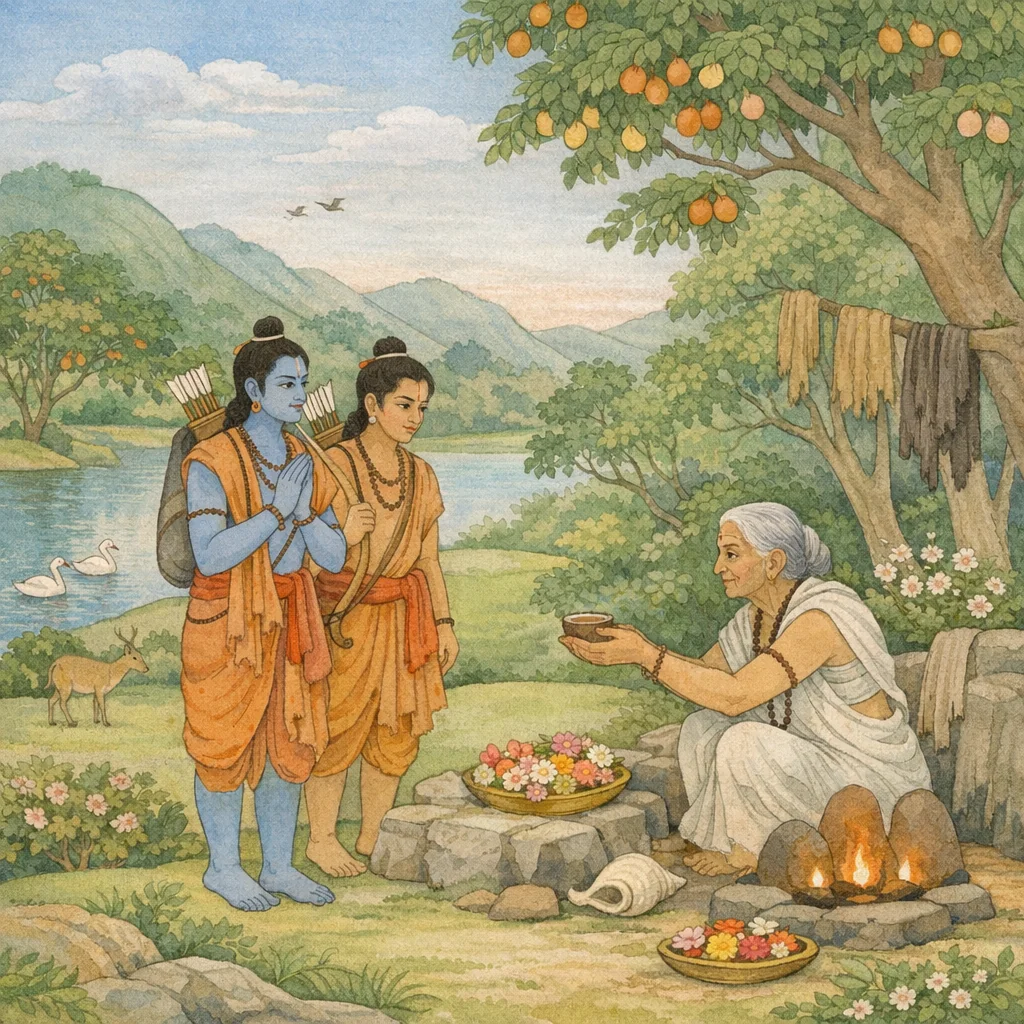
Guided by Kabandha’s directions, Rāma and Lakṣmaṇa travel west toward Lake Pampā and the Matanga-forest region. Reaching the western bank, they behold fertile land and fruit-laden trees and arrive at Śabarī’s hermitage. Śabarī, an accomplished ascetic revered among siddhas, welcomes them with proper ritual hospitality (pādya and ācamanīya). Rāma asks about the fulfillment of her vows—whether obstacles to tapas have been overcome, anger and appetite restrained, the mind made peaceful, and the fruit of service to her gurus attained. Śabarī replies that the completion of her penance has come through Rāma’s darśana: her birth is now fruitful, and by his grace her access to imperishable worlds is assured. She then leads them through the famed Matanga-vana, pointing out sacred landmarks and enduring signs of ascetic power—altars still radiant, waters and offerings sanctified by mantra, flowers that do not wilt, bark garments that remain wet, and even the seven seas said to have come by mere thought. Having shown what is “to be seen and heard,” she seeks leave to relinquish her body; Rāma grants consent, honoring her devotion. Śabarī enters the fire in a yogic exit, is transfigured with divine adornment, and ascends to the blessed realm of the sages she served, while Rāma and Lakṣmaṇa marvel at her dharma-grounded speech and attainment.
Shlokas
Verse 1
तौ कबन्धेन तं मार्गं पम्पाया दर्शितं वने।प्रतस्थतुर्दिशं गृह्य प्रतीचीं नृवरात्मजौ।।।।
The two princes, sons of the king, set out through the forest, taking the western direction along the path to Lake Pampā that Kabandha had shown them.
Verse 2
तौ शैलेष्वाचितानेकान् क्षौद्रकल्पफलान्द्रुमान्।वीक्षन्तौ जग्मतुर्ध्रष्टुं सुग्रीवं रामलक्ष्मणौ।।।।
As they looked upon the mountain trees laden with fruits sweet as honey, Rama and Lakshmana went on to meet Sugriva.
Verse 3
कृत्वा च शैलपृष्ठे तु तौ वासं रामलक्ष्मणौ।पम्पायाः पश्चिमं तीरं राघवावुपतस्थतुः।।।।
After spending the night upon the mountain-slope, Rāma and Lakṣmaṇa set out and reached the western bank of Lake Pampā.
Verse 4
तौ पुष्करिण्याः पम्पायास्तीरमासाद्य पश्चिमम्।अपश्यतां ततस्तत्र शबर्या रम्यमाश्रमम्।।।।
Reaching the western bank of the lake Pampā, the two beheld there Śabarī’s delightful hermitage.
Verse 5
तौ तमाश्रममासाद्य द्रुमैर्बहुभीरावृतम्।सुरम्यमभिवीक्षन्तौ शबरीमभ्युपेयतुः।।।।
Having reached that hermitage, enclosed by many trees, and observing its great beauty, the two approached Śabarī.
Verse 6
तौ च दृष्ट्वा तदा सिद्धा समुत्थाय कृताञ्जलिः।रामस्य पादौ जग्राह लक्ष्मणस्य च धीमतः।।।।
Seeing them, Śabarī, the accomplished ascetic, rose, joined her palms in reverence, and touched the feet of Rāma and of the wise Lakṣmaṇa.
Verse 7
पाद्यमाचमनीयं च सर्वं प्रादाद्यथाविधि।तामुवाच ततो रामश्श्रमणीं संशितव्रताम्।।।।
According to proper custom, she offered water for washing the feet and water for sipping, rendering every due courtesy; then Rāma spoke to that austere woman, steadfast in her vows.
Verse 8
कच्चित्ते निर्जिता विघ्नाः कच्चित्ते वर्धते तपः।कच्चित्ते नियतः क्रोध आहारश्च तपोधने।।।।
“Have the obstacles to your practice been overcome? Is your tapas steadily increasing? And, O treasure of penance, are anger—and even the impulse for food—kept under restraint?”
Verse 9
कच्चित्ते नियमाः प्राप्ताः कच्चित्ते मनसः सुखम्।कच्चित्ते गुरुशुश्रूषा सफला चारुभाषिणि।।।।
“Have you attained the disciplines of self-restraint? Has your mind found peace? And, O gentle-spoken one, has your devoted service to your teacher borne its proper fruit?”
Verse 10
रामेण तापसी पृष्टा सा सिद्धा सिद्धसम्मता।शशंस शबरी वृद्धा रामाय प्रत्युपस्थिता।।।।
Questioned by Rama, the ascetic Śabarī—accomplished and revered by the siddhas—stood before him, and the aged Śabarī spoke in reply to Rama.
Verse 11
अद्य प्राप्ता तपस्सिद्धिस्तव संदर्शनान्मया।अद्य मे सफलं तप्तं गुरवश्च सुपूजिताः।।।।
Today, by beholding you, my tapas has reached fulfillment. Today my practiced penance has borne fruit, and my teachers have been truly honored.
Verse 12
अद्य मे सफलं जन्म स्वर्गश्चैव भविष्यति।त्वयि देववरे राम पूजिते पुरुषर्षभ।।।।
Today my birth has become truly fruitful, and heaven itself is assured—since you, O Rama, best among the godlike and foremost of men, have been worshiped here.
Verse 13
चक्षुषा तव सौम्येन पूतास्मि रघुनन्दन।गमिष्याम्यक्षयान्लोकांस्त्वत्प्रसादादरिन्दम।।।।
By your gentle gaze I am purified, O joy of the Raghus. By your grace, O conqueror of foes, I shall go to imperishable worlds.
Verse 14
चित्रकूटं त्वयि प्राप्ते विमानैरतुलप्रभैः।इतस्ते दिवमारूढा यानहं पर्यचारिषम्।।।।
When you arrived at Chitrakuta, those whom I had served ascended from here to heaven in aerial chariots of incomparable radiance.
Verse 15
तैश्चाहमुक्ता धर्मज्ञैर्महाभागैर्महर्षिभिः।आगमिष्यति ते रामस्सुपुण्यमिममाश्रमम्।।।।स ते प्रतिग्रहीतव्यस्सौमित्रिसहितोतिथिः।तं च दृष्ट्वा वरान्लोकानक्षयांस्त्वं गमिष्यसि।।।।
Those fortunate great seers, knowers of dharma, told me: ‘Rama will come to your supremely sacred hermitage.’
Verse 16
तैश्चाहमुक्ता धर्मज्ञैर्महाभागैर्महर्षिभिः।आगमिष्यति ते रामस्सुपुण्यमिममाश्रमम्।।3.74.15।।स ते प्रतिग्रहीतव्यस्सौमित्रिसहितोतिथिः।तं च दृष्ट्वा वरान्लोकानक्षयांस्त्वं गमिष्यसि।।3.74.16।।
He will come as your guest, accompanied by Saumitri; receive him with due honor. And upon beholding him, you shall attain excellent, imperishable worlds.
Verse 17
मया तु विविधं वन्यं सञ्चितं पुरुषर्षभ।तवार्थे पुरुषव्याघ्र पम्पायास्तीरसम्भवम्।।।।
For your sake, O best of men, O tiger among heroes, I have gathered various forest foods that grow along the banks of Pampa.
Verse 18
एवमुक्तस्स धर्मात्मा शबर्या शबरीमिदम्।राघवः प्राह विज्ञाने तां नित्यमबहिष्कृताम्।।।।
Thus addressed by Śabarī, the righteous Rāghava spoke to her—Śabarī—ever established in true understanding and never excluded from wisdom.
Verse 19
दनोस्सकाशात्तत्त्वेन प्रभावं ते महात्मनः।श्रुतं प्रत्यक्षमिच्छामि सन्द्रष्टुं यदि मन्यसे।।।।
From Danu I have truly heard of your spiritual power, O great-souled one; if you consent, I wish to behold it directly.
Verse 20
एतत्तु वचनं श्रुत्ता रामवक्त्राद्विनिस्सृतम्।शबरी दर्शयामास तावुभौ तद्वनं महत्।।।।
Hearing these words spoken from Rama’s mouth, Śabarī began to show both of them that vast forest-grove.
Verse 21
पश्य मेघघनप्रख्यं मृगपक्षिसमाकुलम्।मतङ्गवनमित्येव विश्रुतं रघुनन्दन।।।।।
Behold, O delight of the Raghus—this grove, dark as a mass of dense cloud and thronged with beasts and birds, is famed as the Matanga forest.
Verse 22
इह ते भावितात्मानो गुरवो मे महावने।जुहवाञ्चक्रिरे तीर्थं मन्त्रवन्मन्त्रपूजितम्।।।।
Here, in this great forest, my teachers—souls refined by realization—performed offerings; and this sacred ford was empowered and sanctified by mantras, revered through mantra-worship.
Verse 23
इयं प्रत्यक्थ्सली वेदिर्यत्र ते मे सुसत्कृताः।पुष्पोपहारं कुर्वन्ति श्रमादुद्वेपिभिः करैः।।।।
This is the altar called Pratyakthsalī, where those venerable sages—whom I once honored—made offerings of flowers with hands trembling from the toil of austerities.
Verse 24
तेषां तपःप्रभावेण पश्याद्यापि रघूद्वह।द्योतयन्ति दिशस्सर्वाश्श्रिया वेद्योऽतुलप्रभाः।।।।
O best of the Raghu line, behold—even today, by the power of their austerities these altars shine with splendor, lighting up all directions with unmatched radiance.
Verse 25
अशक्नुवद्भिस्तैर्गन्तुमुपवासश्रमालसैः।चिन्तितेऽभ्यागतान्पश्य सहितान्सप्तसागरान्।।।।
Behold the seven seas gathered here: those sages, too weary from fasting to go to them, drew them near by the power of thought alone.
Verse 26
कृताभिषेकैस्तैर्न्यस्ता वल्कलाः पादपेष्विह।अद्यापि नावशुष्यन्ति प्रदेशे रघुनन्दन।।।।
O joy of the Raghu race, the bark-robes they laid here upon the trees after bathing have not dried even to this day, in this very place.
Verse 27
देवकार्याणि कुर्वद्भिर्यानीमानि कृतानि वै।पुष्पैःकुवलयैस्सार्धं म्लानत्वं नोपयान्तिवै।।।।
These floral offerings—lotuses and other flowers—arranged for divine worship by those sages have not withered at all.
Verse 28
कृत्स्नं वनमिदं दृष्टं श्रोतव्यं च श्रुतं त्वया।तदिच्छाम्यभ्यनुज्ञाता त्यक्तुमेतत्कलेबरम्।।।।
You have now seen this entire forest-tract and heard what was to be heard; therefore, with your permission, I wish to relinquish this body.
Verse 29
तेषामिच्छाम्यहं गन्तुं समीपं भावितात्मनाम्।मुनीनामाश्रमो येषामहं च परिचारिणी।।।।
I wish to go near those sages of realized spirit—whose hermitage this was, and to whom I was a servant.
Verse 30
धर्मिष्ठं तु वचश्श्रुत्वा राघवस्सहलक्ष्मणः।प्रहर्षमतुलं लेभे आश्चर्यमिति तत्त्वतः।।।।
Hearing her words, firmly rooted in dharma, Rāma—together with Lakṣmaṇa—was filled with incomparable joy, and in truth recognized: “This is wondrous.”
Verse 31
तामुवाच ततो रामश्श्रमणीं संशितव्रताम्।अर्चितोऽहं त्वया भक्त्या गच्छकामं यथासुखम्।।।।
Then Rāma said to the ascetic woman, steadfast in her vow: “You have worshiped me with devotion; go now as you wish, in peace and happiness.”
Verse 32
इत्युक्ता जटिला वृद्धा चीरकृष्णाजिनाम्बरा।तस्मिन्मुहूर्ते शबरी देहं जीर्णं जिहासती।।।।अनुज्ञाता तु रामेण हुत्वात्मानं हुताशने।ज्वलत्पावकसङ्काशा स्वर्गमेव जगाम सा।।।।
Thus addressed, Śabarī—an aged woman with matted locks, clad in bark-cloth and a dark deer-skin—at that very moment wished to abandon her worn-out body.
Verse 33
इत्युक्ता जटिला वृद्धा चीरकृष्णाजिनाम्बरा।तस्मिन्मुहूर्ते शबरी देहं जीर्णं जिहासती।।3.74.32।।अनुज्ञाता तु रामेण हुत्वात्मानं हुताशने।ज्वलत्पावकसङ्काशा स्वर्गमेव जगाम सा।।3.74.33।।
Permitted by Rāma, she offered herself into the sacred fire; radiant like a blazing flame, she indeed went to heaven.
Verse 34
दिव्याभरणसंयुक्ता दिव्यमाल्यानुलेपना।दिव्याम्बरधरा तत्र बभूव प्रियदर्शना।।।।विराजयन्ती तं देशं विद्युत्सौदामिनी यथा।
There she appeared in a divine form—adorned with heavenly ornaments, garlands, and fragrant unguents, clothed in radiant garments—illumining that place like a flash of lightning.
Verse 35
यत्र ते सुकृतात्मानो विहरन्ति महर्षयः।।।।तत्पुण्यं शबरी स्थानं जगामात्मसमाधिना।
By the power of her inward absorption, Śabarī went to that holy realm where great sages—souls refined by good deeds—dwell and move about.
Frequently Asked Questions
The pivotal action is Śabarī’s request to relinquish her body only after obtaining Rāma’s explicit permission (anujñā), framing liberation as ethically regulated rather than impulsive, and grounded in completed duty (guru-service, hospitality, vows).
The dialogue presents tapas as validated by humility, disciplined senses, and faithful service; it also portrays grace (prasāda) and right conduct (dharma) as enabling spiritual fruition, where devotion and ethical completion culminate in a legitimate, peaceful transition.
Key landmarks include Lake Pampā’s western bank, Śabarī’s āśrama, and the celebrated Matanga-vana, along with ritual-cultural markers such as the Pratyaksthali altar, mantra-invoked tīrtha waters, enduring offerings, and the sacred aura attributed to ascetic practice.
Read Valmiki Ramayana in the Vedapath app
Scan the QR code to open this directly in the app, with audio, word-by-word meanings, and more.