Sarga 25
खरसेनासङ्ग्रामः — The Battle with Khara’s Host at the Hermitage
अरण्यकाण्ड
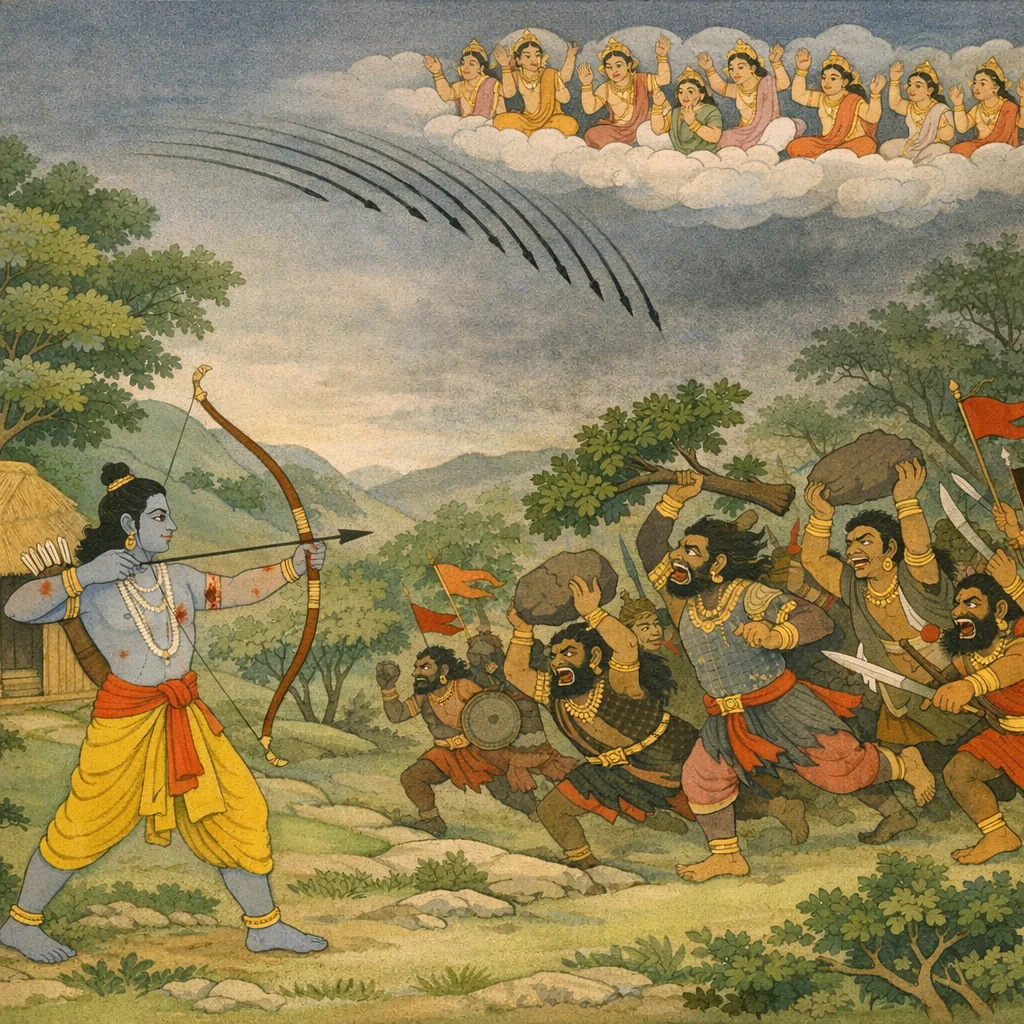
Khara arrives with an advance party at Rāma’s hermitage and beholds Rāma standing in controlled fury, bow readied. Demon ministers gather around their leader as the assault begins. The rākṣasa battalions unleash a “rain of arrows” and showers of weapons—spears, hammers, swords, axes, stones, even trees—likened to clouds and mountains to convey overwhelming force. Rāma meets the onslaught with composure: though struck and bleeding, he remains unshaken, like a mountain under thunderbolts, like the evening sun veiled by clouds. Celestial witnesses—devas, gandharvas, siddhas, and great seers—lament seeing one warrior ringed by thousands, heightening the moral gravity of his solitary protection. Then Rāma turns the tide, releasing hundreds and thousands of straight-flying arrows, described as Yama’s nooses that draw out the demons’ lives. He methodically cripples the enemy—severing bows, flags, armor, heads, and limbs; slaying charioteers, cavalry, elephants with riders, and infantry—until the field is strewn with shattered weapons and dismembered bodies. Survivors flee to Khara; Dūṣaṇa regroups them and they attack from every side, but Rāma answers with the dazzling Gāndharva-astra and a dreadful war-cry, filling the ten quarters with arrows and darkening the sky. The sarga ends with a grim catalogue of carnage, both martial narrative and poetic inventory, mapping the battlefield as a moral theatre of kṣātra-dharma.
Shlokas
Verse 1
अवष्टब्धधनुं रामं क्रुद्धं च रिपुघातिनम्।ददर्शाऽश्रममागम्य खरस्सह पुरस्सरैः।।।।
Arriving at the hermitage with his vanguard, Khara beheld Rama—bow braced, wrathful, and poised as a slayer of foes.
Verse 2
तं दृष्ट्वा सशरं चापमुद्यम्य खरनिस्स्वनम्।रामस्याभिमुखं सूतं चोद्यतामित्यचोदयत्।।।।
Seeing him, Khara lifted his bow with arrow, its twang terrifying; facing Rama, he ordered his charioteer, “Drive straight at him.”
Verse 3
स खरस्याज्ञया सूतस्तुरगान् समचोदयत्।यत्र रामो महाबाहुरेको चुन्वन्स्थितो धनुः।।।।
At Khara’s command, the charioteer urged on the horses—toward the place where mighty-armed Rama stood alone, fitting and readying his bow.
Verse 4
तं तु निष्पतितं दृष्ट्वा सर्वे ते रजनीचराः।नर्दमाना महानादं सचिवाः पर्यवारयन्।।।।
Seeing him rushing forth, all those night-wandering demon ministers surrounded him, roaring with a loud sound.
Verse 5
स तेषां यातुधानानां मध्ये रथगतः खरः।बभूव मध्ये ताराणां लोहिताङ्ग इवोदितः।।।।
Amid those rākṣasas, seated in his chariot, Khara stood out among them like the red planet Mars risen in the midst of the stars.
Verse 6
ततश्शरसहस्रेण राममप्रतिमौजसम्।अर्दयित्वा महानादं ननाद समरे खरः।।।।
Then, striking Rāma—whose prowess was without equal—with a thousand arrows, Khara roared aloud on the battlefield.
Verse 7
ततस्तं भीमधन्वानं क्रुद्धाः सर्वे निशाचराः।रामं नानाविधैः शस्स्रैरभ्यवर्षन्त दुर्जयम्।।।।
Thereafter, all the enraged night-roamers showered invincible Rāma—wielder of a dreadful bow—with weapons of many kinds.
Verse 8
मुद्गरैः पट्टसैश्शूलैः प्रासैः खङ्गै परश्वथैः।राक्षसास्समरे रामं निजघ्नू रोषतत्पराः।।।।
Driven by rage, the rākṣasas kept striking at Rāma in battle with maces, spears, pikes, darts, swords, and battle-axes.
Verse 9
ते वलाहसङ्काशा महानादा महौजसः।अभ्यधावन्त काकुत्स्थं रथैर्वाजिभिरेव च।।।।गजैः पर्वतकूटाभै रामं युद्धे जिघांसवः।
Those mighty rākṣasas, roaring like thunderclouds, rushed at Kakutstha (Rāma), intent on killing him in battle—advancing by chariots, horses, and elephants that looked like mountain-peaks.
Verse 10
ते रामे शरवर्षाणि व्यसृजन् रक्षसां गणाः।।।।शैलेन्द्रमिव धाराभिर्वर्षमाणा वलाहकाः।
The demon-battalions poured a rain of arrows upon Rama, like clouds showering torrents upon a lordly mountain.
Verse 11
स तैः परिवृतो घोरैः राघवो रक्षसां गणैः।।।।तिथिष्वि महादेवो वृत परिषदाङ्गणै
Hemmed in by those dreadful hordes of rakshasas, Rāghava appeared like Mahādeva at dusk, surrounded by his attendant hosts.
Verse 12
तानि मुक्तानि शस्त्राणि यातुधानैस्सराघवः।प्रतिजग्राह विशिखैर्नद्योघानिव सागरः।।।।
Those weapons hurled by the yātudhānas, Rāghava checked with his arrows—like the ocean receiving and holding back the surging river-floods.
Verse 13
स तैः प्रहरणैर्घोरैर्भिन्नगात्रो न विव्यथे।रामः प्रदीप्तैर्बहुभिर्वज्रैरिव महाचलः।।।।
Though struck on his limbs by those dreadful weapons, Rama did not flinch—like a great mountain unmoved even when many blazing thunderbolts strike it.
Verse 14
स विद्धः क्षतजादिग्धः सर्वगात्रेषु राघवः।बभूव रामः सन्ध्याभ्रैर्दिवाकर इवावृतः।।।।
Pierced and smeared with blood over all his limbs, Rāghava looked like the sun veiled by evening clouds.
Verse 15
विषेदुर्देवगन्धर्वास्सिद्धाश्च परमर्षयः।एकं सहस्रैर्भहुभिस्तदा दृष्ट्वा समावृतम्।।।।
Seeing Rama standing alone, hemmed in on all sides by many thousands, the gods, Gandharvas, Siddhas, and great seers were filled with sorrow.
Verse 16
ततो रामस्सुसङ्कृद्धो मण्डलीकृतकार्मुकः।ससर्ज विशिखान्बाणाञ्छतशोऽथ सहस्रश।।।।
Then Rama, fiercely angered, bent his bow into a full arc and loosed unfeathered arrows—by the hundreds, and then by the thousands.
Verse 17
दुरावारान्दुर्विषहान्कालदण्डोपमान् रणे।मुमोच लीलया रामः कङ्कपत्रानजिह्मगान्।।।।
In the battle, Rama—almost as if at play—released arrows fletched with heron-feathers: irresistible, unbearable, like the rod of Death itself, and flying straight to their mark.
Verse 18
ते शराश्शत्रुसैन्येषु मुक्ता रामेण लीलया।अददू रक्षसां प्राणान्पाशाः कालकृता इव।।।।
Those arrows, loosed by Rama with effortless ease into the enemy ranks, tore away the demons’ lives—like nooses fashioned by Death.
Verse 19
भित्त्वा राक्षसदेहां स्तांस्ते शरा रुधिराप्लुताः।अन्तरिक्षगता रेजुर्दीप्ताग्निसमतेजसः।।।।
After piercing those demon bodies, the arrows—drenched in blood—rose into the open sky and blazed there, radiant like burning fire.
Verse 20
असङ्ख्येयास्तु रामस्य सायकाश्चापमण्डलात्।विनिष्पेतुरतीवोग्रा रक्षःप्राणापहारिणः।।।।
From the circle of Rama’s fully drawn bow, countless arrows sprang forth—fierce beyond measure, and life-taking to the demons.
Verse 21
तैर्धनूंषि ध्वजाग्राणि वर्माणि च शिरांसि च।बाहून्सहस्ताभरणानूरून्करिकरोपमान्।।।।चिच्छेद रामस्समरे शतशोऽथ सहस्रशः।
With those arrows, in the thick of battle, Rama severed—by the hundreds and by the thousands—bows, the tips of banners, armor, and heads; and he cut down arms still wearing ornaments and thighs like elephants’ trunks.
Verse 22
हयान्काञ्चनसन्नाहान्रथयुक्तान्ससारथीन्।।।।गजांश्च सगजारोहान्सहयान्सादिनस्तथा।पदातीन्समरे हत्वा ह्यनयद्यमसादनम्।।।।
In the battle he slew horses clad in golden trappings, chariot-teams with their charioteers; elephants with their riders; cavalry with their mounts; and foot-soldiers—sending them to Yama’s abode, the realm of Death.
Verse 23
हयान्काञ्चनसन्नाहान्रथयुक्तान्ससारथीन्।।3.25.22।।गजांश्च सगजारोहान्सहयान्सादिनस्तथा।पदातीन्समरे हत्वा ह्यनयद्यमसादनम्।।3.25.23।।
(A repetition of the preceding) In the battle, Rāma slew chariot-teams with their charioteers, elephants with their riders, cavalry with their mounts, and foot-soldiers—sending them to Yama’s abode, the realm of Death.
Verse 24
ततो नालीकनाराचैस्तीक्ष्णाग्रैश्च विकर्णिभिः।भीममार्तस्वरं चक्रुर्भिद्यमाना निशाचराः।।।।
Then, torn apart by razor-pointed iron arrows and by vikarṇi shafts, the night-roving rākṣasas raised terrible, anguished cries.
Verse 25
तत्सैन्यं निशितैर्बाणैरर्दितं मर्मभेदिभिः।रामेण न सुखं लेभे शुष्कं वनमिवाग्निना।।।।
That host, harried by Rāma’s sharp arrows that pierced the vital spots, found no respite—like a dry forest when fire has seized it.
Verse 26
केचिद्भीमबलाश्शूराश्शूलान्खङ्गान्परश्वधान्।रामस्याभिमुखं गत्वा चिक्षिपुः परमायुधान्।।।।
Some heroes of dreadful strength advanced straight toward Rāma and hurled mighty weapons—spears, swords, and axes.
Verse 27
तानि बाणैर्महाबाहुश्शस्त्राण्यावार्य राघवः।जहार समरे प्राणांश्चिच्छेद च शिरोधरान्।।।।
The mighty-armed Raghava checked those weapons with his arrows; and in the battle he took their lives, cutting down their heads as well.
Verse 28
ते छिन्नशिरसः पेतुश्चिन्नवर्मशरासनाः।सुपर्णवातविक्षिप्ता जगत्यां पादपा यथा।।।।
They fell—heads severed, armor and bows shattered—like trees flung down upon the earth by the gale stirred by Suparna’s wings.
Verse 29
अवशिष्टाश्च ये तत्र विषण्णाश्च निशाचराः।खरमेवाभ्यधावन्त शरणार्थं शरार्दिताः।।।।
Those night-rovers who remained there—arrow-struck and despairing—ran only to Khara, seeking refuge.
Verse 30
तान्सर्वान्पुनरादाय समाश्वास्य च दूषणः।अभ्यधावत काकुत्स्थं क्रुद्धो रुद्रमिवान्तकः।।।।
Gathering them all again and heartening them, Dushana charged at Kakutstha—wrathful like Antaka rushing upon Rudra.
Verse 31
निवृत्तास्तु पुनस्सर्वे दूषणाश्रयनिर्भयाः।राममेवाभ्यधावन्त सालतालशिलायुधाः।।।।
Then they all turned back once more; made fearless by taking shelter with Dūṣaṇa, they rushed upon Rāma, armed with sāla and tāla trees and with stones.
Verse 32
शूलमुद्गरहस्ताश्च चापहस्ता महाबलाः।सृजन्तश्शरवर्षाणि शस्त्रवर्षाणि संयुगे।।।।द्रुमवर्षाणि मुञ्चन्तश्शिलावर्षाणि राक्षसाः।।
With spears and hammers in hand, and bows as well—mighty in strength—the rākṣasas in battle unleashed showers of arrows and weapons, hurling also showers of trees and stones.
Verse 33
तद्बभूवाद्भुतं युद्धं तुमुलं रोमहर्षणम्।रामस्य च महाघोरं पुनस्तेषां च रक्षसाम्।।।।
Once again that battle flared up—astonishing in its intensity, tumultuous and hair-raising—dreadfully fierce both for Rāma and for those rākṣasas.
Verse 34
ते समन्तादतिक्रुद्धा राघवं पुनरभ्ययुः।।।।तैश्च सर्वा दिशो दृष्ट्वा प्रदिशश्च समावृताः।राक्षसैरुद्यतप्रासैश्शरवर्षाभिवर्षिभिः।।।।स कृत्वा भैरवं नादमस्त्रं परमभास्वरम्।संयोजयत गान्धर्वं राक्षसेषु महाबलः।।।।
Enraged, they charged again at Rāghava from every side; and as he looked, all the directions and intermediate quarters were seen covered by rākṣasas with raised spears, showering arrows. Then that mighty one, giving a terrifying roar, fitted and discharged the brilliantly radiant Gāndharva weapon against the rākṣasas.
Verse 35
ते समन्तादतिक्रुद्धा राघवं पुनरभ्ययुः।।3.25.34।।तैश्च सर्वा दिशो दृष्ट्वा प्रदिशश्च समावृताः।राक्षसैरुद्यतप्रासैश्शरवर्षाभिवर्षिभिः।।3.25.35।।स कृत्वा भैरवं नादमस्त्रं परमभास्वरम्।संयोजयत गान्धर्वं राक्षसेषु महाबलः।।3.25.36।।
Then thousands of arrows streamed forth from the arc of his bow, and all ten directions were covered with the arrows as they rushed in.
Verse 36
ते समन्तादतिक्रुद्धा राघवं पुनरभ्ययुः।।3.25.34।।तैश्च सर्वा दिशो दृष्ट्वा प्रदिशश्च समावृताः।राक्षसैरुद्यतप्रासैश्शरवर्षाभिवर्षिभिः।।3.25.35।।स कृत्वा भैरवं नादमस्त्रं परमभास्वरम्।संयोजयत गान्धर्वं राक्षसेषु महाबलः।।3.25.36।।
Though struck by arrows, those rākṣasas could not perceive him as he took up dreadful shafts and released sharp arrows; they only saw him drawing and shooting.
Verse 37
ततश्शरसहस्राणि निर्ययुश्चापमण्डलात्।सर्वा दश दिशो बाणैरावार्यन्त समागतैः।।।।
Then thousands of arrows streamed forth from the arc of his bow, and all ten directions were covered with the arrows as they rushed in.
Verse 38
नाददानं शरान्घोरान्नमुञ्चन्तं शिलीमुखान्।विकर्षमाणं पश्यन्ति राक्षसास्ते शरार्दिताः।।।।
Though struck by arrows, those rākṣasas could not perceive him as he took up dreadful shafts and released sharp arrows; they only saw him drawing and shooting.
Verse 39
शरान्धकारमाकाशमावृणोत्सदिवाकरम्।बभूवावस्थितो रामः प्रवमन्निव ताञ्छरान्।।।।
The sky—along with the sun—was veiled by a darkness of arrows; and Rama, standing firm, appeared as though he were spewing forth those shafts.
Verse 40
युगपत्पतमानैश्च युगपच्च हतैर्भृशम्।युगपत्पतितैश्चैव विकीर्णा वसुधा भवत्।।।।
With some falling as they rushed, others being slain, and still others collapsing at the same time, the earth appeared strewn everywhere in a single overwhelming moment.
Verse 41
निहताः पतिताः क्षीणाश्छिन्ना भिन्ना विदारिताः।तत्र तत्र स्म दृश्यन्ते राक्षसास्ते सहस्रशः।।।।
There, in every place, rākṣasas were seen by the thousand—slain, fallen, weakened, severed, shattered, and torn apart.
Verse 42
सोष्णीषैरुत्तमाङ्गैश्च साङ्गदैर्बाहुभिस्तथा।ऊरुभिर्जानुभिश्छिन्नैर्नानारूपैविभूषणैः।।।।हयैश्च द्विपमुख्यैश्च रथैर्भिन्नैरनेकशः।चामरैर्व्यजनैश्छत्रैर्ध्वजैर्नानाविधैरपि।।।।रामस्य बाणाभिहतैर्विचित्रैश्शूलपट्टिसैः।खङ्गै खण्डीकृतैः प्रासैर्विकीर्णैश्च परश्वधैः।।।।चूर्णिताभिश्शिलाभिश्च शरैश्चित्रैरनेकशः।विच्छिन्नैस्समरे भूमिर्विकीर्णाऽभूद्भयङ्करा।।।।
Struck down by Rāma’s arrows, the battlefield became strewn with severed heads still wearing helmets, arms with armlets, and cut thighs and knees adorned with varied ornaments. It was also littered in many ways with broken chariots, horses, and great elephants, along with yak-tail fans, fans, umbrellas, and many kinds of flags. Weapons too lay scattered—spears and lances shattered, swords broken, darts and battle-axes thrown about; stones were crushed, and countless arrows lay splintered. Thus the ground in that combat was strewn and mangled, and it looked dreadful.
Frequently Asked Questions
The sarga frames a solitary protector’s duty: Rāma must defend the hermitage sphere against massed aggression, maintaining kṣātra discipline even when wounded and surrounded—an enacted model of protective dharma rather than personal vengeance.
Though dialogue is minimal, the narrative teaches steadiness (dhairya) and right-use of power: endurance under assault precedes decisive, ordered response; poetic similes (mountain, evening sun, Yama’s noose) underscore the moral weight of responsibility in violence.
The key landmark is the āśrama (hermitage) as a cultural institution of forest-dharma; the text also maps the battle cosmographically through the ‘ten directions’ motif, portraying the conflict as filling and defining the entire perceived space.