Adhyaya 43
Means to Slay Tāraka: Girijā’s Birth, Kāma’s Burning, and Umā’s Austerities
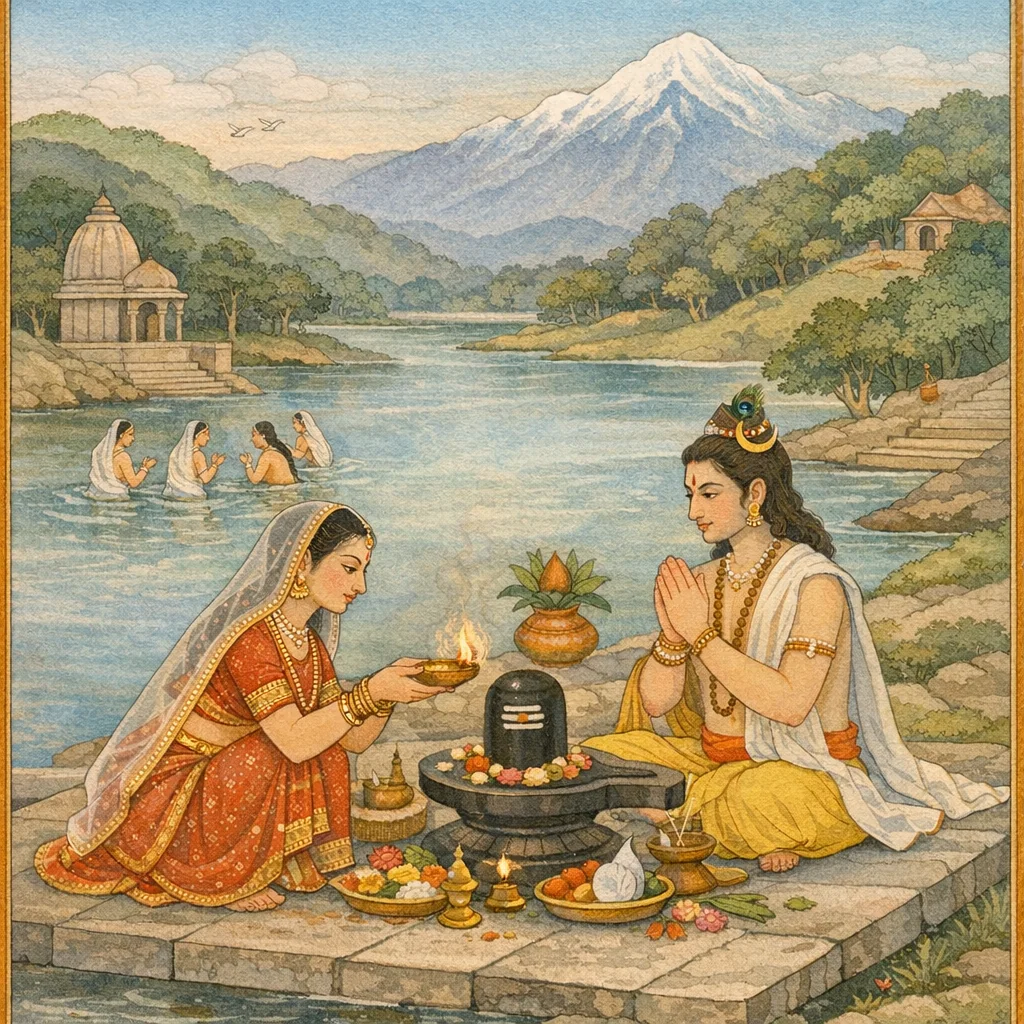
In PP.1.43, after the devas are shamed by the daityas, they seek refuge at Brahmā’s court and offer a lofty hymn describing the cosmic body and the subtle and gross principles. Brahmā declares that Tāraka cannot be slain until the destined slayer is born, and that this requires Śiva’s marriage; he therefore commissions Niśā to bring about Girijā’s birth. Nārada coordinates Indra’s plan with Himavān, explaining the mystery of Śiva as “unborn” and thus the seeming paradox of a “husband not yet born.” Indra sends Kāma to stir Śiva’s desire; Kāma releases the flower-arrow and is burned by Śiva’s third eye. Rati laments, praises Śiva with a stotra, and receives the boon that Kāma will endure as Ananga, bodiless. The chapter then turns to Umā’s fierce austerities and the sages’ dialogue that tests her resolve.
Shlokas
Verse 1
पुलस्त्य उवाच । प्रादुरासीत्प्रतीहारः शुभ्रचीनांशुकांबरः । स जानुभ्यां महीं गत्वा पिहितास्यश्च पाणिना
Pulastya said: A doorkeeper appeared, clad in bright, Chinese silk garments. Going down to the earth upon his knees, he covered his mouth with his hand.
Verse 2
उवाचानाविलं वाक्यमल्पाक्षरपरिष्कृतम् । दैत्येंद्रमर्कवृंदाभं बिभ्रतं भास्वरं वपुः
He spoke words that were clear and unconfused—refined, though in few syllables—while bearing a radiant body, resplendent like a cluster of suns, fit for the lord of the Daityas.
Verse 3
कालनेमिः सुरान्बद्ध्वा प्रादाय द्वारि तिष्ठति । स विज्ञापयति स्थेयं क्व वंदिनि च यैः प्रभो
Kālanemi, having bound the gods and handed them over, stands at the gate. He announces: “Where should I remain, O lord—and by whom, O venerable one?”
Verse 4
तन्निशम्याब्रवीद्दैत्यः प्रतीहारस्य भाषितम् । यथेष्ठं स्थीयतामेभिर्गृहं मे भुवनत्रयं
Hearing the doorkeeper’s words, the Daitya replied: “Let these remain here as they please; my house is as vast as the three worlds.”
Verse 5
केवलं वासवं त्वेकं मुंडयित्वा विमुच्यताम् । सितवस्त्रपरिच्छन्नं शुनःपादेन चिह्नितम्
Only that one Vāsava should be shaved and then released—clad in white garments and marked with the imprint of a dog’s paw.
Verse 6
एवं कृते ततो देवा दूयमानेन चेतसा । जग्मुर्जगद्गुरुं द्रष्टुं शरणं कमलोद्भवम्
When this had happened, the gods—distressed in their hearts—went to see the Teacher of the world, seeking refuge in the Lotus-born (Brahmā).
Verse 7
विनिर्विण्णास्तमासाद्य शिरोभिर्द्धरणीं गताः । तुष्टुवुः सुष्ठु वर्णाढ्यैर्वचोभिः कमलासनम्
Deeply disheartened, they approached him and bowed their heads to the ground. Then, with well-composed, richly worded speech, they praised the Lotus-seated one (Brahmā).
Verse 8
देवा ऊचुः । नमस्त्वोंकारांकुरादिप्रसूत्यै विश्वस्थानानंतभेदस्य पूर्वम् । संभूतस्यानंतरं सत्वमूले संहारेच्छोस्ते नमः सत्वमूर्त्ते
The gods said: Salutations to you—the source from which the sprout of Oṃkāra and all else arise; you who are prior to the universe with its innumerable abodes and divisions. Though you manifest after creation, you are rooted in sattva; and to you, whose will is dissolution—salutations, O embodiment of sattva.
Verse 9
व्यक्तीनां त्वामादिभूतं महिम्ना चास्मादस्मानभिधानाद्विचिंत्य । द्यावापृथ्व्योरूर्द्ध्वलोकांस्तथाधश्चांडादस्मात्त्वं विभागं चकर्थ
You are the primordial source of all manifested beings. By your greatness, and by reflecting on this very designation as the origin, you apportioned the realms above and below between heaven and earth, and you also established the division from this cosmic egg (brahmāṇḍa).
Verse 10
व्यक्तं मेरुर्यज्जरायुस्तवाभूदेवं विद्मस्त्वत्प्रणीतोवकाशः । व्यक्तं देवा जज्ञिरे यस्य देहाद्देहस्यांतश्चारिणो देहभाजः
It is evident that Meru became Your afterbirth; thus we know that space itself was brought forth by You. It is evident too that the gods were born from Your body—embodied beings who move within the body of the cosmos.
Verse 11
द्यौस्ते मूर्द्धा लोचने चंद्रसूर्यौ व्यालाः केशाः श्रोत्ररंध्रे दिशस्ते । गात्रं यज्ञः सिंधवः संधयो वै पादौ भूमिस्तूदरं ते समुद्राः
Heaven is Your head; the Moon and the Sun are Your two eyes. Serpents are Your hair; the directions are the apertures of Your ears. Sacrifice is Your body; the rivers are Your joints. The earth is Your feet, and the oceans are Your belly.
Verse 12
मायाकारः कारणं त्वं प्रसिद्धो वेदैः शांतो ज्योतिरर्कस्त्वमुक्तः । वेदार्थेन त्वां विवृण्वंति बुद्ध्या हृत्पद्मांतः संनिविष्टं पुराणम्
You are renowned in the Vedas as the maker of māyā and the very cause of all. You are declared to be tranquil, the radiant light, and the sun. By the meaning of the Vedas, the wise disclose You through discernment—You, the Ancient One seated within the lotus of the heart.
Verse 13
त्वां चात्मानं लब्धयोगा गृणंति सांख्यैर्याः स्ताः सप्तसूक्ष्माः प्रणीताः । तासां हेतुर्याष्टमी चापि गीता तास्वंतस्थो जीवभूतस्त्वमेव
Those who have attained yoga praise You as the Self (Ātman). The Sāṅkhyas also speak of the seven subtle principles that are taught, and of the eighth, declared as their cause—You alone are the indwelling one within them, existing as the living soul (jīva).
Verse 14
दृष्ट्वा मूर्त्तिं स्थूलसूक्ष्मांचकार ये वै भावाः कारणे केचिदुक्ताः । संभूतास्ते त्वत्त एवादिसर्गे भूयस्तास्त्वां वासनां तेभ्युपेयाः
Having beheld the form—both gross and subtle—those states (bhāvas) which some describe as abiding in the causal source were produced from You alone at the first creation; and again, they return to You, entering as latent impressions (vāsanās).
Verse 15
त्वत्संकेतस्त्वंतरायो निगूढः कालोऽमेयो ध्वस्तसंख्याविकल्पः । भावाभावाव्यक्तिसंहारहेतुः सोऽनंतस्त्वं तस्य कर्ता निधानम्
By your ordinance the hidden obstacle that checks all things arises; you are immeasurable Time, in whom all reckonings and numerical distinctions are dissolved. You are the cause of the reabsorption of being and non-being, and of the unmanifest into dissolution. You are the Infinite; you are its maker and its final resting-place.
Verse 16
स्थूलस्सर्वोऽनर्थभूतस्ततोन्यस्सोऽर्थस्सूक्ष्मो यो हि तेभ्योपिगीतः । स्थूला भावाश्चावृता यैश्च तेषां तेभ्यः स्थूलस्त्वं पुराणे प्रणीतः
Whatever is gross is, in itself, a source of meaninglessness; but distinct from that is the subtle meaning, sung as higher than those. And since gross states are veiled by the factors that cover them, therefore in the Purāṇa you have been set forth in a gross (manifest) form for their sake.
Verse 17
भूतंभूतं भूतिमद्भूतभावं भावेभावे भावितं त्वं युनक्षि । युक्तंयुक्तं व्यक्तिभावान्निरस्य स्थानेस्थाने व्यक्तिवृत्तिं करोषि
You connect each being with the condition suited to it, endowing it with its proper nature and prosperity; and in every state you bring about what is to be manifested. Rejecting whatever manifestation is not fitting, you establish in each place the particular function and mode of expression appropriate there.
Verse 18
इत्थं देवो व्यक्तिभाजां शरण्यस्त्राता गोप्ता भावितोऽनंतमूर्तिः । विरेमुरमरास्तु त्वा ब्रह्माणमिति कारणम्
Thus the God—refuge of embodied beings, their rescuer and protector, contemplated as the One of endless forms—caused the gods to cease their doubt and agitation, for this reason: “You are Brahmā.”
Verse 19
तस्थुर्मनोभिरिष्टार्थसंप्राप्ति प्रार्थनास्ततः । एवं स्तुतो विरिंचिस्तु प्रसादं परमं गतः
Then they stood, offering heartfelt prayers for the attainment of their desired aims. Thus praised, Viriñci (Brahmā) became supremely gracious.
Verse 20
अमरान्वरदोप्याह वामहस्तेन निर्दिशन् । ब्रह्मोवाच । नारी वा भर्तृका कस्माद्धस्तसंत्यक्तभूषणा
Then Varada, gesturing with his left hand, spoke. Brahmā said: “Why is this woman—though she has a husband—standing with the ornaments removed from her hands?”
Verse 21
न राजसे कुतश्शक्रा म्लानवक्त्रसरोरुहः । हुताशनवियुक्तोपि धूमेन न विराजसे
O Śakra (Indra), how could you shine, with your lotus-like face now withered? Even fire, when deprived of its flame, does not shine—only smoke remains.
Verse 22
तृणौघेन प्रतिच्छन्नो दग्धदावश्चिरोषितः । यमामयशरीरेण क्लिष्टो नाद्य विराजसे
Covered over by a mass of grass, scorched by a forest-fire and long neglected—afflicted with a body tormented by disease and death—you do not shine today.
Verse 23
दंडेनालंबनेनेव कृष्टो येन पदेपदे । रजनीचरनाथ त्वं किं भीत इव भाषसे
O lord of the night-roamers, why do you speak as if afraid, when at every step you are being dragged along, as though by a staff and a tether?
Verse 24
राक्षसेंन्द्रकृतादाने त्वमरातिक्षतो यथा । तनुस्ते वरुणोच्छुष्कापरीतस्येव वह्निना
When the lord of the Rākṣasas made that gift, you were struck down by the enemy; and your body became like something dried up by Varuṇa, as though surrounded and scorched by fire.
Verse 25
विमुक्तरुधिरं चाथ पदं त्वं प्रविलोकय । वायो भवान्विचेतस्कः खड्गाग्रैरिव निष्कृतः
Now behold your own footprint, from which the blood has flowed forth. O Vāyu, you have become senseless—like one ripped open by the keen edges of swords.
Verse 26
किं त्वं नतोसि धनद संत्यज्येव कुबेरतां । रुद्रास्त्रिशूलिनः संतोऽविदध्वं बहुशूरतां
Why do you bow down, O Dhanada (Kubera), as though forsaking your very state as Kubera? You are Rudras, bearers of the trident—do not abandon great valor.
Verse 27
भवतां केन चाक्षिप्ता तीव्रता नस्तदुच्यतां । एवमुक्ताः सुरास्तेन ब्रह्मणा ब्रह्मवर्तिना
“By whom has this harsh affliction been cast upon you? Tell us that.” Thus addressed, the devas were spoken to by that Brahmā, who abides in Brahman, steadfast in the Supreme.
Verse 28
वाचां प्रधानभूतत्वात्ते मारुतमचोदयन् । अथ शक्रमुखैर्देवैः पवनः प्रतिचोदितः
Because speech is foremost among them, they urged Māruta, the Wind. Then Pavana, prompted by the devas headed by Śakra (Indra), was set into action.
Verse 29
प्राह देवं चतुर्वक्त्रं भवान्वेत्ति चराचरं । पुरहूतमुखाः सबला निमिषा विजिताः प्रसभं किल दैत्यशतैः
He said to the four-faced god: “You know all that is moving and unmoving. Yet Purahūta (Indra) and the other devas, though supported by their forces, have indeed been forcibly defeated by hundreds of daityas.”
Verse 30
क्रतवो विहिता भवता स्थितये जगतां च महाद्भुतचित्रगुणाः । अपि यज्ञकृतः श्रुतकामफला विहिता ॠषयस्तत एव पुरः
You have ordained the sacrificial rites for the sustaining of the worlds—rites endowed with wondrous and manifold qualities. You have also appointed the Ṛṣis themselves, performers of yajña, whose fruits fulfill what is heard and what is desired, and who stand at the forefront.
Verse 31
अपि नाकमभूत्किल यज्ञभुजां भवतो विनियोगवशात्सततम् । अपहृत्यविमानगणं सकृतो दनुजेन महाकरभूमिसमः
Indeed, it is said that heaven itself came under the control of those who partake of the sacrifices, through your constant appointment and direction. Yet, after a Dānava once seized the host of aerial chariots (vimānas), he was made equal to the great prison-earth—brought down and confined.
Verse 32
कृतवानसि सर्वगुणातिशयं यमशेषमहीधरराजतया । मखभूषितमंशुमतामवधिं सुरधामगिरिं गगनेपि सदा
You have made this mountain excel in every virtue, preeminent among the kings of mountains. Adorned by yajñas, it stands as the very limit of the radiant ones—a mountain that is the abode of the Devas, forever, even in the sky.
Verse 33
अधिवासविहारविधानुचितो दनुजेन परिष्कृतशृंगतटः । प्रविलम्बितरत्नगुहानिवहो बहुदैत्यसमाश्रयतां गमितः
Made fit for residence and pleasure-grounds by the Dānava, its slopes and peaks were carefully fashioned; and its many jewel-caves, richly adorned, became a refuge for numerous Daityas.
Verse 34
असुरस्य च तस्य भयेन गतं सविषाद शरीरनिमित्ततया । उपभोग्यतयाधिकृतं सुचिरं विमलद्युतिपूरितदिग्वदनं
And, due to fear of that Asura, he became downcast in body and spirit. Yet for a long time he remained appointed to undergo the destined fruit, his face turned toward all directions, filled with spotless radiance.
Verse 35
भवतैव विनिर्मितमादियुगे सुरहेतिसमूहवरं कुलिशं । दितिजस्य शरीरमवाप्यगतं शतधा मतिभेदमिवाल्पविदः
You yourself, in the primordial age, fashioned the excellent Vajra, the finest among the gods’ weapons; entering the Dānava’s body, it split him into a hundred parts, like the divided opinions of the poorly informed.
Verse 36
बाणैश्च युधि विद्धांगा द्वारि द्वास्थैर्निदर्शिताः । लब्धप्रवेशाः कृच्छ्रेण वयं तस्यामरद्विषः
In battle our limbs were pierced by arrows, and at the gate the gatekeepers drove us back. Only with great difficulty did we gain entry—we, the foes of the gods.
Verse 37
सभायाममरादेव प्रकृष्योपनिवेशिताः । वेत्रहस्तैरजल्पंतस्तथोपहसिताः परैः
O lord of the gods, in the assembly they were forcibly made to sit; the guards, canes in hand, kept them from speaking, and others mocked them as well.
Verse 38
महार्थाः सिद्धसर्वार्था भवंतः स्वल्पभाषिणः । शास्त्रयुक्तमथ ब्रूत मामरा बहुभाषिणः
You bear profound meaning, and your aims are already fulfilled, for you speak but little. Now, however, speak to me with reasoning grounded in the Śāstra, for we gods are prone to lengthy speech.
Verse 39
सभेयं दैत्यसिंहस्य न शक्रस्य विशृंखला । वदद्भिरिति दैत्यस्य प्रेष्यैर्विहसिता बहु
“This assembly belongs to the lion among the Daityas, not to Indra, the Unshackled!”—so saying, that Daitya’s attendants mocked them greatly.
Verse 40
ॠतवो मूर्तिमंतश्चाप्यहर्निशमुपासते । कृतापराधं सत्रासं न त्यजंति कथंचन
Even the Seasons—embodied in divine forms—worship Him day and night; and in no way do they ever abandon one who has committed a fault and remains afraid.
Verse 41
तंत्रीलयनयोपेतं सिद्धगंधर्वकिन्नरैः । सरागमुपधाविष्टं गीयते तस्य वेश्मसु
Accompanied by vīṇā-strings, rhythmic measures, and musical modes, it was sung with ardor in his palaces by Siddhas, Gandharvas, and Kinnaras.
Verse 42
कृताकृतोपकरणैर्मित्रादि गुरुलाघवः । शरणागतसंत्यागी त्यक्तसत्यप्रतिश्रयः
He weighs friends and others as ‘important’ or ‘insignificant’ according to favors done or not done; he abandons those who seek refuge, and he has forsaken the pledge of truth.
Verse 43
इति निश्शेषमथवा निश्शेषं केन शक्यते । तस्याविनयमाख्यातुं स्रष्टा तत्र परायणम्
Thus, how could anyone possibly relate it in full, completely without remainder? To recount his lack of humility, the Creator himself is devoted to that task.
Verse 44
इत्युक्त्वा व्यरमद्वायुः शनैर्देवविचेष्टितं । सुरानुवाच भगवांस्ततः स्मितमुखांबुजः
Having spoken thus, Vāyu paused, gradually restraining the divine commotion; then the Blessed One—whose lotus-like face bore a gentle smile—addressed the gods.
Verse 45
ब्रह्मोवाच । अवध्यस्तारको दैत्यः सर्वैरपि सुरासुरैः । यस्य वध्यस्स नाद्यापि जातस्त्रिभुवने पुमान्
Brahmā said: “The demon Tāraka cannot be slain by any—neither by the gods nor by the asuras. The man destined to kill him has not yet been born anywhere in the three worlds.”
Verse 46
मया स वरदानेन छंदयित्वा निवारितः । तपसः सांप्रतं राजा त्रैलोक्यदहनात्मकः
I placated him with a boon and restrained him. Yet now that king, through his austerities (tapas), has become of a nature that could burn the three worlds.
Verse 47
स तु वव्रे वधं दैत्यश्शिशुतः सप्तवासरात् । स तु सप्तदिनो बालः शंकराद्यो भविष्यति
But the child asked that the demon be slain after seven days. That boy, when seven days old, will become foremost among Śaṅkara’s attendants.
Verse 48
तारकस्य निहंता स भास्कराभो भविष्यति । सांप्रतं चाप्यपत्नीकः शंकरो भगवान्प्रभुः
He will become the slayer of Tāraka, radiant like the sun. For at present, the Lord Śaṅkara—the blessed sovereign—is without a wife.
Verse 49
हिमाचलस्य दुहिता या च देवी भविष्यति । तस्याः सकाशाद्यः सूनुररण्याः पावको यथा
And the goddess who will be the daughter of Himālaya—from her presence a son will be born, just as fire is born from the araṇi, the sacred fire-sticks.
Verse 50
जनयिष्यति तं प्राप्य तारको न भविष्यति । मयाऽभ्युपायः कथितो यथैष हि भविष्यति
When he attains her, he will beget that One; and then Tāraka shall exist no more. I have declared the means—how, indeed, this will come to pass.
Verse 51
शेषं चाप्यस्य विभवं विभजध्वमनंतरं । स्तोककालं प्रतीक्षध्वं निर्विशंकेन चेतसा
And then, without delay, distribute the remainder of his wealth as well. Wait for a short while, with a mind free from doubt.
Verse 52
इत्युक्तास्त्रिदशास्तेन साक्षात्कमलयोनिना । जग्मुस्ते प्रणिपत्येशं यथायोगं दिवौकसः
Thus addressed by him—the gods—by the very Lotus-born (Brahmā) in person, those heavenly dwellers bowed to the Lord and departed, each according to what was fitting.
Verse 53
ततो यातेषु देवेषु ब्रह्मा लोकपितामहः । निशां सस्मार भगवांस्तां देवीं पूर्वसंभवां
After the gods had departed, Brahmā—the grandsire and father of the worlds—remembered Niśā, that goddess who had arisen in the beginning.
Verse 54
ततो भगवती रात्रिरुपतस्थे पितामहं । तां विविक्ते समालोक्य ब्रह्मोवाच विभावरीम्
Then the revered Night approached Pitāmaha (Brahmā). Seeing her in seclusion, Brahmā spoke to that Night, Vibhāvarī.
Verse 55
ब्रह्मोवाच । विभावरि महत्कार्यं देवानां समुपस्थितं । तत्कर्तव्यं त्वया देवि शृणु कार्यस्य निश्चयं
Brahmā said: O Vibhāvarī, a great task concerning the gods has come before us. O Goddess, it is to be accomplished by you—hear the settled decision in this matter.
Verse 56
तारकोनाम दैत्येंद्रः सुरशत्रुरनिर्जितः । तस्या भवाय भगवान्जनयिष्यति चेश्वरः
There is a lord of the Dānavas named Tāraka, an unconquered enemy of the gods. For her welfare, the Blessed Lord, the Supreme Ruler, will cause a deliverer to be born.
Verse 57
सुतं स भविता तस्य तारकस्यांतकः किल । शंकरस्याभवत्पत्नी सती दक्षसुता तु या
It is said that he would be born as the son (of Śiva) and would indeed become the slayer of Tāraka. And Satī, Dākṣa’s daughter, became Śaṅkara’s wife.
Verse 58
सा पितुः कुपिता देवी कस्मिंश्चित्कारणांतरे । भवित्री हिमशैलस्य दुहिता लोकभाविनी
Angered with her father for some reason, that Goddess would become the daughter of the Himālaya mountain—she who brings forth and sustains the worlds.
Verse 59
विरहेण हरस्तस्या मत्वा शून्यं जगत्त्रयं । स तस्य हिमशैलस्य कंदरे सिद्धसेविते
Separated from her, Hara (Śiva), deeming the three worlds empty, entered a cave of that Himālaya mountain—one frequented and revered by the Siddhas.
Verse 60
प्रतीक्षमाणस्तज्जन्म किंचित्कालं निवत्स्यति । तयोः सुतप्ततपसोर्भविता यो महान्सुतः
Waiting for the birth of that child, he will remain there for some time. From those two, whose austerities are intensely performed, a great son will be born.
Verse 61
भविष्यति स दैत्यस्य तारकस्य विनाशकः । जातमात्रा च सा देवी स्वल्पसंज्ञेव भामिनी
He will become the destroyer of the asura Tāraka. And that Goddess, just born, appeared like a lovely woman, her awareness still faint.
Verse 62
विरहोत्कंठिता गाढं हरसंगमलालसा । तयोः सुतप्ततपसोः संयोगः स्याच्छुभावहः
Tormented by separation and yearning for union with Hara, her longing grows profound; and the meeting of those two, whose austerities are well performed, will indeed bring auspicious results.
Verse 63
ततस्ताभ्यां तु जनितः स्वल्पो वाक्कलहो भवेत् । ततस्तु संशयो भूयस्तारकस्य च दृश्यते
Then, between those two, a slight quarrel of words will arise; and thereafter, an even greater doubt will be seen in Tāraka as well.
Verse 64
तयोः संयुक्तयोस्तस्मात्सुरतासक्तिकारणे । विघ्नं त्वया विधातव्यं यथा ताभ्यां तथा शृणु
Therefore, since the two are united and attached to sensual pleasure, you must create an obstacle. Listen, then, to how it should be done with respect to them.
Verse 65
गर्भस्थमेवतन्मातुः स्वेन रूपेण संज्ञया । ततो विहस्य शर्वस्तां विषण्णो नर्मपूर्वकं
While still in his mother’s womb, he was recognized by his own form and by his name. Then Śarva (Śiva), after laughing, addressed her—though inwardly sorrowful—speaking with gentle, playful humor.
Verse 66
भर्त्सयिष्यति तां देवीं ततः सा कुपिता सती । प्रयास्यति तपश्चर्तुं ततः सा तपसा युता
He will rebuke that Goddess; then the virtuous Satī, angered, will depart to practice austerities. Thereafter, endowed with tapas, she will continue, upheld by her ascetic power.
Verse 67
जनयिष्यति तं शर्वादमितद्युतिमंडलं । संभविष्यति हंतासौ सुरारीणामसंशयम्
From Śarva (Śiva) will be born he whose sphere of radiance is immeasurable; without doubt, he will become the slayer of the enemies of the gods.
Verse 68
त्वयापि दानवा देवि हंतव्या लोकदुर्जयाः । यावत्सुरेश्वरी देहसंक्रांतगुणसंचया
O Goddess, even by you the Dānavas—invincible to the world—must be slain, so long as, O Queen of the gods, you possess the accumulated powers that have entered into your body.
Verse 69
तत्संगमेन तावत्त्वं दैत्यान्हंतुं न शक्यसे । एवं कृते तपस्तप्त्वा त्वया सर्वं करिष्यति
So long as you remain in that association, you will not be able to slay the Daityas. If you act thus—undertaking austerity—then, through you, everything will be accomplished.
Verse 70
समाप्तनियमा देवि यदा चोमा भविष्यति । तदा स्वमेव सा रूपं शैलजा प्रतिपत्स्यते
O Goddess, when Umā has completed her prescribed observances, then of her own accord she will regain her form as Śailajā, the Mountain-born.
Verse 71
तदा त्वयापि सहिता भवानी सा भविष्यति । रूपांशेन तु संयुक्ता उमायास्त्वं भविष्यसि
Then Bhavānī will indeed be united with you; and you, joined with a portion of her form, will become one with Umā.
Verse 72
एकानंशेति लोकस्त्वां वरदे पूजयिष्यति । भेदैर्बहुविधाकारैः सर्वगां कामसाधिनीम्
O boon-giver, the world will worship you as Ekānaṁśā—manifest in many differentiated forms and appearances, all-pervading and granting the fulfillment of desires.
Verse 73
ओंकारवक्त्रा गायत्री त्वमिति ब्रह्मवादिभिः । आक्रांतैरूर्जिताकारा राजभिश्च महाभुजैः
Proclaimed by expounders of Brahman as, “You are Gāyatrī whose face is Oṃ,” you are also invoked by mighty, strong-formed, great-armed kings who have conquered the earth.
Verse 74
त्वं भूरिति विशां माता शूद्रैश्शैवेति पूजिता । क्षांतिर्मुनीनामक्षोभ्या दया नियमिनामपि
You are revered by the Vaiśyas as “Bhū” (Earth), and by the Śūdras as “Śaivī.” You are the unshakable forbearance of sages, and also the compassion of the self-disciplined.
Verse 75
त्वं महोपायसंदेहो नीतिर्नयविसर्पिणाम् । परिचित्तिस्त्वमर्थानां त्वमीहा प्राणिहृच्छया
You are the compendium of great means; you are the guiding policy for those who move with prudence. You are the discerning understanding of matters, and you are the striving born from the heart’s desire in living beings.
Verse 76
त्वं मुक्तिस्सर्वभूतानां त्वं गतिः सर्वदेहिनाम् । रतिस्त्वं रतचित्तानां प्रीतिस्त्वं हृदि देहिनाम्
You are the liberation of all beings; you are the refuge and the goal of all embodied souls. You are desire for those whose minds are enamored, and you are love dwelling in the hearts of the living.
Verse 77
त्वं कीर्तिः सत्यभूतानां त्वं शांतिर्दुष्टकर्मणाम् । त्वं भ्रांतिः सर्वभूतानां त्वं गतिः क्रतुयाजिनाम्
You are the fame of the truthful; you are peace even for those who commit wicked deeds. You are the delusion that befalls all beings, and you are the supreme goal of those who worship through Vedic sacrifices.
Verse 78
जलधीनां महावेला त्वं च लीलाविलासिनी । प्रियकंठग्रहानंददायिनी त्वं विभावरी
You are the great shoreline of the oceans, and you are the sportive one who delights in play. You are the night, bestowing joy through the embrace of your beloved’s neck.
Verse 79
इत्यनेकविधैर्देवी रूपैर्लोके त्वमर्चिता । ये त्वां स्तोष्यंति वरदे पूजयिष्यंति चापि ये
Thus, O Goddess, you are worshipped in the world in many different forms. O bestower of boons, those who will praise you—and those who will also worship you—
Verse 80
ते सर्वकामानाप्स्यंति नियता नात्र संशयः । इत्युक्ता तु निशा देवी तथेत्युक्त्वा कृताञ्जलि
“They will surely obtain all their desired aims—of this there is no doubt.” Thus addressed, the goddess Niśā replied, “So be it,” and, with hands joined in reverence, assented.
Verse 81
जगाम त्वरिता तूर्णं गृहं हिमगिरेर्महत् । तत्रासीनां महाहर्म्ये रत्नभित्तिसमाश्रयाम्
She quickly hurried at once to the great dwelling on the Himālaya mountain; there, in a splendid mansion, she saw her seated, resting against a gem-studded wall.
Verse 82
ददर्श मेनामापाण्डुच्छविवक्त्रसरोरुहाम् । किंचित्क्षामां मुखोदग्रस्तनभारावनामिताम्
He saw Menā, her lotus-like face pale in complexion—slightly emaciated, and bent forward under the weight of her high, heavy breasts.
Verse 83
महौषधिगणाबद्ध मंत्रराजनिषेविताम् । उदूढकनकोन्नद्ध जीवरक्षा मनोरमाम्
Charming and life-protecting, it was bound with clusters of great medicinal herbs, attended by the king of mantras, and richly adorned—uplifted and bedecked—with gold.
Verse 84
मणिदीपगणज्योतिर्महालोकप्रकाशिते । प्रकीर्णबहुसिद्धार्थमनोज्ञपरिचारके
Illumined by the radiance of clusters of jewel-lamps, lighting up the vast realms—filled with many scattered perfections and purposes, and attended by pleasing attendants.
Verse 85
शुद्धचीनांशुकच्छत्र भूशय्यास्तरणोज्ज्वले । धूपामोदमनोरम्ये सज्ज सर्वोपयोगिके
There were canopies of pure silk, and the bedding and coverings spread upon the ground shone brightly; the place was delightful with the fragrance of incense, fully prepared and furnished with all that was needful.
Verse 86
ततः क्रमेण दिवसे गते दूरं विभावरी । विजृंभितसुखोदर्के ततो मेना महागृहे
Then, as the day advanced in its proper course, the night receded far away. When happiness had fully blossomed, they came to the great house of Menā.
Verse 87
प्रसुप्तप्रायपुरुषे निद्राभूतोपचारके । स्फुटालोके शशभृति भ्रान्तरात्रिविहंगमे
When people were as though asleep, and the very sense of proper conduct had turned into mere drowsiness—yet the moon shone clearly, and the night-birds wandered about in confusion.
Verse 88
रजनीचर संचारभूतैरावृत चत्वरे । गाढकंठग्रहालग्ने शुभगोष्टजने ततः
Then, in the courtyard crowded with roaming night-stalkers—spirits and beings—when a fierce seizure gripped the throat, the people of the auspicious assembly were struck with alarm.
Verse 89
किंचिदाकुलतां प्राप्ते मेना नेत्रांबुजद्वये । आविवेश मुखे रात्रिः सुखमद्भुतसंगमा
When Menā’s lotus-like eyes grew slightly troubled, night entered her face, bringing the ease that arises from a wondrous union.
Verse 90
उन्मादाय जगन्मातुः क्रमेण जठरांतरे । आविवेशातुलं जन्म मन्यमाना कदा तु वै
Then, step by step, an incomparable birth entered the womb of the Mother of the world; yet at some time she deemed it only a cause of delusion.
Verse 91
अरंजयद्गृहं देव्या गुहारण्ये विभावरी । ततो जगत्या निर्वाणहेतुर्हिमगिरिप्रिया
Night (Vibhāvarī) delighted the Goddess’s dwelling in the cave-forest; and from her arose in the world the cause of liberation—she who is beloved of Himagiri (the Himalaya).
Verse 92
ब्राह्मे मुहूर्ते सुभगे प्रासूयत गुहारणिं । तस्यां तु जायमानायां जंतवः स्थाणुजंगमाः
At the auspicious brāhma-muhūrta she gave birth to Guhāraṇī; and as she was being born, living beings—both immobile and mobile—came into existence.
Verse 93
अभवन्सुखिनः सर्वे सर्वलोकनिवासिनः । नारकाणामपि तदा सुखं स्वर्गसमं महत्
All beings dwelling in every world became joyful; even the denizens of hell, at that time, experienced great happiness equal to that of heaven.
Verse 94
अभवत्क्रूरसत्वानां चेतः शांतं च देहिनाम् । ज्योतिषामपि तेजस्तु सुतरां चाभवत्तदा
Then even the minds of cruel-natured beings grew tranquil, and the embodied became calm; even the radiance of the luminaries became exceedingly bright at that time.
Verse 95
वनाश्रिताश्चोषधयः स्वादवंति फलानि च । गंधवंति च माल्यानि विमलं च नभोऽभवत्
The forest-dwelling herbs grew potent; the fruits became sweet; the garlands turned fragrant; and the sky became clear, pure, and spotless.
Verse 96
मारुतश्च सुखस्पर्शो दिशश्च सुमनोहराः । ॠतूद्भूतफलायोग परिपाकगुणोज्ज्वला
The breeze was gentle to the touch, and the quarters were exceedingly delightful—radiant with the virtues of ripened abundance, as fruits born in their proper seasons gathered in profusion.
Verse 97
अभवत्पृथिवी देवी शालिमालाकुलापि च । तपांसि दीर्घचीर्णानि मुनीनां भावितात्मनाम्
The Earth became a Goddess, abundant with śālimāla trees; and the long-practised austerities of the munis—disciplined and spiritually cultivated—came to fruition.
Verse 98
तस्मिन्गतानि साफल्यं काले निर्मलचेतसाम् । विस्मृतानि च शास्त्राणि प्रादुर्भावं प्रपेदिरे
In that time, the pure-minded attained fulfillment; and the śāstras that had been forgotten again came forth into manifestation.
Verse 99
प्रभावस्तीर्थमुख्यानां तदा पुण्यतमस्त्वभूत् । अंतरिक्षेऽमराश्चासन्विमानेषु सहस्रशः
At that time, Prabhāva became the most supremely meritorious among the foremost tīrthas. And in the sky, the devas were present by the thousands, seated in their celestial vimānas.
Verse 100
समहेंद्रजलाधीश वायु वह्नि पुरोगमाः । पुष्पवृष्टिं प्रमुमुचुस्तस्मिंस्तुहिन भूधरे
Together with Indra, with Varuṇa the lord of the waters, and the rest—led by Vāyu and Agni—they poured forth a rain of flowers upon that snow-clad mountain.
Verse 101
जगुर्गंधर्वमुख्याश्च ननृतुश्चाप्सरोगणाः । मेरुप्रभृतयश्चापि मूर्तिमंतो महाचलाः
The foremost Gandharvas sang, and hosts of Apsarases danced; and even the great mountains—beginning with Meru—seemed to take embodied form, as though personified.
Verse 102
तस्मिन्महोत्सवे प्राप्ते दिव्याः प्रसृतपाणयः । सागरास्सरितश्चैव समाजग्मुश्च सर्वशः
When that great festival arrived, the divine ones—hands outstretched in reverent offering—gathered from every side; the oceans and the rivers too assembled there.
Verse 103
हिमशैलोऽभवल्लोके तदा सर्वैश्चराचरैः । संसेव्यश्चाधिगम्यश्च साश्रयश्चाचलोत्तमः
Then in the world the Himālaya came to be regarded by all beings—moving and unmoving—as the supreme mountain: a place to be resorted to and revered, accessible to approach, and a sheltering refuge.
Verse 104
अनुभूयोत्सवं देवा जग्मुः स्वान्निलयास्तदा । देवनागेंद्रगंधर्वशैललीलावती गणैः
After experiencing the festival, the gods then departed to their own abodes—accompanied by hosts of divine serpents, chief Nāgas, Gandharvas, mountain-deities, and the playful companies of Līlāvatī.
Verse 105
हिमशैलसुता देवी त्वहंपूर्विकया ततः । क्रमेण बुद्धिमानीता विद्याञ्चानलसैर्बुधैः
O Goddess, daughter of Himashaila (Himalaya), from that time you were set before me; then, in due order, your understanding was guided, and learning too was bestowed by diligent sages.
Verse 106
क्रमेण रूपसौभाग्यप्रबोधैर्भुवनत्रये । संपूर्णलक्षणा जाता हिमालयसुता तथा
Thus, in due course, through the awakening of her beauty and auspicious charm throughout the three worlds, the daughter of Himalaya became endowed with all complete and perfect marks.
Verse 107
एतस्मिन्नंतरे शक्रो नारदं देवसंमतम् । देवर्षिमथ सस्मार कार्यसाधनतत्परः
Meanwhile, Śakra (Indra), intent on accomplishing his objective, called to mind the devarṣi Nārada, who is esteemed among the gods.
Verse 108
स तु शक्रस्य विज्ञाय कांक्षितं भगवांस्तदा । आजगाम मुदा युक्तो महेंद्रस्य निवेशनम्
Then the Blessed Lord, understanding what Śakra desired, came at once—filled with joy—to Mahendra’s abode.
Verse 109
तं तु दृष्ट्वा सहस्राक्षः समुत्थाय महासनात् । यथार्हेण तु पाद्येन पूजयामास वासवः
On seeing him, Sahasrākṣa (Indra) rose from his great throne; and Vāsava honored him as was fitting, offering water for washing the feet.
Verse 110
शक्रप्रणिहितां पूजां प्रतिगृह्य यथाविधि । नारदः कुशलं देवमपृच्छत्पाकशासनम्
Having duly received, according to proper rite, the worship sent by Śakra (Indra), Nārada asked the god Pākaśāsana (Indra) concerning his well-being.
Verse 111
पृष्टे च कुशले शक्रः प्रोवाच वचनं प्रभुः । इंद्र उवाच । कुशलस्यांकुरस्तावत्संवृत्तो भुवनत्रये
When asked about his well-being, Śakra, the Lord, spoke these words: “Indra said: For now, the very ‘sprout’ of well-being has arisen throughout the three worlds.”
Verse 112
तत्फलोद्भवसंपत्तौ त्वं मया विदितो मुने । वेत्स्येव तत्समस्तं त्वं तथापि परिचोदितः
O sage, I have recognized you through the prosperity that has arisen as the fruit (of your practice). You surely know all of it in full; yet even so, you are being prompted to speak.
Verse 113
निर्वृतिं परमां याति निवेद्यार्थं सुहृज्जने । तद्यथाशैलजा देवी योगं यायात्पिनाकिना
One attains the highest peace by confiding one’s purpose to a trusted friend—just as the Mountain-born Goddess (Pārvatī) would enter into yoga, into union with the wielder of the Pināka bow (Śiva).
Verse 114
शीघ्रं तथोद्यमः सर्वैरस्मत्पक्षैर्विधीयताम् । अवगम्यार्थमखिलं तत आमंत्र्य नारदः
“Let all on our side promptly undertake the necessary effort.” Having understood the matter in full, Nārada then took his leave.
Verse 115
शीघ्रं जगाम भगवान्हिमशैलनिकेतनम् । तत्र द्वारे स विप्रेंद्रश्चित्रवेत्रलताकुले
Swiftly the Blessed Lord went to the abode upon the Himālaya. There at its gateway, O best of brāhmaṇas, it was filled with wondrous clusters of cane-vines.
Verse 116
वंदितो हिमशैलेन निर्गतेन पुरो मुनिः । सह प्रविश्य भवनं भुवो भूषणतां गतम्
Honoured by Himālaya, who had come forth to meet him, the sage entered along with him into the palace—an abode that had become an ornament of the earth.
Verse 117
निवेदिते स्वयं हैमे हिमशैलेन विस्तृते । महासने मुनिवरो निषसादातुलद्युतिः
When the golden great seat—spread out by Himālaya himself—had been presented, the best of sages, of incomparable splendor, sat down upon it.
Verse 118
यथार्हमर्घ्यं पाद्यं च शैलस्तस्मै न्यवेदयेत् । मुनिः स प्रतिजग्राह तमर्घ्यं विधिवत्तदा
Śaila then offered him the customary arghya (honor-water) and pādya (water for washing the feet), as was proper. At that time the sage duly accepted that arghya according to the prescribed rite.
Verse 119
गृहीतार्घम्मुनिश्रेष्ठमपृच्छत्श्लक्ष्णया गिरा । कुशलं तपसः शैलः शनैः फुल्लाननांबुजः
Having accepted the arghya, the best of sages gently asked, in a smooth voice, about the welfare of the mountain-like ascetic, whose lotus-face slowly blossomed.
Verse 120
मुनिरप्यद्रिराजानमपृच्छत्कुशलं तदा । नारद उवाच । अहो धर्मोचितस्तेऽस्ति संनिवेशो महागिरे
Then the sage also asked the king of mountains of his well-being. Nārada said: “Ah! O great mountain, your dwelling is truly in accord with dharma.”
Verse 121
पृथुत्वं मनसा तुल्यं कंदराणां तवानघ । गुरुत्वं ते गुणौघानां स्थावरादतिरिच्यते
O sinless one, the vastness of your caves is comparable to the mind itself; and the weight of your amassed virtues surpasses that of the immovable mountains.
Verse 122
प्रसन्नता च तोयस्य मुनिभ्यश्चाधिका तव । न लक्षयामः शैलेन्द्र कुत्राविनयिता स्थिता
Your waters’ serenity and your graciousness toward the sages are exceptional. O lord of mountains, we do not perceive in you any place where discourtesy or lack of humility resides.
Verse 123
नाना तपोभिर्मुनिभिर्ज्वलनार्कसमप्रभैः । पावनैः पावितो नित्यं त्वं कंदरसमाश्रयैः
You are ever purified by many sages—radiant like fire and the sun—holy ones who dwell in mountain caves and practice diverse austerities.
Verse 124
अवमत्य विमानानि स्वर्गवासविरागिणः । पितुर्गृहैवासीना देवगंधर्वकिन्नराः
Disdaining their celestial aerial cars and indifferent to life in heaven, the Devas, Gandharvas, and Kinnaras remained there as if dwelling in their father’s own house.
Verse 125
अहो धन्योसि शैलेन्द्र यस्य ते कंदरं हरः । अध्यास्ते लोकनाथो हि रामध्यानपरायणः
O king of mountains, how blessed you are—since in your cavern dwells Hara (Śiva), the Lord of the worlds, wholly devoted to meditation upon Rāma.
Verse 126
इत्युक्तवति देवर्षौ नारदे सादरं गिरा । हिमशैलस्य महिषी मेना मुनिदिदृक्षया
When the divine sage Nārada had thus spoken with respectful words, Menā—the queen of the Himālaya—approached, wishing to see the sage.
Verse 127
अनुयाता दुहित्रा तु स्वल्पालिपरिचारिका । लज्जाप्रणयनम्राङ्गी प्रविवेश निकेतनम्
Then the young maidservant, who had accompanied the daughter, with only a few attendants, entered the house—her limbs modestly bent with shyness and affectionate deference.
Verse 128
यत्र स्थितो मुनिवरः शैलेन सहितो वशी । तं दृष्ट्वा तेजसो राशिं मुनिं शैलप्रिया तदा
There stood the foremost sage, self-controlled, together with the mountain. Seeing that sage—like a heap of radiance—Śailapriyā then approached in awe.
Verse 129
ववंदे गूढवदना पाणिपद्मकृताञ्जलि । तां विलोक्य महाभागां देवर्षिरमितद्युतिः
With her face modestly lowered, she bowed in reverence with lotus-like hands joined in añjali. Seeing that most fortunate lady, the divine sage of immeasurable splendor looked upon her.
Verse 130
आशीर्भिरमृतोद्गाररूपाभिस्तां व्यवर्द्धयत् । ततो विस्मितचित्ता तु हिमवद्गिरिपुत्रिका
He caused her to flourish by blessings that poured forth like nectar in sweet utterance. Then the daughter of the Himālaya, her mind filled with wonder, stood amazed.
Verse 131
एक्षिष्ट नारदं देवी मुनिमद्भुतरूपिणम् । एहि वत्सेति साप्युक्ता ॠषिणा स्निग्धया गिरा
The Goddess beheld Nārada, the sage of wondrous form. And the ṛṣi addressed her too in a gentle, affectionate voice: “Come, dear child.”
Verse 132
कंठे गृहीत्वा पितरमङ्के सा तु समाविशत् । उवाच माता तां देवीमभिवंदय पुत्रिके
Embracing her father by the neck, she sat upon his lap. Then her mother said to that divine lady, “Bow in reverence, my daughter.”
Verse 133
भगवंतं तपोधन्यं पतिमाप्स्यसि संमतम् । इत्युक्ता तु ततो मात्रा वस्त्रेण पिहितानना
“You will obtain as your husband that blessed one—rich in ascetic merit—who is approved as a fitting match.” Having said this, her mother covered her face with a cloth.
Verse 134
किंचित्कंपितमूर्द्धा तु वाक्यं नोवाच किंचन । ततः पुनरुवाचेदं वाक्यं माता सुतां तदा
With her head slightly trembling, she spoke not a single word. Then, after a moment, the mother again addressed her daughter with these words.
Verse 135
वत्से वंदय देवर्षिं ततो दास्यामि ते शुभम् । रत्नक्रीडनकं रम्यं स्थापितं यच्चिरं मया
My child, bow to the divine sage; then I shall grant you an auspicious gift—this lovely jeweled plaything, which I have kept stored by me for a long time.
Verse 136
इत्युक्ता सा ततो वेगादुद्गत्य चरणौ तदा । ववंदे मूर्ध्नि संधाय पाणिपंकजकुड्मलम्
Thus addressed, she quickly rose and at once bowed at his feet, placing upon her head her lotus-like hands, folded like a bud.
Verse 137
कृते तु वंदने तस्या माता सखिमुखेन तु । चोदयामास शनकैस्तस्याः सौभाग्यदर्शिताम्
When she had finished paying her respects, her mother—through the words of her friend—gently urged her on, pointing out her good fortune.
Verse 138
शरीरलक्षणानां च परिज्ञानाय कौतुकात् । स्त्रीस्वभावात्स्वदुहितुश्चिंतां हृदि समुद्वहन्
Out of curiosity to understand the bodily signs, and owing to a woman’s nature, she carried in her heart an anxious concern for her own daughter.
Verse 139
ज्ञात्वा तदिंगितं शैलो महिष्याहृदयेन तु । अनुदीर्णाकृतिर्मेने रम्यमेतदुपस्थितम्
Understanding her intention in the queen’s heart, Śaila (the mountain) remained outwardly unperturbed, thinking, “This pleasant occasion has presented itself.”
Verse 140
चोदितः शैलमहिषी सख्या मुनिवरस्ततः । स्मिताननो महाभागो वाक्यं प्रोवाच नारदः
Then, urged on by her friend Śailamahiṣī, the excellent sage Nārada—smiling and illustrious—spoke these words.
Verse 141
न जातोऽस्याः पतिर्भद्रे लक्षणैश्च विवर्जितः । उत्तानहस्ता सततं चरणैर्व्यभिचारिभिः
O noble lady, no husband has been born for her—one endowed with the proper marks; her hands are ever outstretched, and her feet are unsteady, straying from the right course.
Verse 142
सुच्छायास्या भविष्येयं किमन्यद्बहु भाष्यते । श्रुत्वैतत्संभ्रमाविष्टो ध्वस्तधैर्यो हिमाचलः
“She will indeed have a splendid radiance—what more need be said at length?” Hearing this, Himācala was seized by agitation, and his composure was shattered.
Verse 143
नारदं प्रत्युवाचाथ साश्रुकंठो महागिरिः । हिमवानुवाच । संसारस्यातिदोषस्य दुर्विज्ञेया गतिर्यतः
Then the great mountain Himavān, his voice choked with tears, replied to Nārada: “For the course of saṃsāra—so greatly afflicted with faults—is indeed difficult to comprehend.”
Verse 144
सृष्ट्या चावश्यभाविन्या केनाप्यतिशयात्मना । कर्त्रा प्रणीता मर्यादा स्थिता संसारिणामियम्
And by the creation—inevitable in its very nature—this boundary (cosmic order) has been established by some supremely excellent Creator; thus this ordinance stands for all beings who transmigrate in saṃsāra.
Verse 145
यो जायते हि यद्बीजाज्जनितुः सोर्थसाधकः । जनिता चापि जातस्य न कश्चिदिति च स्फुटम्
Indeed, one who is born from the seed of a father becomes the fulfiller of that father’s purpose; but for one who is already born, it is clearly so that no one can be called his begetter.
Verse 146
स्वकर्मणैव जायंते विवधा भूतजातयः । अंडजोह्यंडजाज्जातः पुनर्जायेत मानवः
By one’s own actions alone, the various classes of living beings are born. A human too, according to karma, may be born again from an egg-born womb—having become an egg-born creature.
Verse 147
मानुषोपि सरीसृप्यां मानुषत्वेन जायते । तत्रापि जातौ श्रेष्ठायां धर्मस्योत्कर्षणेन तु
Even a human who lives in a creeping, reptile-like condition is still born as a human; and among humans, through the elevation of dharma, one attains birth in a superior lineage.
Verse 148
अपुत्रजन्मनः शेषाः प्राणिनः समवस्थिताः । मनुजास्तत्र सुतरां नयेन सहधर्मिणः
All the remaining creatures were born without offspring and thus stood established in their respective states; but human beings there, all the more, became righteous—living in accordance with proper conduct and with their lawful spouses.
Verse 149
क्रमेणाश्रमसंप्राप्तिर्ब्रह्मचारिव्रतादनु । तस्य कर्तुर्नियोगेन संसारो येन वर्धितः
Thereafter, in due order, one attains the stages of life following the vow of brahmacarya. By the ordinance of that Creator, the cycle of worldly life was established and thereby increased.
Verse 150
संसारस्य हि नोत्पत्तिः सर्वे स्युर्यदि निर्गृहाः । कर्त्रा तु शास्त्रेषु सदा सुतलाभः प्रशंसितः
If all people were without households, worldly existence would cease; thus, the Creator always praises the begetting of children in the scriptures.
Verse 151
प्राणिनां मोहनार्थाय नरकत्राणकारणात् । स्त्रिया विरहिता सृष्टिर्जंतूनां नोपपद्यते
For the enchantment of living beings and as the means of rescue from hell, creation cannot properly proceed without woman.
Verse 152
स्त्रीजातिस्तु प्रकृत्यैव कृपणा दैन्यभागिनी । शास्त्रालोचनसामर्थ्याद्दूषितं तासु कर्तृणा
The female nature is inherently destined for hardship; regarding the study of scriptures, the Creator has placed limitations upon them.
Verse 153
तस्यां नोपरिभावज्ञा भवेदेति च वेधसा । शास्त्रेषूक्तमसंदिग्धं बहुवारं महाफलं
It is declared by Brahma that one should not harbor contempt towards her; this is undoubtedly stated in the scriptures as yielding great fruit.
Verse 154
दशपुत्रसमा कन्या यापि स्याच्छीलवर्जिता । वाक्यमेतत्फलभ्रष्टं पुंसां ग्लानिकरं फलं
Even if a daughter equals ten sons, if she is devoid of good conduct, this saying is bereft of merit and brings only dejection to men.
Verse 155
कन्या हि कृपणा शोच्या पितुर्दुःखविवर्द्धिनी । यापि स्यात्पूर्णसर्वार्था पतिपुत्रसमन्विता
A daughter is indeed pitiable and to be lamented—she increases her father’s sorrow; even if she is endowed with every accomplishment and fulfilled in all respects, possessing a husband and sons.
Verse 156
किं पुनर्दुर्भगा हीना पतिपुत्रधनादिभिः । त्वं चोक्तवान्सुता या मे शरीरे दोषसंग्रहम्
How much more unfortunate am I—bereft of husband, sons, wealth, and the like! And you have said that my daughter is, in her very body, a repository of faults.
Verse 157
अहो मुह्यामि शुष्यामि ग्लामि सीदामि नारद । अयुक्तमपि वक्तव्यमप्राप्यमपि सांप्रतम्
Alas! I am bewildered; I am drying up; I am weary and sinking down, O Nārada. Even what seems improper must now be spoken—yes, even what appears unattainable at present.
Verse 158
अनुग्रहाय मे छिन्धि दुःखं कन्याश्रयं मुने । परिच्छिन्नेप्यसंदिग्धे मनः परिभवाश्रयात्
Out of compassion for me, O sage, cut away this sorrow that clings to the maiden; for my mind—though the matter is settled and not in doubt—still rests upon the humiliation.
Verse 159
तृष्णा मुष्णाति निष्णातं फललोभाश्रयात्पुनः । स्त्रीणां हि परमं जन्म कुलानामुभयात्मनाम्
Craving robs even the learned again, when it takes shelter in greed for results. Indeed, the highest destiny for women is to uphold the lineages of families on both sides, maternal and paternal.
Verse 160
इहामुत्र सुखायोक्तं सत्पतिप्राप्तिसंज्ञितम् । दुर्लभत्वात्सतः स्त्रीणां विगुणोपि पतिः किल
This is taught for happiness here and hereafter, and is known as “attaining a good husband.” Since such husbands are rare for virtuous women, even a husband lacking in qualities is said to be accepted as a husband indeed.
Verse 161
न प्राप्यते विना पुण्यैः पतिर्नार्याः कदाचन । यतो निस्साधनो धर्मः परिणामोत्थिता रतिः
A woman never obtains a husband without merit (puṇya). For dharma is not accomplished without proper means, and affection arises as the ripening of prior causes.
Verse 162
धनं जीवितपर्यंतं पत्यौ नार्याः प्रतिष्ठितम् । निर्द्धनो दुर्मुखो मूर्खः सर्वलक्षणवर्जितः
A woman’s wealth and life-long security are founded upon her husband. A man without wealth is ill-regarded—harsh-faced, foolish, and devoid of all auspicious marks.
Verse 163
दैवतं परमं नार्याः पतिरुक्तः सदैव हि । त्वया देवर्षिणा प्रोक्तं न जातोऽस्याः पतिः किल
For a woman, her husband is always declared to be the highest divinity. Yet you, O divine sage, have said that her husband has not even been born.
Verse 164
एतद्दौर्भाग्यमतुलमसंख्यं च दुरुद्वहम् । चराचरे भूतसर्गे चिंता सा व्यापिनी मुने
This misfortune is incomparable, countless, and hard to bear; in the creation of beings—both moving and unmoving—that anxiety pervades everything, O sage.
Verse 165
स न जात इति श्रुत्वा ममेदं व्याकुलं मनः । मनुष्यदेवजातीनां शुभाशुभनिवेदकम्
Hearing the words, “He has not been born,” my mind became troubled—for this reveals what is auspicious and inauspicious for the races of humans and gods.
Verse 166
लक्षणं हस्तपादाभ्यां लक्षणं विहितं किल । सेयमुत्तानहस्तेति त्वयोक्ता मुनिपुंगव
“A distinguishing mark, it is said, is indeed prescribed by the hands and feet. This mark is called ‘the open-palmed hand’—so you have declared, O best of sages.”
Verse 167
उत्तानहस्तता प्रोक्ता याचतामेव नित्यका । शुभोदयानां धन्यानां न कदाचित्प्रयच्छताम्
“‘Hands held out (in supplication)’ is said to be the constant condition of those who beg; but for the fortunate, whose rise is auspicious, there is never any ‘giving away’ that surrenders their dignity and self-sufficiency.”
Verse 168
सुच्छाययास्याश्चरणौ त्वयोक्तौ व्यभिचारिणौ । तत्रापि श्रेयसी ह्याशा मुने न प्रतिभाति नः
O sage, you have said that her feet are unfaithful, roaming after fair shadows; yet even there no better hope appears to us.
Verse 169
शरीरलक्षणाश्चान्ये पृथक्फलनिवेदिनः । इत्युक्त्वा विरते शैले महादुःखविचारिणि
“Others too are known by bodily marks, each indicating a distinct result.” Having said this, he fell silent on the mountain, absorbed in reflection on great sorrow.
Verse 170
स्मितपूर्वमुवाचेदं नारदो देवपूजितः । नारद उवाच । हर्षस्थाने च महति त्वया दुःखं निरुच्यते
Then Nārada, honored by the gods, spoke with a gentle smile: “O friend, even in this great occasion of joy, you are voicing sorrow.”
Verse 171
अपरिच्छिन्नवाक्यार्थो मोहं यासि महागिरे । इमां शृणु गिरं मत्तो रहस्यपरिनिष्ठिताम्
Since you have not grasped the full meaning of the words, O great mountain, you fall into delusion. Therefore listen to what I say—firmly grounded in secret, esoteric truth.
Verse 172
समाहितो महाशैल मयोक्तस्य विचारणाम् । न जातोस्याः पतिर्देव्या यन्मयोक्तं हिमाचल
O great mountain, reflect carefully on what I have said: for the Goddess, no husband has yet been born—so I declare, O Himācala.
Verse 173
स न जातो महादेवो भूतभव्यभवोद्भवः । शरण्यः शाश्वतः शास्ता शंकरः परमेश्वरः
Mahādeva is not born; from him arise the past, the future, and the present. He is the refuge of all, eternal, the divine ruler and guide—Śaṅkara, the Supreme Lord.
Verse 174
ब्रह्मरुद्रेन्द्रमुनयो गर्भजन्मजरार्दिताः । तस्य ते परमेशस्य सर्वे क्रीडनका गिरे
Brahmā, Rudra, Indra, and the sages—afflicted by conception, birth, and old age—are all, O mountain, merely playthings of that Supreme Lord.
Verse 175
ब्रह्मांडतस्तदिच्छातः संभूतो भुवनप्रभुः । आत्मनो न विनाशोस्ति स्थावरांतेपि भूधर
From the cosmic egg, by His own will, the Lord of the worlds came into manifestation. O Mountain, the Self is not subject to destruction—even at the end of all that is immovable.
Verse 176
संसारे जायमानस्य म्रियमाणस्य देहिनः । नश्यते देह एवात्र नात्मनो नाश उच्यते
In this worldly cycle, for the embodied being who is born and who dies, it is only the body that perishes here; the Self is not said to be destroyed.
Verse 177
ब्रह्मादिस्थावरांतोऽयं संसारो यः प्रकीर्तितः । स जन्ममृत्युदुःखार्तो ह्यनिशं परिवर्तते
This cycle of worldly existence—spoken of as extending from Brahmā down to the immobile beings—is forever afflicted by the sorrow of birth and death, and it ceaselessly turns on and on.
Verse 178
महादेवोऽचलःस्थाणुर्न जातो जनकोऽजरः । भविष्यति पतिः सोऽस्या जगन्नाथो निरामयः
Mahādeva—immovable and steadfast—unborn, the progenitor, and ageless: he will be her husband, the Lord of the universe, free from all affliction.
Verse 179
यदुक्तं च मया देवी लक्षणैर्वर्जिता तव । शृणु तस्यापि वाक्यस्य सम्यक्त्वेन विचारणम्
And, O Goddess, regarding what I said—that you are devoid of (certain) distinguishing marks—listen now to a proper and careful examination of that statement as well.
Verse 180
लक्षणं दैविको ह्यंकः शरीरावयवाश्रयः । स चायुर्धनसौभाग्यपरिणामप्रकाशकः
A bodily mark is indeed a divine sign, abiding in the limbs of the body; it reveals the outcomes of one’s lifespan, wealth, and good fortune.
Verse 181
अनंतस्याप्रमेयस्य सौभाग्यस्य तु भूधर । नैवांको लक्षणाकारः शरीरे संविधीयते
O Bhūdhara, for that infinite and immeasurable blessed glory, no mark, distinguishing sign, or definable form can ever be fixed upon the body.
Verse 182
अतोऽस्या लक्षणं गात्रे शैल नास्ति महामते । यच्चाहमुक्तवानस्या उत्तानकरता सदा
Therefore, O wise Śaila, there is no distinguishing mark upon her body; and as for what I previously said about her—that she is ever one who keeps her hands outstretched, palms upturned—so it is.
Verse 183
उत्तानो वरदः पाणिरेष देव्याः सदैव तु । सुरासुरमुनिव्रातवरदात्री भविष्यति
This outstretched hand of the Goddess is ever a boon-giver; she shall become the bestower of blessings upon the hosts of gods, demons, and multitudes of sages.
Verse 184
यच्च प्रोक्तं मया पादौ सुच्छायौ व्यभिचारिणौ । मत्तः शृणु त्वमस्यापि व्याख्योक्तिं शैलसत्तम
And regarding what I said—that the two feet are ‘fair in appearance’ yet ‘straying’—hear from me, O best of mountains, the explanatory interpretation of that as well.
Verse 185
चरणौ पद्मसंकाशौ स्वच्छावस्या नखोज्वलौ । सुरासुराणां नमतां किरीटमणिकांतिभिः
His feet, lotus-like, shone with clear, gleaming nails, and were made still more radiant by the lustre of the jeweled crowns of gods and demons as they bowed in reverence.
Verse 186
विचित्रवर्णैः पश्यद्भिः सुच्छायौ प्रतिबिंबितौ । एषा भार्या जगद्भर्तुर्वृषांकस्य महीधर
Clearly reflected—beheld by onlookers of many hues—she appeared with a lovely radiance. O bearer of the mountain, this is the wife of Vṛṣāṅka, the Lord of the world.
Verse 187
जननी सर्वलोकस्य संभूताभूतभाविनी । शिवेयं पावनायैव त्वत्क्षेत्रे पावनद्युतिः
She is the Mother of all worlds, from whom beings arise and by whom they are sustained. This auspicious one shines in your sacred domain solely to purify, radiant with sanctifying splendour.
Verse 188
तद्यथाशीघ्रमेवैषा योगं यायात्पिनाकिनः । तथा विधेयं विधिवत्त्वया शैलेंद्रसत्तम
So that she may swiftly attain union with Pinākin (Śiva), you, O best of mountains, should duly perform the prescribed rite, properly and in correct form.
Verse 189
अस्त्यत्र हि महत्कार्यं देवानां हिमभूधर । एवं श्रुत्वा तु शैलेंद्रो नारदात्सर्वमेव हि
“Here, O Himālaya, there is indeed a great task to be accomplished for the gods.” Hearing this, the lord of mountains learned everything from Nārada.
Verse 190
स्वमात्मानं पुनर्जातं मेने मेनापतिस्तदा । उवाच चापि संहृष्टो नारदं तु हिमाचलः
Then Himālaya, the husband of Menā, regarded him as his very Self reborn. Overjoyed, the king of mountains spoke also to Nārada.
Verse 191
दुस्तरान्नरकाद्घोरादुद्धृतोस्मि त्वया विभो । पातालादहमुद्धृत्य सप्तलोकाधिपः कृतः
O all-pervading Lord, you have lifted me from the dreadful hell, so hard to cross. Raising me up from Pātāla, you have made me the sovereign of the seven worlds.
Verse 192
हिमाचलोस्मि विख्यातस्त्वया मुनिवराधुना । हिमाचलाच्छतगुणां प्रापितोस्मि समुन्नतिं
I am Himācala, made renowned by you, O best of sages. From being merely Himācala, I have attained a hundredfold greater exaltation.
Verse 193
आनंदादेव चाहारि हृदयं मे महामुने । नाध्यवस्यति कृत्यानां विभागप्रविचारणम्
O great sage, my heart has been carried away by joy alone; it no longer settles down to deliberate on the proper division and consideration of the duties to be done.
Verse 194
भवद्विधानां नियतममोघं दर्शनं मुने । भवद्भिरेव हि प्रोक्तं निवासायात्मरूपिणाम्
O sage, the darśana of those like you is assured and unfailingly fruitful. Indeed, you yourselves have declared that such a meeting becomes a dwelling-place for those established in the Self.
Verse 195
मुनीनां देवतानां च स्वयं कर्तास्मि कल्मषम् । तथापि वस्तुन्येकस्मिन्नाज्ञा मे संप्रदीयताम्
I myself have become the cause of sin against the sages and even against the gods. Yet, in one particular matter, grant me your command.
Verse 196
इत्युक्तवति शैलेंद्रे स तदा हर्षनिर्भरः । उवाच नारदो वाक्यं कृतं सर्वमिति प्रभो
When the lord of mountains had thus spoken, he (Nārada) was filled with joy. Nārada then said, “O Lord, everything has been accomplished.”
Verse 197
सुरकार्ये स एवार्थस्तवापि सुमहत्तरः । इत्युक्त्वा नारदः शीघ्रं जगाम त्रिदिवं ततः
“That very purpose, in the affair of the gods, is even far more important for you as well.” Having said this, Nārada quickly departed for Tridiva (heaven).
Verse 198
स गत्वा देवभवनं महेंद्रं संददर्श ह । ततोनुरूपे स मुनिरुपविष्टो महासने
Having gone to the divine abode, he beheld Mahendra (Indra). Then that sage, in a seat befitting the occasion, sat down upon a great throne.
Verse 199
पृष्टः शक्रेण प्रोवाच गिरिजासंश्रयां कथाम् । नारद उवाच । यन्मह्यमुक्तं कर्तव्यं तन्मया कृतमेव हि
Questioned by Śakra (Indra), he narrated the account centered on Girijā (Pārvatī). Nārada said: “Whatever duty was enjoined upon me, that indeed has already been done by me.”
Verse 200
किंतु पंचशरस्येषु गोचरत्वमपेक्षितम् । इत्युक्तो देवराजस्तु मुनिना कार्यदर्शिना
“However, it is required that you come within the range of the Five-arrowed one (Kāma).” Thus spoken to by the sage who discerned what was to be done, the king of the gods, Indra, was addressed.