Adhyaya 66: The Sarasvata Vrata: Vow for Sweet Speech, Learning, Social Favor, and Harmony
सारस्वतव्रतविधानम्
Speaker: Matsya (as teacher), Manu (as questioner)
Manu asks Madhusūdana/Mādhava how to gain sweet speech, public favor, exceptional learning, harmony with spouse and kin, and long life. Matsya praises the inquiry and teaches the Sārasvata-vrata: choose an auspicious day (optionally Sunday with graha-tārā-bala), arrange Brahmanical recitation, feed Brahmins with payasa, and offer white garments and gold. Worship Gāyatrī/Sarasvatī with white flowers, garlands, and unguents; recite prayers for fullness in the Vedas, śāstras, and arts, and invoke Sarasvatī’s eight embodied powers for protection. Keep silence at meals and during sandhyā, avoid eating between meals, and continue for thirteen months. On completion, feed a Brahmin first and give concluding gifts—canopy, bell, cow, sandalwood, garments, and a śikhara—while honoring the guru without deceit. The fruits are learning, prosperity, an auspicious strong voice, and residence in Brahmaloka/Vidyādhara realms, even for listeners and women practitioners.
Key Concepts
Shlokas in Adhyaya 66
Verse 1
*मनुरुवाच मधुरा भारती केन व्रतेन मधुसूदन तथैव जनसौभाग्यम् अतिविद्यासु कौशलम् //
Manu said: “O Madhusūdana, by what vow (vrata) does one attain sweet and pleasing speech? And likewise, how does one gain the favor of people and exceptional skill in many branches of learning?”
Verse 2
अभेदश्चापि दम्पत्योस् तथा बन्धुजनेन च आयुश्च विपुलं पुंसां तन्मे कथय माधव //
Tell me, O Mādhava, how unbroken harmony may abide between husband and wife, and likewise with one’s kinsfolk—and how men may attain abundant longevity.
Verse 3
*मत्स्य उवाच सम्यक्पृष्टं त्वया राजञ् छृणु सारस्वतं व्रतम् यस्य संकीर्तनादेव तुष्यतीह सरस्वती //
Matsya said: “O King, you have asked rightly. Hear the Sārasvata vrata (the sacred observance dedicated to Sarasvatī); by the very devout recitation and proclamation of it, Sarasvatī is pleased here, in this world.”
Verse 4
यो यद्भक्तः पुमान्कुर्याद् एतद्व्रतमनुत्तमम् तद्वासरादौ सम्पूज्य विप्रानेतान्समाचरेत् //
Whatever deity a man is devoted to, he should undertake this unsurpassed vow; and at the beginning of its appointed day, having duly worshipped these Brahmanas, he should carry out the observance accordingly.
Verse 5
अथवादित्यवारेण ग्रहताराबलेन च पायसं भोजयेद्विप्रान् कृत्वा ब्राह्मणवाचनम् //
Or else, on a Sunday—taking into account the strength of the planets and stars—one should feed the Brahmins with sweet milk-rice (pāyasa), after arranging the recitation of Brahminical sacred texts.
Verse 6
शुक्लवस्त्राणि दत्त्वा च सहिरण्यानि शक्तितः गायत्रीं पूजयेद्भक्त्या शुक्लमाल्यानुलेपनैः //
Having offered white garments, and also gold according to one’s ability, one should worship Gāyatrī with devotion, using white garlands and white unguents for anointing.
Verse 7
यथा न देवि भगवान् ब्रह्मलोके पितामहः त्वां परित्यज्य संतिष्ठेत् तथा भव वरप्रदा //
O Goddess, just as the venerable Grandfather Brahmā in Brahmaloka does not remain after forsaking you, so too be firmly present here, O bestower of boons.
Verse 8
वेदाः शास्त्राणि सर्वाणि गीतनृत्यादिकं च यत् न विहीनं त्वया देवि तथा मे सन्तु सिद्धयः //
May all the Vedas and every śāstra, and whatever pertains to song, dance, and the like—O Goddess—be granted to me through your grace without deficiency; and may my attainments (siddhi) be fulfilled accordingly.
Verse 9
लक्ष्मीर्मेधा धरा पुष्टिर् गौरी तुष्टिः प्रभा मतिः एताभिः पाहि चाष्टाभिस् तनुभिर्मां सरस्वति //
O Sarasvatī, protect me with these eight embodied forms: Lakṣmī (prosperity), Medhā (intelligence), Dharā (supporting power/earth), Puṣṭi (nourishment), Gaurī (radiant auspiciousness), Tuṣṭi (contentment), Prabhā (splendour), and Mati (right understanding).
Verse 10
एवं सम्पूज्य गायत्रीं वीणाक्षमणिधारिणीम् शुक्लपुष्पाक्षतैर् भक्त्या सकमण्डलुपुस्तकाम् मौनव्रतेन भुञ्जीत सायं प्रातस्तु धर्मवित् //
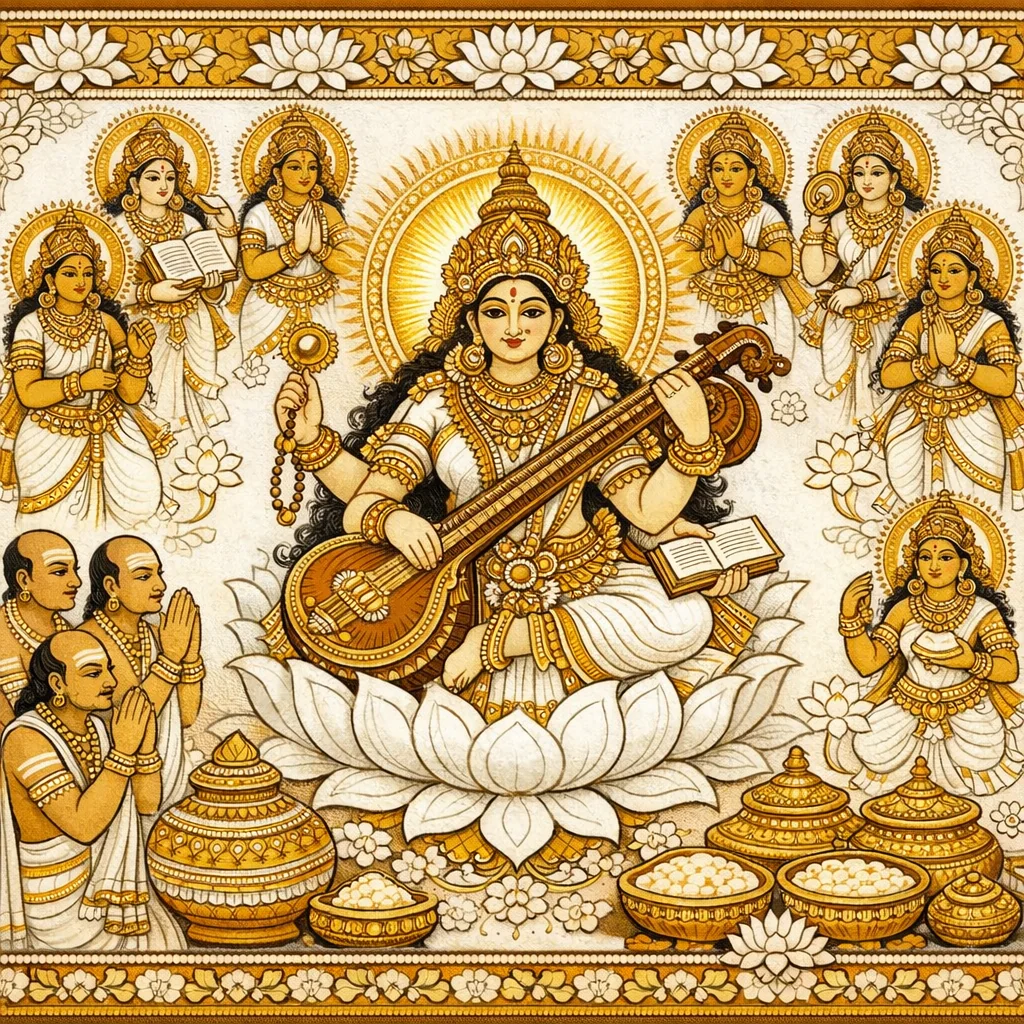
Having thus duly worshipped Goddess Gāyatrī—who bears the vīṇā, the rosary, and the jewel—adorning her with white flowers and unbroken rice-grains in devotion, and contemplating her as holding the water-pot (kamaṇḍalu) and the sacred book, the knower of dharma should take his meal in silence (mauna-vrata), both in the evening and in the morning.
Verse 11
पञ्चम्यां प्रतिपक्षं च पूजयेद्ब्रह्मवासिनीम् तथैव तण्डुलप्रस्थं घृतपात्रेण संयुतम् क्षीरं दद्याद्धिरण्यं च गायत्री प्रीयतामिति //
On the fifth lunar day (pañcamī), and also on its fortnightly counterpart (pratipakṣa), one should worship the goddess who abides in Brahman (Brahmavāsinī). Likewise, one should give a prastha-measure of rice together with a vessel of ghee, and also offer milk and gold, praying, “May Gāyatrī be pleased.”
Verse 12
संध्यायां च तथा मौनम् एतत्कुर्वन्समाचरेत् नान्तरा भोजनं कुर्याद् यावन्मासास्त्रयोदश //
At the times of sandhyā—the daily twilight worship—he should also observe silence; practicing these disciplines, he should live accordingly. He should not eat between meals for as long as thirteen months.
Verse 13
समाप्ते तु व्रते कुर्याद् भोजनं शुक्लतण्डुलैः पूर्वं सवस्त्रयुग्मं च दद्याद्विप्राय भोजनम् //
When the vow is completed, one should prepare a meal with white rice; and first, together with a pair of garments, one should offer a Brahmin a meal.
Verse 14
देव्या वितानं घण्टां च सितनेत्रे पयस्विनीम् चन्दनं वस्त्रयुग्मं च दद्याच्च शिखरं पुनः //
To the Goddess one should offer a ceremonial canopy and a bell; (offer) a white-eyed, milk-yielding cow; and also sandalwood and a pair of garments—then again, one should present a śikhara, a temple-spire or top-ornament, as well.
Verse 15
तथोपदेष्टारमपि भक्त्या सम्पूजयेद्गुरुम् वित्तशाठ्येन रहितो वस्त्रमाल्यानुलेपनैः //
Likewise, one should devoutly honour and worship the guru—one’s instructor as well—free from deceit regarding wealth, offering garments, garlands, and unguents.
Verse 16
अनेन विधिना यस्तु कुर्यात्सारस्वतं व्रतम् विद्यावानर्थसंयुक्तो रक्तकण्ठश्च जायते //
Whoever performs the Sarasvata vow according to this prescribed method becomes learned, endowed with prosperity, and is born with a bright, ruddy throat—i.e., with a strong, auspicious voice.
Verse 17
सरस्वत्याः प्रसादेन ब्रह्मलोके महीयते नारी वा कुरुते या तु सापि तत्फलगामिनी //
By the grace of Sarasvatī, one is honored in Brahmā’s world (Brahmaloka). Even a woman who performs this observance attains that very same fruit.
Verse 18
ब्रह्मलोके वसेद् राजन् यावत् कल्पायुतत्रयम् //
O King, he dwells in Brahmā’s world (Brahmaloka) for as long as three ayutas of kalpas.
Verse 19
सारस्वतं व्रतं यस्तु शृणुयादपि यः पठेत् विद्याधरपुरे सो ऽपि वसेत्कल्पायुतत्रयम् //
Whoever listens to, or even recites, the Sarasvata vow (Sārasvata-vrata), that person too dwells in the city of the Vidyādharas for three ayutas of kalpas.
Frequently Asked Questions
Adhyaya 66 teaches the Sārasvata-vrata, a Sarasvatī/Gāyatrī-centered observance combining worship, disciplined silence, regulated eating, Brahmin feeding, and prescribed gifts. It is presented as the practical means to attain sweet and persuasive speech, excellence in learning (including arts), social goodwill, harmony in family life, and longevity, culminating in exalted spiritual merit.
This chapter is primarily Dharma in the form of Vrata-Dharma (ritual observance and ethical discipline). It does not teach Vastu measurements or Puranic genealogy; instead it focuses on Sarasvatī/Gāyatrī upāsanā, mauna and sandhyā discipline, dāna, Brahmin-bhojana, and the phala (results) promised for practitioners and even listeners.
The discipline is maintained for thirteen months. Key requirements include silence (mauna) during meals and at sandhyā, avoidance of eating between meals, devotion to Gāyatrī/Sarasvatī with white offerings, and charitable acts such as feeding Brahmins and giving rice, ghee, milk, gold, and other concluding gifts.
The text promises learning and skill across branches of knowledge, prosperity, and a bright/auspicious voice (raktakaṇṭha). It also states that by Sarasvatī’s grace the practitioner is honored in Brahmaloka, and that even women receive the same fruit; additionally, one who listens to or recites the vrata is said to dwell in the Vidyādhara city for vast cosmic durations.