Adhyaya 176: Indra Sends Soma to Battle: Frost-Weapon, Moon Hymn, and the Breaking of Asuric Illusion
सोमप्रेषणं शिशिरायुधेन दैत्य मायानाशनम्
Speaker: Matsya, Śakra (Indra), Soma
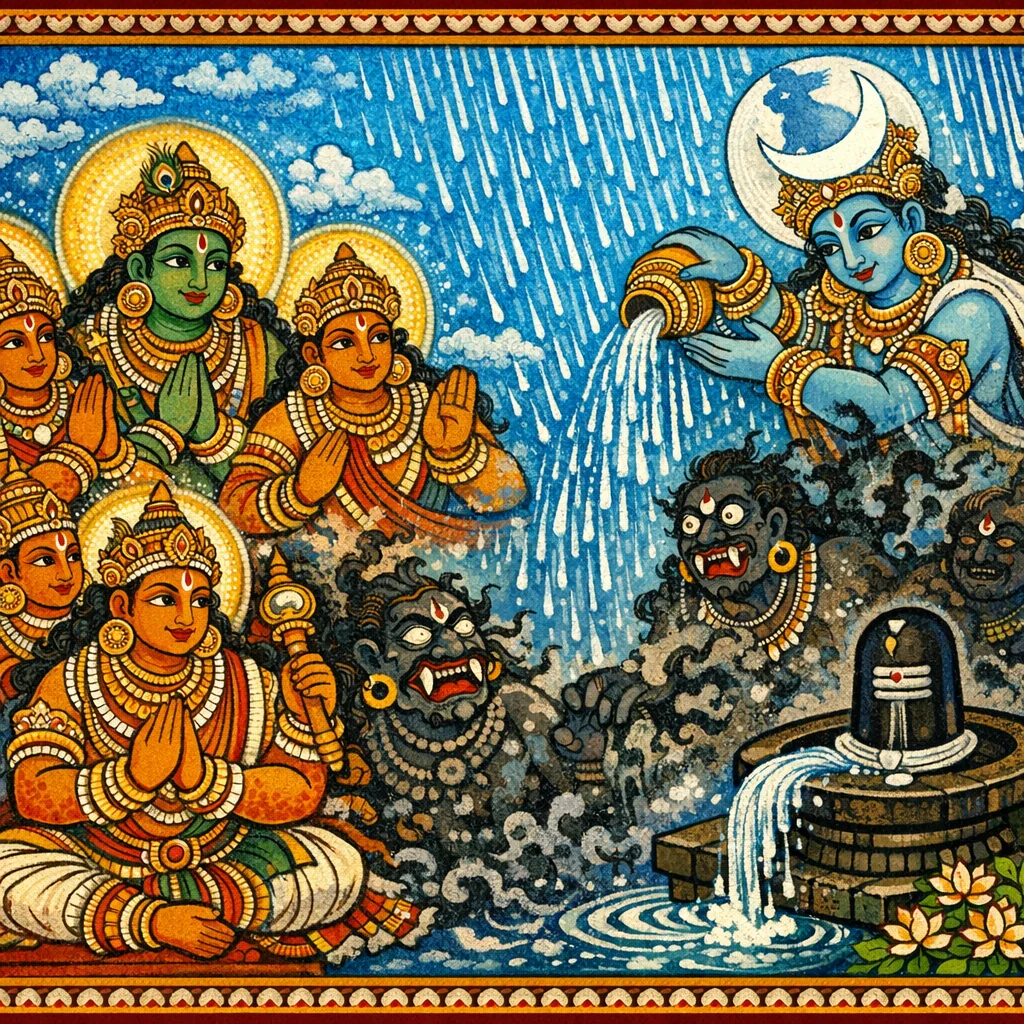
Matsya relates that the delighted Indra commands Soma to advance first in battle, bearing a chilling, wintry weapon. Indra urges Soma to aid Rudra for the destruction of the Asuras and the devas’ victory, praising Soma as supreme among luminaries, all-pervading as rasa, and as the cosmic regulator of time through the moon’s waxing and waning. He notes the mysterious hare-like mark on the lunar orb and Soma’s station beyond the Sun’s path, lauding him as yajña-rasa, lord of herbs, amṛta-support, and the moon adorning Śiva’s crest. Soma assents and releases a cold, illusion-shattering shower; the Daityas are seen wrapped in frost, their māyā broken and their pride humbled. Soma, with Jaleśa/Varuṇa as a protective presence, drenches the field with Śiva-consecrated water to increase peace among the gods, while snow-showers bind the Daityas like nooses and clouds envelop all.
Key Concepts
Shlokas in Adhyaya 176
Verse 1
*मत्स्य उवाच एवमस्त्विति संहृष्टः शक्रस्त्रिदशवर्धनः संदिदेशाग्रतः सोमं युद्धाय शिशिरायुधम् //
Matsya said: “So be it.” Delighted, Śakra—enhancer of the Thirty (gods)—then commanded Soma to go forth in front for battle, armed with the weapon of chilling frost.
Verse 2
गच्छ सोम सहायत्वं कुरु पाशधरस्य वै असुराणां विनाशाय जयार्थं च दिवौकसाम् //
“Go, O Soma; become the ally of the Pāśa-bearer (Rudra), for the destruction of the Asuras and for the victory of the dwellers in heaven.”
Verse 3
त्वं मत्तः प्रतिवीर्यश्च ज्योतिषां चेश्वरेश्वरः त्वन्मयं सर्वलोकेषु रसं रसविदो विदुः //
You are the countervailing power to me, and the Lord of lords even among the shining celestial beings. In all worlds, the wise connoisseurs of essence know the very ‘rasa’ (inner sap/essence) to be permeated by You—made of You.
Verse 4
क्षयवृद्धी तव व्यक्ते सागरस्येव मण्डले परिवर्तस्यहोरात्रं कालं जगति योजयन् //
Your manifest waxing and waning—like the ocean’s circular expanse—sets the turning of day and night in motion, thereby measuring and applying Time within the world.
Verse 5
लोकच्छायामयं लक्ष्म तवाङ्कः शशसंनिभः न विदुः सोम देवापि ये च नक्षत्रयोनयः //
This mark is formed of the world’s shadow; the emblem upon you is like a hare. Even Soma and the gods—indeed, those born of the lunar mansions (the Nakṣatras)—do not fully know it.
Verse 6
त्वमादित्यपथादूर्ध्वं ज्योतिषां चोपरि स्थितः तमः प्रोत्सार्य महसा भासयस्यखिलं जगत् //
You stand above the path of the Sun and even beyond all the luminaries; driving away darkness by your own radiance, you illuminate the entire universe.
Verse 7
श्वेतभानुर् हिमतनुर् ज्योतिषाम् अधिपः शशी अधिकृत् कालयोगात्मा इष्टो यज्ञरसो ऽव्ययः //
The Moon (Śaśī) shines with a white radiance and bears a cool body; he is the lord of the luminaries. He is the ordainer, whose nature is the conjunction of Time; he is the cherished one—the imperishable essence (rasa) of sacrifice.
Verse 8
ओषधीशः क्रियायोनिर् हरशेखरभाक्तथा शीतांशुरमृताधारश् चपलः श्वेतवाहनः //
He is the Lord of medicinal herbs; the very source from which sacred rites arise; the One who is worn upon Hara’s crest; the cool-rayed Moon; the support and repository of ambrosia; the ever-moving (swift) one; and the deity who rides a white vehicle.
Verse 9
त्वं कान्तिः कान्तिवपुषां त्वं सोमः सोमपायिनाम् सौम्यस्त्वं सर्वभूतानां तिमिरघ्नस्त्वम् ऋक्षराट् //
You are the radiance of those whose bodies shine; you are Soma for the drinkers of Soma. You are the gentle, auspicious one for all beings; you are the destroyer of darkness, the sovereign of the stars.
Verse 10
तद्गच्छ त्वं महासेन वरुणेन वरूथिना शमय त्वासुरीं मायां यया दह्याम संयुगे //
Therefore go forth, O great host (Mahāsena), accompanied by Varuṇa as your protector, and quell that asuric illusion by which we are being scorched in the battle.
Verse 11
*सोम उवाच यन्मां वदसि युद्धार्थे देवराज वरप्रद एष वर्षामि शिशिरं दैत्यमायापकर्षणम् //
Soma said: “O king of the gods, bestower of boons—since you urge me for the sake of battle, I shall pour forth a wintry, chilling shower that dispels the demons’ magical illusions.”
Verse 12
एतान्मच्छीतनिर्दग्धान् पश्य त्वं हिमवेष्टितान् विमायान्विमदांश्चैव दैत्यसिंहान्महाहवे //
Behold these lion-like Daityas in the great battle—scorched and consumed by my chilling power, wrapped over with frost, their sorcery broken and their pride brought low.
Verse 13
इत्युक्त्वा तारकाधीशः सजलेशः शिवोदकैः प्लावयामास सैन्यानि सुराणां शान्तिवृद्धये //
Having said this, the lord of Tārakā, together with Jaleśa, drenched the armies with water consecrated to Śiva, in order to increase peace and restore calm among the gods.
Verse 14
तेषां हिमकरोत्सृष्टाः सपाशा हिमवृष्टयः वेष्टयन्ति स्म तान्घोरान् दैत्यान्मेघगणा इव //
Against them, the snow-showers released by the Moon—like nooses—wrapped around those dreadful Daityas, just as masses of clouds envelop (all they cover).
Frequently Asked Questions
The chapter teaches that divine victory is achieved not only through force but through alignment with cosmic order: Soma’s cooling radiance dispels darkness and māyā, while his waxing and waning regulate kāla. Indra’s praise frames the Moon as yajña-rasa and world-pervading essence, implying that ritual-sacral power and cosmological harmony underwrite the devas’ success against demonic illusion.
This adhyāya is primarily cosmological-theological and narrative (Deva–Asura yuddha), focusing on Soma’s cosmic functions (timekeeping, illumination, lunar symbolism) and the destruction of Asuric māyā. It does not address Vāstu-śāstra measurements, royal dharma/statecraft, or genealogical lists directly in these verses.