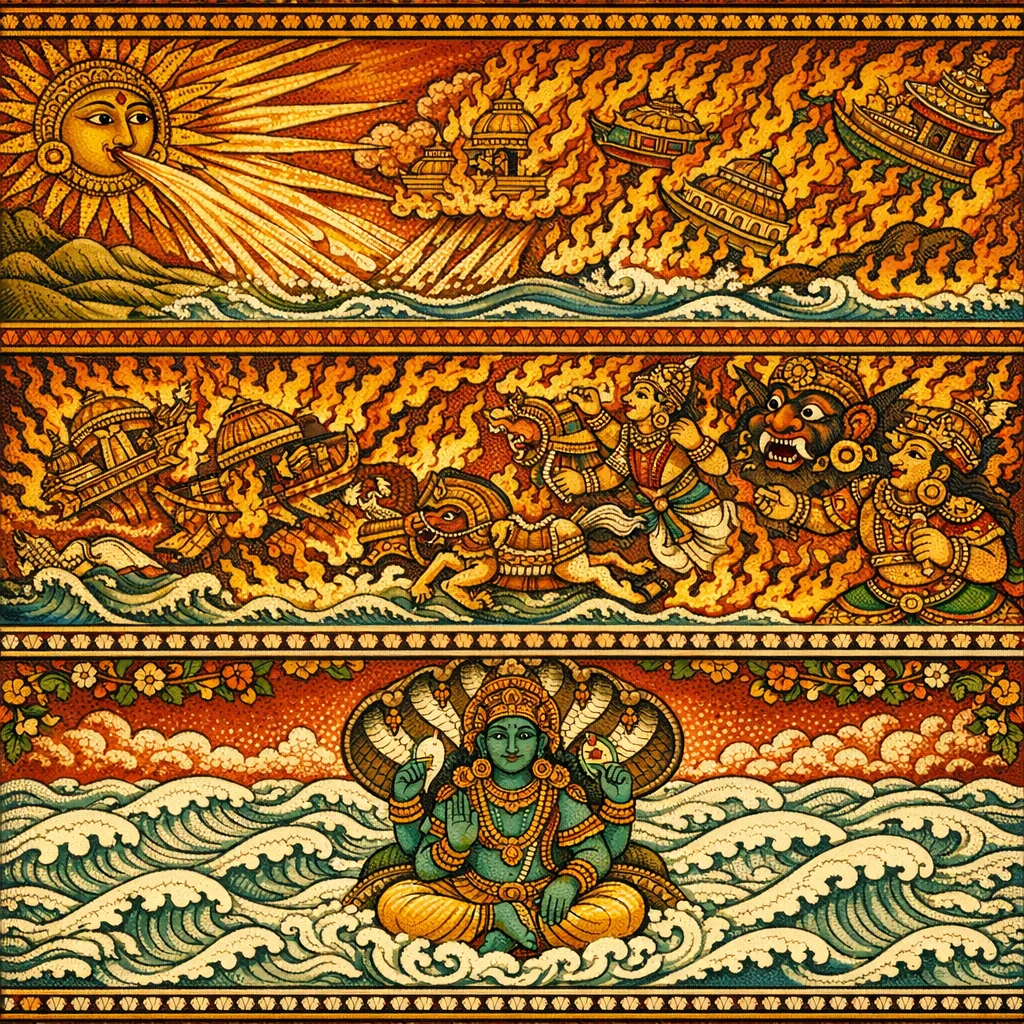
Adhyaya 166: Description of Pralaya: Drying, Burning, Inundation, and the Ekārṇava (Single Cosmic Ocean)
एकार्णवप्रलयवर्णनम्
Speaker: Matsya (narrator/teacher), Questioning interlocutor (implied; asks about Purusha, Yoga, Yogin, duration and ekārṇava-vidhi)
Matsya describes the end-of-age dissolution: Nārāyaṇa’s sun-like radiance dries up and absorbs all waters—surface, subterranean, and even bodily moisture. Then Vāyu grows fierce and, under Hari’s rule, withdraws the inner winds (prāṇa/apāna/samāna). Dissolution is framed as the resting of sensory qualities in their elements (earth, water, fire, wind, ether) and the destruction of worldly māyā, while still acknowledging mind, intellect, and the kṣetrajña (inner knower). A wind-driven friction kindles a vast conflagration that burns celestial vehicles and ancient structures; afterward Hari cools and pacifies the worlds by a yuga-ending act, and floods the earth with sweet, pure, milk-like waters until it becomes ekārṇava—the single cosmic ocean, empty of beings. With sun, wind, and space gone and the cosmos made subtle, all enter the all-pervading Lord; He alone remains as the ancient Purāṇic Yogi in cosmic sleep for thousands of yugas. The section ends with questions about who “Purusha” is, what “Yoga” means, the nature of the “Yogin,” and the procedure and duration of ekārṇava, emphasizing the Lord’s unknowability and supremacy.
Key Concepts
Shlokas in Adhyaya 166
Verse 1
*मत्स्य उवाच भूत्वा नारायणो योगी सत्त्वमूर्तिर्विभावसुः गभस्तिभिः प्रदीप्ताभिः संशोषयति सागरान् //
Matsya said: Having become Nārāyaṇa—the ascetic yogin, embodied as pure sattva and blazing like the Sun—he dries up the oceans with his fiercely radiant beams.
Verse 2
ततः पीत्वार्णवान् सर्वान् नदीः कूपांश्च सर्वशः पर्वतानां च सलिलं सर्वमादाय रश्मिभिः //
Then, with his rays, he drank up all the oceans, and everywhere the rivers and wells as well—drawing up all the waters, even the moisture of the mountains.
Verse 3
भित्त्वा गभस्तिभिश्चैव महीं गत्वा रसातलात् पातालजलमादाय पिबते रसमुत्तमम् //
Piercing the earth with his rays, he goes down to Rasātala; drawing up the waters of Pātāla, he drinks their finest essence.
Verse 4
मूत्रासृक्क्लेदम् अन्यच्च यदस्ति प्राणिषु ध्रुवम् तत्सर्वमरविन्दाक्ष आदत्ते पुरुषोत्तमः //
Whatever is inevitably present in living beings—urine, blood, bodily moisture, and other such impurities—all of that the lotus-eyed Supreme Person (Puruṣottama) takes upon Himself (i.e., absorbs and removes).
Verse 5
वायुश्च बलवान्भूत्वा विधुन्वानो ऽखिलं जगत् प्राणापानसमानाद्यान् वायून् आकर्षते हरिः //
Then Vāyu, becoming exceedingly powerful and shaking the entire world, draws back (withdraws) the winds within beings—such as prāṇa, apāna, and samāna—through Hari (Viṣṇu) as the governing power.
Verse 6
ततो देवगणाः सर्वे भूतान्येव च यानि तु गन्धो घ्राणं शरीरं च पृथिवीं संश्रिता गुणाः //
Then all the divine hosts—and likewise all beings—came to be established in the Earth-element, whose inherent qualities are fragrance, the faculty of smell, and bodily form.
Verse 7
जिह्वा रसश्च स्नेहश्च संश्रिताः सलिले गुणाः रूपं चक्षुर्विपाकश्च ज्योतिरेवाश्रिता गुणाः //
The tongue, taste, and unctuousness are qualities that abide in water; while form (colour), the eye (as the organ of sight), and ripening/digestion are qualities that abide in fire (light).
Verse 8
स्पर्शः प्राणश्च चेष्टा च पवने संश्रिता गुणाः शब्दः श्रोत्रं च खान्येव गगने संश्रिता गुणाः //
Touch, the vital breath, and bodily movement are qualities that rest in the wind (vāyu). Sound, the sense of hearing, and the bodily cavities (orifices) are qualities that rest in space/ether (ākāśa).
Verse 9
लोकमाया भगवता मुहूर्तेन विनाशिता मनो बुद्धिश्च सर्वेषां क्षेत्रज्ञश्चेति यः श्रुतः //
In but a moment, the Blessed Lord destroys the world’s illusion; and it is taught that for all beings there are the mind and the intellect—and also the Knower of the Field (the inner Self).
Verse 10
तं वरेण्यं परमेष्ठी हृषीकेशमुपाश्रितः ततो भगवतस्तस्य रश्मिभिः परिवारितः //
Then Paramēṣṭhī (Brahmā), taking refuge in that most excellent Hṛṣīkeśa (Lord Viṣṇu), stood surrounded by the radiance streaming from that Blessed Lord.
Verse 11
वायुनाक्रम्यमाणासु द्रुमशाखासु चाश्रितः तेषां संघर्षणोद्भूतः पावकः शतधा ज्वलन् //
When the branches of trees are lashed and driven by the wind, fire—born from their mutual friction—arises and blazes forth in a hundred flames.
Verse 12
विमानानि च दिव्यानि पुराणि विविधानि च यानि चाश्रयणीयानि तानि सर्वाणि सो ऽदहत् //
He burned up all of them—celestial vimānas, the many kinds of ancient structures, and whatever places were fit to be taken as refuge.
Verse 13
भस्मीकृत्य ततः सर्वांल् लोकांल्लोकगुरुर्हरिः भूयो निर्वापयामास युगान्तेन च कर्मणा //
Having then reduced all the worlds to ashes, Hari—the Teacher of the worlds—again caused them to be quenched and stilled, by the act that belongs to the end of an age (yuga).
Verse 14
सहस्रवृष्टिः शतधा भूत्वा कृष्णो महाबलः दिव्यतोयेन हविषा तर्पयामास मेदिनीम् //
Becoming a rain of a thousandfold—divided into a hundred streams—Kṛṣṇa, the mighty one, with celestial water as an oblation, satisfied and nourished the Earth.
Verse 15
ततः क्षीरनिकायेन स्वादुना परमाम्भसा शिवेन पुण्येन मही निर्वाणमगमत्परम् //
Then, by that mass of milk-like waters—sweet, supremely pure, auspicious and sanctifying—the Earth attained complete pacification, entering a state of perfect quiescence.
Verse 16
तेन रोधेन संछन्ना पयसां वर्षतो धरा एकार्णवजलीभूता सर्वसत्त्वविवर्जिता //
Covered by that obstruction, the earth—while the waters poured down like rain—became a single ocean of water, emptied of all living beings.
Verse 17
महासत्त्वान्यपि विभुं प्रविष्टान्यमितौजसम् नष्टार्कपवनाकाशे सूक्ष्मे जगति संवृते //
When the sun, the winds, and even space itself have vanished, and the world has contracted into a subtle state, even the great beings enter into that all-pervading Lord of immeasurable power.
Verse 18
संशोषमात्मना कृत्वा समुद्रानपि देहिनः दग्ध्वा संप्लाव्य च तथा स्वपित्येकः सनातनः //
Having, by his own power, dried up even the oceans, and then burning the embodied beings and again inundating (the worlds), the One Eternal Being alone lies down in cosmic sleep.
Verse 19
पौराणं रूपमास्थाय स्वपित्यमितविक्रमः एकार्णवजलव्यापी योगी योगमुपाश्रितः //
Assuming his ancient, Purāṇic form, that one of immeasurable prowess remained in yogic repose; pervading the waters of the single cosmic ocean, the Yogi abided, taking refuge in Yoga.
Verse 20
अनेकानि सहस्राणि युगान्येकार्णवाम्भसि न चैनं कश्चिदव्यक्तं व्यक्तं वेदितुमर्हति //
For many thousands of yugas, (all) lay in the waters of the single cosmic ocean; and no one is able to truly know That—unmanifest—(as though it were) manifest and graspable.
Verse 21
कश्चैव पुरुषो नाम किंयोगः कश्च योगवान् असौ कियन्तं कालं च एकार्णवविधिं प्रभुः //
Who indeed is that ‘Person’ by name? What is ‘Yoga’? And who is that Yogin? O Lord, for how long (does it last), and what is the prescribed procedure concerning the single cosmic ocean (ekārṇava)?
Verse 22
करिष्यतीति भगवान् इति कश्चिन् न बुध्यते //
No one truly understands what the Blessed Lord (Bhagavān) intends to do—(thinking), “He will do (this).”
Verse 23
न द्रष्टा नैव गमिता न ज्ञाता नैव पार्श्वगः तस्य न ज्ञायते किंचित् तमृते देवसत्तमम् //
He has no (separate) seer, no one who can reach Him, no knower, nor any attendant standing beside Him. Nothing whatsoever is truly known of Him—except that He is the most excellent among the gods.
Verse 24
नभः क्षितिं पवनम् अपः प्रकाशकं प्रजापतिं भुवनधरं सुरेश्वरम् पितामहं श्रुतिनिलयं महामुनिं प्रशाम्य भूयः शयनं ह्यरोचयत् //
Having pacified (withdrawn into himself) the sky, the earth, the wind, the waters, the luminous principle, Prajāpati, the supporter of the worlds, the Lord of the gods, Pitāmaha (Brahmā), the abode of the Vedas, and the great sage—he then chose once again to enter his repose (yogic sleep).
Frequently Asked Questions
The chapter teaches a theological cosmology of pralaya: all manifested supports of life (waters, winds, sensory functions, and elemental qualities) are withdrawn back into their sources under Nārāyaṇa’s supreme governance, culminating in ekārṇava where the Lord alone remains in yoga-nidrā. It emphasizes both the orderly dissolution of tattvas and the ultimate unknowability of Bhagavān’s unmanifest state.
This adhyāya is primarily Sṛṣṭi–Pratisarga (creation/dissolution) theology and cosmology. It does not teach Vāstu-śāstra measurements or Rājadharma rules, nor does it present genealogies; instead it focuses on pralaya mechanics (drying, burning, inundation), pañca-mahābhūta/guṇa mappings, prāṇa-withdrawal, and Viṣṇu’s yogic repose in the ekārṇava.
Ekārṇava refers to the ‘single ocean’ state after dissolution, when the earth is fully inundated and all beings have been withdrawn, leaving only the all-pervading Lord abiding in yogic sleep within the cosmic waters.
It states that earth holds fragrance/smell/form (gandha, ghrāṇa, śarīra); water holds tongue/taste/unctuousness (jihvā, rasa, sneha); fire holds form/eye/digestion-ripening (rūpa, cakṣus, vipāka); wind holds touch/vital breath/movement (sparśa, prāṇa, ceṣṭā); and ether holds sound/hearing/bodily cavities (śabda, śrotra, khāni), showing how these rest in elements during dissolution.