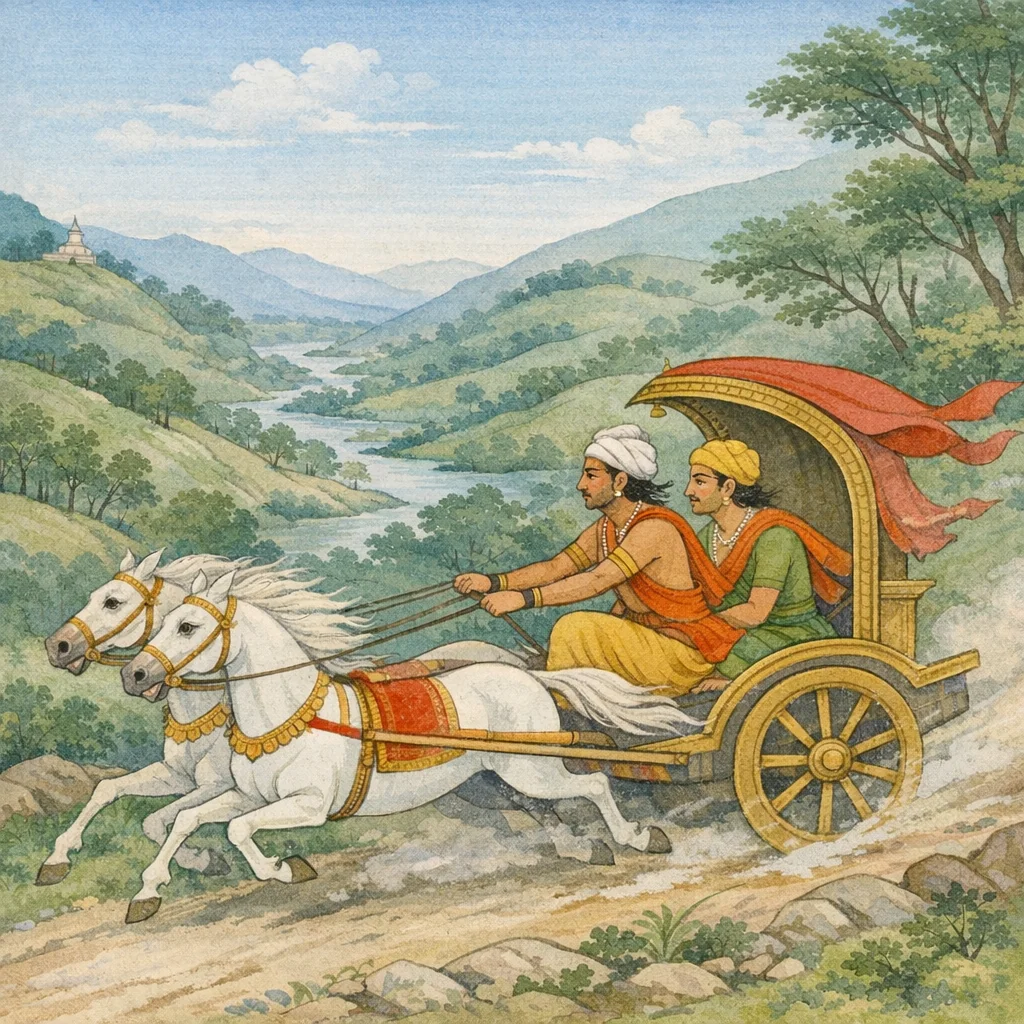
Adhyaya 71
Rathaghoṣa–Saṃjñāna: Damayantī’s Inference and the Dispatch of the Envoy (Āraṇyaka-parva, Adhyāya 71)
Upa-parva: Nala–Damayantī Upākhyāna (Episode of Nala and Damayantī)
Bṛhadaśva narrates Ṛtuperṇa’s arrival at Kuṇḍina in the evening, his chariot resounding through the city as he enters at Bhīma’s summons. The horses and even animals in palace precincts react to the familiar chariot-sound, creating a sensory field of recognition. Damayantī hears the deep ratha-nirghoṣa and experiences a surge of hope, interpreting the sound as characteristic of Nala; she articulates her emotional and ethical steadfastness, recalling Nala’s virtues and expressing the extremity of her longing if reunion fails. She ascends the palace, sees Ṛtuperṇa accompanied by Vārṣṇeya and Bāhuka, and notes the absence of Nala in plain view. Bhīma hosts Ṛtuperṇa with formal honor while privately questioning the plausibility of the visit’s stated purpose. After Ṛtuperṇa is lodged, Bāhuka attends to the horses with technical care. Damayantī, reasoning that either Vārṣṇeya transmitted Nala’s charioteering knowledge or that Ṛtuperṇa resembles Nala in skill, resolves to verify the truth indirectly and dispatches a dūtī to search for and ascertain Nala’s presence.
Chapter Arc: Vidarbha se Damayanti ke “punah svayamvara” ka sandesh aata hai—Raja Ritupurna turant chalne ko vyakul ho uthta hai aur apne sarathi Bahuka (gupt roop me Nala) se ek hi din me pahunchne ki asambhav si yatra ka prashn karta hai। → Ritupurna Bahuka ki ashva-vidya par bharosa jataata hai, par uski maang kathor hai—“ekahna” (ek din) me Vidarbha. Bahuka ke hriday me Damayanti ka naam sunte hi dukh aur udveg ka toofan uthta hai; vah apne bhav chhupa kar yatra ke liye taiyar hota hai. Vashneya (Ritupurna ka sarathi) Bahuka ko dekh-kar uski aayu aur deh-yaashti ko Nala se milata hua, par roop-viparyay se bhramit hota hai aur man-hi-man vichar karta hai ki yah kaun hai। → Bahuka swayam rashmiyan (bagdor) sambhal kar rath ko ati-veg se daudata hai; uski ekagrata, utsah aur ghodon par adbhut niyantran dekh Ritupurna aur Vashneya vismit-anandit ho uthte hain. Isi kshan Bahuka ki asadharan kshamata uski asli pehchan ki chhaya ban kar ubhar aati hai—Vashneya ke sandeh ko bal milta hai aur Ritupurna ko apne lakshya ki siddhi nikat dikhai deti hai। → Ritupurna Bahuka ki hayagyaata par prasann hota hai; yatra ka sankalp dridh hota hai aur rath Vidarbha ki or bijli ki tarah badh chalta hai. Bahuka (Nala) apne antar-vedana ko niyantrit kar, Damayanti tak pahunchne ke liye apni kala ko shastra ki tarah prayog karta hai। → Ati-veg yatra ke beech Vashneya ka sandeh gehraata hai—kya yah Bahuka vastav me Nala hai? aur kya Damayanti ka “svayamvara” satya hai ya koi pariksha/upaay?
Shlokas
Verse 1
/ हि न हुक है एकसप्ततितमो<्ध्याय: राजा ऋतुपर्णका विदर्भदेशको प्रस्थान, राजा नलके विषयमे वाष्णेयका विचार और बाहुककी अद्भुत अश्वसंचालन-कलासे वाष्णेय और ऋतुपर्णका प्रभावित होना बृहृदश्च उवाच श्रुत्वा वच: सुदेवस्य ऋतुपर्णो नराधिप: । सान्त्ययन् “लक्ष्णया वाचा बाहुकं प्रत्यभाषत,बृहदश्व मुनि कहते हैं--युधिष्ठिर! सुदेवकी वह बात सुनकर राजा ऋतुपर्णने मधुर वाणीसे सान्त्वना देते हुए बाहुकसे कहा--
Bṛhadaśva said: Hearing the words of Sudeva, King Ṛtupārṇa—lord of men—spoke to Bāhuka. With a gentle, discerning tone he sought to reassure him, addressing him in a way meant to calm and steady the mind. The scene underscores royal decorum: a ruler responds to troubling news not with haste, but with measured speech that restores composure and preserves dharma in conduct.
Verse 2
विदर्भान् यातुमिच्छामि दमयन्त्या: स्वयंवरम् । एकाह्ला हयतत्त्वज्ञ मन्यसे यदि बाहुक,“बाहुक! तुम अश्वविद्याके तत्त्वज्ञ हो, यदि मेरी बात मानो तो मैं दमयन्तीके स्वयंवरमें सम्मिलित होनेके लिये एक ही दिनमें विदर्भदेशकी राजधानीमें पहुँचना चाहता हूँ”
“I wish to go to Vidarbha for Damayantī’s svayaṃvara. Bāhuka, you are a knower of the true principles of horsemanship—if you agree to my request, do you think we can reach the capital in a single day?”
Verse 3
एवमुक्तस्य कौन्तेय तेन राज्ञा नलस्य ह । व्यदीर्यत मनो दुःखात् प्रदध्यौ च महामना:,कुन्तीनन्दन! राजा ऋतुपर्णके ऐसा कहनेपर राजा नलका मन अत्यन्त दुःखसे विदीर्ण होने लगा। महामना नल बहुत देरतक किसी भारी चिन्तामें निमग्न हो गये
O son of Kuntī, when King Ṛtupārṇa spoke thus, King Nala’s heart was torn by sorrow. The great-minded Nala then sank into deep reflection for a long while—his inner struggle showing how grief can fracture the mind, yet also drive one toward serious, searching thought rather than rash action.
Verse 4
दमयन्ती वदेदेतत् कुर्याद् दुःखेन मोहिता । अस्मदर्थ भवेद् वायमुपायश्चिन्तितो महान्,वे सोचने लगे--'“क्या दमयन्ती ऐसी बात कह सकती है? अथवा सम्भव है, दुःखसे मोहित होकर वह ऐसा कार्य कर ले। कहीं ऐसा तो नहीं है कि उसने मेरी प्राप्तिके लिये यह महान् उपाय सोच निकाला हो?
He thought: “Could Damayantī speak such words? Or, deluded by grief, might she do such a deed? Or is it that, for my sake, she has devised this great stratagem to find me again?”
Verse 5
नृशंसं बत वैदर्भी भर्तृकामा तपस्विनी । मया क्षुद्रेण निकृता कृपणा पापबुद्धिना,“तपस्विनी एवं दीन विदर्भराजकुमारीको मुझ नीच एवं पापबुद्धि पुरुषने धोखा दिया है, इसीलिये वह ऐसा निष्ठछुर कार्य करनेको उद्यत हो गयी। संसारमें स्त्रीका चंचल स्वभाव प्रसिद्ध है। मेरा अपराध भी भयंकर है। सम्भव है मेरे प्रवाससे उसका हार्दिक स्नेह कम हो गया हो, अतः वह ऐसा भी कर ले
Bṛhadaśva said: “Alas, how cruel a course the princess of Vidarbha—faithful to her husband and devoted to austerity—has been driven toward! Deceived by me, a petty and sinful-minded man, that poor woman has been wronged.”
Verse 6
स्त्रीस्वभावश्वलो लोके मम दोषश्नल दारुण: । स्यादेवमपि कुर्यात् सा विवासाद् गतसौहदा,“तपस्विनी एवं दीन विदर्भराजकुमारीको मुझ नीच एवं पापबुद्धि पुरुषने धोखा दिया है, इसीलिये वह ऐसा निष्ठछुर कार्य करनेको उद्यत हो गयी। संसारमें स्त्रीका चंचल स्वभाव प्रसिद्ध है। मेरा अपराध भी भयंकर है। सम्भव है मेरे प्रवाससे उसका हार्दिक स्नेह कम हो गया हो, अतः वह ऐसा भी कर ले
Bṛhadaśva said: “In this world a woman’s nature is known to be fickle; and my own fault is grievous indeed. It may be that, with my long absence, her heartfelt affection has waned—therefore she might even commit such a harsh deed.”
Verse 7
मम शोकेन संविग्ना नैराश्यात् तनुमध्यमा । नैवं सा कर्हिचित् कुर्यात् सापत्या च विशेषत:,“क्योंकि पतली कमरवाली वह युवती मेरे शोकसे अत्यन्त उद्विग्न हो उठी होगी और मेरे मिलनेकी आशा न होनेके कारण उसने ऐसा विचार कर लिया होगा, परंतु मेरा हृदय कहता है कि वह कभी ऐसा नहीं कर सकती। विशेषत: वह संतानवती है। इसलिये भी उससे ऐसी आशा नहीं की जा सकती
Bṛhadaśva said: “That slender-waisted woman must have been deeply shaken by my grief; and, losing hope of ever meeting me again, she may have formed such a thought. Yet my heart tells me she would never do such a thing—especially because she is a mother. For that reason too, one cannot expect this of her.”
Verse 8
यदत्र सत्यं वासत्यं गत्वा वेत्स्यामि निश्चयम् । ऋतुपर्णस्य वै काममात्मार्थ च करोम्यहम्,“इसमें कितना सत्य या असत्य है--इसे मैं वहाँ जाकर ही निश्चितरूपसे जान सकूँगा, अतः मैं अपने लिये ही ऋतुपर्णकी इस कामनाको पूर्ण करूँगा'
“Whether what is said here is true or untrue, I shall know for certain only by going there. Therefore, for my own purpose as well, I will fulfill King Ṛtuparṇa’s request.”
Verse 9
इति निश्चित्य मनसा बाहुको दीनमानस: । कृताञ्जलिर्वाचेदमृतुपर्ण जनाधिपम्,मन-ही-मन ऐसा निश्चय करके दीनहृदय बाहुकने दोनों हाथ जोड़कर राजा ऋतुपर्णसे इस प्रकार कहा--“नरेश्वर! पुरुषसिंह! मैंने आपकी आज्ञा सुनी है, मैं प्रतिज्ञापूर्वक कहता हूँ कि मैं एक ही दिनमें विदर्भवेशकी राजधानीमें आपके साथ जा पहुँचूँगा"
Having thus resolved in his mind, Bāhuka—his heart weighed down with distress—joined his palms in reverence and spoke to King Ṛtuparṇa, the lord of men: “O ruler of men, best of heroes! I have heard your command. I pledge to you that I will reach the capital of Vidarbha together with you within a single day.”
Verse 10
प्रतिजानामि ते वाक््यं गमिष्यामि नराधिप । एकाह्वा पुरुषव्यात्र विदर्भनगरीं नूप,मन-ही-मन ऐसा निश्चय करके दीनहृदय बाहुकने दोनों हाथ जोड़कर राजा ऋतुपर्णसे इस प्रकार कहा--“नरेश्वर! पुरुषसिंह! मैंने आपकी आज्ञा सुनी है, मैं प्रतिज्ञापूर्वक कहता हूँ कि मैं एक ही दिनमें विदर्भवेशकी राजधानीमें आपके साथ जा पहुँचूँगा"
Bṛhadaśva said: “O lord of men, I accept your word. O tiger among men, O king, I pledge that I shall go—within a single day—to the city of Vidarbha.”
Verse 11
ततः परीक्षामश्चानां चक्रे राजन् स बाहुक: । अश्वशालामुपागम्य भाज़सुरिनृपाज्ञया,युधिष्ठिर! तदनन्तर बाहुकने अश्वशालामें जाकर राजा ऋतुपर्णकी आज्ञासे अश्वोंकी परीक्षा की
Then, O king, Bāhuka proceeded to examine the horses. Going to the royal stables, he inspected them in obedience to the command of King Ṛtupārṇa—thus, Yudhiṣṭhira, he carried out his duty promptly and without display, showing the discipline of service and the ethics of faithful execution of one’s appointed work.
Verse 12
स त्वर्यमाणो बहुश ऋतुपर्णेन बाहुकः । अश्वाज्जिज्ञासमानो वै विचार्य च पुन: पुनः । अध्यगच्छत् कृशानश्चान् समर्थानध्वनि क्षमान्,ऋतुपर्ण बाहुकको बार-बार उत्तेजित करने लगे, अतः उसने अच्छी तरह विचार करके अश्वोंकी परीक्षा कर ली और ऐसे अश्वोंको चुना, जो देखनेमें दुबले होनेपर भी मार्ग तय करनेमें शक्तिशाली एवं समर्थ थे
Urged on repeatedly by Ṛtuparṇa, Bāhuka hastened. Seeking to assess the horses, he examined them again and again, and selected those that, though appearing lean, were truly capable—strong enough to endure the road and complete the journey.
Verse 13
तेजोबलसमायुक्तान् कुलशीलसमन्वितान् । वर्जिताल्लक्षणैहीनि: पृथुप्रोथान् महाहनून्,वे तेज और बलसे युक्त थे। वे अच्छी जातिके और अच्छे स्वभावके थे। उनमें अशुभ लक्षणोंका सर्वथा अभाव था। उनकी नाक मोटी और थूथन (ठोड़ी) चौड़ी थी
Bṛhadaśva said: “They were endowed with splendour and strength, and were marked by noble lineage and good conduct. In them there was a complete absence of inauspicious signs. Broad-nosed and wide-jawed, they appeared robust and formidable.”
Verse 14
शूद्धान् दशभिरावर्ते: सिन्धुजान् वातरंहस: । दृष्टवा तानब्रवीद् राजा किंचित् कोपसमन्वित:,वे वायुके समान वेगशाली सिन्धुदेशके घोड़े थे। वे दस आवर्त (भौँवरियों)-के चिह्ोंसे युक्त होनेके कारण निर्दोष थे। उन्हें देखकर राजा ऋतुपर्णने कुछ कुपित होकर कहा --
Bṛhadaśva said: Seeing those swift, wind-like horses bred in the Sindhu country—faultless and marked with ten whorls—the king, somewhat stirred by anger, spoke about them.
Verse 15
किमिदं प्रार्थितं कर्तु प्रलब्धव्या न ते वयम् । कथमल्पबलप्राणा वक्ष्यन्तीमे हया मम । महदध्वानमपि च गन्तव्यं कथमीदृशै:,“क्या तुमसे ऐसे ही घोड़े चुननेके लिये कहा था, तुम मुझे धोखा तो नहीं दे रहे हो। ये अल्प बल और शक्तिवाले घोड़े कैसे मेरा इतना बड़ा रास्ता तय कर सकेंगे? ऐसे घोड़ोंसे इतनी दूरतक रथ कैसे ले जाया जायगा?'
Bṛhadaśva said: “What is this you have been asked to do? We are not to be deceived by you. How will these horses of little strength and vitality carry me? And how is a great journey to be undertaken with animals like these—how will a chariot be taken so far with such horses?”
Verse 16
बाहुक उवाच एको ललाटे द्वौ मूर्थ्नि द्वौ द्वौ पाश्चोपपार्श्चयो: । दौ दौ वक्षसि विज्ञेयौ प्रयाणे चैक एव तु,बाहुकने कहा--राजन्! ललाटमें एक, मस्तकमें दो, पार्श्रभागमें दो, उपपार्श्वभागमें भी दो, छातीमें दोनों ओर दो दो और पीठमें एक--इस प्रकार कुल बारह भँवरियोंको पहचानकर घोड़े रथमें जोतने चाहिये
Bāhuka said: “O king, one whorl is to be marked on the forehead; two upon the head; two on the flanks and likewise two on the regions beside the flanks; two on each side of the chest; and one upon the back. Recognizing these twelve whorls, one should yoke such a horse to the chariot.”
Verse 17
एते हया गमिष्यन्ति विदर्भान् नात्र संशय: । यानन्यान् मन्यसे राजन् ब्रूहि तान् योजयामि ते,ये मेरे चुने हुए घोड़े अवश्य विदर्भदेशकी राजधानीतक पहुँचेंगे, इसमें संशय नहीं है। महाराज! इन्हें छोड़कर आप जिनको ठीक समझें, उन्हींको मैं रथमें जोत दूँगा
Bāhuka said: “These horses will surely reach Vidarbha—of that there is no doubt. O king, if you deem other horses more suitable, tell me; I will harness those for your chariot.”
Verse 18
ऋचुपर्ण उवाच त्वमेव हयतत्त्वज्ञ: कुशलो हासि बाहुक | यान् मन्यसे समर्थास्त्वं क्षिप्रं तानेव योजय,ऋतुपर्ण बोले--बाहुक! तुम अश्वविद्याके तत्त्वज्ञ और कुशल हो, अतः तुम जिन्हें इस कार्यमें समर्थ समझो, उन्हींको शीघ्र जोतो
R̥tuparṇa said: “Bāhuka, you alone truly understand the principles of horses and are skilled in that art. Therefore, quickly yoke only those horses that you judge to be capable for this task.”
Verse 19
ततः सददश्वांश्वतुर: कुलशीलसमन्वितान् | योजयामास कुशलो जवयुक्तान् रथे नल:,तब चतुर एवं कुशल राजा नलने अच्छी जाति और उत्तम स्वभावके चार वेगशाली घोड़ोंको रथमें जोता
Then he saw four swift horses, endowed with good lineage and fine disposition. Skilled in such work, Nala yoked those speed-trained horses to the chariot.
Verse 20
ततो युक्त रथं राजा समारोहत् त्वरान्वित: । अथ पर्यपतन् भूमौ जानुभिस्ते हयोत्तमा:,जुते हुए रथपर राजा ऋतुपर्ण बड़ी उतावलीके साथ सवार हुए। इसलिये उनके चढ़ते ही वे उत्तम घोड़े घुटनोंके बल पृथ्वीपर गिर पड़े
Then King R̥tupārṇa, in great haste, mounted the chariot that had been made ready. As soon as he climbed aboard, those excellent horses sank down to the ground on their knees.
Verse 21
ततो नरवर: श्रीमान् नलो राजा विशाम्पते । सान्त्वयामास तानश्वांस्तेजोबलसमन्वितान्,युधिष्ठिर! तब नरश्रेष्ठ श्रीमान् राजा नलने तेज और बलसे सम्पन्न उन घोड़ोंको पुचकारा
Then the illustrious king Nala, best among men and lord of the people, soothed and reassured those horses endowed with vigor and strength—O Yudhiṣṭhira.
Verse 22
रश्मिभिश्न समुद्यम्य नलो यातुमियेष स: । सूतमारोप्य वा्ष्णेयं जवमास्थाय वै परम्,फिर अपने हाथमें बागडोर ले उन्हें काबूमें करके रथको आगे बढ़ानेकी इच्छा की। वा्ष्णेय सारथिको रथपर बैठाकर अत्यन्त वेगका आश्रय ले उन्होंने रथ हाँक दिया। बाहुकके द्वारा विधिपूर्वक हाँके जाते हुए वे उत्तम अश्व रथीको मोहित--से करते हुए इतने तीव्र वेगसे चले, मानो आकाशमें उड़ रहे हों
Ṛtupārṇa said: “Taking the reins firmly in his hands and bringing the horses under control, Nala resolved to set out. Seating Vārṣṇeya, the charioteer, upon the chariot, he urged the team to its utmost speed and drove on. Those excellent horses, driven in proper fashion by Bāhuka (Nala in disguise), seemed to bewilder the charioteer as they rushed forward with such swiftness that they appeared to be flying through the sky.”
Verse 23
ते चोद्यमाना विधिवद् बाहुकेन हयोत्तमा: । समुत्पेतुरथाकाशं रथिनं मोहयजन्निव,फिर अपने हाथमें बागडोर ले उन्हें काबूमें करके रथको आगे बढ़ानेकी इच्छा की। वा्ष्णेय सारथिको रथपर बैठाकर अत्यन्त वेगका आश्रय ले उन्होंने रथ हाँक दिया। बाहुकके द्वारा विधिपूर्वक हाँके जाते हुए वे उत्तम अश्व रथीको मोहित--से करते हुए इतने तीव्र वेगसे चले, मानो आकाशमें उड़ रहे हों
Urged on and guided with proper skill by Bāhuka, the finest horses surged forward with such disciplined speed that they seemed to leap into the sky, as though dazzling and bewildering the charioteer by their very swiftness.
Verse 24
तथा तु दृष्टवा तानश्वान् वहतो वातरंहस: । अयोध्याधिपति: श्रीमान् विस्मयं परमं ययौ,उस प्रकार वायुके समान वेगसे रथका वहन करनेवाले उन अश्वोंको देखकर श्रीमान् अयोध्यानरेशको बड़ा विस्मय हुआ
Seeing those horses drawing the chariot with a speed like the wind, the illustrious lord of Ayodhyā was seized with the greatest astonishment.
Verse 25
रथघोषं तु त॑ श्रुत्वा हयसंग्रहणं च तत् । वार्ष्णेयश्चिन्तयामास बाहुकस्य हयज्ञताम्,रथकी आवाज सुनकर और घोड़ोंको काबूमें करनेकी वह कला देखकर वार्ष्णेयने बाहुकके अश्व-विज्ञानपर सोचना आरम्भ किया। “क्या यह देवराज इन्द्रका सारथि मातलि है? इस वीर बाहुकमें मातलिका-सा ही महान् लक्षण देखा जाता है
Hearing the rumble of the chariot and witnessing that skill of restraining and managing the horses, Vārṣṇeya began to reflect on Bāhuka’s mastery of horsemanship.
Verse 26
कि नु स्यान्मातलिरयं देवराजस्य सारथि: । तथा तल्लक्षणं वीरे बाहुके दृश्यते महत्,रथकी आवाज सुनकर और घोड़ोंको काबूमें करनेकी वह कला देखकर वार्ष्णेयने बाहुकके अश्व-विज्ञानपर सोचना आरम्भ किया। “क्या यह देवराज इन्द्रका सारथि मातलि है? इस वीर बाहुकमें मातलिका-सा ही महान् लक्षण देखा जाता है
Ṛtuparṇa said: “Could this man be Mātali, the charioteer of the king of the gods? For in this hero Bāhuka, I see the same great distinguishing marks.”
Verse 27
शालिहोत्रो5थ किं नु स्याद्धयानां कुलतत्त्ववित् मानुषं समनुप्राप्तो वपु: परमशोभनम्,“अथवा घोड़ोंकी जाति और उनके विषयकी ताच्विक बातें जाननेवाले ये आचार्य शालिहोत्र तो नहीं हैं, जो परम सुन्दर मानव शरीर धारण करके यहाँ आ पहुँचे हैं
Ṛtupārṇa said: “Could this be Śālihotra—the knower of horses, their lineages, and their true characteristics—who has arrived here in a human form of surpassing beauty?”
Verse 28
उताहोस्विद् भवेद् राजा नल: परपुरंजय: । सो<यं नृपतिरायात इत्येवं समचिन्तयत्,“अथवा शत्रुओंकी राजधानीपर विजय पानेवाले साक्षात् राजा नल ही तो इस रूपमें नहीं आ गये हैं? अवश्य वे ही हैं, इस प्रकार वार्ष्णेयने चिन्तन करना प्रारम्भ किया
Ṛtūparṇa said: “Could this perhaps be King Nala, the conqueror of enemy cities? Surely this very monarch has come.” Thinking in this way, he began to reflect—suspecting that the person before him might indeed be Nala in disguise.
Verse 29
अथ चेह नलो विद्यां वेत्ति तामेव बाहुक: । तुल्यं हि लक्षये ज्ञानं बाहुकस्य नलस्य च,“राजा नल इस जगत्में जिस विद्याको जानते हैं, उसीको बाहुक भी जानता है। बाहुक और नल दोनोंका ज्ञान मुझे एक-सा दिखायी देता है
Ṛtuparṇa said: “If King Nala knows a certain art here, then Bāhuka knows that very same art as well. For I perceive the knowledge of Bāhuka and of Nala to be equal.”
Verse 30
अपि चेदं वयस्तुल्यं बाहुकस्य नलस्य च । नायं नलो महावीर्यस्तद्विद्यक्ष भविष्यति,“इसी प्रकार बाहुक और नलकी अवस्था भी एक है। यह महापराक्रमी राजा नल नहीं है तो भी उनके ही समान विद्वान् कोई दूसरा महापुरुष होगा
Ṛtūparṇa said: “Moreover, the age of Bāhuka and of Nala appears the same. If this is not Nala, that mighty hero, then it must be some other great man—one who is equally skilled and learned.”
Verse 31
प्रच्छन्ना हि महात्मानश्वरन्ति पृथिवीमिमाम् । दैवेन विधिना युक्ता: शास्त्रोक्तैश्न निरूपणै:,“बहुत-से महात्मा प्रच्छन्न रूप धारण करके देवोचित विधि तथा शास्त्रोक्त नियमोंसे युक्त होकर इस पृथ्वीपर विचरते रहते हैं
Many great-souled persons, concealed in guise, move about upon this earth—guided by divine ordinance and disciplined by the prescriptions and regulations taught in the śāstras. Thus true virtue may appear in humble or hidden forms; one should treat others with reverence and ethical caution, for the righteous may be near without being recognized.
Verse 32
भवेन्न मतिभेदो मे गात्रवैरूप्यतां प्रति । प्रमाणात् परिहीनस्तु भवेदिति मतिर्मम,“इसके शरीरकी रूपहीनताको लक्ष्य करके मेरी बुद्धिमें यह भेद नहीं पैदा होता कि यह नल नहीं है, परंतु राजा नलकी जो मोटाई है, उससे यह कुछ दुबला-पतला है। उससे मेरे मनमें यह विचार होता है कि सम्भव है, यह नल न हो
Ṛtuparṇa said: “My understanding does not split into doubt merely because of the deformity of his body; from that alone I do not conclude that he is not Nala. Yet, compared with King Nala’s known fullness of build, he seems somewhat thinner and diminished; therefore my mind entertains the thought that it is possible he may not be Nala.”
Verse 33
वय:प्रमाणं तत्तुल्यं रूपेण तु विपर्यय: । नल॑ सर्वगुणैर्युक्ते मन््ये बाहुकमन्ततः,“इसकी अवस्थाका प्रमाण तो उन्हींके समान है, परंतु रूपकी दृष्टिसे तो अन्तर पड़ता है। फिर भी अन्ततः मैं इसी निर्णयपर पहुँचता हूँ कि मेरी रायमें बाहुक सर्वगुणसम्पन्न राजा नल ही हैं'
Ṛtuparṇa said: “In age and measure he matches him, yet in outward appearance there is a reversal—there is a difference. Still, after weighing everything, I arrive at this conclusion: in my judgment, Bāhuka is none other than King Nala, endowed with every virtue.”
Verse 34
एवं विचार्य बहुशो वार्ष्णेय: पर्यचिन्तयत् । हृदयेन महाराज पुण्यश्लोकस्य सारथि:,महाराज युधिष्ठिर! इस प्रकार पुण्यश्लोक नलके सारथि वार्ष्णेयने बार-बार उपर्युक्त रूपसे विचार करते हुए मन-ही-मन उक्त धारणा बना ली
Having reflected again and again in this way, Vārṣṇeya—the charioteer of the renowned and virtuous King Nala—pondered deeply within his heart, O great king, and inwardly arrived at a settled resolve.
Verse 35
ऋतुपर्णश्व राजेन्द्रो बाहुकस्य हयज्ञताम् | चिन्तयन् मुमुदे राजा सहवाष्णेयसारथि:,महाराज ऋतुपर्ण भी बाहुकके अश्वसंचालन-विषयक ज्ञानपर विचार करके वार्ष्णेय सारथिके साथ बहुत प्रसन्न हुए
King Ṛtuparṇa, best among kings, reflected on Bāhuka’s expertise in horses and their handling; and, accompanied by his Vārṣṇeya charioteer, the king became greatly delighted.
Verse 36
ऐकाग्रयं च तथोत्साहं हयसंग्रहणं च तत् । परं यत्नं च सम्प्रेक्ष्य परां मुदमवाप ह,उसकी वह एकाग्रता, वह उत्साह, घोड़ोंको काबूमें रखनेकी वह कला और वह उत्तम प्रयत्न देखकर उन्हें बड़ी प्रसन्नता प्राप्त हुई
R̥tuparṇa said: Seeing his single-pointed concentration, his spirited resolve, his skill in controlling and managing the horses, and his exceptional effort, he was filled with great delight.
Verse 70
इस प्रकार श्रीमह्याभारत वनपर्वके अन्तर्गत नलोपाख्यानपर्वमें दमयन्तीके पुनः स्वयंवरकी चचसि सम्बन्ध रखनेवाला सत्तरवाँ अध्याय पूरा हुआ
Thus ends the seventieth chapter of the Nala episode within the Vana Parva of the sacred Mahābhārata, concerning the events connected with Damayantī’s second svayaṃvara.
Verse 73
इति श्रीमहाभारते वनपर्वणि नलोपाख्यानपर्वणि ऋतुपर्णविदर्भगमने एकसप्ततितमो<ध्याय:
Thus, in the Śrī Mahābhārata, within the Vana Parva, in the Nalopākhyāna section, in the episode of Ṛtupārṇa’s journey to Vidarbha, ends the seventy-first chapter.
Frequently Asked Questions
Damayantī must balance urgent personal longing with ethical restraint: whether to act immediately on a powerful sign (the chariot-sound) or to proceed through verification and proper channels to avoid error, scandal, or misrecognition.
The chapter foregrounds disciplined inference and procedural prudence: strong affect may initiate inquiry, but reliable knowledge is pursued through corroboration (messengers, observation of conduct, and skilled signs) within social norms.
No explicit phalaśruti is stated in this passage; its meta-function is narrative-ethical, illustrating how recognition and reunion are approached through lawful method, patience, and evidentiary reasoning within the epic’s broader discourse on dharma.