Adhyaya 38
अर्जुनस्य इन्द्रकीलगमनम् तथा शक्रसाक्षात्कारः (Arjuna’s journey to Indrakīla and encounter with Indra)
Upa-parva: Indralokābhigamana / Divyāstrārtha-prayāṇa Episode (Arjuna’s commissioning to seek divine weapons)
Vaiśaṃpāyana narrates Yudhiṣṭhira’s private counsel to Arjuna: the principal masters of dhanurveda are aligned with Duryodhana’s side, making timely preparation necessary. Yudhiṣṭhira invokes received upaniṣadic clarity and directs Arjuna to disciplined observance—maintaining divine favor and undertaking intense tapas—then sends him north, noting that Indra holds the consolidated divine weapons. Arjuna departs ritually prepared, armed yet restrained, receiving blessings from Draupadī and the household, and proceeds with yogic speed across Himālaya regions to Indrakīla. There, a brahmin ascetic challenges the impropriety of weapons in an ascetic domain and urges renunciation; Arjuna remains firm in purpose. The ascetic reveals himself as Śakra (Indra) and offers a boon; Arjuna requests comprehensive knowledge of astras, refusing pleasures, realms, or status as insufficient without fulfilling duty and avoiding lasting disrepute. Indra then conditions the bestowal of divyāstras upon Arjuna’s future vision of Śiva, instructing focused effort toward that darśana, and departs; Arjuna remains in yogic steadiness, poised for further qualification.
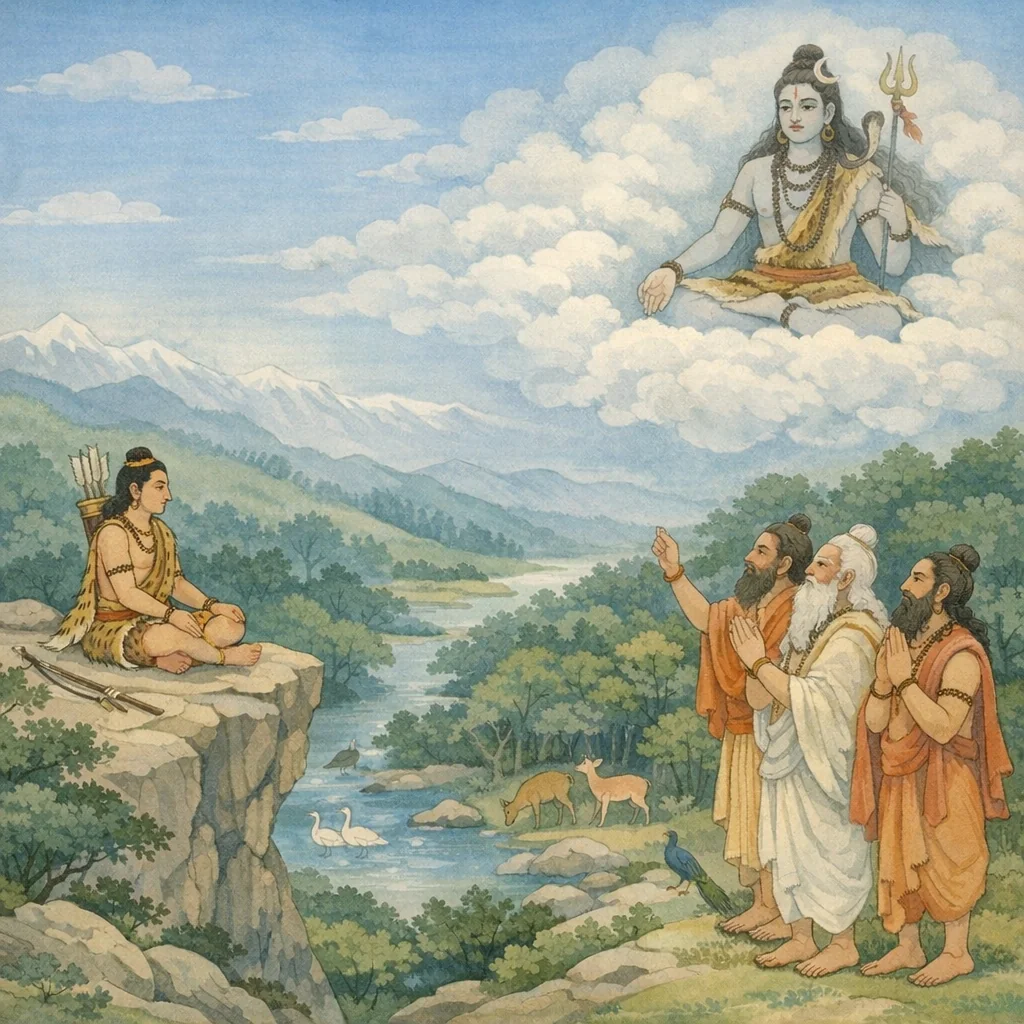
Chapter Arc: Janamejaya asks how the lion-armed Dhananjaya, entering a manless wilderness without fear, lived there and what he accomplished—especially how he pleased both Indra and Lord Sthanu (Shiva). → By Yudhishthira’s command Arjuna journeys toward the Himalayan heights, into a forest rich with flowers, beasts, birds, and visited by Siddhas and Charanas; there he undertakes an unbearable, blazing tapas that seems to smoke the directions and disturb the worlds. → The heat of Arjuna’s austerity agitates the sages and the divine order; the rishis approach Umāpati, Bhūtapati (Shiva) and speak: Arjuna’s tapas scorches even the great seers—Shiva must compassionately restrain or resolve the purpose behind it. → Shiva speaks to the truth-speaking rishis, clarifying his stance and the handling of Arjuna’s fierce vow; hearing Shankara’s words, the sages rejoice and return to their own abodes, the immediate disturbance pacified. → Arjuna’s tapas is acknowledged as world-shaking, and Shiva’s involvement is set—foreshadowing the imminent direct encounter and testing that will decide whether Arjuna gains the divine boon he seeks.
Shlokas
Verse 1
अप अर [हुक हि 7 2 (कैरातपर्व) अष्टात्रिशो5 ध्याय: अर्जुनकी उग्र तपस्या और उसके विषयमें ऋषियोंका भगवान् शंकरके साथ वार्तालाप जनमेजय उवाच भगवज्छोतुमिच्छामि पार्थस्याक्लिष्टकर्मण: । विस्तरेण कथामेतां यथास्त्राण्युपलब्धवान्,जनमेजय बोले--भगवन्! अनायास ही महान् कर्म करनेवाले कुन्तीनन्दन अर्जुनकी यह कथा मैं विस्तारपूर्वक सुनना चाहता हूँ; उन्होंने किस प्रकार अस्त्र प्राप्त किये?
Janamejaya said: “Revered sir, I wish to hear in detail this account of Pārtha Arjuna, whose deeds are accomplished without strain—how, in what manner, he obtained the divine weapons.”
Verse 2
यथा च पुरुषव्याप्रो दीर्घबाहुर्धनंजय: । वन॑ प्रविष्टस्तेजस्वी निर्मनुष्यमभीतवत्,पुरुषसिंह महाबाहु तेजस्वी धनंजय उस निर्जन वनमें निर्भयके समान कैसे चले गये थे?
Janamejaya said: “How did the radiant Dhanañjaya (Arjuna)—the lion among men, long-armed and ever energetic—enter that manless, desolate forest and move about there as though fearless?”
Verse 3
किं च तेन कृतं तत्र वसता ब्रह्मृवित्तम । कथं च भगवान् स्थाणुर्देवराजश्व॒ तोषित:,ब्रह्मवेत्ताओंमें श्रेष्ठ महर्ष] उस वनमें रहकर पार्थने क्या किया? भगवान् शंकर तथा देवराज इन्द्रको कैसे संतुष्ट किया?
Janamejaya asked: “O best of the knowers of Brahman, while living in that forest what did Pārtha accomplish? And by what conduct did he win the satisfaction of the Blessed Sthāṇu (Śiva) and of the king of the gods, Indra?”
Verse 4
एतदिच्छाम्यहं श्रीतुं त्वत्प्रसादाद् द्विजोत्तम | त्वं हि सर्वज्ञ दिव्यं च मानुषं चैव वेत्थ ह,विप्रवर! मैं आपकी कृपासे ये सब बातें सुनना चाहता हूँ। सर्वज्ञ! आप दिव्य और मानुष सभी वृत्तान्तों-को जानते हैं
Janamejaya said: “O best of Brahmins, by your gracious favor I wish to hear this in full. For you are all-knowing—you truly understand both the divine sphere and the human course of events.”
Verse 5
अत्यद्भुततमं ब्रह्मन् रोमहर्षणमर्जुन: । भवेन सह संग्रामं चकाराप्रतिमं किल,ब्रह्मन्! मैंने सुना है, कभी संग्राममें परास्त न होनेवाले, योद्धाओंमें श्रेष्ठ अर्जुनने पूर्वकालमें भगवान् शंकरके साथ अत्यन्त अद्भुत, अनुपम और रोमांचकारी युद्ध किया था, जिसे सुनकर मनुष्योंमें श्रेष्ठ शूरवीर कुन्तीपुत्रोंके हृदयोंमें भी दैन्य, हर्ष और विस्मयके कारण कँपकँपी छा गयी थी। अर्जुनने और भी जो-जो कार्य किये हों, वे सब भी मुझे बताइये
Janamejaya said: “O Brahmin, I have heard that Arjuna once fought an exceedingly wondrous, hair-raising, and truly unparalleled battle with Bhava (Śiva). Please tell me about that event—and also recount whatever other remarkable deeds Arjuna performed.”
Verse 6
पुरा प्रहरतां श्रेष्ठ: संग्रामेष्वपराजित: । यच्छुत्वा नरसिंहाना दैन्यहर्षातिविस्मयात्,ब्रह्मन्! मैंने सुना है, कभी संग्राममें परास्त न होनेवाले, योद्धाओंमें श्रेष्ठ अर्जुनने पूर्वकालमें भगवान् शंकरके साथ अत्यन्त अद्भुत, अनुपम और रोमांचकारी युद्ध किया था, जिसे सुनकर मनुष्योंमें श्रेष्ठ शूरवीर कुन्तीपुत्रोंके हृदयोंमें भी दैन्य, हर्ष और विस्मयके कारण कँपकँपी छा गयी थी। अर्जुनने और भी जो-जो कार्य किये हों, वे सब भी मुझे बताइये
Janamejaya said: “O Brahmin, I have heard that in former times Arjuna—foremost among warriors and never defeated in battle—fought an exceedingly wondrous, unparalleled, hair-raising combat with Lord Śaṅkara. On hearing of it, even the heroic sons of Kuntī, the best of men, were seized with trembling born of dejection, joy, and astonishment. Tell me also all the other deeds that Arjuna performed.”
Verse 7
शूराणामपि पार्थानां हृदयानि चकम्पिरे । यद् यच्च कृतवानन्यत् पार्थस्तदखिलं वद,ब्रह्मन्! मैंने सुना है, कभी संग्राममें परास्त न होनेवाले, योद्धाओंमें श्रेष्ठ अर्जुनने पूर्वकालमें भगवान् शंकरके साथ अत्यन्त अद्भुत, अनुपम और रोमांचकारी युद्ध किया था, जिसे सुनकर मनुष्योंमें श्रेष्ठ शूरवीर कुन्तीपुत्रोंके हृदयोंमें भी दैन्य, हर्ष और विस्मयके कारण कँपकँपी छा गयी थी। अर्जुनने और भी जो-जो कार्य किये हों, वे सब भी मुझे बताइये
Janamejaya said: Even the hearts of the Pārthas—heroes though they are—trembled. O Brahman, tell me in full whatever else that son of Pṛthā (Arjuna) accomplished. (For I have heard that in former times Arjuna, foremost among warriors and never defeated in battle, fought an astonishing, unparalleled, hair-raising combat with Lord Śaṅkara; on hearing of it, even the mighty sons of Kuntī were shaken by humility, exhilaration, and wonder.)
Verse 8
न हास्य निन्दितं जिष्णो: सुसूक्ष्ममपि लक्षये । चरितं तस्य शूरस्य तन्मे सर्व प्रकीर्तय,शूरवीर अर्जुनका अत्यन्त सूक्ष्म चरित्र भी ऐसा नहीं दिखायी देता है, जिसमें थोड़ी-सी भी निन्दाके लिये स्थान हो; अत: वह सब मुझसे कहिये
Janamejaya said: “O Jiṣṇu (Arjuna), I do not perceive in him even the slightest trace—however subtle—of anything blameworthy. Therefore, recount to me in full the conduct and life of that heroic warrior.”
Verse 9
वैशम्पायन उवाच कथयिष्यामि ते तात कथामेतां महात्मन: । दिव्यां पौरवशार्दूल महतीमद्भुतोपमाम्,वैशम्पायनजीने कहा--तात! पौरवश्रेष्ठ! महात्मा अर्जुनकी यह कथा दिव्य, अद्भुत और महत्त्वपूर्ण है; इसे मैं तुम्हें सुनाता हूँ
Vaiśampāyana said: “Dear child, O tiger among the Pauravas, I shall recount to you this tale of the great-souled one—divine in nature, vast in significance, and wondrous beyond compare.”
Verse 10
गात्रसंस्पर्शसम्बद्धां नयम्बकेण सहानघ । पार्थस्य देवदेवेन शूणु सम्यक् समागमम्,अनघ! देवदेव महादेवजीके साथ अर्जुनके शरीरका जो स्पर्श हुआ था, उससे सम्बन्ध रखनेवाली यह कथा है। तुम उन दोनोंके मिलनका यह वृत्तान्त भलीभाँति सुनो
Vaiśampāyana said: “O sinless one, listen carefully to this account—how Pārtha (Arjuna) came into meeting with the God of gods, Mahādeva. This narrative is connected with the bodily contact that occurred between Arjuna and the Three-eyed Lord; hear well, in full, the episode of their encounter.”
Verse 11
युधिष्ठिरनियोगात् स जगामामितविक्रम: । शक्रं सुरेश्वरं द्रष्टे देवदेवं च शंकरम्,राजन्! अमित पराक्रमी, महाबली, महाबाहु, कुरुकुलभूषण, इन्द्रपुत्र अर्जुन, जो सम्पूर्ण विश्वमें विख्यात महारथी और सुस्थिर चित्तवाले थे, युधिष्ठिरकी आज्ञासे देवराज इन्द्र तथा देवाधिदेव भगवान् शंकरका दर्शन करनेके लिये कार्यकी सिद्धिका उद्देश्य लेकर अपने उस दिव्य (गाण्डीव) धनुष और सोनेकी मूँठवाले खड्गको हाथमें लिये उत्तर दिशामें हिमालय पर्वतकी ओर चले
Vaiśampāyana said: By Yudhiṣṭhira’s command, that hero of immeasurable prowess set out, O king, to behold Śakra, the lord of the gods, and also Śaṅkara, the God of gods.
Verse 12
दिव्यं तद् धनुरादाय खड्गं च कनकत्सरुम् | महाबलो महाबाहुरर्जुन: कार्यसिद्धये,राजन्! अमित पराक्रमी, महाबली, महाबाहु, कुरुकुलभूषण, इन्द्रपुत्र अर्जुन, जो सम्पूर्ण विश्वमें विख्यात महारथी और सुस्थिर चित्तवाले थे, युधिष्ठिरकी आज्ञासे देवराज इन्द्र तथा देवाधिदेव भगवान् शंकरका दर्शन करनेके लिये कार्यकी सिद्धिका उद्देश्य लेकर अपने उस दिव्य (गाण्डीव) धनुष और सोनेकी मूँठवाले खड्गको हाथमें लिये उत्तर दिशामें हिमालय पर्वतकी ओर चले
Vaiśampāyana said: Taking up that divine bow and also a sword with a golden hilt, Arjuna—mighty in strength and long-armed—set out, O King, for the accomplishment of his purpose. In the narrative context, this marks Arjuna’s disciplined, duty-bound departure under Yudhiṣṭhira’s command, seeking divine audience and aid (Indra and Śaṅkara) not for personal pride but to secure the means for a righteous objective.
Verse 13
दिशं ५ डक आ कौरव्यो हिमवच्छिखरं प्रति । ऐन्द्रि: राजन् सर्वलोकमहारथ:,राजन्! अमित पराक्रमी, महाबली, महाबाहु, कुरुकुलभूषण, इन्द्रपुत्र अर्जुन, जो सम्पूर्ण विश्वमें विख्यात महारथी और सुस्थिर चित्तवाले थे, युधिष्ठिरकी आज्ञासे देवराज इन्द्र तथा देवाधिदेव भगवान् शंकरका दर्शन करनेके लिये कार्यकी सिद्धिका उद्देश्य लेकर अपने उस दिव्य (गाण्डीव) धनुष और सोनेकी मूँठवाले खड्गको हाथमें लिये उत्तर दिशामें हिमालय पर्वतकी ओर चले
Vaiśampāyana said: Turning his course toward the Himalayan peaks, the Kuru prince set out to the northern quarter. O King, that Arjuna—Indra’s son, the ornament of the Kuru line—renowned throughout the world as a foremost chariot-warrior, of immeasurable prowess, mighty strength, and steady mind, went forth by Yudhiṣṭhira’s command. Seeking the accomplishment of his mission, he departed to obtain the vision of Devarāja Indra and of the supreme Lord among gods, Bhagavān Śaṅkara, bearing in his hand his divine Gāṇḍīva bow and a sword with a golden hilt.
Verse 14
त्वरया परया युक्तस्तपसे धृतनिश्चय: । वन॑ कण्टकितं घोरमेक एवान्वपद्यत,तपस्याके लिये दृढ़ निश्चय करके बड़ी उतावलीके साथ जाते हुए वे अकेले ही एक भयंकर कण्टकाकीर्ण वनमें पहुँचे
Vaiśampāyana said: Resolute in his purpose of austerity, and driven by great haste, he went on alone and entered a dreadful forest thick with thorns—choosing hardship and solitude as the fitting path for his vowed discipline.
Verse 15
नानापुष्पफलोपेतं नानापक्षिनिषेवितम् । नानामृगगणाकीर्ण सिद्धचारणसेवितम्,जो नाना प्रकारके फल-फूलोंसे भरा था, भाँति-भाँतिके पक्षी जहाँ कलरव कर रहे थे, अनेक जातियोंके मृग उस वनमें सब ओर विचरते रहते थे तथा कितने ही सिद्ध और चारण निवास कर रहे थे
Vaiśaṃpāyana said: The forest was adorned with many kinds of flowers and fruits. It was frequented by diverse birds whose calls filled it on all sides; it was thronged with herds of many species of deer and other wild creatures roaming everywhere; and it was also inhabited and visited by numerous Siddhas and Cāraṇas. The scene evokes a sacred, life-sustaining wilderness—an ordered harmony of nature and ascetic presence that frames the exiles’ journey and the moral atmosphere of restraint and contemplation.
Verse 16
ततः प्रयाते कौन्तेये वनं मानुषवर्जितम् । शड़्खानां पटहानां च शब्द: समभवद् दिवि,तदनन्तर कुन्तीनन्दन अर्जुनके उस निर्जन वनमें पहुँचते ही आकाशमें शंखों और नगाड़ोंका गम्भीर घोष गूँज उठा
Vaiśampāyana said: When Kuntī’s son Arjuna had set out and reached that forest, deserted by human beings, a deep, resounding clamour of conches and kettle-drums arose in the sky—an ominous yet majestic sign that unseen powers were marking his arrival and the gravity of his undertaking.
Verse 17
पुष्पवर्ष च सुमहन्निपपात महीतले । मेघजालं च विततं छादयामास सर्वतः,पृथ्वीपर फूलोंकी बड़ी भारी वर्षा होने लगी। मेघोंकी घटा घिरकर आकाशमें सब ओर छा गयी। उन दुर्गम वनस्थलियोंको लाँघकर अर्जुन हिमालयके पृष्ठभागमें एक महान् पर्वतके निकट निवास करते हुए शोभा पाने लगे
Vaiśampāyana said: A very great shower of flowers fell upon the surface of the earth, and a vast net of clouds spread out, covering everything on all sides. In that awe-filled setting, Arjuna—having crossed those difficult forest tracts—came to dwell near a great mountain on the Himalayan heights, where his presence shone with renewed splendor, as if nature itself were acknowledging his resolve.
Verse 18
सो>तीत्य वनदुर्गाणि संनिकर्षे महागिरे: । शुशुभे हिमवत्पृछे वसमानो<र्जुनस्तदा,पृथ्वीपर फूलोंकी बड़ी भारी वर्षा होने लगी। मेघोंकी घटा घिरकर आकाशमें सब ओर छा गयी। उन दुर्गम वनस्थलियोंको लाँघकर अर्जुन हिमालयके पृष्ठभागमें एक महान् पर्वतके निकट निवास करते हुए शोभा पाने लगे
Vaiśampāyana said: Having crossed those difficult forest fastnesses, Arjuna then took up residence near a great mountain on the back of the Himālaya, and there he shone with a quiet splendor—steadfast in purpose as he moved away from human habitations into a harsher landscape suited to austerity and resolve.
Verse 19
तत्रापश्यद् ट्रुमान् फुल्लान् विहगैर्वल्गुनादितान् | नदीश्व विपुलावर्ता वैदूर्यविमलप्रभा:,वहाँ उन्होंने फूलोंसे सुशोभित बहुत-से वृक्ष देखे, जो पक्षियोंके मधुर शब्दसे गुंजायमान हो रहे थे। उन्होंने वैदूर्यमणिके समान स्वच्छ जलसे भरी हुई शोभामयी कितनी ही नदियाँ देखीं, जिनमें बहुत-सी भँवरें उठ रही थीं
There he beheld trees in full bloom, resonant with the sweet calls of birds. He also saw many lovely rivers—clear and lustrous like the pure radiance of a vaidūrya gem—whose broad currents formed numerous swirling eddies, evoking the serene abundance of the forest world through which the travelers were passing.
Verse 20
हंसकारण्डवोदगीता: सारसाभिरुतास्तथा । पुंस्कोकिलरुताश्चैव क्रौज्चबर्हिणनादिता:,हंस, कारण्डव तथा सारस आदि पक्षी वहाँ मीठी बोली बोलते थे। तटवर्ती वृक्षोंपर कोयल मनोहर शब्द बोल रही थी। क्रौंचेके कलरव और मयूरोंकी केकाध्वनि भी वहाँ सब ओर गूँजती रहती थी
Vaiśampāyana said: “There, swans and kāraṇḍava-ducks sang sweetly; cranes too called out. Male cuckoos poured forth their melodious notes, and the cries of krauñca-birds along with the peacocks’ resonant calls echoed all around.” The verse paints a serene, dharmic atmosphere—nature’s harmony framing the forest setting as a place of respite and reflection amid the epic’s hardships.
Verse 21
मनोहरवनोपेतास्तस्मिन्नतिरथो<र्जुन: । पुण्यशीतामलजला: पश्यन् प्रीतमनाभवत्,उन नदियोंके आस-पास मनोहर वनश्रेणी सुशोभित होती थी। हिमालयके उस शिखरपर पवित्र, शीतल और निर्मल जलसे भरी हुई उन सुन्दर सरिताओंका दर्शन करके अतिरथी अर्जुनका मन प्रसन्नतासे खिल उठा
Around those rivers, lovely stretches of forest stood in graceful array. Upon that Himalayan height, beholding those beautiful streams—filled with water that was holy, cool, and crystal-clear—Arjuna, the great chariot-warrior, felt his heart blossom with joy.
Verse 22
रमणीये वनोद्देशे रममाणो<र्जुनस्तदा । तपस्युग्रे वर्तमान उग्रतेजा महामना:,उग्र तेजस्वी महामना अर्जुन वहाँ वनके रमणीय प्रदेशोंमें घूम-फिरकर बड़ी कठोर तपस्यामें संलग्न हो गये
Vaiśampāyana said: At that time Arjuna, delighting in a lovely tract of forest, moved about there and devoted himself to severe austerities—his radiance intense and his resolve great.
Verse 23
दर्भचीरं निवस्याथ दण्डाजिनविभूषित: । शीर्ण च पतितं भूमौ पर्ण समुपयुक्तवान्,कुशाका ही चीर धारण किये तथा दण्ड और मृगचर्मसे विभूषित अर्जुन पृथ्वीपर गिरे हुए सूखे पत्तोंका ही भोजनके स्थानमें उपयोग करते थे
Vaiśampāyana said: Having donned a garment of darbha-grass and being equipped with a staff and a deer-skin, Arjuna sustained himself by using withered leaves that had fallen upon the ground, taking them in place of proper food.
Verse 24
पूर्णे पूर्णे त्रिरात्रे तु मासमेक॑ं फलाशन: । द्विगुणेन हि कालेन द्वितीयं मासमत्ययात्,एक मासतक वे तीन-तीन रातके बाद केवल फलाहार करके रहे। दूसरे मासको उन्होंने पहलेकी अपेक्षा दूने-दूने समयपर अर्थात् छः-छ: रातके बाद फलाहार करके व्यतीत किया
Vaiśampāyana said: For one month he lived on fruits alone, taking that food only at the completion of each set of three nights. Then, doubling the interval of time, he passed the second month by taking fruit only after each set of six nights.
Verse 25
तृतीयमपि मासं स पक्षेणाहारमाचरन् । चतुर्थे त्वथ सम्प्राप्ते मासे भरतसत्तम:,तीसरा महीना पंद्रह-पंद्रह दिनमें भोजन करके बिताया। चौथा महीना आनेपर भरतश्रेष्ठ पाण्डुनन्दन महाबाहु अर्जुन केवल वायु पीकर रहने लगे। वे दोनों भुजाएँ ऊपर उठाये बिना किसी सहारेके पैरके अंगूठेके अग्रभागके बलपर खड़े रहे
Vaiśaṃpāyana said: For the third month, he continued his austerity by taking food only once each fortnight. Then, when the fourth month arrived, that best of the Bharatas intensified his vow still further—advancing step by step in self-restraint and resolve, he moved toward living on air alone.
Verse 26
वायुभक्षो महाबाहुरभवत् पाण्डुनन्दन: । ऊर्ध्वबाहुर्निरालम्ब: पादाड्गुष्ठाग्रविष्ठित:,तीसरा महीना पंद्रह-पंद्रह दिनमें भोजन करके बिताया। चौथा महीना आनेपर भरतश्रेष्ठ पाण्डुनन्दन महाबाहु अर्जुन केवल वायु पीकर रहने लगे। वे दोनों भुजाएँ ऊपर उठाये बिना किसी सहारेके पैरके अंगूठेके अग्रभागके बलपर खड़े रहे
Vaiśampāyana said: The mighty-armed son of Pāṇḍu (Arjuna) began to subsist only on air. With both arms raised upward, without any support, he stood balanced on the very tip of his great toe—an austere vow displaying unwavering resolve and self-mastery in pursuit of a higher aim.
Verse 27
सदोपस्पर्शनाच्चास्य बभूवुरमितौजस: । विद्युदम्भोरुहनिभा जटास्तस्य महात्मन:,अमित तेजस्वी महात्मा अर्जुनके सिरकी जटाएँ नित्य स्नान करनेके कारण विद्युत् और कमलोंके समान हो गयी थीं
Vaiśampāyana said: And because he performed constant ritual ablutions, the matted locks of that great-souled, immeasurably powerful one came to resemble lightning and lotus-stalks—an image of disciplined purity and ascetic restraint shaping even the outward form of a hero.
Verse 28
ततो महर्षय: सर्वे जम्मुर्देवं पिनाकिनम् | निवेदयिषव: पार्थ तपस्युग्रे समास्थितम्,तदनन्तर भयंकर तपस्यामें लगे हुए अर्जुनके विषयमें कुछ निवेदन करनेकी इच्छासे वहाँ रहनेवाले सभी महर्षि पिनाकधारी महादेवजीकी सेवामें गये
Then all the great sages went to the divine Pinākin (Śiva), wishing to report to him about Pārtha (Arjuna), who had taken his stand in fierce austerity. In the narrative frame, the sages act as conscientious witnesses: they approach the Lord not to disturb the ascetic, but to place before the divine authority the truth of Arjuna’s disciplined resolve and the purpose behind it.
Verse 29
त॑ प्रणम्य महादेव शशंसु: पार्थकर्म तत् । एष पार्थो महातेजा हिमवत्पृष्ठमास्थित:,उन्होंने महादेवजीको प्रणाम करके अर्जुनका वह तपरूप कर्म कह सुनाया। वे बोले --“भगवन्! ये महातेजस्वी कुन्तीपुत्र अर्जुन हिमालयके पृष्ठभागमें स्थित हो अपार एवं उग्र तपस्यामें संलग्न हैं और सम्पूर्ण दिशाओंको धूमाच्छादित कर रहे हैं। देवेश्वर! वे क्या करना चाहते हैं, इस विषयमें हमलोगोंमेंसे कोई कुछ नहीं जानता है
Vaiśampāyana said: Having bowed to Mahādeva, they reported that act of austerity undertaken by Pārtha. “O Lord! This Pārtha, the mighty son of Kuntī, has taken his stand upon the slopes of Himavat and is engaged in a vast and fierce penance, veiling the quarters with smoke. O Lord of the gods, what he intends to accomplish—none among us truly knows.”
Verse 30
उग्रे तपसि दुष्पारे स्थितो धूमाययन् दिश: । तस्य देवेश न वयं विद्यः सर्वे चिकीर्षितम्,उन्होंने महादेवजीको प्रणाम करके अर्जुनका वह तपरूप कर्म कह सुनाया। वे बोले --“भगवन्! ये महातेजस्वी कुन्तीपुत्र अर्जुन हिमालयके पृष्ठभागमें स्थित हो अपार एवं उग्र तपस्यामें संलग्न हैं और सम्पूर्ण दिशाओंको धूमाच्छादित कर रहे हैं। देवेश्वर! वे क्या करना चाहते हैं, इस विषयमें हमलोगोंमेंसे कोई कुछ नहीं जानता है
Vaiśampāyana said: “Engaged in a fierce and arduous austerity, he stands there, as though filling the quarters with smoke. O Lord of the gods, none of us knows what that one intends to accomplish.”
Verse 31
संतापयति न: सर्वानसौ साधु निवार्यताम् । तेषां तद्वचनं श्रुत्वा मुनीनां भावितात्मनाम्
“He is tormenting all of us; he must be properly restrained.” Hearing these words spoken by those sages of disciplined and purified minds, Vaiśampāyana continues the narrative toward the response that follows their counsel.
Verse 32
महादेव उवाच न वो विषाद: कर्तव्य: फाल्गुन॑ं प्रति सर्वश:,महादेवजीने कहा--महर्षियो! तुम्हें अर्जुनके विषयमें किसी प्रकारका विषाद करनेकी आवश्यकता नहीं है। तुरन्त आलस्यरहित हो शीघ्र ही प्रसन्नतापूर्वक जैसे आये हो, वैसे ही लौट जाओ। अर्जुनके मनमें जो संकल्प है, मैं उसे भलीभाँति जानता हूँ
Mahādeva said: “O sages, you should not grieve in any way on account of Phālguna (Arjuna). Without delay, free from sloth, return quickly and cheerfully just as you came. I know well the resolve that stands in Arjuna’s heart.”
Verse 33
शीघ्र॑ं गच्छत संहृष्टा यथागतमतन्द्रिता: । अहमस्य विजानामि संकल्पं मनसि स्थितम्,महादेवजीने कहा--महर्षियो! तुम्हें अर्जुनके विषयमें किसी प्रकारका विषाद करनेकी आवश्यकता नहीं है। तुरन्त आलस्यरहित हो शीघ्र ही प्रसन्नतापूर्वक जैसे आये हो, वैसे ही लौट जाओ। अर्जुनके मनमें जो संकल्प है, मैं उसे भलीभाँति जानता हूँ
Mahādeva said: “Go quickly, rejoicing, and return just as you came—without lethargy. There is no need for you to grieve about Arjuna. I know well the resolve that stands firm within his mind.”
Verse 34
नास्य स्वर्गस्पूहा काचिन्नैश्वर्यस्थ तथा5<5युष: । यत् तस्य काड्क्षितं सर्व तत् करिष्येडहमद्य वै,उन्हें स्वर्गलोककी कोई इच्छा नहीं है, वे ऐश्वर्य तथा आयु भी नहीं चाहते। वे जो कुछ पाना चाहते हैं, वह सब मैं आज ही पूर्ण करूँगा
Mahādeva said: “He has no longing for heaven at all; nor does he seek worldly sovereignty or even length of life. Whatever he truly desires, all of that I shall accomplish today.”
Verse 35
वैशम्पायन उवाच तच्छुत्वा शर्ववचनमृषय: सत्यवादिन: । प्रहृष्मनसो जम्मुर्यथा स्वान् पुनरालयान्,वैशम्पायनजी कहते हैं--भगवान् शंकरका यह वचन सुनकर वे सत्यवादी महर्षि प्रसन्नचित्त हो फिर अपने आश्रमोंको लौट गये
Vaiśampāyana said: Hearing those words of Śarva (Lord Śiva), the truth-speaking sages became glad at heart and then returned again to their own abodes (hermitages), each as before.
Verse 38
इति श्रीमहा भारते वनपर्वणि कैरातपर्वणि मुनिशड्करसंवादे अष्टात्रिंशो 5 ध्याय: ।। ३८ ।। इस प्रकार श्रीमह्याभारत वनपर्वके अन्तर्गत कैरातपर्वमें महर्षियों तथा भगवान् शंकरके संवादसे सम्बन्ध रखनेवाला अड़तीसवाँ अध्याय पूरा हुआ
Thus, in the Śrī Mahābhārata, within the Vana Parva, in the section known as the Kairāta Parva, the thirty-eighth chapter—connected with the dialogue between the sages and Lord Śaṅkara—comes to an end.
Verse 313
उमापतिर्भूतपतिर्वाक्यमेतदुवाच ह । “वे अपनी तपस्याके संतापसे हम सब महर्षियोंको संतप्त कर रहे हैं। अत: आप उन्हें तपस्यासे सद्भावपूर्वक निवृत्त कीजिये।” पवित्र चित्तवाले उन महर्षियोंका यह वचन सुनकर भूतनाथ भगवान् शंकर इस प्रकार बोले--
Vaiśampāyana said: Umāpati, the Lord of beings, spoke these words: “By the heat of their austerities they are afflicting all of us great seers. Therefore, please, with goodwill and respect, turn them back from their penance.” Hearing this request of those sages whose minds were pure, Śaṅkara, the Blessed Lord and Master of spirits and creatures, replied as follows.
Frequently Asked Questions
Arjuna must reconcile the ascetic expectation of nonviolence and renunciation in sacred space with kṣatriya responsibility to secure legitimate means for protecting his community and restoring just order.
Desire for pleasure, status, or even heavenly attainment is portrayed as secondary to duty-bound integrity; true qualification for power is measured by restraint, purpose, and willingness to subordinate personal gain to ethical obligation.
No explicit phalaśruti is stated here; the meta-structure functions implicitly by linking narrative comprehension to mokṣa-oriented values—self-control, disciplined action, and the prioritization of dharma over reward.