Adhyaya 45
Sanatsujāta on the Imperceptible Eternal Light (यत्तच्छुक्रं महज्ज्योतिः)
Upa-parva: Sanatsujātīya (Sanatsujāta-Upadeśa) — within Udyoga Parva
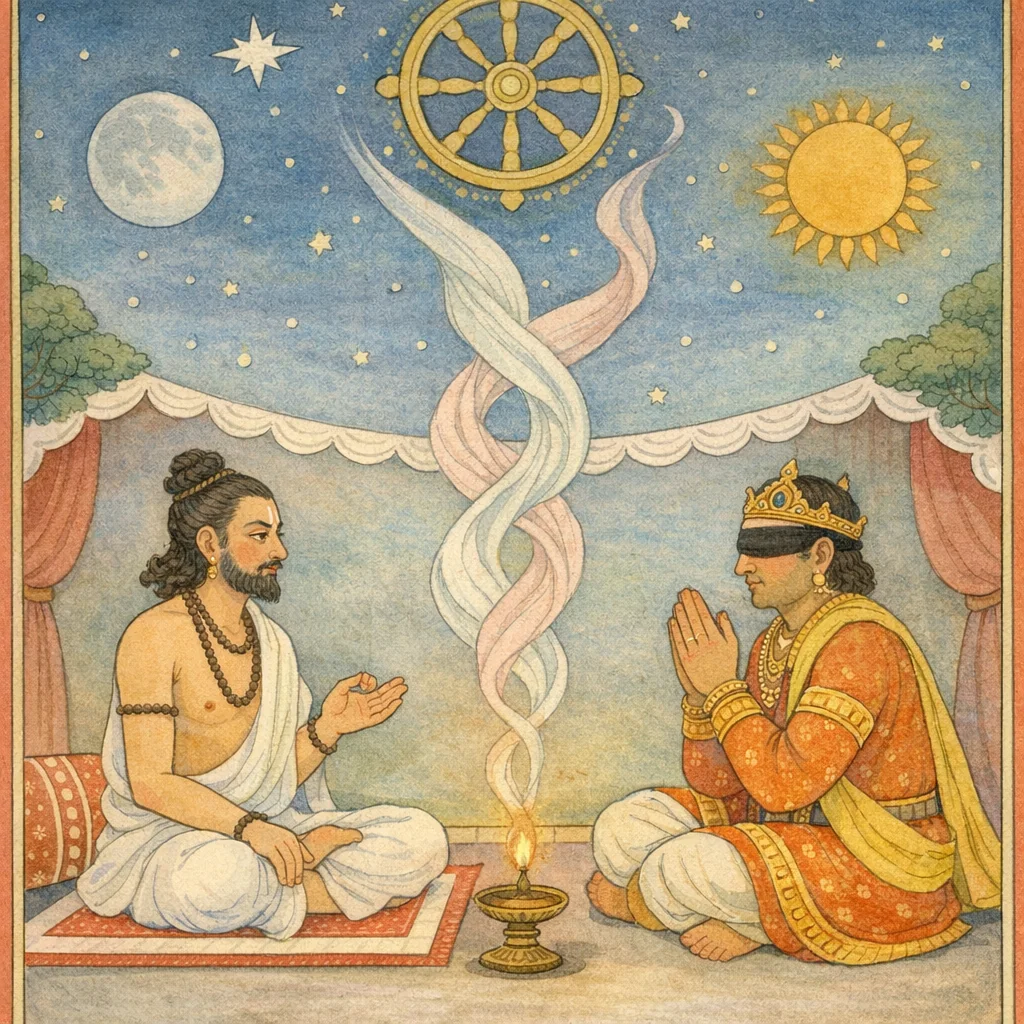
Sanatsujāta continues a compact theological-metaphysical exposition using layered cosmological and contemplative images. The chapter repeatedly asserts that yogins perceive the “Bhagavān, Sanātana” beyond sensory form, described as a great, radiant principle associated with the sun’s brilliance yet not reducible to visible phenomena. It presents origin-and-support motifs (brahman arising from the ‘śukra’ principle; directions, rivers, and oceans proceeding from it), and paradoxical fullness language (“from fullness, fullness is taken; fullness remains”), indicating non-diminishing plenitude. Several verses deny visual grasp (“no one sees it with the eye”), relocating knowledge to purified mind and heart, and link such insight to freedom from mortality. The discourse also employs symbolic sequences (prāṇa/apāna, moon/sun) to depict hierarchical absorption, and culminates in identity statements where the ultimate principle is declared as mother, father, son, and the self of all—an archival marker of non-dual framing within a courtly instruction context.
Chapter Arc: धृतराष्ट्र के भीतर भय और मोह की धुंध है; उसी अंधकार में सनत्सुजात परमात्म-स्वरूप का दीप जलाते हैं—वह ज्योति जो ‘शुक्र’ के मध्य तपती हुई भी अतप्त रहती है। → ऋषि-भाषा में ब्रह्माण्ड-व्यवस्था का उद्घाटन होता है: ब्रह्म का ‘शुक्र’ से प्रादुर्भाव, वायु-अग्नि-सोम-प्राण की उत्पत्ति और उसी में उनकी चेष्टा; सूर्य-चन्द्र-प्राण-अपान के परस्पर ‘गिरने’ (लय) का रहस्य—सब कुछ एक ही सनातन सत्ता में आवर्तित। → सनत्सुजात का निर्णायक प्रतिपादन: योगीजन उसी दिव्य, अजर, इन्द्रिय-मन-बुद्धि से परे भगवान को प्रत्यक्ष देखते हैं—वह ध्रुव-चक्र पर स्थित रथ-चक्र-सा अचल, केतुमान, सर्व-लोक-धारक है। → परमात्मा की सर्वव्यापकता और आत्म-ऐक्य का निष्कर्ष उभरता है: वही पितामह, पिता और पुत्र भी है; सब उसी में आत्मस्थ हैं—‘न मैं तुमसे भिन्न, न तुम मुझसे’—और वही सूक्ष्म से भी सूक्ष्म होकर समस्त भूतों में जाग्रत है।
Shlokas
Verse 1
ऑपन--माज बछ। डे षट्चत्वारिशो5 ध्याय: परमात्माके स्वरूपका वर्णन और योगीजनोंके द्वारा उनके साक्षात्कारका प्रतिपादन सनत्सुजात उवाच यत् तच्छुक्रे महज्ज्योतिर्दीप्यमानं महद् यशः । तद् वै देवा उपासते तस्मात् सूर्यो विराजते । योगिनस्तं प्रपश्यन्ति भगवन्तं सनातनम्,सनत्सुजातजी कहते हैं--राजन्! जो शुद्ध ब्रह्म है, वह महान् ज्योतिर्मय, देदीप्यमान एवं विशाल यशरूप है। सब देवता उसीकी उपासना करते हैं। उसीके प्रकाशसे सूर्य प्रकाशित होते हैं, उस सनातन भगवान्का योगीजन साक्षात्कार करते हैं
Sanatsujāta said: “O King, that pure Brahman is a vast, radiant Light—self-luminous and of great glory. The gods worship That alone; by Its splendor the sun itself shines forth. The yogins behold that eternal Lord directly.”
Verse 2
शुक्राद् ब्रह्म प्रभवति ब्रह्म शुक्रेण वर्धते । तच्छुक्रे ज्योतिषां मध्येडतप्तं तपति तापनम् | योगिनस्तं प्रपश्यन्ति भगवन्तं सनातनम्,शुद्ध सच्चिदानन्द परब्रह्मसे हिरण्यगर्भकी उत्पत्ति होती है तथा उसीसे वह वृद्धिको प्राप्त होता है। वह शुद्ध ज्योतिर्मय ब्रह्म ही सूर्यादि सम्पूर्ण ज्योतियोंके भीतर स्थित होकर सबको प्रकाशित कर रहा है और तपा रहा है; वह स्वयं सब प्रकारसे अतप्त और स्वयंप्रकाश है, उसी सनातन भगवानका योगीजन साक्षात्कार करते हैं
Sanatsujāta said: “From śukra (the generative seed) Brahman comes forth, and by that śukra Brahman is sustained and increases. Within that very seed, in the midst of all lights, there is the heat-giving Radiance that itself is unburnt—yet it causes all to shine and to be warmed. The yogins behold that eternal Lord directly: the self-luminous, ever-pure Reality that is the inner light of the sun and of every luminary.”
Verse 3
अपो5थ अद्भय: सलिलस्य मध्ये उभौ देवी शिश्रियातेडन्तरिक्षे अतन्द्रित: सवितुर्विवस्वा- नुभौ बिभर्ति पृथिवीं दिवं च | योगिनस्तं प्रपश्यन्ति भगवन्तं सनातनम्,जलकी भाँति एकरस परब्रह्म परमात्मामें स्थित पाँच सूक्ष्म महाभूतोंसे अत्यन्त स्थूल पांचभौतिक शरीरके हृदयाकाशमें दो देव--ईश्वर और जीव उसको आश्रय बनाकर रहते हैं। सबको उत्पन्न करनेवाला सर्वव्यापी परमात्मा सदैव जाग्रत् रहता है। वही इन दोनोंको तथा पृथ्वी और द्युलोकको भी धारण करता है। उस सनातन भगवान्का योगीजन साक्षात्कार करते हैं
Sanatsujāta said: “From the waters, and then from the elements, within the midst of the cosmic flood, two divine principles take refuge in the inner space. Ever unwearied, the radiant Sun—ever awake—upholds them both, and also sustains the earth and the heavenly world. Yogins behold that eternal Lord directly.”
Verse 4
उभौ च देवौ पृथिवीं दिवं च दिश: शुक्रो भुवनं बिभर्ति । तस्माद् दिश: सरितश्न स्रवन्ति तस्मात् समुद्रा विहिता महान्ता: । योगिनस्तं प्रपश्यन्ति भगवन्तं सनातनम्,उक्त दोनों देवताओंको, पृथ्वी और आकाशको, सम्पूर्ण दिशाओंको तथा समस्त लोकसमुदायको वह शुद्ध ब्रह्म ही धारण करता है। उसी परब्रह्मसे दिशाएँ प्रकट हुई हैं, उसीसे सरिताएँ प्रवाहित होती हैं तथा उसीसे बड़े-बड़े समुद्र प्रकट हुए हैं। उस सनातन भगवान्का योगीजन साक्षात्कार करते हैं
Sanatsujāta declares that the pure, radiant Brahman alone upholds both the divine powers, as well as earth and heaven, all directions, and the entire order of worlds. From that Supreme arise the directions; from that flow the rivers; from that are established the vast oceans. The yogins, through inner discipline and insight, directly behold that eternal Lord. The teaching places the source of cosmic order in the one imperishable Reality, urging a life of spiritual discernment rather than pride in power or attachment to transient outcomes.
Verse 5
चक्रे रथस्य तिष्ठन्तो<5ध्रुवस्याव्ययकर्मण: । केतुमन्तं वहन्त्यश्वास्तं दिव्यमजरं दिवि । योगिनस्तं प्रपश्यन्ति भगवन्तं सनातनम्,जो इन्द्रिय, मन और बुद्धि आदिका संघात--शरीर विनाशशील है, जिसके कर्म अपने-आप नष्ट होनेवाले नहीं हैं, ऐसे इस शरीररूप रथके चक्रकी भाँति इसे घुमानेवाले कर्मसंस्कारसे युक्त मनमें जुते हुए इन्द्रियरूप घोड़े उस हृदयाकाशमें स्थित ज्ञानस्वरूप दिव्य अविनाशी जीवात्माको जिस सनातन परमेश्वरके निकट ले जाते हैं, उस सनातन भगवान्का योगीजन साक्षात्कार करते हैं?
Sanatsujāta said: As the wheel of a chariot turns while its axle remains steady, so the senses—like horses yoked to the mind—carry the bannered chariot onward, while the imperishable agent of action remains unmoved. That divine, undecaying One, abiding in the heavenly realm, is beheld directly by yogins as the eternal Lord. The teaching points to inner discipline: when the mind and senses are rightly harnessed, one comes to the vision of the timeless Reality beyond the perishing body and its motions.
Verse 6
न सादृश्ये तिक्ठतति रूपमस्य न चक्षुषा पश्यति कश्रिदेनम् मनीषयाथो मनसा ह॒दा च य एन॑ विदुरमृतास्ते भवन्ति । योगिनस्तं प्रपश्यन्ति भगवन्तं सनातनम्,उस परमात्माका स्वरूप किसी दूसरेकी तुलनामें नहीं आ सकता; उसे कोई चर्मचक्षुओंसे नहीं देख सकता। जो निश्चयात्मिका बुद्धिसे, मनसे और हृदयसे उसे जान लेते हैं, वे अमर हो जाते हैं अर्थात् परमात्माको प्राप्त हो जाते हैं। उस सनातन भगवानका योगीजन साक्षात्कार करते हैं:
Sanatsujāta said: His true form does not stand within the range of comparison; no one sees Him with the bodily eye. But those who know Him through discerning intelligence, through the mind’s inward steadiness, and through the heart’s deepest awareness become deathless—meaning they attain the Supreme Self. The yogins directly behold that eternal Lord in inner realization.
Verse 7
द्वादशपूगां सरितं पिबन्तो देवरक्षिताम् । मध्वीक्षन्तश्न ते तस्या: संचरन्तीह घोराम् । योगिनस्तं प्रपश्यन्ति भगवन्तं सनातनम्,जो दस इन्द्रियाँ, मन और बुद्धि--इन बारहके समुदायसे युक्त है तथा जो परमात्मासे सुरक्षित है, उस संसाररूप भयंकर नदीके विषयरूप मधुर जलको देखने और पीनेवाले लोग उसीमें गोता लगाते रहते हैं। इससे मुक्त करनेवाले उस सनातन परमात्माका योगीजन साक्षात्कार करते हैं
Sanatsujāta said: Those who, bound to the twelvefold aggregate—sense-organs, mind, and intellect—drink from the river of worldly existence, guarded by the Divine, keep moving within that dreadful stream, merely beholding its objects as if they were sweet like honey. But yogins behold that eternal Lord—the one who can deliver beings from this current—directly.
Verse 8
तदर्धमासं पिबति संचित्य भ्रमरो मधु । ईशान: सर्वभूतेषु हविर्भूतमकल्पयत् । योगिनस्तं प्रपश्यन्ति भगवन्तं सनातनम्,जैसे शहदकी मक्खी आधे मासतक शहदका संग्रह करके फिर आधे मासतक उसे पीती रहती है, उसी प्रकार यह भ्रमणशील संसारी जीव इस जन्ममें किये हुए संचित कर्मको परलोकमें (विभिन्न योनियोंमें) भोगता है। परमात्माने समस्त प्राणियोंके लिये उनके कर्मानुसार कर्मफलभोगरूप हविकी अर्थात् समस्त भोग-पदार्थोंकी व्यवस्था कर रखी है। उस सनातन भगवान्का योगीलोग साक्षात्कार करते हैं
Sanatsujāta said: “Just as a bee gathers honey and then, for half a month, lives by drinking what it has stored, so too the wandering embodied being experiences in the hereafter the accumulated results of actions performed in this life, tasting them through various births. The Supreme Lord, ruler within all beings, has ordained for creatures the ‘oblation’ that becomes their experience—namely, the array of enjoyments and sufferings that arise as the fruition of their deeds. That eternal Blessed Lord is directly beheld by yogins.”
Verse 9
हिरण्यपर्णम श्वत्थमभिपद्य हापक्षका: । ते तत्र पक्षिणो भूत्वा प्रपतन्ति यथा दिशम् | योगिनस्तं प्रपश्यन्ति भगवन्तं सनातनम्,जिसके विषयरूपी पत्ते स्वर्णके समान मनोरम दिखायी पड़ते हैं, उस संसाररूपी अश्वत्थवृक्षपर आरूढ़ होकर पंखहीन जीव कर्मरूपी पंख धारणकर अपनी वासनाके अनुसार विभिन्न योनियोंमें पड़ते हैं अर्थात् एक योनिसे दूसरी योनिमें गमन करते हैं; किंतु योगीजन उस सनातन परमात्माका साक्षात्कार करते हैं
Sanatsujāta said: Having mounted the aśvattha-tree of worldly existence, whose leaves—objects of sense—seem as alluring as gold, beings who are in themselves wingless take on the “wings” of action and, driven by their own latent desires, fall and fly in whatever direction—passing from one birth to another. But the yogins behold there the Blessed One, the eternal Lord, as He truly is.
Verse 10
पूर्णात् पूर्णान्युद्धरन्ति पूर्णात् पूर्णानि चक्रिरे । हरन्ति पूर्णात् पूर्णानि पूर्णमेवावशिष्यते । योगिनस्तं प्रपश्यन्ति भगवन्तं सनातनम्,पूर्ण परमेश्वरसे पूर्ण--चराचर प्राणी उत्पन्न होते हैं, पूर्ण सत्ता-स्फूर्ति पाकर ही वे पूर्ण प्राणी चेष्टा करते हैं, फिर पूर्णसे ही पूर्णब्रह्ममें उनका उपसंहार (विलय) होता है तथा अन्तमें एकमात्र पूर्णब्रह्म ही शेष रह जाता है। उस सनातन परमात्माका योगीलोग साक्षात्कार करते हैं
Sanatsujāta said: From the Whole, wholes arise; from the Whole, wholes are fashioned. Into the Whole, these wholes are again withdrawn; and in the end, the Whole alone remains. That eternal, blessed Lord—the timeless Reality—yogins behold directly.
Verse 12
उस पूर्णब्रह्मसे ही वायुका आविर्भाव हुआ है और उसीमें वह चेष्टा करता है। उसीसे अग्नि और सोमकी उत्पत्ति हुई है तथा उसीमें यह प्राण विस्तृत हुआ है ।। सर्वमेव ततो विद्यात् तत् तद् वक्तुं न शक्नुम: । योगिनस्तं प्रपश्यन्ति भगवन्तं सनातनम्,कहाँतक गिनावें, हम अलग-अलग वस्तुओंका नाम बतानेमें असमर्थ हैं। तुम इतना ही समझो कि सब कुछ उस परमात्मासे ही प्रकट हुआ है। उस सनातन भगवानका योगीलोग साक्षात्कार करते हैं
From that all-complete Brahman, the wind itself has manifested, and within that very Reality it moves and acts. From that same source arise fire and Soma, and in that same Reality the life-breath spreads through all beings. Therefore know that everything comes from That alone; we are unable to enumerate it by naming each separate thing. Understand simply this: all that exists is an emergence from the Supreme Self, the eternal Lord—whom the yogins directly behold in realization.
Verse 13
अपानं गिरति प्राण: प्राणं गिरति चन्द्रमा: । आदित्यो गिरते चन्द्रमादित्यं गिरते पर: । योगिनस्तं प्रपश्यन्ति भगवन्तं सनातनम्,अपानको प्राण अपनेमें विलीन कर लेता है, प्राणको चन्द्रमा, चन्द्रमाको सूर्य और सूर्यको परमात्मा अपनेमें विलीन कर लेता है; उस सनातन परमेश्वरका योगीलोग साक्षात्कार करते हैं
Sanatsujāta said: “The apāna is absorbed into prāṇa; prāṇa is absorbed into the Moon; the Moon is absorbed into the Sun; and the Sun is absorbed into the Supreme. Yogins directly behold that eternal Lord—the final ground into which all these powers are gathered.”
Verse 14
एकं पाद॑ं नोत्क्षिपति सलिलाद्धंस उच्चरन् । त॑ं चेत् संततमूर्थ्वाय न मृत्युर्नामृतं भवेत् । योगिनस्तं प्रपश्यन्ति भगवन्तं सनातनम्,इस संसार-सलिलसे ऊपर उठा हुआ हंसरूप परमात्मा अपने एक पाद (जगत्)-को ऊपर नहीं उठा रहा है; यदि उसे भी वह ऊपर उठा ले तो सबका बन्ध और मोक्ष सदाके लिये मिट जाय। उस सनातन परमेश्वरका योगीजन साक्षात्कार करते हैं
Sanatsujāta said: “A swan, moving upon the waters, does not lift up one of its feet from the flood. If it were to raise that foot as well—lifting it wholly and forever upward—then neither death nor deathlessness would remain. The yogins behold that eternal Lord: the Supreme, swan-like Reality who stands above the waters of worldly existence.”
Verse 15
अड्गुष्ठमात्र: पुरुषो$न्तरात्मा लिड्रस्य योगेन स याति नित्यम् | तमीशमीड्यमनुकल्पमाद्यं पश्यन्ति मूढा न विराजमानम् | योगिनस्तं प्रपश्यन्ति भगवन्तं सनातनम्,हृदयदेशमें स्थित वह अंगुष्ठमात्र जीवात्मा सूक्ष्म (वहीं अन्तर्यामीरूपसे स्थित) शरीरके सम्बन्धसे सदा जन्म-मरणको प्राप्त होता है। उस सबके शासक, स्तुतिके योग्य, सर्वसमर्थ, सबके आदिकारण एवं सर्वत्र विराज-मान परमात्माको मूढ़ जीव नहीं देख पाते; किंतु योगीजन उस सनातन परमेश्वरका साक्षात्कार करते हैं
Sanatsujāta says: Within the body there is the inner Self, the person “of the measure of a thumb.” Bound by association with the subtle body (liṅga-śarīra), it continually undergoes transmigration. Yet the Supreme Lord—ruler of all, worthy of praise, the primordial cause and all-capable—though present everywhere in His own radiance, is not perceived by the deluded. The disciplined yogins, however, truly behold that eternal, blessed Lord.
Verse 16
असाधना वापि ससाधना वा समानमेतद् दृश्यते मानुषेषु । समानमेतदमृतस्येतरस्य मुक्तास्तत्र मध्व उत्सं समापु: । योगिनस्तं प्रपश्यन्ति भगवन्तं सनातनम्,कोई साधनसम्पन्न हों या साधनहीन, वह ब्रह्म सब मनुष्योंमें समानरूपसे देखा जाता है। वह (अपनी ओरसे) बद्ध और मुक्त दोनोंके ही लिये समान है। अन्तर इतना ही है कि इन दोनोंमेंसे जो मुक्त पुरुष हैं, वे ही आनन्दके मूलस्रोत परमात्माको प्राप्त होते हैं (दूसरे नहीं) उसी सनातन भगवान्का योगीलोग साक्षात्कार करते हैं
Whether one is without spiritual discipline or endowed with it, that Supreme Reality is seen as the same in all human beings. From its own side it is equally present for both the bound and the liberated; the difference is only this: the liberated alone attain that fountainhead of bliss, the immortal Lord. It is that eternal Bhagavān whom the yogins directly behold.
Verse 17
उभौ लोकौ विद्यया व्याप्य याति तदा हुतं चाहुतमग्निहोत्रम् । मा ते ब्राह्मी लघुतामादधीत प्रज्ञानं स्यान्नाम धीरा लभन्ते | योगिनस्तं प्रपश्यन्ति भगवन्तं सनातनम्,ज्ञानी पुरुष ब्रह्मविद्याके द्वारा इस लोक और परलोक दोनोंके तत्त्वको जानकर ब्रह्मभावको प्राप्त होता है। उस समय उसके द्वारा यदि अग्निहोत्र आदि कर्म न भी हुए हों तो भी वे पूर्ण हुए समझे जाते हैं। राजन! यह ब्रह्मविद्या तुममें लघुता न आने दे तथा इसके द्वारा तुम्हें वह ब्रह्मज्ञान प्राप्त हो, जिसे धीर पुरुष ही प्राप्त करते हैं। उसी ब्रह्मविद्याके द्वारा योगीलोग उस सनातन परमात्माका साक्षात्कार करते हैं
Sanatsujāta says: “By knowledge one pervades and attains both worlds. Then even the offerings made and not made—such as the Agnihotra—are regarded as fulfilled. O King, may this Brahmic wisdom not become something you treat lightly; through it may you gain that true knowing which only the steadfast attain. By that very Brahma-knowledge, yogins behold the Blessed, eternal Lord.”
Verse 18
एवंरूपो महात्मा स पावकं पुरुषो गिरन् । यो वैत॑ पुरुष वेद तस्येहार्थो न रिष्यते । योगिनस्तं प्रपश्यन्ति भगवन्तं सनातनम्,जो ऐसा महात्मा पुरुष है, वह भोक्ताभावको अपनेमें विलीन करके उस पूर्ण परमेश्वरको जान लेता है। इस लोकमें उसका प्रयोजन नष्ट नहीं होता [अर्थात् वह कृतकृत्य हो जाता है|| उस सनातन परमात्माका योगीलोग साक्षात्कार करते हैं
Sanatsujāta said: “Such a great-souled person, as it were ‘swallowing’ the fire (of consuming experience) into himself, comes to know that Supreme Person. For one who truly knows that Person, his purpose in this world is not ruined—he becomes fulfilled and complete in what is to be done. The yogins directly behold that eternal, blessed Lord.”
Verse 19
यः सहस््र॑ं सहस्राणां पक्षान् संतत्य सम्पतेत् । मध्यमे मध्य आगच्छेदपि चेत् स्यान्मनोजव: । योगिनस्तं प्रपश्यन्ति भगवन्तं सनातनम्,कोई मनके समान वेगवाला ही क्यों न हो और दस लाख भी पंख लगाकर क्यों न उड़े, अन्तमें उसे हृदयस्थित परमात्मामें ही आना पड़ेगा। उस सनातन परमात्माका योगीजन साक्षात्कार करते हैं
Even if someone were to attach thousands upon thousands of wings and fly with the speed of the mind, he would still, in the end, arrive at the very center—returning to the Lord who abides within the heart. That eternal, divine Reality is directly beheld by yogins. The teaching underscores the futility of outward escape and the inevitability of turning inward to the indwelling Self as the final refuge and goal.
Verse 20
न दर्शने तिष्ठति रूपमस्य पश्यन्ति चैनं सुविशुद्धसत्त्वा: । हितो मनीषी मनसा न तप्यते ये प्रत्रजेयुरमृतास्ते भवन्ति । योगिनस्तं प्रपश्यन्ति भगवन्तं सनातनम्,इस परमात्माका स्वरूप सबके प्रत्यक्ष नहीं होता; जिनका अन्त:ःकरण विशुद्ध है, वे ही इसे देख पाते हैं। जो सबके हितैषी और मनको वशगमें करनेवाले हैं तथा जिनके मनमें कभी दुःख नहीं होता एवं जो संसारके सब सम्बन्धोंका सर्वथा त्याग कर देते हैं, वे मुक्त हो जाते हैं। उस सनातन परमात्माका योगीलोग साक्षात्कार करते हैं
Sanatsujāta teaches that the Supreme’s true form is not laid bare to ordinary sight. Only those whose inner being is wholly purified can behold Him. The wise, devoted to the welfare of all and master of the mind, is not scorched by inward grief; and those who utterly renounce worldly ties attain deathlessness. It is that eternal Lord whom the yogins directly realize.
Verse 21
गूहन्ति सर्पा इव गद्धराणि स्वशिक्षया स्वेन वृत्तेन मर्त्या: । तेषु प्रमुहान्ति जना विमूढा यथाध्वानं मोहयन्ते भयाय । योगिनस्तं प्रपश्यन्ति भगवन्तं सनातनम्,जैसे साँप बिलोंका आश्रय ले अपनेको छिपाये रहते हैं, उसी प्रकार दम्भी मनुष्य अपनी शिक्षा और व्यवहारकी आड़में अपने दोषोंको छिपाये रखते हैं। जैसे ठग रास्ता चलनेवालोंको भयमें डालनेके लिये दूसरा रास्ता बतलाकर मोहित कर देते हैं, मूर्ख मनुष्य उनपर विश्वास करके अत्यन्त मोहमें पड़ जाते हैं; इसी प्रकार जो परमात्माके मार्ममें चलनेवाले हैं, उन्हें भी दम्भी पुरुष भयमें डालनेके लिये मोहित करनेकी चेष्टा करते हैं, किंतु योगीजन भगवत्कृपासे उनके फंदेमें न आकर उस सनातन परमात्माका ही साक्षात्कार करते हैं
Sanatsujāta said: “As serpents hide themselves in their holes, so do deceitful mortals conceal their faults behind the cover of their learning and outward conduct. Deluded people are bewildered by them, just as highway-robbers mislead travelers by pointing out a false route in order to frighten and ensnare them. In the same way, pretenders try to confuse and intimidate even those who are moving on the inner path toward the Supreme; but true yogins, not falling into such snares, behold that eternal Lord Himself.”
Verse 22
नाहं सदासत्कृत:ः स्यां न मृत्यु- न चामृत्युरमृतं मे कुतः स्यात् । सत्यानृते सत्यसमानबन्धे सतश्नष योनिरसतश्नैक एव । योगिनस्तं प्रपश्यन्ति भगवन्तं सनातनम्,राजन! मैं कभी किसीके असत्कारका पात्र नहीं होता। न मेरी मृत्यु होती है न जन्म, फिर मोक्ष किसका और कैसे हो [क्योंकि मैं नित्यमुक्त ब्रह्म हूँ]। सत्य और असत्य सब कुछ मुझ सनातन समत्रह्ममें स्थित हैं। एकमात्र मैं ही सत् और असतूकी उत्पत्तिका स्थान हूँ। मेरे स्वरूपभूत उस सनातन परमात्माका योगीजन साक्षात्कार करते हैं
Sanatsujāta says: “I am never subject to honor or dishonor. For me there is neither death nor birth; so how could liberation be ‘mine,’ and from what would it be gained? Truth and untruth—bound together as though equal—rest in me, the eternal Brahman. I alone am the single source from which both the real and the unreal arise. Yogins behold that everlasting, divine Lord directly.”
Verse 23
न साधुना नोत असाधुना वा- समानमेतद् दृश्यते मानुषेषु । समानमेतदमृतस्य विद्या- देवंयुक्तो मधु तद् वै परीप्सेत् । योगिनस्तं प्रपश्यन्ति भगवन्तं सनातनम्,परमात्माका न तो साधुकर्मसे सम्बन्ध है और न असाधुकर्मसे। यह विषमता तो देहाभिमानी मनुष्योंमें ही देखी जाती है। ब्रह्मका स्वरूप सर्वत्र समान ही समझना चाहिये। इस प्रकार ज्ञानयोगसे युक्त होकर आनन्दमय ब्रह्मको ही पानेकी इच्छा करनी चाहिये। उस सनातन परमात्माका योगीलोग साक्षात्कार करते हैं
Sanatsujāta said: “In human beings, one does not truly see this Reality as different in the ‘good’ or in the ‘bad’; such inequality is perceived only among those who identify with the body. Know the nature of the Immortal to be the same everywhere. Therefore, endowed with the discipline of knowledge and yoga, one should seek that blissful Brahman alone. The yogins behold that eternal Lord—the ancient, supreme Self—directly.”
Verse 24
नास्यातिवादा हृदयं तापयन्ति नानधीत॑ नाहुतमग्निहोत्रम् । मनो ब्राह्मी लघुतामादधीत प्रज्ञां चास्मै नाम धीरा लभन्ते । योगिनस्तं प्रपश्यन्ति भगवन्तं सनातनम्,इस ब्रह्मवेत्ता पुरुषके हृदयको निन्दाके वाक्य संतप्त नहीं करते। “मैंने स्वाध्याय नहीं किया, अग्निहोत्र नहीं किया” इत्यादि बातें भी उसके मनमें तुच्छ भाव नहीं उत्पन्न करतीं। ब्रह्मविद्या शीघ्र ही उसे वह स्थिरबुद्धि प्रदान करती है, जिसे धीर पुरुष ही प्राप्त करते हैं। उस सनातन परमात्माका योगीजन साक्षात्कार करते हैं
Sanatsujāta said: For the knower of Brahman, harsh words and excessive blame do not scorch the heart. Nor do thoughts such as, “I have not studied,” or “I have not offered the Agnihotra,” produce a sense of smallness in his mind. The Brahman-oriented mind lays aside pettiness, and he attains that steady wisdom which only the truly steadfast gain. The yogins behold that eternal Lord directly.
Verse 25
एवं य: सर्वभूतेषु आत्मानमनुपश्यति । अन्यत्रान्यत्र युक्तेषु किं स शोचेत् तत: परम्
Sanatsujāta says: One who truly perceives the Self in all beings—though those beings appear variously engaged in different conditions and attachments—what could such a person grieve for any longer? Having seen the underlying unity, sorrow finds no further ground.
Verse 26
इस प्रकार जो समस्त भूतोंमें परमात्माको निरन्तर देखता है, वह ऐसी दृष्टि प्राप्त होनेके अनन्तर अन्यान्य विषयभोगोंमें आसक्त मनुष्योंके लिये क्या शोक करे? ।। यथोदपाने महति सर्वतः सम्प्लुतोदके । एवं सर्वेषु वेदेषु आत्मानमनुजानत:
One who continually beholds the Supreme Self in all beings—after attaining such vision—what cause has he to grieve for people whose minds cling to the enjoyment of passing objects? Just as a small well becomes of little consequence when there is a vast expanse of water flooding everywhere, so too, for one who truly recognizes the Self, the many teachings of the Vedas are, in a sense, already encompassed and fulfilled.
Verse 27
जैसे सब ओर जलसे परिपूर्ण बड़े जलाशयके प्राप्त होनेपर जलके लिये अन्यत्र जानेकी आवश्यकता नहीं होती, उसी प्रकार आत्मज्ञानीके लिये सम्पूर्ण वेदोंमें कुछ भी प्राप्त करनेयोग्य शेष नहीं रह जाता ।। अड्गुष्ठमात्र: पुरुषो महात्मा न दृश्यते सौहृदि संनिविष्ट: । अजक्षरो दिवारात्रमतन्।द्रितश्न सतं मत्वा कविरास्ते प्रसन्न:,यह अंगुष्ठमात्र अन्तर्यामी परमात्मा सबके हृदयके भीतर स्थित है, किंतु सबको दिखायी नहीं देता। वह अजन्मा, चराचरस्वरूप और दिन-रात सावधान रहनेवाला है। जो उसे जान लेता है, वह ज्ञानी परमानन्दमें निमग्न हो जाता है
Just as, on reaching a great reservoir filled with water on every side, one has no need to go elsewhere in search of water, so too for the knower of the Self there remains nothing further to be gained from all the Vedas. The great Self, the Person of the measure of a thumb, abides within the heart, yet is not seen by all. Unborn and imperishable, ever wakeful through day and night, He truly is; knowing Him as the Real, the wise one rests in serene joy.
Verse 28
अहमेव स्मृतो माता पिता पुत्रो5स्म्यहं पुन: । आत्माहमपि सर्वस्य यच्च नास्ति यदस्ति च,धृतराष्ट्र! मैं ही सबकी माता और पिता माना गया हूँ, मैं ही पुत्र हूँ और सबका आत्मा भी मैं ही हूँ। जो है, वह भी और जो नहीं है, वह भी मैं ही हूँ
Sanatsujāta declares the all-pervading Self: “I alone am remembered as mother and father; again, I am the son. I am also the very Self of all beings. O Dhṛtarāṣṭra, whatever exists and whatever does not exist—both are within Me.”
Verse 29
पितामहो5स्मि स्थविर: पिता पुत्रश्न भारत । ममैव यूयामात्मस्था न मे यूयं न वो वयम्,भारत! मैं ही तुम्हारा बूढ़ा पितामह, पिता और पुत्र भी हूँ। तुम सब लोग मेरी ही आत्मामें स्थित हो, फिर भी (वास्तवमें) न तुम हमारे हो और न हम तुम्हारे हैं
Sanatsujāta said: “O Bhārata, I am your aged grandsire, your father, and your son as well. All of you abide within my very Self; yet, in the ultimate truth, you are not ‘mine,’ nor am I ‘yours.’”
Verse 30
आत्मैव स्थानं मम जन्म चात्मा ओतप्रोतो5हमजरप्रतिष्ठ: । अजकश्षरो दिवारात्रमतन्द्रितो 5हं मां विज्ञाय कविरास्ते प्रसन्न:,आत्मा ही मेरा स्थान है और आत्मा ही मेरा जन्म (उद्गम) है। मैं सबमें ओतप्रोत और अपनी अजर ([नित्य-नूतन) महिमामें स्थित हूँ। मैं अजन्मा, चराचर-स्वरूप तथा दिन-रात सावधान रहनेवाला हूँ। मुझे जानकर ज्ञानी पुरुष परम प्रसन्न हो जाता है
Sanatsujāta declares the Self as the ultimate ground: “The Self alone is my abode, and the Self alone is my origin. I pervade all beings, interwoven through them, yet I stand established in an unaging, ever-fresh majesty. Unborn, present as the moving and the unmoving, and ever wakeful through day and night—knowing me thus, the wise seer abides in deep serenity.”
Verse 31
अणोरणीयान् सुमना: सर्वभूतेषु जाग्रति । पितरं सर्वभूतेषु पुष्करे निहितं विदु:,परमात्मा सूक्ष्मसे भी सूक्ष्म तथा विशुद्ध मनवाला है। वही सब भूतोंमें अन्तर्यामीरूपसे प्रकाशित है। सम्पूर्ण प्राणियोंके हृदयकमलमें स्थित उस परमपिताको ज्ञानी पुरुष ही जानते हैं
The Supreme Self is subtler than the subtlest, with a mind pure and clear. He is awake within all beings as the Inner Ruler (antaryāmin), shining from within. Only the wise know that Supreme Father who dwells in the lotus of the heart of every creature.
Verse 46
इति श्रीमहाभारते उद्योगपर्वणि सनत्सुजातपर्वणि षट्चत्वारिंशो 5 ध्याय:,इस प्रकार श्रीमह्याभारत उद्योगपर्वके अन्तर्गत सनत्युजातपर्वमें छियालीसवाँ अध्याय पूरा हुआ
Thus, in the Śrī Mahābhārata, within the Udyoga Parva, in the section known as the Sanatsujāta Parva, the forty-sixth chapter concludes.
Verse 131
तस्माद् वै वायुरायातस्तस्मिंश्व॒ प्रयतः सदा । तस्मादन्निश्व सोमश्न तस्मिंक्ष॒ प्राण आतत:ः
Therefore the Wind has arisen from That; and in That it ever remains disciplined and restrained. From That also arise Fire and Soma; and in That the vital breath (prāṇa) is spread out and sustained.
Frequently Asked Questions
The dilemma is whether one relies on sensory certainty and fear-conditioned inference, or cultivates inner knowledge (mind-heart discernment) that dissolves fear and stabilizes ethical decision-making.
The refrain indicates that the ultimate principle is not an object of ordinary perception; it is realized through purified consciousness, and that realization is presented as the basis for fearlessness and continuity beyond death.
Yes in functional form: the chapter repeatedly links correct knowing to amṛtatva—those who know or take refuge in that principle are described as becoming ‘amṛta’ (not bound by mortality), framing comprehension as soteriologically consequential.