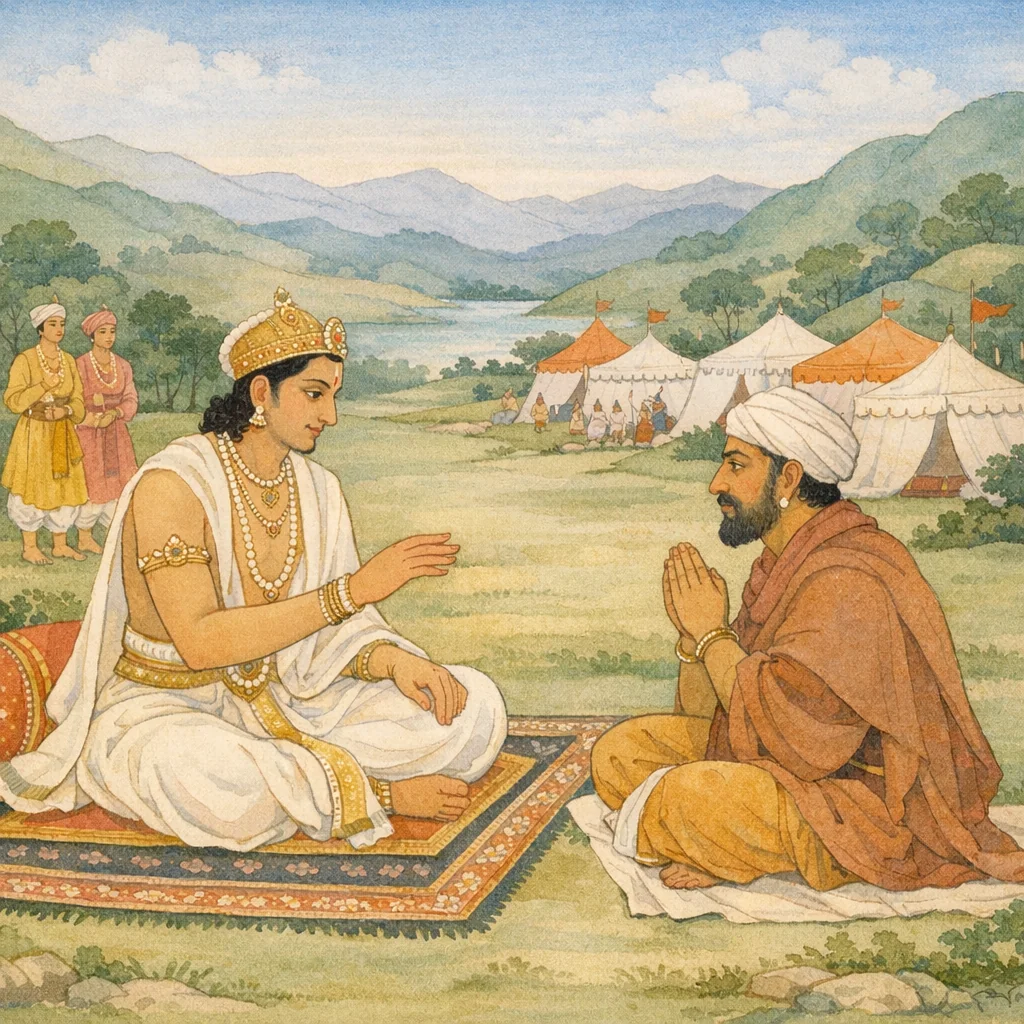
Adhyaya 30
Udyoga-parva Adhyāya 30: Sañjaya’s Departure and Yudhiṣṭhira’s Commission of Greetings
Upa-parva: Sanjaya–Yudhishthira Saṃvāda (Envoy’s Leave-taking and Courteous Commissioning)
The chapter opens with Sañjaya requesting leave from the Pāṇḍavas, offering auspicious wishes and asking whether any harsh or harmful word might have been spoken under emotional strain. Yudhiṣṭhira grants permission, explicitly attesting to Sañjaya’s purity of intent and reliability as an āpta-dūta (trusted envoy), and commends his truthful speech and self-control. Yudhiṣṭhira then issues a detailed diplomatic commission: Sañjaya is to convey respectful salutations and inquire after the welfare (kuśala/anāmaya) of Brahmins, ascetics, royal preceptors and officiants, martial elders (including Bhīṣma), and key court figures (including Duryodhana, Duḥśāsana, Śakuni, Karṇa, Vidura), as well as allied kings assembled for conflict. The instructions extend to women of the household, daughters-in-law, unmarried girls, and also to dependents and vulnerable groups (servants, the disabled, the elderly, and those without protection), emphasizing a welfare-oriented ethical posture. The chapter concludes with a firm message to be delivered to Duryodhana: the desire that disturbs him admits no easy settlement; he must either grant a rightful share (symbolically framed) or accept the consequences of armed contest—presented as a constrained binary arising from failed accommodation.
Chapter Arc: युधिष्ठिर संजय से कहते हैं कि विधाता—पूर्वकर्मों के अनुसार—बालक को पाण्डित्य और पण्डित को बालता तक दे देता है; इसलिए मनुष्य का बल, बुद्धि और भाग्य सब एक ही नियन्ता के अधीन हैं। → वे संजय को दूत-धर्म का सूक्ष्म आदेश देते हैं: यदि दुर्योधन या धृतराष्ट्र उनके बल और सेना का समाचार पूछें तो यथातथ्य कहकर भी ऐसा कहो कि सत्य से हटे बिना शान्ति का द्वार खुला रहे। साथ ही वे स्मरण कराते हैं कि पाण्डवों ने पूर्वापर क्लेश सहकर भी संयम रखा—यह बात समस्त कुरु जानते हैं। → युधिष्ठिर का निर्णायक संदेश उभरता है: ‘राजन! शान्ति और परस्पर प्रीति बनी रहे—हम शम चाहते हैं; राज्य का एक देश (एक अंश) भी हमें दे दो।’ यह न्यूनतम मांग युद्ध-टालने की अंतिम रेखा बन जाती है। → वे भीष्म आदि वयोवृद्धों को प्रणाम-सहित स्मरण करने और धृतराष्ट्र से यह कहने को कहते हैं कि उनके प्रसाद से ही ‘बाल’ पाण्डवों को राज्य मिला था—अब उन्हें राज्य में स्थापित कर विनाश की ओर जाते हुए उपेक्षित न किया जाए। युधिष्ठिर स्पष्ट करते हैं कि वे शान्ति में भी समर्थ हैं और युद्ध में भी—धर्मार्थ के लिए मृदु और दारुण दोनों रूप धारण कर सकते हैं। → संजय के इस संदेश को लेकर हस्तिनापुर में धृतराष्ट्र-दुर्योधन की प्रतिक्रिया क्या होगी—शान्ति का अंश मिलेगा या युद्ध का निश्चय?
Shlokas
Verse 1
युधिष्ठिर बोले--संजय! साधु-असाधु, बालक-वृद्ध तथा निर्बल एवं बलिष्ठ--सबको विधाता अपने वशमें रखता है
Yudhiṣṭhira said: “Sañjaya, the Ordainer holds all within His control—whether virtuous or wicked, child or aged, weak or mighty.”
Verse 2
उत बालाय पाण्डित्यं पण्डितायोत बालताम् | ददाति सर्वमीशान: पुरस्ताच्छुक्रमुच्चरन्,वही सबका नियन्ता है और प्राणियोंके पूर्वजन्मके कर्मोंके अनुसार उन्हें सब प्रकारका फल देता है। वही मूर्खको विद्वान् और विद्वानको मूर्ख बना देता है
Yudhiṣṭhira said: “The Lord, the supreme Ruler, bestows everything. Proclaiming the ancient, luminous ordinance, He can grant learning to a childlike person and, likewise, childishness to one who is learned. In accordance with beings’ prior deeds, He dispenses every kind of result.”
Verse 3
बल॑ जिज्ञासमानस्य आचक्षीथा यथातथम् | अथ मन्त्र मन्त्रयित्वा याथातथ्येन हृष्टवत्,दुर्योधन अथवा धृतराष्ट्र यदि मेरे बल और सेनाका समाचार पूछें तो तुम उन्हें सब ठीक-ठीक बता देना। जिससे वे प्रसन्न होकर आपसमें सलाह करके यथार्थरूपसे अपने कर्तव्यका निश्चय कर सकें
Yudhiṣṭhira said: “If Duryodhana or Dhṛtarāṣṭra asks about my strength and my army, tell them everything exactly as it is, truthfully—so that, pleased, they may confer among themselves and rightly determine their course of duty.”
Verse 4
गावल्गणे कुरून् गत्वा धृतराष्ट्रं महाबलम् | अभिवाद्योपसंगृहा[ ततः पृच्छेरनामयम्,संजय! तुम कुरुदेशमें जाकर मेरी ओरसे महाबली धूृतराष्ट्रको प्रणाम करके उनके दोनों पैर पकड़ लेना और उनसे स्वास्थ्यका समाचार पूछना
Yudhiṣṭhira said: “O Gāvalgaṇa (Sañjaya), go to the land of the Kurus. Having approached the mighty Dhṛtarāṣṭra, offer him respectful salutations, clasping his feet in humility, and then inquire after his well-being. Let my reverence be conveyed through you.”
Verse 5
ब्रूयाश्वैनं त्वमासीनं कुरुभि: परिवारितम् | तवैव राजन् वीर्येण सुखं जीवन्ति पाण्डवा:,तत्पश्चात् कौरवोंसे घिरकर बैठे हुए इन महाराज धुृतराष्ट्रसे कहना--'राजन्! पाण्डवलोग आपकी ही सामर्थ्यसे सुखपूर्वक जीवन बिता रहे हैं
Yudhiṣṭhira said: “Tell him—while he sits surrounded by the Kurus—‘O King, it is by your very power and protection that the Pāṇḍavas live in comfort.’”
Verse 6
तव प्रसादाद् बालास्ते प्राप्ता राज्यमरिंदम । राज्ये तान् स्थापयित्वाग्रे नोपेक्षस्व विनश्यत:
O subduer of foes, by your gracious favor your young sons have obtained the kingdom. Having first firmly established them in the sovereignty, do not neglect them—lest they come to ruin.
Verse 7
'शत्रुदमन नरेश! जब वे बालक थे, तब आपकी ही कृपासे उन्हें राज्य मिला था। पहले उन्हें राज्यपर बिठाकर अब अपने ही आगे उन्हें नष्ट होते देख उपेक्षा न कीजिये” ।। सर्वमप्येतदेकस्य नालं संजय कस्यचित् | तात संहत्य जीवामो द्विषतां मा वशं गम:,संजय! उन्हें यह भी बताना कि “तात! यह सारा राज्य किसी एकके ही लिये पर्याप्त हो, ऐसी बात नहीं है। हम सब लोग मिलकर एक साथ रहकर सुखपूर्वक जीवन-निर्वाह करें, इसके विपरीत करके आप शत्रुओंके वशमें न पड़े!
Yudhiṣṭhira said: “O Sañjaya, tell him: ‘O subduer of foes, O King! When they were boys, it was by your grace that they obtained the kingdom. First establish them firmly in sovereignty; do not stand by and neglect them as they perish before you.’ Tell him also: ‘Father, this whole kingdom is not meant to suffice for only one man. Let us live together in unity and sustain our lives in peace; do not act otherwise and fall under the power of our enemies.’”
Verse 8
तथा भीष्म शान्तनवं भारतानां पितामहम् । शिरसाभिवदेथास्त्वं मम नाम प्रकीर्तयन्,इसी तरह भरतवंशियोंके पितामह शान्तनुनन्दन भीष्मजीको भी मेरा नाम लेते हुए सिर झुकाकर प्रणाम करना और प्रणामके पश्चात् हमारे उन पितामहसे इस प्रकार कहना -- दादाजी! आपने शान्तनुके डूबते हुए वंशका पुनरुद्धार किया था। अब फिर अपनी बुद्धिसे विचार करके कोई ऐसा काम कीजिये, जिससे आपके सभी पौत्र परस्पर प्रेमपूर्वक जीवन बिता सकें”
Yudhiṣṭhira said: “Likewise, bow your head and pay reverence—uttering my name—to Bhīṣma, Śāntanu’s son, the grandsire of the Bhāratas. After offering obeisance, speak to that grandsire thus: ‘Grandfather! You once restored Śāntanu’s sinking lineage. Now again, reflect with your wisdom and undertake such a course that all your grandsons may live together in mutual love.’”
Verse 9
अभिवाद्य च वक्तव्यस्ततो5स्माकं पितामह: । भवता शन््तनोर्वशो निमग्न: पुनरुद्धृत:,इसी तरह भरतवंशियोंके पितामह शान्तनुनन्दन भीष्मजीको भी मेरा नाम लेते हुए सिर झुकाकर प्रणाम करना और प्रणामके पश्चात् हमारे उन पितामहसे इस प्रकार कहना -- दादाजी! आपने शान्तनुके डूबते हुए वंशका पुनरुद्धार किया था। अब फिर अपनी बुद्धिसे विचार करके कोई ऐसा काम कीजिये, जिससे आपके सभी पौत्र परस्पर प्रेमपूर्वक जीवन बिता सकें”
After offering respectful salutations, you should then address our grandsire. Say to him, “Grandfather! You rescued and raised again the lineage of Śāntanu when it had sunk into decline. Now, reflecting once more with your own discernment, do something by which all your grandsons may live together in mutual affection.”
Verse 10
स त्वं कुरु तथा तात स्वमतेन पितामह । यथा जीवन्ति ते पौत्रा: प्रीतिमन्तः परस्परम्,इसी तरह भरतवंशियोंके पितामह शान्तनुनन्दन भीष्मजीको भी मेरा नाम लेते हुए सिर झुकाकर प्रणाम करना और प्रणामके पश्चात् हमारे उन पितामहसे इस प्रकार कहना -- दादाजी! आपने शान्तनुके डूबते हुए वंशका पुनरुद्धार किया था। अब फिर अपनी बुद्धिसे विचार करके कोई ऐसा काम कीजिये, जिससे आपके सभी पौत्र परस्पर प्रेमपूर्वक जीवन बिता सकें”
Therefore, dear one, act in that very way, using your own judgment, and with reverence for the grandsire—so that your grandsons may live on, mutually affectionate toward one another.
Verse 11
तथैव विदुरं ब्रूया: कुरूणां मन्त्रधारिणम् | अयुद्ध॑ सौम्य भाषस्व हितकामो युधिष्िरे,संजय! इसी प्रकार कौरवोंके मन्त्री विदुरजीसे कहना--'सौम्य! आप युद्ध न होनेकी ही सलाह दें; क्योंकि आप युधिष्ठिरका हित चाहनेवाले हैं”
In the same way, convey to Vidura as well—the counsellor who bears the counsel of the Kurus: “O gentle one, speak in favor of non-war. For you are one who seeks Yudhiṣṭhira’s welfare, O Saṃjaya.”
Verse 12
अथ दुर्योधन ब्रूया राजपुत्रममर्षणम् । मध्ये कुरूणामासीनमनुनीय पुन: पुनः,तदनन्तर कौरवोंकी सभामें बैठे हुए अमर्षमें भरे रहनेवाले राजकुमार दुर्योधनसे बार- बार अनुनय-विनय करके कहना--
Then you should address Duryodhana—the prince, seething with resentment—who sits in the midst of the Kurus’ assembly; and, after repeatedly conciliating him with gentle entreaty, speak to him.
Verse 13
अपापां यदुपैक्षस्त्वं कृष्णामेतां सभागताम् | तत् दुःखमतितिक्षाम मा वधिष्म कुरूनिति,“तुमने द्रौपदीको बिना किसी अपराधके सभामें बुलाकर जो उसका तिरस्कार किया, उस दुःखको हमलोगोंने इसलिये चुपचाप सह लिया है कि हमें कौरवोंका वध न करना पड़े
Yudhiṣṭhira said: “Because you looked on with indifference when this blameless Kṛṣṇā (Draupadī) was brought into the assembly, we endured that suffering in silence—so that we might not be driven to slay the Kurus.”
Verse 14
एवं पूर्वापरान् क्लेशानतितिक्षन्त पाण्डवा: । बलीयांसो5पि सन्तो यत् तत् सर्व कुरवो विदु:,“इसी प्रकार पाण्डवोंने अत्यन्त बलिष्ठ होते हुए भी जो (तुम्हारे दिये हुए) पहले और पीछेके सभी क्लेशोंको सहन किया है, उसे सब कौरव जानते हैं
Thus the Pāṇḍavas, though mighty, have endured all the sufferings imposed upon them—those that came before and those that followed. This fact is known to all the Kurus.
Verse 15
यन्नः प्राव्राजय: सौम्य अजिनै: प्रतिवासितान् । तद् दुःखमतितिक्षाम मा वधिष्म कुरूनिति,'सौम्य! तुमने हमलोगोंको मृगछाला पहनाकर जो वनमें निर्वासित कर दिया, उस दुःखको भी हम इसलिये सह लेते हैं कि हमें कौरवोंका वध न करना पड़े
Yudhiṣṭhira said: “O gentle one, when you drove us into exile—made to live in the forest clad in deerskins—we endured even that suffering for this very reason: that we might not be compelled to slay the Kurus.”
Verse 16
यत् कुन्तीं समतिक्रम्य कृष्णां केशेष्वधर्षयत् । दुःशासनस्ते5नुमते तच्चास्माभिरुपेक्षितम्,“तुम्हारी अनुमतिसे दुःशासनने माता कुन्तीकी उपेक्षा करके जो द्रौपदीके केश पकड़ लिये, उस अपराधकी भी हमने इसीलिये उपेक्षा कर दी है
Yudhiṣṭhira said: “With your consent, Duḥśāsana, disregarding even Kuntī, laid violent hands upon Kṛṣṇā (Draupadī) by seizing her by the hair. That outrage too was endured and overlooked by us.”
Verse 17
अथोचितं स्वकं भागं लभेमहि परंतप । निवर्तय परद्रव्याद् बुद्धि गृद्धां नरर्षभ,“परंतप! परंतु अब हम अपना उचित भाग निश्चय ही लेंगे। नरश्रेष्ठ! तुम दूसरोंके धनसे अपनी लोभसयुक्त बुद्धि हटा लो
“O scorcher of foes, we shall now surely obtain our rightful share. O best of men, turn your greed-driven mind away from what belongs to others.”
Verse 18
शान्तिरेवं भवेद् राजनू् प्रीतिश्वैव परस्परम् | राज्यैकदेशमपि न: प्रयच्छ शममिच्छताम्,“राजन! इस प्रकार हमलोगोंमें परस्पर शान्ति एवं प्रीति बनी रह सकती है। हम शान्ति चाहते हैं; भले ही तुम हमें राज्यका एक हिस्सा ही दे दो
Yudhiṣṭhira said: “O King, in this way peace may be secured, and mutual goodwill preserved between us. We seek reconciliation; therefore, grant us even a single portion of the kingdom, so that concord may prevail.”
Verse 19
अविस्थलं वृकस्थलं माकन्दीं वारणावतम् | अवसानं भवत्वत्र किंचिदेक॑ च पठचमम्,“अविस्थल, वृकस्थल, माकन्दी, वारणावत तथा पाँचवाँ कोई भी एक गाँव दे दो। इसीपर युद्धकी समाप्ति हो जायगी
Yudhiṣṭhira said: “Let Avisthala, Vṛkasthala, Mākandī, and Vāraṇāvata be granted to us—and any one other village as a fifth. Let the conflict end here on this small concession.” In this appeal, he makes peace a moral imperative, asking only the bare minimum so that bloodshed may be avoided and dharma preserved.
Verse 20
भ्रातृणां देहि पञ्चानां पठ्च ग्रामान् सुयोधन । शान्तिनोस्तु महाप्राज्ञ ज्ञातिभि: सह संजय,'सुयोधन! हम पाँच भाइयोंको पाँच गाँव दे दो।” महाप्राज्ञ संजय! ऐसा हो जानेपर अपने कुट॒म्बीजनोंके साथ हमलोगोंकी शान्ति बनी रहेगी
Yudhiṣṭhira said: “O Suyodhana, grant to us five brothers five villages. O Sañjaya, wise one, if this is done, peace may be preserved for us together with our kinsmen.”
Verse 21
भ्राता भ्रातरमन्वेतु पिता पुत्रेण युज्यताम् | स्मयमाना: समायान्तु पञ्चाला: कुरुभि: सह,'भाई-भाईसे मिले और पिता पुत्रसे मिले। पांचालदेशीय क्षत्रिय कुरुवंशियोंके साथ मुसकराते हुए मिलें। मेरी यही कामना है कि कौरवों तथा पांचालोंको अक्षतशरीर देखूँ। तात! भरतश्रेष्ठ दुर्योधन! हम सब लोग प्रसन्नचित्त होकर शान्त हो जाय, ऐसी चेष्टा करो”
Yudhiṣṭhira said: “Let brother go to meet brother, and let father be reunited with son. Let the Pañcālas come together with the Kurus, smiling as they meet. This is my wish: that I may see both the Kauravas and the Pañcālas with bodies uninjured. Dear one—O best of the Bharatas, Duryodhana—strive so that we all may become calm and reconciled, with hearts made glad.”
Verse 22
अक्षतान् कुरुपाज्चालान् पश्येयमिति कामये । सर्वे सुमनसस्तात शाम्याम भरतर्षभ,'भाई-भाईसे मिले और पिता पुत्रसे मिले। पांचालदेशीय क्षत्रिय कुरुवंशियोंके साथ मुसकराते हुए मिलें। मेरी यही कामना है कि कौरवों तथा पांचालोंको अक्षतशरीर देखूँ। तात! भरतश्रेष्ठ दुर्योधन! हम सब लोग प्रसन्नचित्त होकर शान्त हो जाय, ऐसी चेष्टा करो”
Yudhiṣṭhira said: “I long to see the Kurus and the Pāñcālas unharmed. Dear one—O best of the Bharatas—let us all become calm, with minds made glad. Strive for peace, so that brothers may meet brothers and fathers may meet sons in goodwill, and the Pāñcāla warriors may greet the Kuru line with smiles rather than weapons.”
Verse 23
अलमेव शमायास्मि तथा युद्धाय संजय । धर्मार्थयोरलं चाहं मृदवे दारुणाय च,संजय! मैं शान्ति रखनेमें भी समर्थ हूँ और युद्ध करनेमें भी। धर्म और अर्थके विषयका भी मुझे ठीक-ठीक ज्ञान है। मैं समयानुसार कोमल भी हो सकता हूँ और कठोर भी
Yudhiṣṭhira said: “Sañjaya, I am fully capable of maintaining peace, and equally capable of waging war. I understand what is right (dharma) and what is expedient (artha) as they truly are. According to the demands of time and circumstance, I can be gentle, and I can also be severe.”
Verse 31
इति श्रीमहा भारते उद्योगपर्वणि सञ्जययानपर्वणि युधिष्ठिरसंदेशे एकत्रिंशो 5ध्याय:
Thus, in the revered Mahābhārata, within the Udyoga Parva—specifically the section concerning Sañjaya’s journey—this concludes the message of Yudhiṣṭhira, marking the end of the thirty-first chapter.
Frequently Asked Questions
The dilemma is a constrained choice between negotiated restitution (granting a rightful share/settlement) and escalation to armed resolution, framed as the outcome of persistent refusal to accommodate legitimate claims.
That diplomatic speech should be truthful, non-injurious, and institutionally respectful; even in adversarial politics, one preserves dharma through measured conduct, broad welfare concern, and avoidance of gratuitous insult.
No explicit phalaśruti is stated; the meta-function is archival and normative—modeling envoy protocol and ethical communication as part of the epic’s broader instruction on governance and conflict escalation.