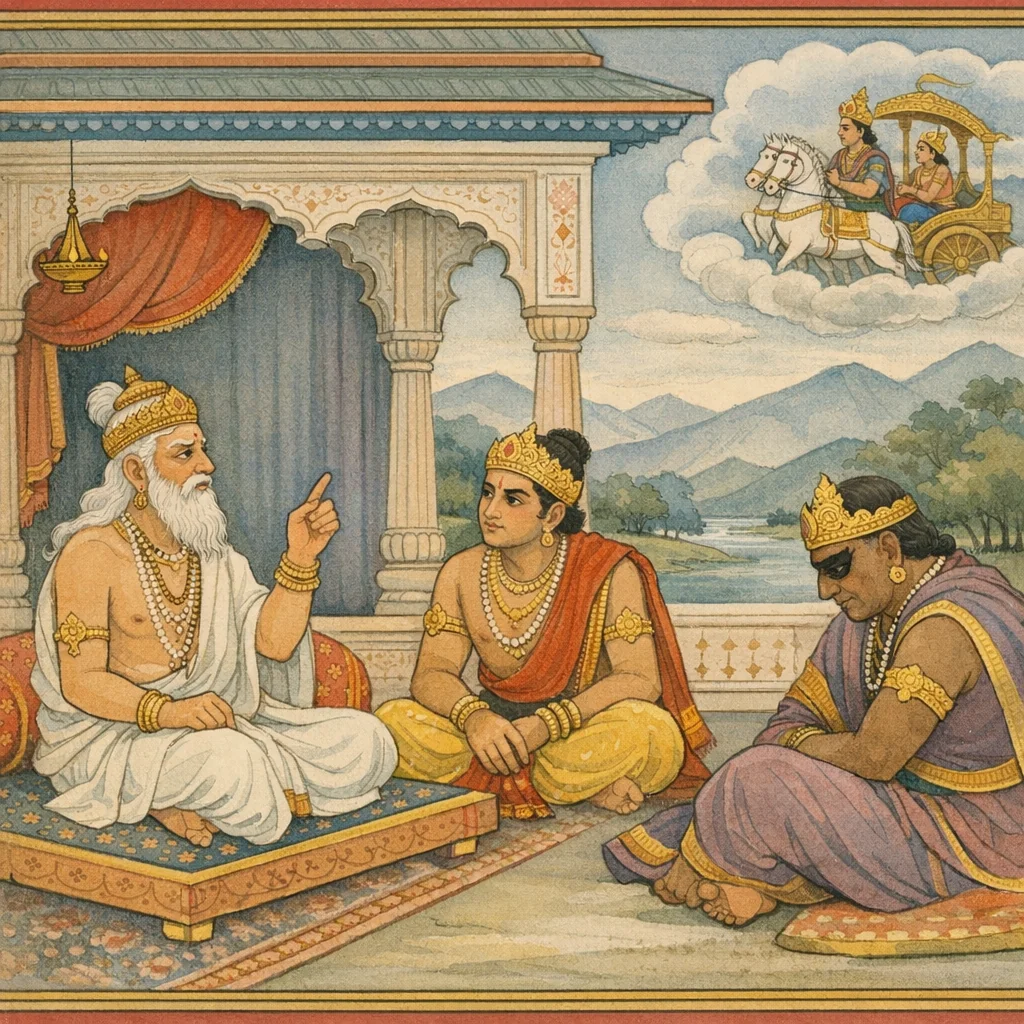
Adhyaya 164
Bhīṣma’s Appraisal of Kaurava Champions (भीष्मकृतः रथिनां गुणनिरूपणम्)
Upa-parva: Udyoga Parva – Ratha/Mahāratha-guṇa-kathana (Warrior Appraisal Discourse)
Bhīṣma addresses Dhṛtarāṣṭra and enumerates prominent Kaurava-aligned fighters and their operational significance. The chapter opens with Śakuni identified as a single-ratha combatant committed to sustained hostility toward the Pāṇḍavas. It then highlights Droṇa’s son Aśvatthāmā as exceptionally formidable in archery and divine weaponry, while noting a critical limitation: strong attachment to life and self-preservation, making Bhīṣma reluctant to rank him as a fully committed ratha/atiratha in Bhīṣma’s evaluative scheme. Droṇa is praised as an elder teacher and battlefield actor, yet his affection and esteem for Arjuna are emphasized as an ethical constraint on lethal intent. The discourse proceeds to additional Kaurava assets: Paurava (as a mahāratha), Satyavrata as a prominent ratha, Vṛṣasena (Karna’s son), Jalasaṃdha of Magadha, Bāhlīka as an unretreating atiratha, the rākṣasa Alāyudha with fierce prior enmity, and Bhagadatta of Prāgjyotiṣa renowned for elephant warfare, likened to Indra upon Airāvata. Overall, the chapter functions as a strategic roster combining capability descriptions, temperamental qualifiers, and coalition breadth.
Chapter Arc: धृतराष्ट्र के दरबार में युद्ध की गणना-भाषा गूंजती है—दुर्योधन जानना चाहता है कि उसके और शत्रु-पक्ष के रथी-अतिरथी कौन हैं, कितने हैं, और किस पर भरोसा रखा जाए। → भीष्म, अपनी कीर्ति का बखान किए बिना, कौरव-पक्ष के प्रमुख योद्धाओं का परिचय और उनकी श्रेणियाँ बताते हुए सेना के आत्मविश्वास को साधते हैं; साथ ही पाण्डव-पक्ष की शक्ति का संकेत भी देते हैं—विशेषतः अर्जुन का दृढ़ धनुष और वासुदेव-कृष्ण का साथ, जिसे सुनकर विजय की आशा के भीतर भय की लहर उठती है। → अर्जुन की प्रतिज्ञा और कृष्ण-सहायता का स्मरण युद्ध-गणना को अचानक ‘भाग्य-गणना’ बना देता है—भीष्म की वाणी में यह स्वीकार झलकता है कि जहाँ पार्थ के साथ वासुदेव हैं, वहाँ कौरवों के लिए ‘हतमेव’ का साया मंडराता है; फिर भी वे शास्त्र-विधि से सेना-रक्षा का व्रत लेते हैं। → भीष्म दुर्योधन के प्रश्न का उत्तर ‘व्यवस्था’ में बदल देते हैं—रथियों/अतिरथियों की पहचान, क्रम, और नियुक्ति का संकेत देकर मानसिक ज्वर शांत करने का आश्वासन देते हैं: वे तत्त्वतः युद्ध करेंगे और कौरव-वाहिनी की रक्षा करेंगे। → नियुक्ति और गणना पूरी होते ही प्रश्न शेष रह जाता है—क्या संख्या और श्रेणी, कृष्ण-युक्त पार्थ के सामने टिक पाएगी, और कौन-सा ‘पुराना वैर’ (जैसे जयद्रथ का) अगले अध्यायों में रक्त बनकर फूटेगा?
Shlokas
Verse 1
पम्प बछ। अर: (रथातिरथसंख्यानपर्व) पज्चषष्ट्यधिकशततमो< ध्याय: दुर्योधनके पूछनेपर भीष्मका कौरवपक्षके रथियों और अतिरथियोंका परिचय देना धृतराष्ट उवाच प्रतिज्ञाते फाल्गुनेन वधे भीष्मस्य संयुगे । किमकुर्वत मे मन्दा: पुत्रा दुर्योधनादय:,धृतराष्ट्रने पूछा--संजय! जब अर्जुनने युद्धभूमिमें भीष्मका वध करनेकी प्रतिज्ञा कर ली, तब दुर्योधन आदि मेरे मूर्ख पुत्रोंने क्या किया?
Dhṛtarāṣṭra said: “Sañjaya, when Phālguna (Arjuna) had vowed to slay Bhīṣma in the battle, what did my foolish sons—Duryodhana and the rest—do then?”
Verse 2
हतमेव हि पश्यामि गाड़ेयं पितरं रणे । वासुदेवसहायेन पार्थेन दृढ्धन्वना,अर्जुन सुदृढ़ धनुष धारण करते हैं। इसके सिवा भगवान् श्रीकृष्ण उनके सहायक हैं; अतः मैं रणभूमिमें अपने पिता गंगानन्दन भीष्मको उनके द्वारा मारा गया ही मानता हूँ
Dhṛtarāṣṭra said: “I already see my father Bhīṣma, the son of the Gaṅgā, as slain on the battlefield—because Pārtha (Arjuna), whose bow is held with unshakable firmness, fights with Vāsudeva (Kṛṣṇa) as his helper. With such support and such prowess, Bhīṣma’s fall seems inevitable.”
Verse 3
स चापरिमितप्रज्ञस्तच्छुत्वा पार्थभाषितम् । किमुक्तवान् महेष्वासो भीष्म: प्रहरतां वर:,अर्जुनकी उस प्रतिज्ञाको सुनकर अमित बुद्धिमान् योद्धाओंमें श्रेष्ठ महाधनुर्धर भीष्मने क्या कहा?
Dhṛtarāṣṭra said: “After hearing what Pārtha (Arjuna) had declared, what did the great bowman Bhīṣma—of immeasurable wisdom and foremost among warriors in striking—say?”
Verse 4
सैनापत्यं च सम्प्राप्प कौरवाणां धुरन्धर: । किमचेष्टत गाड़ेयो महाबुद्धिपराक्रम:,कौरवकुलका भार वहन करनेवाले परम बुद्धिमान् और पराक्रमी गंगापुत्र भीष्मने सेनापतिका पद प्राप्त करनेके पश्चात् युद्धँके लिये कौन-सी चेष्टा की?
Dhṛtarāṣṭra said: “After obtaining the command of the Kaurava army, what measures did Gaṅgā’s son Bhīṣma—steadfast bearer of the Kuru line’s burden, endowed with great intelligence and valor—undertake in preparation for war?”
Verse 5
वैशम्पायन उवाच ततस्तत् संजयस्तस्मै सर्वमेव न्यवेदयत् । यथोक्तं कुरुवृद्धेन भीष्मेणामिततेजसा,वैशम्पायनजी कहते हैं-जनमेजय! तदनन्तर संजयने अमिततेजस्वी कुरुवृद्ध भीष्मने जैसा कहा था, वह सब कुछ राजा धृतराष्ट्रको बताया
Vaiśampāyana said: Thereafter Sañjaya reported everything in full to him (Dhṛtarāṣṭra), exactly as it had been spoken by the aged Kuru elder Bhīṣma, whose splendor was immeasurable.
Verse 6
संजय उवाच सैनापत्यमनुप्राप्य भीष्म: शान्तनवो नूप । दुर्योधनमुवाचेदं वचन हर्षयन्निव,संजय बोले--नरेश्वर! सेनापतिका पद प्राप्त करके शान्तनुनन्दन भीष्मने दुर्योधनका हर्ष बढ़ाते हुए-से उससे यह बात कही--
Sañjaya said: O king, having attained the office of commander-in-chief, Bhīṣma, the son of Śāntanu, spoke these words to Duryodhana, as though to heighten his confidence and delight.
Verse 7
नमस्कृत्य कुमाराय सेनानये शक्तिपाणये । अहं सेनापतिस्ते5द्य भविष्यामि न संशय:,“राजन! मैं हाथमें शक्ति धारण करनेवाले देवसेनापति कुमार कार्तिकेयको नमस्कार करके अब तुम्हारी सेनाका अधिपति होऊँगा, इसमें संशय नहीं है
Sañjaya said: “Having bowed to Kumāra Kārttikeya—the divine commander of the gods, the wielder of the spear—I shall today become your commander-in-chief; of this there is no doubt.”
Verse 8
सेनाकर्मण्यभिज्ञो5स्मि व्यूहेषु विविधेषु च । कर्म कारयितुं चैव भृतानप्यभृतांस्तथा,“मुझे सेनासम्बन्धी प्रत्येक कर्मका ज्ञान है। मैं नाना प्रकारके व्यूहोंके निर्माणमें भी कुशल हूँ। तुम्हारी सेनामें जो वेतनभोगी अथवा वेतन न लेनेवाले मित्रसेनाके सैनिक हैं, उन सबसे यथायोग्य काम करा लेनेकी भी कला मुझे ज्ञात है
Sañjaya said: “I am skilled in every duty connected with an army, and I am proficient in arranging many kinds of battle-formations. I also know how to assign and have carried out the proper tasks by all troops—whether they are paid soldiers or unpaid allies and friends—so that the army functions in disciplined order.”
Verse 9
यात्रायाने च युद्धे च तथा प्रशमनेषु च | भृशं वेद महाराज यथा वेद बृहस्पति:,“महाराज! मैं युद्धके लिये यात्रा करने, युद्ध करने तथा विपक्षीके चलाये हुए अस्त्रोंका प्रतीकार करनेके विषयमें जैसा बृहस्पति जानते हैं, उसी प्रकार सम्पूर्ण आवश्यक बातोंकी विशेष जानकारी रखता हूँ
Sañjaya said: “O great king, I know thoroughly the march to war, the conduct of battle, and the means of pacifying and countering the weapons set in motion by the foe—just as Bṛhaspati knows.”
Verse 10
व्यूहानां च समारम्भान् दैवगान्धर्वमानुषान् | तैरहं मोहयिष्यामि पाण्डवान् व्येतु ते ज्वर:,“मुझे देवता, गन्धर्व और मनुष्य--तीनोंकी ही व्यूहरचनाका ज्ञान है। उनके द्वारा मैं पाण्डवोंको मोहित कर दूँगा। अतः तुम्हारी मानसिक चिन्ता दूर हो जानी चाहिये
Sañjaya said: “I know the formations and deployments of battle-arrays—those of the gods, the Gandharvas, and men. By means of these I shall bewilder the Pāṇḍavas; therefore, let your feverish anxiety be dispelled.”
Verse 11
सोऊहं योत्स्यामि तत्त्वेन पालयंस्तव वाहिनीम् | यथावच्छास्त्रतो राजन व्येतु ते मानसो ज्वर:,“राजन! मैं तुम्हारी सेनाकी रक्षा करता हुआ शास्त्रीय विधानके अनुसार यथार्थरूपसे पाण्डवोंके साथ युद्ध करूँगा। अतः तुम्हारी मानसिक चिन्ता दूर हो जाय”
Sañjaya said: “O King, I shall truly fight, while safeguarding your army, and I shall do so in accordance with the prescriptions of the śāstra. Let the fever of anxiety in your mind be dispelled.”
Verse 12
दुर्योधन उवाच विद्यते मे न गाड़ेय भयं देवासुरेष्वपि । समस्तेषु महाबाहो सत्यमेतद् ब्रवीमि ते,दुर्योधन बोला--महाबाहु गंगानन्दन! मैं आपसे सत्य कहता हूँ, मुझे सम्पूर्ण देवताओं और असुरोंसे भी कभी भय नहीं होता है
Duryodhana said: “O mighty-armed son of the Gaṅgā, I have no deep-seated fear—even of the gods and the asuras, taken all together. I tell you this in truth.”
Verse 13
कि पुनस्त्वयि दुर्धर्षे सैनापत्ये व्यवस्थिते । द्रोणे च पुरुषव्याप्रे स्थिते युद्धाभिनन्दिनि,फिर जब आपज-जैसे दुर्धर्ष वीर हमारे सेनापतिके पदपर स्थित हैं तथा युद्धका अभिनन्दन करनेवाले पुरुष-सिंह द्रोणाचार्य-जैसे योद्धा मेरे लिये युद्धभूमिमें उपस्थित हैं, तब तो मुझे भय हो ही कैसे सकता है?
Duryodhana said: “How could there be any fear for me, when you—so hard to assail—stand firmly appointed as commander of the army, and when Droṇa too, that lion among men who delights in battle, is stationed here?”
Verse 14
भवद्धयां पुरुषाग्र्या भ्यां स्थिताभ्यां विजये मम । नदुर्लभं कुरुश्रेष्ठ देवराज्यमपि ध्रुवम्,कुरुश्रेष्ठ! जब आप दोनों पुरुषप्रवर वीर मेरी विजयके लिये यहाँ खड़े हैं, तब तो अवश्य ही मेरे लिये देवताओंका राज्य भी दुर्लभ नहीं है
Duryodhana said: “With you two—foremost among men—standing here for my victory, O best of the Kurus, even the sovereignty of the gods is surely not beyond my reach.”
Verse 15
रथसंख्यां तु कार्त्स्न्येन परेषामात्मनस्तथा । तथैवातिरथानां च वेत्तुमिच्छामि कौरव,कुरुनन्दन! आप शत्रुओंके तथा अपने पक्षके रथियों और अतिरथियोंकी संख्याको पूर्णरूपसे जानते हैं, अतः मैं भी आपसे इस विषयकी जानकारी प्राप्त करना चाहता हूँ; क्योंकि पितामह शत्रुपक्ष तथा अपने पक्षकी सभी बातोंके ज्ञानमें निपुण हैं, अत: मैं इन सब राजाओंके साथ आपके मुहसे इस विषयको सुनना चाहता हूँ
Duryodhana said: “O Kaurava, joy of the Kurus! You know in full the number of chariot-warriors on the enemy’s side and on our own, and likewise the count of the great chariot-fighters (atirathas). I wish to learn this from you. Since the grandsire is skilled in knowing every detail of both sides, I want to hear this assessment from your own mouth in the presence of these kings.”
Verse 16
पितामहो हि कुशल: परेषामात्मनस्तथा | श्रोतुमिच्छाम्यहं सर्वे: सहैभिर्वसुधाधिपै:,कुरुनन्दन! आप शत्रुओंके तथा अपने पक्षके रथियों और अतिरथियोंकी संख्याको पूर्णरूपसे जानते हैं, अतः मैं भी आपसे इस विषयकी जानकारी प्राप्त करना चाहता हूँ; क्योंकि पितामह शत्रुपक्ष तथा अपने पक्षकी सभी बातोंके ज्ञानमें निपुण हैं, अत: मैं इन सब राजाओंके साथ आपके मुहसे इस विषयको सुनना चाहता हूँ
Duryodhana said: “Grandfather Bhīṣma is indeed fully competent—he knows well the strengths of the enemy as well as our own. Therefore I wish to hear it from you, in the presence of all these kings: a clear account of the warriors and great chariot-fighters on both sides.”
Verse 17
भीष्म उवाच गान्धारे शृणु राजेन्द्र रथसंख्यां स्वके बले । ये रथा: पृथिवीपाल तथैवातिरथाश्न ये,भीष्म बोले--राजेन्द्र गान्धारीनन्दन! तुम अपनी सेनाके रथियोंकी संख्या श्रवण करो। भूपाल! तुम्हारी सेनामें जो रथी और अतिरथी हैं, उन सबका वर्णन करता हूँ
Bhīṣma said: “O son of Gāndhārī, O lord of kings, listen to the count of the chariot-warriors in your own army. O protector of the earth, I shall describe those who are chariot-fighters and those who are great chariot-fighters (atirathas) among your forces.”
Verse 18
बहूनीह सहस्राणि प्रयुतान्यर्बुदानि च । रथानां तव सेनायां यथामुख्यं तु मे शूणु,तुम्हारी सेनामें रथियोंकी संख्या अनेक सहस्र, लक्ष और अर्बुदों (करोड़ों)-तक पहुँच जाती है; तथापि उनमें जो प्रधान-प्रधान हैं, उनके नाम मुझसे सुनो
Bhīṣma said: “In your army here there are many thousands, tens of thousands, and even crores upon crores of chariot-warriors. Yet, hear from me the names of those who are foremost among them.”
Verse 19
भवानग्रे रथोदार: सह सर्व: सहोदरै: । दुःशासनप्रभृतिभिभर्श्नातृभि: शतसम्मितै:,सबसे पहले अपने दुःशासन आदि सौ सहोदर भाइयोंके साथ तुम्हीं बहुत बड़े उदार रथी हो
Bhīṣma said: “Foremost among them, you yourself are a noble and eminent chariot-warrior, together with all your brothers—your uterine kinsmen—numbering as a hundred, beginning with Duḥśāsana.”
Verse 20
सर्वे कृतप्रहरणाश्छेद भेदविशारदा: । रथोपस्थे गजस्कन्धे गदाप्रासासिचर्मणि,तुम सब लोग अस्त्रविद्याके ज्ञाता तथा छेदन-भेदनमें कुशल हो। रथपर और हाथीकी पीठपर बैठकर भी युद्ध कर सकते हो। गदा, प्रास तथा ढाल-तलवारके प्रयोगमें भी कुशल हो
Bhīṣma said: “All of you are fully equipped for combat and are adept in the arts of cutting and cleaving. You can fight from the platform of a chariot and from the back of an elephant, and you are skilled in the use of the mace, the spear, and the sword-and-shield.”
Verse 21
संयन्तार: प्रहर्तार: कृतास्त्रा भारसाधना: । इष्वस्त्रे द्रोणशिष्याश्व॒ कृपस्य च शरद्वतः,तुमलोग रथके संचालन और अस्त्रोंके प्रहारमें भी निपुण हो। अस्त्रविद्याके ज्ञाता तथा भार उठानेमें भी समर्थ हो। धनुष-बाणकी विद्यामें तो तुमलोग द्रोणाचार्य और कृपाचार्यके सुयोग्य शिष्य हो
Bhīṣma said: “You are skilled charioteers and effective strikers in battle; you are trained in the use of weapons and capable of bearing heavy burdens. In the science of bow and arrow, you are worthy disciples of Droṇa—and also of Kṛpa Śāradvata.”
Verse 22
एते हनिष्यन्ति रणे पञ्चालान् युद्धदुर्मदान् । कृतकिल्बिषा: पाण्डवेयैर्धार्तराष्ट्रा ममनस्विन:,धृतराष्ट्रके ये सभी मनस्वी पुत्र पाण्डवोंके साथ वैर बाँधे हुए हैं; अतः युद्धमें उन्मत्त होकर लड़नेवाले पांचाल योद्धाओंको ये समरभूमिमें मार डालेंगे
These resolute sons of Dhṛtarāṣṭra, who have bound themselves in enmity with the Pāṇḍavas and bear guilt for their wrongs against them, will slay on the battlefield the Pañcāla warriors, maddened for war.
Verse 23
तथाहं भरतश्रेष्ठ सर्वसेनापतिस्तव । शत्रून् विध्वंसयिष्यामि कदर्थीकृत्य पाण्डवान्,भरतश्रेष्ठ! मैं तो तुम्हारी सम्पूर्ण सेनाका प्रधान सेनापति ही हूँ; अतः पाण्डवोंको कष्ट देकर शत्रुसेनाके सैनिकोंका संहार करूँगा
Bhīṣma said: “So it is, O best of the Bharatas. I am indeed the commander-in-chief of your entire host; therefore I shall crush the enemy forces, first afflicting the Pāṇḍavas and then bringing about the destruction of the opposing warriors.”
Verse 24
न त्वात्मनो गुणान् वक्तुमहामि विदितोडस्मि ते । कृतवर्मा त्वतिरथो भोज: शस्त्रभृतां वर:,मैं अपने मुँहसे अपने ही गुणोंका बखान करना उचित नहीं समझता। तुम तो मुझे जानते ही हो। शस्त्रधारियोंमें श्रेष्ठ भोजवंशी कृतवर्मा तुम्हारे दलमें अतिरथी वीर हैं
Bhīṣma said: “It is not fitting for me to proclaim my own merits with my own mouth; you already know me well. In your host, the Bhoja prince Kṛtavarmā stands as an atiratha—an exceptional chariot-warrior—foremost among those who bear arms.”
Verse 25
अर्थसिद्धि तव रणे करिष्यति न संशय: । शस्त्रविद्धिरनाधृष्यो दूरपाती दृढायुध:,हनिष्यति चमूं तेषां महेन्द्रो दानवानिव । ये युद्धमें तुम्हारे अभीष्ट अर्थकी सिद्धि करेंगे। इसमें संशय नहीं है। बड़े-बड़े शस्त्रवेत्ता भी इन्हें परास्त नहीं कर सकते। इनके आयुध अत्यन्त दृढ़ हैं और ये दूरके लक्ष्यको भी मार गिरानेमें समर्थ हैं। जैसे देवराज इन्द्र दानवोंका संहार करते हैं, उसी प्रकार ये भी पाण्डवोंकी सेनाका विनाश करेंगे
Bhīṣma said: “In battle he will surely accomplish your desired objective—there is no doubt. A master of weapons, unassailable by even great experts, firm in his armaments and capable of striking targets from afar, he will destroy their army, just as Mahendra (Indra), king of the gods, once slew the Dānavas.”
Verse 26
मद्रराजो हेष्वास: शल्यो मेडतिरथो मतः,स्पर्थते वासुदेवेन नित्यं यो वै रणे रणे । महाधनुर्धर मद्रराज शल्यको भी मैं अतिरथी मानता हूँ, जो प्रत्येक युद्धमें सदा भगवान् श्रीकृष्णके साथ स्पर्धा रखते हैं
Bhīṣma said: “Śalya, the king of Madra, is regarded as a foremost chariot-warrior and a master of archery. In every battle he continually measures himself against Vāsudeva (Kṛṣṇa), seeking to match his prowess.”
Verse 27
भागिनेयान् निजांस्त्यक्त्वा शल्यस्तेडतिरथो मतः । एष योत्स्यति संग्रामे पाण्डवांश्व महारथान्,सागरोर्मिंसमैर्बाणै: प्लावयन्निव शात्रवान् | ये अपने सगे भानजों नकुल-सहदेवको छोड़कर अन्य सभी पाण्डव महारथियोंसे समरभूमिमें युद्ध करेंगे। तुम्हारी सेनाके इन वीरशिरोमणि शल्यको मैं अतिरथी ही समझता हूँ। ये समुद्रकी लहरोंके समान अपने बाणोंद्वारा शत्रुपक्षके सैनिकोंको डुबाते हुए-से युद्ध करेंगे
Bhīṣma said: “Setting aside even his own sister’s sons, Śalya is, in my judgment, an atiratha for you. In the coming battle he will fight against the Pāṇḍavas—those great chariot-warriors—flooding the enemy host as though with waves of the ocean, by showers of his arrows.”
Verse 28
भीष्म-दुर्योधन-संवाद भूरिश्रवा: कृतास्त्रश्न तव चापि हित: सुहृत्,सोमदत्तके पुत्र महाधनुर्धर भूरिश्रवा भी अस्त्र-विद्याके पण्डित और तुम्हारे हितैषी सुहृद् हैं। ये रथियोंके यूथपतियोंके भी यूथपति हैं, अतः तुम्हारे शत्रुओंकी सेनाका महान् संहार करेंगे
Bhīṣma said: “Bhurishravas—Somadatta’s son—is a fully trained warrior, a mighty archer, and also your well-wishing friend. Skilled in the science of weapons and a leader even among the leaders of chariot-warrior divisions, he will therefore bring about a great destruction in the army of your enemies.”
Verse 29
सौमदत्तिर्महेष्वासो रथयूथपयूथप: । बलक्षयममित्राणां सुमहान्तं करिष्यति,सोमदत्तके पुत्र महाधनुर्धर भूरिश्रवा भी अस्त्र-विद्याके पण्डित और तुम्हारे हितैषी सुहृद् हैं। ये रथियोंके यूथपतियोंके भी यूथपति हैं, अतः तुम्हारे शत्रुओंकी सेनाका महान् संहार करेंगे
Somadatti, a great archer, is a leader among the leaders of chariot-warrior divisions; he will bring about a very great wasting of the enemies’ strength.
Verse 30
सिन्धुराजो महाराज मतो मे द्विगुणो रथ: । योत्स्यते समरे राजन् विक्रान्तो रथसत्तम:,महाराज! सिन्धुराज जयद्रथको मैं दो रथियोंके बराबर समझता हूँ। ये बड़े पराक्रमी तथा रथी योद्धाओंमें श्रेष्ठ हैं। राजन! ये भी समरांगणमें पाण्डवोंके साथ युद्ध करेंगे
Bhīṣma said: “O great king, in my judgment the Sindhu ruler—Jayadratha—counts as the strength of two chariot-warriors. O king, this most excellent and valiant charioteer will fight in the battle, taking the field against the Pāṇḍavas.”
Verse 31
द्रौोपदीहरणे राजन् परिक्लिष्टश्न॒ पाण्डवै: । संस्मरंस्तं परिक्लेशं योत्स्यते परवीरहा,नरेश्वर! द्रौपदीहरणके समय पाण्डवोंने इन्हें बहुत कष्ट पहुँचाया था। उस महान् क्लेशको याद करके शत्रुवीरोंका नाश करनेवाले जयद्रथ अवश्य युद्ध करेंगे
Bhīṣma said: “O King, at the time of Draupadī’s abduction he was grievously tormented by the Pāṇḍavas. Remembering that great humiliation and suffering, Jayadratha—slayer of enemy heroes—will certainly fight, O lord of men.”
Verse 32
एतेन हि तदा राजंस्तप आस्थाय दारुणम् | सुदुर्लभो वरो लब्ध: पाण्डवान् योद्धुमाहवे,राजन्! उस समय इन्होंने कठोर तपस्या करके युद्धमें पाण्डवोंसे मुठभेड़ कर सकनेका अत्यन्त दुर्लभ वर प्राप्त किया था
Bhīṣma said: “By this very means, O King, he once undertook severe austerities and obtained an exceedingly rare boon—namely, the ability to meet the Pāṇḍavas in battle.”
Verse 33
स एष रथशार्दूलस्तद् वैरं संस्मरन् रणे । योत्स्यते पाण्डवैस्तात प्राणांस्त्यक्त्वा सुदुस्त्यजान्,तात! ये रथियोंमें श्रेष्ठ जयद्रथ युद्धमें उस पुराने वैरको याद करके अपने दुस्त्यज प्राणोंकी भी बाजी लगाकर पाण्डवोंके साथ संग्राम करेंगे
Bhīṣma said: “This foremost of chariot-warriors—remembering that old enmity amid the battle—will fight against the Pāṇḍavas, dear one, staking even his life, though life is so hard to relinquish.”
Verse 164
इस प्रकार श्रीमह्याभारत उद्योगपर्वके अन्तर्गत उलूकदूतागमनपर्वरें सेनापतिके द्वारा सैनिकोंकी युद्धर्ें नियुक्तिविषयक एक सौ चौंसठवाँ अध्याय पूरा हुआ
Sanjaya concludes by marking the end of the 164th chapter of the Udyoga Parva, within the section on Uluka’s embassy. This chapter has dealt with the commander’s assignment and deployment of soldiers for battle—an editorial colophon that underscores the formal organization of war and the deliberate, accountable ordering of forces before conflict.
Verse 165
इति श्रीमहाभारते उद्योगपर्वणि रथातिरथसंख्यानपर्वणि पज्चषष्टयधिकशततमो< ध्याय:,इस प्रकार श्रीमहाभारत उद्योगपर्वके अन्तर्गत रथातिरथसंख्यानपर्वमें एक सौ पैंसठवाँ अध्याय पूरा हुआ
Thus, in the Śrī Mahābhārata, within the Udyoga Parva, in the section titled “Enumeration of Chariot-warriors and Great Chariot-warriors,” the one-hundred-and-sixty-fifth chapter concludes. (This is a colophon marking the end of the chapter rather than a spoken verse.)
Frequently Asked Questions
Bhīṣma differentiates between raw capability and dependable commitment: a warrior may possess extraordinary weapons and skill, yet be strategically less certain if self-preservation or personal bonds constrain decisive action.
Effective governance requires integrating moral psychology into strategy—assessing allies and commanders by motives, loyalties, and restraints, not merely by titles, lineage, or weaponry.
No explicit phalaśruti appears in the supplied passage; the chapter’s meta-function is archival and strategic, serving as a roster-based interpretive lens for understanding later campaign dynamics.