Adhyaya 16
अग्निस्तुति, इन्द्रदर्शन, नहुष-भयवर्णन (Agni-hymn, discovery of Indra, and the Nahuṣa threat)
Upa-parva: Śakra–Nahuṣa-Upākhyāna (Indra’s concealment and Nahuṣa’s accession episode)
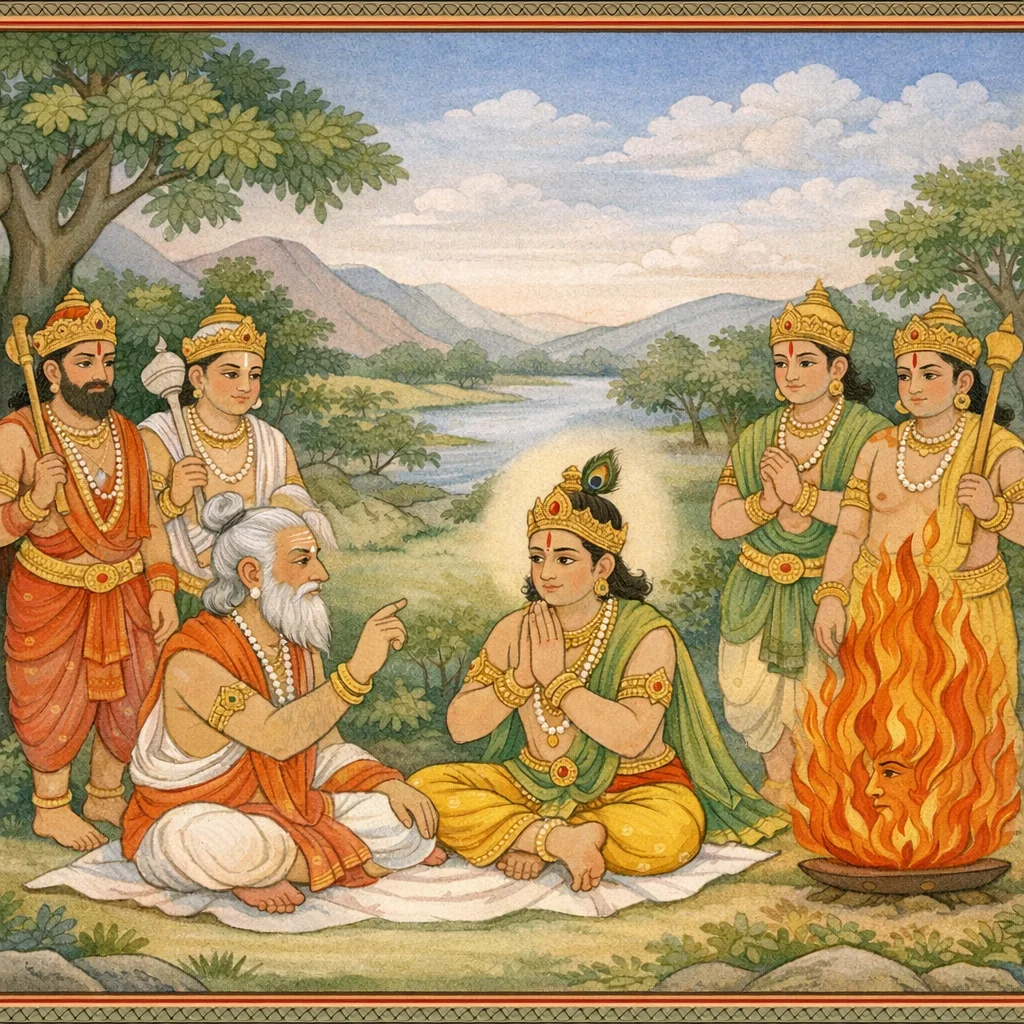
The chapter opens with Bṛhaspati’s formal stuti of Agni as the mouth of the gods, the hidden witness within beings, and the sustaining principle without which the world would collapse. Agni is praised as both carrier and substance of offering, linked to cosmic processes (creation, maturation/consumption, and re-establishment). Pleased, Agni promises to reveal Indra. Entering the waters, he reaches a lake and discovers Indra concealed in a lotus-fiber form, minute in body. Bṛhaspati and accompanying seers and gandharvas then praise Indra by recalling his prior victories (e.g., over Vṛtra and other adversaries) and urge him to protect the worlds; Indra gradually regains strength and resumes his form. Indra asks what duty remains, and Bṛhaspati reports the crisis: the human king Nahuṣa has obtained the devarājya and oppresses the devas; his gaze is described as dangerous, prompting the gods to move in concealment. Additional lokapālas (Kubera, Yama, Soma, Varuṇa) arrive, congratulate Indra, and request coordinated action. Indra seeks their support against Nahuṣa; Agni requests a ritual share for assistance, which Indra grants (a joint Indra–Agni portion in a great rite). Indra then honors and assigns jurisdictions—affirming Varuṇa’s authority over waters and Yama’s over the ancestors—thereby consolidating an administrative coalition for the impending resolution.
Chapter Arc: शल्य राजा धृतराष्ट्र को एक प्राचीन दैवी प्रसंग सुनाते हैं—जब इन्द्र अपने पद से विचलित हुए, तब देवताओं ने बृहस्पति के माध्यम से अग्नि का स्तवन कर के संकट-निवारण का उपाय खोजा। → अग्नि की सर्वव्यापकता और त्रिविध स्वरूप का वर्णन होता है—कवि उसे ‘एक’ भी कहते हैं और ‘तीन प्रकार’ का भी; उसके त्याग से जगत का त्वरित विनाश संभव है। देव-समाज में भय फैलता है कि यदि इन्द्र-पद रिक्त रहा तो व्यवस्था ढह जाएगी; नहुष जैसे प्रतिद्वन्द्वी का उभार भीषण छाया बनकर उपस्थित होता है। → इन्द्र अपने ‘स्वरूप’ को पुनः धारण कर बल-पराक्रम से सम्पन्न होते हैं और बृहस्पति के समक्ष स्थित होकर निर्णय लेते हैं: नहुष को पराजित करने हेतु देव-गण एकत्र हों, और साथ ही इन्द्र अपने अधिकारों का पुनर्विन्यास कर लोकपालों को उनके-उनके विभाग सौंपते हैं। → बृहस्पति देवताओं की व्याकुलता व्यक्त करते हैं और इन्द्र से कहते हैं कि नहुष-विजय के बाद ही देव-भाग सुरक्षित होंगे। इन्द्र सहमति देते हैं—अग्नि, वरुण, यम, कुबेर आदि को उनके-उनके अधिपत्य/भाग प्रदान कर के देव-व्यवस्था को स्थिर करते हैं और संयुक्त रूप से नहुष-वध/पराजय की ओर अग्रसर होते हैं। → नहुष ‘घोरदृष्टि’ शत्रु के रूप में सामने है—देव-गण संगठित तो हो गए, पर निर्णायक टकराव अभी शेष है।
Shlokas
Verse 1
अफ्-४-क+ घोडशो>< ध्याय: बृहस्पतिद्वारा अग्नि और इन्द्रका स्तवन तथा बृहस्पति एवं लोकपालोंकी इन्द्रसे बातचीत ब॒हस्पतिरुवाच त्वमग्ने सर्वदेवानां मुखं त्वमसि हव्यवाट् । त्वमन्तः सर्वभूतानां गूढश्चवरसि साक्षिवत्,बृहस्पति बोले--अग्निदेव! आप सम्पूर्ण देवताओंके मुख हैं। आप ही देवताओंको हविष्य पहुँचानेवाले हैं। आप समस्त प्राणियोंके अन्तःकरणमें साक्षीकी भाँति गूढ़भावसे विचरते हैं
Bṛhaspati said: “O Agni, you are the mouth of all the gods; you are the bearer who conveys the offered oblations. Hidden within the hearts of all beings, you move as an inner witness.”
Verse 2
त्वामाहुरेक॑ कवयस्त्वामाहुस्त्रिविध॑ पुनः । त्वया त्यक्तं जगच्चेदं सद्यो बात ही शन,विद्वान् पुछष आपको एक बताते हैं। फिर वे ही आपको तीन प्रकारका कहते हैं। हुताशन! आपके त्याग देनेपर यह सम्पूर्ण जगत् तत्काल नष्ट हो जायगा
The sages declare you to be one; again, they describe you as threefold. O Hutāśana (Fire), if you were to abandon this entire world, it would at once perish—swiftly falling to ruin.
Verse 3
कृत्वा तुभ्यं नमो विप्रा: स्वकर्मविजितां गतिम् । गच्छन्ति सह पत्नीभि: सुतैरपि च शाश्वतीम्,ब्राह्यगलोग आपकी पूजा और वन्दना करके अपनी पत्नियों तथा पुत्रोंक साथ अपने कर्माद्वारा प्राप्त चिरस्थायी स्वर्गीय सुख लाभ करते हैं
Having offered you reverent homage, the brāhmaṇas—by the merit won through their own prescribed duties—attain an enduring state of blessedness, proceeding there together with their wives and even their sons.
Verse 4
त्वमेवाग्ने हव्यवाहस्त्वमेव परमं हवि: । यजन्ति सज्रैस्त्वामेव यज्ैश्न परमाध्वरे,अग्ने! आप ही हविष्यको वहन करनेवाले देवता हैं। आप ही उत्कृष्ट हवि हैं। याज्ञिक विद्वान् पुरुष बड़े-बड़े यज्ञोंमें अवान्तर सत्रों और यज्ञोंद्वारा आपकी ही आराधना करते हैं
O Agni! You alone are the bearer of oblations (Havyavāha), and you alone are the supreme offering itself. In the greatest sacrificial rites, learned ritualists worship you alone—through subsidiary sacrificial sessions (satra) and through solemn yajñas.
Verse 5
सृष्टवा लोकांस्त्रीनिमान् हव्यवाह प्राप्त काले पचसि पुनः समिद्ध: । त्वं सर्वस्य भुवनस्य प्रसूति- स्त्वमेवाग्ने भवसि पुन: प्रतिष्ठा,हव्यवाहन! आप ही सृष्टिके समय इन तीनों लोकोंको उत्पन्न करके प्रलयकाल आनेपर पुनः प्रज्वलित हो इन सबका संहार करते हैं। अग्ने! आप ही सम्पूर्ण विश्वके उत्पत्तिस्थान हैं और आप ही पुनः इसके प्रलयकालमें आधार होते हैं
O Havyavāha, at the time of creation you brought forth these three worlds; and when the destined hour arrives, you blaze up again and consume them in dissolution. O Agni, you are the very source from which the whole universe is born, and at the cosmic end you alone become its support once more.
Verse 6
त्वामग्ने जलदानाहुर्विद्युतश्च मनीषिण: । दहन्ति सर्वभूतानि त्वत्तो निष्क्रम्य हेतय:,अग्निदेव! मनीषी पुरुष आपको ही मेघ और विद्युत् कहते हैं। आपसे ही ज्वालाएँ निकलकर सम्पूर्ण भूतोंको दग्ध करती हैं
O Agnideva, the wise declare you to be the rain-bearing cloud and also the lightning. From you issue the blazing tongues of fire which, bursting forth, scorch all living beings.
Verse 7
त्वय्यापो निहिता: सर्वास्त्वयि सर्वमिदं जगत् । न ते>स्त्यविदितं किंचित् त्रिषु लोकेषु पावक,पावक! आपमें ही सारा जल संचित है। आपमें ही यह सम्पूर्ण जगत् प्रतिष्ठित है। तीनों लोकोंमें कोई ऐसी वस्तु नहीं है, जो आपको ज्ञात न हो
O Pāvaka, all waters are contained within you, and upon you this entire world is established. Therefore, in the three worlds there is nothing whatsoever that is unknown to you.
Verse 8
स्वयोनिं भजते सर्वो विशस्वापो5विशड्कित: । अहं त्वां वर्धयिष्यामि ब्राहौर्मन्त्रै: सनातनै:,समस्त पदार्थ अपने-अपने कारणमें प्रवेश करते हैं। अतः आप भी नि:शंक होकर जलमें प्रवेश कीजिये। मैं सनातन वेदमन्त्रोंद्वारा आपको बढ़ाऊँगा
All things return to their own source; therefore enter the waters without fear or doubt. I shall strengthen and increase you by the ancient Vedic mantras uttered by the Brahmins.
Verse 9
एवं स्तुतो हव्यवाट् स भगवान् कविरुत्तम: । बृहस्पतिमथोवाच प्रीतिमान् वाक्यमुत्तमम् | दर्शयिष्यामि ते शक्रं सत्यमेतद् ब्रवीमि ते,इस प्रकार स्तुति की जानेपर हविष्य वहन करनेवाले श्रेष्ठ एवं सर्वज्ञ भगवान् अग्निदेव प्रसन्न होकर बृहस्पतिसे यह उत्तम वचन बोले--'ब्रह्मन! मैं आपको इन्द्रका दर्शन कराऊँगा, यह मैं आपसे सत्य कह रहा हूँ”
Thus praised, the fire-god—bearer of the oblation, the blessed and foremost seer—was pleased and spoke to Bṛhaspati these excellent words: “O Brahman, I will show you Śakra (Indra). This I tell you in truth.”
Verse 10
शल्य उवाच प्रविश्यापस्ततो वह्निः ससमुद्रा: सपल्वला: । आससाद सरस्तच्च गूढो यत्र शतक्रतु:,शल्य कहते हैं--युधिष्ठि!! तदनन्तर अग्निदेव छोटे गड़ढेसे लेकर बड़े-से-बड़े समुद्रतकके जलमें प्रवेश करके पता लगाते हुए क्रमश: उस सरोवरमें जा पहुँचे, जहाँ इन्द्र छिपे हुए थे
Śalya said: “O Yudhiṣṭhira! Thereafter Agni entered the waters— from the smallest pools to the vastest seas—searching them in due course, until he reached the lake where Śatakratu (Indra) lay hidden.”
Verse 11
अथ तत्रापि पद्मानि विचिन्वन् भरतर्षभ | अपश्यत् स तु देवेन्द्र बिसमध्यगतं स्थितम्,भरतश्रेष्ठ! उसमें भी कमलोंके भीतर खोज करते हुए अग्निदेवने एक कमलके नालमें बैठे हुए देवेन्द्रकों देखा
Then, even there, while searching among the lotuses, O bull of the Bharatas, he beheld Indra—lord of the gods—seated and concealed within the very middle of a lotus-stalk.
Verse 12
आगत्य च ततस्तूर्ण तमाचष्ट बृहस्पते: । अणुमात्रेण वपुषा पद्मतन्त्वश्रितं प्रभुम्,वहाँसे तुरंत लौटकर अग्निदेवने बृहस्पतिको बताया कि भगवान् इन्द्र सूक्ष्म शरीर धारण करके एक कमलनालका आश्रय लेकर रहते हैं
Returning at once from there, Agni promptly informed Bṛhaspati that the Lord Indra was abiding in concealment—having assumed an exceedingly subtle body and taken refuge within the fiber-like stalk of a lotus.
Verse 13
गत्वा देवर्षिंगन्धर्व: सहितो5थ बृहस्पति: । पुराणै: कर्मभियदेंवं तुष्टाव बलसूदनम्,तब बृहस्पतिजीने देवर्षियों और गन्धरवोंके साथ वहाँ जाकर बलसूदन इन्द्रके पुरातन कर्मोका वर्णन करते हुए उनकी स्तुति की--
Then Bṛhaspati went there accompanied by divine seers and Gandharvas. Recounting Indra’s ancient deeds, he praised the slayer of Bala.
Verse 14
महासुरो हत: शक्र नमुचिर्दारुणस्त्वया | शम्बरश्न बलश्नैव तथोभौ घोरविक्रमौ,“इन्द्र! आपने अत्यन्त भयंकर नमुचि नामक महान् असुरको मार गिराया है। शम्बर और बल दोनों भयंकर पराक्रमी दानव थे; परंतु उन्हें भी आपने मार डाला
Śalya said: “O Śakra (Indra), you have slain the mighty asura Namuci, fierce and dreadful. And Śambara and Bala too—both terrible in valor—were likewise killed by you.”
Verse 15
इस प्रकार श्रीमह्याभारत उद्योगपर्वके अन्तर्गत सेनोट्रोगपर्वरमें ब॒हस्पति-अग्निसंवादविषयक पंद्रहवाँ अध्याय पूरा हुआ,शतक्रतो विवर्धस्व सर्वाउ्छत्रून् निषूदय । उत्तिष्ठ शक्र सम्पश्य देवर्षीक्ष समागतान् “शतक्रतो! आप अपने तेजस्वी स्वरूपसे बढ़िये और समस्त शत्रुओंका संहार कीजिये। इन्द्रदेव! उठिये और यहाँ पधारे हुए देवर्षियोंका दर्शन कीजिये
Śalya said: “O Śatakratu (Indra), increase in your radiant might and strike down all enemies. Rise up, O Śakra, and behold the divine seers who have assembled here.”
Verse 16
महेन्द्र दानवान् हत्वा लोकास्त्रातास्त्वया विभो । अपां फेनं समासाद्य विष्णुतेजो5तिबूंहितम् । त्वया वृत्रो हतः पूर्व देवराज जगत्पते,'प्रभो महेन्द्र! आपने कितने ही दानवोंका वध करके समस्त लोकोंकी रक्षा की है। जगदीश्वर देवराज! भगवान् विष्णुके तेजसे अत्यन्त शक्तिशाली बने हुए समुद्रफेनको लेकर आपने पूर्वकालमें वृत्रासुरका वध किया इति श्रीमहाभारते उद्योगपर्वणि सेनोद्योगपर्वणि इन्द्रवरुणादिसंवादे षोडशो< ध्याय: इस प्रकार श्रीमहाभारत उद्योगपर्वके अन्तर्गत सेनोट्रोगपर्वमें इन्द्रवरुणादिसंवादविषयक सोलहवाँ अध्याय पूरा हुआ
Śalya said: “O Mahendra, O mighty lord, by slaying the Dānavas you have protected the worlds. Taking up the ocean’s foam—made exceedingly potent by the radiance of Viṣṇu—you formerly struck down Vṛtra. O king of the gods, O lord of the universe: you are the protector who overcomes chaos and restores order.”
Verse 17
त्वं सर्वभूतेषु शरण्य ईड्य- स्त्वया सम॑ विद्यते नेह भूतम् त्वया धार्यन्ते सर्वभूतानि शक्र त्वं देवानां महिमानं चकर्थ,“आप सम्पूर्ण भूतोंमें स्त्वन करने योग्य और सबके शरणदाता हैं। आपकी समानता करनेवाला जगतमें दूसरा कोई प्राणी नहीं है। शक्र! आप ही सम्पूर्ण भूतोंको धारण करते हैं और आपने ही देवताओंकी महिमा बढ़ायी है
Śalya said: “You are the refuge of all beings, worthy of praise. In this world there exists no creature equal to you. O Śakra, you uphold all beings, and it is you who have established and increased the glory of the gods.”
Verse 18
पाहि सर्वाश्व लोकांश्व महेन्द्र बलमाप्नुहि | एवं संस्तूयमानश्न सो<5वर्धत शनै: शनै:,“महेन्द्र! आप शक्ति प्राप्त कीजिये और सम्पूर्ण लोकोंकी रक्षा कीजिये।” इस प्रकार स्तुति की जानेपर देवराज इन्द्र धीरे-धीरे बढ़ने लगे
Śalya said: “Protect all the worlds, O Mahendra; attain strength.” Thus praised in this manner, Indra, the lord of the gods, gradually grew in power.
Verse 19
स्वं चैव वपुरास्थाय बभूव स बलान्वित: । अब्रवीच्च गुरुं देवो बृहस्पतिमवस्थितम्,अपने पूर्व शरीरको प्राप्त करके वे बल-पराक्रमसे सम्पन्न हो गये। तत्पश्चात् इन्द्रने वहाँ खड़े हुए अपने गुरु बृहस्पतिसे कहा--
Having regained his own bodily form, he became endowed once more with strength and prowess. Then Indra, lord of the gods, addressed his preceptor Bṛhaspati, who stood there—signaling the return of rightful order and the seeking of counsel before decisive action.
Verse 20
कि कार्यमवशिष्टं वो हतस्त्वाष्टो महासुर: । वृत्रश्न सुमहाकायो यो वै लोकाननाशयत्,“ब्रह्मन्! त्वष्टाका पुत्र विशालकाय महासुर वृत्र, जो सम्पूर्ण लोकोंका विनाश कर रहा था, मेरे द्वारा मारा गया; अब आपलोगोंका कौन-सा बचा हुआ कार्य करूँ?”
Shalya said: “What task of yours still remains? I have slain that great Asura Vṛtra, the mighty-bodied son of Tvaṣṭṛ, Indra’s formidable foe, who was bringing ruin upon the worlds. O Brahman, what further service is left for me to do for you?”
Verse 21
ब॒हस्पतिर्वाच मानुषो नहुषो राजा देवर्षिगणतेजसा । देवराज्यमनुप्राप्त: सर्वान् नो बाधते भृूशम्,बृहस्पति बोले--देवेन्द्र! मनुष्य-लोकका राजा नहुष देवर्षियोंके प्रभावसे देवताओंका राज्य पा गया है, जो हम सब लोगोंको बड़ा कष्ट दे रहा है
Bṛhaspati said: “O Lord of the gods, the human king Nahuṣa, empowered by the radiance and spiritual might of the host of divine seers, has attained the sovereignty of heaven; and now he grievously oppresses all of us.”
Verse 22
इन्द्र उवाच कथं च नहुषो राज्यं देवानां प्राप दुर्लभम् । तपसा केन वा युक्त: किंवीर्यो वा बृहस्पते,(तत् सर्व कथयध्वं मे यथेन्द्रत्वमुपेयिवान् ।) इन्द्र बोले--बृहस्पते! नहुषने देवताओंका दुर्लभ राज्य कैसे प्राप्त किया? वह किस तपस्यासे संयुक्त है? अथवा उसमें कितना बल और पराक्रम है? उसे किस प्रकार इन्द्रपदकी प्राप्ति हुई है? ये सारी बातें आप सब लोग मुझे बताइये
Indra said: “O Bṛhaspati, how did Nahuṣa obtain the sovereignty of the gods, so difficult to attain? By what austerity was he endowed, or what measure of valor did he possess? Tell me everything—how he came to reach the status of Indra.”
Verse 23
ब॒हस्पतिरु्वाच देवा भीता: शक्रमकामयन्त त्वया त्यक्तं महदैन्द्रं पद तत् तदा देवा: पितरो<थर्षयश्न गन्धर्वमुख्याश्न समेत्य सर्वे,बृहस्पति बोले--शक्र! आपने जब उस महान् इन्द्र-यदका परित्याग कर दिया, तब देवतालोग भयभीत होकर दूसरे किसी इन्द्रकी कामना करने लगे। तब देवता, पितर, ऋषि तथा मुख्य गन्धर्व--सब मिलकर राजा नहुषके पास गये। शक्र! वहाँ उन्होंने नहुषसे इस प्रकार कहा--“आप हमारे राजा होइये और सम्पूर्ण विश्वकी रक्षा कीजिये।” यह सुनकर नहुषने उनसे कहा--“मुझमें इन्द्र बननेकी शक्ति नहीं है, अतः आपलोग अपने तप और तेजसे मुझे आप्यायित (पुष्ट) कीजिये”
Bṛhaspati said: “O Śakra, when you abandoned that great station of Indra, the gods, seized with fear, began to desire another Indra in your place. Then the gods, the Pitṛs, the Ṛṣis, and the foremost Gandharvas all assembled and went together to King Nahuṣa. There they said to him, ‘Be our king and protect the entire world.’ Hearing this, Nahuṣa replied, ‘I do not possess the power to become Indra; therefore, strengthen and empower me through your austerity and spiritual radiance.’”
Verse 24
गत्वाब्रुवन् नहुषं तत्र शक्र त्वं नो राजा भव भुवनस्य गोप्ता । तानब्रवीन्नहुषो नास्मि शक्त आप्यायध्वं तपसा तेजसा माम्,बृहस्पति बोले--शक्र! आपने जब उस महान् इन्द्र-यदका परित्याग कर दिया, तब देवतालोग भयभीत होकर दूसरे किसी इन्द्रकी कामना करने लगे। तब देवता, पितर, ऋषि तथा मुख्य गन्धर्व--सब मिलकर राजा नहुषके पास गये। शक्र! वहाँ उन्होंने नहुषसे इस प्रकार कहा--“आप हमारे राजा होइये और सम्पूर्ण विश्वकी रक्षा कीजिये।” यह सुनकर नहुषने उनसे कहा--“मुझमें इन्द्र बननेकी शक्ति नहीं है, अतः आपलोग अपने तप और तेजसे मुझे आप्यायित (पुष्ट) कीजिये”
Indra said: Having gone there, they addressed Nahusha: “O Śakra, become our king, the protector of the world.” Hearing them, Nahusha replied, “I am not capable (of becoming Indra). Strengthen and empower me with your austerity (tapas) and spiritual radiance (tejas).”
Verse 25
एवमुक्तिर्वर्धितश्नापि देवै राजाभवन्नहुषो घोरवीर्य: । त्रैलोक्ये च प्राप्य राज्यं महर्षीन् कृत्वा वाहान् याति लोकान् दुरात्मा,उसके ऐसा कहनेपर देवताओंने उसे तप और तेजसे बढ़ाया। फिर भयंकर पराक्रमी राजा नहुष स्वर्गका राजा बन गया। इस प्रकार त्रिलोकीका राज्य पाकर वह दुरात्मा नहुष महर्षियोंको अपना वाहन बनाकर सब लोकोंमें घूमता है
When he spoke thus, the gods further increased him in austerity-born power and splendor. Then Nahusha, a king of dreadful might, became ruler of heaven. Having obtained sovereignty over the three worlds, that wicked-minded Nahusha made the great seers his bearers and roamed through the worlds.
Verse 26
तेजोहरं दृष्टिविषं सुघोरं मा त्वं पश्येर्नहुषं वै कदाचित् । देवाश्व सर्वे नहुष॑ भृशार्ता न पश्चन्ते गूढरूपा श्चरन्त:,वह देखनेमात्रसे सबका तेज हर लेता है। उसकी दृष्टिमें भयंकर विष है। वह अत्यन्त घोर स्वभावका हो गया है। तुम नहुषकी ओर कभी देखना नहीं। सब देवता भी अत्यन्त पीड़ित हो गूढरूपसे विचरते रहते हैं; परंतु नहुषकी ओर कभी देखते नहीं हैं
Indra said: “Nahuṣa is one who steals the very radiance of others merely by being seen; his gaze is like a dreadful poison, and his nature has become exceedingly fierce. Therefore, never look upon Nahuṣa at any time. Even the gods, sorely afflicted by him, move about in concealment and disguise, and they do not look toward Nahuṣa.”
Verse 27
शल्य उवाच एवं वदत्यड्रिरसां वरिष्ठे बृहस्पती लोकपाल: कुबेर: । वैवस्वतश्चैव यम: पुराणो देवश्व सोमो वरुणश्वाजगाम,शल्य कहते हैं--राजन! अंगिराके पुत्रोंमें श्रेष्ठ बृहस्पति जब ऐसा कह रहे थे, उसी समय लोकपाल कुबेर, सूर्यपुत्र यम, पुरातन देवता चन्द्रमा तथा वरुण भी वहाँ आ पहुँचे
Śalya said: “O King, while Bṛhaspati—the foremost among the sons of Aṅgiras—was speaking in this manner, the guardian of the world Kubera arrived there, and so too Vaivasvata Yama, the ancient lord of justice; along with them came the god Soma (the Moon) and Varuṇa.”
Verse 28
ते वै समागम्य महेन्द्रमूचु- दिष्ट्या त्वाष्टो निहतश्लैव वृत्र: । दिष्ट्या च त्वां कुशलिनमक्षतं च पश्यामो वै निहतारिं च शक्र,वे सब देवराज इन्द्रसे मिलकर बोले--'शक्र! बड़े सौभाग्यकी बात है कि आपने त्वष्टाके पुत्र वृत्रासुरका वध किया। हमलोग आपको शत्रुका वध करनेके पश्चात् सकुशल और अक्षत देखते हैं, यह भी बड़े आनन्दकी बात है”
Gathering together, the gods addressed Mahendra (Indra): “By good fortune, Vṛtra—Tvāṣṭra’s son—has indeed been slain. And by good fortune we behold you, Śakra, safe and uninjured after destroying your enemy.”
Verse 29
स तान् यथावच्च हि लोकपालान् समेत्य वै प्रीतमना महेन्द्र: । उवाच चैनान् प्रतिभाष्य शक्रः संचोदयिष्यन्नहुषस्यान्तरेण,उन लोकपालोंसे यथायोग्य मिलकर महेन्द्रको बड़ी प्रसन्नता हुई। उन्होंने उन सबको सम्बोधित करके राजा नहुषके भीतर बुद्धिभेद उत्पन्न करनेके लिये प्रेरणा देते हुए कहा --
Having met the Lokapālas in due and proper manner, Mahendra’s heart was filled with satisfaction. Then Śakra addressed them, speaking with the intent to spur on a plan that would sow inner confusion in King Nahuṣa—so that Nahuṣa’s own mind would be turned against right judgment from within.
Verse 30
राजा देवानां नहुषो घोररूप- स्तत्र साहां दीयतां मे भवद्धि: । ते चाब्रुवन् नहुषो घोररूपो दृष्टीविषस्तस्य बिभीम ईश,“इन देवताओंका राजा नहुष बड़ा भयंकर हो रहा है। उसे स्वर्गसे हटानेके कार्यमें आपलोग मेरी सहायता करें।' यह सुनकर उन्होंने उत्तर दिया--*देवेश्वर! नहुष तो बड़ा भयंकर रूपवाला है। उसकी दृष्टिमें विष है। अत: हमलोग उससे डरते हैं
Śalya said: “Nahuṣa, the king of the gods, has become terrifying in form. In the task of removing him from heaven, you must grant me your assistance.” Hearing this, they replied, “O Lord of the gods, Nahuṣa is indeed dreadful; his very gaze is like poison. Therefore we are afraid of him.”
Verse 31
त्वं चेद् राजानं नहुषं पराजये- स्ततो वयं भागमर्हाम शक्र । इन्द्रोडब्रवीद् भवतु भवानपां पति- यम: कुबेरश्व मयाभिषेकम्
Śalya said: “If you can defeat King Nahuṣa, then we too shall deserve a share, O Śakra.” Indra replied, “So be it: let you become the lord of the waters; and let Yama and Kubera also receive consecration at my hands.”
Verse 32
सम्प्राप्तुवन्त्वद्य सहैव दैवतै रिपुं जयाम तं॑ नहुषं घोरदृष्टिम् । तत: शक्रं ज्वलनो>प्याह भागं प्रयच्छ महां तव साहां करिष्ये । तमाह शक्रो भविताग्ने तवापि चेन्द्राग्न्योर्वैं भाग एको महाक्रतौ,“शक्र! यदि आप हमारी सहायतासे राजा नहुषको पराजित करनेके लिये उद्यत हैं तो हम भी यज्ञमें भाग पानेके अधिकारी हों।” इन्द्रने कहा--“वरुणदेव! आप जलके स्वामी हों, यमराज और कुबेर भी मेरे द्वारा अपने-अपने पदपर अभिषिक्त हों। देवताओंसहित हम सब लोग भयंकर दृष्टिवाले अपने शत्रु नहुषको परास्त करेंगे।! तब अग्निने भी इन्द्रसे कहा --'प्रभो! मुझे भी भाग दीजिये, मैं आपकी सहायता करूँगा।” तब इन्द्रने उनसे कहा --“अग्निदेव! महायज्ञमें इन्द्र और अग्निका एक सम्मिलित भाग होगा, जिसपर तुम्हारा भी अधिकार रहेगा”
“Let us, together with the gods, set out today and defeat that enemy Nahuṣa of dreadful gaze.” Then even Agni (the Fire-god) said to Śakra (Indra), “Grant me a share in the sacrifice; I will render you great assistance.” Śakra replied, “So be it, Agni: in the great sacrifice there shall be a single combined portion for Indra and Agni—therein you too will have your rightful claim.”
Verse 33
शल्य उवाच एवं संचिन्त्य भगवान् महेन्द्र: पाकशासन: । कुबेरं सर्वयक्षाणां धनानां च प्रभुं तथा,शल्य कहते हैं--राजन्! इस प्रकार सोच-विचारकर पाकशासन भगवान् महेन्द्रने कुबेरको सम्पूर्ण यक्षों तथा धनका अधिपति बना दिया
Śalya said: “O King, having thus reflected, the blessed Mahendra—Indra, the chastiser of Pāka—appointed Kubera as the lord of all the Yakṣas and as the master of wealth as well.”
Verse 34
वैवस्वतं पितृणां च वरुण चाप्यपां तथा । आधिपत्यं ददौ शक्र: संचिन्त्य वरदस्तथा,इसी प्रकार वरदायक इन्द्रने खूब सोच-समझकर वैवस्वत यमको पितरोंका तथा वरुणको जलका स्वामित्व प्रदान किया
Śalya said: After due reflection, Indra—the great giver of boons—bestowed sovereignty: to Vaivasvata (Yama) over the realm of the departed, to the Pitṛs over the ancestral order, and to Varuṇa over the waters. The passage underscores that rightful authority is not arbitrary but assigned with deliberation, aligning each power with its proper domain for the maintenance of cosmic and moral order.
Frequently Asked Questions
The chapter stages a legitimacy dilemma: a human king (Nahuṣa) holds devarājya through extraordinary empowerment, yet his conduct becomes oppressive, forcing the devas to choose between concealment, negotiated containment, or coordinated removal—raising questions of rightful rule versus acquired power.
Authority is sustained through aligned institutions and ethical restraint; when power detaches from self-control, it becomes socially corrosive. The stuti also teaches a cosmological ethic: Agni symbolizes the inner witness and the ritual-legal medium by which order is maintained.
No explicit phalaśruti is stated in this chapter. Its meta-function is exemplary: it models how hymn, counsel, and administrative redistribution restore stability, offering a narrative template for interpreting political crises within a dharmic framework.