Adhyaya 115
Divodāsa–Mādhavī Saṃvāda: Pratardana-janma and Kanyā-niryātana (दिवोदास–माधवी संवादः / प्रतर्दन-जननम् / कन्या-निर्यातनम्)
Upa-parva: Gālavopākhyāna (Episode of Gālava and Mādhavī)
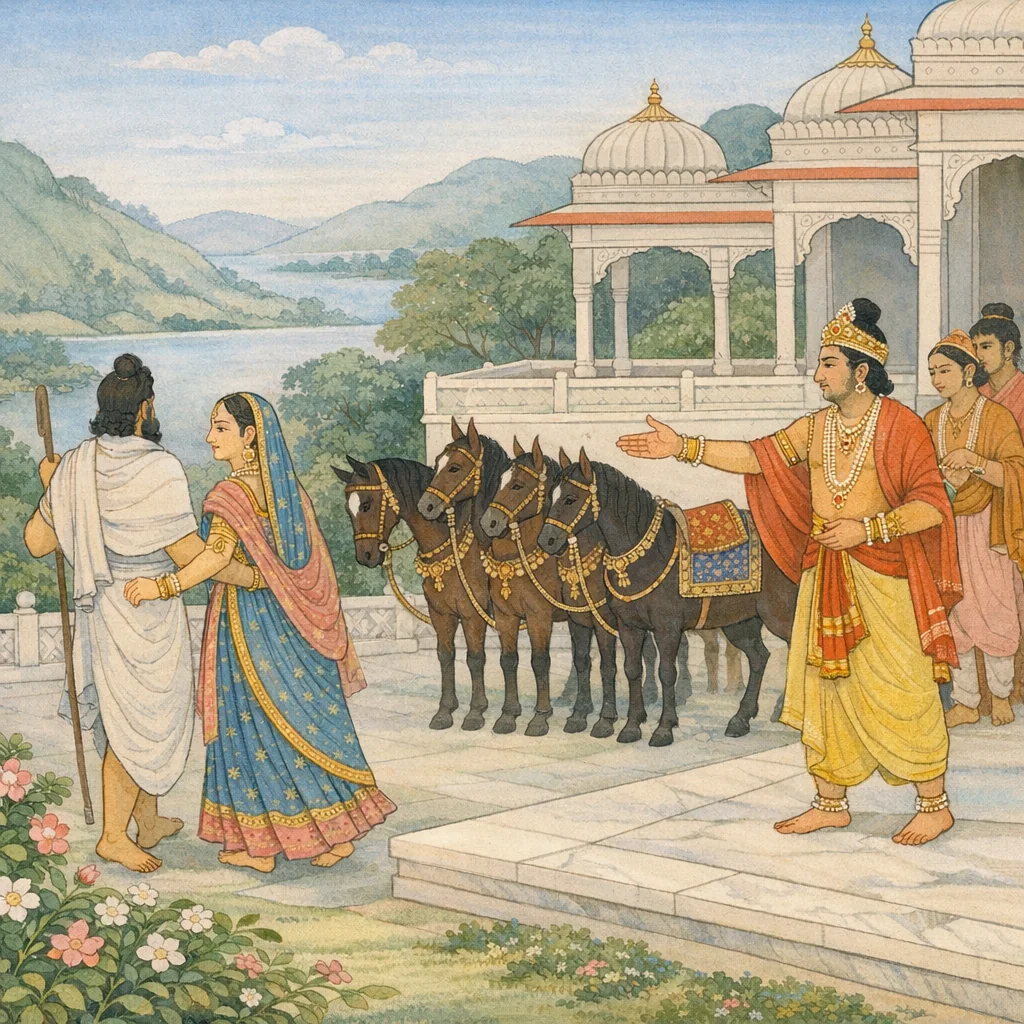
This chapter is framed by alternating speakers (Gālava, Nārada, and King Divodāsa of Kāśī). Gālava identifies Divodāsa as a renowned, self-controlled, truthful ruler and urges Mādhavī to proceed without anxiety. Nārada narrates the approach and proper reception of the sage, after which Gālava requests assistance for the purpose of progeny within the constraints of an existing arrangement. Divodāsa acknowledges prior knowledge of the matter, approves Gālava’s choice, and agrees to beget a single royal son through Mādhavī. Nārada formally gives the maiden to the king, who accepts her according to prescribed procedure. The text then employs a sustained series of similes comparing the couple’s harmonious union to paradigmatic divine and exemplary pairings, emphasizing concord and legitimacy. Mādhavī bears one son, Pratardana. When the agreed time arrives, Gālava returns and requests the release of the maiden while the horses remain; Divodāsa, steadfast in truth, returns her in accordance with the stipulated terms.
Chapter Arc: नारद के कथन से गालव-चरित आगे बढ़ता है: राजा हर्यश्व माधवी के विषय में गहन विचार करते हैं—संतान की इच्छा, वचन की मर्यादा, और दुर्लभ श्यामकर्ण अश्वों का दबाव एक साथ उपस्थित हो उठता है। → हर्यश्व गालव से कहते हैं कि वे माधवी से एक पुत्र उत्पन्न करेंगे, पर शर्तों का गणित कठोर है—चार राजाओं से दो-दो सौ अश्व मिलकर आठ सौ पूरे होंगे, और हर्यश्व को ‘शुल्क’ का चतुर्थांश देकर कन्या ग्रहण करनी है। परंतु शेष छह सौ श्यामकर्ण अश्वों की दुर्लभता राजा के संकल्प को परीक्षा में डाल देती है। → सत्यवचन पर दृढ़ हर्यश्व, पुरुषार्थ में समर्थ होते हुए भी, छह सौ श्यामकर्ण अश्व न जुट पाने के कारण माधवी को लौटा देते हैं—यह क्षण दिखाता है कि सामर्थ्य से अधिक निर्णायक है प्रतिज्ञा की शुद्धता और असंभव की स्वीकृति। → गालव प्रस्थान करते समय हर्यश्व से कहते हैं कि जो अश्व अभी उपलब्ध हैं वे वहीं रहें; फिर वे माधवी को साथ लेकर अगले राजा—दिवोदास—की ओर बढ़ते हैं, ताकि यज्ञ-शुल्क की शेष पूर्ति हो सके। → गालव और माधवी दिवोदास के द्वार पर—क्या अगला राजा शेष अश्व देगा, या फिर एक और नई शर्त कथा को और कठिन मोड़ देगी?
Shlokas
Verse 1
ऑपन-आक्रात बछ। अं क्ाञाज षोडशाधिकशततमोब<्ध्याय: हर्यश्वका दो सौ श्यामकर्ण घोड़े देकर ययातिकन्याके गर्भसे वसुमना नामक पुत्र उत्पन्न करना और गालवका इस कन्याके साथ वहाँसे प्रस्थान नारद उवाच हर्यश्वस्त्वब्रवीद् राजा विचिन्त्य बहुधा ततः । दीर्घमुष्णं च नि:श्वस्य प्रजाहेतोर्नपोत्तम:
Narada said: Then King Haryaśva, after pondering the matter in many ways, spoke. The best of kings, heaving a long, heated sigh—burdened by concern for progeny and the continuance of his line—addressed the situation with the gravity of one who must place dynastic duty above personal ease.
Verse 2
उन्नतेषूतन्नता षट्सु सूक्ष्मा सूक्ष्मेषु पडचसु । गम्भीरा त्रिषु गम्भीरेष्वियं रक्ता च पउचसु
Nārada said: “This (principle/quality) rises among the exalted and bends among the bent; it is subtle in six, subtler still among the subtle; it is deep in three, deeper among the deep; and it is also ‘red’ in five—colored by passion and attachment.”
Verse 3
नारदजी कहते हैं--तदनन्तर नृपतिश्रेष्ठ राजा हर्यश्वने उस कनन््याके विषयमें बहुत सोच-विचारकर संतानोत्पादनकी इच्छासे गरम-गरम लम्बी साँस खींचकर मुनिसे इस प्रकार कहा--(द्विजश्रेष्ठ) इस कनन््याके छ: अंग जो ऊँचे होने चाहिये, ऊँचे हैं। पाँच अंग जो सूक्ष्म होने चाहिये, सूक्ष्म हैं। तीन अंग जो गम्भीर होने चाहिये, गम्भीर हैं तथा इसके पाँच अंग रक्तवर्णके हैं ।। (श्रोण्यौ ललाटमूरू च प्राणं चेति षद्ुन्नतम् । सूक्ष्माण्यड्गुलिपर्वाणि केशरोमनखत्वच: ।। स्वर: सत्त्वं च नाभिश्ष त्रिगम्भीरं प्रचक्षते । पाणिपादतले रक्ते नेत्रान्तौ च नखानि च ।। ) “दो नितम्ब, दो जाँघें, ललाट और नासिका-ये छः अंग ऊँचे हैं। अंगुलियोंके पर्व, केश, रोम, नख और त्वचा--ये पाँच अंग सूक्ष्म हैं। स्वर, अन्त:करण तथा नाभि--ये तीन गम्भीर कहे जा सकते हैं तथा हथेली, पैरोंके तलवे, दक्षिण नेत्रप्रान्त, वाम नेत्रप्रान्त तथा नख--ये पाँच अंग रक्तवर्णके हैं। बहुदेवासुरालोका बहुगन्धर्वदर्शना । बहुलक्षणसम्पन्ना बहुप्रसवधारिणी,“यह बहुत-से देवताओं तथा असुरोंके लिये भी दर्शनीय है। इसे गन्धर्वविद्या (संगीत)- का भी अच्छा ज्ञान है। यह बहुत-से शुभ लक्षणोंद्वारा सुशोभित तथा अनेक संतानोंको जन्म देनेमें समर्थ है
Nārada said: After this, the best of kings, King Haryaśva, having reflected deeply on the maiden and desiring offspring, drew a long, heated breath and spoke to the sage as follows: “O best of twice-born ones, in this girl the six features that ought to be prominent are prominent; the five that ought to be fine are fine; the three that ought to be deep are deep; and five of her features are of a ruddy hue. Her hips, forehead, thighs, and vital breath are counted among the six prominent features; the joints of the fingers, her hair, body-hair, nails, and skin are the five fine features; her voice, inner disposition, and navel are said to be deep; and her palms, soles, the corners of her eyes, and her nails are reddish. She is worthy to be seen even by many gods and asuras, is pleasing to the Gandharvas, is endowed with many auspicious marks, and is capable of bearing many children.”
Verse 4
समर्थेयं जनयितुं चक्रवर्तिनमात्मजम् । ब्रृहि शुल्कं द्विजश्रेष्ठ समीक्ष्य विभवं मम,“विप्रवर! आपकी यह कन्या चक्रवर्ती पुत्र उत्पन्न करनेमें समर्थ है; अतः आप मेरे वैभवको देखते हुए इसके लिये समुचित शुल्क बताइये”
“This maiden is capable of bearing a son who will become a universal sovereign. Therefore, O best of Brahmins, after considering my means and resources, declare the appropriate bride-price for her.”
Verse 5
गालव उवाच एकत: श्यामकर्णानां शतान्यष्टौ प्रयच्छ मे । हयानां चन्द्रशु भ्राणां देशजानां वपुष्मताम्,गालवने कहा--राजन्! आप मुझे अच्छे देश और अच्छी जातिमें उत्पन्न हृष्ट-पुष्ट अंगोंवाले आठ सौ ऐसे घोड़े प्रदान कीजिये, जो चन्द्रमाके समान उज्ज्वल कान्तिसे विभूषित हों तथा उनके कान एक ओरसे श्यामवर्णके हों। यह शुल्क चुका देनेपर मेरी यह विशाल नेत्रोंवाली शुभलक्षणा कन्या अग्नियोंको प्रकट करनेवाली अरणीकी भाँति आपके तेजस्वी पुत्रोंकी जननी होगी
Gālava said: “Grant me eight hundred horses—fine, well-bred, and robust, born in good regions—whose bodies shine with moonlike whiteness, yet whose ears are dark on one side.”
Verse 6
ततस्तव भवित्रीयं पुत्राणां जननी शुभा । अरणीव हुताशानां योनिरायतलोचना,गालवने कहा--राजन्! आप मुझे अच्छे देश और अच्छी जातिमें उत्पन्न हृष्ट-पुष्ट अंगोंवाले आठ सौ ऐसे घोड़े प्रदान कीजिये, जो चन्द्रमाके समान उज्ज्वल कान्तिसे विभूषित हों तथा उनके कान एक ओरसे श्यामवर्णके हों। यह शुल्क चुका देनेपर मेरी यह विशाल नेत्रोंवाली शुभलक्षणा कन्या अग्नियोंको प्रकट करनेवाली अरणीकी भाँति आपके तेजस्वी पुत्रोंकी जननी होगी
Gālava said: “Then this auspicious, large-eyed maiden will become the mother of your sons. Like the araṇī (fire-stick) that serves as the womb from which the sacred fires are brought forth, so will she be the source from which your illustrious sons will arise—once the stipulated bride-price has been duly paid.”
Verse 7
नारद उवाच एतच्छुत्वा वचो राजा हर्यश्वः काममोहित: । उवाच गालवं दीनो राजर्षिऋषिसत्तमम्,नारदजी कहते हैं--यह वचन सुनकर काममोहित हुए राजर्षि महाराज हर्यश्व मुनिश्रेष्ठ गालवसे अत्यन्त दीन होकर बोले--
Narada said: Hearing these words, King Haryaśva—his judgment clouded by desire—addressed the sage Gālava. The royal seer, overwhelmed and humbled, spoke to that foremost of ascetics.
Verse 8
द्वे मे शते संनिहिते हयानां यद्धिधास्तव । एष्टव्या: शतशस्त्वन्ये चरन्ति मम वाजिन:,“ब्रह्म! आपको जैसे घोड़े लेने अभीष्ट हैं, वैसे तो मेरे यहाँ इन दिनों दो ही सौ घोड़े मौजूद हैं; किंतु दूसरी जातिके कई सौ घोड़े यहाँ विचरते हैं
Nārada said: “Brahmā, at present I have only two hundred horses ready and available—of the very kind you desire. Yet besides these, many hundreds of my other steeds, of different breeds, roam about here.”
Verse 9
सो5हमेकमपत्यं वै जनयिष्यामि गालव । अस्यामेतं भवान् काम॑ सम्पादयतु मे वरम्
Nārada said: “Therefore, O Gālava, I shall indeed beget a single child. In this woman, please see to the fulfillment of this desire of mine—grant me this boon.”
Verse 10
“अत: गालव! मैं इस कन्यासे केवल एक संतान उत्पन्न करूँगा। आप मेरे इस श्रेष्ठ मनोरथको पूर्ण करें” ।। एतच्छुत्वा तु सा कन्या गालवं वाक्यमत्रवीत् । मम दत्तो वर: कश्रित् केनचिद् ब्रह्म॒वादिना,यह सुनकर उस कन्याने महर्षि गालवसे कहा--'मुने! मुझे किन्हीं वेदवादी महात्माने यह एक वर दिया था कि तुम प्रत्येक प्रसवके अन्तमें फिर कन्या ही हो जाओगी। अतः आप दो सौ उत्तम घोड़े लेकर मुझे राजाको सौंप दें
Nārada said, “Therefore, O Gālava, from this maiden I shall beget only a single child. Fulfil this noble intention of mine.” Hearing this, the maiden spoke to Gālava: “Sage, a boon was once granted to me by a certain Veda-knowing seer: after each childbirth I shall become a maiden again. Therefore, take two hundred excellent horses and deliver me to the king.”
Verse 11
प्रसूत्यन्ते प्रसूत्यन्ते कन्यैव त्वं भविष्यसि । स त्वं ददस्व मां राजे प्रतिगृह्म हयोत्तमान्,यह सुनकर उस कन्याने महर्षि गालवसे कहा--'मुने! मुझे किन्हीं वेदवादी महात्माने यह एक वर दिया था कि तुम प्रत्येक प्रसवके अन्तमें फिर कन्या ही हो जाओगी। अतः आप दो सौ उत्तम घोड़े लेकर मुझे राजाको सौंप दें
Nārada said: “At the end of each childbirth, you will become a maiden again. Therefore, O king, accept me: take these finest horses (as the due gift).”
Verse 12
नृपेभ्यो हि चतुर्भ्यस्ते पूर्णान्यष्टी शतानि मे । भविष्यन्ति तथा पुत्रा मम चत्वार एव च,“इस प्रकार चार राजाओंसे दो-दो सौ घोड़े लेनेपर आपके आठ सौ घोड़े पूरे हो जायाँगे और मेरे भी चार ही पुत्र होंगे
Nārada said: “Indeed, from four kings, by taking two hundred horses from each, your total will be completed as eight hundred. And as for me, I shall have only four sons.”
Verse 13
क्रियतामुपसंहारो गुर्वर्थ द्विजसत्तम | एषा तावन्मम प्रज्ञा यथा वा मन्यसे द्विज,“विप्रवर! इसी तरह आप गुरुदक्षिणाके लिये धनका संग्रह करें, यही मेरी मान्यता है। फिर आप जैसा ठीक समझें, वैसा करें”
Nārada said: “O best of brāhmaṇas, let this matter now be brought to its close, for the sake of the guru’s due (guru-dakṣiṇā). This, for the present, is my considered counsel; yet, O brāhmaṇa, act as you yourself judge to be right.”
Verse 14
एवमुक्तस्तु स मुनि: कन््यया गालवस्तदा । हर्यश्नं पृथिवीपालमिदं वचनमत्रवीत्,कन्याके ऐसा कहनेपर उस समय गालव मुनिने भूपाल हर्यश्वसे यह बात कही --
Thus addressed by the maiden, the sage Gālava then spoke these words to King Haryaśva, the ruler of the earth—continuing the negotiation with due propriety, mindful of the obligations that bind both ascetics and kings.
Verse 15
इयं कन्या नरश्रेष्ठ हर्यश्व॒ प्रतिगृह्मताम् चतुभगिेन शुल्कस्य जनयस्वैकमात्मजम्,“नरश्रेष्ठ हर्यश्व! नियत शुल्कका चौथाई भाग देकर आप इस कन्याको ग्रहण करें और इसके गर्भसे केवल एक पुत्र उत्पन्न कर लें”
Nārada said: “O best of men, Haryaśva, accept this maiden. Having paid one-fourth of the stipulated bride-price (śulka), beget from her only a single son.”
Verse 16
प्रतिगृह्म स तां कन्यां गालवं प्रतिनन्द्य च । समये देशकाले च लब्धवान् सुतमीप्सितम्,तब राजाने गालव मुनिका अभिनन्दन करके उस कन्याको ग्रहण किया और उचित देश-कालमें उसके-द्वारा एक मनोवांछित पुत्र प्राप्त किया
Having accepted that maiden and duly honoring the sage Gālava, the king, at the proper time and in the fitting place, obtained through her the son he had long desired.
Verse 17
ततो वसुमना नाम वसुभ्यो वसुमत्तर: । वसुप्रख्यो नरपति: स बभूव वसुप्रद:,तदनन्तर उनका वह पुत्र वसुमनाके नामसे विख्यात हुआ। वह वसुओंके समान कान्तिमान् तथा उनकी अपेक्षा भी अधिक धन-रत्नोंसे सम्पन्न और धनका खुले हाथ दान करनेवाला नरेश हुआ
Then there arose a king renowned by the name Vasuman. Radiant like the Vasus—and even surpassing them in wealth—he became famed as a generous ruler, one who bestowed riches freely.
Verse 18
अथ काले पुनर्धीमान् गालव: प्रत्युपस्थित: । उपसंगम्य चोवाच हर्यश्च॑ं प्रीतमानसम्,तत्पश्चात् उचित समयपर बुद्धिमान् गालव पुनः वहाँ उपस्थित हुए और प्रसन्नचित्त राजा हर्यश्वसे मिलकर इस प्रकार बोले--
Then, at the proper time, the wise Gālava arrived again. Approaching King Haryaśva, whose heart was pleased, he spoke—signaling a courteous request, timely and framed in reverence for royal dignity and righteous conduct.
Verse 19
जातो नृप सुतस्ते5यं बालो भास्करसंनिभ:। कालो गन्तुं नरश्रेष्ठ भिक्षार्थमपरं नृपम्,“नरश्रेष्ठ नरेश! आपको यह सूर्यके समान तेजस्वी पुत्र प्राप्त हो गया। अब इस कनन््याके साथ घोड़ोंकी याचना करनेके लिये दूसरे राजाके यहाँ जानेका अवसर उपस्थित हुआ है!
Nārada said: “O king, this son of yours has been born—still a child, yet radiant like the sun. Now, O best of men, the time has come for you to go to another ruler to seek horses as a boon.”
Verse 20
हर्यश्व: सत्यवचने स्थित: स्थित्वा च पौरुषे । दुर्लभत्वाद्धयानां च प्रददौ माधवीं पुन:
Nārada said: Haryaśva, steadfast in truth and firm in manly resolve, and considering how rare such horses were, gave Mādhavī back once again.
Verse 21
राजा हर्यश्व॒ सत्य वचनपर दृढ़ रहनेवाले थे। उन्होंने पुरुषार्थमें समर्थ होकर भी छ: सौ श्यामकर्ण घोड़े दुर्लभ होनेके कारण माधवीको पुनः लौटा दिया ।। माधवी च पुनर्दीप्तां परित्यज्य नृपश्रियम् कुमारी कामतो भूत्वा गालवं पृष्ठतो5न्वयात्,माधवी पुनः इच्छानुसार कुमारी होकर अयोध्याकी उज्ज्वल राजलक्ष्मीका परित्याग करके गालव मुनिके पीछे-पीछे चली गयी
Nārada said: King Haryaśva was steadfast in truth. Though capable of exerting himself, he returned Mādhavī because the six hundred dark-eared horses were exceedingly hard to obtain. Mādhavī, for her part, renounced the radiant royal fortune of Ayodhyā; becoming a maiden again by her own will, she followed behind the sage Gālava.
Verse 22
त्वय्येव तावत् तिष्ठन्तु हया इत्युक्तवान् द्विज: । प्रययौ कन्यया सार्ध दिवोदासं प्रजेश्वरम्,जाते समय ब्राह्मणने राजा हर्यश्वसे कहा--“महाराज! आपके दिये हुए दो सौ श्यामकर्ण घोड़े अभी आपके ही पास धरोहरके रूपमें रहें।! ऐसा कहकर गालव मुनि उस राजकन्याके साथ राजा दिवोदासके यहाँ गये
Nārada said: “Let the horses remain with you for the time being,” said the brāhmaṇa. Having spoken thus, he departed together with the maiden to King Divodāsa, the lord of the people.
Verse 116
इति श्रीमहाभारते उद्योगपर्वणि भगवद्यानपर्वणि गालवचरिते षोडशाधिकशततमो<ध्याय:
Thus ends the one-hundred-and-sixteenth chapter of the Udyoga Parva of the Śrī Mahābhārata, within the section known as “Bhagavad-yāna” (the Lord’s mission), and specifically the episode concerning Gālava. This closing colophon marks the completion of the chapter’s narrative unit and sets it within the larger ethical arc of diplomacy, duty (dharma), and the attempt to avert war through righteous counsel and action.
Frequently Asked Questions
The ethical tension concerns how to fulfill a vow-bound objective (progeny and agreed exchange) without violating ritual propriety or personal integrity—resolved through consent, formal procedure, and strict adherence to the stipulated timeframe.
The chapter models governance and personal conduct grounded in satya: legitimacy arises when power and desire are constrained by promise-keeping, orderly rites, and reciprocal respect between social orders.
No explicit phalaśruti is stated here; the meta-significance is implicit—understanding this episode clarifies how dharma operates through contracts, timing, and social procedure, which the epic treats as causal forces shaping historical outcomes.