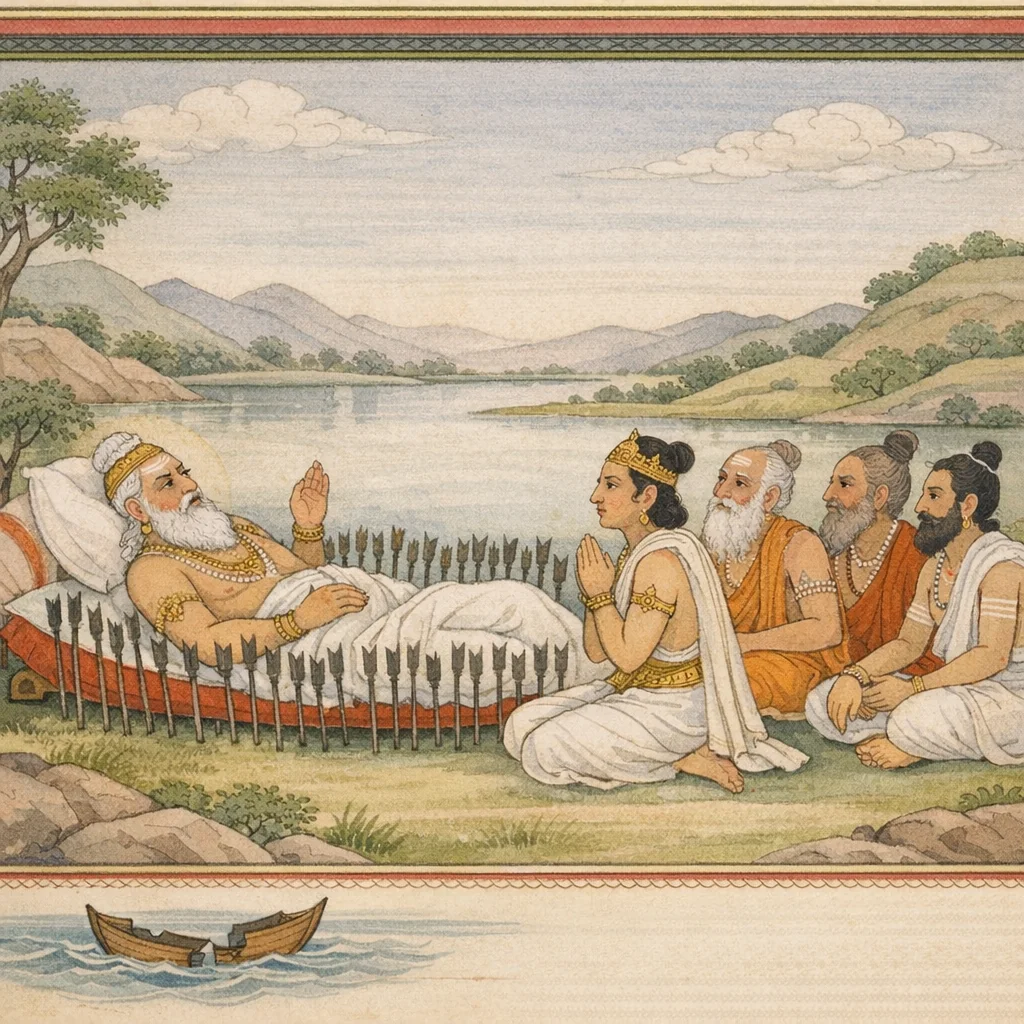
Adhyaya 86
Vyavahāra-Śuddhi and Rājadharma: Clean Administration, Counsel, and Proportional Punishment (Chapter 86)
Upa-parva: Rājadharmānuśāsana Upa-Parva (Instruction on Royal Duty)
Chapter 86 frames enduring fame (kīrti) as the byproduct of dharma-consistent governance. Yudhiṣṭhira asks how a king, by protecting subjects, gains lasting repute; Bhīṣma answers that purity in legal-administrative procedure (śuddha-vyavahāra) yields both dharma and social legitimacy. The discourse then becomes operational: the king should rely on a structured advisory circle and qualified functionaries, emphasizing competence, memory, impartiality, and freedom from severe vices. It warns against secretive or destructive undertakings that can destabilize the realm, producing fear and undermining the ruler’s moral standing. Judicially, the chapter stresses assessing witness strength, giving special scrutiny to cases lacking witnesses or involving unprotected persons, and imposing penalties proportionate to offenses—without arbitrariness or mere hearsay. It prohibits harming envoys, defines desirable qualities of messengers and gatekeepers, and outlines competencies for negotiators and commanders. The chapter closes with a strategic maxim: the disciplined management of trust—encouraging confidence in others while avoiding naïve overreliance—even toward intimates, presented as a guarded principle of statecraft.
Chapter Arc: युधिष्ठिर, युद्धोत्तर शोक और राज्य-भार के बीच, भीष्म से पूछते हैं—राजा को किन-किन लोगों के साथ कैसा ‘व्यवहार’ (प्रशासनिक आचरण/प्रक्रिया) रखना चाहिए कि धर्म भी बचे और कीर्ति भी। → भीष्म राजधर्म को ‘शुद्ध व्यवहार’ की कसौटी पर रखते हैं: मंत्रिमण्डल का गठन, दूत-द्वारपाल-शिरोरक्षक-सेनापति जैसे पदों के गुण, और निर्णयों को परामर्श से निश्चित कर राष्ट्र में प्रचारित करने की विधि बताते हैं; साथ ही चेताते हैं कि अन्याय/अविश्वसनीयता से प्रजा श्येन से पक्षियों की तरह बिखर जाएगी और राज्य समुद्र में टूटी नाव की तरह रिस-रिस कर नष्ट होगा। → दण्डनीति का निर्णायक प्रतिपादन—‘सम्यक् प्रणयतः दण्डं’ अर्थात दण्ड यदि युक्ति, मर्यादा और न्याय से लगाया जाए तो वह अधर्म नहीं, शाश्वत धर्म का ही रूप है; और राजाओं का ‘गुह्य’ गुण—अति-विश्वास से बचना—राज्य-रक्षा का रहस्य कहा जाता है। → भीष्म नीति-शास्त्र का सार समेटते हैं: शुद्ध आचरण, सुविचारित परामर्श, सार्वजनिक रूप से स्थापित निर्णय, और न्याययुक्त दण्ड—इन्हीं से राजा धर्म, कीर्ति और प्रजा-पालन प्राप्त करता है। → युधिष्ठिर के सामने अगला प्रश्न खुला रह जाता है—जब ‘अविश्वास’ को राज-गुण कहा गया, तब करुणा, विश्वास और पारदर्शिता की सीमा कहाँ तक धर्मसंगत है?
Shlokas
Verse 1
भीकम (2 अमान पञ्चाशीतितमोब<् ध्याय: राजाकी व्यावहारिक नीति, मन्त्रिमण्डलका संघटन, दण्डका औचित्य तथा दूत, द्वारपाल, शिरोरक्षक, मन्त्री और सेनापतिके गुण युधिछिर उवाच कथं स्विदिह राजेन्द्र पालयन् पार्थिव: प्रजा: । प्रीतिं धर्मविशेषेण कीर्तिमाप्रोति शाश्वतीम्,युधिष्ठिरने पूछा--राजेन्द्र! इस जगतमें राजा किस प्रकार धर्मविशेषके द्वारा प्रजाका पालन करे, जिससे वह लोगोंका प्रेम और अक्षय कीर्ति प्राप्त कर सके?
Yudhiṣṭhira said: “O king among kings, how should a ruler in this world protect and govern his subjects so that, by a distinctive adherence to dharma, he wins their affection and attains enduring fame?”
Verse 2
भीष्म उवाच व्यवहारेण शुद्धेन प्रजापालनतत्पर: । प्राप्प धर्म च कीर्ति च लोकानाप्रोत्युभी शुचि:,भीष्मजीने कहा--राजन्! जो राजा बाहर-भीतरसे पवित्र रहकर शुद्ध व्यवहारसे प्रजापालनमें तत्पर रहता है, वह धर्म और कीर्ति प्राप्त करके इहलोक और परलोक दोनोंको सुधार लेता है
Bhīṣma said: “O king, the ruler who is pure outwardly and inwardly, and who is devoted to protecting the people through upright and untainted conduct, gains both dharma and renown, and sets in order both this world and the next.”
Verse 3
युधिछिर उवाच कीदशैरव्यवहारैस्तु कैश्न व्यवहरेन्नप: । एतत्पृष्टो महाप्राज्ञ यथावद् वक्तुमहसि,युधिष्ठिरे पूछा--महामते! राजाको किस-किस प्रकारके लोगोंसे किस-किस प्रकारका बर्ताव काममें लाना चाहिये? मेरे इस प्रश्नचका आप यथावत््रूपसे समाधान करें
Yudhiṣṭhira said: “O greatly wise one, with what kinds of people—especially those of improper conduct—and in what manner should a king conduct his dealings? Since I ask you this, you ought to explain it correctly and in due order.”
Verse 4
ये चैव पूर्व कथिता गुणास्ते पुरुष प्रति । नैकस्मिन् पुरुषे होते विद्यन्त इति मे मति:,मेरी तो ऐसी मान्यता है कि पहले आपने पुरुषके लिये जिन गुणोंका वर्णन किया है, वे सब किसी एक पुरुषमें नहीं मिल सकते
Yudhiṣṭhira said: “The virtues you previously described as belonging to an ideal man, in my understanding, cannot all be found together in any single person.”
Verse 5
भीष्म उवाच एवमेतन्महाप्राज्ञ यथा वदसि बुद्धिमन् । दुर्लभ: पुरुष: कश्रिदेभियुक्तो गुणै: शूभै:,भीष्मजीने कहा--महा प्राज्ञ! परम बुद्धिमान् युधिष्ठिर! तुम जैसा कहते हो, वह ठीक ऐसा ही है। वस्तुत: इन सभी शुभ गुणोंसे सम्पन्न किसी एक पुरुषका मिलना कठिन है
Bhishma said: “So it is, O great sage; just as you say, O wise one. Indeed, it is rare to find even a single man who is endowed with these auspicious virtues.”
Verse 6
किंतु संक्षेपत: शीलं प्रयत्नेनेह दुर्लभम् । वक्ष्यामि तु यथामात्यान् यादृशांश्व करिष्यसि,इसलिये तुम जिस भावसे जैसे मन्त्रियोंको संगठित करोगे अर्थात् करना चाहते हो, उनका दुर्लभ शील-स्वभाव जैसा होना चाहिये--इस बातको मैं प्रयत्नपूर्वक संक्षेपसे बताऊँगा
“Yet, even with effort, such good character is hard to find in this world. Still, I shall tell you—briefly and with care—what manner of disposition your ministers should possess, according to how you mean to organize them.”
Verse 7
चतुरो ब्राह्मणान् वैद्यान् प्रगल्भान् स्नातकान् शुचीन् । क्षत्रियांश्ष॒ तथा चाष्टौ बलिन: शस्त्रपाणिन:,राजाको चाहिये कि जो वेदविद्याके विद्वान, निर्भीक, बाहर-भीतरसे शुद्ध एवं स्नातक हों, ऐसे चार ब्राह्मण, शरीरसे बलवान् तथा शस्त्रधारी आठ क्षत्रिय, धन-धान्यसे सम्पन्न इक्कीस वैश्य, पवित्र आचार-विचारवाले तीन विनयशील शूद्र तथा आठः गुणोंसे युक्त एवं पुराणविद्याको जाननेवाला एक सूत जातिका मनुष्य--इन सब लोगोंका एक मन्त्रिमण्डल बनावे। उस सूतकी अवस्था लगभग पचास वर्षकी हो और वह निर्भीक, दोषदृष्टिसे रहित, श्रुतियों और स्मृतियोंके ज्ञानसे सम्पन्न, विनयशील, समदर्शी, वादी-प्रतिवादीके मामलोंका निपटारा करनेमें समर्थ, लोभरहित और अत्यन्त भयंकर सातः प्रकारके दुर्व्यसनोंसे बहुत दूर रहनेवाला हो। ऐसे आठ मन्त्रियोंके बीचमें राजा गुप्त मन्त्रणा करे
Bhishma said: “A king should appoint as counsellors four Brahmins—learned in the Veda and its disciplines, confident in speech and conduct, initiated graduates (snātakas), and pure in outward and inward discipline—and also eight Kshatriyas who are physically strong and bear arms.”
Verse 8
वैश्यान् वित्तेन सम्पन्नानेकविंशतिसंख्यया । त्रींक्ष शूद्रान् विनीतांश्व शुचीन् कर्मणि पूर्वके,राजाको चाहिये कि जो वेदविद्याके विद्वान, निर्भीक, बाहर-भीतरसे शुद्ध एवं स्नातक हों, ऐसे चार ब्राह्मण, शरीरसे बलवान् तथा शस्त्रधारी आठ क्षत्रिय, धन-धान्यसे सम्पन्न इक्कीस वैश्य, पवित्र आचार-विचारवाले तीन विनयशील शूद्र तथा आठः गुणोंसे युक्त एवं पुराणविद्याको जाननेवाला एक सूत जातिका मनुष्य--इन सब लोगोंका एक मन्त्रिमण्डल बनावे। उस सूतकी अवस्था लगभग पचास वर्षकी हो और वह निर्भीक, दोषदृष्टिसे रहित, श्रुतियों और स्मृतियोंके ज्ञानसे सम्पन्न, विनयशील, समदर्शी, वादी-प्रतिवादीके मामलोंका निपटारा करनेमें समर्थ, लोभरहित और अत्यन्त भयंकर सातः प्रकारके दुर्व्यसनोंसे बहुत दूर रहनेवाला हो। ऐसे आठ मन्त्रियोंके बीचमें राजा गुप्त मन्त्रणा करे
Bhishma said: “Let the king appoint, as part of his council, twenty-one Vaiśyas who are prosperous in wealth, and three Śūdras who are disciplined and pure, trained in their customary duties.”
Verse 9
अष्टभिश्न गुणैर्युक्त सूतं पौराणिकं तथा । पज्चाशद्वधर्षवयसं प्रगल्भमनसूयकम्,राजाको चाहिये कि जो वेदविद्याके विद्वान, निर्भीक, बाहर-भीतरसे शुद्ध एवं स्नातक हों, ऐसे चार ब्राह्मण, शरीरसे बलवान् तथा शस्त्रधारी आठ क्षत्रिय, धन-धान्यसे सम्पन्न इक्कीस वैश्य, पवित्र आचार-विचारवाले तीन विनयशील शूद्र तथा आठः गुणोंसे युक्त एवं पुराणविद्याको जाननेवाला एक सूत जातिका मनुष्य--इन सब लोगोंका एक मन्त्रिमण्डल बनावे। उस सूतकी अवस्था लगभग पचास वर्षकी हो और वह निर्भीक, दोषदृष्टिसे रहित, श्रुतियों और स्मृतियोंके ज्ञानसे सम्पन्न, विनयशील, समदर्शी, वादी-प्रतिवादीके मामलोंका निपटारा करनेमें समर्थ, लोभरहित और अत्यन्त भयंकर सातः प्रकारके दुर्व्यसनोंसे बहुत दूर रहनेवाला हो। ऐसे आठ मन्त्रियोंके बीचमें राजा गुप्त मन्त्रणा करे
Bhishma said: “The king should also appoint a Sūta—one who is learned in the Purāṇic tradition—endowed with eight virtues: about fifty years of age, confident and courageous, free from fault-finding and envy.”
Verse 10
श्रुतिस्मृतिसमायुक्तं विनीतं समदर्शिनम् । कार्य विवदमानानां शक्तमर्थेष्वलोलुपम्,राजाको चाहिये कि जो वेदविद्याके विद्वान, निर्भीक, बाहर-भीतरसे शुद्ध एवं स्नातक हों, ऐसे चार ब्राह्मण, शरीरसे बलवान् तथा शस्त्रधारी आठ क्षत्रिय, धन-धान्यसे सम्पन्न इक्कीस वैश्य, पवित्र आचार-विचारवाले तीन विनयशील शूद्र तथा आठः गुणोंसे युक्त एवं पुराणविद्याको जाननेवाला एक सूत जातिका मनुष्य--इन सब लोगोंका एक मन्त्रिमण्डल बनावे। उस सूतकी अवस्था लगभग पचास वर्षकी हो और वह निर्भीक, दोषदृष्टिसे रहित, श्रुतियों और स्मृतियोंके ज्ञानसे सम्पन्न, विनयशील, समदर्शी, वादी-प्रतिवादीके मामलोंका निपटारा करनेमें समर्थ, लोभरहित और अत्यन्त भयंकर सातः प्रकारके दुर्व्यसनोंसे बहुत दूर रहनेवाला हो। ऐसे आठ मन्त्रियोंके बीचमें राजा गुप्त मन्त्रणा करे
Bhishma said: “(The king should appoint as a counsellor) one who is grounded in both revelation and tradition (śruti and smṛti), disciplined in conduct, impartial in outlook, competent to settle disputes arising in matters of duty and administration, and free from greed in questions of wealth and advantage.”
Verse 11
वर्जित चैव व्यसनै: सुघोरै: सप्तभिर्भुशम् अष्टानां मन्त्रिणां मध्ये मन्त्र राजोपधारयेत्,राजाको चाहिये कि जो वेदविद्याके विद्वान, निर्भीक, बाहर-भीतरसे शुद्ध एवं स्नातक हों, ऐसे चार ब्राह्मण, शरीरसे बलवान् तथा शस्त्रधारी आठ क्षत्रिय, धन-धान्यसे सम्पन्न इक्कीस वैश्य, पवित्र आचार-विचारवाले तीन विनयशील शूद्र तथा आठः गुणोंसे युक्त एवं पुराणविद्याको जाननेवाला एक सूत जातिका मनुष्य--इन सब लोगोंका एक मन्त्रिमण्डल बनावे। उस सूतकी अवस्था लगभग पचास वर्षकी हो और वह निर्भीक, दोषदृष्टिसे रहित, श्रुतियों और स्मृतियोंके ज्ञानसे सम्पन्न, विनयशील, समदर्शी, वादी-प्रतिवादीके मामलोंका निपटारा करनेमें समर्थ, लोभरहित और अत्यन्त भयंकर सातः प्रकारके दुर्व्यसनोंसे बहुत दूर रहनेवाला हो। ऐसे आठ मन्त्रियोंके बीचमें राजा गुप्त मन्त्रणा करे
Bhishma said: “Let the king be thoroughly free from the seven most dreadful vices. Then, in the midst of eight ministers, the king should deliberate upon counsel in secrecy.”
Verse 12
ततः सम्प्रेषयेद् राष्ट्रे राष्ट्रियाय च दर्शयेत् । अनेन व्यवहारेण द्रष्टव्यास्ते प्रजा: सदा,इन सबकी रायसे जो बात निश्चित हो, उसको देशमें प्रचारित करे और राष्ट्रके प्रत्येक नागरिकको इसका ज्ञान करा दे। युधिष्ठिर! इस प्रकारके व्यवहारसे तुम्हें सदा प्रजावर्गकी देख-रेख करनी चाहिये
Bhishma said: “Thereafter, let the king have it formally communicated throughout the realm, and let it be made known to each citizen. By conducting affairs in this manner—through transparent proclamation and public awareness—you must continually keep watch over the welfare and condition of your subjects, O Yudhishthira.”
Verse 13
न चापि गूढं द्रव्यं ते ग्राह्मे कार्योपघातकम् । कार्य खलु विपन्ने त्वां सो<धर्मस्तांश्व पीडयेत्,राजन! तुमको किसीका कोई गुप्त धन ग्रहण नहीं करना चाहिये; क्योंकि वह तुम्हारे कर्तव्य--न्यायधर्मका नाश करनेवाला होगा। यदि कहीं वास्तवमें तुम्हारे न््यायधर्मका नाश हुआ तो वह अधर्म तुम्हें और तुम्हारे मन्त्रियोंको बड़े कष्टमें डाल देगा
Bhīṣma said: “Nor should you accept any hidden or secret wealth, for it undermines your rightful duty—your work of justice and governance. If your public duty is truly brought to ruin, that very adharma will afflict you, O king, and it will also bring great suffering upon your ministers.”
Verse 14
विद्रवेच्चैव राष्ट्र ते श्येनात् पक्षिगणा इव । परिस्रवेच्च सततं नौर्विशीर्णेव सागरे,फिर तो तुम्हें अन्यायी मानकर राष्ट्रकी सारी प्रजा तुमसे उसी प्रकार दूर भागेगी, जैसे बाज पक्षीके डरसे दूसरे पक्षी भागते हैं तथा जैसे टूटी हुई नाव समुद्रमें कहाँकी कहाँ बह जाती है, उसी प्रकार प्रजा धीरे-धीरे तुम्हारा राज्य छोड़कर अन्यत्र चली जायगी
Bhīṣma said: “If you act unjustly, your kingdom itself will take flight from you—like flocks of birds scattering in fear of a hawk. And your realm will keep slipping away, ceaselessly, as a shattered boat in the ocean is carried off and lost. Thus the people, judging you to be unrighteous, will gradually abandon your rule and go elsewhere.”
Verse 15
प्रजा: पालयतो<सम्यगधर्मेणेह भूपते: । हार्द भयं सम्भवति स्वर्गक्षास्य विरुद्धयते,जो राजा अन्याय एवं अधर्मपूर्वक प्रजाका पालन करता है, उसके हृदयमें भय बना रहता है तथा उसका परलोक भी बिगड़ जाता है
Bhishma said: “O king, when a ruler governs his subjects improperly and not in accordance with dharma, an inward fear arises in his heart; and his hope of heaven and the welfare of the next world is thwarted.”
Verse 16
अथ यो<थधर्मत: पाति राजामात्योडथ वा55त्मज: । धर्मासने संनियुक्तो धर्ममूले नरर्षभ,नरश्रेष्ठ! धर्म ही जिसकी जड़ है, उस धर्मासन अथवा न्यायासनपर बैठकर जो राजा, मन्त्री अथवा राजकुमार धर्म-पूर्वक प्रजाकी रक्षा नहीं करता तथा राजाका अनुसरण करनेवाले राज्यके दूसरे अधिकारी भी यदि अपनेको सामने रखकर प्रजाके साथ उचित बर्ताव नहीं करते हैं तो वे राजाके साथ ही स्वयं भी नरकमें गिर जाते हैं
Bhishma said: “O bull among men, O best of men—whether it be the king, his minister, or his son: if, though appointed to sit upon the seat of Dharma (the court of justice) whose very foundation is righteousness, he does not protect the people in accordance with Dharma, then he fails in his charge. And if the other officers of the realm who follow the king likewise do not place themselves under the rule of fairness and deal properly with the subjects, they too fall—along with the king—into hell.”
Verse 17
कार्येष्वधिकृता: सम्यगकुर्वन्तो नृपानुगा: । आत्मानं पुरत: कृत्वा यान्त्यध: सहपार्थिवा:,नरश्रेष्ठ! धर्म ही जिसकी जड़ है, उस धर्मासन अथवा न्यायासनपर बैठकर जो राजा, मन्त्री अथवा राजकुमार धर्म-पूर्वक प्रजाकी रक्षा नहीं करता तथा राजाका अनुसरण करनेवाले राज्यके दूसरे अधिकारी भी यदि अपनेको सामने रखकर प्रजाके साथ उचित बर्ताव नहीं करते हैं तो वे राजाके साथ ही स्वयं भी नरकमें गिर जाते हैं
Bhishma said: “O best of men, those who are appointed to public duties—royal attendants and officers—if they do not perform their tasks rightly, and if, putting their own interests first, they fail to deal justly with the people, then they fall downward (into hell) together with the king.”
Verse 18
बलात्कृतानां बलिभि: कृपणं बहु जल्पताम् | नाथो वै भूमिपो नित्यमनाथानां नृणां भवेत्
Bhishma said: “Those who have been wronged by the powerful lament pitifully and speak at length. Therefore a king should always be a true protector—ever the refuge of people who have no other support.”
Verse 19
बलवानोंके बलात्कार (अत्याचार) से पीड़ित हो अत्यन्त दीनभावसे पुकार मचाते हुए अनाथ मनुष्योंको आश्रय देनेवाला उनका संरक्षक या स्वामी राजा ही होता है ।। ततः साक्षिबलं साधु द्वेधवादकृतं भवेत् । असाक्षिकमनाथं वा परीक्ष्यं तद् विशेषत:,जब कोई अभियोग उपस्थित हो और उसमें उभय पक्षद्वारा दो प्रकारकी बातें कही जायूँ, तब उसमें यथार्थताका निर्णय करनेके लिये साक्षीका बल श्रेष्ठ माना गया है (अर्थात् मौकेका गवाह बुलाकर उससे सच्ची बात जाननेका प्रयत्न करना चाहिये)। यदि कोई गवाह न हो तथा उस मामलेकी पैरवी करनेवाला कोई मालिक-मुख्तार न दिखायी दे तो राजाको स्वयं ही विशेष प्रयत्न करके उसकी छानबीन करनी चाहिये
Bhishma said: “When a dispute is brought forward and the two sides present conflicting versions, the strength of witness-testimony is rightly regarded as the best means for reaching the truth—one should therefore seek out and examine those who actually saw the matter. But if there are no witnesses, or if the complainant is helpless and without any protector or advocate, then the king must himself undertake a special and careful investigation. In this way the ruler becomes the refuge of the unprotected, especially of those oppressed by the violence of the powerful.”
Verse 20
अपराधानुरूपं च दण्डं पापेषु धारयेत् । वियोजयेद् धनैर््रद्धानधनानथ बन्धनै:,तत्पश्चात् अपराधियोंको अपराधके अनुरूप दण्ड देना चाहिये। अपराधी धनी हो तो उसको उसकी सम्पत्तिसे वज्चित कर दे और निर्धन हो तो उसे बन्दी बनाकर कारागारमें डाल दे
Bhishma said: Punishment should be imposed in proportion to the offence, especially in cases of wrongdoing. If the offender is wealthy, he should be separated from his wealth through fines or confiscation; if he is poor, he should be restrained by bonds—kept in custody or imprisonment. Thus, justice is to be corrective and proportionate, not arbitrary.
Verse 21
विनयेच्चापि दुर्वृत्तान् प्रहारैरपि पार्थिव: । सान्त्वेनोपप्रदानेन शिष्टांश्ष परिपालयेत्,जो अत्यन्त दुराचारी हों, उन्हें मार-पीटकर भी राजा राहपर लानेका प्रयत्न करे तथा जो श्रेष्ठ पुरुष हों, उन्हें मीठी वाणीसे सान्त्वना देते हुए सुख-सुविधाकी वस्तुएँ अर्पित करके उनका पालन करे
Bhīṣma said: A king should also try to bring the wicked and ill-conducted under discipline—even by the use of chastisement. But those who are cultured and virtuous he should protect and sustain through gentle speech, reassurance, and the granting of comforts and provisions. Thus, governance must combine firm correction of wrongdoing with respectful support of the good.
Verse 22
राज्ञो वधं चिकीर्षेद् यस्तस्य चित्रो वधो भवेत् | आदीपकस्य स्तेनस्य वर्णसंकरिकस्य च,जो राजाका वध करनेकी इच्छा करे, जो गाँव या घरमें आग लगावे, चोरी करे अथवा व्यभिचारद्वारा वर्णसंकरता फैलानेका प्रयत्न करे, ऐसे अपराधीका वध अनेक प्रकारसे करना चाहिये
Bhishma said: Whoever seeks to slay the king—his execution should be carried out in a conspicuous and exemplary manner. Likewise, the arsonist, the thief, and the one who promotes social disorder by causing intermixture of classes through illicit conduct are offenders whose killing is enjoined in various ways, so that the realm is protected and dharma is upheld.
Verse 23
सम्यक् प्रणयतो दण्डं भूमिपस्य विशाम्पते । युक्तस्य वा नास्त्यधर्मो धर्म एव हि शाश्वत:
Bhīṣma said: “When a king, O lord of the people, applies punishment rightly and with due measure, there is no unrighteousness in it. For when it is properly regulated and aligned with justice, punishment itself becomes enduring dharma.”
Verse 24
प्रजानाथ! जो भलीभाँति विचार करके अपराधीको उचित दण्ड देता है और अपने कर्त्तव्यपालनके लिये सदा उद्यत रहता है, उस राजाको वध और बन्धनका पाप नहीं लगता, अपितु उसे सनातन धर्मकी ही प्राप्ति होती है ।। कामकारेण दण्डं तु यः कुर्यादविचक्षण: । स इहाकीर्तिसंयुक्तो मृतो नरकमृच्छति,जो अज्ञानी नरेश बिना विचारे स्वेच्छापूर्वक दण्ड देता है, वह इस लोकमें तो अपयशका भागी होता है और मरनेपर नरकमें पड़ता है
Bhishma said: “O lord of the people! A king who, after careful deliberation, inflicts a fitting punishment upon the guilty and remains ever intent on fulfilling his royal duty does not incur the sin of killing or of binding; rather, he attains the eternal order of dharma. But the unwise ruler who, without discernment, imposes punishment out of mere whim becomes stained with disgrace in this world, and after death falls into hell.”
Verse 25
न परस्य प्रवादेन परेषां दण्डमर्पयेत् । आगमानुगमं कृत्वा बध्नीयान्मोक्षयीत वा,राजा दूसरेके अपराधपर दूसरोंको दण्ड न दे, बल्कि शास्त्रके अनुसार विचार करके अपराध सिद्ध होता हो तो अपराधीको कैद करे और सिद्ध न होता हो तो उसे मुक्त कर दे
Bhishma said: A king should not inflict punishment on people merely on the basis of another person’s accusation. After examining the matter in accordance with the authoritative teachings of the śāstras and established procedure, if the offence is proven he should confine the offender; if it is not proven, he should release him.
Verse 26
नतु हन्यान्नूपो जातु दूतं कस्याज्चिदापदि । दूतस्य हन्ता निरयमाविशेत् सचिवै: सह,राजा कभी किसी आपकत्तिमें भी किसीके दूतकी हत्या न करे। दूतका वध करनेवाला नरेश अपने मन्त्रियोंसहित नरकमें गिरता है
Bhīṣma said: Even in times of calamity, a king must never kill anyone’s envoy. The ruler who slays a messenger incurs grave sin and, together with his ministers, falls into hell—because the envoy is protected by dharma as an inviolable bearer of communication.
Verse 27
यथोीक्तवादिन दूत॑ क्षत्रधर्मरतो नृपः । यो हन्यात् पितरस्तस्य भ्रूणहत्यामवाप्तुयु:,क्षत्रियधर्ममें तत्पर रहनेवाला जो राजा अपने स्वामीके कथनानुसार यथार्थ बातें कहनेवाले दूतको मार डालता है, उसके पितरोंको भ्रूणहत्याके फलका भोग करना पड़ता है
Bhishma said: Even if a king is devoted to the warrior’s code, if he kills a messenger who merely speaks the truth as instructed by his master, then that king’s forefathers are made to suffer the consequence of a most grievous sin—here described as the grave demerit of killing an unborn child (bhrūṇa-hatyā). The verse underscores the ethical inviolability of envoys and the far-reaching, ancestral burden created by violating that protection.
Verse 28
कुलीन: शीलसम्पन्नो वाग्मी दक्ष: प्रियंवद: । यथोक्तवादी स्मृतिमान् दूतः स्यात् सप्तभिगुणै:,राजाके दूतको कुलीन, शीलवान्, वाचाल, चतुर, प्रिय वचन बोलनेवाला, संदेशको ज्यों का-त्यों कह देनेवाला तथा स्मरणशक्तिसे सम्पन्न--इस प्रकार सात गुणोंसे युक्त होना चाहिये
A king’s envoy should be of noble birth, of good conduct, eloquent, capable, sweet-spoken, one who repeats the message exactly as instructed, and endowed with strong memory—thus possessing seven qualities.
Verse 29
एतैरेव गुणैर्युक्त: प्रतिहारो5स्य रक्षिता । शिरोरक्षश्न भवति गुणैरेतै: समन्वित:,राजाके द्वारकी रक्षा करनेवाले प्रतीहारी (द्वारपाल) में भी ये ही गुण होने चाहिये। उसका शिरोरक्षक (अथवा अड्रक्षक) भी इन्हीं गुणोंसे सम्पन्न हो
Bhīṣma said: “The doorkeeper who serves as the king’s guard should be endowed with these very qualities. Likewise, the chief bodyguard—responsible for the ruler’s personal safety—must also be equipped with the same virtues.”
Verse 30
धर्मशास्त्रार्थतत्त्वज्ञ: संधिविग्रहिको भवेत् । मतिमान् धृतिमान् ह्वीमान् रहस्यविनिगूहिता,सन्धि-विग्रहके अवसरको जाननेवाला, धर्मशास्त्रका तत्त्वज्ञ, बुद्धिमान, धीर, लज्जावान रहस्यको गुप्त रखनेवाला, कुलीन, साहसी तथा शुद्ध हृदयवाला मन्त्री ही उत्तम माना जाता है। सेनापति भी इन्हीं गुणोंसे युक्त होना चाहिये
Bhīṣma said: A minister should be one who truly understands the principles and purpose of the Dharmaśāstras, who knows when to make peace and when to wage conflict, and who is intelligent, steadfast, modest, and able to keep counsel secret. Such a person is regarded as the best kind of adviser; and a commander too should possess these very qualities.
Verse 31
कुलीन: सच्त्वसम्पन्न: शुक्लो<मात्य: प्रशस्यते । एतैरेव गुणैर्युक्तस्तथा सेनापतिर्भवेत्,सन्धि-विग्रहके अवसरको जाननेवाला, धर्मशास्त्रका तत्त्वज्ञ, बुद्धिमान, धीर, लज्जावान रहस्यको गुप्त रखनेवाला, कुलीन, साहसी तथा शुद्ध हृदयवाला मन्त्री ही उत्तम माना जाता है। सेनापति भी इन्हीं गुणोंसे युक्त होना चाहिये
Bhishma said: “A minister is praised when he is of noble lineage, endowed with inner strength and virtue, and pure in conduct. Possessing these very qualities, the commander of the army too should be appointed. He should understand the proper occasions for peace and for conflict, know the essence of the dharma-texts, be intelligent and steady, modest, able to keep counsel secret, high-born, courageous, and pure-hearted. Such a minister is regarded as the best—and the general should likewise be formed by the same virtues.”
Verse 32
व्यूहयन्त्रायुधानां च तत्त्वज्ञो विक्रमान्वित: । वर्षशीतोष्णवातानां सहिष्णु: पररन्ध्रवित्,इनके सिवा वह व्यूहरचना (मोर्चाबंदी), यन्त्रोंके प्रयोग तथा नाना प्रकारके अन्यान्य अस्त्र-शस्त्रोंकी चलानेकी कलाका तत्त्वज्ञ-विशेष जानकार हो, पराक्रमी हो, सर्दी, गर्मी, आँधी और वषकि कष्टको धैर्यपूर्वक सहनेवाला तथा शत्रुओंके छिद्रको समझनेवाला हो
Bhishma said: He should be a true expert in the principles of battle-formations, military engines, and weapons; endowed with valor; patient in enduring rain, cold, heat, and wind; and skilled at discerning the enemy’s vulnerabilities. Such qualities, beyond mere strength, mark the disciplined warrior who can act effectively and responsibly in war.
Verse 33
विश्वासयेत परांश्ैव विश्वसेच्च न कस्यचित् । पुत्रेष्वपि हि राजेन्द्र विश्वासों न प्रशस्यते,राजा दूसरोंके मनमें अपने ऊपर विश्वास पैदा करे; परंतु स्वयं किसीका भी विश्वास न करे। राजेन्द्र! अपने पुत्रोंपर भी पूरा-पूरा विश्वास करना अच्छा नहीं माना गया है
Bhishma said: “A king should inspire confidence in others, yet he should not place full trust in anyone. O best of kings, complete reliance is not commended even in one’s own sons.”
Verse 34
एतच्छास्त्रार्थतत्त्वं तु मया55ख्यातं तवानघ । अविश्वासो नरेन्द्राणां गुह्मां परममुच्यते
Bhīṣma said: “O sinless one, I have explained to you the true essence of the meaning and purport of this teaching. Know that for kings, distrust (i.e., prudent caution in relying on others) is spoken of as the highest secret—an inner principle to be guarded and applied for the protection of the realm.”
Verse 84
इस प्रकार श्रीमह्याभारत शान्तिपर्वके अन्तर्गत राजधर्मानुशासनपर्वमें इन्द्र और ब॒हस्पतिका संवादविषयक चौरासीवाँ अध्याय पूरा हुआ
Thus concludes the eighty-fourth chapter of the Rājadharmānuśāsana section within the Śānti Parva of the Śrī Mahābhārata, whose subject is the dialogue between Indra and Bṛhaspati—bringing to completion this unit of ethical instruction on kingship and governance.
Verse 85
निष्पाप युधिष्ठिर! यह नीतिशास्त्रका तत्त्व है, जिसे मैंने तुम्हें बताया है। किसीपर भी पूरा विश्वास न करना नरेशोंका परम गोपनीय गुण बताया जाता है ।। इति श्रीमहाभारते शान्तिपर्वणि राजधर्मानुशासनपर्वणि अमात्यवि भागे पज्चाशीतितमो<ध्याय:
Bhishma said: “O sinless Yudhishthira, this is the essential principle of political ethics that I have explained to you. A king should not place complete trust in anyone; such guardedness is described as a ruler’s most confidential and vital quality.”
Frequently Asked Questions
The dilemma is how a ruler can exercise coercive authority (daṇḍa) without slipping into adharma—i.e., how punishment and secrecy can be used as instruments of order while remaining accountable to procedure, evidence, and proportionality.
Legitimacy is procedural: dharma in governance is shown through transparent standards—qualified counsel, careful evaluation of testimony, protection of vulnerable parties, and non-arbitrary sanctions—so that power serves order rather than personal will.
A direct phalaśruti formula is not foregrounded; instead, the chapter offers a pragmatic meta-claim: śuddha-vyavahāra yields both dharma and enduring kīrti (socially recognized merit), while arbitrary punishment and rumor-based judgment lead to disrepute and moral decline.