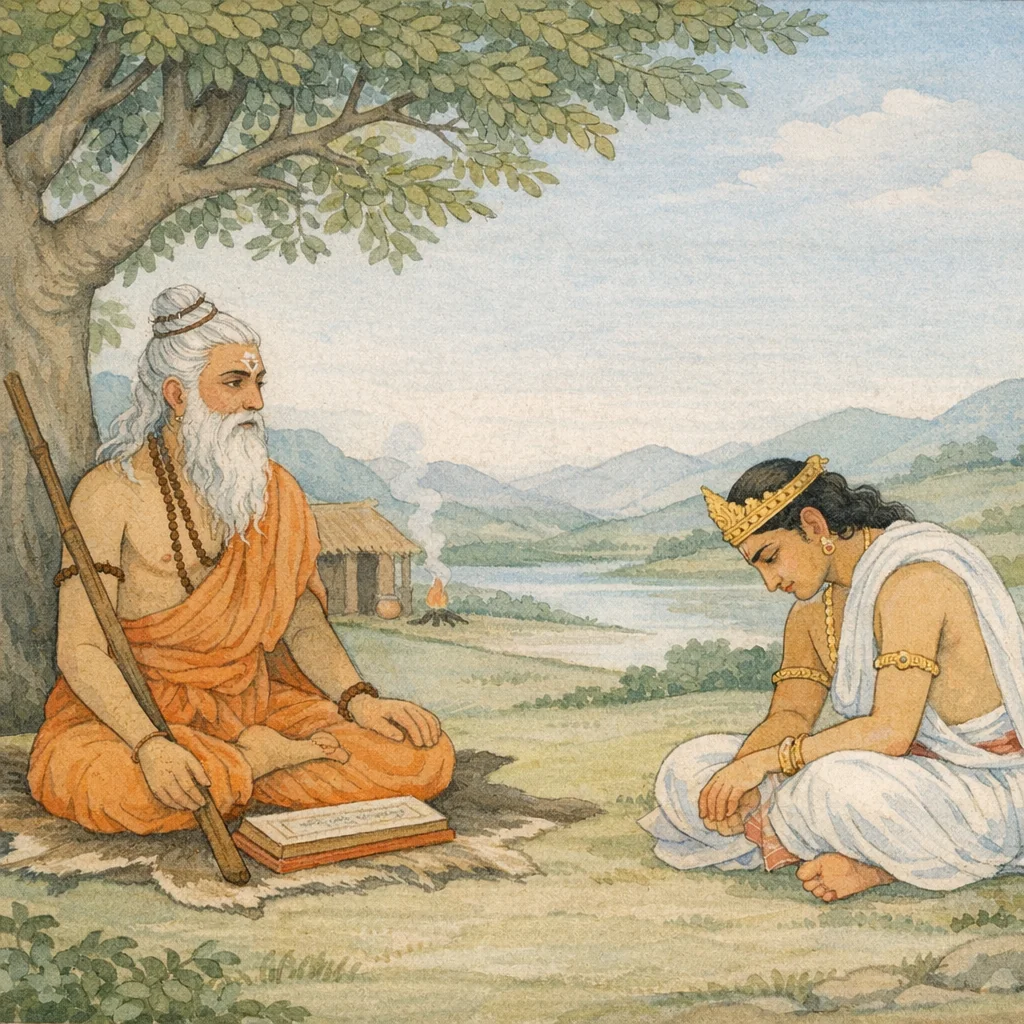
Adhyaya 27
Yudhiṣṭhira’s Remorse and Vyāsa’s Teaching on Impermanence (Śoka-nivāraṇa)
Upa-parva: Śoka-nivāraṇa (Grief-Restraint) Discourse within Śānti Parva
Yudhiṣṭhira enumerates the deaths of key figures and allies, framing his sorrow as inescapable and intensified by self-judgment. He recalls Bhīṣma’s fall and interprets it as his own culpability, then extends blame to other episodes: the stratagem that misled Droṇa, the killing of Karṇa, and Abhimanyu’s entry into a hostile formation. He describes a loss of moral confidence and aversion to facing surviving companions, and announces a resolve to undertake prāyopaveśa (fasting unto death), refusing food and water. Vaiśaṃpāyana reports Vyāsa’s intervention: Vyāsa prohibits excessive grief and reiterates a teaching on the inevitability of separation—saṃyoga and viprayoga as natural conditions of embodied life—using images of bubbles in water and aphoristic statements on the transience of accumulation, prosperity, and life itself. The counsel concludes by redirecting Yudhiṣṭhira toward svadharma: perform the work allotted by the cosmic order, recognizing the limits of personal control while maintaining disciplined responsibility.
Chapter Arc: युद्धोत्तर धूलि अभी बैठी भी नहीं—पर युधिष्ठिर शोक से ऐसे जर्जर हैं कि देह-त्याग का निश्चय कर लेते हैं; यह देख व्यास प्रकट होकर उन्हें रोकते हैं। → युधिष्ठिर व्यास के सामने अपने अपराधों की सूची खोल देते हैं: अभिमन्यु जैसे बालक-वीर का वध, अनेक देश-देशांतर के राजाओं का संहार, कुल-क्षय, और विशेषतः अपने ही स्वजनों के रक्त से राज्य-प्राप्ति का कलंक। वे कहते हैं कि यह शोक उन्हें छोड़ता नहीं—वे स्वयं को ‘ज्ञातिघाती’, ‘राज्यकामुक’, ‘वंशोच्छेदकारिण’ मानते हैं। → आत्म-निन्दा चरम पर पहुँचती है: युधिष्ठिर स्वीकारते हैं कि लोभवश उन्होंने द्रोण-पालित कौरव-वाहिनी में प्रवेश कराया, और फिर अर्जुन (बीभत्सु) का मुख देखने का साहस भी नहीं कर पाते; वे स्वयं को ज्येष्ठ भ्राता के प्रति भीषण पाप का कर्ता मानकर पूछते हैं—‘मुझसे बढ़कर पापी कौन?’ और किस लोक में जाऊँगा? → व्यास कठोर करुणा के साथ उन्हें ‘मैवम्’ कहकर थामते हैं और बार-बार एक ही सत्य दुहराते हैं—यह सब ‘दिष्ट’ (प्रारब्ध/नियत) के अधीन घटित हुआ; शोक से धर्म-मार्ग न छोड़ो। वे संसार-धर्म का उपदेश देते हैं: संयोग का अंत वियोग है, जीवन का अंत मरण है, संग्रह का अंत विनाश है—अतः शोक को विवेक से बाँधो। → युधिष्ठिर का आत्म-त्याग का आवेग तो रोका जाता है, पर उनके भीतर का प्रश्न शेष रहता है—अब वे इस रक्त-ऋण और राजधर्म को किस प्रकार शुद्ध करेंगे?
Shlokas
Verse 1
ऑपन--र< बछ। ] अति्ऑफाएड सप्तविशो<्ध्याय: युधिष्ठिरको शोकवश शरीर त्याग देनेके लिये उद्यत देख व्यासजीका उन्हें उससे निवारण करके समझाना युधिछिर उवाच अभिमन्यौ हते बाले द्रौपद्यास्तनयेषु च । धृष्टय्युम्ने विराटे च द्रुपदे च महीपतौ,युधिषछ्िरने व्यासजीसे कहा--मुनिश्रेष्ठ! इस युद्धमें बालक अभिमन्यु, द्रौपदीके पाँचों पुत्र, धृष्टद्युम्न, विराट, राजा ट्रुपद, धर्मज्ञ वृषसेन, चेदिराज धृष्टकेतु तथा नाना देशोंके निवासी अन्यान्य नरेश भी वीरगतिको प्राप्त हुए हैं। मैं जाति-भाइयोंका घातक, राज्यका लोभी, अत्यन्त क्रूर और अपने वंशका विनाश करनेवाला निकला, यही सब सोचकर मुझे शोक नहीं छोड़ रहा है और मैं अत्यन्त आतुर हो रहा हूँ
Yudhiṣṭhira said: “O best of sages, in this war the young Abhimanyu has been slain, and so too the sons of Draupadī; Dhṛṣṭadyumna, Virāṭa, and King Drupada have also fallen. Seeing these deaths and the ruin of kinsmen, I am consumed by grief—thinking myself a killer of my own people, greedy for sovereignty, and the cause of my lineage’s destruction.”
Verse 2
वृषसेने च धर्मज्ञे धृष्टकेतौ तु पार्थिवे । तथान्येषु नरेन््द्रेषु नानादेश्येषु संयुगे,युधिषछ्िरने व्यासजीसे कहा--मुनिश्रेष्ठ! इस युद्धमें बालक अभिमन्यु, द्रौपदीके पाँचों पुत्र, धृष्टद्युम्न, विराट, राजा ट्रुपद, धर्मज्ञ वृषसेन, चेदिराज धृष्टकेतु तथा नाना देशोंके निवासी अन्यान्य नरेश भी वीरगतिको प्राप्त हुए हैं। मैं जाति-भाइयोंका घातक, राज्यका लोभी, अत्यन्त क्रूर और अपने वंशका विनाश करनेवाला निकला, यही सब सोचकर मुझे शोक नहीं छोड़ रहा है और मैं अत्यन्त आतुर हो रहा हूँ
Yudhiṣṭhira said: “And Vṛṣasena, the knower of dharma, and Dhṛṣṭaketu, the king—along with many other rulers from diverse lands—have fallen in this war. Reflecting on this, I am consumed by grief: I have become the slayer of my own kin, greedy for sovereignty, exceedingly harsh, and the cause of my lineage’s destruction.”
Verse 3
न च मुज्चति मां शोको ज्ञातिघातिनमातुरम् | राज्यकामुकमत्युग्रं स्ववंशोच्छेदकारिणम्,युधिषछ्िरने व्यासजीसे कहा--मुनिश्रेष्ठ! इस युद्धमें बालक अभिमन्यु, द्रौपदीके पाँचों पुत्र, धृष्टद्युम्न, विराट, राजा ट्रुपद, धर्मज्ञ वृषसेन, चेदिराज धृष्टकेतु तथा नाना देशोंके निवासी अन्यान्य नरेश भी वीरगतिको प्राप्त हुए हैं। मैं जाति-भाइयोंका घातक, राज्यका लोभी, अत्यन्त क्रूर और अपने वंशका विनाश करनेवाला निकला, यही सब सोचकर मुझे शोक नहीं छोड़ रहा है और मैं अत्यन्त आतुर हो रहा हूँ
Yudhiṣṭhira said: “Grief does not release me. I am tormented, for I have become a slayer of my own kin—one who coveted a kingdom, grew exceedingly fierce, and brought about the destruction of my own lineage.”
Verse 4
यस्यांके क्रीडमानेन मया वै परिवर्तितम् । स मया राज्यलुब्धेन गांगेयो युधि पातित:,जिनकी गोदीमें खेलता हुआ मैं लोटपोट हो जाता था, उन्हीं पितामह गंगानन्दन भीष्मजीको मैंने राज्यके लोभसे मरवा डाला
Yudhiṣṭhira said: “Upon whose lap I once played and rolled about as a child—him, Bhīṣma, the son of the Gaṅgā, I have caused to be struck down in battle, driven by my craving for kingship. This thought burns me with remorse, for it turns a revered elder into a victim of my ambition.”
Verse 5
यदा होन॑ विघूर्णन्तमपश्यं पार्थसायकै: । कम्पमानं यथा वचजे: प्रेक्ष्ष्माणं शिखण्डिना,जब मैंने देखा कि अर्जुनके वज्रोपम बाणोंसे आहत हो बूढ़े सिंहके समान मेरे उन्नतकाय पुरुषसिंह पितामह कम्पित हो रहे हैं और उन्हें चक्कर-सा आने लगा है, शिखण्डी उनकी ओर देख रहा है और उनका सारा शरीर बाणोंसे खचाखच भर गया है तो यह सब देखकर मेरे मनमें बड़ी व्यथा हुई
Yudhiṣṭhira said: When I saw him reeling—struck by Arjuna’s arrows—trembling like an aged lion, while Śikhaṇḍin stood facing him, and his whole body was packed tight with shafts, a deep anguish arose in my heart at that sight. The scene made me confront the bitter moral cost of war: even the most venerable and heroic can be brought low, and victory can feel inseparable from grief.
Verse 6
जीर्णसिंहमिव प्रांशुं नरसिंहं पितामहम् | कीर्यमाणं शरैर्दृष्टवा भृशं मे व्यथितं मन:,जब मैंने देखा कि अर्जुनके वज्रोपम बाणोंसे आहत हो बूढ़े सिंहके समान मेरे उन्नतकाय पुरुषसिंह पितामह कम्पित हो रहे हैं और उन्हें चक्कर-सा आने लगा है, शिखण्डी उनकी ओर देख रहा है और उनका सारा शरीर बाणोंसे खचाखच भर गया है तो यह सब देखकर मेरे मनमें बड़ी व्यथा हुई
Yudhiṣṭhira said: “When I saw the grandsire—lofty like an aged lion, a lion among men—being covered over with arrows, my mind was deeply pained. The sight of the venerable elder, shaken and overwhelmed amid the violence of battle, struck me with anguish, for it revealed how even the highest dharma-bearers can be brought low by the inexorable course of war.”
Verse 7
प्राडमुखं सीदमानं च रथे पररथारुजम् । घूर्णमानं यथा शैलं तदा मे कश्मलो5भवत्,जो शत्रुदलके रथियोंको पीड़ा देनेमें समर्थ थे, वे पूर्वकी ओर मुँह करके चुपचाप बैठे हुए बाणोंका आघात सह रहे थे और जैसे पर्वत हिल रहा हो, उसी प्रकार झूम रहे थे। उस समय उनकी यह अवस्था देखकर मुझे मूर्छा-सी आ गयी थी
Yudhiṣṭhira said: “When I saw him on his chariot—his face turned toward the east, sinking into helplessness, enduring the assault of arrows—swaying like a mountain that trembles, then a sudden moral and emotional collapse seized me. Seeing the one who could afflict the enemy’s chariot-warriors reduced to such a state, my mind was overwhelmed with faintness and confusion.”
Verse 8
यः स बाणभनुष्पाणियोंधयामास भार्गवम् | बहुन्यहानि कौरव्य: कुरुक्षेत्रे महामृधे,जिन कुरुकुलशिरोमणि वीरने कुरक्षेत्रमें महायुद्ध ठानकर हाथमें धनुष-बाण लिये बहुत दिनोंतक परशुरामजीके साथ युद्ध किया था, जिन वीर गंगा-नन्दन भीष्मने वाराणसीपुरीमें काशिराजकी कन्याओंके लिये युद्धका अवसर उपस्थित होनेपर एकमात्र रथके द्वारा वहाँ एकत्र हुए समस्त क्षत्रिय नरेशोंको ललकारा था तथा जिन्होंने दुर्जय चक्रवर्ती राजा उग्रायुधको अपने अस्त्रोंके प्रतापसे दग्ध कर दिया था, उन्हींको मैंने युद्धमें मरवा डाला
Yudhiṣṭhira said: “He who, with bow and arrows in hand, fought the Bhārgava (Paraśurāma) for many days—O Kauravya—on the field of Kurukṣetra in that great and terrible combat: that very hero I caused to be slain in war.”
Verse 9
समेत पार्थिव क्षत्रं वाराणस्यां नदीसुतः । कन्यार्थमाह्नयद् वीरो रथेनैकेन संयुगे,जिन कुरुकुलशिरोमणि वीरने कुरक्षेत्रमें महायुद्ध ठानकर हाथमें धनुष-बाण लिये बहुत दिनोंतक परशुरामजीके साथ युद्ध किया था, जिन वीर गंगा-नन्दन भीष्मने वाराणसीपुरीमें काशिराजकी कन्याओंके लिये युद्धका अवसर उपस्थित होनेपर एकमात्र रथके द्वारा वहाँ एकत्र हुए समस्त क्षत्रिय नरेशोंको ललकारा था तथा जिन्होंने दुर्जय चक्रवर्ती राजा उग्रायुधको अपने अस्त्रोंके प्रतापसे दग्ध कर दिया था, उन्हींको मैंने युद्धमें मरवा डाला
Yudhiṣṭhira said: “The heroic son of the river (Bhīṣma), for the sake of the maidens, challenged in battle all the assembled kings and warriors at Vārāṇasī—standing alone upon a single chariot. Such was his might and resolve; and yet it is he whom I caused to be slain in war.”
Verse 10
येन चोग्रायुधो राजा चक्रवर्ती दुरासद: । दग्धश्नास्त्रप्रतापेन स मया युधि घातित:,जिन कुरुकुलशिरोमणि वीरने कुरक्षेत्रमें महायुद्ध ठानकर हाथमें धनुष-बाण लिये बहुत दिनोंतक परशुरामजीके साथ युद्ध किया था, जिन वीर गंगा-नन्दन भीष्मने वाराणसीपुरीमें काशिराजकी कन्याओंके लिये युद्धका अवसर उपस्थित होनेपर एकमात्र रथके द्वारा वहाँ एकत्र हुए समस्त क्षत्रिय नरेशोंको ललकारा था तथा जिन्होंने दुर्जय चक्रवर्ती राजा उग्रायुधको अपने अस्त्रोंके प्रतापसे दग्ध कर दिया था, उन्हींको मैंने युद्धमें मरवा डाला
Yudhiṣṭhira said: “He by whose irresistible martial power the unconquerable, world-sovereign king Ugrāyudha was scorched and subdued—him I caused to be slain in battle. Remembering such deeds, my heart is burdened with remorse: that a hero of such stature fell through the course of this war.”
Verse 11
स्वयं मृत्युं रक्षमाण: पाञ्चाल्यं यः शिखण्डिनम् । न बाणै: पातयामास सोअ3र्जुनेन निपातित:,जिन्होंने अपने लिये मृत्यु बनकर आये हुए पाज्चाल राजकुमार शिखण्डीकी स्वयं ही रक्षा की और उसे बाणोंसे धराशायी नहीं किया, उन्हीं पितामहको अर्जुनने मार गिराया
Yudhiṣṭhira said: “He who, as though guarding Death itself, protected the Pāñcāla prince Śikhaṇḍin and did not strike him down with arrows—that very grandsire was brought down by Arjuna.”
Verse 12
यदैनं पतितं भूमावपश्यं रुधिरोक्षितम् । तदैवाविशददत्युग्रो ज्वरो मां मुनिसत्तम,मुनिश्रेष्ठ! जब मैंने पितामहको खूनसे लथपथ होकर पृथ्वीपर पड़ा देखा, उसी समय मुझपर अत्यन्त भयंकर शोक-ज्वरका आवेश हो गया
O best of sages, when I saw him fallen upon the earth, drenched in blood, at that very moment an exceedingly fierce fever of grief seized me.
Verse 13
येन संवर्धिता बाला येन सम परिरक्षिता: । स मया राज्यलुब्धेन पापेन गुरुघातिना
Yudhiṣṭhira said: “Those very elders by whom we were nurtured as children, and by whom we were equally protected—those have been slain by me, a sinner, driven by greed for kingship, a killer of my own revered elders.”
Verse 14
आचार्य श्न महेष्वास: सर्वपार्थिवपूजित:
Yudhiṣṭhira speaks of the revered teacher as a mighty archer, honored by all kings—highlighting the moral weight that arises when such an eminent, universally respected figure becomes central to questions of duty, conduct, and rightful action.
Verse 15
तन्मे दहति गात्राणि यन्मां गुरुभाषत,उस समय गुरुने मुझसे पूछा था--'राजन्! सच बताओ, क्या मेरा पुत्र जीवित है?” उन ब्राह्मणने सत्यका निर्णय करनेके लिये ही मुझसे यह बात पूछी थी। उनकी वह बात जब याद आती है तो मेरा सारा शरीर शोकाग्निसे दग्ध होने लगता है
Yudhiṣṭhira said: “That memory burns my limbs—the words my teacher once spoke to me. At that time the guru questioned me: ‘O King, speak the truth—does my son still live?’ That brāhmaṇa asked me only to determine what truth required. Whenever I recall his words, my whole body feels scorched by the fire of grief.”
Verse 16
सत्यमाख्याहि राजंस्त्वं यदि जीवति मे सुतः । सत्यमामर्षयन् विप्रो मयि तत् परिपृष्टवान्,उस समय गुरुने मुझसे पूछा था--'राजन्! सच बताओ, क्या मेरा पुत्र जीवित है?” उन ब्राह्मणने सत्यका निर्णय करनेके लिये ही मुझसे यह बात पूछी थी। उनकी वह बात जब याद आती है तो मेरा सारा शरीर शोकाग्निसे दग्ध होने लगता है
Yudhiṣṭhira said: “Tell me the truth, O king—does my son still live?” A brāhmaṇa, intent on discerning what truth demands, once put this very question to me. Whenever I recall those words, my whole body feels as though it is being scorched by the fire of grief.
Verse 17
कुण्जरं चान्तरं कृत्वा मिथ्योपचरितं मया । सुभृशं राज्यलुब्धेन पापेन गुरुघातिना,परंतु राज्यके लोभमें अत्यन्त फँसे हुए मुझ पापी गुरु-हत्यारेने मरे हुए हाथीकी आड़ लेकर उनसे झूठ बोल दिया और उनके साथ धोखा किया
I used the elephant as a cover and acted falsely. Blinded by an intense greed for the kingdom, I—the sinful one, a slayer of my own teacher—deceived him by speaking an untruth under the shelter of the report of the elephant’s death.
Verse 18
सत्यकज्चुकमुन्मुच्य मया स गुरुराहवे । अश्वत्थामा हत इति निरुक्त: कुञ्जरे हते,मैंने सत्यका चोला उतार फेंका और युद्धमें अश्वत्थामा नामक हाथीके मारे जानेपर गुरुदेवसे कह दिया कि “अश्वत्थामा मारा गया।” (इससे उन्हें अपने पुत्रके मारे जानेका विश्वास हो गया)
Casting off the ‘cloak of truth,’ I spoke to my teacher in the midst of battle: ‘Aśvatthāmā has been slain’—referring to the elephant named Aśvatthāmā that had been killed. By that utterance, the preceptor took it as the death of his son, and his moral certainty was shaken, revealing the grave ethical cost of winning through equivocation.
Verse 19
कॉल्लोकांस्तु गमिष्यामि कृत्वा कर्म सुदुष्करम् | अघातयं च यत् कर्ण समरेष्वपलायिनम्
Yudhiṣṭhira said: “I shall go to the worlds of death, having done a deed most difficult and grievous—for I caused Karṇa, who never fled from battle, to be slain in the wars.”
Verse 20
अभिमन्युं च यद् बाल॑ं जात॑ सिंहमिवाद्रिषु
“And Abhimanyu too—though still a mere boy—had been born with the spirit and prowess of a lion among the mountains.”
Verse 21
प्रावेशयमहं लुब्धो वाहिनी द्रोणपालिताम् | तदाप्रभृति बीभत्सुं न शकनोमि निरीक्षितुम्
Blinded by greed, I drew into battle the army protected and commanded by Droṇa. From that time onward, I have been unable to look upon Bībhatsu (Arjuna), overwhelmed by shame and remorse for the chain of violence my choice helped set in motion.
Verse 22
कृष्णं च पुण्डरीकाक्षं किल्बिषी भ्रूणहा यथा । मैंने राज्यके लोभमें पड़कर जब पर्वतोंपर उत्पन्न हुए सिंहके समान पराक्रमी अभिमन्युको द्रोणाचार्यद्वारा सुरक्षित कौरवसेनामें झोंक दिया, तभीसे भ्रूण-हत्या करनेवाले पापीके समान मैं अर्जुन तथा कमलनयन श्रीकृष्णकी ओर आँख उठाकर देख नहीं पाता हूँ ।। द्रौपदी चापि दुःखार्ता पञ्चपुत्रैर्विनाकृताम्
Yudhiṣṭhira said: “I cannot raise my eyes to Arjuna or to lotus-eyed Kṛṣṇa, as though I were a sinner guilty of foeticide. For, having fallen into greed for kingship, I hurled Abhimanyu—lion-like in valor, as if born among mountains—into the Kaurava host that was guarded by Droṇa. From that moment onward, I have been unable to look up at them. And Draupadī too, tormented by grief, has been left bereft of her five sons.”
Verse 23
शोचामि पृथिवीं हीनां पञ्चभि: पर्वतैरिव । जैसे पृथ्वी पाँच पर्वतोंसे हीन हो जाय, उसी प्रकार अपने पाँचों पुत्रोंसे हीन होकर दुःखसे आतुर हुई द्रौपदीके लिये भी मुझे निरन्तर शोक बना रहता है ।। सो5हमागस्कर: पाप: पृथिवीनाशकारक:
Yudhiṣṭhira said: “I grieve for the earth, as though she were bereft of her five mountains. In the same way, I remain in unceasing sorrow for Draupadī, who is tormented by anguish at being deprived of her five sons. Thus I—guilty, sinful, a cause of ruin to the realm—lament my own failing in dharma and kingship.”
Verse 24
प्रायोपविष्टं जानीध्वमथ मां गुरुघातिनम्
Know that I have resolved upon fasting unto death—and know me also as one who has slain his own elders and teachers.
Verse 25
न भोक्ष्ये न च पानीयमुपभोक्ष्ये कथठ्चन
Yudhiṣṭhira said: “I will not eat, nor will I drink; I will not partake of food or water in any way.”
Verse 26
इस प्रकार श्रीमह्याभारत शान्तिपर्वके अन्तर्गत राजधर्मानुशासनपर्वमें युधिष्ठिरका वाक्यविषयक छब्बीसवाँ अध्याय पूरा हुआ,यथेष्टं गम्यतां काममनुजाने प्रसाद्य व:
Thus, in the Śrī Mahābhārata, within the Śānti Parvan—specifically in the instruction on royal dharma—ends the twenty-sixth chapter concerning Yudhiṣṭhira’s discourse. “Now go as you wish, according to your desire; I grant you leave, having been pleased with you.”
Verse 27
सर्वे मामनुजानीत त्यक्ष्यामीदं कलेवरम् । मैं आपलोगोंको प्रसन्न करके अपनी ओरसे चले जानेकी अनुमति देता हूँ। जिसकी जहाँ इच्छा हो वहाँ अपनी रुचिके अनुसार चला जाय। आप सब लोग मुझे आज्ञा दें कि मैं इस शरीरको अनशन करके त्याग दूँ ।। वैशम्पायन उवाच तमेवंवादिनं पार्थ बन्धुशोकेन विह्नलम्,इति श्रीमहा भारते शान्तिपर्वणि राजधर्मानुशासनपर्वणि व्यासवाक्ये सप्तविंशोडध्याय:
“All of you, grant me leave. I shall abandon this body. Having satisfied you, I ask permission to depart from my side; let each go wherever he wishes, according to his own inclination. Give me your consent that I may relinquish this body by fasting (anasana).” Vaiśampāyana said: Thus spoke that Pārtha, overcome and bewildered by grief for his kinsmen.
Verse 28
व्यास उवाच अतिवेलं महाराज न शोकं कर्तुमहसि
Vyāsa said: “O great king, you should not give yourself over to grief beyond measure.”
Verse 29
संयोगा विप्रयोगान्ता जातानां प्राणिनां ध्रुवम्
Vyāsa said: For all living beings who are born, every coming-together is inevitably destined to end in separation.
Verse 30
बुद्बुदा इव तोयेषु भवन्ति न भवन्ति च | जैसे पानीमें बुलबुले होते और मिट जाते हैं, उसी प्रकार संसारमें उत्पन्न हुए प्राणियोंके जो आपसमें संयोग होते हैं, उनका अन्त निश्चय ही वियोगमें होता है ।। सर्वे क्षयान्ता निचया: पतनान्ता: समुच्छुया:
Vyāsa said: “Like bubbles upon water, beings appear and vanish. In the same way, all unions formed among creatures in this world inevitably end in separation. Every accumulation ends in loss, and every rise ends in a fall.”
Verse 31
सुखं दुःखान्तमालस्यं दाक्ष्यं दुः:खं सुखोदयम् । भूति: श्रीद्वीर्धृति: कीर्तिर्देक्षे वसति नालसे,आलस्य सुखरूप प्रतीत होता है, परंतु उसका अन्त दु:ख है तथा कार्यदक्षता दुःखरूप प्रतीत होती है, परंतु उससे सुखका उदय होता है। इसके सिवा ऐश्वर्य, लक्ष्मी, लज्जा, धृति और कीर्ति--ये कार्यदक्ष पुरुषमें ही निवास करती हैं, आलसीमें नहीं
Vyāsa said: Idleness seems pleasant, yet it ends in suffering; skillful, diligent effort seems painful, yet from it happiness arises. Prosperity, fortune, steadfastness, and fame dwell with the capable and industrious—not with the lazy.
Verse 32
नाल॑ सुखाय सुह्दो नाल॑ दुःखाय शत्रव: । न च प्रजालमर्थेभ्यो न सुखेभ्यो5प्यलं धनम्,न तो सुहृद् सुख देनेमें समर्थ हैं न शत्रु दुख देनेमें। इसी प्रकार न तो प्रजा धन दे सकती है और न धन सुख दे सकता है
Vyāsa said: Friends are not truly sufficient to bestow happiness, nor are enemies sufficient to inflict sorrow. Likewise, dependents or subjects cannot by themselves produce wealth, and even wealth is not, by itself, sufficient to produce happiness.
Verse 33
यथा सृष्टोडसि कौन्तेय धात्रा कर्मसु तत् कुरु । अत एव हि सिद्धिस्ते नेशस्त्वं कर्मणां नृप,कुन्तीनन्दन! नरेश्वर! विधाताने जैसे कर्मोंके लिये तुम्हारी सृष्टि की है, तुम उन्हींका अनुष्ठान करो। उन्हींसे तुम्हें सिद्धि प्राप्त होगी। तुम कर्मोके (फलके) स्वामी या नियन्ता नहीं हो
Vyāsa said: “O son of Kuntī, just as the Creator has fashioned you for particular duties, perform those very actions. From them alone your fulfillment will arise. O king, you are not the master or controller of actions (and their results).”
Verse 136
अल्पकालस्य राज्यस्य कृते मूढेन घातित: । जिन्होंने हमें बचपनसे पाल-पोसकर बड़ा किया और सब प्रकारसे हमारी रक्षा की, उन्हींको मुझ पापी, राज्य-लोभी, गुरुघाती एवं मूर्खने थोड़े समयतक रहनेवाले राज्यके लिये मरवा डाला
Yudhiṣṭhira laments that, for the sake of a kingdom that would last only a short time, he—deluded and blinded by desire for sovereignty—became the cause of the killing of those very elders and protectors who had raised and safeguarded him from childhood.
Verse 143
अभिगम्य रणे मिथ्या पापेनोक्तः सुतं प्रति । सम्पूर्ण राजाओंसे पूजित, महाधनुर्धर आचार्यके पास जाकर मुझ पापीने उनके पुत्रके सम्बन्धमें झूठी बात कही
Yudhiṣṭhira said: “In the midst of battle, I—sinful as I was—approached the revered teacher, honored by kings and famed as a mighty archer, and I spoke a falsehood to him concerning his son. Thus, under the pressure of war, I stained myself with deceit against one who deserved truth and reverence.”
Verse 193
ज्येष्ठभ्रातरमत्युग्रं को मत्त: पापकृत्तम: | यह अत्यन्त दुष्कर पापकर्म करके मैं किन लोकोंमें जाऊँगा? युद्धमें कभी पीठ न दिखानेवाले अत्यन्त उग्र पराक्रमी अपने बड़े भाई कर्णको भी मैंने मरवा दिया--मुझसे बढ़कर महान् पापाचारी दूसरा कौन होगा?
Yudhiṣṭhira said: “Having brought about the death of my own elder brother—Karna, fierce and of terrible might—who could be a greater sinner than I? After committing such an exceedingly hard and grievous deed, to what worlds shall I go? I caused even Karna to be slain—the supremely valiant warrior who never once showed his back in battle. Who else could be more deeply stained by sin than I?”
Verse 233
आसीन एवमेवेदं शोषयिष्ये कलेवरम् । अतः मैं पापी, अपराधी तथा सम्पूर्ण भूमण्डलका विनाश करनेवाला हूँ; इसलिये यहीं इसी रूपमें बैठा हुआ अपने इस शरीरको सुखा डालूँगा
Yudhiṣṭhira said: “Seated just as I am, I will waste away this body. For I am a sinner, a transgressor, and one who has brought ruin upon the whole earth; therefore, here and in this very posture, I shall dry up this body of mine.”
Verse 246
जातिष्वन्यास्वपि यथा न भवेयं कुलान्तकृत् आपलोग मुझ गुरुघातीको आमरण अनशनके लिये बैठा हुआ समझें, जिससे दूसरे जन्मोंमें मैं फिर अपने कुलका विनाश करनेवाला न होऊँ
Yudhiṣṭhira said: “So that, even in other births, I may not become a destroyer of my lineage again—let people regard me, the slayer of my elders and teachers, as one who has sat down to fast unto death, so that I may not once more bring ruin upon my own family in future lives.”
Verse 256
शोषयिष्ये प्रियान् प्राणानिहस्थो5हं तपोधना: । तपोधनो! अब मैं किसी तरह न तो अन्न खाऊँगा और न पानी ही पीऊँगा। यहीं रहकर अपने प्यारे प्राणोंको सुखा दूँगा
Yudhiṣṭhira said: “O you whose wealth is austerity! Remaining here, I shall dry up these dear life-breaths of mine. From today, in no way will I eat food or drink water. Staying right here, I will let my beloved life ebb away.”
Verse 273
मैवमित्यब्रवीद् व्यासो निगृहाय मुनिसत्तम: । वैशम्पायनजी कहते हैं-जनमेजय! अपने बन्धु-जनोंके शोकसे विह्बल होकर युधिष्ठिरको ऐसी बातें करते देख मुनिवर व्यासजीने उन्हें रोककर कहा--“नहीं, ऐसा नहीं हो सकता”
Vaiśampāyana said: Seeing Yudhiṣṭhira, overwhelmed by grief for his kinsmen, speaking in that manner, the sage Vyāsa—the best among ascetics—restrained him and said, “No; it cannot be so.”
Verse 283
पुनरुक्त तु वक्ष्यामि दिष्टमेतदिति प्रभो । व्यासजी बोले--महाराज! तुम बहुत शोक न करो। प्रभो! मैं पहलेकी कही हुई बात ही फिर दुहरा रहा हूँ। यह सब प्रारब्धका ही खेल है
Vyāsa said: “O Lord, I will state again what has already been said: this has been ordained by destiny. Therefore, do not sink into excessive grief; what has occurred is the working out of what was allotted.”
Verse 303
संयोगा विप्रयोगान्ता मरणान्तं हि जीवितम् । सम्पूर्ण संग्रहोंका अन्त विनाश है, सारी उन्नतियोंका अन्त पतन है, संयोगोंका अन्त वियोग है और जीवनका अन्त मरण है
Vyāsa declares a universal law of impermanence: every coming-together ends in separation, and life itself inevitably ends in death. The verse urges sober discernment—do not cling to possessions, relationships, or worldly rise, for all compounded states culminate in dissolution; therefore one should ground one’s conduct in dharma rather than in transient gains.
Frequently Asked Questions
Yudhiṣṭhira faces a dharma-sankat between personal remorse (leading to self-punishment via fasting unto death) and the obligation to sustain life and governance for the protection and stability of the realm.
Vyāsa’s takeaway is that separation is intrinsic to embodied existence; therefore grief must be regulated, not absolutized. One should act according to svadharma, acknowledging impermanence and the constrained scope of individual control.
No explicit phalaśruti is stated in this unit. The meta-function is pedagogical: it reframes post-war despair into a disciplined ethical posture, preparing the listener for broader Śānti-parva instruction on rājadharma and liberation-oriented reflection.