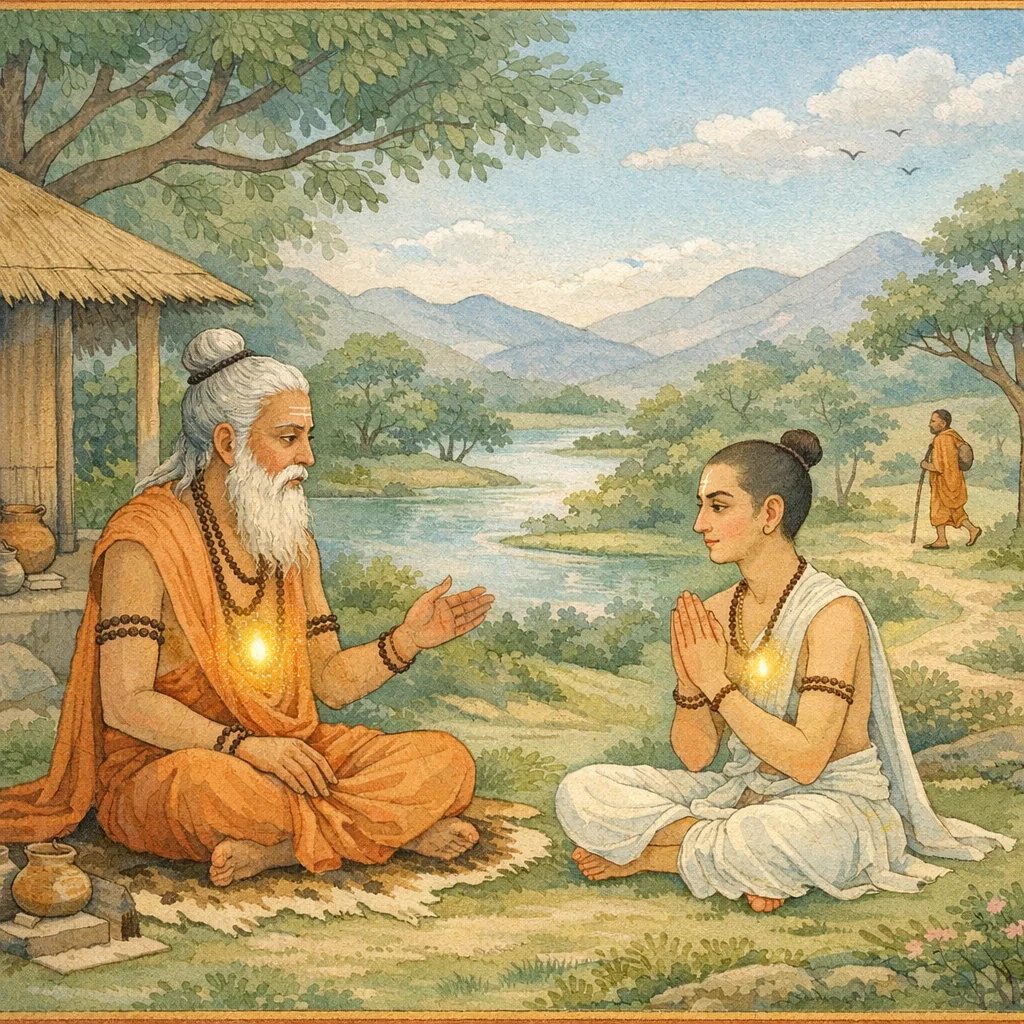
Adhyaya 245
सूक्ष्मभूत-भूतात्मविज्ञानम् (Knowing the subtle principle and the bhūtātman through yoga)
Upa-parva: Mokṣa-dharma (Liberation Teachings) — Sub-episode on the subtle self, dream-cognition, and yogic perception
Vyāsa describes how the subtle principle associated with the embodied being is understood by those trained in śāstra and disciplined cognition. He employs analogies: subtle entities move like visible rays; the self is apprehended as a reflected likeness, like the sun’s heat/perception mirrored in water. Those with controlled senses are said to perceive subtle beings freed from the body, each according to its own nature. The chapter then correlates waking and dream: the cognizer experiences pleasure and pain in dreams, performs actions with emotional afflictions (anger, greed), and can also experience satisfaction and “gain,” suggesting continuity of karmic patterning across states. Yet, beings dominated by tamas and rajas fail to recognize the luminous principle situated in the heart. The instruction recommends śāstra-yoga orientation and indicates that yoga in samādhi is characterized as śama (ascribed to Śāṇḍilya). Finally, knowledge of “seven subtle” factors and the six-limbed great Lord, together with correct application of prakṛti/primordial principle (pradhāna-viniyoga), is stated to lead toward realization of the supreme Brahman.
Chapter Arc: व्यास शुकदेव से कहते हैं—ब्रह्मचर्य और गृहस्थ के संस्कारों को साधकर अब परम-परमार्थ की ओर एकाग्र होकर सुनो: संन्यास (पारिव्राज्य) का उत्तम मार्ग। → व्यास क्रमशः आश्रम-क्रम का संकेत देते हैं—पूर्वोक्त तीन अवस्थाओं में कषाय (राग-द्वेषादि मल) को पकाकर/जला कर, फिर ‘श्रेणिस्थान’ (आध्यात्मिक सोपान/स्थितियों) में स्थिर होकर अकेले, असहाय-सा, सिद्धि के लिए एकधर्मचारी बनकर प्रव्रज्या ग्रहण करने की शिक्षा देते हैं। यह ‘एकाकी धर्म’ मन के लिए कठिन है—क्योंकि सहारा, संग्रह, प्रतिष्ठा और विवाद-प्रवृत्ति सब छोड़नी पड़ती है। → अहिंसा को सर्वधर्म-शिरोमणि की तरह प्रतिष्ठित किया जाता है—जो हिंसा में प्रवृत्त नहीं होता, वह ‘अमृत’ के समान नित्य वास करता है। साथ ही बाह्य यज्ञों के स्थान पर ‘आत्मयज्ञ’ का उत्कर्ष आता है: हृदय-प्रदेश से निकले प्राणों को आत्मा में ही होम करना—यही उसका अग्निहोत्र है, जो देवसहित समस्त लोकों में मान्य है। → व्यास संन्यासी-लक्षणों का चित्र खींचते हैं—रोष-मोह से अछूता, समलोष्टकाञ्चन (मिट्टी-स्वर्ण सम), निन्दा-स्तुति, प्रिय-अप्रिय, संधि-विग्रह से उदासीन; मन की ‘सम्प्रसाद’ (प्रसन्न-शुद्ध) अवस्था को जगत-शरीर का आधार बताकर, उसी में स्थित भिक्षु के निर्भय, अनन्त लोक-प्राप्ति का निष्कर्ष देते हैं।
Shlokas
Verse 1
इस प्रकार श्रीमहाभारत शान्तिपर्वके अन्तर्गत मोक्षधर्मपर्वमें शुकदेवका अनुप्रश्नविषयक दो सौ चौवालीसवाँ अध्याय पूरा हुआ ॥/ २४४ ॥। (दाक्षिणात्य अधिक पाठका ३ “लोक मिलाकर कुल ३१३ “लोक हैं) शीश (0) आल आन+- > ७ प्राणाय स्वाहा, * अपानाय स्वाहा, ७ व्यानाय स्वाहा, * समानाय स्वाहा, $ उदानाय स्वाहा--ये प्राणाग्निहोत्रके पाँच मन्त्र हैं, भोजन आरम्भ करते समय पहले आचमन करके इनमेंसे एक-एक मन्त्रको पढ़कर एक-एक ग्रास अन्न मुँहमें डाले। इस प्रकार पाँच ग्रास पूरे होनेपर पुन: आचमन कर ले। यही प्राणाग्निहोत्र कहलाता है। पज्चचत्वारिशर्दाधिकद्विशततमो< ध्याय: संन्यासीके आचरण और ज्ञानवान् संन्यासीकी प्रशंसा शुक उवाच वर्तमानस्तथैवात्र वानप्रस्थाश्रमे यथा । योक्तव्यो55त्मा कथं शक्त्या वेद्यं वै काड्क्षता परम्,शुकदेवजीने पूछा--पिताजी! ब्रह्मचर्य और गार्हस्थ्य आश्रमोंमें जैसे शास्त्रोक्त नियमके अनुसार चलना आवश्यक है, उसी प्रकार इस वानप्रस्थ आश्रममें भी शास्त्रोक्त नियमका पालन करते हुए चलना चाहिये। यह सब तो मैंने सुन लिया। अब मैं यह जानना चाहता हूँ, जो जानने योग्य परब्रह्म परमात्माको पाना चाहता हो, उसे अपनी शक्तिके अनुसार उस परमात्माका चिन्तन कैसे करना चाहिये?
Śuka said: “Father, I have heard how one must live according to the scriptural rule in the stages of brahmacarya and householdership; likewise, in this very vānaprastha stage too, one should proceed while observing the śāstric discipline. Now I wish to know this: for one who longs to realize the supreme Reality that is to be known, how should one, according to one’s capacity, apply oneself inwardly—how should one contemplate and discipline the self so as to reach that Supreme?”
Verse 2
व्यास उवाच प्राप्प संस्कारमेताभ्यामाश्रमा भ्यां तत: परम् । यत्कार्य परमार्थ तु तदिहैकमना: शूणु,व्यासजीने कहा--बेटा! ब्रह्मचर्य और गृहस्थाश्रमके धर्मोद्वारा चित्तका संस्कार (शोधन) करनेके अनन्तर मुक्तिके लिये जो वास्तविक कर्तव्य है, उसे बताता हूँ, तुम यहाँ एकाग्रचित्त होकर सुनो
Vyāsa said: “After attaining inner refinement through these two stages of life—brahmacarya (student discipline) and gṛhastha (householder duty)—I shall now tell you the true task that leads to the highest good, liberation. Here, listen with a single-pointed mind.”
Verse 3
कषायं पाचयित्वा$<शु श्रेणिस्थानेषु च त्रिषु । प्रव्रजेच्च परं स्थान पारिव्राज्यमनुत्तमम्,पंक्तिक्रमसे स्थित पूर्वोक्त तीन आश्रम ब्रह्मचर्य, गृहस्थ और वानप्रस्थमें चित्तके राग- द्वेष आदि दोषोंको पकाकर--उन्हें नष्ट करके शीघ्र ही सर्वोत्तम चतुर्थ आश्रम संन््यासको ग्रहण कर ले
Vyāsa said: Having quickly ‘cooked’ (ripened and burnt away) the inner impurities, and having duly passed through the three ordered stations of life, one should renounce and enter the highest state—the unsurpassed life of the wandering mendicant (saṃnyāsa). The ethical thrust is that renunciation is not escapism but the culmination of disciplined self-purification and fulfilled duties, where attachment and aversion are extinguished.
Verse 4
तत् भवानेवमभ्यस्थ वर्ततां श्रूयतां तथा । एक एव चरेद् धर्म सिद्धयर्थमसहायवान्,बेटा! तुम इस संन्यास-धर्मके नियमोंको सुनो और उन्हें अभ्यासमें लाकर उसीके अनुसार बर्ताव करो। संन्यासीको चाहिये कि वह सिद्धि प्राप्त करनेके लिये किसीको साथ न लेकर अकेला ही संन्यास-धर्मका पालन करे
Vyāsa said: “Having thus practiced it, live accordingly; listen further as well. For the sake of attaining spiritual accomplishment, one should follow the dharma of renunciation alone—without taking any companion.”
Verse 5
एकश्चरति य: पश्यन् न जहाति न हीयते । अनग्निरनिकेतश्न ग्राममन्नार्थमा श्रयेत्,जो आत्मतत्त्वका साक्षात्कार करके एकाकी विचरता रहता है, वह सर्वव्यापी होनेके कारण न तो स्वयं किसीका त्याग करता है और न दूसरे ही उसका त्याग करते हैं। संन्यासी कभी न तो अग्निकी स्थापना करे और न घर या मठ ही बनाकर रहे; केवल भिक्षा लेनेके लिये ही गाँवमें जाय
Vyāsa said: “One who, seeing the truth, wanders alone does not abandon anyone, nor is he abandoned by anyone—for, being all-pervading, he stands beyond the usual bonds of possession and rejection. A renunciant should keep no sacred fire and should not settle by building a house or monastery; he should enter a village only for the sake of obtaining alms.”
Verse 6
अश्वस्तनविधाता स्यान्मुनिर्भावसमाहित: । लघ्वाशी नियताहार: सकृदन्ननिषेविता,वह दूसरे दिनके लिये अन्नका संग्रह न करे। चित्त-वृत्तियोंको एकाग्र करके मौनभावसे रहे। हलका और नियमानुकूल भोजन करे तथा दिन-रातमें केवल एक ही बार अन्न ग्रहण करे
Vyāsa said: “A sage should not lay in provisions for the next day. With his inner faculties gathered into one-pointedness, he should abide in silence and composure. He should eat lightly, taking food in a disciplined and regulated manner, and partake of grain only once in the day and night.”
Verse 7
कपाल वृक्षमूलानि कुचैलमसहायता । उपेक्षा सर्वभूतानामेतावद् भिक्षुलक्षणम्,भिक्षापात्र एवं कमण्डलु रखे। वृक्षकी जड़में सोये या निवास करे। जो देखनेमें सुन्दर न हो, ऐसा वस्त्र धारण करे। किसीको साथ न रखे और सब प्राणियोंकी उपेक्षा कर दे। ये सब संन्यासीके लक्षण हैं
Vyāsa said: “A mendicant’s marks are these: a skull-bowl, the roots of trees for shelter, a coarse and unattractive garment, living without companions, and maintaining detachment toward all beings. He should keep only a begging-bowl and a water-pot; he should sleep or dwell at the foot of a tree; he should wear clothing that does not invite admiration; he should keep no one as an attendant, and he should remain indifferent—free from clinging and aversion—toward all creatures. Such are the characteristics of a renunciant.”
Verse 8
यस्मिन् वाच: प्राविशन्ति कूपे त्रस्ता द्विपा इव । न कक्तारं पुनर्यान्ति स कैवल्याश्रमे वसेत्
Vyāsa said: “He into whom words enter as frightened elephants plunge into a well—never returning to their driver—such a man should dwell in the hermitage of solitude (kaivalya).”
Verse 9
जैसे डरे हुए हाथी भागकर किसी जलाशयमें प्रवेश कर जाते हैं, फिर सहसा निकलकर अपने पूर्व स्थानको नहीं लौटते उसी प्रकार जिस पुरुषमें दूसरोंके कहे हुए निन्दात्मक या प्रशंसात्मक वचन समा जाते हैं, परंतु प्रत्युत्तरके रूपमें वे वापस पुनः नहीं लौटते अर्थात् जो किसीकी की हुई निन्दा या स्तुतिका कोई उत्तर नहीं देता, वही संन्यास- आश्रममें निवास कर सकता है ।। नैव पश्येन्न शृणुयादवाच्यं जातु कस्यचित् | ब्राह्मणानां विशेषेण नैव ब्रूयात् कथंचन,संन्यासी किसीकी निन्दा करनेवाले पुरुषकी ओर आँख उठाकर देखे नहीं, कभी किसीका निन्दात्मक वचन सुने नहीं तथा विशेषत:ः ब्राह्मणोंके प्रति किसी प्रकार न कहने योग्य बात न कहे
Vyāsa said: Just as frightened elephants run into a pond and then suddenly come out, yet do not return to their former place, so too is the man in whom others’ words of blame or praise are absorbed and do not come back out as a reply. Only he who gives no answer at all to either censure or commendation is fit to dwell in the order of renunciation. A renunciant should not even raise his eyes toward a man who speaks in blame; he should never listen to abusive or unfit speech; and, especially with regard to brāhmaṇas, he should not utter anything improper in any manner.
Verse 10
यद् ब्राह्मणस्य कुशलं तदेव सततं वदेत् । तूष्णीमासीत निन्दायां कुर्वन् भैषज्यमात्मन:,जिससे ब्राह्मणोंका हित हो, वैसा ही वचन सदा बोले। अपनी निन्दा सुनकर भी चुप रह जाय--इस मौनावलम्बनको भवरोगसे छूटनेकी दवा समझकर इसका सेवन करता रहे
Vyāsa said: One should always speak only those words that promote the welfare of a brāhmaṇa. Even when blamed, one should remain silent—treating this discipline of silence as a medicine for oneself, a remedy that cures the disease of worldly becoming.
Verse 11
येन पूर्णमिवाकाशं भवत्येकेन सर्वदा | शून्यं येन जनाकीर्ण त॑ देवा ब्राह्मणं विदु:,जो सदा अपने सर्वव्यापी स्वरूपसे स्थित होनेके कारण अकेले ही सम्पूर्ण आकाभमें परिपूर्ण-सा हो रहा है तथा जो असंग होनेके कारण लोगोंसे भरे हुए स्थानको भी सूना समझता है, उसे ही देवतालोग ब्राह्मण (ब्रह्मज्ञानी) मानते हैं
Vyāsa said: He who, abiding always in his all-pervading nature, seems by himself to fill the whole sky as though it were complete; and he who, being unattached, regards even a place crowded with people as empty—him the gods recognize as a true brāhmaṇa, a knower of Brahman.
Verse 12
येन केनचिदाच्छन्नो येन केनचिदाशित: । यत्र क्वचन शायी च त॑ देवा ब्राह्मणं विदु:,जो जिस किसी भी (वस्त्र-वल्कल आदि) वस्तुसे अपना शरीर ढक लेता है, समयपर जो भी रूखा-सूखा मिल जाय, उसीसे भूख मिटा लेता है और जहाँ कहीं भी सो रहता है, उसे देवता ब्रह्मज्ञानी समझते हैं
Vyāsa said: He who covers his body with whatever he happens to obtain, who eats whatever comes to him in due course, and who lies down to sleep wherever he may be—such a person the gods recognize as a true brāhmaṇa, a knower of Brahman.
Verse 13
अहेरिव गणादू् भीत: सौहित्यान्नरकादिव । कुणपादिव च स्त्रीभ्यस्तं देवा ब्राह्मणं विदु:,जो जनसमुदायको सर्प-सा समझकर उसके निकट जानेसे डरता है, स्वादिष्ट भोजनजनित तृप्तिको नरक-सा मानकर उससे दूर रहता है और स्त्रियोंको मुर्दोके समान समझकर उनकी ओरसे विरक्त होता है, उसे देवता ब्रह्मज्ञानी मानते हैं
Vyāsa said: The gods recognize as a true brāhmaṇa (a knower of Brahman) the person who fears a crowd as one would fear a serpent, who keeps away from the satisfaction born of rich and tasty foods as from hell itself, and who turns away from women as from a corpse—thus living in restraint and detachment.
Verse 14
न क़ुद्धयेन्न प्रह्ष्येच्च मानितो$मानितश्न यः । सर्वभूतेष्वभयदस्तं देवा ब्राह्मणं विदु:,जो सम्मान प्राप्त होनेपर हर्षित, अपमानित होनेपर कुपित नहीं होता तथा जिसने सम्पूर्ण प्राणियोंको अभय दान कर दिया है, उसे ही देवता लोग ब्रह्मज्ञानी मानते हैं
Vyāsa said: One who neither grows angry nor exults—whether honored or dishonored—and who grants fearlessness to all beings, him the gods recognize as a true brāhmaṇa, a knower of Brahman.
Verse 15
नाभिनन्देत मरणं नाभिनन्देत जीवितम् । कालमेव प्रतीक्षेत निदेशं भूतको यथा,संन्न्यासी न तो जीवनका अभिनन्दन करे और न मृत्युका ही। जैसे सेवक स्वामीके आदेशकी प्रतीक्षा करता रहता है, उसी प्रकार उसे भी कालकी प्रतीक्षा करनी चाहिये
Vyāsa said: One should neither rejoice at death nor celebrate life. Rather, one should simply await the appointed time—just as a hired servant waits for the master’s instruction.
Verse 16
अनभ्याहतचित्त: स्यादनभ्याहतवाग भवेत् । निर्मुक्तः सर्वपापेभ्यो निरमित्रस्थ कि भयम्,संन्यासी अपने चित्तको राग-द्वेष आदि दोषोंसे दूषित न होने दे। अपनी वाणीको निन्दा आदि दोषोंसे बचावे और सम्पूर्ण पापोंसे मुक्त होकर सर्वथा शत्रुहीन हो जाय। जिसे ऐसी स्थिति प्राप्त हो उसे किसीसे क्या भय हो सकता है?
Vyāsa said: “Let a renunciant keep his mind unstruck—unwounded by passion, aversion, and the like—and let his speech remain untainted, not falling into blame or harmful talk. Freed from every sin, standing as one without enemies, what fear could there be for him?”
Verse 17
अभयं सर्वभूते भ्यो भूतानामभयं तत: । तस्य मोहाद् विमुक्तस्य भयं नास्ति कुतश्चन
Vyāsa said: ‘Let there be fearlessness toward all beings—and from all beings, fearlessness in return. For one who has been freed from delusion, fear does not arise from anywhere at all.’
Verse 18
जिसे सम्पूर्ण प्राणियोंसे अभय प्राप्त है तथा जिसकी ओरसे किसी भी प्राणीको कोई भय नहीं है, उस मोहमुक्त पुरुषको किसीसे भी भय नहीं होता ।। यथा नागपदे<न्यानि पदानि पदगामिनाम् । सर्वाण्येवापिधीयन्ते पदजातानि कौज्जरे,जैसे पैरोंद्वारा चलनेवाले अन्य प्राणियोंके सम्पूर्ण पदचिह्न हाथीके पदचिह्ममें समा जाते हैं, उसी प्रकार सारा धर्म और अर्थ अहिंसाके अन्तर्भूत है। जो किसीकी हिंसा नहीं करता, वह सदा अमृत (जन्म और मृत्युके बन्धनसे मुक्त) होकर निवास करता है
Vyāsa said: He from whom all beings receive fearlessness, and from whom no being has any fear—such a man, freed from delusion, has nothing to fear from anyone. Just as the footprints of all other creatures that move by feet are covered and contained within the footprint of an elephant, so too all dharma and all artha are encompassed within non-violence. One who harms no one abides ever as ‘deathless’—free from the bondage of repeated birth and death.
Verse 19
एवं सर्वमहिंसायां धर्मार्थमपिधीयते । अमृत: स नित्यं वसति यो हिंसां न प्रपद्यते,जैसे पैरोंद्वारा चलनेवाले अन्य प्राणियोंके सम्पूर्ण पदचिह्न हाथीके पदचिह्ममें समा जाते हैं, उसी प्रकार सारा धर्म और अर्थ अहिंसाके अन्तर्भूत है। जो किसीकी हिंसा नहीं करता, वह सदा अमृत (जन्म और मृत्युके बन्धनसे मुक्त) होकर निवास करता है
Thus, within complete non-violence are comprehended both dharma and artha. He who does not resort to harming any being dwells ever as “deathless”—freed from the bondage of repeated birth and death.
Verse 20
अहिंसक: सम: सत्यो धृतिमान् नियतेन्द्रिय: । शरण्य: सर्वभूतानां गतिमाप्रोत्यनुत्तमाम्,जो हिंसा न करनेवाला, समदर्शी, सत्यवादी, धैर्यवान्, जितेन्द्रिय और सम्पूर्ण प्राणियोंको शरण देनेवाला है, वह अत्यन्त उत्तम गति पाता है
Vyāsa said: One who is non-violent, even-minded, truthful, steadfast, self-restrained, and a refuge to all living beings attains the highest, unsurpassed state.
Verse 21
एवं प्रज्ञानतृप्तस्य निर्भयस्य निराशिष: । न मृत्युरतिगो भाव: स मृत्युमधिगच्छति,इस प्रकार जो ज्ञानानन्दसे तृप्त होकर भय और कामनाओंसे रहित हो गया है, उसपर मृत्युका जोर नहीं चलता। वह स्वयं ही मृत्युको लाँध जाता है
Vyāsa said: Thus, for one who is satisfied through awakened wisdom, who is fearless and free from craving, death has no overpowering force. Such a person, established in inner freedom, crosses beyond death itself.
Verse 22
विमुक्तं सर्वसड्रेभ्यो मुनिमाकाशवत् स्थितम् । अस्वमेकचरं शान्तं त॑ देवा ब्राह्म॒णं विदु:
Vyāsa said: Freed from all attachments, the sage stands like the open sky—unbound and unobstructed. Without possessions, moving alone, and inwardly tranquil, such a one the gods themselves recognize as a true brāhmaṇa.
Verse 23
जो सब प्रकारकी आसक्तियोंसे छूटकर मुनिवृत्तिसे रहता है, आकाशकी भाँति निर्लेप और स्थिर है, किसी भी वस्तुको अपनी नहीं मानता, एकाकी विचरता और शान्तभावसे रहता है, उसे देवता ब्रह्मवेत्ता मानते हैं ।। जीवितं यस्य धर्मार्थ धर्मो हर्यर्थमेव च । अहोगात्राश्न पुण्यार्थ त॑ देवा ब्राह्मणं विदु:
Vyāsa said: He whose very life is for the sake of dharma, whose dharma is directed solely toward Hari, and who regards even the mere sustaining of the body through food as an act undertaken only for merit—him the gods recognize as a true brāhmaṇa, a knower of Brahman: detached, unpossessive, solitary, and serene like the sky.
Verse 24
जिसका जीवन धर्मके लिये और धर्म भगवान् श्रीहरिके लिये होता है, जिसके दिन और रात धर्म-पालनमें ही व्यतीत होते हैं, उसे देवता ब्रह्मज्ञ मानते हैं ।। निराशिषमनारम्भं निर्नमस्कारमस्तुतिम् | निर्मुक्ते बन्धनै: सर्वैस्तं देवा ब्राह्मणं विदु:,जो कामनाओंसे रहित तथा सब प्रकारके आरम्भोंसे रहित है, नमस्कार और स्तुतिसे दूर रहता तथा सब प्रकारके बन्धनोंसे मुक्त होता है, उसे ही देवता ब्रह्मज्ञानी मानते हैं
Vyāsa said: The gods recognize as a true knower of Brahman that brāhmaṇa who is free from expectations and desires, who does not initiate worldly undertakings, who keeps away from acts of salutation and from praise-seeking, and who is released from every kind of bondage. Such a person’s days and nights are spent in the observance of dharma, and his life is oriented to dharma alone.
Verse 25
सर्वाणि भूतानि सुखे रमन्ते सर्वाणि दुःखस्य भृशं त्रसन्ते । तेषां भयोत्पादनजातखेद: कुर्यान्न कर्माणि हि श्रद्धधान:,सम्पूर्ण प्राणी सुखमें प्रसन्न होते और दुःखसे बहुत डरते हैं; अतः प्राणियोंपर भय आता देखकर जिसे खेद होता है, उस श्रद्धालु पुरुषको भयदायक कर्म नहीं करना चाहिये
Vyāsa said: All beings delight in happiness, and all are greatly afraid of suffering. Therefore, a faithful person—one who feels sorrow upon seeing fear arise in living creatures—should not perform actions that generate fear in others.
Verse 26
दान॑ हि भूताभयदक्षिणाया: सर्वाणि दानान्यधितिष्ठतीह । तीक्ष्णां तनुं यः प्रथमं जहाति सो5<नन्त्यमाप्रोत्य भयं प्रजाभ्य:,इस जगतमें जीवोंको अभयकी दक्षिणा देना सब दानोंसे बढ़कर है। जो पहलेसे ही हिंसाका त्याग कर देता है, वह सब प्राणियोंसे निर्भय होकर मोक्ष प्राप्त कर लेता है
Vyāsa said: In this world, the gift whose ‘fee’ is fearlessness for living beings stands above all other gifts. One who first abandons the sharp-bodied act of violence attains the endless state (liberation), becoming free from fear in relation to all creatures.
Verse 27
उत्तान आस्ये न हविर्जुहोति लोकस्य नाभिर्जगत: प्रतिष्ठा । तस्याड्रमज्ननि कृताकृतं च वैश्वानर: सर्वमिदं प्रपेदे .,जो संन्यासी खोले हुए मुखमें “प्राणाय स्वाहा” इत्यादि मन्त्रोंसे प्राणोंके लिये अन्नकी आहुति नहीं देता, अपितु प्राणों (इन्द्रिय-मन आदि) को ही आत्मामें होम देता--लीन करता है, उसका मस्तक आदि सारा अंगसमुदाय तथा किया हुआ और नहीं किया हुआ कर्मसमूह अग्निका ही अवयव हो जाता है अर्थात् वह उस अग्निका स्वरूप हो जाता है, जो सृष्टिके आरम्भसे ही प्राणियोंके नाभिस्थान--उदरमें जठरानलरूपमें विराजमान है तथा सम्पूर्ण जगत्का आश्रय है। उस वैश्वानर (अग्नि)-ने इस सम्पूर्ण जगत्को व्याप्त कर रखा है
Vyāsa said: The renunciant does not pour an oblation into an open mouth (as into an external fire). Rather, he offers the life-breaths and the inner faculties into the Self. For such a one, the whole body and the entire accumulation of deeds—done and not done—become, as it were, limbs of Fire itself; he becomes one with that Vaiśvānara, the inner digestive fire abiding in the belly, the navel of living beings and the support of the world. That Vaiśvānara pervades this entire universe.
Verse 28
प्रादेशमात्रे हृदि निःसृतं यत् तस्मिन् प्राणानात्मयाजी जुहोति । तस्याग्निहोत्रं हुतमात्मसंस्थं सर्वेषु लोकेषु सदेवकेषु,आत्मयज्ञ करनेवाला ज्ञानी पुरुष नाभिसे लेकर हृदयतकका जो प्रादेशमात्र स्थान है, उसमें प्रकट हुई जो चैतन्यज्योति है, उसीमें समस्त प्राणोंकी--इन्द्रिय, मन आदिकी आहुति देता है अर्थात् समस्त प्राणादिका आत्मामें लय करता है। उसका प्राणाग्निहोत्र यद्यपि अपने शरीरके भीतर ही होता है तथापि वह सर्वात्मा होनेके कारण उसके द्वारा देवताओंसहित सम्पूर्ण लोकोंमें प्राणाग्निहोत्रकर्म सम्पन्न हो जाता है; अर्थात् उसके प्राणोंकी तृप्तिसे सम्पूर्ण ब्रह्माण्डके प्राण तृप्त हो जाते हैं
Vyāsa said: The knower who performs the inner sacrifice offers his vital powers into that consciousness-flame which has arisen within the heart, in the space of a mere span. Though his agnihotra is offered within his own self, it is, by virtue of his identity with the universal Self, accomplished throughout all worlds together with the gods—so that by the satisfaction and pacification of his own prāṇas, the life-forces of the whole cosmos are as it were satisfied.
Verse 29
देवं त्रिधातु त्रिवृतं सुपर्ण ये विद्युरग्रयां परमात्मतां च । ते सर्वलोकेषु महीयमाना देवा: समर्त्या: सुकृतं वदन्ति,जो सम्पूर्ण जगत्में अपने चिन्मयस्वरूपसे प्रकाशित होता है, तीन धातु (वर्ण-अकार, उकार, मकार) अर्थात् प्रणव जिसका वाचक है, जो सत्त्व आदि तीनों गुणोंमें--त्रिगुणमयी मायामें उसके नियन्तारूपसे विद्यमान है तथा जिसके जगत्-सम्बन्धी व्यापार वृक्षके सुन्दर पत्तोंक समान विस्तारको प्राप्त हुए हैं, उस अन्तर्यामी पुरुषको तथा उसकी उत्तम परब्रह्मस्वरूपताको जो जानते हैं, वे सम्पूर्ण लोकोंमें सम्मानित होते हैं और मनुष्योंसहित सम्पूर्ण देवता उनके शुभकर्मकी प्रशंसा करते हैं
Vyāsa said: Those who truly know the indwelling Lord—signified by the threefold sound (A-U-M), present as the inner ruler amid the three qualities, and whose cosmic activity spreads like the fair leaves of a great tree—and who also know His supreme status as the highest Self, become honored in all worlds. Even the gods, together with mortals, proclaim the merit of their righteous conduct.
Verse 30
वेदांश्व वेद्यं तु विधिं च कृत्स्न- मथो निरुक्त परमार्थतां च । सर्व शरीरात्मनि य: प्रवेद तस्यैव देवा: स्पृहयन्ति नित्यम्,सम्पूर्ण वेदशास्त्र, ज्ेय वस्तु (आकाश आदि भूत और भौतिक जगत्), समस्त विधि (कर्मकाण्ड), निरुक्त (शब्दप्रमाणगम्य परलोक आदि) और परमार्थता (आत्माकी सत्यस्वरूपता)--यह सब कुछ शरीरके भीतर विद्यमान आत्मामें ही प्रतिष्ठित है। ऐसा जो जानता है, उस सर्वात्मा ज्ञानी पुरुषकी सेवाके लिये देवता भी सदा लालायित रहते हैं
Vyāsa said: He who truly knows the indwelling Self—the Self present within all bodies—knows in essence the Vedas, all that is to be known, the entire range of prescribed rites and disciplines, the interpretive knowledge that discloses meaning, and the highest truth. For such a knower of the all-pervading Self, even the gods continually yearn, desiring to serve him.
Verse 31
भूमावसक्तं दिवि चाप्रमेयं हिरण्मयं यो5ण्डजमण्डमध्ये | पतत्त्रिणं पक्षिणमन्तरिक्षे यो वेद भोग्यात्मनि रश्मिदीप्त:,जो पृथ्वीपर रहकर भी उसमें आसक्त नहीं है, अनन्त आकाशमें अप्रमेयभावसे स्थित है, जो हिरण्मय (चिन्मय ज्योतिस्वरूप), अण्डज--ब्रह्माण्डके भीतर प्रादुर्भूत और अण्ड- पिण्डात्मक शरीरके मध्यभागमें स्थित हृदय-कमलके आसनपर, भोग्यात्मा (शरीर) के अन्तर्गत हृदयाकाशमें जीवरूपसे विराजमान है; जिसमें अनेक अंगदेवता छोटे-छोटे पंखोंके समान शोभा पाते हैं तथा जो मोद और प्रमोद नामक दो प्रमुख पंखोंसे शोभायमान है; उस सुवर्णमय पक्षीरूप जीवात्मा एवं ब्रह्मको जो जानता है, वह ज्ञानकी तेजोमयी किरणोंसे प्रकाशित होता है
Vyāsa said: He who knows that radiant, golden Self—though dwelling upon the earth yet not clinging to it; established in the immeasurable heaven-like expanse; manifested within the cosmic egg and also seated in the heart-lotus within the embodied being, moving like a bird in the inner sky—such a knower shines, illumined by the blazing rays of knowledge.
Verse 32
आवर्तमानमजरं विवर्तनं षण्णाभिकं द्वादशारं सुपर्व । यस्येदमास्ये परियाति विश्रृ तत् कालचक्रं निहितं गुहायाम्,जो निरन्तर घूमता रहता है, कभी जीर्ण या क्षीण नहीं होता, जो लोगोंकी आयुको क्षीण करता है, छः ऋतुएँ जिसकी नाभि हैं, बारह महीने जिसके अरे हैं, दर्शपौर्णमास आदि जिसके सुन्दर पर्व हैं; यह सम्पूर्ण विश्व जिसके मुँहमें भक्ष्य पदार्थके समान जाता है, वह कालचक्र बुद्धिरूपी गुहामें स्थित है (उसे जो जानता है, देवगण उसके शुभकर्मकी प्रशंसा करते हैं)
Vyāsa said: “Ever turning, never aging, ceaselessly revolving—this is the Wheel of Time. The six seasons are its hub, the twelve months its spokes, and its well-jointed ‘nodes’ are the sacred observances such as the new- and full-moon rites. Into its mouth this entire universe passes as though it were food. That Wheel of Time is set within the cave of the inner intellect; one who truly knows it is praised by the gods for his auspicious conduct.”
Verse 33
यः सम्प्रसादो जगत: शरीरं सर्वान् स लोकानधिगच्छतीह । तस्मिन् हित॑ तर्पयतीह देवां- स्ते वै तृप्तास्तर्पयन्त्यास्यमस्य,जो मनको प्रसन्नता प्रदान करता है, इस जगत्का शरीर है अर्थात् सम्पूर्ण जगत् जिसके विराट् शरीरमें विराजित है, वह परमात्मा इस जगत्में सब लोकोंको घेरे हुए स्थित है। उस परमात्मामें ध्यानद्वारा स्थापित किया हुआ मन, इस देहमें स्थित देवताओं-- प्राणोंको तृप्त करता है और वे तृप्त हुए प्राण उस ज्ञानीके मुखको ज्ञानामृतसे तृप्त करते हैं
Vyāsa said: He who is the serene, all-pervading Self—the very body of the universe—encompasses all worlds here. When the mind is steadily placed in that Supreme, it satisfies the deities within this body (the vital powers); and when those vital powers are satisfied, they in turn nourish the knower’s mouth with the nectar of knowledge.
Verse 34
तेजोमयो नित्यमय: पुराणो लोकाननन्तानभयानुपैति । भूतानि यस्मान्न त्रसन््ते कदाचित् स भूतानां न त्रसते कदाचित्
Vyāsa said: He is made of pure radiance, eternal in essence, and primeval. He attains the countless worlds that are free from fear. Because beings never tremble before him at any time, he too never trembles before beings at any time. The teaching points to a moral and spiritual stature in which one’s harmlessness and fearlessness become mutually reinforcing: when one does not threaten others, one is not haunted by fear of them.
Verse 35
जो ब्रह्मज्ञाममय तेजसे सम्पन्न और पुरातन नित्य-ब्रह्मपरायण है, वह भिक्षु अनन्त एवं निर्भय लोकोंको प्राप्त होता है। जिससे जगतके प्राणी कभी भयभीत नहीं होते, वह भी संसारके प्राणियोंसे कभी भय नहीं पाता है ।। अग्हणीयो न च गर्हते5न्यान् स वै विप्र: परमात्मानमीक्षेत् । विनीतमोहो व्यपनीतकल्मषो न चेह नामुत्र च सो5न्नमृच्छति,जो न तो स्वयं निन्दनीय है और न दूसरोंकी निन्दा करता है, वही ब्राह्मण परमात्माका दर्शन कर सकता है। जिसके मोह और पाप दूर हो गये हैं, वह इस लोक ओर परलोकके भोगोंमें आसक्त नहीं होता
Vyāsa said: The mendicant who is endowed with the radiance born of Brahma-knowledge—ancient in spirit and ever devoted to Brahman—attains endless, fearless worlds. One by whom the beings of the world are never made afraid, that person in turn never meets fear from worldly creatures. He who is not blameworthy himself and does not revile others—such a brahmin is fit to behold the Supreme Self. With delusion humbled and sin removed, he does not cling to enjoyments here or hereafter.
Verse 36
अरोषमोह: समलोष्टकाञउचन: प्रहीणकोशो गतसंधिविग्रह: । अपेतनिन्न्दास्तुतिरप्रियाप्रिय- श्वरन्नुदासीनवदेष भिक्षुक:,ऐसे संन्यासीको रोष और मोह नहीं छू सकते। वह मिट्टीके ढेले और सोनेको समान समझता है। पाँच कोशोंका अभिमान त्याग देता है और संधि-विग्रह तथा निन्दा-स्तुतिसे रहित हो जाता है। उसकी दृष्टिमें न कोई प्रिय होता है न अप्रिय। वह संन्यासी उदासीनकी भाँति सर्वत्र विचरता रहता है
Vyāsa said: Such a mendicant is untouched by anger and delusion. He regards a clod of earth and gold as the same. Having cast off the sense of possession and the pride of one’s “stores” (kośas), he goes beyond the impulses of alliance and hostility, and is free from both blame and praise. For him none is specially dear and none is hateful; moving through the world like one indifferent, he wanders on—steady in renunciation and even-mindedness.
Verse 245
इति श्रीमहाभारते शान्तिपर्वणि मोक्षधर्मपर्वणि शुकानुप्रश्ने पजञ्चचत्वारिंशदधिकद्धिशततमो<5 ध्याय:,इस प्रकार श्रीमह्ाभारत शान्तिपर्वके अन्तर्गत मौक्षधर्मपर्वमें शुकदेवका अनुप्रश्नविषयक दो सौ पैतालीसवाँ अध्याय पूरा हुआ
Thus, in the Śrī Mahābhārata, within the Śānti Parva—specifically in the Mokṣa-dharma section—ends the two-hundred-and-forty-fifth chapter, concerning Śuka’s further inquiry. This closing colophon marks the completion of the chapter and frames the discourse as a continuation of Śuka’s questioning in the context of liberation-oriented dharma.
Frequently Asked Questions
The dilemma is epistemic: how to distinguish the subtle self-principle from body-based appearances when ordinary perception is conditioned by rajas/tamas and by karma-patterning evident in both waking and dream.
Reliable knowledge of the subtle principle is framed as dependent on disciplined perception—śāstra-informed yoga, sensory restraint, and mental quietude—rather than on untrained experience that is easily shaped by guṇas and afflictive drives.
Yes: the closing movement links technical knowledge (seven subtle factors, six-limbed Lord, correct engagement with pradhāna) with a stated soteriological endpoint—approach to or realization of the supreme Brahman—positioning the chapter as a step in mokṣa-oriented instruction.