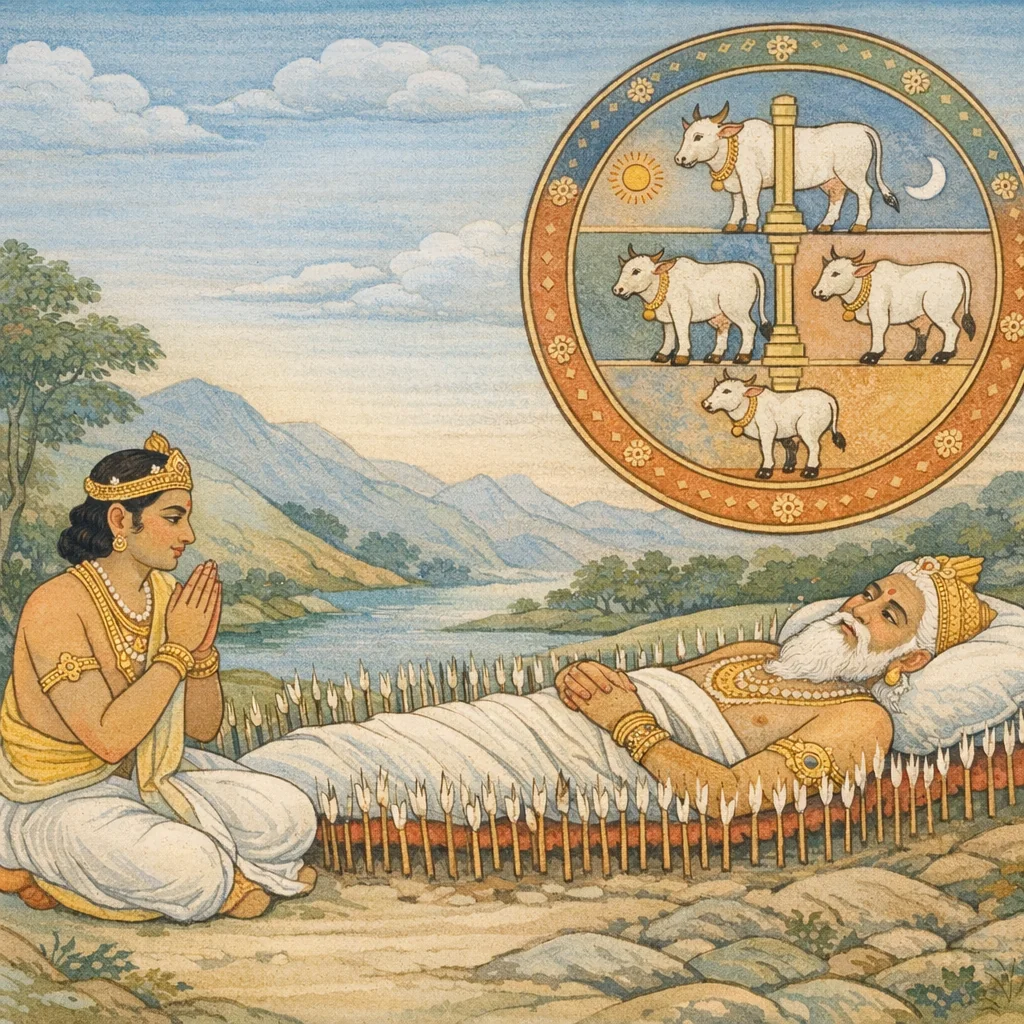
Adhyaya 231
आत्मदर्शन-उपदेशः (Ātma-darśana Upadeśa) — Mind, Senses, and the All-pervading Self
Upa-parva: Mokṣa-dharma (Liberation Teachings) — Adhyāya 231 Context Unit
Bhīṣma introduces an embedded instruction and praises the ‘paramarṣi’ teaching oriented to mokṣadharma. Śuka asks how a person endowed with household and Vedic qualifications can reach Brahman, and requests a clear account whether by Sāṃkhya or Yoga. Vyāsa replies that realization is not attained without knowledge joined to tapas, indriya-nigraha, and sarva-saṃnyāsa (comprehensive relinquishment). He then presents an analytic map of embodiment: the mahābhūtas are said to be established in living bodies; specific functions and deities are correlated with bodily loci (e.g., sight with light, digestion with fire), and the five sense-gates present their objects (sound, touch, form, taste, smell) to the mind. The mind is described as the governor of the senses, while the bhūtātman, seated in the heart, governs the mind; prāṇa and apāna are named as constant factors in embodied life. The discourse turns to the visibility of the self: the mahān ātman is not grasped by ordinary senses but shines to a ‘kindled’ mind; it is characterized as beyond sound/touch/form/taste/smell, imperishable, and to be discerned as bodiless within the body. One who perceives the unmanifest within manifest beings becomes fit for brahma-bhūya. Ethical cognition follows: the wise are equal-seeing across social and species distinctions, since one great self pervades all beings; seeing self in all and all in self is presented as the condition of ‘becoming Brahman.’ The chapter further describes the subtlety and all-pervasiveness of the principle (beyond spatial capture, subtler than the subtle, greater than the great), introduces the kṣara/akṣara distinction, and uses the ‘nine-gated city’ and haṃsa imagery to indicate the sovereign, disciplined inner principle; knowing the kūṭastha akṣara, the knower relinquishes prāṇa-bound rebirth.
Chapter Arc: युधिष्ठिर, शान्ति-पर्व के मोक्षधर्म-प्रसंग में, लोक-तत्त्व और प्राणियों की गति-अगति का रहस्य जानने की तीव्र जिज्ञासा से प्रश्न उठाते हैं—यह सृष्टि-नाश और आवागमन किससे प्रवर्तित होता है? → भीष्म उत्तर देने के लिए एक पुरातन इतिहास का द्वार खोलते हैं: शुकदेव का व्यास से प्रश्न—काल, सृष्टि-प्रलय, और ब्राह्मण-धर्म के कर्तव्य का निश्चय। जिज्ञासा ‘किसने बनाया’ से आगे बढ़कर ‘काल कैसे चलाता है’ और ‘युग-धर्म कैसे घटता-बढ़ता है’ तक पहुँचती है। → युग-चक्र और ब्रह्मा के दिन-रात्रि का विराट मापन सामने आता है—कृत, त्रेता, द्वापर, कलि में धर्म का क्रमशः क्षय; और सहस्र-चतुर्युगों से ब्रह्मा का एक दिन, उतनी ही रात्रि—प्रलय में ईश्वर का ध्यान-निद्रा और फिर सृष्टि का पुनरुदय। काल का स्वरूप यहाँ ‘घड़ी’ नहीं, ‘सृष्टि की श्वास’ बनकर प्रकट होता है। → भीष्म, शुक-व्यास संवाद के माध्यम से यह स्थिर करते हैं कि लोक-तत्त्व, भूतों की गति, और युग-धर्म का परिवर्तन काल-नियम से बँधा है; जो ब्रह्मा के दिन-रात्रि को यथार्थ जानता है, वही काल-ज्ञान में स्थित होकर संसार-परिवर्तन को सम्यक् समझता है। → काल-चक्र का यह मापन आगे ‘जीव की मुक्ति-यात्रा’ और ‘कर्तव्य बनाम वैराग्य’ के सूक्ष्म निर्णयों की भूमि तैयार करता है—अब प्रश्न यह रह जाता है कि इस ज्ञान के प्रकाश में मनुष्य अपना आचरण कैसे स्थिर करे।
Shlokas
Verse 1
ऑपन--माज बछ। जि एकत्रिशर्दाधिकद्विशततमो< ध्याय: शुकदेवजीका प्रश्न और व्यासजीका उनके प्रश्नोंका उत्तर देते हुए कालका स्वरूप बताना युधिछिर उवाच आद्यन्तं सर्वभूतानां ज्ञातुमिच्छामि कौरव । ध्यानं कर्म च काल॑ च तथैवायुर्युगे युगे,युधिष्ठिरने पूछा--कुरुनन्दन! अब मैं यह जानना चाहता हूँ कि सम्पूर्ण भूतोंकी उत्पत्ति किससे होती है? उनका अन्त कहाँ होता है? परमार्थकी प्राप्तिके लिये किसका ध्यान और किस कर्मका अनुष्ठान करना चाहिये? कालका क्या स्वरूप है? तथा भिन्न-भिन्न युगोंमें मनुष्योंकी कितनी आयु होती है?
Yudhiṣṭhira said: “O Kaurava, I wish to understand the beginning and the end of all beings. For attaining the highest good, what should one meditate upon, and what action should one undertake? What is the true nature of Time (Kāla), and what is the span of human life in each of the different ages (yugas)?”
Verse 2
लोकतत्त्वं च कार्त्स्न्येन भूतानामागतिं गतिम् । सर्गश्न निधनं चैव कुत एतत् प्रवर्तते,मैं लोकका तत्त्व पूर्णरूपसे जानना चाहता हूँ। प्राणियोंक आवागमन और सृष्टि-प्रलय किससे होते हैं?
Yudhiṣṭhira said: “I wish to understand, in its entirety, the true nature of the world—how beings come and go in the course of transmigration, and how creation and dissolution occur. From what source does this whole process arise and proceed?”
Verse 3
यदि तेअनुग्रहे बुद्धिरस्मास्विह सतां वर । एतदू भवन्तं पृच्छामि तद् भवानू प्रब्रवीतु मे,सत्पुरुषोंमें श्रेष्ठ पितामह! यदि आपका हमलोगोंपर अनुग्रह करनेका विचार है तो मैं यही बात आपसे पूछता हूँ। आप मुझे बताइये
Yudhiṣṭhira said: “O best among the virtuous, if you truly intend to show us favor here, then I ask you this very question. Please tell me the answer.”
Verse 4
पूर्व हि कथित श्रुत्वा भूगुभाषितमुत्तमम् । भरद्वाजस्य विप्रर्षेस्ततो मे बुद्धिरुत्तमा,पहले ब्रह्मर्षि भरद्वाजके प्रति भूगुजीका जो उत्तम उपदेश हुआ था, उसे आपके मुँहसे सुनकर मुझे उत्तम बुद्धि प्राप्त हुई थी
Yudhiṣṭhira said: “Earlier, having heard from your own lips that excellent instruction spoken by Bhṛgu to the brahmarṣi Bharadvāja, my understanding became refined and elevated.”
Verse 5
जाता परमधर्मिष्ठा दिव्यसंस्थान संस्थिता । ततो भूयस्तु पृच्छामि तद् भवान् वक्तुमरहति,मेरी बुद्धि परम धर्मिष्ठ एवं दिव्य स्थितिमें स्थित हो गयी थी; इसीलिये फिर पूछता हूँ। आप इस विषयका वर्णन करनेकी कृपा करें
Yudhiṣṭhira said: “My understanding has become firmly established in the highest dharma, set in a divine and elevated state. Therefore I ask again: may you be pleased to explain this matter further.”
Verse 6
भीष्म उवाच अत्र ते वर्तयिष्येडहमितिहासं पुरातनम् । जगौ यद् भगवान् व्यास: पुत्राय परिपृच्छते,भीष्मजीने कहा--युधिष्ठिर! इस विषयमें भगवान् व्यासने अपने पुत्रके पूछनेपर जो उपदेश दिया था, वही प्राचीन इतिहास मैं दुहराऊँगा
Bhishma said: “Here I shall recount to you an ancient tradition. It is the old account that the venerable Vyasa once spoke, when his son questioned him—this very teaching I will repeat for you.”
Verse 7
अधीत्य वेदानखिलान् साड्रोपनिषदस्तथा । अन्विच्छन्नैष्ठिकं कर्म धर्मनैपुणदर्शनात्,अंगों और उपनिषदोंसहित सम्पूर्ण वेदोंका अध्ययन करके व्यासपुत्र शुकदेवने नैष्ठिक कर्मको जाननेकी इच्छासे अपने पिता श्रीकृष्णद्वैपायन व्यासकी धर्मज्ञानविषयक निपुणता देखकर उनसे अपने मनका संदेह पूछा। उन्हें यह विश्वास था कि पिताजीके उपदेशसे मेरा धर्म और अर्थविषयक सारा संशय दूर हो जायगा
Bhishma said: Having studied all the Vedas in their entirety—together with their ancillary disciplines and the Upanishads—Shuka, the son of Vyasa, desiring to understand the steadfast, ultimate course of disciplined conduct, approached his father Krishna-Dvaipayana Vyasa. Seeing his father’s mastery in discerning dharma, he questioned him to resolve the doubts in his own mind, trusting that his father’s instruction would dispel his uncertainties regarding dharma and artha.
Verse 8
कृष्णद्वैपायन व्यासं पुत्रो वैयासकि: शुक:ः । पप्रच्छ संदेहमिमं छिन्नधर्मार्थसंशयम्,अंगों और उपनिषदोंसहित सम्पूर्ण वेदोंका अध्ययन करके व्यासपुत्र शुकदेवने नैष्ठिक कर्मको जाननेकी इच्छासे अपने पिता श्रीकृष्णद्वैपायन व्यासकी धर्मज्ञानविषयक निपुणता देखकर उनसे अपने मनका संदेह पूछा। उन्हें यह विश्वास था कि पिताजीके उपदेशसे मेरा धर्म और अर्थविषयक सारा संशय दूर हो जायगा
Bhishma said: Shuka, the son of Vyasa—Krishna Dvaipayana—approached his father and questioned him about this doubt, seeking a clear resolution of his uncertainties regarding dharma and artha. Having mastered the Vedas along with their limbs and the Upanishads, Shuka wished to understand steadfast, disciplined conduct, and trusted that his father’s instruction would dispel his moral and practical perplexities.
Verse 9
श्रीशुक उवाच भूतग्रामस्य कर्तारें कालज्ञाने च निश्चयम् । ब्राह्मणस्य च यत् कृत्यं तद् भवान् वक्तुमहति,श्रीशुकदेवजी बोले--पिताजी! समस्त प्राणि-समुदायको उत्पन्न करनेवाला कौन है? कालके ज्ञानके विषयमें आपका क्या निश्चय है? और ब्राह्मणका क्या कर्तव्य है? ये सब बातें आप बतानेकी कृपा करें
Śrī Śuka said: “Father, who is the creator of the entire multitude of living beings? What is your settled understanding regarding the knowledge of Time? And what, indeed, is the proper duty of a brāhmaṇa? Please be so kind as to explain these matters.”
Verse 10
भीष्म उवाच तस्मै प्रोवाच तत् सर्व पिता पुत्राय पृच्छते । अतीतानागते विद्वान सर्वज्ञ: सर्वधर्मवित्,भीष्मजी कहते हैं-राजन! भूत और भविष्यके ज्ञाता तथा सम्पूर्ण धर्मोंको जाननेवाले सर्वज्ञ विद्वान् पिता व्यासने अपने पुत्रके पूछनेपर उसे उन सब बातोंका इस प्रकार उपदेश किया
Bhishma said: To him, the father—wise, all-knowing, and versed in every form of dharma, with insight into what has passed and what is yet to come—explained everything, when his son asked.
Verse 11
व्यास उवाच अनाद्यन्तमजं दिव्यमजरं ध्रुवमव्ययम् । अप्रतर्क्यमविज्ञेयं ब्रह्माग्रे सम्प्रवर्तते,व्यासजी बोले--बेटा! सृष्टिके आरम्भमें अनादि, अनन्त, अजन्मा, दिव्य, अजर- अमर, ध्रुव, अविकारी, अतर्क्य और ज्ञानातीत ब्रह्म ही रहता है
Vyāsa said: “My child, at the very beginning of creation there exists only Brahman—without beginning or end, unborn, divine, unaging, steadfast and imperishable; beyond the reach of reasoning and not an object of ordinary knowing.”
Verse 12
काष्ठा निमेषा दश पञ्च चैव त्रिंशत्तु काष्ठा गणयेत् कलां ताम् | त्रिंशत्कलक्षापि भवेन्मुहूर्तो भाग: कलाया दशमश्न यः स्यात्,(अब कालका विभाग इस प्रकार समझना चाहिये) पंद्रह निमेषकी एक काष्ठा और तीस काष्ठाकी एक कला गिननी चाहिये। तीस कलाका एक मुहूर्त होता है। उसके साथ कलाका दसवाँ भाग और सम्मिलित होता है अर्थात् तीस कला और तीन काष्ठाका एक मुहूर्त होता है
Vyāsa explains the traditional reckoning of time: fifteen nimeṣas make one kāṣṭhā, and thirty kāṣṭhās are counted as one kalā. Thirty kalās constitute a muhūrta; and in addition, a tenth part of a kalā is included—so a muhūrta is understood as thirty kalās plus three kāṣṭhās. This teaching places human action within an ordered cosmic measure, urging clarity and precision when speaking of dharma, ritual timing, and disciplined conduct.
Verse 13
त्रिंशन्मुहूर्त तु भवेदहश्न रात्रिश्न संख्या मुनिभि: प्रणीता । मास: स्मृतो रात््यहनी च त्रिंशत् संवत्सरो द्वादशमास उक्तः,तीस मुहूर्तका एक दिन-रात होता है। महर्षियोंने दिन और रात्रिके मुहूर्तोंकी संख्या उतनी ही बतायी है। तीस रात-दिनका एक मास और बारह मासोंका एक संवत्सर बताया गया है
Vyāsa said: A day and a night together consist of thirty muhūrtas—such is the reckoning established by the sages. Thirty such day-nights are remembered as a month, and twelve months are declared to make a year. Thus the wise set forth the measured order of time for disciplined living and ritual duty.
Verse 14
संवत्सरं द्वे त्वयने वदन्ति संख्याविदो दक्षिणमुत्तरं च,विद्वान पुरुष दो अयनोंको मिलाकर एक संवत्सर कहते हैं। वे दो अयन हैं--उत्तरायण और दक्षिणायन
Vyāsa said: Those who are learned in reckoning declare that a single year (saṃvatsara) consists of two ‘courses’ (ayanas): the southern course (dakṣiṇāyana) and the northern course (uttarāyaṇa).
Verse 15
अहोरात्रे विभजते सूर्यो मानुषलौकिके । रात्रि: स्वप्लाय भूतानां चेष्टायै कर्मणामह:,मनुष्यलोकके दिन-रातका विभाग सूर्यदेव करते हैं। रात प्राणियोंके सोनेके लिये है और दिन काम करनेके लिये
Vyāsa said: In the human world, the Sun apportions the two divisions—day and night. Night is meant for the sleep and restoration of living beings, while day is meant for activity and the performance of one’s works. Thus, time itself is arranged to support orderly conduct and disciplined living.
Verse 16
पित्र्ये राग्यहनी मास: प्रविभागस्तयो: पुनः । शुक्लो5ह: कर्मचेष्टायां कृष्ण: स्पप्नाय शर्वरी,मनुष्योंके एक मासमें पितरोंका एक दिन-रात होता है। शुक्लपक्ष उनके काम-काज करनेके लिये दिन है और कृष्णपक्ष उनके विश्रामके लिये रात है
Vyāsa explains the different measure of time for the ancestral realm: what humans count as one month is, for the Pitṛs, a complete day and night. The bright fortnight is their ‘day,’ the time for activity and the performance of their functions; the dark fortnight is their ‘night,’ the time of rest and sleep. The teaching situates human ritual life within a larger moral cosmos, implying that one’s conduct and offerings are synchronized with an unseen order and should be performed with regularity and reverence.
Verse 17
दैवे रात्यहनी वर्ष प्रविभागस्तयो: पुनः । अहस्तत्रोदगयन रात्रि: स्याद् दक्षिणायनम्,मनुष्योंका एक वर्ष देवताओंके एक दिन-रातके बराबर है, उनके दिन-रातका विभाग इस प्रकार है। उत्तरायण उनका दिन है और दक्षिणायन उनकी रात्रि
Vyāsa said: For the gods, a human year constitutes a single day and night. Their division of day and night is as follows: the northward course of the sun (uttarāyaṇa) is their day, and the southward course (dakṣiṇāyaṇa) is their night.
Verse 18
ये ते रात्यहनी पूर्व कीर्तिते जीवलौकिके । तयो: संख्याय वर्षग्रं ब्राह्मे वक्ष्याम्पह:क्षपे,पहले मनुष्योंके जो दिन-रात बताये गये हैं, उन्हींकी संख्याके हिसाबसे अब मैं ब्रह्माके दिन-रातका मान बताता हूँ। साथ ही सत्ययुग, त्रेता, द्वापए और कलियुग--इन चारों युगोंकी वर्ष-संख्या भी अलग-अलग बता रहा हूँ
Vyāsa said: “Those nights and days that were previously described in relation to the human world—using their reckoning as the measure, I shall now state the span of Brahmā’s day and night, and the total count of years therein.”
Verse 19
पृथक् संवत्सराग्राणि प्रवक्ष्याम्यनुपूर्वश: । कृते त्रेतायुगे चैव द्वापरे च कलौ तथा,पहले मनुष्योंके जो दिन-रात बताये गये हैं, उन्हींकी संख्याके हिसाबसे अब मैं ब्रह्माके दिन-रातका मान बताता हूँ। साथ ही सत्ययुग, त्रेता, द्वापए और कलियुग--इन चारों युगोंकी वर्ष-संख्या भी अलग-अलग बता रहा हूँ
Vyāsa said: “I shall now set forth, in due order, the distinct measures of years. I will state separately the year-counts belonging to the Kṛta (Satya), Tretā, Dvāpara, and Kali ages as well.”
Verse 20
चत्वार्याहु: सहस्राणि वर्षाणां तत्कृतं युगम् । तस्य तावच्छती संध्या संध्यांशक्ष तथाविध:,देवताओंके चार हजार वर्षोका एक सत्ययुग होता है। सत्ययुगमें चार सौ दिव्य वर्षोंकी संध्या होती है और उतने ही वर्षोका एक संध्यांश भी होता है (इस प्रकार सत्ययुग अड़तालीस सौ दिव्य वर्षोंका होता है)
Vyāsa said: The wise declare that the Kṛta (Satya) Yuga consists of four thousand years. Its dawn (sandhyā) lasts four hundred years, and its twilight portion (sandhyāṃśa) is of the same measure. Thus the text sets out the divine time-scale by which the ages are ethically graded and measured.
Verse 21
संध्या और संध्यांशोंसहित अन्य तीन युगोंमें यह (चार हजार आठ सौ वर्षोकी) संख्या क्रमश: एक-एक चौथाई घटती जाती है-
Vyāsa said: Including their twilight periods (sandhyā) and the portions of twilight (sandhyāṃśa), in the other three yugas this total—reckoned here as 4,800 years—diminishes in due order by one quarter each time. The teaching frames time itself as governed by a moral rhythm: as the ages proceed, the measure of dharma and the span of auspicious order steadily decline.
Verse 22
एतानि शाश्वताँललोकान् धारयन्ति सनातनान् | एतद् ब्रह्माविदां तात विदितं ब्रह्म शाश्वतम्,ये चारों युग प्रवाहरूपसे सदा रहनेवाले सनातन लोकोंको धारण करते हैं। तात! यह युगात्मक काल ब्रह्मवेत्ताओंके सनातन ब्रह्मका ही स्वरूप है
These cycles of time uphold the eternal, primeval worlds. Dear one, for those who know Brahman it is understood that this time—shaped as the succession of the yugas—is itself the very form of the everlasting Brahman.
Verse 23
इतरेषु ससंध्येषु संध्यांशेषु ततस्त्रिषु । एक पादेन हीयन्ते सहस्राणि शतानि च,चतुष्पात् सकलो धर्म: सत्यं चैव कृते युगे । नाधर्मेणागम: कश्चित् परस्तस्य प्रवर्तते सत्ययुगमें सत्य और धर्मके चारों चरण मौजूद रहते हैं--उस समय सत्य और धर्मका पूरा-पूरा पालन होता है उस समय कोई भी धर्मशास्त्र अधर्मसे संयुक्त नहीं होता; उसका उत्तम रीतिसे पालन होता है
Vyāsa said: In the other three transitional portions (the remaining yuga-junctions), thousands and hundreds diminish by one quarter each time. In the Kṛta Yuga, dharma stands complete on all four feet, and truth likewise prevails. In that age, no scriptural ordinance is mixed with unrighteousness; rather, it proceeds and is practiced in the highest and proper manner.
Verse 24
इतरेष्वागमाद् धर्म: पादशस्त्ववरोप्यते । चौर्यकानृतमायाभिर धर्म श्वोपचीयते
Vyāsa said: In the later ages, dharma is diminished step by step, as though each of its quarters is taken away. Through theft, falsehood, and deceit, dharma is reduced to the level of a dog—fed and sustained only in a degraded form.
Verse 25
अन्य युगोंमें शास्त्रोक्त धर्मका क्रमश: एक-एक चरण क्षीण होता जाता है और चोरी, असत्य तथा छल-कपट आदिके द्वारा अधर्मकी वृद्धि होने लगती है ।। अरोगा: सर्वसिद्धार्थ श्चितुर्वर्षशतायुष: । कृते त्रेतायुगे त्वेषां पादशो हसते वय:,सत्ययुगके मनुष्य नीरोग होते हैं। उनकी सम्पूर्ण कामनाएँ सिद्ध होती हैं तथा वे चार सौ वर्षोकी आयुवाले होते हैं। त्रेतायुग आनेपर उनकी आयु एक चौथाई घटकर तीन सौ वर्षोकी रह जाती है। इसी प्रकार द्वापरमें दो सौ और कलियुगमें सौ वर्षोकी आयु होती है
Vyāsa explains that as the world moves through successive ages, the scripturally enjoined order of dharma loses its supports one by one. With the spread of theft, falsehood, and deceit, adharma correspondingly grows. In the Kṛta (Satya) age, people are free from disease, their aims are fulfilled, and they live for four hundred years; when the Tretā age arrives, their lifespan diminishes by a quarter, and so it continues to decline in the later ages.
Verse 26
वेदवादाश्वानुयुगं हसन्तीतीह न: श्रुतम् । आयूंषि चाशिषश्चैव वेदस्यैव च यत्फलम्,त्रेता आदि युगोंमें वेदोंका स्वाध्याय और मनुष्योंकी आयु घटने लगती है, ऐसा सुना गया है। उनकी कामनाओंकी सिद्धिमें भी बाधा पड़ती है और वेदाध्ययनके फलमें भी न्यूनता आ जाती है
Vyāsa said: We have heard it said in this world that, as the ages proceed, the proclamations of the Veda come to be treated with derision. Human lifespans diminish; blessings and desired attainments meet with obstruction; and even the fruits of Vedic study and practice become reduced. The teaching underscores the moral decline of later yugas and the need for steadiness in dharma despite weakening capacities.
Verse 27
अन्ये कृतयुगे धर्मास्त्रितायां द्वापरेडपरे । अन्ये कलियुगे नृणां युगहासानुरूपत:,युगोंके हासके अनुसार सत्ययुग, त्रेता, द्वापर और कलियुगमें मनुष्योंके धर्म भी भिन्न- भिन्न प्रकारके हो जाते हैं
Vyāsa said: In the Kṛta age, certain forms of dharma prevail; in Tretā and in Dvāpara, other forms arise; and in the Kali age, yet other duties apply for human beings—each set of practices shaped in accordance with the character and conditions of that particular age. Thus righteousness is not merely a fixed outward code, but must be understood and applied to suit the moral capacities and circumstances of the time, while still aiming at the same highest good.
Verse 28
तप: परं कृतयुगे त्रेतायां ज्ञानमुत्तमम् । द्वापरे यज्ञमेवाहुर्दानमेक॑ कलौ युगे,सत्ययुगमें तपस्याको ही सबसे बड़ा धर्म माना गया है। त्रेतामें ज्ञानको ही उत्तम बताया गया है। द्वापरमें यज्ञ और कलियुगमें एकमात्र दान ही श्रेष्ठ कहा गया है
Vyāsa explains that the foremost spiritual discipline changes with the character of each age: in the Kṛta (Satya) Yuga, austerity and self-restraint are held to be supreme; in the Tretā Yuga, true knowledge is praised as the highest; in the Dvāpara Yuga, sacrificial worship (yajña) is declared the principal path; and in the Kali Yuga, giving—dāna, charity offered in the spirit of dharma—is taught as the single best practice. The verse frames dharma as one in aim but adapted in method to the capacities and conditions of different times.
Verse 29
एतां द्वादशसाहसत्रीं युगाख्यां कवयो विदु: । सहस्रपरिवर्त तद् ब्राह्मं दिवसमुच्यते,इस प्रकार देवताओंके बारह हजार वर्षोका एक चतुर्युग होता है; यह विद्वानोंकी मान्यता है। एक सहस्र चतुर्युगको ब्रह्माका एक दिन बताया जाता है
Vyāsa said: The sages know that the age called a yuga amounts to twelve thousand (years) of the gods. A thousand such revolutions (of the four-yuga cycle) are declared to constitute a single day of Brahmā. Thus the teaching places human time within a vast cosmic order, urging humility and steadiness in dharma amid the rise and fall of ages.
Verse 30
रात्रिमेतावतीं चैव तदादौ विश्वमी श्वर: । प्रलये ध्यानमाविश्य सुप्त्वा सो<न्ते विबुद्धयते,इतने ही युगोंकी उनकी एक रात्रि भी होती है। भगवान् ब्रह्मा अपने दिनके आरम्भमें संसारकी सृष्टि करते हैं और रातमें जब प्रलयका समय होता है, तब सबको अपनेमें लीन करके योगनिद्राका आश्रय ले सो जाते हैं; फिर प्रलयका अन्त होने अर्थात् रात बीतनेपर वे जाग उठते हैं
“Such a span constitutes His night as well. At the beginning of that (day), the Lord brings forth the universe; and when dissolution (pralaya) arrives, He withdraws all beings into Himself, enters meditative absorption, and sleeps. When that dissolution ends—when the night has passed—He awakens again.”
Verse 31
सहस्रयुगपर्यन्तमहर्यद्ब्रह्म॒णो विदु: । रात्रि युगसहस्रान्तां तेडहोरात्रविदो जना:
Vyāsa said: Those who truly understand the measure of day and night know that Brahmā’s “day” extends to the end of a thousand yugas, and that his “night” likewise ends after a thousand yugas. Thus, the wise discern time on a cosmic scale, beyond ordinary human reckoning.
Verse 32
एक हजार चतुर्युगका जो ब्रह्माका एक दिन बताया गया है और उतनी ही बड़ी जो उनकी रात्रि कही गयी है, उसको जो लोग ठीक-ठीक जानते हैं, वे ही दिन और रात अर्थात् कालतत्त्वको जाननेवाले हैं ।। प्रतिबुद्धों विकुरुते ब्रह्माक्षय्यं क्षपाक्षये सृजते च पर | तस्माद् व्यक्तात्मकं मन:,रात्रि समाप्त जाग्रत् हुए ब्रह्माजी पहले अपने अक्षय स्वरूपको मायासे विकारयुक्त बनाते हैं फिर महत्तत्त्वको उत्पन्न करते हैं। तत्पश्चात् उससे स्थूल जगत्को धारण करनेवाले मनकी उत्पत्ति होती है
Vyāsa said: Those who truly know that Brahmā’s single day consists of a thousand cycles of four yugas, and that his night is of the same vast measure—only they are knowers of day and night, that is, knowers of the principle of Time. When the night ends and Brahmā awakens, he first, through māyā, renders his imperishable being fit for manifestation and change; then he brings forth the Great Principle (mahat). Thereafter, from that arises mind, which upholds and orders the gross world.
Verse 230
इस प्रकार श्रीमह्याभारत शान्तिपर्वके अन्तर्गत गोक्षधर्मपर्वमें श्रीकृष्ण और उग्रसेनका संवादविषयक दो सौ तीसवाँ अध्याय पूरा हुआ
Thus ends the two hundred and thirtieth chapter of the Śānti Parva of the Śrī Mahābhārata, within the section on the duties concerning the cow (Gokṣa-dharma), presenting a dialogue between Śrī Kṛṣṇa and Ugrasena.
Verse 231
इति श्रीमहाभारते शान्तिपर्वणि मोक्षधर्मपर्वणि शुकानुप्रश्ने एकत्रिशदधिकद्विशततमो< ध्याय:,इस प्रकार श्रीमहाभारत शान्तिपर्वके अन्तर्गत मोौक्षधर्मपर्वमें शुकका अनुप्रश्नविषयक दो सौ इकतीसवाँ अध्याय पूरा हुआ
Thus ends the two-hundred-and-thirty-first chapter of the Mokṣadharma section within the Śānti Parva of the Śrī Mahābhārata, in the portion concerning Śuka’s follow-up questions.
Frequently Asked Questions
Śuka asks how a person with Vedic learning, ritual standing, maturity, and non-envious character can attain Brahman, and requests the practical means—whether articulated through Sāṃkhya analysis or Yogic discipline.
Liberation is presented as dependent on disciplined cognition: restraining the senses, stabilizing the mind, and discerning the imperceptible ātman that pervades all beings; equal vision (sama-darśana) is treated as a cognitive-ethical marker of that realization.
Yes in doctrinal form: it states that the one who perceives the unmanifest within the manifest becomes fit for brahma-bhūya, and that the knower of the kūṭastha akṣara relinquishes prāṇa-bound rebirth (i.e., is oriented to amṛtatva).