Adhyaya 70
द्रोण–धृष्टद्युम्नयुद्धवर्णनम् (Drona–Dhrishtadyumna Battle Description)
Upa-parva: Droṇa–Dhṛṣṭadyumna Saṃgrāma (Battle Account within Droṇa-parva)
Saṃjaya reports that as Pārtha and Vārṣṇeya have entered the fray and Duryodhana moves behind, the Pāṇḍavas with the Somakas surge toward Droṇa with great speed and noise, initiating an exceptionally intense engagement before the battle-formation. Dhṛṣṭadyumna and the Pāṇḍava host shower Droṇa’s army with arrows; the Kauravas, placing Droṇa at their front, respond in kind. The narration repeatedly uses storm, river-flood, and fire imagery to characterize reciprocal missile-exchanges and the churning of units. Droṇa checks the coalition’s advance “like a mountain against torrents,” yet Dhṛṣṭadyumna persistently draws him and strikes back, and at one point the host becomes divided into three. The chapter then catalogs concurrent containment actions: Kaurava champions surround Bhīma; others block the Draupadeyas; Śalya covers Yudhiṣṭhira; Duḥśāsana advances against Sātyaki; Śakuni checks Nakula; Vindānu-vindau engage Virāṭa; Bāhlika counters Śikhaṇḍin; and Alāyudha runs at Ghaṭotkaca. Finally, Jayadratha is positioned at the rear under a carefully named protective arrangement: wheel-guards and rear-guards including Droṇi (Aśvatthāman), Karṇa, and other elite archers, indicating deliberate asset-protection within the wider melee.
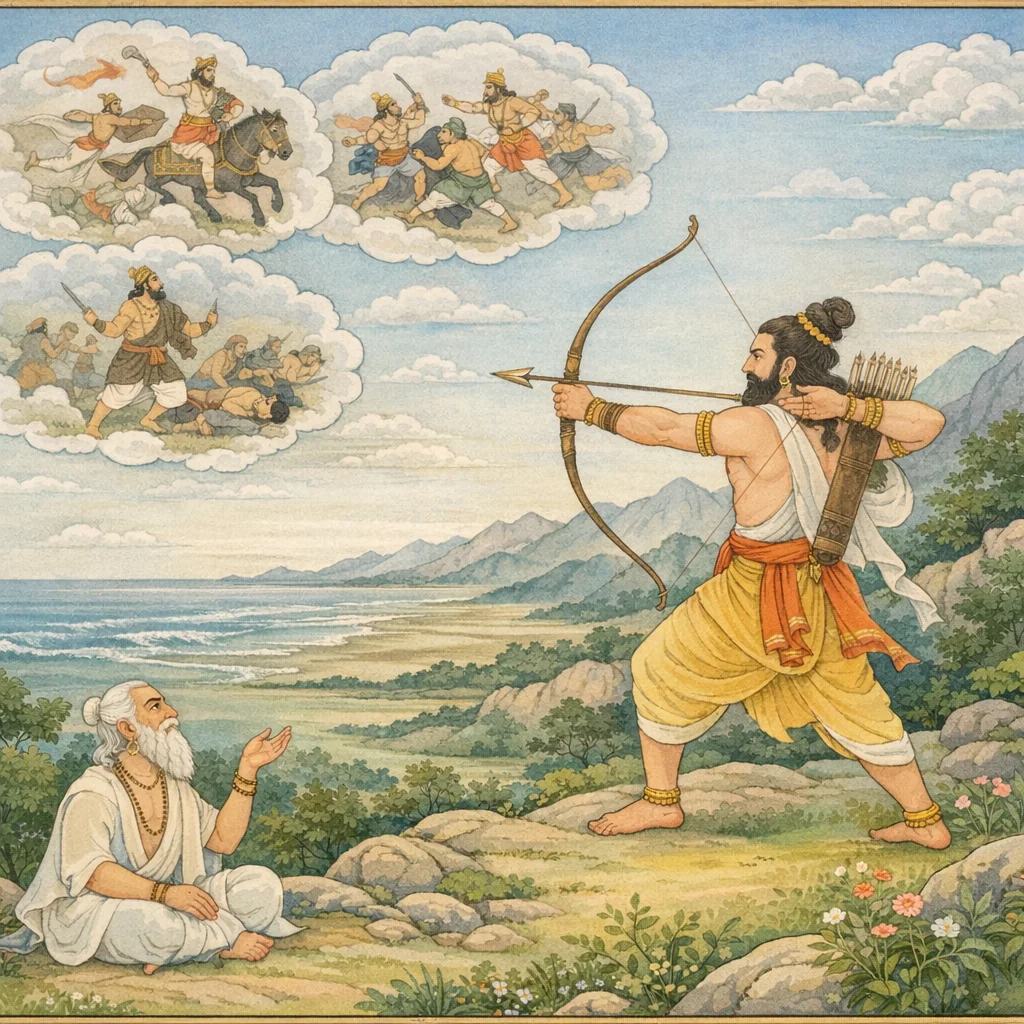
Chapter Arc: नारद सृंजय से कहते हैं कि महातपस्वी, शूरवीर, लोक-वन्दित जमदग्निनन्दन परशुराम भी अंततः अतृप्त-सा ही मृत्यु के मुख में जाएगा—यह वाक्य वीरता की चरम सीमा पर भी मानव-सीमा का स्मरण कराता है। → कथा परशुराम के तेजस्वी जीवन-वृत्त में उतरती है: पृथ्वी को ‘सुखमय’ बनाने वाले आदिधर्म-पालक का रूप, फिर क्षत्रियों के अत्याचार से उत्पन्न ज्वाला—गाय के बछड़े का अपहरण और पिता जमदग्नि का वध; इस अपमान से प्रतिशोध धर्म-युद्ध बनकर फैलता है। → परशुराम का उग्र संहार-चक्र: परशु से दश-सहस्रों का वध, देश-देशांतर के राजन्यों पर बाण-वर्षा, रक्त-प्रवाह से सरोवरों का भर जाना और ‘अठारह द्वीपों’ तक भय का विस्तार—यह क्षत्रिय-नाश का महाविस्फोट अध्याय का शिखर है। → कश्यप के आदेश से परशुराम का महेन्द्र पर्वत पर निवास और समुद्र को पीछे हटाकर भूमि-सीमा का निर्धारण (जहाँ तक बाण फेंका जा सके); फिर यज्ञों का अनुष्ठान—क्रतुशत, पूर्ण दक्षिणा—और भृगुकुल-कीर्ति का स्थापन। उग्र प्रतिशोध तप और दान में रूपांतरित होता है। → नारद का निष्कर्ष—इतने गुणों और यश के बाद भी जामदग्न्य ‘मरिष्यति’—यह संकेत छोड़ता है कि महावीर का अंत भी अपूर्ण तृप्ति और कर्म-फल की अनिवार्यता से बंधा है।
Shlokas
Verse 1
नारदजी कहते हैं--सृंजय! महातपस्वी शूरवीर, वीरजनवन्दित महायशस्वी जमदग्निनन्दन परशुरामजी भी अतृप्त अवस्थामें ही मौतके मुखमें चले जायँगे
Narada said: “O Sṛñjaya, even Paraśurāma—the great ascetic and heroic warrior, honored by the brave and renowned as the son of Jamadagni—will go to the very face of Death while still unsated. Thus, neither fame, valor, nor austerity can exempt one from mortality when desire remains unfulfilled.”
Verse 2
यः स्माद्यमनुपर्येति भूमिं कुर्वन्निमां सुखाम् । न चासीदू विक्रिया यस्य प्राप्य श्रियमनुत्तमाम्,जिन्होंने इस पृथ्वीको सुखमय बनाते हुए आदि युगके धर्मका जहाँ निरन्तर प्रचार किया था तथा परम उत्तम सम्पत्तिको पाकर भी जिनके मनमें किसी प्रकारका विकार नहीं आया
He was one who followed the dharma of the primeval age, making this earth a place of well-being and ceaselessly proclaiming that law; and even upon attaining the highest prosperity, no distortion or taint arose within his mind.
Verse 3
यः क्षत्रियै: परामृष्टे वत्से पितरि चाब्रुवन् । ततो<वधीत् कार्तवीर्यमजितं समरे परै:,जब क्षत्रियोंने गायके बछड़ेको पकड़ लिया और पिता जमदग्निको मार डाला, तब जिन्होंने मौन रहकर ही समरभूमिमें दूसरोंसे कभी पराजित न होनेवाले कृतवीर्यकुमार अर्जुनका वध किया था
Narada said: When the Kshatriyas seized the calf and, after killing his father Jamadagni, spoke to him, he—maintaining a grim silence—then slew Kartavirya (Arjuna), who had never been defeated by others in battle.
Verse 4
क्षत्रियाणां चतु:ःषष्टिमयुतानि सहस्रश: । तदा मृत्यो: समेतानि एकेन धनुषाजयत्,उस समय मरने-मारनेका निश्चय करके एकत्र हुए चौसठ करोड़ क्षत्रियोंको उन्होंने एकमात्र धनुषके द्वारा जीत लिया
Narada said: “Sixty-four ayutas of Kshatriyas—counted in thousands—had assembled then with a settled resolve to kill and be killed. Yet he overcame that mass of warriors by the power of a single bow.”
Verse 5
ब्रह्मद्विषां चाथ तस्मिन् सहस््राणि चतुर्दश । पुनरन्यानि जग्राह दन्तक़््रं जघान ह,उसी युद्धके सिलसिलेमें परशुरामजीने चौदह हजार दूसरे ब्रह्मद्रोहियोंका दमन किया और दन्तक़्ूर नामक राजाको भी मार डाला
Narada said: “In that same course of warfare, Paraśurāma subdued fourteen thousand more who were hostile to the Brāhmaṇas; and he also slew the king named Dantakrūra.”
Verse 6
सहस्र मुसलेनाहन् सहस्रमसिनावधीत् | उद्बन्धनात् सहस्नं च सहस्रमुदके धृतम्,उन्होंने एक सहस्र क्षत्रियोंको मूसलसे मार गिराया, एक सहस्र राजपूतोंको तलवारसे काट डाला, फिर एक सहस क्षत्रियोंको वृक्षोंकी शाखाओंमें फाँसीपर लटकाकर मार डाला और पुन: एक सहसख्रको पानीमें डुबो दिया
Nārada said: “With a mace he struck down a thousand; with a sword he slew another thousand. A further thousand he killed by hanging them from above, and yet another thousand he caused to be held under water (and drowned).” The verse underscores the escalating brutality of violence and the moral collapse that can accompany unchecked wrath and power, even when narrated as a tally of battlefield ‘feats’.
Verse 7
दन्तान् भड़क्त्वा सहस्नस्य कर्णान् नासान्यकृन्तत । ततः सप्तसहस्राणां कट्धूपमपाययत्,एक सहस्र राजपूतोंके दाँत तोड़कर नाक और कान काट डाले तथा सात हजार राजाओंको कड़वा धूप पिला दिया
Narada said: “Having broken the teeth of a thousand (kings/warriors), he cut off their ears and noses. Then he forced seven thousand (kings) to drink a bitter, acrid fumigation/decoction.” The passage underscores a descent into cruelty in the war-narrative, where humiliation and mutilation replace righteous combat, highlighting the ethical collapse that adharma brings upon rulers and armies alike.
Verse 8
शिष्टान् बद्ध्वा च हत्वा वै तेषां मूर्थ्नि विभिद्य च । गुणावतीमुत्तरेण खाण्डवाद् दक्षिणेन च | गिर्यन्ते शतसाहस्रा हैहया: समरे हता:,शेष क्षत्रियोंको बाँधकर उनका वध कर डाला। उनमेंसे कितनोंके ही मस्तक विदीर्ण कर डाले। गुणावतीसे उत्तर और खाण्डव वनसे दक्षिण पर्वतके निकटवर्ती प्रदेशमें लाखों हैहयवंशी क्षत्रिय वीर पिताके वधसे कुपित हुए बुद्धिमान् परशुरामजीके द्वारा समरभूमिमें मारे गये। वे अपने रथ, घोड़े और हाथियोंसहित मारे जाकर वहाँ धराशायी हो गये
Nārada said: Having bound the remaining warriors and slain them, he even split the heads of many among them. To the north of Guṇāvatī and to the south of the Khāṇḍava forest, in the mountain-bordering region, hundreds of thousands of Haihaya kṣatriyas were killed in battle—cut down by the wise Paraśurāma, enraged by the slaying of his father. Struck down together with their chariots, horses, and elephants, they fell there upon the earth.
Verse 9
सरथाश्वगजा वीरा निहतास्तत्र शेरते | पितुर्वधामर्षितेन जामदग्न्येन धीमता,शेष क्षत्रियोंको बाँधकर उनका वध कर डाला। उनमेंसे कितनोंके ही मस्तक विदीर्ण कर डाले। गुणावतीसे उत्तर और खाण्डव वनसे दक्षिण पर्वतके निकटवर्ती प्रदेशमें लाखों हैहयवंशी क्षत्रिय वीर पिताके वधसे कुपित हुए बुद्धिमान् परशुरामजीके द्वारा समरभूमिमें मारे गये। वे अपने रथ, घोड़े और हाथियोंसहित मारे जाकर वहाँ धराशायी हो गये
Nārada said: “There, the heroic warriors lie slain—together with their chariots, horses, and elephants—cut down in that place by the wise Jāmadagnya (Paraśurāma), who, unable to endure the outrage of his father’s killing, acted in wrathful retribution. The battlefield is thus strewn with the fallen, showing how vengeance born of grief can turn into vast and indiscriminate destruction.”
Verse 10
निजघ्ने दशसाहस्रान् राम: परशुना तदा । न ह्मृष्यत ता वाचो यास्तैर्भूशमुदीरिता:
Nārada said: Then Rāma (Paraśurāma) struck down ten thousand men with his axe. Yet he did not exult in the loud cries that were raised by them—showing a grim, duty-driven ferocity rather than delight in slaughter.
Verse 11
ततः काश्मीरदरदान् कुन्तिक्षुद्रकमालवान्,तदनन्तर प्रतापी परशुरामने काश्मीर, दरद, कुन्ति, क्षुद्रक, मालव, अंग, वंग, कलिंग, विदेह, ताम्रलिप्त, रक्षोवाह, वीतिहोत्र, त्रिगर्त, मार्तिकावत, शिबि तथा अन्य सहसों देशोंके क्षत्रियोंका अपने तीखे बाणोंद्वारा संहार किया
Thereafter, Paraśurāma, blazing with prowess, slaughtered with his keen arrows the Kṣatriyas of many realms—Kashmir, Darada, Kunti, Kṣudraka, Malava, Aṅga, Vaṅga, Kaliṅga, Videha, Tāmralipta, Rakṣovāha, Vītihotra, Trigarta, Mārtikāvata, Śibi, and thousands of other lands besides.
Verse 12
अड़वड़कलिड्रांश्न विदेहांस्ताम्रनलिप्तकान् | रक्षोवाहान् वीतिहोत्रांस्त्रिगर्तान् मार्तिकावतान्,तदनन्तर प्रतापी परशुरामने काश्मीर, दरद, कुन्ति, क्षुद्रक, मालव, अंग, वंग, कलिंग, विदेह, ताम्रलिप्त, रक्षोवाह, वीतिहोत्र, त्रिगर्त, मार्तिकावत, शिबि तथा अन्य सहसों देशोंके क्षत्रियोंका अपने तीखे बाणोंद्वारा संहार किया
Nārada said: “Thereafter, the mighty Paraśurāma, blazing with prowess, struck down with his keen arrows the Kṣatriyas of many lands—such as the Videhas, the people of Tāmralipta, the Rakṣovāhas, the Vītihotras, the Trigartas, and the Mārtikāvatas—along with countless others.”
Verse 13
शिबीनन्यांश्व राजन्यान् देशान् देशान्ू सहस्रशः । निजघान शितैर्बाणैर्जामदग्न्य: प्रतापवान्,तदनन्तर प्रतापी परशुरामने काश्मीर, दरद, कुन्ति, क्षुद्रक, मालव, अंग, वंग, कलिंग, विदेह, ताम्रलिप्त, रक्षोवाह, वीतिहोत्र, त्रिगर्त, मार्तिकावत, शिबि तथा अन्य सहसों देशोंके क्षत्रियोंका अपने तीखे बाणोंद्वारा संहार किया
Nārada said: “The mighty Jāmadagnya (Paraśurāma) slew the Śibis and countless other Kṣatriyas from region after region, striking them down with his sharp arrows.”
Verse 14
कोटीशतसहस््राणि क्षत्रियाणां सहस्रश: । इन्द्रगोपकवर्णस्य बन्धुजीवनिभस्य च,ईजे क्रतुशतै: पुण्यै: समाप्तवरदक्षिणै: । सहस्रों और लाखों कोटि क्षत्रियोंके इन्द्रगोप (वीर-बहूटी) नामक कीट तथा बन्धुजीव (दुपहरिया)-पुष्पके समान रंगवाले रक्तकी धाराओंसे भृगुनन्दन परशुरामने कितने ही तालाब भर दिये और समस्त अठारह द्वीपोंको अपने वशमें करके उत्तम दक्षिणाओंसे युक्त सौ पवित्र यज्ञोंका अनुष्ठान किया
Narada said: “In countless multitudes—hundreds of koṭis and thousands upon thousands—Kṣatriyas were slain. With streams of blood the color of the indragopa insect and like the bandhujīva flower, Paraśurāma, Bhṛgu’s descendant, filled many ponds. Having brought the eighteen islands (the whole earth) under his control, he then performed a hundred sacred sacrifices, each duly completed with excellent gifts to the priests.”
Verse 15
रुधिरस्य परीवाहै: पूरयित्वा सरांसि च | सर्वनिष्टादश द्वीपान् वशमानीय भार्गव:
Nārada said: “By torrents and channels of blood he filled the lakes as well; and having brought all the eighteen islands of the world under his control, the Bhārgava (Paraśurāma) established his dominion.”
Verse 16
वेदीमष्टनलोत्सेधां सौवर्णा विधिनिर्मिताम्
Nārada said: “(They) prepared a golden sacrificial altar, fashioned according to the prescribed ritual rule (vidhi), and raised to the height of eight measures.”
Verse 17
सर्वरत्नशतै: पूर्णा पताकाशतमालिनीम् । ग्राम्यारण्यै: पशुगणै: सम्पूर्णां च महीमिमाम्
Nārada said: “This land is filled with hundreds of every kind of jewel, adorned with garlands of a hundred banners, and made complete with herds of animals—both domesticated and those of the forests.”
Verse 18
रामस्य जामदग्न्यस्य प्रतिजग्राह कश्यप: । उस यज्ञमें विधिपूर्वक बत्तीस हाथ ऊँची सोनेकी वेदी बनायी गयी थी, जो सब प्रकारके सैकड़ों रत्नोंसे परिपूर्ण और सौ पताकाओंसे सुशोभित थी। जमदग्निनन्दन परशुरामकी उस वेदीको तथा ग्रामीण और जंगली पशुओंसे भरी-पूरी इस पृथ्वीको भी महर्षि कश्यपने दक्षिणारूपसे ग्रहण किया || १६-१७ $ ।। ततः शतसहस्राणि द्विपेन्द्रान हेमभूषणान्,उस समय परशुरामजीने लाखों गजराजोंको सोनेके आभूषणोंसे विभूषित करके तथा पृथ्वीको चोर-डाकुओंसे सूनी और साधु पुरुषोंसे भरी-पूरी करके महायज्ञ अश्वमेधमें कश्यपजीको दे दिया
Nārada said: “Kaśyapa accepted the vowed gift of Rāma Jāmadagnya (Paraśurāma). In that sacrifice, a golden altar—thirty-two cubits high—was duly constructed according to ritual rule (vidhi), filled with hundreds of gems and adorned with a hundred banners. Kaśyapa received as dakṣiṇā that altar of Jamadagni’s son Paraśurāma, and even the earth itself, teeming with village and forest creatures. Thereafter, in the great Aśvamedha, Paraśurāma also presented to Kaśyapa hundreds of thousands of lordly elephants decked with golden ornaments, and a land made free of thieves and brigands and filled with righteous people.”
Verse 19
निर्दस्युं पृथिवीं कृत्वा शिष्टेष्टजनसंकुलाम् | कश्यपाय ददौ रामो हयमेथे महामखे,उस समय परशुरामजीने लाखों गजराजोंको सोनेके आभूषणोंसे विभूषित करके तथा पृथ्वीको चोर-डाकुओंसे सूनी और साधु पुरुषोंसे भरी-पूरी करके महायज्ञ अश्वमेधमें कश्यपजीको दे दिया
Nārada said: “Having made the earth free of thieves and brigands, and filled with the righteous and the worthy, Rāma (Paraśurāma) bestowed it upon Kaśyapa at the great sacrificial rite of the Aśvamedha.”
Verse 20
त्रि:सप्तकृत्व: पृथिवीं कृत्वा नि:क्षत्रियां प्रभु: इष्ट्वा क्रतुशतैर्वीरो ब्राह्मणेभ्यो हुमन्यत,वीर एवं शक्तिशाली परशुरामजीने इक्कीस बार इस पृथ्वीको क्षत्रियोंसे शून्य करके सैकड़ों यज्ञोंद्वार भगवानूका यजन किया और इस वसुधाको ब्राह्मणोंके अधिकारमें दे दिया
Nārada said: “That lordly hero made the earth bereft of Kṣatriyas three times seven (twenty-one times). Having performed hundreds of sacrifices, the warrior then placed this land under the authority of the Brāhmaṇas.”
Verse 21
सप्तद्वीपां वसुमतीं मारीचो<वगृह्नत द्विज: । राम॑ प्रोवाच निर्गच्छ वसुधातो ममाज्ञया,ब्रह्मर्षि कश्यपने जब सातों द्वीपोंसे युक्त यह पृथ्वी दानमें ले ली, तब उन्होंने परशुरामजीसे कहा--“अब तू मेरी आज्ञासे इस पृथ्वीसे निकल जाओ” (और कहीं अन्यत्र जाकर रहो)
Nārada said: The brahmin Mārīca accepted as a gift the earth endowed with the seven continents and took it into his rightful possession. Then he addressed Rāma (Paraśurāma): “By my command, depart from this earth.” Thus is shown the moral force of a duly given gift, and the duty—even of the mighty—to honor lawful ownership and rightful authority.
Verse 22
स कश्यपस्य वचनात् प्रोत्सार्य सरितां प्रतिम् । इषुपाते युधां श्रेष्ठ: कुर्वन् ब्राह्मणशासनम्
At Kaśyapa’s command, he drove (his foe) back toward the river. Though foremost among warriors in the discharge of missiles, he acted in obedience to a brahmin’s injunction—showing that martial prowess must be ruled by rightful counsel and restraint.
Verse 23
एवं गुणशतैर्युक्तो भूगूणां कीर्तिवर्धन:
Nārada said: “Thus endowed with hundreds of virtues, he became one who increased the fame and renown of the Bhṛgus.”
Verse 24
त्वया चतुर्भद्रतर: पुत्रात् पुण्यतरस्तव
Nārada said: “For you, he is fourfold more auspicious—indeed, more meritorious than your own son.”
Verse 25
अयज्वानमदाक्षिण्यं मा पुत्रमनुतप्यथा: । सूंजय! चारों कल्याणकारी गुणोंमें वे तुमसे श्रेष्ठ और तुम्हारे पुत्रसे अधिक पुण्यात्मा हैं। अतः तुम यज्ञानुष्ठान और दान-दक्षिणासे रहित अपने पुत्रके लिये शोक न करो ।। २४ $ई || एते चतुर्भद्रतरास्त्वया भद्रशताधिका: । मृता नरवरश्रेष्ठ मरिष्यन्ति च सृूजजय,नरश्रेष्ठ संजय! अबतक जिन लोगोंका वर्णन किया गया है, ये चतुर्विध कल्याणकारी गुणोंमें तो तुमसे बढ़कर थे ही, तुम्हारी अपेक्षा उनमें सैकड़ों मंगलकारी गुण अधिक भी थे; तथापि वे मर गये और जो विद्यमान हैं, वे भी मरेंगे ही
Nārada said: “Do not grieve for your son, who was without sacrifice and without dakṣiṇā, the priestly gifts. O Saṃjaya, those men were superior to you in the fourfold auspicious virtues, and were more meritorious than your son. Therefore, do not lament for your son who lacked the performance of sacrifice and the practice of charity with due gifts. Even those described earlier—men more auspicious than you, endowed with hundreds of virtues beyond yours—have died, O best of men. And those who are alive now will also surely die, O Saṃjaya.”
Verse 70
इति श्रीमहाभारते द्रोणपर्वणि अभिमन्युवधपर्वणि षोडशराजकीये सप्ततितमो<5ध्याय:
Thus, in the Śrī Mahābhārata, within the Droṇa Parva—specifically in the section concerning the slaying of Abhimanyu—ends the seventieth chapter, belonging to the episode known as the “Sixteen Kings.” As a colophon, this line marks the close of a narrative unit, reminding the reader that the war’s events are being framed and preserved with careful textual order even amid moral catastrophe.
Verse 106
भूगो रामाभिधावेति यदाक्रन्दन् द्विजोत्तमा: । परशुरामजीने उस समय अपने फरसेसे दस हजार क्षत्रियोंको काट डाला। आश्रमवासियोंने आर्तभावसे जो बातें कही थीं, वहाँके श्रेष्ठ ब्राह्मणोंने 'भूगुवंशी परशुराम! दौड़ो, बचाओ' इस प्रकार कहकर जो करुण क्रन्दन किया था, उनकी वह कातर पुकार परशुरामजीसे नहीं सही गयी
Nārada said: When the foremost Brāhmaṇas cried out, “O Rāma of the Bhṛgu line!”, their lament was a desperate appeal for protection. Yet Paraśurāma, inflamed by wrath, had already cut down countless Kṣatriyas with his axe. The anguished words spoken by the hermitage-dwellers and the compassionate wailing—“Bhārgava Paraśurāma, run, save us!”—became an unbearable cry that pierced him, revealing the moral tension between violent retribution and the duty to protect the innocent.
Verse 226
अध्यावसद् गिरिश्रेष्ठ॑ं महेन्द्र पर्वतोत्तमम् । कश्यपके इस आदेशसे योद्धाओंमें श्रेष्ठ परशुरामने जितनी दूर बाण फेंका जा सकता है, समुद्रको उतनी ही दूर पीछे हटाकर ब्राह्मणकी आज्ञाका पालन करते हुए उत्तम पर्वत गिरिश्रेष्ठ महेन्द्रपर निवास किया
Nārada said: Obeying the command of the brāhmaṇa, Paraśurāma—foremost among warriors—drove the sea back as far as an arrow could be cast, and then took up residence on the excellent mountain Mahendra, the best of peaks. The episode underscores disciplined restraint: even immense power is to be exercised within the bounds of righteous instruction rather than personal impulse.
Verse 236
जामदग्न्यो ह्ृतियशा मरिष्यति महाद्युति: । इस प्रकार भूगुकुलकी कीर्ति बढ़ानेवाले महायशस्वी, महातेजस्वी और सैकड़ों गुणोंसे सम्पन्न जमदग्निनन्दन परशुराम भी एक-न-एक दिन मरेंगे ही
Nārada said: “Even Jāmadagnya Paraśurāma—renowned for his glory and blazing with great splendor—will, one day or another, surely die.” In the midst of war-narrative and heroic reputations, the verse underscores an ethical reminder: no fame, lineage, or power can exempt anyone from mortality, and therefore pride and attachment to status are ultimately futile.
Verse 1563
ईजे क्रतुशतै: पुण्यै: समाप्तवरदक्षिणै: । सहस्रों और लाखों कोटि क्षत्रियोंके इन्द्रगोप (वीर-बहूटी) नामक कीट तथा बन्धुजीव (दुपहरिया)-पुष्पके समान रंगवाले रक्तकी धाराओंसे भृगुनन्दन परशुरामने कितने ही तालाब भर दिये और समस्त अठारह द्वीपोंको अपने वशमें करके उत्तम दक्षिणाओंसे युक्त सौ पवित्र यज्ञोंका अनुष्ठान किया
Narada said: He performed a hundred meritorious sacrifices, each duly completed with the prescribed and excellent gifts. Bhargava Parashurama—after bringing the eighteen islands of the world under his control—so drenched the earth with streams of Kshatriya blood, red like the indragopa insect and the bandhu-jiva flower, that he is said to have filled many ponds with it. The passage frames his ritual piety alongside the terrifying excess of violence, inviting reflection on how power and vengeance can coexist with outwardly correct religious performance.
Frequently Asked Questions
The chapter presents an implicit dharma-tension rather than a stated debate: commanders must decide between direct confrontation and protective prioritization—balancing personal valor and duty to engage the enemy against the obligation to preserve strategic assets and maintain formation integrity.
The narrative suggests that outcomes in collective crises depend on disciplined coordination as much as individual prowess: ethical intent in warfare is tested by the necessity of organization, restraint, and role-based duty within a larger system.
No explicit phalaśruti is stated here; the meta-commentary is conveyed through Saṃjaya’s evaluative similes and cataloging, framing the battle as a measure of leadership, cohesion, and the limits of human agency under overwhelming conditions.