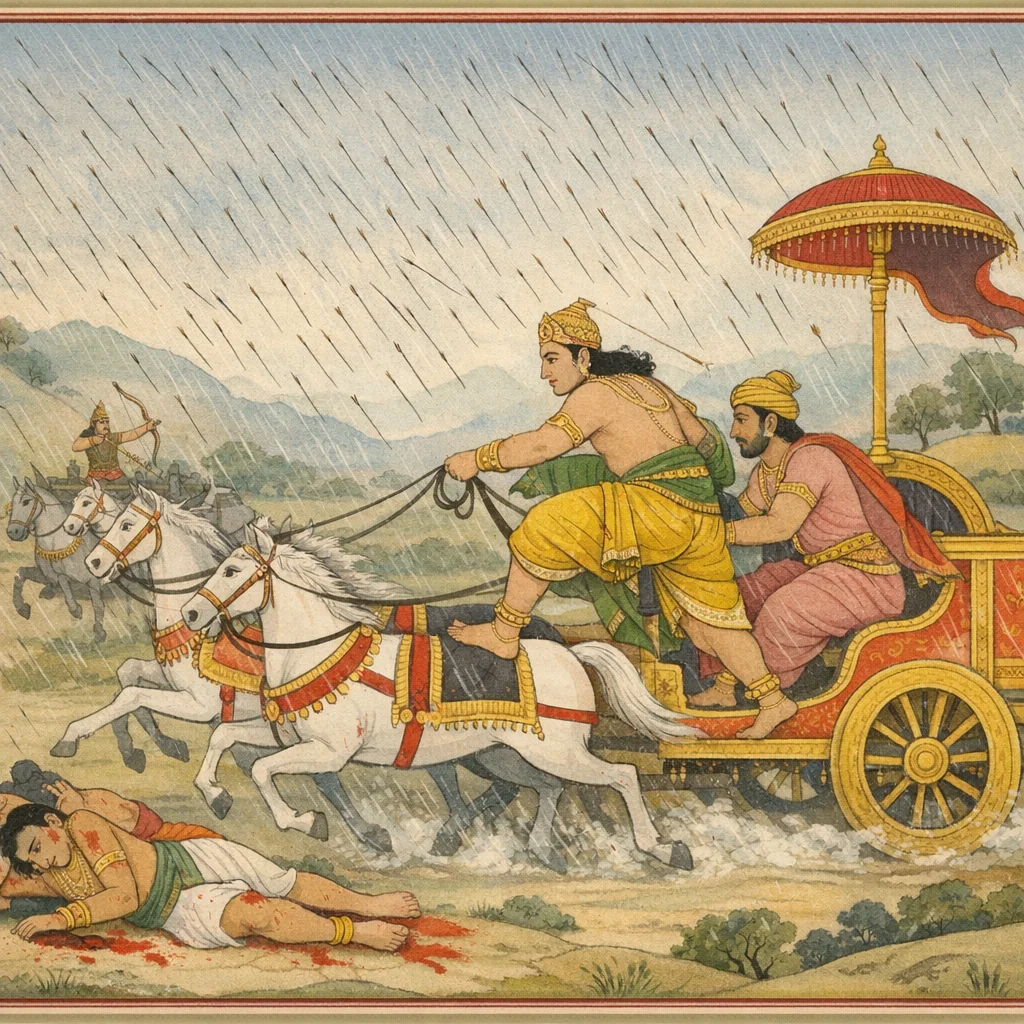
Adhyaya 81
भीष्मवधाय प्रयाणम् — The Advance toward Bhīṣma and Counter-Engagements
Upa-parva: Bhīṣma-vadha-prayāṇa (Advance toward Bhīṣma’s engagement)
Saṃjaya reports a dense sequence of engagements. Arjuna (Dhanaṃjaya), under heavy arrow-pressure, responds by forcibly cutting down the bows of multiple mahārathas and striking them in quick succession, causing numerous combatants to fall. Additional Trigarta-linked units, described as rear-guards and encircling attackers, attempt concentrated missile volleys; Arjuna answers with calibrated volleys (including a set count of arrows) and defeats a large formation, then hastens toward confronting Bhīṣma. The Trigarta king, seeing allied losses, moves to intercept Arjuna, while Pāṇḍava protectors led by Śikhaṇḍin surge forward to safeguard Arjuna’s chariot. Arjuna breaks through and sights Bhīṣma alongside Duryodhana, Jayadratha, and other kings. Yudhiṣṭhira arrives with force and, after Śikhaṇḍin is disarmed by Bhīṣma, addresses Śikhaṇḍin with harsh, honor-centered admonition focused on keeping a public commitment to oppose Bhīṣma. Śalya blocks Śikhaṇḍin’s charge with a formidable weapon; Śikhaṇḍin counters with a Vāruṇa weapon, creating a visible weapons-duel witnessed by onlookers. Bhīṣma damages Yudhiṣṭhira’s equipment, prompting Bhīma to rush Jayadratha with a mace; Jayadratha answers with extensive arrow-strikes. Duryodhana then advances toward Bhīma; a dramatic mace-throw destroys a chariot, prompting reactions of fear, withdrawal, and acclaim among surrounding troops for Duryodhana’s perceived prowess.
Chapter Arc: संजय धृतराष्ट्र से कहते हैं—मोहनास्त्र के मोह से जागकर भी दुर्योधन पीछे नहीं हटता; वह युद्धभूमि में अडिग भीमसेन को फिर बाण-वर्षा से रोक देता है। → भीम अपने रथ पर पुनः आरूढ़ होकर उसी दिशा में बढ़ता है जहाँ दुर्योधन है; दोनों ओर से तीव्र धनुष-टंकार और शरों की झड़ी चलती है। दुर्योधन द्रौपदी के पुत्रों पर भी पृथक्-पृथक् तीखे बाण बरसाता है, और रणभूमि रक्त-धारा से रंग जाती है। → घोर संकुल-युद्ध में कौरव-पाण्डव सेनाओं के बीच चारों ओर कबन्ध उठते दिखते हैं—मानो मृत्यु स्वयं रण में नृत्य कर रही हो; फिर भी योद्धाओं का अद्भुत उत्साह बना रहता है और कोई युद्ध से विमुख नहीं होता। → वीर महान् यश और विजय की आकांक्षा से एक-दूसरे पर टूट पड़ते हैं; अध्याय का अंत इस निष्कर्ष पर होता है कि दोनों पक्ष समान उन्माद और दृढ़ता से लड़ रहे हैं, और युद्ध का प्रवाह थमता नहीं। → भीम और दुर्योधन की टक्कर तथा द्रौपदी-पुत्रों पर बढ़ते संकट के बीच अगला प्रहार किसका निर्णायक होगा—यह अनिर्णीत रह जाता है।
Shlokas
Verse 1
इस प्रकार श्रीमह्याभारत भीष्मपर्वके अन्तर्गत भीष्मवधपर्वमें संकुलयुद्धमें द्रोगपराक्रमविषयक सतहत्तरवाँ अध्याय पूरा हुआ ॥/ ७७ ॥। [दाक्षिणात्य अधिक पाठके ४ ६ श्लोक मिलाकर कुल ७९ ६ “लोक हैं।] #स्न्रैमा+ () अिऔमस+- अष्टसप्ततितमो< ध्याय: उभय पक्षकी सेनाओंका संकुल युद्ध संजय उवाच ततो दुर्योधनो राजा मोहात् प्रत्यागतस्तदा । शरवर्ष: पुनर्भीम॑ प्रत्यवारयदच्युतम्
Sañjaya said: Then King Duryodhana, having turned back in delusion, at that time again checked Bhīma and Acyuta (Kṛṣṇa) by a shower of arrows.
Verse 2
संजय कहते हैं--महाराज! तदनन्तर (मोहनास्त्र-जनित) मोहसे जगनेपर राजा दुर्योधनने युद्धभूमिसे पीछे न हटनेवाले भीमसेनको पुनः बाणोंकी वर्षासे रोक दिया ।। एकीभूतास्ततश्वैव तव पुत्रा महारथा: । समेत्य समरे भीम॑ योधयामासुरुद्यता:,फिर आपके सभी महारथी पुत्र समरभूमिमें एकत्र होकर पूर्ण प्रयत्नपूर्वक भीमसेनके साथ युद्ध करने लगे
Sañjaya said: O Maharaja, then all your sons—great chariot-warriors—gathered on the battlefield, united in purpose and firmly resolved, and engaged Bhīma in combat.
Verse 3
भीमसेनो5पि समरे सम्प्राप्य स्वरथं पुन: । समारुह्य महाबाहुर्यया येन तवात्मज:,महाबाहु भीमसेन भी समरभूमिमें पुन: अपने रथपर सवार हो उधर ही चल दिये, जिस मार्गसे आपका पुत्र दुर्योधन गया था
Sañjaya said: Bhīmasena too, having regained his chariot amid the battle, mounted it again. The mighty-armed hero drove on by the very route your son had taken, pressing the pursuit through the tumult of war.
Verse 4
प्रगृह्दा च महावेगं परासुकरणं दृढम् । सज्जं शरासन संख्ये शरैरविव्याध ते सुतम्,उन्होंने युद्धस्थलमें मृत्युकी प्राप्ति करानेवाले महान् वेगशाली सुदृढ़ धनुषको लेकर उसपर प्रत्यंचा चढ़ायी और अनेक बाणोंद्वारा आपके पुत्रको घायल कर दिया
Sañjaya said: Taking up that firm bow of tremendous force—an instrument that brings death in battle—he strung it and, in the thick of the fight, pierced your son with many arrows.
Verse 5
ततो दुर्योधनो राजा भीमसेनं महाबलम् | नाराचेन सुतीक्ष्णेन भृशं मर्मण्यताडयत्,तब राजा दुर्योधनने महाबली भीमसेनके मर्मस्थलोंमें अत्यन्त तीखे नाराचसे गहरी चोट पहुँचायी
Sañjaya said: Then King Duryodhana struck the mighty Bhīmasena fiercely in a vital spot with a razor-sharp nārāca arrow.
Verse 6
सो35तिविद्धो महेष्वासस्तव पुत्रेण धन्विना । क्रोधसंरक्तनयनो वेगेनाक्षिप्य कार्मुकम्,आपके धनुर्धर पुत्रके द्वारा चलाये हुए बाणसे अत्यन्त पीड़ित हो महाधनुर्धर भीमसेनने क्रोधसे लाल आँखें करके वेगपूर्वक धनुषको खींचा और तीन बाणोंसे दुर्योधनकी दोनों भुजाओं तथा छातीमें चोट पहुँचायी। उन बाणोंद्वारा राजा दुर्योधन तीन शिखरोंसे युक्त गिरिराजकी भाँति शोभा पाने लगा
Sañjaya said: Struck and pained by the arrows shot by your son, the great archer Bhīmasena—his eyes reddened with wrath—swiftly drew his bow with force. Then, with three shafts, he wounded Duryodhana in both arms and in the chest. Marked by those arrows, King Duryodhana appeared resplendent, like a mountain-king adorned with three peaks.
Verse 7
दुर्योधन त्रिभिबाणिर्बाह्वोरुससि चार्पयत् | स तत्र शुशुभे राजा शिखरैगिरिराडिव,आपके धनुर्धर पुत्रके द्वारा चलाये हुए बाणसे अत्यन्त पीड़ित हो महाधनुर्धर भीमसेनने क्रोधसे लाल आँखें करके वेगपूर्वक धनुषको खींचा और तीन बाणोंसे दुर्योधनकी दोनों भुजाओं तथा छातीमें चोट पहुँचायी। उन बाणोंद्वारा राजा दुर्योधन तीन शिखरोंसे युक्त गिरिराजकी भाँति शोभा पाने लगा
Sañjaya said: Bhīma struck Duryodhana with three arrows—on both arms and on the chest. Wounded by those shafts, the king shone on the battlefield like a great mountain crowned with three peaks.
Verse 8
तौ दृष्टवा समरे क्रुद्धौं विनिध्नन्तौ परस्परम् | दुर्योधनानुजा: सर्वे शूरा: संत्यक्तजीविता:,क्रोधमें भरे हुए इन दोनों वीरोंको समरभूमिमें एक-दूसरेपर प्रहार करते देख दुर्योधनके सभी शूरवीर छोटे भाई प्राणोंका मोह छोड़कर भयंकर कर्म करनेवाले भीमसेनको जीवित पकड़नेके विषयमें की हुई पहली सलाहको याद करके एक दृढ़ निश्चयपर पहुँचकर उन्हें पकड़नेका उद्योग करने लगे
Sañjaya said: Seeing those two warriors, enraged on the battlefield and striking each other in mutual assault, all the heroic younger brothers of Duryodhana—having cast aside attachment to life—recalled their earlier counsel to seize Bhīmasena alive, and with grim resolve set about to capture him.
Verse 9
संस्मृत्य मन्त्रितं पूर्व निग्रहे भीमकर्मण: । निश्चयं परमं कृत्वा निग्रहीतुं प्रचक्रमु:,क्रोधमें भरे हुए इन दोनों वीरोंको समरभूमिमें एक-दूसरेपर प्रहार करते देख दुर्योधनके सभी शूरवीर छोटे भाई प्राणोंका मोह छोड़कर भयंकर कर्म करनेवाले भीमसेनको जीवित पकड़नेके विषयमें की हुई पहली सलाहको याद करके एक दृढ़ निश्चयपर पहुँचकर उन्हें पकड़नेका उद्योग करने लगे
Sañjaya said: Recalling the earlier counsel about subduing Bhīma—he whose deeds were terrible in battle—they formed a firm, decisive resolve and began their attempt to seize and restrain him.
Verse 10
तानापतत एवाजौ भीमसेनो महाबल: । प्रत्युद्ययाौ महाराज गज: प्रतिगजानिव,महाराज! उन्हें युद्धमें आक्रमण करते देख जैसे हाथी अपने विपक्षी हाथियोंकी ओर दौड़ता है, उसी प्रकार महावली भीमसेन उनकी अगवानीके लिये आगे बढ़े
Sañjaya said: Seeing them rushing forward on the battlefield, mighty Bhīmasena advanced to meet them, O King—like a great elephant charging toward opposing elephants.
Verse 11
भृशं क्रुद्धश्न तेजस्वी नाराचेन समार्पयत् चित्रसेनं महाराज तव पुत्रं महायशा:,नरेश्वर! महायशस्वी और तेजस्वी भीमसेन अत्यन्त क्रोधमें भरे हुए थे। उन्होंने आपके पुत्र चित्रसेनपर एक नाराचके द्वारा प्रहार किया
Sañjaya said: Greatly enraged yet radiant with prowess, the illustrious Bhīmasena struck your son Citrasena, O King, with a nārāca arrow.
Verse 12
तथेतरांस्तव सुतांस्ताडयामास भारत | शरैर्बहुविधै: संख्ये रुक्मपुड्खै: सुतेजनै:,भारत! इसी प्रकार रणभूमिमें सोनेकी पाँखवाले अत्यन्त तीखे और बहुसंख्यक बाणोंद्वारा उन्होंने आपके अन्य पुत्रोंको भी पीड़ित किया
Sanjaya said: “So too, O Bharata, in the thick of battle he struck and harassed your other sons with many kinds of arrows—gold-feathered and exceedingly sharp—inflicting pain and pressure upon them amid the clash of arms.”
Verse 13
ततः संस्थाप्य समरे तान्यनीकानि सर्वशः । अभिमन्युप्रभूतयस्ते द्वादश महारथा:,महाराज! तत्पश्चात् अपनी सेनाओंको सब प्रकारसे समरभूमिमें स्थापित करके भीमसेनके पद-चिह्लोंपर चलनेवाले उन अभिमन्यु आदि बारह महारथियोंने, जिन्हें धर्मराज युधिष्ठिरने भेजा था, आपके महाबली पुत्रोंपर धावा किया
Sanjaya said: Then, having arrayed those divisions on every side in the field of battle, the twelve great chariot-warriors—led by Abhimanyu—who followed in the track of Bhimasena and had been dispatched by Dharmaraja Yudhishthira, thereafter charged upon your mighty sons.
Verse 14
प्रेषिता धर्मराजेन भीमसेनपदानुगा: । प्रतिजग्मुर्महाराज तव पुत्रान् महाबलान्,महाराज! तत्पश्चात् अपनी सेनाओंको सब प्रकारसे समरभूमिमें स्थापित करके भीमसेनके पद-चिह्लोंपर चलनेवाले उन अभिमन्यु आदि बारह महारथियोंने, जिन्हें धर्मराज युधिष्ठिरने भेजा था, आपके महाबली पुत्रोंपर धावा किया
Sañjaya said: Dispatched by Dharmarāja (Yudhiṣṭhira), those warriors who followed in the track of Bhīmasena advanced, O King, against your mighty sons. Then, after arranging their forces in every way upon the battlefield, those twelve great chariot-fighters—beginning with Abhimanyu—sent by Dharmarāja Yudhiṣṭhira, charged upon your powerful sons.
Verse 15
दृष्टवा रथस्थांस्तान् शूरान् सूर्याग्निसमतेजस: । सवनिव महेष्वासान् भ्राजमानान् श्रिया वृतान्,वे सब-के-सब रथपर बैठे हुए शूरवीर, सूर्य और अग्निके समान तेजस्वी, महाधनुर्धर, उत्तम शोभासे प्रकाशमान, सुवर्णमय मुकुटसे जगमग प्रतीत होनेवाले और अत्यन्त कान्तिमान् थे। उस महासमरमें उन्हें आते देखकर आपके महाबली पुत्र भीमसेनको छोड़कर वहाँसे दूर हट गये
Sañjaya said: Seeing those heroes stationed on their chariots—radiant like the sun and fire, great bowmen, shining with splendor and encompassed by fortune—(the opposing warriors) recoiled from the field; only Bhīmasena, your mighty son, did not withdraw in that great battle.
Verse 16
महाहवे दीप्यमानान् सुवर्णमुकुटोज्ज्वलान् | तत्यजु: समरे भीम॑ तव पुत्रा महाबला:,वे सब-के-सब रथपर बैठे हुए शूरवीर, सूर्य और अग्निके समान तेजस्वी, महाधनुर्धर, उत्तम शोभासे प्रकाशमान, सुवर्णमय मुकुटसे जगमग प्रतीत होनेवाले और अत्यन्त कान्तिमान् थे। उस महासमरमें उन्हें आते देखकर आपके महाबली पुत्र भीमसेनको छोड़कर वहाँसे दूर हट गये
Sanjaya said: In that great battle, those warriors blazed with splendour, their golden crowns shining. Seeing them advance in the thick of combat, your mighty sons, O Bhīma (Dhṛtarāṣṭra), abandoned the fight and fell back from the field.
Verse 17
तान् नामृष्यत कौन्तेयो जीवमाना गता इति । अन्वीय च पुन: सर्वास्तव पुत्रानपीडयत्,परंतु वे जीवित लौट गये; यह बात भीमसेनसे नहीं सही गयी। उन्होंने पुन आपके उन सब पुत्रोंका पीछा करके उन्हें अपने बाणोंसे पीड़ित कर दिया
Sañjaya said: Bhīmasena, the son of Kuntī, could not endure the thought that they had escaped alive. Pursuing them again, he pressed hard upon all your sons, wounding and harassing them with his arrows.
Verse 18
अथाभिमन्युं समरे भीमसेनेन संगतम् । पार्षतेन च सम्प्रेक्ष्य तव सैन्ये महारथा:,इधर, उस समरभूमिमें अभिमन्युको भीमसेन तथा धृष्टद्युम्नससे मिला हुआ देख आपकी सेनाके दुर्योधन आदि महारथी हाथोंमें धनुष लिये अत्यन्त वेगशाली अअश्रोंद्वारा वहाँ जा पहुँचे, जहाँ वे बारह पाण्डवपक्षीय महारथी विद्यमान थे
Sañjaya said: Then, seeing Abhimanyu on the battlefield joined in combat with Bhīmasena and with Pārṣata (Dhṛṣṭadyumna), the great chariot-warriors in your army advanced swiftly, bows in hand, rushing toward the place where those Pāṇḍava-side champions stood.
Verse 19
दुर्योधनप्रभूतय: प्रगृहीतशरासना: । भृशमश्रैः प्रजवितै: प्रययुर्यत्र ते रथा:,इधर, उस समरभूमिमें अभिमन्युको भीमसेन तथा धृष्टद्युम्नससे मिला हुआ देख आपकी सेनाके दुर्योधन आदि महारथी हाथोंमें धनुष लिये अत्यन्त वेगशाली अअश्रोंद्वारा वहाँ जा पहुँचे, जहाँ वे बारह पाण्डवपक्षीय महारथी विद्यमान थे
Sañjaya said: Led by Duryodhana, those warriors—bows in hand—drove forward with great force, urged on by swift horses, to the place where those chariots of the Pāṇḍava side were stationed.
Verse 20
अपराह्ने महाराज प्रावर्तत महारण: । तावकानां च बलिनां परेषां चैव भारत,महाराज! भरतनन्दन! तब अपराह्लकालमें आपके और पाण्डवपक्षके अत्यन्त बलवान योद्धाओं में बड़ा भारी युद्ध आरम्भ हुआ
Sañjaya said: “In the afternoon, O King, a great battle broke out—between your own mighty warriors and those of the opposing side, O descendant of Bharata.”
Verse 21
अभिमन्युर्विकर्णस्य हयान् हत्वा महाहवे | अथीैनं पज्चविंशत्या क्षुद्रकाणां समार्पयत्,अभिमन्युने उस महायुद्धमें विकर्णके घोड़ोंको मारकर स्वयं विकर्णको भी पचीस बाणोंसे घायल कर दिया
Sañjaya said: In that great battle, Abhimanyu slew Vikarna’s horses; then he struck Vikarna himself with twenty-five swift arrows.
Verse 22
हताश्व॑ रथमुत्सज्य विकर्णस्तु महारथ: । आरुरोह रथं राजंश्रित्रसेनस्थ भारत,भरतवंशी नरेश! घोड़ोंके मारे जानेपर महारथी विकर्ण अपना रथ छोड़कर चित्रसेनके रथपर जा बैठा
Sañjaya said: When his horses had been slain, the great chariot-warrior Vikarṇa abandoned his own chariot and, O King, mounted the chariot of Citrasena. Thus the harsh pragmatics of battle are seen—amid sudden loss and confusion, a warrior must swiftly adapt to survive and to carry on his duty in combat.
Verse 23
स्थितावेकरथे तौ तु भ्रातरौ कुलवर्धनौ । आर्जुनि: शरजालेन च्छादयामास भारत,भरतनन्दन! अभिमन्युने एक रथपर बैठे हुए उन दोनों वंशवर्धक भ्राताओंको अपने बाणोंके जालसे आच्छादित कर दिया
Sañjaya said: Those two brothers, enhancers of their lineage, were stationed together on a single chariot. Then Abhimanyu, O Bharata, covered them with a net of arrows—a display of martial mastery that also bespeaks the relentless pressure of kṣatriya duty upon the battlefield.
Verse 24
चित्रसेनो विकर्णश्ष कार्ष्णि पञचभिरायसै: । विव्याध तेन चाकम्पत् कार्ष्णिमिरुरिव स्थित:,चित्रसेन और विकर्णने भी लोहेके पाँच बाणोंसे अभिमन्युको बींध डाला। उस आघातसे अर्जुनकुमार अभिमन्यु विचलित नहीं हुआ। मेरु पर्वतकी भाँति अडिग खड़ा रहा
Sañjaya said: Chitrasena and Vikarna struck Kārṣṇi (Abhimanyu) with five iron arrows. Yet even under that blow, the son of Arjuna did not waver; he stood firm like Mount Meru—an image of steadfast courage and disciplined resolve amid the violence of war.
Verse 25
दुःशासनस्तु समरे केकयान् पञ्च मारिष । योधयामास राजेन्द्र तदद्भुतमिवाभवत्,आर्य! राजेन्द्र! द:शासनने अकेले ही समरभूमिमें पाँच केकयराजकुमारोंके साथ युद्ध किया। वह एक अद्भुत-सी बात हुई
Sañjaya said: In the thick of battle, Duḥśāsana engaged the five Kekaya princes all by himself, O king. To witness a single warrior taking on five royal fighters at once seemed almost wondrous—an episode that highlights both the ferocity and the perilous excesses of the Kurukṣetra war.
Verse 26
द्रौपदेया रणे क्रुद्धा दुर्योधनमवारयन् । शरैराशीविषाकारै: पुत्र॑ं तव विशाम्पते,प्रजानाथ! युद्धमें कुपित हुए द्रौपदीके पाँचों पुत्रोंने विषधर सर्पके समान आकारवाले भयंकर बाणोंद्वारा आपके पुत्र दुर्योधनको आगे बढ़नेसे रोक दिया
Sañjaya said: In the fury of battle, Draupadī’s sons checked Duryodhana’s advance. With dreadful arrows shaped like venomous serpents, they held back your son, O lord of the people—showing how, in war, even royal ambition must yield before determined resistance and the consequences of one’s chosen course.
Verse 27
पुत्रो5पि तव दुर्धर्षो द्रौपद्यास्तनयान् रणे । सायकैर्निशितै राजन्नाजघान पृथक् पृथक्,राजन! तब आपके दुर्धर्ष पुत्रने भी तीखे सायकों-द्वारा रणभूमिमें द्रौपदीके पाँचों पुत्रोंपर पृथक्-पृथक् प्रहार किया
Sañjaya said: “O King, even your own hard-to-subdue son, in the midst of battle, struck Draupadī’s sons one by one with sharp arrows.”
Verse 28
तैश्नापि विद्धः शुशुभे रुधिरेण समुक्षित: । गिरि: प्रस्रवणैर्यद्वद् गैरिकादिविमिश्रितै:,फिर उनके द्वारा भी अत्यन्त घायल किये जानेपर आपका पुत्र रक्तसे नहा उठा और गेरु आदि धातुओंसे मिश्रित झरनोंके जलसे युक्त पर्वतकी भाँति शोभा पाने लगा
Sañjaya said: “Though struck and grievously wounded by them as well, your son shone—bathed in blood—like a mountain made beautiful by streams flowing down, their waters mingled with red ochre and other minerals.”
Verse 29
भीष्मो5पि समरे राजन् पाण्डवानामनीकिनीम् | कालयामास बलवान् पाल: पशुगणानिव,राजन! तदनन्तर बलवान भीष्म भी संग्रामभूमिमें पाण्डव-सेनाको उसी प्रकार खदेड़ने लगे, जैसे चरवाहा पशुओंको हाँकता है
Sañjaya said: “O King, even Bhīṣma—mighty in battle—drove back the Pāṇḍavas’ army on the field, herding it as a cowherd drives a flock of cattle.”
Verse 30
ततो गाण्डीवनिर्घोष: प्रादुरासीद् विशाम्पते | दक्षिणेन वरूथिन्या: पार्थस्यारीन् विनिघ्नत:,प्रजानाथ! तदनन्तर शत्रुओंका संहार करते हुए अर्जुनके गाण्डीवधनुषका घोष सेनाके दक्षिणभागसे प्रकट हुआ
Sañjaya said: “Then, O lord of the people, the thunderous sound of Arjuna’s Gāṇḍīva bow became manifest from the right wing of the army, as Pārtha was striking down his foes.”
Verse 31
उत्तस्थु: समरे तत्र कबन्धानि समन्तत: । कुरूणां चैव सैन्येषु पाण्डवानां च भारत,भारत! वहाँ समरमें कौरवों और पाण्डवोंकी सेनाओंमें चारों ओर कबन्ध उठने लगे
Sañjaya said: “There, in the midst of that battle, headless trunks began to rise up on every side—among the armies of the Kurus and among those of the Pāṇḍavas, O Bhārata.”
Verse 32
शोणितोदं शरावर्त गजद्दीपं हयोर्मिणम् | रथनौभिरन्नरव्याप्रा: प्रतेर: सैन्यसागरम्,वह सेना एक समुद्रके समान थी। रक्त ही वहाँ जलके समान था। बाणोंकी भँवर उठती थी। हाथी द्वीपके समान जान पड़ते थे और घोड़े तरंगकी शोभा धारण करते थे। रथरूपी नौकाओंके द्वारा नरश्रेष्ठ वीर उस सैन्य-सागरको पार करते थे
Sañjaya said: That army was like a vast ocean—its water was blood, its whirlpools the circling arrows; elephants stood like islands, and horses rose like waves. In that sea of battle, the foremost of men crossed over in chariots as if in boats—an image of war’s overwhelming force and the warriors’ relentless resolve amid a field soaked in violence.
Verse 33
छिन्नहस्ता विकवचा विदेहाश्न नरोत्तमा: । दृश्यन्ते पतितास्तत्र शशशो5थ सहस्रश:,वहाँ सैकड़ों और हजारों नरश्रेष्ठ धरतीपर पड़े दिखायी देते थे। उनमेंसे कितनोंके हाथ कट गये थे, कितने ही कवचहीन हो रहे थे और बहुतोंके शरीर छिल्न-भिन्न हो गये थे
Sañjaya said: There, in that field of battle, countless men—noble warriors—were seen lying fallen in hundreds and thousands: some with hands severed, some stripped of their armor, and many with bodies torn and mangled. The scene lays bare the moral cost of war, where even the ‘best of men’ are reduced to broken forms, reminding the listener that victory is inseparable from grievous human suffering.
Verse 34
निहतैर्मत्तमातज्ैः शोणितौघपरिप्लुतै: । भूर्भाति भरतश्रेष्ठ पर्वतैराचिता यथा,भरतश्रेष्ठ) मरकर गिरे हुए मतवाले हाथी खूनसे लथपथ हो रहे थे। उनसे ढकी हुई वहाँकी भूमि पर्वतोंसे व्याप्त-सी जान पड़ती थी
Sañjaya said: O best of the Bharatas, the earth—covered with fallen, rut-maddened elephants and flooded with torrents of blood—appeared as though it were strewn with mountains. The image underscores the moral weight of war: even the mightiest beings become mere heaps upon the ground, and the battlefield’s grandeur is inseparable from its grievous cost.
Verse 35
तत्राद्भुतमपश्याम तव तेषां च भारत । न तत्रासीत् पुमान् कश्रिद् यो युद्ध नाभिकाड्क्षति,भारत! हमने वहाँ आपके और पाण्डवोंके सैनिकोंका अद्भुत उत्साह देखा। वहाँ ऐसा कोई पुरुष नहीं था, जो युद्ध न चाहता हो
Sañjaya said: “There we witnessed a wondrous ardour among both your forces and theirs, O Bhārata. In that place there was not a single man who did not long for battle.”
Verse 36
एवं युयुधिरे वीरा: प्रार्थयाना महद् यश: । तावका: पाण्डवै: सार्धमाकाडुशक्षन्तो जयं युधि,इस प्रकार महान् यशकी अभिलाषा रखते और युद्धमें विजय चाहते हुए आपके वीर सैनिक पाण्डवोंके साथ युद्ध करते थे
Sañjaya said: Thus the warriors fought on—your men and the Pāṇḍavas together—each longing for great renown and striving for victory in battle.
Verse 78
इति श्रीमहाभारते भीष्मपर्वणि भीष्मवधपर्वणि संकुलयुद्धे अष्टसप्ततितमो<5ध्याय:
Thus, in the Śrī Mahābhārata, within the Bhīṣma Parva—specifically in the section concerning the fall (slaying) of Bhīṣma—here ends the seventy-eighth chapter, describing the confused and densely entangled battle.
Frequently Asked Questions
The chapter centers on whether a public vow and collective strategic necessity justify pressuring Śikhaṇḍin to confront Bhīṣma despite fear and prior setback—testing the balance between personal limits, truthfulness (satya), and wartime duty.
Speech and commitment function as binding ethical instruments: a leader’s harsh counsel can be framed as safeguarding dharma, lineage honor, and credibility, while the narrative simultaneously warns that strategy often relies on constraints created by vows and reputations.
No explicit phalaśruti appears in this chapter; its meta-significance lies in illustrating how battlefield outcomes are shaped by vow-bound conduct and leadership rhetoric, reinforcing the epic’s broader inquiry into dharma under pressure.