Adhyaya 66
भीष्मपर्व — अध्याय ६६: तुमुलसंग्रामवर्णनम् (The Tumult of Battle Described)
Upa-parva: Kurukṣetra Saṅgrāma-varṇana (Battle Commencement and Tumult Description Unit)
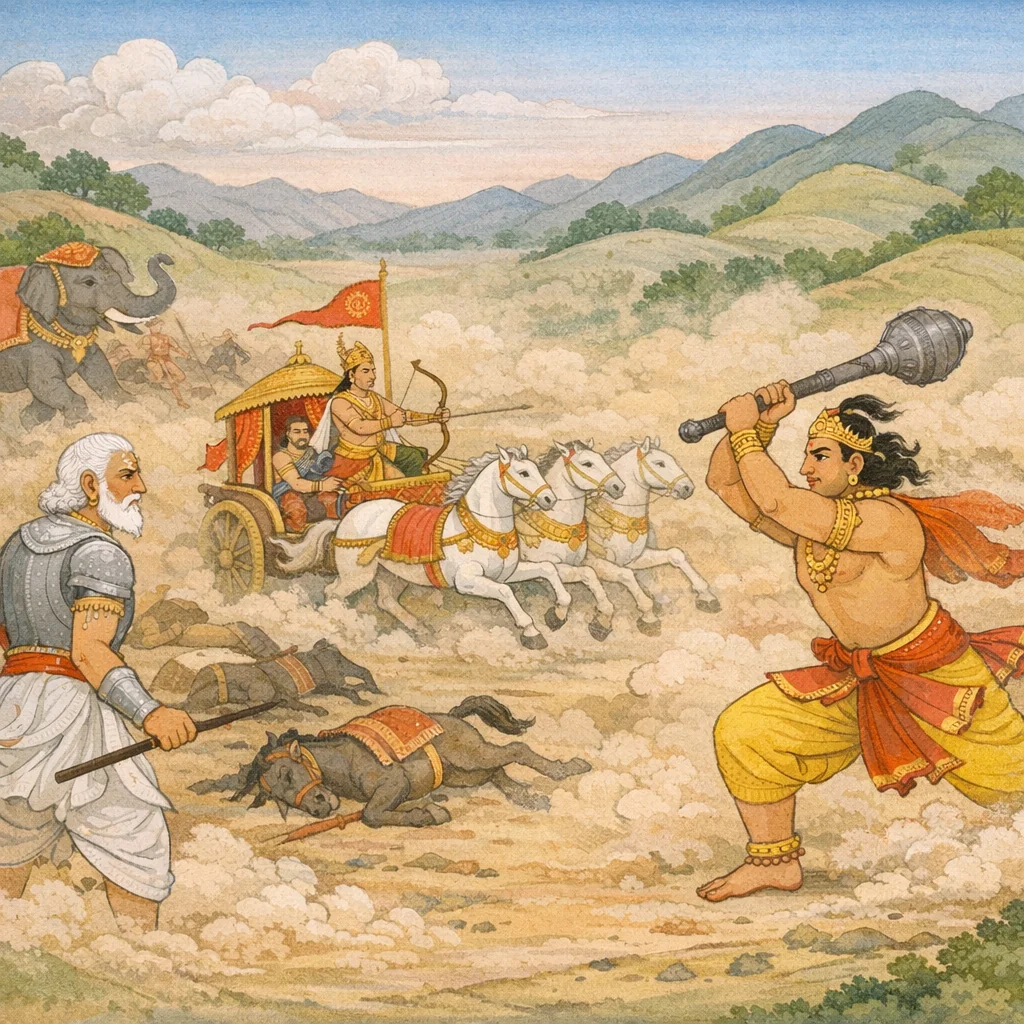
Saṃjaya reports that Bhīṣma Śāṃtanava initiates an exceptionally intense engagement, motivated by concern regarding Bhīmasena’s battlefield impact and a protective intent toward Dhṛtarāṣṭra’s sons. The narrative then shifts into a technical-sensory depiction of combat escalation: the morning engagement becomes highly destructive among leading warriors; the soundscape (elephants’ cries, horses’ neighing, drums and conches) expands to a sky-touching roar; severed heads and armored limbs are described as falling in volumes likened to a storm of stones. The ground is rapidly covered with bodies and equipment, while dust-clouds lit by weapon-flash render the clash thunder-like. The encounter is characterized as harsh and blood-flowing, with repeated arrow volleys and collisions of elephants, horses, and chariots; dismounted horses run in all directions; close-quarters fighting occurs with clubs, swords, spears, arrows, and even fists, knees, and palms. The chapter culminates in a convergence: Duryodhana, surrounded by Kaliṅga forces and placing Bhīṣma forward, advances against the Pāṇḍavas; the Pāṇḍavas, rallying around Bhīma (Vṛkodara), charge toward Bhīṣma in anger, intensifying the central confrontation.
Chapter Arc: संजय धृतराष्ट्र से कहते हैं—हाथियों की सेना कट जाने पर दुर्योधन घबराकर समस्त वाहिनियों को एक ही लक्ष्य देता है: ‘सब मिलकर भीमसेन को मार डालो।’ → कौरव-सेना दुर्योधन की आज्ञा से भैरव गर्जना करती हुई भीम पर टूट पड़ती है—ऐसा अपार बलौघ कि देवताओं के लिए भी दुर्धर्ष, पर्व-काल के समुद्र की तरह उफनता हुआ। भीम गदा उठाकर जिस ओर दृष्टि डालते हैं, उधर-उधर की पंक्तियाँ फटती जाती हैं; मनुष्य, घोड़े, गज—हर ओर कटे हुए शरीरों का ढेर लगने लगता है। → दोपहर के सूर्य-ताप के समान असह्य वेग से भीम का गदा-प्रहार रणभूमि को रौद्र बना देता है; उनकी गदा मज्जा-वसा-मांस-रक्त से लथपथ होकर और भी भयावह दिखती है। इसी उथल-पुथल के बीच सत्यसंध सात्यकि शिनिप्रवीर की भाँति पितामह भीष्म पर झपटते हैं और दृढ़ धनुष से शरवर्षा कर कौरव-सेना को कंपा देते हैं—भीम की ध्वंस-लीला और सात्यकि का आक्रमण एक साथ कौरव-मन में आतंक भर देता है। → कौरव योद्धा सात्यकि पर मेघों की तरह बाण-वर्षा करते हैं, पर वे उसे रोक नहीं पाते; भीम भी युगांत-काल के समान विचरते हुए रथियों और अश्व-समूहों का संहार जारी रखते हैं। अध्याय का अंत रण के धुएँ, रक्त और गर्जना में होता है—कौरव-सेना दबती हुई, पर निर्णायक विराम के बिना। → सात्यकि और भीष्म का सामना अब प्रत्यक्ष टकराव की ओर बढ़ता है—क्या पितामह के सामने सात्यकि टिक पाएँगे, और क्या भीम को घेरकर रोका जा सकेगा?
Shlokas
Verse 1
संजय कहते हैं--महाराज! हाथियोंकी उस सेनाके मारे जानेपर आपके पुत्र दुर्योधनने समस्त सैनिकोंको आज्ञा दी कि सब मिलकर भीमसेनको मार डालो
Sanjaya said: “O King! When that elephant-corps had been cut down, your son Duryodhana commanded all the soldiers: ‘Join together and kill Bhimasena.’”
Verse 2
ततः सर्वाण्यनीकानि तव पुत्रस्य शासनात् । अभ्यद्रवन् भीमसेनं नदन्तं भैरवान् रवान्,तदनन्तर आपके पुत्रकी आज्ञासे समस्त सेनाएँ भैरव गर्जना करती हुई भीमसेनपर टूट पड़ीं
Sanjaya said: Then, at your son’s command, all the divisions of the army surged forward against Bhimasena, roaring with dreadful cries.
Verse 3
त॑ बलौघमपर्यन्तं देवैरपि सुदुःसहम् । आपतत्तं सुदुष्पारं समुद्रमिव पर्वणि
Sanjaya said: That boundless mass of forces—hard to withstand even for the gods—came surging on, difficult to cross, like the ocean when it swells at the time of the full moon.
Verse 4
सेनाका वह अनन्त वेग देवताओंके लिये भी दुःसह था। पूर्णिमाको बढ़े हुए समुद्रके समान अपार जान पड़ता था ।।
Sañjaya said: That army surged forward with immeasurable speed, unbearable even to the gods, and seemed boundless—like the ocean swelling on the full-moon night. It was densely packed with chariots, elephants, and horses; it roared with the blare of conches and the beat of kettledrums. Its chariots and foot-soldiers were beyond counting, and dust spread everywhere, veiling the scene.
Verse 5
त॑ भीमसेन: समरे महोदधिमिवापरम् | सेनासागरमक्षोभ्यं वेलेव समवारयत्,दूसरे महासागरके समान उस अक्षोभ्य सैन्यसमुद्रको युद्धमें भीमसेनने तटप्रदेशकी भाँति रोक दिया
Sañjaya said: In the thick of battle, Bhīmasena checked that unshakable ocean of troops—like a shoreline holding back a second great sea.
Verse 6
तदाश्षर्यमपश्याम पाण्डवस्य महात्मन: । भीमसेनस्य समरे राजन् कर्मातिमानुषम्,राजन्! उस समय संग्रामभूमिमें हमलोगोंने महामना पाण्डुनन्दन भीमसेनका अत्यन्त आश्चर्यमय अतिमानुष कर्म देखा था
Sañjaya said: “O King, there on the battlefield we witnessed a deed of Bhīmasena—the great-souled son of Pāṇḍu—so astonishing that it seemed beyond ordinary human power.”
Verse 7
उदीर्णान् पर्थिवान् सर्वान् साश्वान् सरथकुण्जरान् | असम्भ्रमं भीमसेनो गदया समवारयत्
Sañjaya said: As all the kings surged forward—together with their horses, chariots, and elephants—Bhīmasena, without the least agitation, checked them with his mace.
Verse 8
स संवार्य बलौघांस्तान् गदया रथिनां वर: । अतिष्ठत् तुमुले भीमो गिरिमेंरुरिवाचल:,रथियोंमें श्रेष्ठ भीमसेन उस सारे सैन्यसमूहको गदाद्वारा रोककर उस भयंकर युद्धमें मेरु पर्वतके समान अविचलभावसे खड़े रहे
Sañjaya said: Having checked that entire mass of troops with his mace, Bhīma—foremost among chariot-warriors—stood firm amid the tumult of battle, unmoving like Mount Meru.
Verse 9
तस्मिन् सुतुमुले घोरे काले परमदारुणे । भ्रातरश्ैव पुत्राश्न धृष्टय्रुम्नश्व पार्षत:
Sañjaya said: In that exceedingly dreadful and most cruel hour of tumult, neither his brothers nor his sons—nor Dhṛṣṭadyumna, the son of Pārṣata (Drupada)—abandoned the mighty Bhīmasena.
Verse 10
द्रौपदेयाइभिमन्युश्न शिखण्डी चापराजित: । न प्राजहन् भीमसेनं भये जाते महाबलम्
Sañjaya said: When that great and dreadful fear arose, neither Dhṛṣṭadyumna, nor the five sons of Draupadī, nor Abhimanyu, nor the unconquered hero Śikhaṇḍī abandoned the mighty Bhīmasena.
Verse 11
ततः शैक्यायसी गुर्वी प्रगृह्ा महतीं गदाम् । अधावत् तावकान् योधान् दण्डपाणिरिवान्तक:
Sañjaya said: Then Bhīmasena, grasping a huge and heavy iron mace, charged upon your warriors. Like Yama, the wielder of the staff of punishment, he rushed in as the agent of inevitable retribution, turning the battlefield into a scene where arrogance meets its due consequence.
Verse 12
पोथयन् रथवृन्दानि वाजिवृन्दानि चाभिभू: । कर्षयन् रथवृन्दानि बाहुवेगेन पाण्डव:
Sañjaya said: The Pāṇḍava, overpowering clusters of chariots and masses of horses, struck them down and, by the sheer force of his arms, dragged and scattered the chariot-formations. The verse underscores the battlefield reality where personal prowess and disciplined force decide immediate outcomes, even as the larger war remains bound to questions of rightful duty and consequence.
Verse 13
ऊरुवेगेन संकर्षन् रथजालानि पाण्डव:
Sañjaya said: With the force of his thighs, the Pāṇḍava dragged and tore through the interlaced formations of chariots. The line underscores the sheer bodily prowess brought to bear in war, where strength and resolve become decisive amid the moral weight of fratricidal conflict.
Verse 14
बलानि सम्ममर्दाशु नड्वलानीव कुञज्जर: । पाण्डुनन्दन भीम अपने महान् वेगसे रथसमूहोंको खींचकर नष्ट कर देते और शीघ्र ही सारी सेनाको उसी प्रकार रौंद डालते थे, जैसे हाथी नरकुलके पौधोंको ।।
Sañjaya said: Like an elephant swiftly crushing thickets of reeds, Bhīma—the son of Pāṇḍu—using his tremendous speed, dragged and destroyed masses of chariots. In no time he trampled the whole host, just as an elephant crushes stands of cane. He crushed chariot-warriors from their chariots, and elephant-fighters from their elephants.
Verse 15
सादिनश्चाश्वपृष्ठेभ्यो भूमौ चापि पदातिन: । गदया व्यधमत् सर्वान् वातो वृक्षानिवौजसा
Sañjaya said: With his mace he struck down them all—both the horsemen from their mounts and the foot-soldiers on the ground—like a powerful wind uprooting trees. The verse underscores the overwhelming, impersonal force of battlefield violence, where strength and momentum can scatter ranks regardless of station, reminding the listener of war’s swift, leveling destruction.
Verse 16
भीमसेनो महाबाहुस्तव पुत्रस्य वै बले । महाबाहु भीमसेन रथोंसे रथियोंको, हाथियोंसे हाथी-सवारोंको, घोड़ोंकी पीठोंसे घुड़सवारोंको और पृथ्वीपर पैदलोंको मसलते हुए गदासे आपके पुत्रकी सेनाके सब लोगोंको उसी प्रकार नष्ट कर देते थे, जैसे हवा अपने वेगसे वृक्षोंको उखाड़ फेंकती है ।।
Sañjaya said: Mighty-armed Bhīmasena, in the very midst of your son’s host, crushed charioteers with chariots, elephant-riders with elephants, horsemen from the backs of horses, and foot-soldiers upon the earth; with his mace he kept destroying the men of your son’s army—just as the wind, by its force, uproots trees. And that battlefield too was smeared with marrow, fat, and flesh, and drenched with blood.
Verse 17
तत्र तत्र हतैश्नापि मनुष्यगजवाजिभि:
Sañjaya said: “Here and there, the ground was strewn with the slain as well—men, elephants, and horses—so that every quarter bore the mark of the battle’s ruin.”
Verse 18
रणाजड्ुणं समभवन्म्रावाससंनिभम् | जहाँ-तहाँ मरकर गिरे हुए मनुष्य, हाथी और घोड़ोंसे वह सारी रणभूमि मृत्युके निवासस्थान-सी प्रतीत होती थी ।।
Sañjaya said: The battlefield had become like the very abode of Death. Everywhere lay fallen men, elephants, and horses, so that the whole ground seemed a dwelling-place of mortality. And Bhīmasena’s dreadful, slaughter-dealing mace was seen as terrifying as Rudra’s Pināka bow when he rages to destroy living beings at the time of cosmic dissolution, and like Yama’s staff of punishment. Its crash resounded like Indra’s thunderbolt.
Verse 19
यमदण्डोपमामुग्रामिन्द्राशनिसमस्वनाम् | ददृशुर्भीमसेनस्य रौद्रीं विशसनीं गदाम्
Sañjaya said: They beheld Bhīmasena’s mace—fierce like Yama’s staff, and sounding like Indra’s thunderbolt—terrible and wrathful, a weapon made for slaughter.
Verse 20
आविद्धयतो गदां तस्य कौन्तेयस्य महात्मन: । बभौ रूपं महाघोरं कालस्येव युगक्षये,अपनी गदाको घुमाते हुए महामना कुन्तीकुमार भीमसेनका रूप युगान्त-कालके यमराजके समान अत्यन्त भयंकर प्रतीत होता था
Sañjaya said: As that great-souled son of Kuntī whirled his mace, his form appeared exceedingly dreadful—like Time itself at the end of an age—striking terror into the battlefield and foreshadowing inevitable destruction for those who opposed him.
Verse 21
त॑ं तथा महतीं सेनां द्रावयन्तं पुन: पुनः । दृष्टवा मृत्युमिवायान्तं सर्वे विममनसो5भवन्,उस विशाल सेनाको बारंबार भगानेवाले भीमसेनको मौतके समान सामने आते देख समस्त योद्धाओंका मन उदास हो जाता था
Sañjaya said: Seeing Bhīmasena again and again routing that vast army, and beholding him advancing like Death itself, all the warriors became downcast at heart.
Verse 22
यतो यतः प्रेक्षते सम गदामुद्यम्य पाण्डव: । तेन तेन सम दीर्यन्ते सर्वसैन्यानि भारत
Sañjaya said: Wherever that Pāṇḍava—Bhīmasena—looked while brandishing his mace, in that very direction the entire ranks of the armies split apart, O Bhārata.
Verse 23
प्रदारयन्तं सैन्यानि बलेनामितविक्रमम् । ग्रसमानमनीकानि व्यादितास्यमिवान्तकम्
Sañjaya said: With irresistible might and immeasurable prowess, Bhīma was tearing through the armies. He seemed like Death itself, mouth agape, as though to swallow entire battle-formations as his prey. Seeing that dreadful, mighty Bhīma raising his massive mace, Bhīṣma swiftly arrived there to confront him.
Verse 24
त॑ तथा भीमकर्माणं प्रगृहीतमहागदम् । दृष्टवा वृकोदरं भीष्म: सहसैव समभ्ययात्
Seeing Vṛkodara—mighty in deeds—holding aloft his massive mace, Bhīṣma at once rushed toward him.
Verse 25
महता रथघोषेण रथेनादित्यवर्चसा । छादयन् शरवर्षेण पर्जन्य इव वृष्टिमान्
Sañjaya said: Mounted on a vast chariot whose wheels thundered loudly, radiant like the sun, he arrived there—covering all around with a shower of arrows, like a rain-laden cloud pouring down its storm.
Verse 26
तमायान्तं तथा दृष्टवा व्यात्ताननमिवान्तकम् । भीष्म भीमो महाबाहूु: प्रत्युदीयादमर्षित:,मुँह फैलाये हुए यमराजके समान भीष्मजीको आते देख महाबाहु भीमसेन अमर्षमें भरकर उनका सामना करनेके लिये आगे बढ़े
Sañjaya said: Seeing Bhīṣma advancing, like Death itself with gaping jaws, the mighty-armed Bhīma—filled with fierce indignation—moved forward to confront him. The moment frames the moral tension of war: personal wrath and heroic resolve rising against an elder whose duty binds him to the battlefield.
Verse 27
तस्मिन् क्षणे सात्यकि: सत्यसंध: शिनिप्रवीरो5भ्यपतत् पितामहम् । निष्नन्नमित्रान् धनुषा दृढेन संकम्पयंस्तव पुत्रस्य सैन्यम्
At that very moment, Sātyaki—true to his vow, the foremost hero of the Śini line—rushed straight at the Grandsire Bhīṣma. With his firm bow he cut down foes, and by his assault he made your son’s army tremble—showing how, in the heat of war, steadfast resolve and lineage-pride drive warriors to challenge even the most revered elders on the battlefield.
Verse 28
त॑ यान्तमश्वै रजतप्रकाशै: शरान् वपन्तं निशितान् सुपुड्खान् | नाशवनुवन् धारयितुं तदानीं सर्वे गणा भारत ये त्वदीया:
O Bhārata! At that time Sātyaki advanced on his chariot drawn by silver-bright white horses, showering keen, well-feathered arrows. Then all your troops together could not hold him back.
Verse 29
अविध्यदेनं दशभि: पृषत्कै- रलम्बुषो राक्षस5सौ तदानीम् | शरैश्नतुर्भि: प्रतिविद्धय तं च नप्ता शिनेरभ्यपतद् रथेन
Sañjaya said: At that moment the Rākṣasa Alambuṣa struck him with ten arrows. In return, the grandson of Śini pierced that Rākṣasa with four shafts, and then, mounting his chariot, charged forward in attack—pressing the battle on with swift retaliation amid the righteous yet relentless demands of war.
Verse 30
अन्वागतं वृष्णिवरं निशम्य त॑ं शत्रुमध्ये परिवर्तमानम् | प्रद्रावयन्तं कुरुपुज्वांश्व पुनः पुनश्च प्रणदन्तमाजौ
Sañjaya said: Hearing that the foremost hero of the Vṛṣṇis—Sātyaki—had come and was moving about amid the enemy ranks, repeatedly driving back the prominent Kuru warriors and roaring again and again on the battlefield, your fighters showered him with arrows like rain-clouds pouring streams upon a mountain. Yet, even so, they could not check him—he stood unrestrained, like the blazing midday sun.
Verse 31
योधास्त्वदीया: शरवर्षैरवर्षन् मेघा यथा भूधरमम्बुवेगै: । तथापि त॑ धारयितुं न शेकु- मध्यन्दिने सूर्यमिवातपन्तम्
Sañjaya said: Your warriors showered him with volleys of arrows, as clouds pour rushing streams of water upon a mountain. Yet they could not check him—he blazed like the scorching midday sun, unrestrained amid the press of battle.
Verse 32
न तत्र कश्रिन्नविषण्ण आसी- दृते राजन् सोमदत्तस्य पुत्रात् । स वै समादाय थधनुर्महात्मा भूरिश्रवा भारत सौमदत्ति:
Sañjaya said: O King, there was no warrior there who was not overcome by dejection—except the son of Somadatta. That high-souled Bhūriśravā, the Saumadatti, taking up his bow, advanced with resolve, for he could not bear to watch the chariot-warriors forced into flight.
Verse 33
दृष्टवा रथान् स्वान् व्यपनीयमानान् प्रत्युद्ययौ सात्यकिं योद्धुमिच्छन्
Sañjaya said: Seeing his own chariots being driven back, Bhūriśravas, son of Somadatta, rose up to meet Sātyaki, eager to fight. O King, at that moment there was no warrior there—apart from Bhūriśravas—who was not seized by dejection. O Bhārata, the high-minded Bhūriśravas, seeing his chariot-warriors forced into flight, took up his bow and advanced against Sātyaki with the resolve to engage in battle.
Verse 63
इति श्रीमहाभारते भीष्मपर्वणि भीष्मवधपर्वणि सात्यकिभूरिश्रव:समागमे त्रिषष्टितमो5 ध्याय:,इस प्रकार श्रीमह्याभारत भीष्मपर्वके अन्तर्गत भीष्मवधपर्वमें सात्यकिभूरिश्रवा- समागमविषयक तिरसठवाँ अध्याय पूरा हुआ
Sañjaya said: Thus, in the Śrī Mahābhārata, within the Bhīṣma Parva—specifically in the section concerning the slaying of Bhīṣma—ends the sixty-third chapter, describing the encounter between Sātyaki and Bhūriśravas.
Verse 126
विनिधघ्नन् व्यचरत् संख्ये युगान्ते कालवदू विभु: । फिर वे प्रभावशाली बलवान पाण्डुनन्दन रथियों और घोड़ोंके समूहको नष्ट करके अपनी भुजाओंके वेगसे रथोंके समुदायको खींचते और नष्ट करते हुए प्रलयकालके यमराजकी भाँति संग्रामभूमिमें विचरने लगे
Sañjaya said: Slaying without pause, the mighty one moved about in the battle like Time itself at the end of an age—overpowering the enemy’s charioteers and horses, dragging and shattering chariots by the sheer force of his arms, and roaming the field like Yama at the hour of dissolution.
Verse 166
अदृश्यत महारीौद्रा गदा नागाश्चव॒पातनी । हाथियों और घोड़ोंको मार गिरानेवाली उनकी वह गदा भी मज्जा, वसा, मांस तथा रक्तमें सनकर बड़ी भयानक दिखायी देती थी
Sañjaya said: That mace appeared exceedingly dreadful—an instrument that could bring down even elephants. Smeared with marrow, fat, flesh, and blood, it looked terrifying, underscoring the brutal, dehumanizing momentum of battle and the moral weight borne by those who wield such force.
Frequently Asked Questions
The chapter implies a tension between protective duty toward the Kuru heirs and the escalation of harm required to secure them, illustrating how safeguarding a lineage can drive intensification of conflict with broader human cost.
The descriptive method instructs that conflict rapidly becomes systemic—noise, dust, and cascading injuries degrade control—so leadership decisions must be interpreted as occurring within constrained visibility, high volatility, and compounding consequences.
No explicit phalaśruti is present in the provided verses; the chapter functions primarily as narrative reportage and thematic framing, contributing to the epic’s cumulative reflection on duty, cost, and historical causality.
Read Mahabharata in the Vedapath app
Scan the QR code to open this directly in the app, with audio, word-by-word meanings, and more.