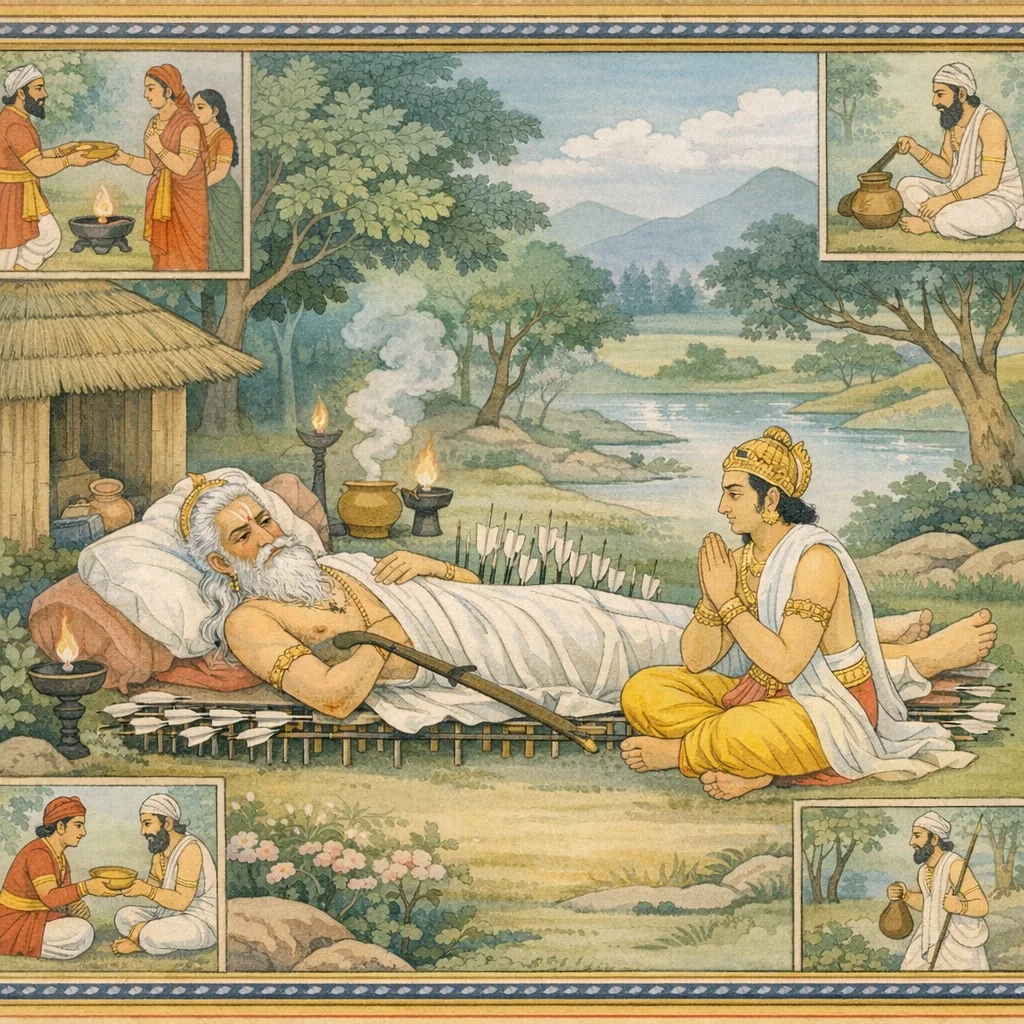
Adhyaya 25
अहिंसयित्वा ब्रह्महत्याविधानम् / Brahmahatyā incurred without physical violence
Upa-parva: Brahmahatyā-anuśāsana (Discourse on ‘Brahmin-slaying’ by non-violent means)
Yudhiṣṭhira asks Bhīṣma to explain, in principled terms, how brahmahatyā can occur ‘without harming’ (ahiṃsayitvā). Bhīṣma replies that he previously posed the same question to Vyāsa and now transmits Vyāsa’s definitive categories. The chapter enumerates non-violent acts that are treated as brahmahatyā because they effectively destroy a Brahmin’s survival, dignity, or the continuity of sacred knowledge: (1) inviting a poor Brahmin for alms and then refusing by saying ‘there is none’; (2) depriving an uninvolved/neutral learned Brahmin of his means of livelihood; (3) creating obstacles to water access for a thirsty cattle-community; (4) disparaging śruti or authoritative śāstra without understanding; (5) withholding a well-suited marriage for one’s accomplished daughter; (6) causing deep, penetrating grief to twice-born persons through falsehood and adharmic conduct; (7) seizing the entire property of a blind, lame, or incapacitated Brahmin; and (8) abandoning the sacred fire through negligence in āśrama, forest, village, or city. The discourse reframes ‘killing’ as structural harm: deprivation, obstruction, and corrosive speech that dismantle dharmic infrastructure.
Chapter Arc: शरशय्या पर पड़े पितामह के पास युधिष्ठिर का प्रश्न उठता है—प्राचीन ब्राह्मण किसे दान का श्रेष्ठ पात्र मानते हैं: दण्ड-कमण्डलु धारण करने वाला ब्रह्मचारी, या वह जो जीवन-रक्षा हेतु वर्णाश्रमोचित वृत्ति अपनाए? → भीष्म पात्रता को बाह्य चिह्नों से नहीं, आचरण-धर्म से जोड़ते हैं; युधिष्ठिर फिर शंका करते हैं—यदि दाता की श्रद्धा शुद्ध हो तो क्या हव्य-कव्य-दान में दोष रह जाता है? इस पर चर्चा ‘श्रद्धा बनाम पात्रता’ के सूक्ष्म द्वंद्व में प्रवेश करती है। → कश्यप-वचन और भीष्म-निर्णय से शिखर आता है—वेद, षडङ्ग, सांख्य, पुराण, कुल-गौरव—ये सब शील-रहित द्विज को गति नहीं देते; और धर्म-लक्षण के रूप में अहिंसा, सत्य, अक्रोध, आनृशंस्य, दम, आर्जव तथा ब्रह्मचर्य, मद्य-मांस-त्याग, शम आदि को निर्णायक बताया जाता है। → भीष्म निष्कर्ष देते हैं कि जिन ब्राह्मणों में ये गुण हों, उन्हें दिया दान महान फल देता है; ऐसे पात्र को गाय, घोड़ा, अन्न, धन आदि देने से दाता परलोक में शोक नहीं करता, और एक भी उत्तम द्विज कुल का उद्धार कर सकता है—अतः गुणोपेत ब्राह्मण को दूर से भी खोजकर सत्कारपूर्वक दान देना चाहिए।
Shlokas
Verse 1
युधिष्ठिरने पूछा--भरतश्रेष्ठ! प्राचीन ब्राह्मण किसको दानका श्रेष्ठ पात्र बताते हैं? दण्ड-कमण्डलु आदि चिह्न धारण करनेवाले ब्रह्मचारी ब्राह्मणको अथवा चिह्नरहित गृहस्थ ब्राह्मगको?,सत्पुरुषोंद्वारा सम्मानित गुणवान् ब्राह्मण यदि कहीं दूर भी सुनायी पड़े तो उसको वहाँसे अपने यहाँ बुलाकर उसका हर प्रकारसे पूजन और सत्कार करना चाहिये ।। इति श्रीमहाभारते अनुशासनपर्वणि दानधर्मपर्वणि बहुप्राश्निके द्वाविंशो5ध्याय: ।। २२ ।। इस प्रकार श्रीमह्याभारत अनुशासनपर्वके अन्तर्गत दानधर्मपर्वमें बहुत-से प्रश्नोंका निर्णयविषयक बाईसवाँ अध्याय पूरा हुआ ॥/ २२ ॥ (दाक्षिणात्य अधिक पाठके ४६ श्लोक मिलाकर कुल ८७ श्लोक हैं) - श्राद्धमें भोजन करने योग्य ब्राह्मणोंके विषयमें स्मृतियोंमें इस प्रकार उल्लेख मिलता है--कर्मनिष्ठास्तपोनिष्ठा: पजञ्चान्निब्रह्मचारिण: । पितृमातृपराश्रैव ब्राह्मणा: श्राद्धसम्पद: ।। तथा--'व्रतस्थमपि दौत्ित्र श्राद्धे यत्नेन भोजयेत् ।' तात्पर्य यह है कि क्रियानिष्ठ, तपस्वी, पञ्चाग्निका सेवन करनेवाले, ब्रह्मचारी तथा पिता-माताके भक्त--े पाँच प्रकारके ब्राह्मण श्राद्धकी सम्पत्ति हैं। इन्हें भोजन करानेसे श्राद्धकर्मका पूर्णतया सम्पादन होता है।” तथा “अपनी कन्याका बेटा ब्रह्मचारी हो तो भी यत्नपूर्वक उसे श्राद्धमें भोजन कराना चाहिये।” ऐसा करनेसे श्राद्धकर्ता पुण्यका भागी होता है। केवल श्राद्धमें ही ऐसी छूट दी गयी है। श्राद्धके अतिरिक्त और किसी कर्ममें ब्रह्मचारीको लोभ आदि दिखाकर जो उसके व्रतको भंग करता है, उसे दोषका भागी होना पड़ता है और अपने किये हुए दानका भी पूरा-पूरा फल नहीं मिलता। इसीलिये शास्त्रमें लिखा है कि “मनसा पात्रमुद्दिश्य जलमध्ये जल क्षिपेत् । दाता तत्फलमाप्रोति प्रतिग्राही न दोषभाक् ॥। * अर्थात् “यदि किसी सुपात्र (ब्रह्मचारी आदि)-को दान देना हो तो उसका मनमें ध्यान करे और उसे दान देनेके उद्देश्यसे हाथमें संकल्पका जल लेकर उसे जलहीमें छोड़ दे। इससे दाताको दानका फल मिल जाता है और दान लेनेवालेको दोषका भागी नहीं होना पड़ता।” यह बात सत्पात्रका आदर करनेके लिये बतायी गयी है। (नीलकण्ठी) त्रयोविशो<् ध्याय: देवता और पिततरोंके कार्यमें निमन्त्रण देने योग्य पात्रों तथा नरकगामी और स्वर्गगामी मनुष्योंके लक्षणोंका वर्णन युधिछिर उवाच श्राद्धकाले च दैवे च पित्रयेषपि च पितामह । इच्छामीह त्वया55ख्यातं विहित॑ यत् सुरषिभि:
Yudhiṣṭhira said: “O Grandfather, at the time of śrāddha rites, and in offerings to the gods, and also in rites for the ancestors—please tell me what has been prescribed by the divine seers. Whom do the ancient Brāhmaṇas declare to be the best recipient for gifts and invitations: a brahmacārin Brāhmaṇa bearing the marks of ascetic discipline such as staff and water-pot, or a householder Brāhmaṇa without such external signs? And if a virtuous Brāhmaṇa, honored by the good, is heard of even at a distance, one should invite him from there and honor him in every way.”
Verse 2
भीष्म उवाच स्ववृत्तिमभिपन्नाय लिज़्िने चेतराय च । देयमाहुर्महाराज उभावेतौ तपस्विनौ,भीष्मजीने कहा--महाराज! जीवन-रक्षाके लिये अपनी वर्णाश्रमोचित वृत्तिका आश्रय लेनेवाले चिह्नधारी या चिह्लरहित किसी भी ब्राह्मणको दान दिया जाना उचित बताया गया है; क्योंकि स्वधर्मका आश्रय लेनेवाले ये दोनों ही तपस्वी एवं दानपात्र हैं
Bhishma said: O great king, it is declared that alms should be given both to a Brahmin who has taken up his own rightful means of livelihood for the sake of preserving life—whether he bears the outward marks of an ascetic or does not. For both, resting upon their proper duty, are to be regarded as austere and worthy recipients of charity.
Verse 3
युधिछिर उवाच श्रद्धया परया पूतो यः प्रयच्छेद् द्विजातये । हव्यं कव्यं तथा दानं को दोष: स्यात् पितामह,युधिष्ठिरने पूछा--पितामह! जो केवल उत्कृष्ट श्रद्धासे ही पवित्र होकर ब्राह्मणको हव्य-कव्य तथा अन्य वस्तुका दान देता है, उसे अन्य प्रकारकी पवित्रता न होनेके कारण किस दोषकी प्राप्ति होती है?
Yudhiṣṭhira said: “Grandfather, if a man—purified solely by the highest faith—gives to a twice-born (a brāhmaṇa) offerings meant for the gods (havya), offerings meant for the ancestors (kavya), and other gifts, what fault, if any, would still attach to him because he lacks other forms of ritual purity?”
Verse 4
भीष्म उवाच श्रद्धापूतो नरस्तात दुर्दान्तोी5पि न संशय: । पूतो भवति सर्वत्र किमुत त्वं महाद्युते,भीष्मजीने कहा--तात! मनुष्य जितेन्द्रिय न होनेपर भी केवल श्रद्धामात्रसे पवित्र हो जाता है--इसमें संशय नहीं है। महातेजस्वी नरेश! श्रद्धापूत मनुष्य सर्वत्र पवित्र होता है, फिर तुम-जैसे धर्मात्माके पवित्र होनेमें तो संदेह ही क्या है?
Bhishma said: “Dear one, even a man who is hard to restrain is purified by faith (śraddhā) alone—of this there is no doubt. One purified by faith is pure everywhere; how much more, then, are you, O mighty one, whose disposition is aligned with dharma?”
Verse 5
युधिछिर उवाच न ब्राह्मणं परीक्षेत दैवेषु सततं नर: । कव्यप्रदाने तु बुधा: परीक्ष्यं ब्राह्मणं विदु:,युधिष्ठिरने पूछा--पितामह! विद्वानोंका कहना है कि देवकार्यमें कभी ब्राह्मणकी परीक्षा न करे, किंतु श्राद्धमें अवश्य उसकी परीक्षा करे; इसका क्या कारण है?
Yudhishthira said: “Grandfather, the wise declare that in rites offered to the gods one should never test a Brahmin; yet in śrāddha offerings to the ancestors they say a Brahmin must be examined. What is the reason for this?”
Verse 6
भीष्म उवाच न ब्राह्मण: साधयते हव्यं दैवात् प्रसिद्ध्यति । देवप्रसादादिज्यन्ते यजमानैर्न संशय:,भीष्मजीने कहा--बेटा! यज्ञ-होम आदि देवकार्यकी सिद्धि ब्राह्मणके अधीन नहीं है, वह दैवसे सिद्ध होता है। देवताओंकी कृपासे ही यजमान यज्ञ करते हैं। इसमें संशय नहीं है
Bhishma said: “My son, the success of rites offered to the gods—such as sacrifice (yajña) and fire-offerings (homa)—does not rest in the Brahmin’s control; it is accomplished by divine dispensation (daiva). By the gods’ grace alone the sacrificers (yajamāna) perform the yajña—of this there is no doubt.”
Verse 7
ब्राह्मणान् भरतश्रेष्ठ सततं ब्रह्म॒ुवादिन: । मार्कण्डेय: पुरा प्राह इति लोकेषु बुद्धिमान् ७ ।। भरतमश्रेष्ठ! बुद्धिमान मार्कण्डेयजीने बहुत पहलेसे ही यह बता रखा है कि श्राद्धमें सदा वेदवेत्ता ब्राह्मणोंको ही निमन्त्रित करना चाहिये (क्योंकि उसकी सिद्धि सुपात्र ब्राह्मणके ही अधीन है)
Bhishma said: “O best of the Bharatas, one should always invite Brahmins devoted to the teaching of Brahman (true Vedic knowers). The wise sage Markandeya declared this long ago, and it is accepted among people.”
Verse 8
युधिछिर उवाच अपूर्वोजप्यथवा विद्वान् सम्बन्धी वा यथा भवेत् । तपस्वी यज्ञशीलो वा कथं पात्र भवेत् तु सः,युधिष्ठिरने पूछा--जो अपरिचित, विद्वान, सम्बन्धी, तपस्वी अथवा यज्ञशील हों, इनमेंसे कौन किस प्रकारके गुणोंसे सम्पन्न होनेपर श्राद्ध एवं दानका उत्तम पात्र हो सकता है?
Yudhishthira said: “Whether a person is previously unknown, or a learned man recognized as worthy; whether he is a relative as the case may be; whether he is an ascetic or devoted to sacrifice—by what qualities does such a person become a truly fit recipient (pātra) for śrāddha offerings and for gifts?”
Verse 9
भीष्म उवाच कुलीन: कर्मकृद् वैद्यस्तथैवाप्यानृशंस्यवान् | ह्वीमानृजु: सत्यवादी पात्र पूर्वे च ये त्रय:,भीष्मजीने कहा--कुलीन, कर्मठ, वेदोंके विद्वान, दयालु, सलज्ज, सरल और सत्यवादी--इन सात प्रकारके गुणवाले जो पूर्वोक्त तीन (अपरिचित विद्वान, सम्बन्धी और तपस्वी) ब्राह्मण हैं, वे उत्तम पात्र माने गये हैं
Bhishma said: A worthy recipient is one who is of good lineage, diligent in right action, learned in the Veda, and compassionate; who is also modest, straightforward, and truthful. And those three kinds mentioned earlier as well—the unknown learned Brahmin, the kinsman, and the ascetic—are likewise regarded as excellent recipients for gifts.
Verse 10
तत्रेमं शृणु मे पार्थ चतुर्णा तेजसां मतम् | पृथिव्या: काश्यपस्याग्नेर्मार्कण्डेयस्य चैव हि,कुन्तीनन्दन! इस विषयमें तुम मुझसे पृथ्वी, काश्यप, अग्नि और मार्कण्डेय--इन चार तेजस्वी व्यक्तियोंका मत सुनो
Bhīṣma said: “Now, O Pārtha, listen to me here: I shall relate the considered view of four illustrious authorities—Earth herself, Kaśyapa, Agni, and the sage Mārkaṇḍeya. Their testimony will clarify this matter in a way grounded in dharma and lived experience.”
Verse 11
पृथिव्युवाच यथा महाणेवि क्षिप्त: क्षिप्रं लेष्टविनश्यति । तथा दुश्नरितं सर्व त्रिवृत्यां च निमज्जति,पृथ्वी कहती है--जिस प्रकार महासागरमें फेंका हुआ ढेला तुरंत गलकर नष्ट हो जाता है, उसी प्रकार याजन, अध्यापन और प्रतिग्रह--इन तीन वृत्तियोंसे जीविका चलानेवाले ब्राह्मणमें सारे दुष्कर्मोका लय हो जाता है
The Earth said: “Just as a clod of earth, when thrown into the great ocean, quickly dissolves and disappears, so too all misconduct sinks and is submerged in one who lives by the threefold Brahminical means of livelihood—sacrificing for others, teaching, and accepting gifts.”
Verse 12
काश्यप उवाच सर्वे च वेदा: सह षड्भिरज्जैः सांख्यं पुराणं च कुले च जन्म । नैतानि सर्वाणि गतिर्भवन्ति शीलव्यपेतस्य नृप द्विजस्य,काश्यप कहते हैं--नरेश्वर! जो ब्राह्मण शीलसे रहित हैं, उसे छहों अंगोंसहित वेद, सांख्य और पुराणका ज्ञान तथा उत्तम कुलमें जन्म--ये सब मिलकर भी उत्तम गति नहीं प्रदान कर सकते
Kāśyapa said: O king, even if a brahmin possesses all the Vedas together with their six auxiliaries, along with knowledge of Sāṅkhya and the Purāṇas, and even if he is born in an excellent lineage—none of these, taken together, become a means to a higher destiny for one who is devoid of good conduct.
Verse 13
अग्निर॒ुवाच अधीयान: पण्डितं मन्यमानो यो विद्यया हन्ति यश: परेषाम् | प्रभ्रश्यतेडसौ चरते न सत्यं लोकास्तस्य हारान्तवन्तो भवन्ति,अग्नि कहते हैं--जो ब्राह्मण अध्ययन करके अपनेको बहुत बड़ा पण्डित मानता और अपनी दिद्वत्तापर गर्व करने लगता है तथा जो अपनी विद्याके बलसे दूसरोंके यशका नाश करता है, वह धर्मसे भ्रष्ट होकर सत्यका पालन नहीं करता; अतः उसे नाशवान् लोकोंकी प्राप्ति होती है
Agni said: “A man who has studied and, thinking himself a great scholar, becomes proud of his learning, and who by the power of that learning destroys the good name of others—he falls away from dharma and does not walk in truth. Therefore, the worlds he attains are perishable and end in loss.”
Verse 14
मार्कण्डेय उवाच अश्वमेधसहस्रं च सत्यं च तुलया धृतम् । नाभिजानामि यद्यस्य सत्यस्यार्धमवाप्तरुयात्,मार्कण्डेयजी कहते हैं--यदि तराजूके एक पलड़ेमें एक हजार अश्वमेध-यज्ञको और दूसरेमें सत्यको रखकर तौला जाय तो भी न जाने वे सारे अश्वमेध-यज्ञ इस सत्यके आधेके बराबर भी होंगे या नहीं?
Mārkaṇḍeya said: “If a thousand Aśvamedha sacrifices were placed on one pan of a balance and Truth on the other, I cannot say that those sacrifices would even deserve to equal half of Truth. Such is the immeasurable worth of truthfulness.”
Verse 15
भीष्म उवाच इत्युक्त्वा ते जग्मुराशु चत्वारोडमिततेजस: । पृथिवी काश्यपो<ग्निश्च प्रकृष्टायुश्व भार्गव:,भीष्मजी कहते हैं-युधिष्ठि!! इस प्रकार अपना मत प्रकट करके वे चारों अमिततेजस्वी व्यक्ति--पृथ्वी, काश्यप, अग्नि और मार्कण्डेय शीघ्र ही चले गये
Bhishma said: “Having thus stated their considered view, those four beings of immeasurable radiance departed at once—Earth, Kashyapa, Agni, and the Bhargava of exceptionally long life (Markandeya).”
Verse 16
युधिषछ्िर उवाच यदि ते ब्राह्मणा लोके व्रतिनो भुञ्जते हवि: । दत्तं ब्राह्गकामाय कथं तत् सुकृतं भवेत्,युधिष्ठिरने पूछा--पितामह! यदि ब्रह्मचर्यव्रतका पालन करनेवाले ब्राह्मण श्राद्धमें हविष्यान्नका भोजन करते हैं तो श्रेष्ठ ब्राह्यणकी कामनासे उन्हें दिया हुआ दान कैसे सफल हो सकता है?
Yudhiṣṭhira said: “O grandsire, if in this world Brahmins who are observing vows partake of the havis-offering food at a śrāddha, then how can a gift—given with the desire to obtain the status or merit of a ‘brāhma’ (highest) good—truly become a successful act of virtue?”
Verse 17
भीष्म उवाच आदिष्टिनो ये राजेन्द्र ब्राह्मणा वेदपारगा: । भुज्जते ब्रह्म॒कामाय व्रतलुप्ता भवन्ति ते,भीष्मजीने कहा--राजेन्द्र! (जिन्हें गुरुने नियत वर्षोंतक ब्रह्मचर्य-व्रत पालन करनेका आदेश दे रखा है वे आदिष्टी कहलाते हैं।) ऐसे वेदके पारड़त आदिष्टी ब्राह्मण यदि यजमानकी ब्राह्मणको दान देनेकी इच्छापूर्तिके लिये श्राद्धमें भोजन करते हैं तो उनका अपना ही व्रत नष्ट हो जाता है (इससे दाताका दान दूषित नहीं होता है)-
Bhishma said: “O king, those Brahmins who are ‘ādiṣṭin’—learned in the Vedas and bound by a teacher’s injunction to observe brahmacarya for a fixed term—if they partake of the śrāddha meal merely to satisfy the patron’s wish to give (to Brahmins), then their own vow becomes impaired. The fault lies in the eater’s breach of discipline, not in the donor’s intention to give.”
Verse 18
युधिछिर उवाच अनेकान्तं बहुद्वारं धर्ममाहुर्मनीषिण: । किंनिमित्तं भवेदत्र तन्मे ब्रूहि पितामह,युधिष्ठिरने पूछा--पितामह! विद्वानोंका कहना है कि धर्मके साधन और फल अनेक प्रकारके हैं। पात्रके कौन-से गुण उसकी दानपात्रतामें कारण होते हैं? यह मुझे बताइये
Yudhiṣṭhira said: “The wise declare dharma to be many-sided and approached through many gateways. In this matter, what is the determining cause? Tell me that, O Grandsire.”
Verse 19
भीष्म उवाच अहिंसा सत्यमक्रोध आनृशंस्यं दमस्तथा । आर्जवं चैव राजेन्द्र निश्चितं धर्मलक्षणम्,भीष्मजीने कहा--राजेन्द्र! अहिंसा, सत्य, अक्रोध, कोमलता, इन्द्रियसंयम और सरलता--ये धर्मके निश्चित लक्षण हैं
Bhishma said: “O king, the sure marks of dharma are these: non-violence, truthfulness, freedom from anger, compassion (gentleness toward all beings), restraint of the senses, and straightforwardness. When these qualities are firmly established, they reveal what righteous conduct truly is.”
Verse 20
ये तु धर्म प्रशंसन्तश्नरन्ति पृथिवीमिमाम् | अनाचरन्तस्तद् धर्म संकरेडभिरता: प्रभो,प्रभो! जो लोग इस पृथ्वीपर धर्मकी प्रशंसा करते हुए घूमते-फिरते हैं; परंतु स्वयं उस धर्मका आचरण नहीं करते, वे ढोंगी हैं और धर्मसंकरता फैलानेमें लगे हैं
Bhishma said: “Those who roam about this earth praising dharma, yet do not practice that very dharma themselves, are hypocrites, O lord; they become absorbed in causing confusion and corruption in the name of righteousness.”
Verse 21
तेभ्यो हिरण्यं रत्नं वा गामश्चं वा ददाति यः । दश वर्षाणि विष्ठां स भुड्क्ते निरयमास्थित:,ऐसे लोगोंको जो सुवर्ण, रत्न, गौ अथवा अश्व आदि वस्तुओंका दान करता है वह नरकमें पड़कर दस वर्षोंतक विष्ठा खाता है
Bhishma said: “Whoever gives to such people gold, jewels, cows, horses, or similar valuables—he falls into hell and, for ten years, is made to subsist on filth. The teaching warns that charity is not merely the act of giving, but must be guided by discernment about the recipient’s conduct and worthiness, lest generosity become complicity in wrongdoing.”
Verse 22
मेदानां पुल्कसानां च तथैवान्तेवसायिनाम् । कृतं कर्माकृतं वापि रागमोहेन जल्पताम्,जो उच्चवर्णके लोग राग और मोहके वशीभूत हो अपने किये अथवा बिना किये शुभ कर्मका जनसमुदायमें वर्णन करते हैं वे मेद, पुल्कस तथा अन्त्यजोंके तुल्य माने जाते हैं
Bhishma said: “Those who, overcome by passion and delusion, boast in public about meritorious deeds—whether actually performed or not—are to be regarded as no better than the Medas, the Pulindas/Pulkasas, and the Antyajas (outcaste groups). The ethical point is that self-advertisement and false claims about virtue degrade one’s standing, regardless of birth or social rank.”
Verse 23
वैश्वदेवं च ये मूढा विप्राय ब्रह्मचारिणे । ददते नेह राजेन्द्र ते लोकान् भुज्जतेडशुभान्,राजेन्द्र! जो मूढ़ मानव ब्रह्मचारी ब्राह्मणको बलि-वैश्वदेवसम्बन्धी अन्न (अतिथियोंको देनेयोग्य हन्तकार) नहीं देते हैं, वे अशुभ लोकोंका उपभोग करते हैं
Bhishma said: “O king, those deluded people who, in this world, do not give the Vaiśvadeva offering—food meant to be shared—to a brahmin who is a brahmacārin, come to partake of inauspicious realms. The teaching is that neglect of daily hospitality and sacred sharing, especially toward disciplined seekers, leads to harmful consequences after death.”
Verse 24
युधिछिर उवाच कि परं ब्रह्मचर्य च कि परं धर्मलक्षणम् | किं च श्रेष्ठतमं शौचं तन्मे ब्रूहि पितामह,युधिष्ठिरने पूछा--पितामह! उत्तम ब्रह्मचर्य क्या है? धर्मका सबसे श्रेष्ठ लक्षण क्या है? तथा सर्वोत्तम पवित्रता किसे कहते हैं? यह मुझे बताइये
Yudhiṣṭhira said: “Grandfather, tell me: what is the highest form of brahmacarya (self-restraint)? What is the supreme mark by which dharma is known? And what is the greatest purity (śauca)?”
Verse 25
भीष्म उवाच ब्रह्मचर्यात् परं तात मधुमांसस्य वर्जनम् | मयदियां स्थितो धर्म: शमश्वैवास्य लक्षणम्,भीष्मजीने कहा--तात! मांस और मदिराका त्याग ब्रह्मचर्यसे भी श्रेष्ठ है--वही उत्तम ब्रह्मचर्य है। वेदोक्त मर्यादामें स्थित रहना सबसे श्रेष्ठ धर्म है तथा मन और इन्द्रियोंको संयममें रखना ही सर्वोत्तम पवित्रता है
Bhishma said: “Dear one, higher even than celibacy is the renunciation of honey (intoxicants) and meat. True dharma is to remain established within the bounds of the Vedic rule of life, and its defining mark is self-restraint—the calming and governing of the mind and senses.”
Verse 26
युधिछिर उवाच कस्मिन् काले चरेद् धर्म कस्मिन् काले<र्थमाचरेत् । कस्मिन् काले सुखी च स्यात् तन्मे ब्रूहि पितामह
Yudhiṣṭhira said: “At what time should one practice dharma? At what time should one pursue artha (worldly welfare and means)? At what time may one become happy? Tell me this, O Grandfather.”
Verse 27
युधिष्ठिने पूछा-पितामह! मनुष्य किस समय धर्मका आचरण करे? कब अर्थोपार्जनमें लगे तथा किस समय सुखभोगमें प्रवृत्त हो? यह मुझे बताइये ।। भीष्म उवाच कल्यमर्थ निषेवेत ततो धर्ममनन्तरम् | पश्चात् काम॑ निषेवेत न च गच्छेत् प्रसड्भिताम्,भीष्मजीने कहा--राजन! पूर्वाह्नमें धनका उपार्जन करे, तदनन्तर धर्मका और उसके बाद कामका सेवन करे; परंतु काममें आसक्त न हो
Bhishma said: “O king, one should first apply oneself to the acquisition of wealth at the proper time; next, without delay, one should practice dharma; and only thereafter may one pursue pleasure. Yet one must not slip into attachment and obsessive indulgence in pleasure.”
Verse 28
ब्राह्मणांश्वैव मन्येत गुरूंश्वाप्पभिपूजयेत् । सर्वभूतानुलोमश्न मृदुशील: प्रियंवद:,ब्राह्मणोंका सम्मान करे। गुरुजनोंकी सेवा-पूजामें संलग्न रहे। सब प्राणियोंके अनुकूल रहे। नम्रताका बर्ताव करे और सबसे मीठे वचन बोले
Bhishma said: One should hold Brahmins in reverence and duly honor one’s elders and teachers. One should live in harmony with all beings, be gentle in conduct, and speak words that are pleasing—thus embodying the ethical discipline praised as righteous behavior.
Verse 29
अधिकारे यदनृतं यच्च राजसु पैशुनम् । गुरोश्वालीककरणं तुल्य॑ तद् ब्रह्म॒हत्यया,न्यायका अधिकार पाकर झूठा फैसला देना अथवा न्यायालयमें जाकर झूठ बोलना, राजाओंके पास किसीकी चुगली करना और गुरुके साथ कपटपूर्ण बर्ताव करना--ये तीन ब्रह्महत्याके समान पाप हैं
Bhishma said: A falsehood spoken in the course of one’s official duty (especially in judgment), malicious tale-bearing before kings, and deceitful conduct toward one’s teacher—these three are sins held to be equal to brahmahatyā, the killing of a brāhmaṇa.
Verse 30
प्रहरेन्न नरेन्द्रेषु न हन्याद् गां तथैव च । भ्रूणहत्यासमं चैव उभयं यो निषेवते,राजाओं पर प्रहार न करे और गायको न मारे। जो राजा और गौपर प्रहाररूप द्विविध दुष्कर्मका सेवन करता है, उसे भ्रूणहत्याके समान पाप लगता है
Bhishma said: One should not strike at kings, and likewise one should not kill a cow. Whoever engages in either of these two wrongful acts—violence against a king or the slaughter of a cow—incurs sin regarded as equal to the killing of an embryo.
Verse 31
नाग्निं परित्यजेज्जातु न च वेदान् परित्यजेत् । नच ब्राह्मणमाक्रोशेत् सम॑ तद् ब्रह्महत्यया,अग्निहोत्रका कभी त्याग न करे। वेदोंका स्वाध्याय न छोड़े तथा ब्राह्मणकी निन्दा न करे; क्योंकि ये तीनों दोष ब्रह्महत्याके समान हैं
Bhīṣma said: One should never abandon the sacred fire, nor give up the study and recitation of the Vedas, and one should not revile a brāhmaṇa. These three transgressions are declared to be as grave as brahmahatyā.
Verse 32
युधिछिर उवाच कीदृशा: साधवो वितप्रा: केभ्यो दत्त महाफलम् | कीदृशानां च भोक्तव्यं तन्मे ब्रूहि पितामह,युधिष्ठिरने पूछा--पितामह! कैसे ब्राह्मणोंको श्रेष्ठ समझना चाहिये? किनको दिया हुआ दान महान् फल देनेवाला होता है? तथा कैसे ब्राह्मणोंको भोजन कराना चाहिये? यह मुझे बताइये
Yudhiṣṭhira said: “Grandfather, what kind of brāhmaṇas are truly virtuous and worthy to be regarded as excellent? To whom does a gift, when given, yield great spiritual fruit? And what kind of brāhmaṇas should be invited and fed? Please tell me.”
Verse 33
भीष्म उवाच अक्रोधना धर्मपरा: सत्यनित्या दमे रता: | तादृशा: साधवो वित्रास्तेभ्यो दत्त महाफलम्,भीष्मजीने कहा--राजन्! जो क्रोधरहित, धर्मपरायण, सत्यनिष्ठ और इन्द्रियसंयममें तत्पर हैं, ऐसे ब्राह्मणोंको श्रेष्ठ समझना चाहिये और उन्हींको दान देनेसे महान् फलकी प्राप्ति होती है (अतः उन्हींको श्राद्धमें भोजन कराना चाहिये)
Bhishma said: Those brāhmaṇas who are free from anger, devoted to dharma, steadfast in truth, and intent on self-restraint—such men are the truly virtuous. Gifts given to them yield great fruit (and therefore they are the proper recipients to be fed in rites such as śrāddha).
Verse 34
अमानिन: सर्वसहा दृढार्था विजितेन्द्रिया: । सर्वभूतहिता मैत्रास्ते भ्यो दत्त महाफलम्
Bhīṣma said: Those who are free from self-importance, who endure every hardship, who are firm in purpose, who have conquered their senses, and who are friendly and devoted to the welfare of all beings—gifts given to such people are granted great fruit.
Verse 35
जिनमें अभिमानका नाम नहीं है, जो सब कुछ सह लेते हैं, जिनका विचार दृढ़ है, जो जितेन्द्रिय, सम्पूर्ण प्राणियोंक हितकारी तथा सबके प्रति मैत्रीभाव रखनेवाले हैं, उनको दिया हुआ दान महान् फल देनेवाला है ।। अलुब्धा: शुचयो वैद्या ह्वीमन्त: सत्यवादिन: । स्वकर्मनिरता ये च तेभ्यो दत्त महाफलम्,जो निर्लोभ, पवित्र, विद्वान, संकोची, सत्यवादी और अपने कर्तव्यका पालन करनेवाले हैं, उनको दिया हुआ दान भी महान् फलदायक होता है
Bhishma said: Gifts offered to those who are free from greed, inwardly pure, truly learned, modest in conduct, truthful in speech, and steadfast in their rightful duties yield great fruit. Charity is most fruitful when the recipient embodies self-restraint, integrity, and commitment to dharma.
Verse 36
साड़ांश्व चतुरो वेदानधीते यो द्विजर्षभ: । षड्भ्य: प्रवृत्त: कर्मभ्यस्तं पात्रमृषयो विदु:,जो श्रेष्ठ ब्राह्मण अंगोंसहित चारों वेदोंका अध्ययन करता और ब्राह्मणोचित छ: कर्मों (अध्ययन-अध्यापन, यजन-याजन और दान-प्रतिग्रह) में प्रवृत्त रहता है, उसे ऋषिलोग दानका उत्तम पात्र समझते हैं
Bhishma said: The foremost among the twice-born who studies the four Vedas together with their ancillary disciplines, and who is actively engaged in the six duties proper to a Brahmin—study and teaching, sacrificing and officiating for others, giving and receiving—such a person is recognized by the sages as a worthy and excellent recipient of gifts.
Verse 37
ये त्वेवंगुणजातीयास्तेभ्यो दत्त महाफलम् | सहस्रगुणमाप्रोति गुणाहाय प्रदायक:
Bhishma said: Gifts given to recipients who truly possess such worthy qualities yield great fruit. Indeed, the giver attains a thousandfold return, for the act of giving is enhanced by the recipient’s virtues and the giver’s discerning choice.
Verse 38
जो ब्राह्मण ऊपर बताये हुए गुणोंसे युक्त होते हैं, उन्हें दिया हुआ दान महान् फल देनेवाला है। गुणवान् एवं सुयोग्य पात्रको दान देनेवाला दाता सहसख्रगुना फल पाता है ।। प्रज्ञाश्रुताभ्यां वृत्तेन शीलेन च समन्वित: । तारयेत कुल॑ सर्वमेको<5पीह द्विजर्षभ:,यदि उत्तम बुद्धि, शास्त्रकी विद्वत्ता, सदाचार और सुशीलता आदि उत्तम गुणोंसे सम्पन्न एक श्रेष्ठ ब्राह्मण भी दान स्वीकार कर ले तो वह दाताके सम्पूर्ण कुलका उद्धार कर देता है
Bhishma said: A gift offered to a Brahmin endowed with the virtues described above yields great fruit; the giver who donates to a worthy and well-qualified recipient gains a thousandfold reward. Indeed, even a single excellent Brahmin—endowed with sound intelligence, learning from the śāstras, upright conduct, and good character—if he accepts a donation here, can uplift and deliver the donor’s entire lineage.
Verse 39
गामश्चृ वित्तमन्नं वा तद्विधे प्रतिपादयेत् । द्रव्याणि चान्यानि तथा प्रेत्यभावे न शोचति,अतः ऐसे गुणवान् पुरुषको ही गाय, घोड़ा, अन्न, धन तथा दूसरे पदार्थ देने चाहिये। ऐसा करनेसे दाताको मरनेके बाद पश्चात्ताप नहीं करना पड़ता
Bhishma said: One should bestow cows, a horse, wealth, food, and other such goods upon a worthy recipient. By giving in this manner, the donor does not fall into regret after death; the act of well-directed charity becomes a safeguard against posthumous remorse and affirms righteous conduct.
Verse 40
तारयेत कुलं सर्वमेको5पीह द्विजोत्तम: । किमज़ पुनरेवैते तस्मात् पात्रं समाचरेत्,(तृप्ते तृप्ता: सर्व देवा: पितरो मुनयो5पि च ।) एक भी उत्तम ब्राह्मण श्राद्धकर्ताके समस्त कुलको तार सकता है। यदि उपर्युक्त बहुत- से ब्राह्मण तार दें इसमें तो कहना ही क्या है। अतः सुपात्रकी खोज करनी चाहिये। उससे तृप्त होनेपर सम्पूर्ण देवता, पितर और ऋषि भी तृप्त हो जाते हैं
Bhīṣma said: “Even a single excellent brāhmaṇa here can deliver an entire lineage. How much more, then, if many such brāhmaṇas are present! Therefore one should carefully seek and honor a worthy recipient. When such a person is satisfied, all the gods, the ancestors, and the sages too are considered satisfied.”
Verse 41
निशम्य च गुणोपेतं ब्राह्म॒णं साधुसम्मतम् । दूरादानाय्य सत्कृत्य सर्वतश्नचापि पूजयेत्
Bhishma said: Having heard of a Brahmin endowed with virtues and approved by the good, one should bring him even from afar, receive him with due honor, and show him reverence in every way.
Frequently Asked Questions
How an agent can incur brahmahatyā without literal killing—resolved by redefining ‘slaying’ as actions that dismantle life-support systems (alms, livelihood, water, dignity, and knowledge transmission).
Non-violence is not merely abstention from physical harm; it includes safeguarding access to essentials, truthful dealing with dependents, and restraint in speech that targets scripture or vulnerable persons.
No explicit phalaśruti appears in this excerpt; the chapter functions as a definitional/legal-ethical taxonomy, emphasizing consequence through classification rather than promised merit.