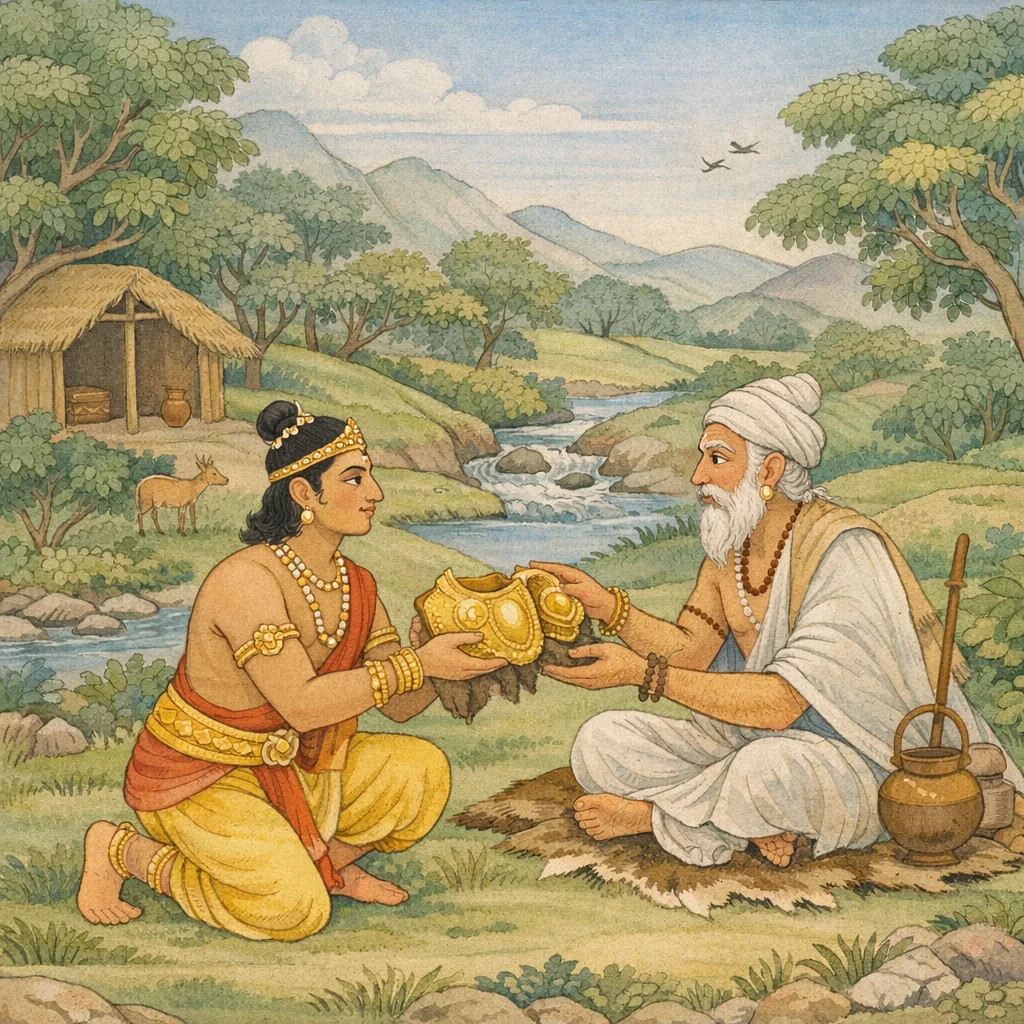
Adhyaya 111
पाण्डोः तपः-प्रसङ्गः, ऋण-धर्मः, अपत्य-प्राप्ति-चिन्ता (Pāṇḍu’s Asceticism, the Doctrine of Debts, and Deliberations on Progeny)
Upa-parva: Sambhava Upa-Parva (Genealogies and Early Kuru Continuities)
Vaiśaṃpāyana describes Pāṇḍu’s disciplined ascetic life and his favorable standing among siddhas and cāraṇas. Pāṇḍu, accompanied by his queens, attempts an arduous northward ascent toward a heavenly passage and voices concern for their hardship. He then articulates a dharmic problem: an heirless person lacks access to auspicious post-mortem states because humans are born with four obligations (ṛṇa), and while obligations to gods, sages, and humans can be discharged through sacrifice, study/asceticism, and compassion, the ancestral obligation requires progeny and śrāddha. He laments that a curse has obstructed his capacity to beget children and enumerates recognized categories of sons used in exceptional circumstances for lineage continuity. Hearing ascetics predict that he will obtain worthy offspring, Pāṇḍu privately addresses Kuntī, arguing that progeny is the stabilizing foundation of dharma and proposing a sanctioned method (niyoga-like recourse) by analogy to earlier precedent, urging prompt action for succession.
Chapter Arc: शूरसेन के सत्यवचन और मित्र-धर्म से कथा आरम्भ होती है—संतानहीन कुन्तिभोज को वचन देकर वह अपनी ज्येष्ठ कन्या कुन्ती को उसे सौंप देता है, और इसी दान से आगे चलकर एक अद्भुत भाग्य-रेखा खिंचती है। → कुन्ती के जीवन में दुर्वासा का आगमन और उसकी सेवा से प्राप्त मन्त्र (देव-आवाहन की शक्ति) भीतर ही भीतर एक भय और आकर्षण जगाता है—देवों को बुलाने की क्षमता, पर लोक-लज्जा और अनजाने परिणामों का संकट। कौतूहल/अविवेक से वह सूर्यदेव का आवाहन करती है; देव प्रत्यक्ष होकर वरदान/संयोग की मांग के साथ उसे धर्म-संकट में डालते हैं। → सूर्य के तेज से कर्ण का जन्म होता है—जन्मजात कवच-कुण्डल सहित। आगे चलकर उसी कर्ण का महान त्याग-क्षण प्रतिध्वनित होता है: इन्द्र के याचक-वेष में आने पर कर्ण अपने शरीर से कवच उतारकर और कुण्डल काटकर दान दे देता है; इसी कर्म से वह ‘वैकर्त्तन’ कहलाता है। → कुन्ती नवजात कुमार को देखकर दीन-मन से एकान्त में सोचती है कि ऐसा क्या करे जिससे ‘सुकृत’ हो—लोक-लज्जा, मातृत्व और भविष्य-भय के बीच वह निर्णय की ओर बढ़ती है। कर्ण की पहचान/नाम-परिवर्तन (वसुषेण से वैकर्त्तन) उसके भाग्य को स्थायी रूप से चिह्नित करता है। → कुन्ती के सामने प्रश्न खड़ा रह जाता है—इस दिव्य-तेजस्वी पुत्र के साथ वह क्या करेगी, और यह गुप्त जन्म आगे चलकर किस-किस के जीवन को उलट देगा?
Shlokas
Verse 1
है 7 >> छा अि>-छऋाज दशाधिकशततमोब<् ध्याय: कुन्तीको दुर्वासासे मन्त्रकी प्राप्ति
Vaiśampāyana said: “O King, among the Yādavas there was a foremost man named Śūra, who became the father of Vasudeva. He had a daughter named Pṛthā; in beauty she was without equal upon the earth.”
Verse 2
पितृष्वस्रीयाय स तामनपत्याय भारत । अग्रयमग्रे प्रतिज्ञाय स्वस्यापत्यं स सत्यवाक्
Vaiśampāyana said: O Bhārata, that truthful man had earlier pledged that he would give his first-born child to his paternal aunt’s son, who was without offspring. Thus, keeping his prior promise, he resolved to hand over his own first issue—an act grounded in fidelity to one’s word and kinship duty.
Verse 3
अग्रजामथ तां कन््यां शूरो<नुग्रहकाड्क्षिणे | प्रददौ कुन्तिभोजाय सखा सख्ये महात्मने,उन्हें पहले कन्या ही उत्पन्न हुई। अतः कृपाकांक्षी महात्मा सखा राजा कुन्तिभोजको उनके मित्र शूरसेनने वह कन्या दे दी
Vaiśampāyana said: When his firstborn was a daughter, Śūra—wishing to show favor—gave that girl to his noble friend Kuntibhoja, as an act of friendship.
Verse 4
सा नियुक्ता पितुर्गेहि देवता5तिथिपूजने । उग्र पर्यचरत् तत्र ब्राह्मणं संशितव्रतम्
Vaiśampāyana said: In her father’s household, Pṛthā had been entrusted with the duties of worshipping the gods and honoring guests. At that time she diligently attended upon a brāhmaṇa there—one of austere vows and a fierce temperament—serving him with disciplined care, as required by dharma and hospitality.
Verse 5
निगूढनिश्चयं धर्मे यं तं दुर्वाससं विदु: । तमुग्रं संशितात्मानं सर्वयत्नैरतोषयत्
Vaiśampāyana said: The one whose resolve regarding dharma was kept hidden—him people knew as Durvāsā. Though he was fierce and of sternly disciplined spirit, Pṛthā satisfied him completely by every possible effort.
Verse 6
तस्यै स प्रददौ मन्त्रमापद्धर्मान्ववेक्षया । अभिचाराभिसंयुक्तमब्रवीच्चैव तां मुनि:
Vaiśampāyana said: Considering the demands of dharma in times of crisis, the sage gave her a mantra—one connected with rites of compelling influence—and also instructed her in its proper application. Thereafter, the muni spoke further to her.
Verse 7
य॑ य॑ देवं त्वमेतेन मन्त्रेणावाहयिष्यसि । तस्य तस्य प्रसादेन पुत्रस्तव भविष्यति,'शुभे! तुम इस मन्त्रद्वारा जिस-जिस देवताका आवाहन करोगी, उसी-उसीके अनुग्रहसे तुम्हें पुत्र प्राप्त होगा"
Vaiśampāyana said: “O auspicious lady, whichever deity you invoke by means of this mantra, by that very deity’s favor a son will be born to you.”
Verse 8
तथोक्ता सा तु विप्रेण कुन्ती कौतूहलान्विता । कन्या सती देवमर्कमाजुहाव यशस्विनी
Vaiśampāyana said: Thus addressed by the brahmin, Kuntī—filled with curiosity—though still an unmarried maiden, invoked the Sun-god Arka to test the power of the mantra.
Verse 9
सा ददर्श तमायान्तं भास्करं लोकभावनम् । विस्मिता चानवद्याज्ञी दृष्टवा तन््महद्भुतम्
Vaiśampāyana said: She saw Bhāskara—the Sun, the sustainer of the worlds—approaching. Beholding that great marvel, the blameless and discerning Kuntī was struck with astonishment, for the invoked deity had truly appeared before her.
Verse 10
तां समासाद्य देवस्तु विवस्वानिदमब्रवीत् | अयमस्म्यसितापाड़ि ब्रूहि किं करवाणि ते
Having approached her, the god Vivasvān (the Sun) spoke these words: “I am here, O dark-eyed Pāṇḍī (Kuntī). Tell me—what dear wish of yours shall I accomplish?”
Verse 11
(आहूतोपस्थितं भद्रे ऋषिमन्त्रेण चोदितम् । विद्धि मां पुत्रलाभाय देवमर्क शुचिस्मिते ।।
Vaiśampāyana said: “O auspicious lady, summoned by you and impelled by the sage’s mantra, I have come before you to grant you a son. O Kuntī of pure smile, know me to be the god Arka (the Sun).” Kuntī said: “O lord who destroys foes, a brāhmaṇa once bestowed on me, as a boon, a sacred formula and the knowledge for invoking the gods. It was to test that power that I performed your invocation, O mighty one.”
Verse 12
एतस्मिन्नपराधे त्वां शिरसाहं प्रसादये । योषितो हि सदा रक्ष्या: स्वापराद्धापि नित्यश:
Vaiśampāyana said: “For this offence, I bow my head and beg you to be gracious and forgive me. For women are always to be protected; even when they themselves have erred, noble men should continually uphold their safety.”
Verse 13
सूर्य उवाच वेदाहं सर्वमेवैतद् यद् दुर्वासा वरं ददौ । संत्यज्य भयमेवेह क्रियतां संगमो मम
Surya said: “I know all of this—that Durvasa has granted you a boon. Therefore, cast aside your fear and, here and now, consent to union with me.”
Verse 14
अमोघं दर्शन महामाहूतश्वास्मि ते शुभे । वथाद्वाने5पि ते भीरु दोष: स्वान्नात्र संशय:
Sūrya said: “Auspicious one, my appearance is never fruitless, and you have indeed invoked me. But, timid one, even if this invocation were made in vain, a grave fault would still fall upon you—of this there is no doubt.”
Verse 15
वैशम्पायन उवाच एवमुक्ता बहुविध॑ सान्त्वपूर्व विवस्व॒ता । सा तु नैच्छद् वरारोहा कन्याहमिति भारत
Vaiśampāyana said: Thus addressed in many ways—first with soothing and conciliatory words—by Vivasvat (the Sun), the high-born maiden did not consent. Thinking, “I am still an unmarried girl,” the lovely Kuntī, O Bhārata, did not desire union with him.
Verse 16
बन्धुपक्ष भयाद् भीता लज्जया च यशस्विनी । तामर्कः पुनरेवेदमब्रवीद् भरतर्षभ
Vaiśampāyana said: The illustrious maiden, fearing the disgrace that might spread among her kinsmen and also constrained by womanly modesty, stood distressed. Then the Sun-god (Arka) again addressed her, O bull among the Bharatas—
Verse 17
(पुत्रस्ते निर्मित: सुभ्रु शूणु यादृक्छुभानने ।।
Vaiśampāyana said: “O fair-browed princess, O lovely-faced one—hear what sort of son will be fashioned for you. Smiling in purity, he will be born wearing the divine earrings of Āditya and my own cuirass; that armor will be unbreakable by weapons and missiles. For Brahmins there will be nothing that is ‘not to be given’ by him—no gift will be beyond him. Even when urged by me, he will not entertain in his mind any unworthy act or thought. When Brahmins request, he will indeed give them all manner of gifts; and yet he will also be deeply self-respecting and proud.”
Verse 18
प्रकाशकर्ता तपन: सम्बभूव तया सह । तत्र वीर: समभवत् सर्वशस्त्रभृतां वर: । आमुक्तकवच: श्रीमान् देवगर्भ: श्रियान्वित:
Vaiśampāyana said: The Sun-god—maker of light and heat—united with her, and from that union a heroic son was born at once, the foremost among all bearers of weapons. From birth he wore his armor, radiant and auspicious, as though a divine child.
Verse 19
सहजं कवचं बिश्रत् कुण्डलो द्योतितानन: । अजायत सुत: कर्ण: सर्वलोकेषु विश्रुत:
Vaiśampāyana said: Bearing a natural coat of armor from birth, and with his face radiant from the earrings that were also innate, a son was born—Karna—who would become renowned throughout all the worlds.
Verse 20
प्रादाच्च तस्यै कन्यात्वं पुन: स परमद्युति: । दत्त्वा च तपतां श्रेष्ठो दिवमाचक्रमे तत:
Vaiśaṃpāyana said: The supremely radiant one restored her maidenhood again. Having granted this boon, the best among those who shine with heat—Bhagavān Sūrya—then departed for heaven.
Verse 21
उस नवजात कुमारको देखकर वृष्णिवंशकी कन्या कुलीके हृदयमें बड़ा दुःख हुआ। उसने एकाग्रचितसे विचार किया कि अब क्या करनेसे अच्छा परिणाम निकलेगा
Seeing the newborn boy, Kulīkā, a maiden of the Vṛṣṇi lineage, was overwhelmed with grief. With her mind gathered into single-pointed focus, she reflected on what course of action might now lead to the best outcome.
Verse 22
गूहमानापचारं सा बन्धुपक्षभयात् तदा । उत्ससर्ज कुमारं तं जले कुन्ती महाबलम्,उस समय कुट॒म्बीजनोंके भयसे अपने उस अनुचित कृत्यको छिपाती हुई कुन्तीने महाबली कुमार कर्णको जलमें छोड़ दिया
Then Kuntī, concealing her transgression out of fear of her own kin and family circle, abandoned that mighty child by casting him into the water.
Verse 23
तमुत्सृष्टं जले गर्भ राधाभर्ता महायशा: । पुत्रत्वे कल्पयामास सभार्य: सूतनन्दन:
Vaiśampāyana said: The illustrious Adhiratha, the charioteer’s son and husband of Rādhā, took up that newborn child who had been cast into the water. Together with his wife, he accepted the boy as their own son.
Verse 24
नामधेयं च चक्राते तस्य बालस्य तायुभौ | वसुना सह जातो<यं वसुषेणो भवत्विति,उन दम्पतिने उस बालकका नामकरण इस प्रकार किया; यह वसु (कवच-कुण्डलादि धन)-के साथ उत्पन्न हुआ है, इसलिये वसुषेण नामसे प्रसिद्ध हो
Vaiśampāyana said: The couple then performed the naming of the child, saying, “This one has been born together with wealth (protective gifts); therefore let him be known as Vasuṣeṇa.”
Verse 25
स वर्थमानो बलवान् सर्वास्त्रिपूद्यतो 5भवत् | आ पृष्ठतापादादित्यमुपातिष्ठत वीर्यवान्
As the boy grew, he became strong and skilled in every art of weapons. The valiant Karṇa, from dawn until the sun turned westward, remained steadfast in worship of the Sun.
Verse 26
तस्मिन् काले तु जपतस्तस्य वीरस्य धीमत: । नादेयं ब्राह्मणेष्वासीत् किंचिद् वसु महीतले
Vaiśampāyana said: At that time, while that wise hero was absorbed in mantra-recitation, there was nothing on the face of the earth—no wealth or possession—that he would withhold when Brahmins asked for it.
Verse 27
(ततः काले तु कम्मिंश्चिचत् स्वप्रान्ते कर्णमब्रवीत् । आदित्यो ब्राह्मणो भूत्वा शूणु वीर वचो मम ।।
Vaiśampāyana said: At a certain time, in a dream, the Sun-god—having assumed the form of a brāhmaṇa—spoke to Karṇa: “Hero, listen to my words. When this night has passed and dawn arrives, Vāsava (Indra) will come to you as a brāhmaṇa. Do not grant him alms. He has resolved to take away your natural armor and your earrings. I am warning you truly—remember what I say.” Having spoken thus in the dream, the brāhmaṇa-form (Sun) vanished on the spot. Karṇa awoke and began to ponder the dream and its meaning.
Verse 28
स्वशरीरात् समुत्कृत्य कवचं स्वं निसर्गजम् । कर्णस्तु कुण्डले छित्त्वा प्रायच्छत् कृताञ्जलि:
Vaiśampāyana said: Karṇa, with hands joined in reverence, tore from his own body the natural armor with which he had been born, and, cutting off his two earrings as well, gave them away.
Verse 29
प्रतिग्रह तु देवेशस्तुष्टस्तेनास्य कर्मणा । (अहो साहसमित्येवं मनसा वासवो हसन् । देवदानवयक्षाणां गन्धर्वोरगरक्षसाम् ।।
Vaiśampāyana said: Pleased with that deed of his—accepting the gift—the Lord of the gods, Vāsava (Indra), smiled to himself and thought, “Ah, what daring!” “Among gods, demons, yakṣas, gandharvas, nāgas, and rākṣasas, I see none with such boldness; who else could accomplish such an act?” Then, speaking aloud, he said: “Hero, I am delighted by this deed of yours. Choose from me whatever boon you desire.” Karṇa replied: “Blessed Lord, I desire that unfailing spear granted by you, the destroyer of enemies.”
Verse 30
देवासुरमनुष्याणां गन्धर्वोरगरक्षसाम् । यमेकं जेतुमिच्छेथा: सोडनया न भविष्यति
Vaiśaṃpāyana said: “O best of heroes! Among gods, asuras, humans, gandharvas, nāgas, and rākṣasas—whichever single one you choose to conquer, that very one will not survive the blow of this power.”
Verse 31
प्राड़ नाम तस्य कथितं वसुषेण इति क्षितौ । कर्णो वैकर्तनश्वैव कर्मणा तेन सो5भवत्
Vaiśaṃpāyana said: Formerly, on this earth, his name was spoken of as Vasuṣeṇa. Later, because of that deed—cutting away the natural armor from his own body—he became renowned by the names Karṇa and also Vaikartana.
Verse 109
इस प्रकार श्रीमह्याभारत आदिपर्वके अन्तर्गत सम्भवपर्वनें धृतराष्ट्रविवाहविषयक एक सौ नवाँ अध्याय पूरा हुआ
Thus ends the one hundred and ninth chapter of the Sambhava Parva, within the Ādi Parva of the revered Mahābhārata, concerning the marriage of Dhṛtarāṣṭra. This closing colophon marks the completion of a narrative unit and signals the transition to the next portion of the account of lineage and origins.
Verse 110
इति श्रीमहाभारते आदिपर्वणि सम्भवपर्वणि कर्णसम्भवे दशाधिकशततमो< ध्याय:,इस प्रकार श्रीमह्यझा भारत आदिपव॑ीके अन्तर्गत सम्भवपर्वमें कर्णकी उत्पत्तिसे सम्बन्ध रखनेवाला एक सौ दसवाँ अध्याय पूरा हुआ
Thus, in the Śrī Mahābhārata, within the Ādi Parva and specifically the Sambhava Parva, the one-hundred-and-tenth chapter—concerning the origin (birth-account) of Karṇa—comes to an end. The colophon marks the completion of this narrative unit, formally closing the episode that frames Karṇa’s beginnings and the moral tensions surrounding birth, identity, and social recognition.
Verse 231
दृष्टवा कुमारं जात॑ सा वार्ष्णेयी दीनमानसा । एकाग्रं चिन्तयामास कि कृत्वा सुकृतं भवेत्
Seeing that newborn boy, the Vārṣṇeyī woman—her heart weighed down with distress—fixed her mind in one-pointed thought, considering what she might do so that a truly meritorious deed (sukṛta) would result.
Frequently Asked Questions
Pāṇḍu faces a conflict between personal limitation (a curse obstructing procreation) and public-ritual duty (securing progeny to discharge the ancestral debt and preserve dynastic continuity), prompting consideration of exceptional, norm-governed solutions.
Dharma is operationalized through obligations: ritual, learning, compassion, and lineage duties are interdependent. The chapter frames progeny not merely as desire but as a structured responsibility tied to social order and ancestral rites.
No explicit phalaśruti is stated here; instead, the meta-logic is juridical-ethical: failure to recognize and discharge obligations (especially pitṛ-ṛṇa) is presented as leading to the absence of favorable post-mortem standing, motivating the narrative’s policy discussion.
Read Mahabharata in the Vedapath app
Scan the QR code to open this directly in the app, with audio, word-by-word meanings, and more.