Adhyaya 95
An exposition of varṇa-dharma as taught by Yājñavalkya
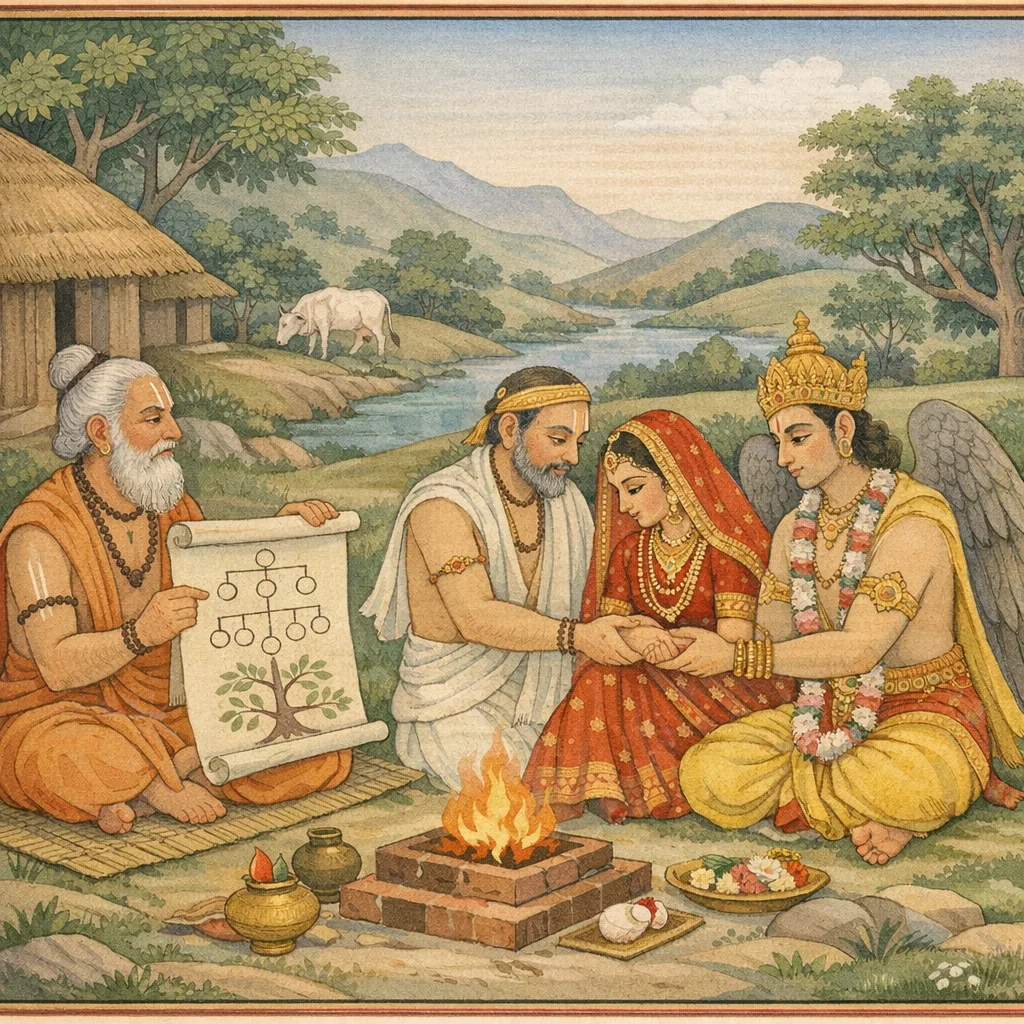
Continuing the Ācāra-kāṇḍa’s teaching of lived dharma, Yājñavalkya turns from the completion of brahmacarya to the duties of the gṛhastha. He sets norms for choosing a bride—good character, health, non-sapinda and not near in gotra, proper age—while not treating cross-varṇa unions, especially with a Śūdra wife, as the preferred standard, and he states the allowable number of wives by varṇa. The chapter lists marriage forms, praising the Brāhma marriage and ranking others (Āsura, Gāndharva, Rākṣasa, Paiśāca) with varṇa-based permissions and censures. It links righteous marriage, sacrificial fees, and charity (dāna) to the purification of generations. It then gives rules for household governance: giving a maiden in marriage, penalties for abandonment or abduction, exceptional procreation arrangements to preserve lineage (kṣetraja/niyoga-like), and discipline for adultery. Women’s ritual purity is affirmed, yet grave sins connected with adultery and foeticide are warned against. The chapter concludes with ideals of marital harmony, maintenance duties, timing of fertility, avoidance of inauspicious days, and a protective, honor-centered household order, preparing for further teachings on social and ritual conduct in gṛhastha life.
Shlokas
Verse 1
इत श्रीगारुडे महापुराणे पूर्वखण्डे प्रथमांशाक्ये आचारकाण्डे याज्ञवल्क्योक्तवर्णधर्मनिरूपणं नाम चतुर्नवतितमो ऽध्यायः याज्ञवल्क्य उवाच / शृण्वन्तु मुनयो धर्मान् गृहस्थस्य यतव्रताः / गुरवे च धनं दत्त्वा स्नात्वा च तदनुज्ञया
Thus, in the Śrī Garuḍa Mahāpurāṇa, in the Pūrvakhaṇḍa (First Section), within the Ācāra-kāṇḍa, begins the chapter entitled “An exposition of varṇa-dharma as taught by Yājñavalkya.” Yājñavalkya said: “Let the sages, restrained by vows, listen to the duties of the householder—having given the due wealth to the teacher (guru), and having bathed with his permission.”
Verse 2
समापितब्रह्मचर्यो लक्षण्यां स्त्रियमुद्वहेत् / अनन्यपूर्विकां कान्तामसपिण्डां यवीयसीम्
After completing the stage of brahmacarya (celibate studentship), one should marry a woman of auspicious marks and good character—one not previously married, pleasing and beloved, not sapinda (of the same kin-line), and younger.
Verse 3
अरोगिणीं भ्रातृमतीमसमानार्षगोत्रजाम् / पञ्चमात्सप्तमादूर्ध्वं मातृतः पितृतस्तथा
He should marry a healthy woman who has brothers, who is not of the same ṛṣi-lineage (ārṣa-gotra), and who lies beyond the forbidden degrees of kinship—above the fifth on the mother’s side and above the seventh on the father’s side.
Verse 4
दशपूरुषविख्याताच्छ्रोत्रियाणां महाकुलात् / सवर्णः श्रोत्रियो विद्वान्वरो दोषान्वितो न च
He is deemed an excellent choice: one born in a great lineage of Vedic scholars (śrotriyas) renowned for ten generations, of the same varṇa, himself a learned śrotriya, and free from defects.
Verse 5
यदुच्यते द्विजातीनां शूद्राद्दारोपसंग्रहः / न तन्मम मतं यस्मात्तत्रायं जायते स्वयम्
What is said—that the twice-born (dvija) may take a wife from a Śūdra—is not my view; for from such a union, that very kind of issue arises of itself.
Verse 6
तिस्रो वर्णानुपूर्व्येण द्वे तथैका यथाक्रमम् / ब्राह्मणक्षत्त्रियविशां भार्याः स्वा शूद्रजन्मनः
In due order by the varṇas, a Brāhmaṇa may have three wives, a Kṣatriya two, and a Vaiśya one; but for one born a Śūdra, only a wife of his own varṇa is prescribed.
Verse 7
ब्राह्मो विवाह आहूय दीयते शक्त्यलङ्कृता / तज्जः पुनात्युभयतः पुरुषोनेकविंशतिम्
In the Brāhma form of marriage, the groom is respectfully invited, and the bride—adorned according to one’s means—is given. A son born of that union purifies twenty-one persons on both sides of the family.
Verse 8
यज्ञस्थायर्त्विजे दैवमादायार्षस्तु गोयुगम् / चतुर्दश प्रथमजः पुनात्युत्तरजश्च षटू
At a yajña, the officiating priest receives the prescribed dakṣiṇā; for a ṛṣi, the due is a yoke of cows. The first-born purifies fourteen generations, and the later-born purifies six more.
Verse 9
इत्युक्त्वा चरतां धर्मं सह या दीयते ऽर्थिने / स कायः पावयेत्तज्जः षड्वंश्यानात्मना सह
Having thus enjoined the practice of dharma, whatever is given together as charity to a worthy supplicant—by that act a person purifies his own embodied existence, and along with himself purifies the six lines of his family.
Verse 10
आसुरो द्रविणादानाद्गान्धर्वः समयान्मिथः / राक्षसो युद्धहरणात्पैशाचः कन्यकाच्छलात्
A marriage is called Āsura when wealth is taken (by the bride’s side) in exchange; it is called Gāndharva when it arises from mutual agreement; it is Rākṣasa when the girl is seized in battle; and it is Paiśāca when a maiden is violated through deceit.
Verse 11
चत्वारो ब्राह्मणस्याद्यास्तथा गान्धर्वराक्षसौ / राज्ञस्तथासुरो वैश्ये शूद्रे चान्त्यस्तु गर्हितः
For a Brāhmaṇa, the first four forms of marriage are prescribed; likewise, for a Kṣatriya king the Gāndharva and Rākṣasa forms are permitted. The Āsura form applies to a Vaiśya, while for a Śūdra the last—Antya (i.e., Paiśāca)—is condemned.
Verse 12
पाणिर्ग्राह्यः सवर्णासु गृह्णीत क्षत्त्रिया शरम् / वैश्या प्रतोदमादद्याद्वेदने चाग्रजन्मनः
In marriages within one’s own varṇa, the bride’s hand should be taken in the proper manner. A Kṣatriya should take up an arrow; a Vaiśya should take up a goad; and for the higher-born (Brāhmaṇa), the rite of leading should be done with a staff.
Verse 13
पिता पितामहो भ्राता सकुल्यो जननी तथा / कन्याप्रदः पूर्वनाशे प्रकृतीस्थः परः परः
When one’s former worldly condition comes to an end (at death), the father, grandfather, brother, kinsmen, mother, and even the giver of a daughter in marriage—all remain established in their own natural worldly state; but the Supreme Lord (Bhagavān, Vishnu) is beyond all, the Highest beyond the highest.
Verse 14
अप्रयच्छन्समाप्नोति भ्रूणहत्यामृतावृतौ / एषामभावे दातॄणां कन्या कुर्यात् स्वयंवरम्
One who withholds what ought to be given incurs the sin of foeticide, and at the time of death he is enveloped by that sin. If such eligible donors or guardians are absent, the maiden may choose a husband for herself by svayaṃvara.
Verse 15
सकृत्प्रदीयते कन्या हरंस्तां चोरदण्डभाक् / अदुष्टां हि त्यजन्दण्ड्यः सुदुष्टां तु परित्यजेत्
A maiden is to be given in marriage only once; whoever carries her off incurs the punishment of a thief. Indeed, one who abandons a blameless wife deserves punishment; but a thoroughly wicked wife should be renounced.
Verse 16
अपुत्रा गुबपुज्ञातो देवरः पुत्रकान्यगा / सपिण्डो वा समोत्रो वा घृताभ्यक्त ऋतावियात्
If a woman is without a son and her husband is unknown or unavailable, then the brother-in-law (devara), or a kinsman—either a sapinda of the same ancestral line or one of the same gotra—having anointed himself with ghee, may approach her in the proper season (ṛtu) for the sake of begetting a son.
Verse 17
आगर्भसम्भवं गच्छेत्पतितस्त्वन्यथा भवेत् / अनेन विधिना जात क्षेत्रपस्य भवेत्सुतः
He should be regarded as “born from the womb,” a legitimate son; otherwise the man would be deemed fallen (patita). A son produced according to this prescribed procedure becomes the son of the kṣetrapa—the lawful husband, the ‘owner of the field’.
Verse 18
हृताधिकारां मलिनां पिण्डमात्रोपसेविनीम् / परिभूतामधः शय्यां वासयेद्य्वभिचारिणीम्
He should keep the adulterous woman stripped of authority, made impure, sustained only on morsels of food, disgraced, and made to lie on a low bed.
Verse 19
सोमः शौचं ददौ तासां गन्धर्वश्च सुभां गिरम् / पावकः सर्वमेध्यत्वं मेध्या वै योषितो यतः
Soma bestowed purity upon them; the Gandharva granted them a beautiful voice; and Pāvaka conferred complete ritual purity—because women are indeed considered ritually pure.
Verse 20
व्यभिचारादृतौशुद्धिर्गर्भेत्यागं करोति च / गर्भभर्तृवधे तासां तथा महति पातके
Through adultery she loses her purity during the menstrual period; and when conception occurs, she may even abandon the fetus. For such women, killing the fetus and slaying the husband are counted among the gravest sins.
Verse 21
सुरापि व्याधिता द्वेष्ट्री वन्ध्यार्थघ्न्यप्रियंवदा / अधिविन्ना च भर्तव्या महदेनोन्यथा भवेत्
Even if a wife is addicted to liquor, chronically ill, hateful, barren, wasteful of wealth, or sweet-tongued; and even if she has been superseded by another wife—she should still be maintained. Otherwise, it becomes a great sin.
Verse 22
यत्राविरोधो दम्पत्योस्त्रिवर्गस्तत्त्र वर्धते / मृते जीवति या पत्यौ या नान्यमुपगच्छति
Where there is harmony between husband and wife, the three aims of life—dharma, artha, and kāma—flourish there. A woman who, whether her husband is living or has died, does not go to another man is called faithful.
Verse 23
सेह कीर्तिमवाप्नोति मोदते चोमया सह / शुद्धां त्यजंस्तृतीयांशं दद्यादामरणं स्त्रियाः
Here in this very world he attains good renown and rejoices together with Umā. If he abandons a “pure” (rightful) wife, he should give her one-third (of his wealth/support) for as long as she lives.
Verse 24
स्त्रीभिर्भर्तुर्वचः कार्यमेष धर्मः परः स्त्रियाः / षोडशर्तुनिशाः स्त्रीणां तासु युग्मासु संविशेत्
For women, carrying out the husband’s word is to be done—this is declared the highest duty of women. A woman has sixteen nights of fertility; on those even nights one should unite (with her).
Verse 25
ब्रह्मचारी च पर्वाण्याद्याश्ततस्त्रस्तु वर्जयेत् / एवं गच्छं स्त्रियं क्षामां मघां मूलां च वर्जयेत्
A celibate student (brahmacārī) should avoid certain sacred junction-days and the beginnings (of particular periods); likewise he should avoid going to a woman who is emaciated, and he should also avoid inauspicious asterisms such as Maghā and Mūlā.
Verse 26
लक्षण्यं जनयेदेव पुत्रं रोगविवर्जितम् / यथा कामी भवेद्वापि स्त्रीणां (स्म) वलमनुस्मरन्
By remembering (and employing) this potency, one begets a son endowed with auspicious marks and free from disease; and by remembering the strength of women, one may even become passionately desirous.
Verse 27
स्वदारनिरतश्चैव स्त्रियो रक्ष्या यतस्ततः / भर्तृभ्रातृपितृज्ञातिश्वश्रूश्वशुरदेवरैः
A man should be devoted to his own wife; and women should be duly protected in every way—by the husband, brothers, father, relatives, mother-in-law, father-in-law, and brothers-in-law.
Verse 28
बन्धुभिश्च स्त्रियः पूज्या भूषणाच्छादनाशनैः / संयतो पस्करा दक्षा हृष्टा व्ययपराङ्मुखी
Women should be honored by their kinsmen with ornaments, clothing, and food. She should be self-controlled, flourishing, capable, cheerful, and averse to wasteful expenditure.
Verse 29
श्वश्रूश्वशुरयोः कुर्यात्पादयोर्वन्दनं सदा / क्रीडाशरीरसंस्कारसमाजोत्सवदशनम्
One should always bow at the feet of one’s mother-in-law and father-in-law, and also attend recreations, bodily rites of passage, social gatherings, and festive celebrations.
Verse 30
हास्यं परगृहे यानं त्यजेत्प्रेषितभर्तृका / रक्षेत्कन्यां पिता बाल्ये यौवने पतिरेव ताम्
A woman whose husband is away should avoid joking and visiting other households. A daughter should be protected by her father in childhood, and in youth by her husband alone.
Verse 31
वार्धक्ये रक्षते पुत्रो ह्यन्यथा ज्ञातयस्तथा / पतिं विना न तिष्ठेत्तु दिवा वा यदि वा निशि
In old age, it is the son who protects; otherwise, the kinsmen do so. A woman, however, should not remain without her husband—whether by day or by night.
Verse 32
ज्येष्ठां धर्मविधौ कुर्यान्न कनिष्ठां कदाचन / दाहयेदग्निहोत्रेण स्त्रियं वृत्तवतीं पतिः
In the performance of dharma-prescribed rites, one should take the elder wife as the principal, and never the younger. A husband should cremate, with the sacred household fire (agnihotra), a wife who has lived a virtuous life.
Verse 33
आहरेद्विधिवद्दारानग्निं चैवाविलम्बितः / हिता भर्तुर्दिवं गच्छेदिह कीर्तीरवाप्य च
Without delay, and in accordance with the prescribed rite, she should duly arrange (or bring) the wife and the sacred fire; devoted to her husband’s welfare, she attains heaven, and in this world too she gains enduring renown.
Frequently Asked Questions
It prioritizes dharmic forms (with Brāhma highlighted) and then maps permissions by varṇa: the first four forms are stated for Brāhmaṇas; Kṣatriyas may also employ Gāndharva and Rākṣasa; Āsura is associated with Vaiśyas; and Paiśāca is treated as the condemned ‘antya’ form.
Dāna given to a worthy recipient is presented as a purifying act: it sanctifies the giver’s embodied life and extends purification across multiple family lines, reinforcing the Purāṇic theme that household virtue has transgenerational karmic effects.