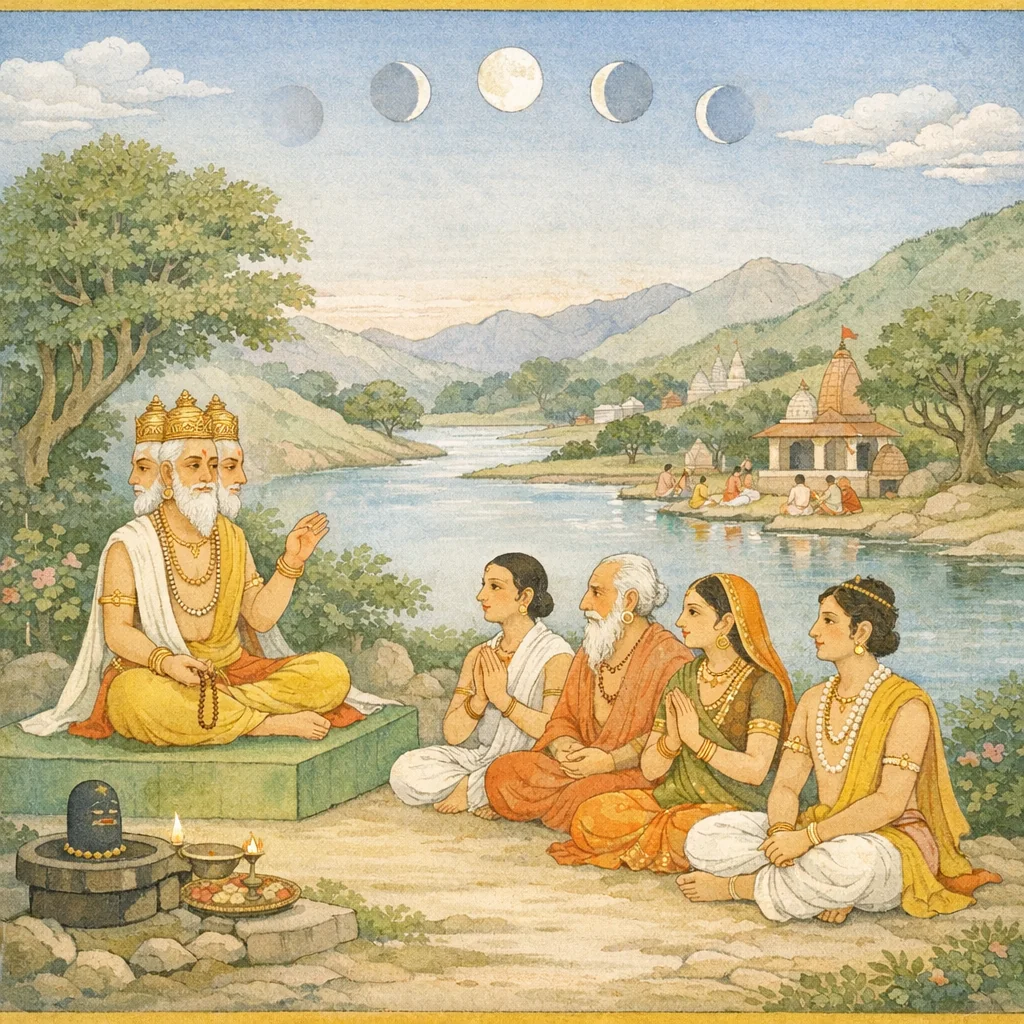
Adhyaya 52
Prāyaścitta for Mahāpātakas (Great Sins), Vows, Tīrtha, and Sin-Destroying Observances
Continuing the Brahma Khanda’s practical dharma teaching, Brahmā turns from general moral order to the concrete workings of prāyaścitta for the gravest offenses. He defines the mahāpātakas and the added sin of associating with such offenders, then sets out graded expiations: forest-dwelling and severe vows for brahma-hatyā; prescribed purifications for surā-pāna; and harsh consequences with remedies for theft and guru-talpa. The chapter then widens from crime-specific penances to universal sin-destroyers—complete charity, Cāndrāyaṇa/Kṛcchra observances, tīrtha-yātrā (especially Gayā and other sacred fords), worship on Amāvasyā, fasting on caturdaśī, and salutations and offerings to Yama with sesame-water. It further commends disciplined living (celibacy, sleeping on the ground, honoring brāhmaṇas), Sun worship after ṣaṣṭhī fasting, and Ekādaśī worship of Janārdana as powerful correctives. The closing verses extend dharma into household ideals through the pativratā theme and end with a Viṣṇu-to-Brahmā transmission, preparing the next chapters to keep linking conduct, ritual timing, and karmic results.
Shlokas
Verse 1
नामैकपञ्चाशत्तमो ऽध्यायः ब्रह्मोवाच / अतः परं प्रवक्ष्यामि प्रायश्चित्तविधिं द्विजाः / ब्रह्महा च सुरापश्च स्तेयी च गुरुतल्पगः
Chapter Fifty-Two. Brahmā said: “Now, O twice-born ones, I shall set forth the ordinance of expiation (prāyaścitta)—for the slayer of a brāhmaṇa, the drinker of intoxicants, the thief, and the violator of the guru’s bed.”
Verse 2
पञ्च पातकिनस्त्वेते तत्संयोगी च पञ्चमः / उपपापानि गोहत्याप्रभृतीनि सुरा जगुः
These are the five great sinners; and as a fifth is reckoned the one who keeps company with them. The sages have also declared subsidiary sins (upapāpa), beginning with the killing of a cow.
Verse 3
ब्रह्महा द्वादशाब्दानि कुटीं कृत्वा वने वसेत् / कुर्यादनशनं वाथ भृगोः पतनमेव च
A slayer of a brāhmaṇa should build a hut and dwell in the forest for twelve years. Or else he may undertake anāśana—fasting unto death; likewise, he may perform the expiatory rite known as “Bhṛgu’s falling” (Bhṛgu-patanam).
Verse 4
ज्वलन्तं वा विशेदग्निं जलं वा प्रविशेत्स्वयम् / ब्राह्मणार्थे गवार्थे वा सम्यक् प्राणान्परित्यजेत्
One may enter a blazing fire, or oneself enter water (to die), if it is for the sake of a brāhmaṇa or for the sake of cows; thus should one rightly relinquish the life-breaths only for such a righteous cause.
Verse 5
दत्त्वा चान्नं च विदुषे ब्रह्महत्यां व्यपोहति / अश्वमेधावभृथके स्नात्वा वा मुच्यते द्विजः
By giving food to a learned person, one drives away the sin of slaying a brāhmaṇa; or a twice-born person is freed from that sin by bathing in the concluding ablution (avabhṛtha) of the Aśvamedha sacrifice.
Verse 6
सर्वस्वं वा वेदविदे ब्राह्मणाय प्रदापयेत् / सरस्वत्यास्तरङ्गिण्याः सङ्गमे लोकविश्रुते
One should give away even all one’s possessions to a Brāhmaṇa learned in the Vedas, at the world-renowned confluence where the wave-borne river Sarasvatī meets.
Verse 7
शुद्धे त्रिषवणस्नातस्त्रिरात्रोपोषितो द्विजः / सेतुबन्धे नरः स्नात्वा मुच्यते ब्रह्महत्यया
A twice-born who, in purity, bathes at the three sandhyās (dawn, noon, and dusk) and fasts for three nights—by bathing at Setubandha, a man is freed from the sin of brahma-hatyā (slaying a Brāhmaṇa).
Verse 8
कपालमोचने स्नात्वा वाराणस्यां तथैव च / सुरापस्तु सुरां पीत्वा अग्निवर्णां द्विजोत्तमः
Having bathed at Kapālamocana and likewise at Vārāṇasī, the Brāhmaṇa who has incurred the sin of drinking liquor should drink liquor again—fiery in appearance—as an act of expiation, O best of the twice-born.
Verse 9
पयो घृतं वा गोमूत्रं तस्मात्पापात्प्रमुच्यते / सुवर्णस्तेयी मुक्तः स्यान्मुसलेन हतो नृपैः
By taking milk, ghee, or cow’s urine, one is released from that sin. Even a thief of gold may be set free, though he be struck down with a pestle by the king’s men.
Verse 10
चीरवासा द्विजो ऽरण्ये चरेद्ब्रह्महणव्रतम् / गुरुभार्यां समारुह्य ब्राह्मणः काममोहितः
Wearing bark-garments, a twice-born should dwell in the forest and undertake the expiatory vow for brahma-hatyā (slaying a Brāhmaṇa). A Brāhmaṇa, deluded by lust, who violates the wife of his guru must perform such atonement.
Verse 11
अवगूहेत्स्त्रियं तप्तां दीप्तां कार्ष्णायसीं कृताम् / गुर्वङ्गनागामिनश्च चरेयुर्बह्महव्रतम्
He should embrace a woman fashioned of black iron, heated and blazing; and those who have approached the wife of one’s guru should undertake the brahma-havrata, a severe expiatory vow.
Verse 12
चान्द्रायणानि वा कुर्यात्पञ्च चत्वारि वा पुनः / पतितेन च संसर्गं कुरुते यस्तु वै द्विजः
Or he should perform the Cāndrāyaṇa expiatory observance—five times, or again four times—this is prescribed for that twice-born who associates with a fallen person.
Verse 13
स तत्पापापनोदार्थं तस्यैव व्रतमाचरेत् / तप्तकृच्छ्रं चरेद्वाथ संवत्सरमतन्द्रितः
To remove that very sin, one should observe that same vow; or else, one should diligently perform the Tapta-Kṛcchra penance for a full year without negligence.
Verse 14
सर्वस्वदानं विधिवत्सर्वपापविशोधनम् / चान्द्रायणं च विधिना कृतं चैवातिकृच्छ्रकम्
The gift of one’s entire wealth, when performed according to proper rule, purifies all sins. Likewise, the Cāndrāyaṇa vow and the severe Atikṛcchra penance too—when undertaken in the prescribed manner—bring purification.
Verse 15
पुण्यक्षेत्रे गयादौ च गमनं पापनाशनम् / अमावस्यां तिथिं प्राप्य यः समाराधयेद्भवम्
Going to a holy pilgrimage place—especially Gayā and the like—destroys sins. And whoever, upon attaining the new-moon day (Amāvasyā), duly worships Bhava (Śiva), gains sin-destroying merit.
Verse 16
ब्राह्मणान् भोजयित्वा तु सर्वपापैः प्रमुच्यते / उपोषितश्चतुर्दश्यां कृष्णपक्षे समाहितः
Having fed the brāhmaṇas, one is released from all sins. And, with a composed mind, one should fast on the fourteenth lunar day (caturdaśī) of the dark fortnight (kṛṣṇa-pakṣa).
Verse 17
यमाय धर्मराजाय मृत्यवे चान्तकाय च / वैवस्वताय कालाय सर्वभूतक्षयाय च
Salutations to Yama—the king of Dharma; to Death, and to Antaka (the Ender); to Vaivasvata; to Time (Kāla); and to the universal destroyer of all beings.
Verse 18
प्रत्येकं तिलसंयुक्तान्दद्यात्सप्त जलाञ्जलीन् / स्नात्वा नद्यां तु पूर्वाह्ने मुच्यते सर्वपातकैः
Each time, one should offer seven handfuls of water mixed with sesame seeds. By bathing in a river in the forenoon, one is freed from all sins.
Verse 19
ब्रह्मचर्यमधः शय्यामुपवासं द्विजार्चनम् / व्रतेष्वेतेषु कुर्वीत शान्तः संयतमानसः
Maintaining celibacy, sleeping on the ground, fasting, and honoring the twice-born (brāhmaṇas)—one should observe these vows with tranquility and a well-restrained mind.
Verse 20
पष्ठ्यामुपोषितो देवं शुक्लपक्षे समाहितः / सप्तम्यामर्चयेद्भानुं मुच्यते सर्वपातकैः
With a focused mind, having observed a fast on the sixth day of the bright fortnight (śukla-pakṣa), one should worship the Sun on the seventh (Saptamī); thereby one is freed from all sins.
Verse 21
एकादश्यां निराहारः समभ्यर्च्य जनार्दनम् / द्वादश्यां शुक्लपक्षस्य महापापैः प्रमुच्यते
One who, on Ekādaśī, fasts without food and duly worships Janārdana is, on the Dvādaśī of the bright fortnight, released even from great sins.
Verse 22
तपो जपस्तीर्थसेवा देवब्राह्मणपूजनम् / ग्रहणादिषु कालेषु महापातकनाशनम्
Austerity, mantra-recitation, service at sacred tīrthas, and worship of the gods and Brahmins—when performed at times such as eclipses and other holy occasions—become destroyers even of the gravest sins.
Verse 23
यः सर्वपापयुक्तो ऽपि पुण्यतीर्थेषु मानवः / नियमेन त्यजेत्प्राणान्मुच्यते सर्वपातकैः
Even a person burdened with all sins, if at sacred tīrthas he gives up his life with due discipline, is released from every kind of grave wrongdoing.
Verse 24
ब्रह्मघ्नं वा कृतघ्नं वा महापातकदूषितम् / भर्तारमुद्धरेन्नारी प्रविष्टा सह पावकम्
Even if her husband is a slayer of a Brahmin, or ungrateful, or tainted by great sins, a wife may deliver her husband by entering the fire along with him.
Verse 25
पतिव्रता तु या नारी भर्तुः शुश्रूषणोत्सुका / न तस्या विद्यते पापमिह लोके परत्र च
But the woman who is pativratā—devoted to her husband and eager to serve him—incurs no sin, either in this world or in the world beyond.
Verse 26
तथा रामस्य सुभगा सीता त्रैलोक्यविश्रुता / पत्नी दाशरथेर्देवी विजिग्ये राक्षसेश्वरम्
Likewise, Sītā—the blessed one, renowned in the three worlds—consort of Rāma, Daśaratha’s son, conquered the lord of the Rākṣasas.
Verse 27
फल्गुतीर्थादिषु स्नातः सर्वाचारफलं लभेत् / इत्याह भगवान्विष्णुः पुरा मम यतव्रताः
One who bathes at Phalgu Tīrtha and other sacred fords attains the fruit of all righteous observances. Thus, in ancient times, Lord Viṣṇu spoke to me and to those of restrained vows.
Frequently Asked Questions
It begins by sin-type (mahāpātakas and association), then expands into vow-type (Cāndrāyaṇa, Tapta-Kṛcchra, Atikṛcchra) and finally sacred geography (Setubandha, Kapālamocana, Vārāṇasī, Phalgu, Gayā). The effect is a layered map: offense → discipline → sanctified time/place as amplifiers of purification.
Ekādaśī is presented as a disciplined withdrawal from sense-gratification paired with devotional alignment to Viṣṇu (Janārdana). In karmic terms, restraint (niyama) plus bhakti redirects the mind and conduct, producing a countervailing merit said to dissolve even “great sins” when performed duly.