Adhyaya 236
Atma-Jnana as the Direct Means to Moksha: Advaita, Maya, and the Three States
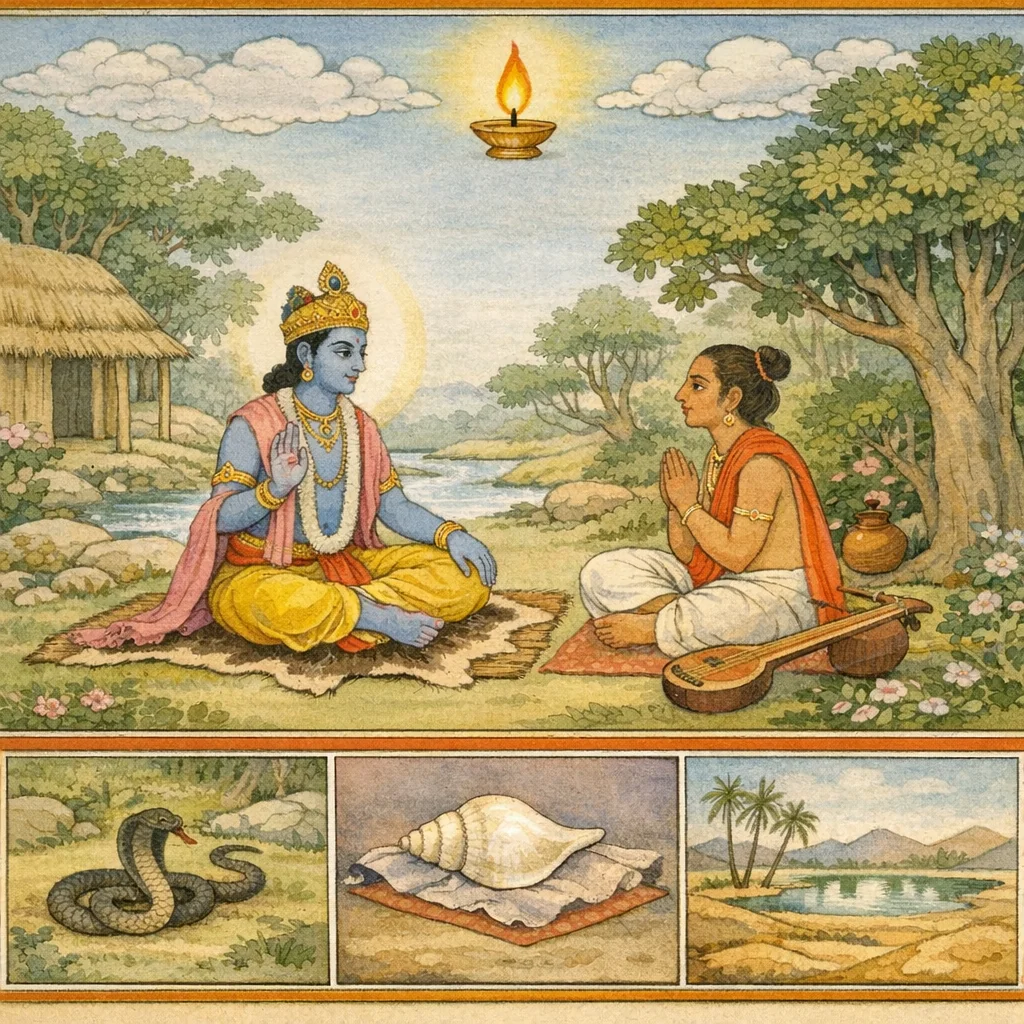
Continuing the Brahma Khanda’s inward movement toward liberation, Bhagavān instructs Nārada with a decisive teaching on Self-knowledge (ātma-jñāna). He declares the liberating doctrine to be Advaita (non-duality), also explained through Sāṅkhya-like discernment, and defines Yoga as one-pointedness of mind that supports realization. The chapter contrasts true knowledge with ritual merit: sacrifices, charity, austerity, and pilgrimages cannot by themselves grant mokṣa, whereas śravaṇa–manana–nididhyāsana culminate in the recognition “I am Brahman.” To establish non-duality, it analyzes the three states—waking, dream, and deep sleep (Tripurā)—as constructions of māyā, while the bodiless, all-pervading Witness remains unmoving and beyond action. Classic adhyāsa examples (rope-snake, shell-silver, mirage) show how ignorance superimposes name-and-form upon the Self. Inquiry into māyā both reveals and dissolves it, leading to jīvanmukti: the falling away of heart-desires and the steady inner lamp of knowledge. The chapter thus grounds all dharma and practice in the primacy of Brahman-realization, preparing for the teachings that follow.
Shlokas
Verse 1
नाम पञ्चत्रिंशदुत्तरद्विशततमो ऽध्यायः श्रीभगवानुवाच / आत्मज्ञानं प्रवक्ष्यामि शृणु नारद तत्त्वतः / अद्वैतं साङ्ख्यमित्याहुर्योगस्तत्रैकचित्तता
Thus begins the two-hundred-and-thirty-sixth chapter. The Blessed Lord said: “I shall teach Self-knowledge—listen, O Nārada, in its true reality. They call it non-dual (Advaita) and also Sāṅkhya; and Yoga, in that context, is one-pointedness of the mind.”
Verse 2
अद्वैतयोगसम्पन्नास्ते मुच्यन्ते ऽतिबन्धनात् / अतीतारब्धमागामि कर्म नश्यति बोधतः
Those endowed with the yoga of non-duality are freed from the exceedingly strong bondage; through true realization, the accumulated past and the yet-to-come karmas are destroyed.
Verse 3
सद्विचारकुठारेण च्छिन्नसंसारपादपः / ज्ञानवैराग्यतीर्थेन लभते वैष्णवं पदम्
With the axe of right discernment he cuts down the tree of worldly becoming; and by bathing in the sacred ford of knowledge and dispassion, he attains the Vaishnava state—the supreme abode of Vishnu.
Verse 4
जाग्रत्स्वप्नसुषुप्तं च माया त्रिपुरमुच्यते / अत्रैवान्तर्गतं सर्वं शाश्वते नाद्वये पदे
Waking, dreaming, and deep sleep—this Māyā is called the “threefold city” (Tripura). Yet all of this is contained within That very eternal, non-dual state (pada).
Verse 5
नामरूपक्रियाहीनं सर्वं तत्परमं पदम् / जगत्कृत्वेश्वरो ऽनन्तं स्वयमत्र प्रविष्टवान्
That supreme state is wholly beyond name, form, and action. Having created the universe, the infinite Lord Himself entered into it.
Verse 6
वेदाहमेतं पुरुषं चिद्रूपं तमसः परम् / सो ऽहमस्मीति मोक्षाय नान्यः पन्था विमुक्तये
I know that Supreme Person whose very nature is pure consciousness, beyond darkness (ignorance). Realizing “I am He” is for liberation—there is no other path to complete release.
Verse 7
श्रवणं मननं ध्यानं ज्ञानानां चैव साधनम् / यज्ञदानतपस्तीर्थवेदैर्मुक्तिर्न लभ्यते
Listening (to the truth), reflecting upon it, and meditating are indeed the means to spiritual knowledge; liberation is not attained merely through sacrifices, charity, austerities, pilgrimages, or even through (mere recitation of) the Vedas.
Verse 8
त्यागेन केनचिद्ध्यानपूजाकर्मादिभिर्यथा / द्विविधं वेदवचनं कुरु कर्म त्यजेति च
Just as some speak of renunciation through meditation, worship, rites, and the like, so too the Veda’s instruction is twofold: “perform action” and also “renounce.”
Verse 9
यज्ञादयो विमुक्तानां निष्कामानां विमुक्तये / अन्तः करणशुद्ध्यर्थमूचुरेवात्र केचन
Some teachers declare here that rites such as yajña (sacrifice) are enjoined for the liberation of those who are desireless and already detached—chiefly to purify the inner instrument, the mind and heart.
Verse 10
एकेन जन्मना ज्ञानन्मुक्तिर्न द्वैतभाविनाम् / योगभ्रष्टाः कुयोगाश्च विप्रा योगिकुलोद्भवाः
For those who cling to a dualistic outlook, liberation through knowledge is not attained in a single lifetime. Even Brahmins born in yogic lineages may fall from yoga, and some may turn to misguided or inferior practices.
Verse 11
कर्मणा बध्यते जन्तुर्ज्ञानान्मुक्तो भवाद्भवेत् / आत्मज्ञानन्त्वाश्रयेद्वै अज्ञानं यदतो ऽन्यथा
A living being is bound by karma, but through knowledge he is freed from worldly becoming. Therefore one should truly take refuge in Self-knowledge (ātma-jñāna); ignorance leads to the contrary—bondage.
Verse 12
यदा सर्वे विमुच्यन्ते कामा येस्यहृदि स्थिताः / तदामृतत्वमाप्नोति जीवन्नेव न संशयः
When all the desires dwelling in one’s heart are completely released, then—while still living—one attains immortality (amṛtatva); of this there is no doubt.
Verse 13
व्यापकत्वात्कथं याति को याति क्व स याति च / अनन्तत्वान्नदेशो ऽस्ति अमूर्तित्वाद्गतिः कुतः
Since the Self is all-pervading, how could it ‘go’ at all? Who is it that goes, and to where would it go? Since it is infinite, there is no particular place for it; and since it is formless, how can there be any movement for it?
Verse 14
अद्वयत्वान्न को ऽप्यस्ति बोधत्वाज्जडता कुतः / एकोद्दिष्टं यदन्यस्य मतिवाग्गतिसंस्थिति (म्)
Because Reality is non-dual, there is no “other” at all; and because it is pure consciousness, how could inertness exist? What is pointed out as belonging to another—mind, speech, movement, and condition—is, in truth, not separate from the One.
Verse 15
कथमाकाशकल्पस्य गतिरागतिसंस्थिति / जाग्रत्स्वप्नसुषुप्तं च मायया परिकल्पितम्
How are the movement, return, and abiding of that which is space-like to be understood? And how are the states of waking, dreaming, and deep sleep imagined by Māyā?
Verse 16
वस्तु तैजसकं प्राज्ञे यत्तु पुण्यमखण्डकम् / यथा ते प्रियात्मा नः सर्वेषां च तथा प्रियः
O wise one, that radiant essence which is unbroken merit—just as the Self dear to you is dear, so too is he dear to us all.
Verse 17
बोधमार्गे यथा चित्तं सर्वेषां च तथा मते / सर्वदा सर्वभूतानां सर्वस्य च महामुने
O great sage, as the mind is directed on the path of awakening (true knowledge) for all, so too is the understanding: at all times, for every being, this principle applies to everyone.
Verse 18
नाहमत्रात्मविज्ञानं तस्मात्पूर्णं निरन्तरम् / जाग्रत्स्वप्नं तथा वृत्तं सौषुप्तसुखमेव च
Here, I do not have uninterrupted, complete knowledge of the Self; therefore my experience runs through the states of waking and dream, and it also partakes of the happiness of deep sleep.
Verse 19
स्मरणं विस्मृतार्थस्य नास्ति चेत्कस्य जायते / सत्यमस्तु तथा वाणु अशरीरं परं तथा
If remembrance does not arise in one who has forgotten the matter, then for whom could it arise at all? So be it—truth indeed is thus: speech is bodiless, and the Supreme too is bodiless.
Verse 20
नास्ति चेत्सुखदुः खानां सर्वेषां वेदनं कथम् / सदा सर्वत्र सर्वज्ञः सर्वस्य हृदये न येत्
If pleasure and pain did not exist, how could there be experience or awareness of them for all beings? And if the Omniscient One is always everywhere, how would He not enter and abide in the heart of every being?
Verse 21
साक्षिभूतः समाश्रित्य को जानाति विचेष्टितम् / सत्य ज्ञानानन्त भिन्नं स्यान्नसत्यं ज्ञानतः पृथक्
Taking refuge in the Witness-Self, who can truly know the workings of action and experience? Truth is not different from consciousness and infinitude; and what is untrue is not separate from knowledge as something apart.
Verse 22
नानन्त्यात्पृथगानन्दं नाप्यमानन्दतः पृथक् / त्वमेव परमं ब्रह्म सत्यज्ञानादिलक्षणम्
Bliss is not separate from infinitude, nor is infinitude separate from bliss. You alone are the Supreme Brahman, characterized by truth, knowledge, and the like.
Verse 23
अहं ब्रह्म परं तत्त्वं ज्ञात्वा त्वखिलविद्भवेत् / यथैकमृन्मये ज्ञाते सर्वमेतच्चराचरम्
Knowing Me as Brahman—the supreme Reality—one becomes a knower of all. Just as, by knowing a single lump of clay, everything made of clay is understood, so too is this entire moving and unmoving universe comprehended.
Verse 24
यथैकहेममणिना सर्वं हेममयं भवेत् / ज्ञानं तथैवमीशेन ज्ञानिनाप्यखिलं जगत्
Just as by a single philosopher’s stone all becomes wholly gold, so too, through the Lord (Īśa) and through the knower’s true wisdom, this entire universe is realized as nothing but that Supreme Reality.
Verse 25
यथान्धकारदोषेण रज्जुः सम्यङ्नदृश्यते / यथा संमोहदोषेण चात्मा सम्यङ्नदृश्यते
Just as, through the fault of darkness, a rope is not seen rightly, so too, through the fault of delusion (moha), the Self (ātman) is not perceived as it truly is.
Verse 26
सर्पधारादिभिर्भेदरैन्यथा वस्तुकल्पनम् / व्योमादिना सरूपाद्यैरन्यथात्मा प्रकल्प्यते
Just as, by distinctions such as the appearance of a snake and the like, an object is imagined otherwise, so too the Self is misconceived as something else—through notions like space and other categories, together with the superimposition of name-and-form and related ideas.
Verse 27
प्रत्यक्षमपि यद्द्रव्यन्दुर्दर्शमिति भाषते / व्योमादिना सरूपाद्यैरन्यथा कल्पितैस्तथा
Even when a substance is directly present, one may still say, “It is hard to perceive”; likewise, by imagining it otherwise—through examples such as space and the like, and by notions of form and related attributes—people misconstrue it.
Verse 28
तथा हि रज्जुरुरगः शुक्तिः कारजतं यथा / मृगतृष्णापथायाम्भस्तृप्तिं विष्णो तथा जगत्
Just as a rope is mistaken for a snake, and mother-of-pearl for silver, and as the water seen on the road as a mirage cannot bring true satisfaction—so too, O Viṣṇu, is this world: an appearance born of delusion, not a source of real fulfillment.
Verse 29
हाहिष्णोद्विजा कथि द्भोहमितिदृ / ग्रहनाशात्पुनर्ध्यायन्ब्राह्मण्यं मन्यते यथा
Alas! Some twice-born (brāhmaṇas), crying, “How could this befall me?”, then—when the affliction has passed—return to meditation and imagine they have regained the brāhmaṇa-state (purity and standing), as though the mere ending of the “seizure” (graha) restores all.
Verse 30
मायाविष्टस्तथा जीवो देहोहमिति मन्यते / मायानाशात्पुनः स्वीयरूपं ब्रह्मास्मि मन्यते
Thus the individual soul (jīva), deluded by māyā, imagines, “I am the body.” But when māyā is destroyed, it again recognizes its true nature and knows, “I am Brahman.”
Verse 31
ग्रहनाशाद्यथा मान्यजनोक्रूरमवेक्षते / स्वरूपदर्शनाच्चायं माया नाशन्तया विना
Just as, when the graha (eclipse) has ended, an honorable person beholds what seemed dreadful as it truly is, so too this māyā is destroyed only by the direct vision of one’s own real nature—by no other means.
Verse 32
अनादित्वं समं द्वाभ्यां स्वरूपं तद्विलक्षणम् / एकः सत्यं तथा भागी विचारेण परं मृषा
Beginninglessness (anāditva) is common to both; yet their essential nature is distinct. Of the two, one is real and the experiencer (the enjoyer of results); upon inquiry, the other is found to be wholly false.
Verse 33
अजोपि हि सकृत्प्रेत्य संभवाम्यात्ममायया / मायेच्छया द्विधा स स्यात्पतिः पत्नी सुखं जगत्
Though unborn, after departing (from a body) I manifest again by My own inner power of māyā. By the mere will of māyā, that One appears as two—husband and wife—and thus the world’s experience of pleasure arises.
Verse 34
अष्टाविंशतिभेदैस्तु त्रैगुण्यं विद्यते पृथक् / चतुरशीतिर्लक्ष्यन्ते नरनार्याकृतीनि च
Indeed, the three guṇas—sattva, rajas, and tamas—are found separately in twenty-eight distinct variations; and correspondingly, eighty-four kinds of human forms, male and female, are observed.
Verse 35
एषुविश्वं प्रभवति खण्डजं मायया यथा / आदावन्ते च सन्त्येते नामरूपक्रियादयः
Within these (elements/conditions) the universe arises, appearing fragmented and differentiated, as though brought forth by māyā. At the beginning and at the end, these remain: name, form, action, and the rest of worldly distinctions.
Verse 36
सत्तावकल्पनं काले न सन्ति परमार्थतः / यथा रथादयः स्वप्ने सन्तो नैव च सत्यतः
Conceptions of existence projected by time are not real in the ultimate sense; just as chariots and the like appear to exist in a dream, yet are not truly real.
Verse 37
तथा जाग्रदवस्थायां भूतानि न तु सन्निधौ / द्वैरूप्यं मायया याति जाग्रत्स्वप्नपदज्ञ (क्ष) योः
Likewise, in the waking state beings are perceived though they are not actually present nearby; by māyā there arises a double appearance for one who knows the levels of waking and dream.
Verse 38
एवमेतत्परं ब्रह्म स्वप्नजाग्रत्पदद्वये / सुषुप्तमचलं रूपमद्वयं पदमुच्यते
Thus, this is the Supreme Brahman: amid the two conditions called dream and waking, it is spoken of as suṣupti—the unmoving, changeless form—the non-dual state (advaya).
Verse 39
मायाविचारसिद्धैव विचारेण विलीयते / आपातरहिता सापि कल्पना कालवर्तिनी
Māyā is established only by inquiry into itself, and by that very inquiry it is dissolved. Even a notion free from immediate appearances is still but a mental construction, moving within the stream of time.
Verse 40
एवं तस्या (दात्या) त्मनादित्यं सिद्धमेकस्य सत्यजा / सतोस्तित्वं वसातित्वादस्तित्वासत्यतां ततः
Thus, by that doctrine—established through one’s own reasoning—the truth of the Self is settled: the existence of what is real is affirmed; and what is unreal, because it depends upon a support, is understood as non-existent—thereby its falsity is concluded.
Verse 41
ज्ञानं ततोप्यनन्तो नः पूर्णोन्तः शुकमात्मना / न नित्यभावाज्जातोहमकृत्वादमृतोस्म्यहम् / दीपवद्धृदये ज्योतिरहं ब्रह्मास्मि मुक्तये
Knowledge is endless; within, I am complete—pure bliss as the Self. I am not born from any eternal “state”; being non-agent, I am immortal. Like a lamp, the light shines in the heart: “I am Brahman”—for liberation.
Frequently Asked Questions
Yoga is defined as ekāgratā—one-pointedness of mind—used to stabilize contemplation so that non-dual knowledge becomes firm and karmic bondage is severed through realization.
It affirms the Veda’s twofold instruction—action and renunciation—but insists that final liberation is not attained by sacrifices, gifts, austerities, pilgrimages, or mere recitation; it is attained through knowledge cultivated by listening, reflection, and meditation.
They illustrate adhyāsa: due to ignorance, the Self is misconstrued and the world is taken as independently real, like mistaking a rope for a snake or a mirage for water; direct vision of one’s real nature alone removes the error.
It indicates jīvanmukti: when heart-desires are completely released, one abides as the Self even during embodied life, free from binding karma and fear of change.