Adhyaya 231
Śiva’s Narasiṃha-Stotra and the Pacification of the Mātṛgaṇas
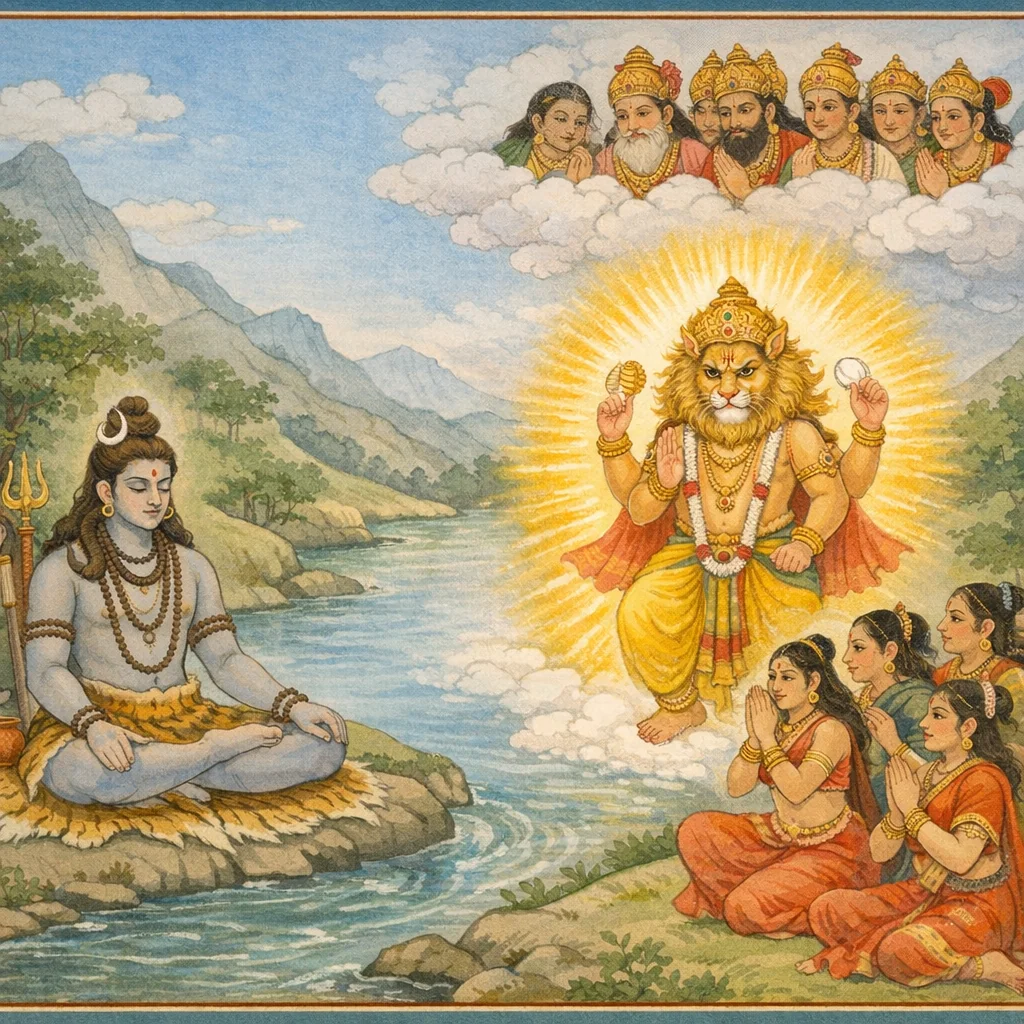
Sūta introduces a Narasiṃha hymn spoken by Śiva and handed down in the Śaunaka lineage. The Mātṛgaṇas ask leave to consume the universe; Śiva forbids them, reminding them their true duty is protection, yet they disobey and begin devouring the three worlds. In the cosmic emergency, unwilling to destroy beings he created, Śiva meditates on Hari as Narasiṃha; the deity appears exactly as envisioned, so awe-inspiring that even the gods can scarcely behold him. Śiva offers an exalted stotra praising Narasiṃha’s radiant, terrifying sovereignty and world-protecting power, and petitions him to restrain the Mothers. Narasiṃha manifests Vāgīśvara from his tongue, gathers gods and Mother-hosts, restores peace and welfare, and then disappears. The chapter ends with phalaśruti: disciplined recitation and meditation on Narasiṃha grant desired aims and dissolve sorrow; Śiva is shown instituting Narasiṃha worship and receiving grace and transmission linked with the Mothers, bridging crisis-resolution to ongoing ritual devotion.
Shlokas
Verse 1
नाम त्रिंशदुत्तरद्विशततमो ऽध्यायः सूत उवाच / नारसिंहस्तुतिं वक्ष्ये शिवोक्तं शौनकाधुना / पूर्वं मातृगणाः सर्वे शङ्करं वाक्यमब्रुवन्
Sūta said: “Now begins the two-hundred-and-thirty-first chapter. I shall relate the hymn to Lord Narasiṃha—spoken by Śiva and taught to Śaunaka. Formerly, all the hosts of the Mother-goddesses (Mātṛgaṇas) addressed words to Śaṅkara (Śiva).”
Verse 2
भगवन् भक्षयिष्यामः सदेवासुरमानुषम् / त्वत्प्रसादाज्जगत्सर्वं तदनुज्ञातुमर्हसि
O Blessed Lord, we wish to consume the entire world—together with the devas, asuras, and humans. Since all this universe exists by Your grace, please deign to grant permission for that.
Verse 3
शङ्करौवाच / भवतीभिः प्रजाः सर्वा रक्षणीया न संशयः / तस्माड्वोरतरप्रायं मनः शीघ्रं निवर्त्यताम्
Śaṅkara said: “All beings must indeed be protected by you—of this there is no doubt. Therefore, quickly turn your minds away from the path that tends toward devouring and destruction.”
Verse 4
इत्येवं शङ्करेणोक्तमनादृत्य तु तद्वचः / भक्षयामासुरव्यग्रास्त्रैलोक्यं सचराचरम्
Thus, disregarding the words spoken by Śaṅkara, those agitated beings began to devour the entire three worlds—together with all that moves and all that is unmoving.
Verse 5
त्रैलोक्ये भक्ष्यमाणे तु तदा मातृगणेन वै / नृसिंहरूपिणं देवं प्रदध्यौ भगवाञ्छिवः
Then, as the three worlds were being devoured by the host of Mothers (Mātṛ-gaṇas), the Blessed Lord Śiva entered contemplation of the divine Lord in the form of Narasiṁha.
Verse 6
अनादिनिधनं देवं सर्वभूतभवोद्भवम् / विद्युज्जिह्वं महादंष्ट्रं स्फुरत्केसरमालिनम्
I bow to the Divine Lord—without beginning or end, the source from whom the becoming of all beings arises—whose tongue flashes like lightning, whose fangs are immense, and who is garlanded with a radiant mane.
Verse 7
रत्नाङ्गदं समुकुटं हेमकेसरभूषितम् / खोणिसूत्रेण महता काञ्चनेन विराजितम्
Adorned with jeweled armlets and a crown, embellished with golden ornaments, He shines resplendent—made splendid by a great golden waist-cord.
Verse 8
नीलोत्पलदलश्यामं रत्ननूपुरभूषितम् / तेजसाक्रान्तसकलब्रह्माण्डोदरमण्डपम्
Dark as the petal of a blue lotus and adorned with jeweled anklets, by His own radiance He pervaded the entire inner pavilion of the Brahmāṇḍa—the cosmic egg of the universe.
Verse 9
आवर्तसदृशाकारैः संयुक्तं देहरोमभिः / सर्वपुष्पैर्योजिताञ्च धारयंश्च महास्त्रजम्
He wore a great garland, fashioned in spiral-like forms, interwoven with the hairs of the body, and arranged with every kind of flower.
Verse 10
स ध्यातमात्रो भगवान्प्रददौ तस्य दर्शनम् / यादृशेन रूपेण ध्यातो रुद्रैस्तु भक्तितः
The Blessed Lord, merely by being meditated upon, granted him His vision (darśana), appearing in precisely the form in which the Rudras had contemplated Him with devotion.
Verse 11
तादृशेनैव रूपेण दुर्निरीक्ष्येण दैवतैः / प्रणिपत्य तु देवेशं तदा तुष्टाव शङ्करः
Then Śaṅkara (Śiva), beholding that very form—so awe-inspiring that even the gods could scarcely gaze upon it—bowed down to the Lord of the gods and offered hymns of praise.
Verse 12
शङ्कर उवाच / नमस्ते ऽस्त जगन्नाथ नरसिंहवपुर्धर / दैत्येश्वरेन्द्रसंहारिनखशुक्तिविराजित
Śaṅkara said: Salutations to You, O Lord of the universe, who bear the form of Narasiṃha—You who destroy the foremost lords of the demons, and whose nails shine like radiant mother-of-pearl.
Verse 13
नखमण्डलसभिन्नहेमपिङ्गलविग्रह / नमो ऽस्तु पद्मनाभाय शोभनाय जगद्गुरो / कल्पान्ताम्भोदनिर्घोष सूर्यकोटिसमप्रभ
Salutations to Padmanābha, the beautiful Teacher of the world—whose golden-tawny form is as if adorned and distinguished by the circles of His nails; whose roar is like the thunder of clouds at the end of an age, and whose radiance equals that of ten million suns.
Verse 14
सहस्रयमसंत्रास सहस्रेन्द्रपराक्रम / हसस्त्रधनदस्फीत सहस्रचरणात्मक
He is terrifying like a thousand Yamas, mighty like a thousand Indras, opulent like a thousand Kuberas, and possessed of a thousand feet in form.
Verse 15
सहस्रचन्दप्रतिम ! सहस्रांशुहरिक्रम / सहस्ररुद्रतेजस्क सहस्रब्रह्मसंस्तुत
O You whose splendor is like a thousand moons—O Lord whose stride is like a thousand suns; O You endowed with the radiance of a thousand Rudras, praised by a thousand Brahmās.
Verse 16
सहस्ररुद्रसंजप्त सहस्राक्षनिरीक्षण / सहस्रजन्ममथन सहस्रबन्धनमोचन
Chanted by a thousand Rudras, beheld by the Thousand‑eyed Lord; O You who churn away the effects of a thousand births, O liberator who loosens a thousand bonds.
Verse 17
सहस्रवायुवेगाक्ष सहस्राज्ञकृपाकर / स्तुत्वैवं देवदेवेशं नृसिंहवपुषं हरिम् / विज्ञापयामास पुनर्विनयावनतः शिवः
O You whose gaze is swifter than a thousand winds, O compassionate One who knows a thousand commands—having thus praised Hari, the Lord of lords, who bore the form of Narasiṃha, Śiva again, bowed down in humility, submitted his petition.
Verse 18
अन्धकस्य विनाशाय या सृष्टा मातरो मया / अनादृत्य तु मद्वाक्यं भक्ष्यन्त्वद्भुताः प्रजाः
“Those Mother-goddesses whom I created for the destruction of Andhaka—disregarding my command—shall devour the wondrous beings.”
Verse 19
सृष्ट्वा ताश्च न शक्तो ऽहं संहर्तुमपराजितः / पूर्वं कृत्वा कथं तासां विनाशमभिरोचये
Having created them, I—though unconquered—am not able to destroy them; having first brought them into being, how could I ever wish for their ruin?
Verse 20
एवमुक्तः स रुद्रेण नरसिहवपुर्हरिः / सहस्रहेवीर्जिह्वाग्रात्तदा वागीश्वरो हरिः
Thus addressed by Rudra, Hari—assuming the form of Narasiṁha—then, from the very tip of His tongue, manifested as Vāgīśvara, the Lord of Sacred Speech, endowed with a thousand hymnic cries.
Verse 21
तथा सुरगणान्सर्वान्रौद्रान्मातृगणान्विभुः / संहृत्य जगतः शर्म कृत्वा चान्तर्दधे हरिः
Likewise, the all-pervading Lord gathered up all the hosts of the gods, together with the fierce companies of the Mothers; having restored peace and well-being to the world, Hari then vanished from sight.
Verse 22
नारसिंहमिदं स्तोत्रं यः पठेन्नियतेन्द्रियः / मनोरथप्रदस्तस्य रुद्रस्येव न संशयः
Whoever recites this Narasiṁha hymn with disciplined senses—there is no doubt—will have his desired aims granted, just as Rudra (Śiva) grants them.
Verse 23
ध्यायेन्नृसिंहं तरुणार्कनेत्रं सिदाम्बुजातं ज्वलिताग्निवत्क्रम् / अनादिमध्यान्तमज पुराणं परापरेशं जगतां निधानम्
One should meditate on Narasiṁha—whose eyes are like the rising sun, who is born from the white lotus, whose stride is like blazing fire—who is without beginning, middle, or end; unborn and primeval; the Lord of both higher and lower realms, the treasury and foundation of all worlds.
Verse 24
जपेदिदं सन्ततदुः खजालं जहाति नीहारमिवांशुमाली / समातृवर्गस्य करोति मूर्तिं यदा तदा तिष्ठति तत्समीपे
Whoever repeatedly recites this casts off the unbroken web of sorrow, just as the sun, Aṁśumālī, dispels mist. Whenever one fashions an image of the maternal lineage (mātṛ-varga), at that very time the blessed presence stands near it.
Verse 25
देवेश्वरस्यापि नृसिंहमूर्तेः पूजां विधातुं त्रिपुरान्तकारी / प्रसाद्य तं देववरं स लब्ध्वा अव्याज्जगन्मातृगणेभ्य एव च
Tripurāntaka (Śiva), wishing to establish the worship even of the Lord of the gods in His Narasiṁha form, pleased that best of Devas; and, having obtained His grace, he also received it directly and without pretext from the host of the Mothers of the universe.
Frequently Asked Questions
They function as divine powers created for a limited destructive purpose (Andhaka’s defeat) that become excessive when unrestrained; the chapter uses them to dramatize the need for dharmic containment—fierce energies must be redirected from consumption to protection.
The text explicitly states that by being meditated upon, Narasiṃha grants darśana in the very form contemplated, establishing a Purāṇic principle: disciplined visualization and devotion can precipitate a revelatory presence aligned with the devotee’s focused conception.