Adhyaya 225
Saṃsāra-cakra, Preta’s 12-day Transit to Yama, Re-embodiment, and Karma-Vipāka Catalog of Sins and Rebirths
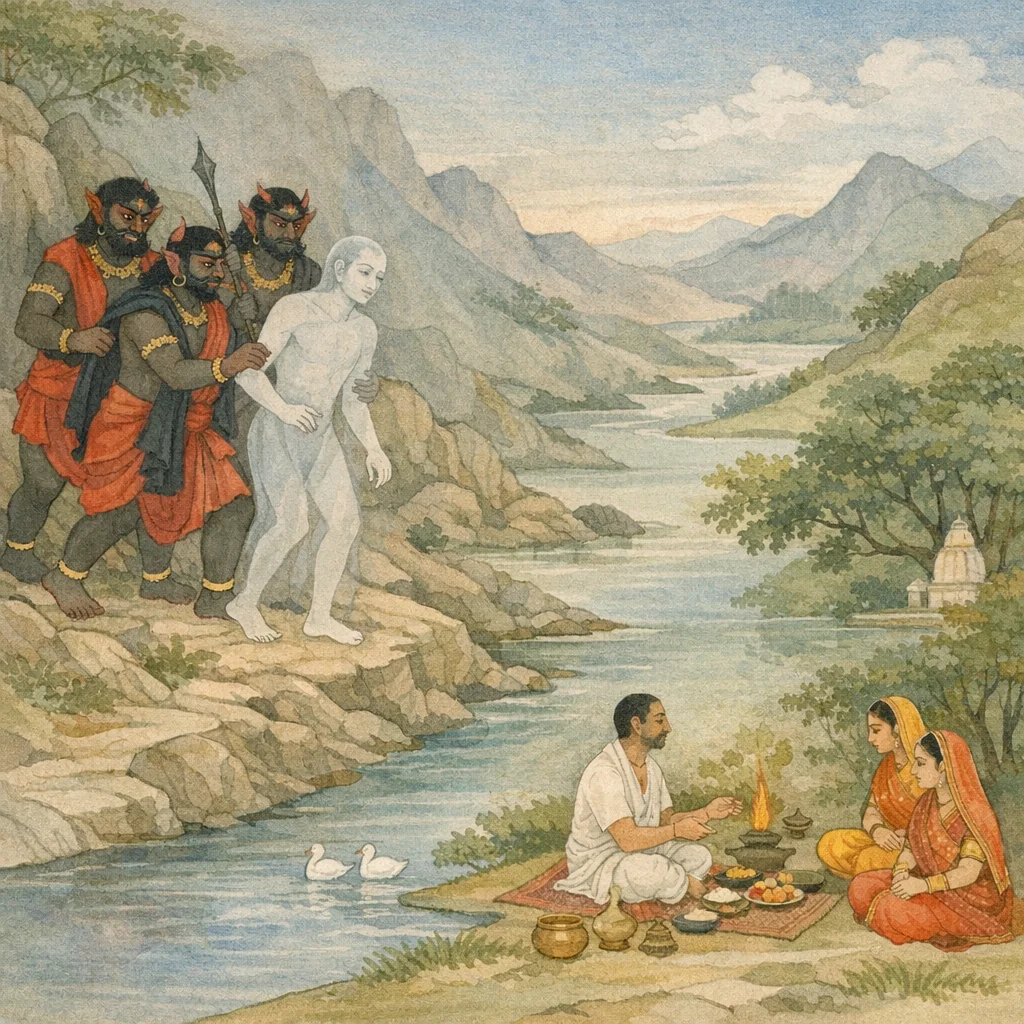
Continuing the Preta Kalpa’s post-death instruction, Sūta teaches that liberation arises from insight into the threefold afflictions and the saṃsāra-wheel. He recounts the after-death course: the jīva leaves the body, takes a subtle form, and is led by Yama’s attendants to Yama within twelve days, while śrāddha offerings (tila-udaka and piṇḍa) become the preta’s sustenance. Karma is routed—sin to naraka, merit to svarga—yet both are temporary and are followed by womb-birth; a brief account of embryonic growth (kalala to aṅkura) and Māyā’s veiling through life-stages returns the being to death, completing the wheel. The chapter then gives a detailed karma-vipāka ledger linking specific wrongs (types of theft, sexual transgressions, deceit, ingratitude, cruelty, disrespect to elders/teachers, obstruction of rites) to degraded rebirths (worms, birds, animals, demonic forms) and notes dreadful hells such as Raurava for certain thieves. It closes by defining virtues that mark svarga—compassion, truth, beneficial speech, Vedic authority, guru-deva-ṛṣi-sevā—and points to Aṣṭāṅga Yoga as the culminating attainment, preparing for later chapters on afterlife ethics and liberation.
Shlokas
Verse 1
चतुर्विंशत्यधिकद्विशततमो ऽध्यायः सूत उवाच / आध्यात्मिकादितापांस्त्रीञ्ज्ञात्व संस्राचक्रवित् / उत्पन्नज्ञानवैराग्यः प्राप्नोत्यात्यन्तिकं लयम्
Chapter 225 begins. Sūta said: Knowing the three kinds of afflictions—beginning with the inner (ādhyātmika)—and understanding the wheel of saṃsāra, one in whom knowledge and dispassion (vairāgya) have arisen attains the final, absolute dissolution—liberation.
Verse 2
संसारचक्रं वक्ष्ये ऽहमादाबुत्क्रान्तिकालतः / यद्विना पुरुषार्थो न लीनः स्यात्परमात्मनि
I shall explain the wheel of saṃsāra, beginning from the time of departure (leaving the body at death); for without understanding this, the aim of human life cannot be absorbed into the Supreme Self (Paramātman).
Verse 3
ऊर्ध्ववासी नरस्त्यक्त्वा देहमन्यत्प्रपद्यते / नीयतेद्वादशाहेन यमस्य यमपूरुषैः
The soul, abiding above in the subtle realm, abandons the body and takes up another subtle form; within twelve days it is led to Yama by Yama’s attendants.
Verse 4
तत्र यद्वान्धवास्तोयं प्रयच्छन्ति तिलैः सह / यच्च पिण्डं प्रयच्छन्ति यमलोके तदश्नुते
There, whatever water mixed with sesame the relatives offer, and whatever piṇḍa (ritual rice-ball) they present—those very offerings the departed one partakes of in Yama’s realm.
Verse 5
गतश्च नरकं पापात्स्वर्गं याति स्वपुण्यतः / पापकृद्याति नरकं पुण्यकृद्याति वै दिवम्
By sin one goes to hell, and by one’s own merit one goes to heaven. The doer of evil goes to hell; the doer of virtue indeed goes to the celestial world.
Verse 6
स्वर्गाच्च नरकात्त्यक्तः स्त्रीणां गर्भे भवत्यपि / नाभिभूतञ्च तस्यैव याति बीजद्वयं हि तत्
When the embodied being is released from heaven and from hell, he is born again in a woman’s womb. Then the twofold seed—the paired generative essences—proceeds to that very being, becoming the basis of his embodiment.
Verse 7
कललं बुद्ब्रुदमयं ततः शोणितमेव च / पेश्याः पलसमो ऽण्डः स्यादङ्कुरं तत उच्यते
First it becomes a kalala—like a tiny bubble-mass; then it becomes blood. From that arises a fleshy lump; and an egg-like form, about the size of a palāśa measure, appears—this is then called the sprout (aṅkura).
Verse 8
उपाङ्गान्यङ्गुलीनेत्रनासास्यश्रवणानि च / आवहं याति चाङ्गेभ्यस्तत्परन्तु नखादिकम्
The subsidiary parts—fingers, eyes, nose, mouth, and ears—are borne away from the limbs; thereafter, only things like the nails and the like remain.
Verse 9
त्वचो रोमाणि जायन्ते केशाश्चैव ततः परम् / नरश्चाधोमुखः स्थित्वा दशमे च सः जायते
From the skin arise the body-hairs, and thereafter the head-hair as well. Then the human being, positioned head-down, is born in the tenth month.
Verse 10
ततस्तु वैष्णवी माया वृणोत्यत्यन्तमोहिनी / बालत्वं त्वथ कौमारं यौवनं वृद्धतामपि
Thereafter, the supremely deluding Vaiṣṇavī Māyā envelops the embodied being, covering it with the states of childhood, then boyhood, youth, and even old age.
Verse 11
ततश्च मरणं तत्तद्धर्मामाप्नोति मानवः / एवं संसारचक्रे ऽस्मिन् भ्राम्यते घटीयन्त्रवत्
And then comes death; a human being attains the particular destiny in accordance with his own dharma (deeds and moral law). Thus, in this wheel of saṃsāra, he keeps revolving—like a water-wheel mechanism.
Verse 12
नरकात्प्रतिमुक्तस्तु पापयोनिषु जायते / पतितात्प्रतिगृह्याथ अधोयोनिं व्रजेद्बुधः
One who is released from hell is then born again in sinful wombs. And the wise person, by accepting gifts or support from a fallen sinner, thereafter goes to a lower birth.
Verse 13
नरकात्प्रतिमुक्तस्तु कृमिर्भवति याचकः / उपाध्यायव्यलीकं तु कृत्वा श्वा भवति द्विज
Released from hell, the beggar is reborn as a worm. And the twice-born (brāhmaṇa) who deceives or wrongs his upādhyāya, his teacher, is reborn as a dog.
Verse 14
तज्जायां मनसा वाञ्छंस्तद्द्रव्यं वाप्यसंशयम् / गर्दभोजायते जन्तुर्मित्रस्यैवापमानकृत्
He who in his mind lusts after another man’s wife, or covets his wealth, is without doubt reborn as a donkey; likewise, one who humiliates a friend meets the same fate.
Verse 15
पितरौ पीडयित्वा तु कच्छपत्वञ्च जायते / भुर्तुः पिण्डमुपाश्वस्तो वञ्जयित्वा तमेव यः
One who torments his parents is reborn as a tortoise. And one who approaches the piṇḍa—the food-offering meant for her husband—and deceives him, incurs that very consequence in rebirth.
Verse 16
सो ऽपि मोहसमापन्नो जायते वानरो मृतः / न्यासापहर्ता नरकाद्विमुक्तो जायते कृमिः
Even he, having fallen into delusion, is reborn as a monkey and dies so. But the one who steals what has been entrusted (nyāsa), after being released from hell, is born again as a worm.
Verse 17
असूयकश्च नरकान्मुक्तो भवति राक्षसः / विश्वासहर्ता च नरो मीनयोनौ प्रजायते
One who is maliciously envious is released from hell only to be born as a rākṣasa (demonic being). And a man who steals another’s trust is born in the womb of a fish, as an aquatic creature.
Verse 18
यवधान्यानि संहृत्य जायते मूषको मृतः / परदाराभिमर्शात्तु वृको घोरो ऽभिजायते
He who steals barley and other grains, after death is born as a mouse; but he who violates another’s wife is born as a dreadful wolf.
Verse 19
भ्रातृभार्याप्रसंगेन कोकिलो जायते नरः / गुर्वादिभार्यागमनाच्छूकरो जायते नरः
Through illicit involvement with a brother’s wife, a man is born as a cuckoo; and by going to the wives of one’s guru and other revered elders, a man is born as a pig.
Verse 20
यज्ञदानविवाहानां विघ्नकर्ता भवेत्कृमिः / देवतापितृविप्राणामदत्त्वा यो ऽन्नमश्नुते
One who becomes an obstacle to sacrifices (yajña), charitable giving, and marriages is reborn as a worm in a degraded state. And one who eats without first offering to the Devas, the Pitṛs, and the Brahmins likewise incurs grave fault.
Verse 21
प्रमुक्तो नरकाद्वापि वायसः सन्प्रजायते / ज्येष्ठभ्रात्रपमानाच्च क्रौञ्चयोनौ प्रजायते
Even after being released from hell, one is born as a crow. And due to the sin of dishonouring one’s elder brother, one is born in the species of the krauñca bird (crane/heron-like).
Verse 22
शूद्रस्तु ब्राह्मणीं गत्वा कृमियोनौ प्रजायते / तस्यामपत्यमुत्पाद्य काष्ठान्तः कटीको भवेत्
But if a Śūdra approaches a Brāhmaṇī, he is born in the womb of worms; and having produced offspring through her, he becomes a kaṭīka, condemned to dwell within wood in a degraded, immobilized form of existence.
Verse 23
कृतघ्नः कृमिकः कीटः पतङ्गो वृश्चिकस्तथा / अशस्त्रं पुरुषं हर्ता नरः सञ्जायते खरः
The ungrateful is born as a worm or insect—such as a moth or a scorpion; and the man who slays an unarmed person is reborn as a donkey.
Verse 24
कृमिः स्त्रीवधकर्ता च बालहन्ता च जायते / भोजनञ्चोरयित्वा तु मक्षिका जायते नरः
One who kills a woman, and one who kills a child, is born as a worm. And a man who steals food is born as a fly.
Verse 25
हृत्वाज्यञ्चैव मार्जारस्तिलहृच्चैव मूषकः / घृतं हृत्वा च नकुलः काको मद्भुरमामिषम्
A cat is said to be one who steals ghee, and a mouse one who steals sesame; a mongoose is one who steals clarified butter, and a crow one who steals meat and sweet offerings.
Verse 26
मधु हृत्वा नरो दंश-पूपं हृत्वा पिपीलिकः / अपो हृत्वा तु पापात्मा वायसः सम्प्रजायते
One who steals honey is reborn as a human afflicted by stings; one who steals sweet cakes becomes an ant; and the sinful person who steals water is reborn as a crow.
Verse 27
हृते काष्ठे च हारीतः कपोतो वा प्रजायते / हृत्वा तु काञ्चनं भाण्डं कृमियोनौ प्रजायते
If one steals wood, the thief is reborn as a green bird or as a pigeon. But if one steals a golden vessel, one is born in the womb of worms, as a worm-like creature.
Verse 28
कार्पासिके हृते क्रौञ्चो वह्रिहर्ता बकस्तथा / मयूरो वर्णकं हृत्वा शाकपत्रञ्च जायते
Whoever steals cotton cloth is reborn as a krauñca bird; the thief of fire is reborn as a crane. And one who steals dye or pigment is reborn as a peacock, and also as a leafy vegetable for food.
Verse 29
जीवञ्जीवकतां याति रक्तवस्त्वपहृन्नरः / छुछुन्दरिः शुभान्गन्धाञ्छशं हृत्वा शशो भवेत्
A man who steals red garments is reborn as a jīvañjīvaka bird. One who steals fine fragrances is born as a chuchundarī (musk-rat) and thereafter becomes a hare.
Verse 30
षण्डाः कलापहरणे काष्ठहृत्तृणकीटकः / पुष्पं हृत्वा दरिद्रस्तु पङ्गुर्याचकहृन्नरः
One who steals a bundle of goods is reborn as a eunuch; one who steals wood is reborn as a grass-insect. One who steals flowers becomes poor; and the man who steals from a beggar becomes lame.
Verse 31
शाकहर्ता च हारीतस्तोयहर्ता च चातकः / गृहहृन्नरकान्गत्वा रौरवादीन्सुदारुणान्
The thief of vegetables, the stealer of green crops, the one who steals water, and the house-breaker—after death—go to dreadful hells such as Raurava and other extremely terrifying realms.
Verse 32
तृणगुल्मलतावल्लीत्वग्घारी तरुतां व्रजेत् / एष एव क्रमो दृष्टो गोसुवर्णादिहारिणाम्
One who steals grass, shrubs, creepers, vines, or bark is reborn among trees. This very sequence of consequences is observed also in the case of those who steal cows, gold, and the like.
Verse 33
विद्यापहारी मूकः स्याद्गत्वा च नरकान्बहन् / असमिद्धे हुते चाग्नौ मन्दाग्निः खलु जायते
He who steals knowledge becomes mute and, after death, goes to many hells. Likewise, when oblations are offered into a fire not properly kindled, a weak and ineffectual sacred fire is indeed produced.
Verse 34
परनिन्दा कृतघ्नत्वं परसीमाभिघातनम् / नैष्ठुर्यं निर्घृणत्वञ्च परदारोपसेवनम्
Slandering others, ingratitude, violating another’s boundary or domain, harshness, cruelty, and consorting with another man’s wife—these are counted among sinful acts.
Verse 35
परस्वहरणाशौचं देवतानां च कुत्सनम् / निकृत्य बन्धनं नॄणां कार्पण्यञ्च नृणां वधः / उपलक्षणाद्विजानीयान्मुक्तानां नरकादनु
Stealing what belongs to others, impurity, reviling the deities, deceit, binding or imprisoning people, miserliness, and the killing of humans—by such indicative marks one should understand the acts from which beings are released after undergoing hell.
Verse 36
दया भूतेषु संवादः परलोकं प्रति क्रिया / सत्यं हितार्थमुक्तिश्च वेदप्रामाण्यदर्शनम्
Compassion toward all beings, harmonious conduct in dealings, acting with an eye to the next world, truthfulness, speaking what is beneficial, and recognizing the authority of the Vedas—these are the marks of righteous conduct.
Verse 37
गुरुदेवर्षिसिद्धर्षिसेवनं साधुसंयमः / सत्क्रियाष्वसनं मैत्री स्वर्गस्य लक्षणं विदुः / अष्टाङ्गयोगविज्ञानात्प्राप्नोत्यात्यन्तिकं फलम्
Service to the guru, the gods, sages and perfected seers; self-restraint like that of the virtuous; steadfastness in righteous conduct; and friendliness—these are known as the marks of heaven. And by true knowledge of Aṣṭāṅga Yoga, one attains the ultimate fruit.
Frequently Asked Questions
It states the jīva leaves the gross body, assumes a subtle embodiment, and is escorted by Yama’s attendants to Yama within twelve days; during this phase, offerings made by relatives are described as consumable support in Yama’s realm.
The text directly claims the preta partakes of the exact water mixed with sesame and the rice-balls offered by relatives, presenting śrāddha as a practical mechanism of post-death nourishment rather than mere symbolism.
It describes svarga and naraka as karmically determined but finite experiences; once released, the being enters a woman’s womb, supported by the ‘twofold seed’ (paired generative essences), and proceeds through embryonic stages before birth.
The chapter uses karma-vipāka as moral causality: specific acts (theft categories, sexual misconduct, deceit toward guru/elders, cruelty, ingratitude, obstruction of dharmic rites) are paired with specific degraded embodiments, functioning as an ethical deterrent and a taxonomy of consequences.
Compassion to all beings, harmonious conduct, truthfulness and beneficial speech, acceptance of Vedic authority, and service to guru, deities, sages, and siddhas are listed as svarga-marks, with Aṣṭāṅga Yoga named as leading to the supreme fruit.