Chapter 11: Chapter 11: Innate Qualities, Character Assessment, and Social-Role Typologies
Adhyaya 11
Dharmic Behaviour in Daily Life
Adhyaya 11 presents a cluster of aphorisms characteristic of Sanskrit Subhāṣita-style Nīti literature, combining moral psychology with pragmatic social observation. The chapter opens by distinguishing “innate” virtues—generosity, pleasing speech, steadiness, and situational discernment—from qualities acquired through training, framing ethical capacity as partly naturalized. Several verses develop a theory of character persistence: the “wicked” is described as resistant to reform, illustrated through stable metaphors (e.g., neem’s bitterness). The text also juxtaposes visible power with effective control, emphasizing that seemingly small instruments (goad, lamp, thunderbolt/vajra) can govern larger forces, a common didactic motif. A disciplinary note for students lists avoidances (desire, anger, greed, indulgences, excess sleep), aligning with ascetic-educational ideals. The latter portion offers an archaic, hierarchical typology that re-labels “vipra” across occupational and moral behaviors, including pejorative categories; for archival purposes these should be read as historical social classifications and polemical rhetoric rather than descriptive sociology.
Key Concepts
Key Principles
Strategic Themes
Shlokas in Chapter 11
Verse 1
दातृत्वं प्रियवक्तृत्वं धीरत्वमुचितज्ञता । अभ्यासेन न लभ्यन्ते चत्वारः सहजा गुणाः ॥
Generosity, pleasant speech, fortitude, and knowing what is fitting—these four virtues are held to be innate, not gained by practice alone.
Verse 2
आत्मवर्गं परित्यज्य परवर्गं समाश्रयेत् । स्वयमेव लयं याति यथा राजान्यधर्मतः ॥
One who abandons their own circle and takes shelter with another faction comes to ruin of their own accord, like a ruler who acts against dharma.
Verse 3
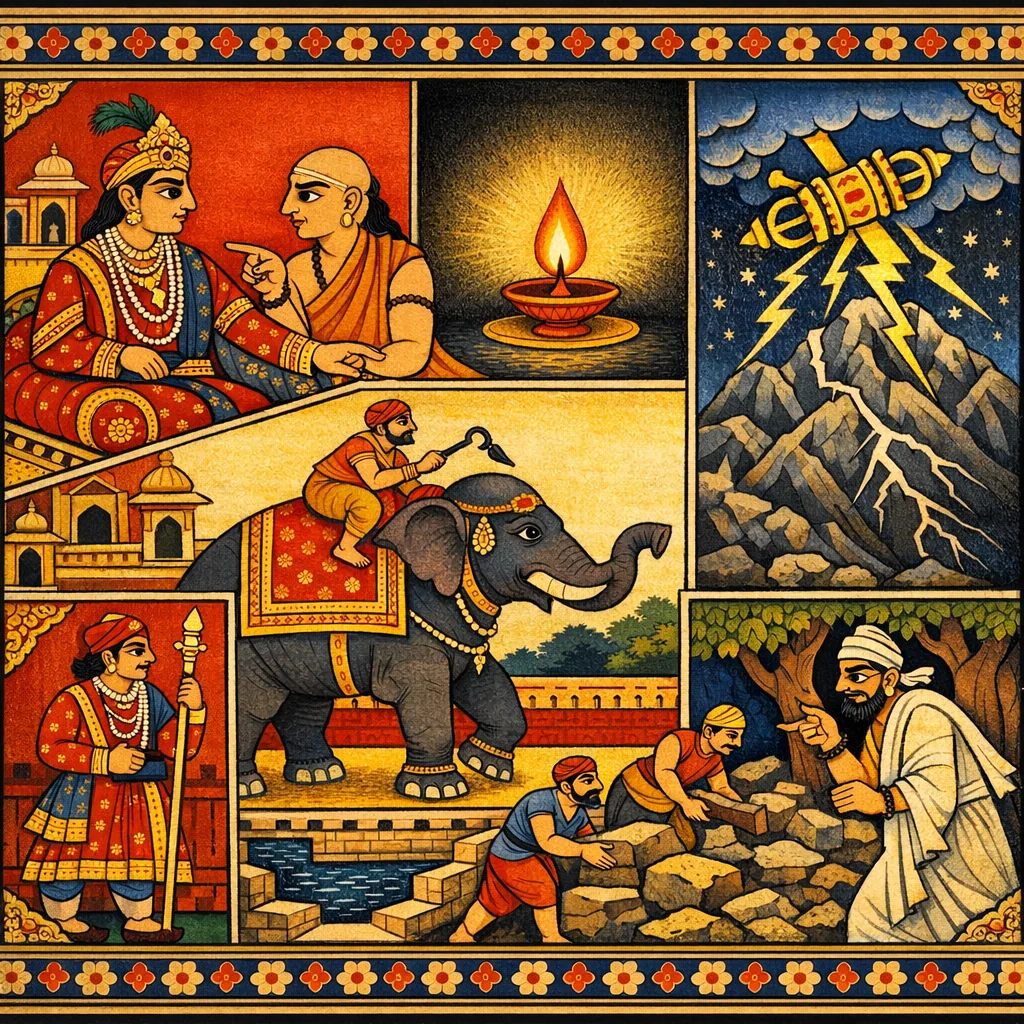
हस्ती स्थूलतनुः स चाङ्कुशवशः किं हस्तिमात्रोऽङ्कुशो दीपे प्रज्वलिते प्रणश्यति तमः किं दीपमात्रं तमः । वज्रेणापि हताः पतन्ति गिरयः किं वज्रमात्रं नगा- स्तेजो यस्य विराजते स बलवान्स्थूलेषु कः प्रत्ययः ॥
An elephant, though huge, is ruled by a goad; when a lamp is lit, darkness vanishes; even mountains fall when struck by lightning. Truly strong is the one whose inner tejas shines—what trust is there in mere bulk?
Verse 4
कलौ दशसहस्राणि हरिस्त्यजति मेदिनीम् । तदर्धं जाह्नवीतोयं तदर्धं ग्रामदेवताः ॥
In the Kali age, Hari (Viṣṇu) is said to depart the earth for ten thousand (measures of time); half of that sacred presence abides in the waters of the Jāhnavī (the Gaṅgā), and half among the village deities.
Verse 5
गृहासक्तस्य नो विद्या नो दया मांसभोजिनः । द्रव्यलुब्धस्य नो सत्यं स्त्रैणस्य न पवित्रता ॥
One attached to household life has no learning; one who eats meat has no compassion; one greedy for wealth has no truth; one enslaved by women has no purity.
Verse 6
न दुर्जनः साधुदशामुपैति बहुप्रकारैरपि शिक्ष्यमाणः । आमूलसिक्तः पयसा घृतेन न निम्बवृक्षो मधुरत्वमेति ॥
A wicked man does not attain the state of the virtuous, though taught in many ways. Like the neem tree: even watered to the roots with milk and ghee, it does not turn sweet.
Verse 7
अन्तर्गतमलो दुष्टस्तीर्थस्नानशतैरपि । न शुध्यति यथा भाण्डं सुराया दाहितं च सत् ॥
A wicked man with impurity within is not cleansed even by hundreds of baths at sacred fords. Like a vessel—though sound—that does not become clean after being tainted by surā (liquor).
Verse 8
न वेत्ति यो यस्य गुणप्रकर्षं स तं सदा निन्दति नात्र चित्रम् । यथा किराती करिकुम्भलब्धां मुक्तां परित्यज्य बिभर्ति गुञ्जाम् ॥
He who does not recognize another’s excellence always disparages him—there is nothing strange in that. Like the Kirātī woman who, finding a pearl from an elephant’s frontal globes, casts it aside and wears a guñjā seed instead.
Verse 9
ये तु संवत्सरं पूर्णं नित्यं मौनेन भुञ्जते । युगकोटिसहस्रं तैः स्वर्गलोके महीयते ॥
Those who for a full year take their food while constantly observing silence are honored in the heavenly realm for thousands of crores of ages.
Verse 10
कामक्रोधौ तथा लोभं स्वादुशृङ्गारकौतुके । अतिनिद्रातिसेवे च विद्यार्थी ह्यष्ट वर्जयेत् ॥
A student should avoid eight things: desire, anger, greed, indulgence in tasty foods, erotic preoccupation, frivolous amusements or idle curiosity, excessive sleep, and excessive service or attachment.
Verse 11
अकृष्टफलमूलानि वनवासरतिः सदा । कुरुतेऽहरहः श्राद्धमृषिर्विप्रः स उच्यते ॥
He who ever delights in forest-dwelling, lives on uncultivated fruits and roots, and performs śrāddha day after day—he is called a “vipra” and a “ṛṣi”.
Verse 12
एकाहारेण सन्तुष्टः षट्कर्मनिरतः सदा । ऋतुकालाभिगामी च स विप्रो द्विज उच्यते ॥
Content with a single meal, ever devoted to the six prescribed duties, and approaching sexual union only in the proper season—such a one is called a “vipra”, a “dvija”.
Verse 13
लौकिके कर्मणि रतः पशूनां परिपालकः । वाणिज्यकृषिकर्मा यः स विप्रो वैश्य उच्यते ॥
One devoted to worldly work—tending cattle and earning by trade and agriculture—is here called a “vaiśya”, even if elsewhere regarded as a “vipra”.
Verse 14
लाक्षादितैलनीलीनां कौसुम्भमधुसर्पिषाम् । विक्रेता मद्यमांसानां स विप्रः शूद्र उच्यते ॥
A vipra who trades in lac, oils, indigo/dyes, safflower dye, honey, ghee—and also sells liquor and meat—is in this text called a “śūdra”.
Verse 15
परकार्यविहन्ता च दाम्भिकः स्वार्थसाधकः । छली द्वेषी मृदुः क्रूरो विप्रो मार्जार उच्यते ॥
A vipra who thwarts others’ affairs, is hypocritical and self-serving, deceitful and spiteful, outwardly gentle yet inwardly cruel—he is called a “cat”.
Verse 16
वापीकूपतडागानामारामसुरवेश्मनाम् । उच्छेदने निराशङ्कः स विप्रो म्लेच्छ उच्यते ॥
A Brahmin who, without hesitation, destroys stepwells, wells, ponds, gardens, and temples is called a “mleccha” in this moral idiom.
Verse 17
देवद्रव्यं गुरुद्रव्यं परदाराभिमर्शनम् । निर्वाहः सर्वभूतेषु विप्रश्चाण्डाल उच्यते ॥
One who makes a living by misusing temple wealth, a teacher’s property, or by violating another man’s wife—though a Brahmin—is spoken of as a “cāṇḍāla”.
Frequently Asked Questions
The text foregrounds a historical Nīti principle that ethical and strategic judgment depends on stable dispositions and discernment: certain virtues are portrayed as innate, while entrenched malice is depicted as difficult to reform. It also contrasts external ritual or appearance with internal moral condition, using metaphors to argue that inner qualities govern outcomes more than surface acts.
Rather than mapping friends and enemies explicitly, the chapter categorizes persons by character and conduct: the “good” and “wicked” are distinguished through reformability and inner purity; students are described through disciplines and temptations; and a late sequence classifies social identities via occupations and behaviors, functioning as a moralized typology for assessing associates in a courtly or communal setting.
The aphorisms align with broader South Asian strategic pedagogy seen in the Arthashastra and Panchatantra traditions: character assessment is treated as essential for governance and alliance management; small instruments controlling larger forces echoes administrative technique; and the emphasis on speech, restraint, and discernment parallels courtly ethics. The occupational-moral typologies reflect later didactic polemics and provide evidence for how Nīti texts encoded social order and moral evaluation.