Adhyaya 5
Lokakalpanā / The Ordering of the Worlds (Cosmogony and Earth’s Retrieval)
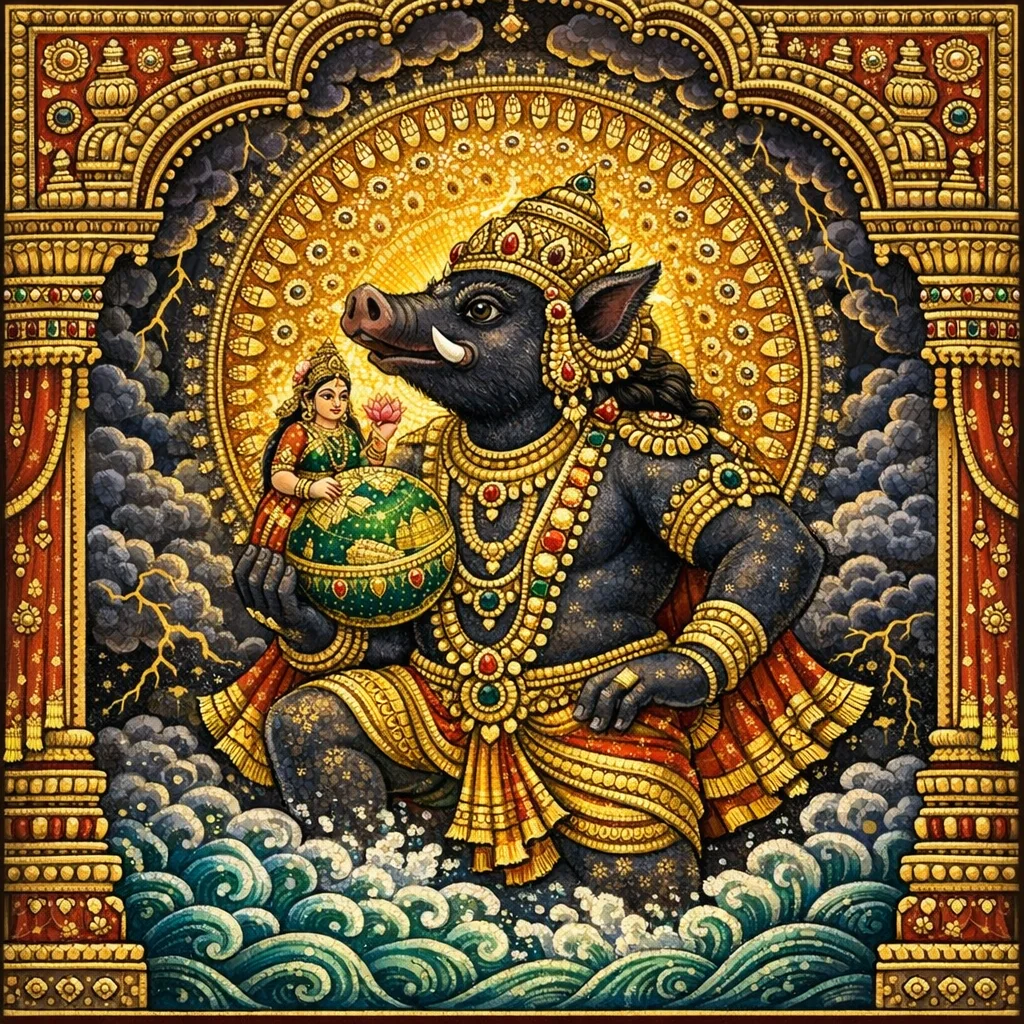
This adhyāya sets forth a cosmogonic sequence: at first primordial waters prevail and no differentiated world is perceived. In a sūta-style frame, dissolution-like stillness gives way to the manifestation of Brahmā/Nārāyaṇa as a thousand-eyed, thousand-footed cosmic being abiding in the waters. An etymological-theological hinge is stated: “nāra” means waters and “ayana” a resting-place, hence the name Nārāyaṇa. The discourse then turns to divine agency: seeing Earth submerged, the deity considers the proper form to uplift it and recalls the Varāha (boar) embodiment suited to moving in water. Varāha’s colossal, meteorological splendor is described—cloud-dark body, thunderous roar, lightning-and-fire brilliance—culminating in the descent to Rasātala to raise the Earth, reestablishing terrestrial stability after inundation and grounding later cosmography.
Shlokas
Verse 1
इति श्रीब्रह्माण्डे महापुराणे वायुप्रोक्ते पूर्वभागे प्रथमे प्रक्रियापदे लोककल्पनं नाम चतुर्थो ऽध्यायः श्रीसूत उवाच आपो ऽग्रे सर्वगा आसन्नेनसिमन्पृथिवीतले / शान्तवातैः प्रलीने ऽस्मिन्न प्राज्ञायत किञ्चन
Thus, in the Śrī Brahmāṇḍa Mahāpurāṇa, in the former section spoken by Vāyu, within the first Prakriyāpada, is the fourth chapter called “Lokakalpana” (the fashioning of the worlds). Śrī Sūta said: In the beginning, the waters pervaded all; upon the face of the earth there was no boundary. When all this had dissolved into tranquil winds, nothing whatsoever could be discerned.
Verse 2
एकार्णवे तदा तस्मिन्नष्टे स्थावरजङ्गमे / विभुर्भवति स ब्रह्मा सहस्राक्षः सहस्रपात्
When, in that single cosmic ocean, all the immovable and the moving had perished, the all-pervading Brahmā came forth, with a thousand eyes and a thousand feet.
Verse 3
सहस्रशीर्षा पुरुषो रुक्मवर्णो ह्यतीन्द्रियः / ब्रह्म नारायणाख्यस्तु सुष्वाप सलिले तदा
That thousand-headed Puruṣa, golden-hued and beyond the senses—Brahmā known as Nārāyaṇa—then lay asleep upon the waters.
Verse 4
सत्त्वोद्रेकान्निषिद्धस्तु शून्यं लोकमवैक्षत / इमं चोदाहरन्त्यत्रर् श्लोकं नारायणं प्रति
Stirred by the upsurge of sattva, he beheld the world as void; and here this verse is recited in reverence to Nārāyaṇa.
Verse 5
आपो नारा इति प्रोक्ता आपो वै नरसूनवः / अयन तस्य ताःप्रोक्तास्तेन नारायणः स्मृतः
The waters are called ‘Nārā’, and the waters indeed are said to be the sons of Nara; they are his ‘ayana’, his resting-place—therefore he is remembered as Nārāyaṇa.
Verse 6
तुल्य युगसहस्रस्य वसन्कालमुपास्यतः / स्वर्णपत्रेप्रकुरुते ब्रह्मत्वादर्शकारणात्
Dwelling and worshipping for a span equal to a thousand yugas, and through the cause of beholding Brahmahood, he sets forth the ordinance (of creation) upon a golden leaf.
Verse 7
ब्रह्म तु सलिले तस्मिन्नवाग् भूत्वा तदा चरन् / निशायामिव खद्योतः प्रापृट्काले ततस्ततः
Then Brahmā, turned downward, moved within those waters; like a firefly in the night flashing here and there, so in the time of pralaya he wandered from place to place.
Verse 8
ततस्तु सलिले तस्मिन् विज्ञायान्तर्गते महत् / अनुमानादसंमूढो भूमेरद्धरणं प्रति
Then, discerning within those waters the great principle hidden inside, Brahmā—unbewildered by inference—turned his intent toward the raising up of the Earth.
Verse 9
ओङ्काराषृतनुं त्वन्यां कल्पादिषु यथा पुरा / ततो महात्मा मनसा दिव्यरूपम चिन्तयत्
As in former times at the beginnings of the kalpas he had assumed another body founded upon Oṁkāra, so then the great-souled one contemplated within his mind a divine form.
Verse 10
सलिले ऽवप्लुतां भूमिं दृष्ट्वा स समचिन्तयत् / किं तु रूपमहं कृत्वा सलिलादुद्धरे महीम्
Seeing the Earth submerged in the waters, he reflected: “In what form shall I take shape, that I may lift this land up from the flood?”
Verse 11
जलक्रीडासमुचितं वाराहं रूपमस्मरत् / उदृश्यं सर्वभूतानां वाङ्मयं ब्रह्मसंज्ञितम्
Then he recalled the Varāha form, fit for sport within the waters—visible to all beings, made of sacred speech, and renowned by the name of Brahman.
Verse 12
दशयोजनविस्तीर्णमायतंशतयोजनम् / नीलमेघप्रतीकाशं मेघस्तनितनिःस्वनम्
Ten yojanas in breadth and a hundred yojanas in length, it shone like a dark-blue cloud and roared like the thunder of storm-clouds.
Verse 13
महापर्वतवर्ष्माणं श्वेततीक्ष्णोग्रदंष्ट्रिणाम् / विद्युदग्निप्रतिकाशमादित्यसमतेजसम्
Its body was like a mighty mountain, with white, sharp, fearsome tusks; it blazed like lightning and fire, radiant with the splendor of the Sun.
Verse 14
पीनवृत्तायतस्कन्धं विष्णुविक्रमगामि च / पीनोन्नतकटीदेशं वृषलक्षणपूजितम्
With broad, rounded, mighty shoulders, it moved with the stride of Vishnu’s Vikrama; its waist was full and high, revered for the auspicious marks of the Bull.
Verse 15
आस्थाय रूपमतुलं वाराहममितं हरिः / पृथिव्युद्धरणार्थाय प्रविवेश रसातलम्
Assuming the incomparable, immeasurable form of Varaha, Hari entered Rasatala to raise up and rescue the Earth.
Verse 16
दीक्षासमाप्तीष्टिदंष्ट्रःक्रतुदन्तो जुहूसुखः / अग्निजिह्वो दर्भरोमा ब्रह्मशीर्षो महातपाः
Its tusks were the iṣṭi that completes the dīkṣā, its teeth were the kratus, and it delighted in the juhū ladle; its tongue was Agni, its hair was darbha grass, its head was Brahmā—an ascetic of mighty tapas.
Verse 17
वेदस्कन्धो हविर्गन्धिर्हव्यकव्यादिवेगवान् / प्राग्वंशकायो द्युतिमान् नानादीक्षाभिरन्वितः
He is the very trunk of the Vedas, fragrant with the scent of oblation, swift with the force of offerings—havya and kavya. Of ancient lineage in form, radiant, and endowed with manifold sacred initiations.
Verse 18
दक्षिणा त्दृदयो योगी श्रद्धासत्त्वमयो विभुः / उपाकर्मरुचिश्चैव प्रवर्ग्यावर्तभूषणः
He is the yogin, firm of heart through dakṣiṇā, the all-pervading Lord formed of faith and sattva. He delights in the rite of upākarman and is adorned with the sacred turning of pravargya.
Verse 19
नानाछन्दोगतिपथो गुह्योपनिषदासनः / मायापत्नीसहायो वै गिरिशृङ्गमिवोच्छ्रयः
He moves along the paths of many metres, seated upon the secret Upaniṣads. With Māyā as his consort and support, he rises aloft like a mountain peak.
Verse 20
अहोरात्रेक्षणाधरो वेदाङ्गश्रुतिभूषणः / आज्यगन्धः स्रुवस्तुण्डः सामघोषस्वनो महान्
He bears day and night as the support of his gaze, adorned with Vedāṅga and Śruti. Fragrant with ājya, with a sruva-like snout, he resounds with the mighty tone of Sāma-chant.
Verse 21
सत्यधर्ममयः श्रीमान् कर्मविक्रमसत्कृतः / प्रायश्चित्तनखो घोरः पशुजानुर्महामखः
He is auspicious, made of truth and dharma, honoured for the valour of his sacred acts. Atonement is as his claws, terrible in majesty; the sacrificial beasts are his knees—he is the Mahāmākha, the great sacrifice itself.
Verse 22
उद्गातात्रो होमलिङ्गः फलबीजमहोषधीः / वाद्यन्तरात्मसत्रस्य नास्मिकासो मशोणितः
There the Udgātā himself was the sacred mark of the homa; fruits, seeds, and mighty healing herbs were its offerings. In the sacrificial session of the inner Self, instruments resounded, and the flow from the nose was like a mosquito’s blood.
Verse 23
भक्ता यज्ञवराहान्ताश्चापः संप्राविशत्पुनः / अग्निसंछादितां भूमिं समामिच्छन्प्रजापतिम्
The devotees, having reached the end of Yajña-Varāha, entered the waters once more; and upon the earth veiled in fire they sought Prajāpati in due order.
Verse 24
उपगम्या जुहावैता मद्यश्चाद्यसमन्यसत् / मामुद्राश्च समुद्रेषु नादेयाश्च नदीषु च / पृथक् तास्तु समीकृत्य पृथिव्यां सो ऽचिनोद्गिरीन्
Drawing near, they offered the āhutis and set in place the madya and the food as well. The ‘mā-mudrās’ were placed in the oceans and the ‘nā-deyās’ in the rivers; then, gathering them separately and setting them in order, he heaped up mountains upon the earth.
Verse 25
प्राक्सर्गे दह्यमानास्तु तदा संवर्तकाग्निना / देनाग्निना विलीनास्ते पर्वता भुवि सर्वशः
In the former creation, those mountains were then being burned by the Saṃvartaka fire; by that very fire they melted away everywhere upon the earth.
Verse 26
सत्यादेकार्णवे तस्मिन् वायुना यत्तु संहिताः / निषिक्ता यत्रयत्रासंस्तत्रतत्राचलो ऽभवत्
In that single ocean called Satya, whatever had been gathered together by the wind—wherever it was poured down, there and then it became an acala, a steadfast mountain.
Verse 27
ततस्तेषु प्रकीर्णेषु लोकोदधिगिरींस्तथा / विश्वकर्मा विभजते कल्पादिषु पुनः पुनः
Then, when all these were scattered, Viśvakarmā again and again, at the beginnings of the kalpas, apportions the worlds, the oceans, and the mountains.
Verse 28
ससमुद्रामिमां पृथ्वीं सप्तद्वीपां सपर्वताम् / भूराद्यांश्चतुरो लोकान्पुनःपुनरकल्पयत्
Again and again he fashioned this earth with its oceans, with its seven dvīpas and mountains, and the four worlds beginning with Bhūr.
Verse 29
लाकान्प्रकल्पयित्वा च प्रजासर्ग ससर्ज ह / ब्रह्मा स्वयंभूर्भगवाम् सिसृक्षुर्विविधाः प्रजाः
Having arranged the worlds, he brought forth the creation of beings (prajā-sarga). Bhagavān Brahmā, the Self-born, desired to create diverse creatures.
Verse 30
ससर्ज सृष्टं तद्रूपं कल्पादिषु यथा पुरा / तस्याभिध्यायतः सर्गं तदा वै बुद्धिपूर्वकम्
He created that same form of creation at the beginnings of the kalpas, just as before. Meditating upon the sarga, he then set it forth with deliberate intelligence.
Verse 31
प्रधानसमकाले च प्रादुर्भूतस्तमो मयः / तमो मोहो महामोहस्तामिस्रो ह्यन्धसंज्ञितः
At the same time as Pradhāna, the tamas-filled principle arose: Tamas, Moha, Mahāmoha, Tāmisra, and that known as Andha.
Verse 32
अविद्या पञ्चपर्वैषा प्रादुर्भूता महात्मनः / पञ्चधावस्थितः सर्गो ध्यायत साभिमानिनः
This five-jointed Avidyā arose from the Great Self; creation stood established in fivefold form—let those possessed of ego contemplate it.
Verse 33
सर्वतस्तमसा चैव बीजकुंभलतावृताः / बहिरन्तश्चाप्रकाशस्तथानिःसंज्ञ एव च
They were shrouded in darkness on every side, veiled by seed, pot, and creeper; without light within or without, and wholly without awareness.
Verse 34
यस्मात्तेषां कृता बुद्धिर् दुःखानि करणानि च / तस्माच्च संवृतात्मानो नगा मुख्याः प्रकीर्तिताः
For them were fashioned buddhi, sufferings, and the instruments of sense; therefore they are proclaimed as ‘Nagas’, their selves enclosed, and as the ‘Mukhya’, the foremost.
Verse 35
मुख्यसर्गे तदोद्भूतं दृष्ट्वा ब्रह्मात्मसंभवः / अप्रती तमनाः सोथ तदोत्पत्तिममन्यत
Seeing what had arisen in the primary creation, Brahmā, born of the Self, found no satisfaction; then he deemed that origination unfit.
Verse 36
तस्याभिध्यायतश्चान्यस्तिर्यक्स्रोतो ऽभ्यवर्तत / यस्मात्तिर्यग्विवर्त्तेत तिर्यकस्रोतस्ततः स्मृतः
As he meditated, another creation arose—the Tiryak-srota; because it unfolds in a transverse course, it is remembered as Tiryak-srota.
Verse 37
तमोबहुत्वात्ते सर्वे ह्यज्ञानबहुलाः स्मृताः / उत्पाद्यग्राहिमश्चैव ते ऽज्ञाने ज्ञानमानिनः
Because tamas is abundant in them, all are remembered as steeped in ignorance; they bring forth and cling, and in ignorance itself imagine themselves to be wise.
Verse 38
अहङ्कृता अहंमाना अष्टाविंशद्द्विधात्मिकाः / एकादशन्द्रियविधा नवधात्मादयस्तथा
Formed of ahaṃkāra and filled with the conceit of “I”, they are of dual nature in twenty-eight modes; they are classified as eleven kinds of indriyas, and likewise as ninefold ātman and the rest.
Verse 39
अष्टौ तु तारकाद्याश्च तेषां शक्तिवधाः स्मृताः / अन्तः प्रकाशास्ते सर्वे आवृताश्च बहिः पुनः
There are eight—Tāraka and the rest—and their distinctions of śakti are taught in the smṛtis; all are luminous within, yet outwardly they are again veiled.
Verse 40
तिर्यक् स्रोतस उच्यन्ते वश्यात्मानस्त्रिसंज्ञकाः
They are called tiryak-srotas; their nature is pliant and submissive, and they are designated by the name “three”.
Verse 41
तिर्यक् स्रोतस्तु सृष्ट्वा वै द्वितीयं विश्वमीश्वरः / अभिप्रायमथोद्भूतं दृष्ट्वा सर्गं तथाविधम्
Having created the tiryak-srotas, the Lord brought forth the second universe; then, beholding that creation as it had arisen and discerning its intent, He proceeded onward.
Verse 42
तस्याभिध्यायतो योन्त्यः सात्त्विकः समजायत / ऊर्द्धस्रोतस्तृतीयस्तु तद्वै चोर्द्धं व्यवस्थितम्
As He contemplated, a sattvic womb of creation arose. The third is called Urdhvasrota, established indeed in the higher realm.
Verse 43
यस्मादूर्द्धं न्यवर्तन्त तदूर्द्धस्रोतसंज्ञकम् / ताः सुखं प्रीतिबहुला बहिरन्तश्च वावृताः
Because they turned upward, they are known as Urdhvasrota. They dwelt in ease, abundant in joy, enveloped both outwardly and inwardly.
Verse 44
प्रकाशा बहिरन्तश्च ऊर्द्धस्रोतःप्रजाः स्मृताः / नवधातादयस्ते वै तुष्टात्मानो बुधाः स्मृताः
The Urdhvasrota beings are remembered as radiant, outwardly and inwardly. They are the Navadhatas and the like—content of soul, and counted among the wise.
Verse 45
ऊर्द्धस्रोत स्तुतीयो यः स्मृतः सर्वः सदैविकः / ऊर्द्धस्रोतःसु सृष्टेषु देवेषु स तदा प्रभुः
The third, remembered as Urdhvasrota, is wholly divine. When the Urdhvasrota gods were brought forth, He was then their Lord.
Verse 46
प्रीतिमानभवद्ब्रह्मा ततो ऽन्यं नाभिमन्यत / सर्गमन्यं सिमृक्षुस्तं साधकं पुनरीश्वरः
Then Brahma became filled with delight and regarded nothing else. Thereafter the Lord, wishing for another creation, stirred that accomplisher once again.
Verse 47
तस्याभिध्यायतः सर्गं सत्याभिध्यायिनस्तदा / प्रादुर्बभौ भौतसर्गः सोर्वाक् स्रोतस्तु साधकः
As he, the contemplator of Truth, meditated upon creation, then the material creation manifested; it is the upward-flowing stream, called the Sādhaka.
Verse 48
यस्मात्तेर्वाक्प्रवर्तन्ते ततोर्वाकूस्रोतसस्तु ते / ते च प्रकाशबहुलास्तमस्पृष्टरजोधिकाः
Because they proceed upward, they are known as the Ūrdhvākū-srotas; they abound in light, are untouched by tamas, and are rajas-dominant.
Verse 49
तस्मात्ते दुःखबहुला भूयोभूयश्च कारिमः / प्रकाशा बहिरन्तश्च मनुष्याः साधकाश्च ते
Therefore they are filled with suffering and act again and again; those humans are radiant outwardly and inwardly, and they too are called Sādhakas.
Verse 50
लक्षणैर्नारकाद्यैस्तैरष्टधा च व्यवस्थिताः / सिद्धात्मानो मनुष्यास्ते गन्धर्वैः सह धर्मिणः
By such marks as the hellish and the rest, they are arranged in eightfold ways; those humans, perfected in soul, are righteous, together with the Gandharvas.
Verse 51
पञ्चमो ऽनुग्रहः सर्गश्चतुर्द्धा स व्यवस्थितः / विपर्ययेण शक्त्या च सिद्ध मुख्यास्तथैव च
The fifth creation, the Anugraha-sarga, is established in fourfold form: viparyaya (perversion), śakti (power), siddhi (attainment), and likewise the chief (mukhya).
Verse 52
निवृत्ता वर्तमानाश्च प्रजायन्ते पुनःपुनः / भूतादिकानां सत्त्वानां षष्ठः सर्गः स उच्यते
Those that have subsided and those that are present are born again and again; this is called the sixth creation (sarga) of beings beginning with the bhūtas and the like.
Verse 53
स्वादनाश्चाप्यशीलाश्च ज्ञेया भूतादिकाश्च ते / प्रथमो महतः सर्गो विज्ञेयो ब्रह्मणस्तु सः
Those known as ‘svādana’ and also ‘aśīla’ are to be understood as the bhūtas and the like; the first creation of Mahat is to be known as the creation of Brahmā.
Verse 54
तन्मात्राणां द्वितीयस्तु भूत सर्गः स उच्यते / वैकारिकस्तृतीयस्तु चैद्रियः सर्ग उच्यते
The second is the creation of the tanmātras, called the creation of the elements (bhūta-sarga); the third is the vaikārika, also spoken of as the creation of the senses (indriya-sarga).
Verse 55
इत्येत प्राकृताः सर्गा उत्पन्ना बुद्धिपूर्वकाः / मुख्यसर्गश्च तुर्थस्तु मुख्या वै स्थावराः स्मृताः
Thus these natural (prākṛta) creations arose with buddhi preceding them; the fourth is the principal creation, wherein the immobile beings (sthāvaras) are remembered as foremost.
Verse 56
तिर्यक्स्रोतःससर्गस्तु तैर्यग्योन्यस्तु पञ्चमः / तथोर्द्धस्रोतसां सर्गः षष्ठो देवत उच्यते
The creation of the tiryak-srotas, namely the tairyag-yoni (animal womb-born), is the fifth; and the creation of the ūrdhva-srotas is the sixth, called the creation of the devas.
Verse 57
तत्रोर्द्धस्रोतसां सर्गः सप्तमः स तु मानुषः / अष्टमोनुग्रहः सर्गः सात्त्विकस्तामसश्च सः
There, the seventh creation of the upward-streaming beings is the human creation. The eighth is the creation called Anugraha (grace), possessing both sāttvika and tāmasa qualities.
Verse 58
पञ्चैते वैकृताः सर्गाः प्राकृताद्यास्त्रयः स्मृताः / प्राकृतो वैकृतश्चैव कौमारो नवमः स्मृतः
These five are the vaikṛta (modified) creations; the three beginning with prākṛta are remembered as prākṛta. Prākṛta, vaikṛta, and kaumāra are thus recalled as the ninth creation.
Verse 59
प्रकृता बुद्धिपूर्वास्तु त्रयः सर्गास्तु वैकृताः / दुद्धिबुर्वाः प्रवर्तेयुस्तद्वर्गा ब्राह्मणास्तु वै
The prākṛta creations are prior to buddhi; and three creations are called vaikṛta. They set forth even before buddhi arises; and that class is indeed the class of brāhmaṇas.
Verse 60
विस्तराच्च यथा सर्वे कीर्त्यमानं निबोधत / चतुर्द्धा च स्थितस्सो ऽपि सर्वभूतेषु कृत्स्नशः
Understand in fuller detail what is being proclaimed: He abides wholly within all beings, established everywhere in a fourfold manner.
Verse 61
विपर्ययोण शत्त्या च बुद्ध्या सिद्ध्या तथैव च / स्थावरेषु विपर्यासस्तिर्यग्योनिषु शक्तितः
He manifests as viparyaya (delusion), śakti (power), buddhi (intelligence), and siddhi (attainment). Among the immovables He appears as viparyaya; among animal births (tiryaṅ-yoni) as śakti.
Verse 62
सिद्धात्मानो मनुष्यास्तु पुष्टिर्देवेषु कृत्स्नशः / अथो ससर्ज वै ब्रह्मा मानसानात्मनः समान्
Men whose selves were perfected gained full sustenance among all the gods; then Brahmā created mind-born sons, equal to his own being.
Verse 63
वैवर्त्येन तु ज्ञानेन निवृत्तास्ते महौ जसः / संबुद्ध्य चैव नामाथो अपवृत्तास्त्रयस्तु ते
Through knowledge turned awry, those of great splendor withdrew; and, having awakened to the name, those three too turned aside.
Verse 64
असृष्ट्वैव प्रजासर्गंप्रतिसर्गं ततस्ततः / ब्रह्मा तेषु व्यरक्तेषु ततो ऽन्यान्सा धकान्सृजन्
Without yet bringing forth the creation and re-creation of beings, seeing them detached, Brahmā then created other seekers and practitioners.
Verse 65
स्थानाभिमानिनो देवाः पुनर्ब्रह्मानुशासनम् / अभूतसृष्ट्यवस्था चे स्थानिनस्तान्निबोध मे
The gods, proud of their appointed stations, again accepted Brahmā’s ordinance; learn from me of those station-keeping deities in the primordial state of creation.
Verse 66
आपो ऽग्निः पृथिवी वायुरन्तरिक्षो दिवं तथा / स्वर्गो दिशः समुद्राश्च नद्यश्चैव वनस्पतीन्
Waters, fire, earth, wind, the mid-space and the heavens; also Svarga, the directions, the oceans, the rivers, and the plant realm.
Verse 67
औषधीनां तथात्मानो ह्यात्मनो वृक्षवीरुधाम् / लताः काष्ठाः कलाश्चैव मुहूर्ताः संधिरात्र्यहाः
Medicinal herbs too have their own ātman, and so do trees and creeping plants. Vines, wood, portions of time (kalā), muhūrtas, and the junctions of night and day are also (its forms).
Verse 68
अर्द्धमासाश्च मासाश्च अयनाब्दयुगानि च / स्थाने स्रोतःस्वभीमानाः स्थानाख्याश्चैव ते स्मृताः
Half-months, months, ayanas, years, and yugas—these all abide in their respective stations with a flowing nature; thus they are remembered also by the name “sthāna” (stations).
Verse 69
स्थानात्मनः स सृष्ट्वा तु ततो ऽन्यान्स तदासृजत् / देवांश्चैव पितॄंश्चैव यौरिमा वर्द्धिताः प्रजाः
Having first created the very essence of the stations (sthāna), he then, at that time, brought forth others as well—both the Devas and the Pitṛs (Fathers), by whom these creatures were increased.
Verse 70
भृग्वङ्गिरा मरीचिश्च पुलस्त्यः पुलहः क्रतुः / दक्षो ऽत्रिश्च वसिष्ठश्च सासृजन्नव मानसान्
Bhṛgu, Aṅgiras, Marīci, Pulastya, Pulaha, Kratu, Dakṣa, Atri, and Vasiṣṭha—these sages brought forth the nine mind-born sons (mānasa).
Verse 71
नव ब्रह्माण इत्येते पुराणे निश्चयं गताः / ब्रह्मा यथात्मकानां तु सर्वेषां ब्रह्मयोगिनाम्
These are known as the “nine Brahmās”—so the Purāṇa declares with certainty. For all brahma-yogins whose nature is the Self, they are as Brahmā himself (a primordial archetype).
Verse 72
ततो ऽसृजत्पुनर्ब्रह्मा रुद्रं रोषत्मसंभवम् / संकल्पं चैव धर्म च सर्वेषामेव पर्वतौ
Then Brahmā again created Rudra, born of the very essence of wrath; and he also manifested Saṅkalpa and Dharma, the support of all beings.
Verse 73
सो ऽसृजद्व्यवसायं तु ब्रह्मा भूतं सुखात्मकम् / संकल्पाच्चैव संकल्पो जज्ञे सो ऽव्यक्तयोनिनः
Brahmā then created Vyavasāya, a being whose nature is bliss; and from Saṅkalpa arose Saṅkalpa itself, whose womb is the Unmanifest (Avyakta).
Verse 74
प्राणाद्दक्षो ऽसृजद्वाचं चक्षुर्भ्यां च मरीचिनम् / भृगुश्च हृदयाज्जज्ञे ऋषिः सलिलयोनिनः
From prāṇa Dakṣa created Vāk, the sacred Speech; from the eyes, Marīci; and from the heart was born the Ṛṣi Bhṛgu, whose womb is water.
Verse 75
शिरसश्चाङ्गिराश्चैव श्रोत्रादत्रिस्तथैव च / पुलस्त्यश्च तथोदानाद्व्यानात्तु पुलहस्तथा
From the head arose Aṅgiras, and from the ear Atri; likewise from Udāna arose Pulastya, and from Vyāna arose Pulaha.
Verse 76
समानतो वसिष्ठश्च ह्यपानान्निर्ममे क्रतुम् / इत्येते ब्रह्मणः श्रेष्ठाः पुत्रा वै द्वादश स्मृताः
From Samāna arose Vasiṣṭha, and from Apāna was fashioned Kratu; thus these are remembered as the twelve most excellent sons of Brahmā.
Verse 77
धर्मादयः प्रथमजा विज्ञेया ब्रह्ममः स्मृताः / भृग्वादयस्तु ये सृष्टा न च ते ब्रह्मवादिनः
Dharma and the others, born first, are to be known as the honored sons of Brahmā; but Bhṛgu and the rest who were created are not proclaimers of Brahman.
Verse 78
गृहमेधिपुराणास्ते विज्ञेया ब्रह्मणः सुताः / द्वादशैते प्रसूयन्ते सह रूद्रेण च द्विजाः
Those known as the Gṛhamedhi-purāṇas are to be understood as the sons of Brahmā; these twelve twice-born arise together with Rudra.
Verse 79
क्रतुः सनत्कुमारश्च द्वावेतावूर्द्धरेतसौ / पूर्वोत्पत्तौ पुरा ह्येतौ सर्वेषामपि पूर्वजौ
Kratu and Sanatkumāra—these two are ūrdhva-retas; in the primeval creation they were indeed the forefathers of all.
Verse 80
व्यतीतौ सप्तमे कल्पे पुराणौ लोकसाधकौ / विरजेते ऽत्र वै लोके तेजसाक्षिप्य चात्मनः
When the seventh kalpa has passed, those two ancients, benefactors of the worlds, shine in this realm, casting forth the splendor of their own radiance.
Verse 81
तापुभौ योगधर्माणावारोप्यात्मानमात्मना / प्रजाधर्मं च कामं च वर्तयेते महौजसौ
Those two of mighty splendor, establishing within themselves the disciplines of yoga and raising the self by the self, set in motion both the dharma of progeny and kāma as well.
Verse 82
यथोत्पन्नस्तथैवेह कुमार इति चोच्यते / ततः सनत्कुमारेति नाम तस्य प्रतिष्ठितम्
As he was born, so here he was called “Kumāra”; therefore his name became established as “Sanatkumāra”.
Verse 83
तेषां द्वादश ते वंशा दिव्या देवगाणान्विताः / क्रियावन्तः प्रजावन्तो महर्षिभिरलङ्कृताः
Their twelve lineages were divine, attended by hosts of devas—active in sacred rites, rich in progeny, and adorned by great maharṣis.
Verse 84
प्राणजांस्तु स दृष्ट्वा वै ब्रह्मा द्वादश सात्त्विकान् / ततो ऽसुरान्पितॄन्देवान्मनुष्यांश्चासृजत्प्रभुः
Seeing those twelve sāttvic beings born of vital breath, Lord Brahmā then created the asuras, the pitṛs, the devas, and humankind.
Verse 85
मुखाद्देवानजनयत् पितॄंश्चैवाथ वक्षसः / प्रजननान्मनुष्यान्वै जघनान्निर्ममे ऽसुरान्
From his mouth he brought forth the devas, and from his breast the pitṛs; from the generative organ, humankind, and from the lower part he fashioned the asuras.
Verse 86
नक्तं सृजन्पुनर्ब्रह्मा ज्योत्स्नाया मानुषात्मनः / सुधायाश्च पितॄंश्चैव देवदेवः ससर्जह
Then Brahmā, God of gods, creating night anew, brought forth human-natured beings from moonlight (jyotsnā), and from ambrosia (sudhā) he also created the pitṛs.
Verse 87
मुख्यामुख्यान् मृजन्देवानसुरांश्च ततः पुनः / सनसश्च मनुष्यांश्च पितृवन्महतः पितॄन्
Then he fashioned the chief and lesser gods and the asuras; and again he brought forth the Sanasas, humankind, and the great Pitṛs, revered like ancestral sires.
Verse 88
विद्युतो ऽशनिमेघांश्च लोहितेन्द्रधनूंषि च / ऋचो यजूंषि सामानि निर्ममे यज्ञसिद्धये
He created lightning, thunderbolts, and clouds, and the crimson rainbows as well; and for the fulfillment of sacrifice he fashioned the Ṛk, Yajus, and Sāma hymns.
Verse 89
उच्चावचानि भूतानि महसस्तस्य जज्ञिरे / ब्रह्मणस्तु प्रजासर्गं देवार्षिपितृमानवम्
From that great radiance were born beings of many kinds, high and low; and Brahmā’s progeny-creation appeared as gods, seers, Pitṛs, and humankind.
Verse 90
पुनः सृजति भूतानि चराणि स्थावराणि च / यक्षान्पिशाचान् गन्धर्वान्सर्वशो ऽप्सरसस्तथा
Again he creates beings, both moving and unmoving—yakṣas, piśācas, gandharvas, and likewise apsarās in every way.
Verse 91
नरकिन्नररक्षांसि वयः पशुमृगोरगान् / अव्ययं वा व्ययञ्चैव द्वयं स्थावरजङ्गमम्
He creates humans, kinnaras, and rākṣasas; birds, cattle, wild beasts, and serpents; and also the twofold world—imperishable and perishable—both the unmoving and the moving.
Verse 92
तेषां ते यान्ति कर्माणि प्राक् सृष्टानि स्वयंभुवा / तान्येव प्रतिपद्यन्ते सृज्यमानाः पुनः पुनः
Their deeds, fashioned long ago by the Self-born Lord, move toward their own fruition; and beings, created again and again, take up those very deeds repeatedly.
Verse 93
हिंस्राहिंस्रे मृदुक्रूरे धर्माधर्मौं कृताकृते / तेषामेव पृथक् सूतमविभक्तं त्रयं विदुः
In the contrasts of violent and non-violent, gentle and cruel, dharma and adharma, done and undone, the wise discern in them a distinct threefold ‘sūta’, yet undivided in essence.
Verse 94
एतदेवं च नैवं च न चोभे नानुभे तथा / कर्म स्वविषयं प्राहुः सत्त्वस्थाः समदर्शिनः
It is thus, and yet not thus; neither both, nor neither—so it is said. The even-sighted, established in sattva, declare that karma bears fruit within its own proper sphere.
Verse 95
नामात्मपञ्चभूतानां कृतानां च प्रपञ्चताम् / दिवशब्देन पञ्चैते निर्ममे समहेश्वरः
To unfold the expanse of name, the Self, and the five elements already made, the even-souled Maheshvara fashioned these five through the sacred utterance “diva”.
Verse 96
आर्षाणि चैव नामानि याश्च देवेषु सृष्टयः / शर्वर्यां न प्रसूयन्ते पुनस्तेभ्योदधत्प्रभुः
The seers’ sacred names and the creations among the gods are not brought forth in the night; the Lord draws them forth again, manifesting them anew from those very sources.
Verse 97
इत्येवं कारणाद्भूतो लोकसर्गः स्वयंभुवः / महदाद्या विशेषान्ता विकाराः प्राकृताः स्वयम्
Thus, from the primal cause arose the self-born creation of the worlds. From Mahat onward, up to the final differentiations, all transformations are of Prakriti, arising of themselves.
Verse 98
चन्द्रसूर्यप्रभो लोको ग्रहनक्षत्रमण्डितः / नदीभिश्च समुद्रैश्च पर्वतैश्च सहस्रशः
This world shines with the radiance of moon and sun, adorned with planets and stars; filled with rivers and oceans, and with mountains by the thousand.
Verse 99
पुरैश्च विविधै रम्यैः स्फीतैर्जनपदैस्तथा / अस्मिन् ब्रह्मवने ऽव्यक्तो ब्रह्मा चरति सर्ववित्
This world is filled with many lovely cities and flourishing realms. In this forest of Brahma, Brahma the Unmanifest, the All-knowing, moves and roams.
Verse 100
अव्यक्तबीजप्रभवस्तस्यैवानुग्रहे स्थितः / बुद्धिस्कन्धमयश्चैव इन्द्रियान्तरकोटरः
Born of the unmanifest seed, it abides by His very grace. Buddhi is its trunk, and the inner hollows of the senses are its hidden chambers.
Verse 101
महाभूतप्रकाशश्च विशेषैः पत्रवांस्तु सः / धर्माधर्मसुपुष्पस्तु सुखदुःखफलोदयः
It shines with the revelation of the great elements, and bears the differentiations as its leaves. Dharma and adharma are its fair blossoms, and the rise of pleasure and pain is its fruit.
Verse 102
आजीवः सर्वभूतानां ब्रह्मवृक्षः सनातनः / एतद्ब्रह्मवनं चैव ब्रह्मवृक्षस्य तस्य तत्
The livelihood and support of all beings is the eternal Tree of Brahman; and this Forest of Brahman is indeed the grove of that very Tree of Brahman.
Verse 103
अव्यक्तं कारणं यत्र नित्यं सदसदात्मकम् / प्रधानं प्रकृतिंमायां चैवाहुस्तत्त्वचिन्तकाः
Where the eternal cause, of the nature of being and non-being, abides unmanifest, the contemplators of truth call it Pradhāna, Prakṛti, and also Māyā.
Verse 104
इत्येषो ऽनुग्रहःमर्गो ब्रह्मनैमित्तिकः स्मृतः / अबुद्धिपूर्वकाः सर्गा ब्रह्मणः प्राकृतास्त्रयः
Thus this path of grace is remembered as Brahma-naimittika; and three are Brahmā’s natural (prākṛta) creations, arising without prior deliberation.
Verse 105
सुख्यादयस्तु षट् सर्गा वैकृता बुद्धिपूर्वकाः / वैकल्पात्संप्रवर्तन्ते ब्रह्मणस्तेभिमन्यवः
But the six creations beginning with Sukhyā are vaikirta, brought forth with deliberative intellect; they proceed from Brahmā’s saṅkalpa and are said to be tinged with abhimāna (self-sense).
Verse 106
इत्येते प्राकृताश्चैव वैकृताश्च नव स्मृताः / सर्गाः परस्परोत्पन्नाः कारणं तु बुधैः स्मृतम्
Thus the prākṛta and the vaikirta creations are remembered as nine; these creations arise from one another, and the wise declare this to be the causal principle.
Verse 107
मूर्द्धानं वै यस्य वेदा वदन्ति वियन्नाभिश्चन्द्रसूर्यौं च नेत्रे / दिशः श्रोत्रे विद्धि पादौ क्षितिं च सो ऽचिन्त्यात्मा सर्वभूतप्रणेता
He whose head the Vedas proclaim, whose navel is the sky, whose eyes are the Moon and the Sun, whose ears are the directions, and whose feet are the Earth—He is the inconceivable Self, the guide of all beings.
Verse 108
वक्त्राद्यस्य ब्राह्मणाः संप्रसूता वक्षसश्चैव क्षत्रियाः पूर्वभागे / वैश्या ऊरुभ्यां यस्य पद्भ्यां च शूद्राःसर्वेवर्णा गात्रतः संप्रसूताः
From His mouth were born the Brahmanas; from the forepart of His chest, the Kshatriyas; from His thighs, the Vaishyas; and from His feet, the Shudras—thus all the varnas arose from His body.
Verse 109
नारायणात्परोव्यक्तादण्डमव्यक्तसंज्ञितम् / अण्डजस्तु स्वयं ब्रह्मा लोकास्तेन कृताः स्वयम्
From the manifest principle beyond Narayana arose the Egg known as the Unmanifest; from that Egg Brahma himself was born, and he himself fashioned the worlds.
Verse 110
तत्र कल्पान् दशस्थित्वा सत्यं गच्छन्ति ते पुनः / ते लोका ब्रह्मलोकं वै अपरावर्तिनीं गतिम्
Abiding there for ten kalpas, they again attain Satyaloka; those realms are truly Brahmaloka, the path from which there is no return.
Verse 111
आधिपत्यं विना ते वै ऐश्वर्येण तु तत्समाः / भवन्ति ब्रह्मणा तुल्या रूपेण विषयेण च
Though without sovereign rule, they are equal to him in divine splendor; in form and in the objects of enjoyment, too, they become comparable to Brahma.
Verse 112
तत्र ते ह्यवतिष्ठन्ते प्रीतियुक्ताः स्वसंयुताः / अवश्यंभाविनार्थेन प्राकृतं तनुते स्वयम्
There they abide, filled with love and self-restraint; for an inevitable purpose, He Himself assumes a natural (prakṛta) body.
Verse 113
नानात्वनाभिसंबध्यास्तदा तत्कालभाविताः / स्वपतो ऽबुद्धिपूर्व हि बोधो भवति वै यथा
Then, bound to multiplicity, they are shaped by the mood of that time; as with one asleep—first unknowing, and then surely awakening awareness arises.
Verse 114
तत्कालभाविते तेषां तथा ज्ञानं प्रवर्त्तते / प्रत्याहारैस्तु भेदानां तेषां हि न तु शुष्मिणाम्
In those shaped by that time’s condition, knowledge likewise proceeds; the withdrawal of distinctions belongs to them, not to the śuṣmin.
Verse 115
तैश्व सार्धं प्रवर्तन्ते कार्याणि कारणानि च / नानात्वदर्शिनां तेषां ब्रह्मलोकनिवासिनाम्
Along with them, effects and causes also come into operation; they are the seers of multiplicity, dwelling in Brahmaloka.
Verse 116
विनिवृत्तविकाराणां स्वेन धर्मेण तिष्ठताम् / तुल्यलक्षण सिद्धास्तु शुभात्मानो निरञ्जनाः
Those who have withdrawn from all change and abide in their own dharma are siddhas of like marks—auspicious-souled and stainless (nirañjana).
Verse 117
प्राकृते करणोपेताः स्वात्मन्येव व्यवस्थिताः / प्रस्थापयित्वा चात्मानं प्रकृतिस्त्वेष तत्तवतः
Endowed with the instruments of Prakriti, they abide established in their own Self. Having set the Atman in its place, this Prakriti, in truth, becomes yours.
Verse 118
पुरुषान्यबहुत्वेन प्रतीता न प्रवर्तते / प्रवर्तते पुनः सर्गस्तेषां साकारणात्मनाम्
When the Purushas are not apprehended as many, there is no activity. Yet creation again proceeds for those whose selves still bear causal bonds.
Verse 119
संयोगः प्रकृतिर्ज्ञेया यक्तानां तत्त्वदर्शिनाम् / तत्रोपवर्गिणी तेषामपुनर्भारगामिनाम्
For yogins who behold the principles, union (saṃyoga) is to be known as Prakriti. Therein lies the liberating state for those who do not return to the burden of rebirth.
Verse 120
अभावतः पुनः सत्यं शान्तानामर्चिषामिव / ततरतेषु गतेषूर्द्धं त्रैलोक्यात्तु मुदात्मसु
In the state of non-manifestation, truth becomes quiet again, like flames that have been stilled. When they have gone upward, within the three worlds remain selves suffused with joy.
Verse 121
ते सार्द्धं चैर्महर्ल्लोकस्तदानासादितस्तु वै / तच्छिष्या ये ह तिष्ठन्ति कल्पदाह उपस्थिते
At that time they do not even reach Maharloka together. Yet their disciples—those who remain steadfast when the conflagration of the kalpa draws near—abide there.
Verse 122
गन्धर्वाद्याः पिशाचाश्चमानुषा ब्रह्मणादयः / पशवः पक्षिणश्चैव स्थावराः ससरीसृपाः
Gandharvas and the like, Piśācas, humans, and Brahmā and others; beasts and birds, the immobile beings and the creeping reptiles as well.
Verse 123
तिष्ठत्सुतेषु तत्कालं पृथिवीतलवसिषु / सहस्रंयत्तु रश्मीनां सूर्यस्येह विनश्यति
When the dwellers upon the face of the earth remain still at that time, then a thousand of the Sun’s rays here pass into destruction.
Verse 124
ते सप्त रश्मयो भूत्वा एकैको जायते रविः / क्रमेण शतमानास्ते त्रींल्लोकान्प्रदहन्त्युत
Becoming those seven rays, Ravi (the Sun) is born one by one; and they, increasing in due order by hundreds, scorch even the three worlds.
Verse 125
जङ्गमान्स्थावरांश्चैव नदीः सर्वाश्च पर्वतान् / शुष्के पूर्वमनावृष्ट्या चैस्तैशचैव प्रतापिताः
The moving and the unmoving, all rivers and the mountains too—first are dried by the lack of rain, and then are seared by the might of those very rays.
Verse 126
तदा ते विवशाः सर्वे निर्दग्धाः सूर्यरश्मिभिः / जङ्गमाः स्थावराश्चैव धर्माधर्मादिकास्तु वै
Then all of them, helpless, are burned by the Sun’s rays—the moving and the unmoving; and indeed even dharma and adharma and the like.
Verse 127
दग्धदेहास्तदा ते तु धूतपापा युगात्यये / ख्यातातपा विनिर्मुक्ताः शुभया चातिबन्धया
At the yuga’s end, though their bodies were burned, their sins were washed away; freed from the famed heat of austerity, they were bound by an auspicious and most steadfast bond.
Verse 128
ततस्ते ह्युपपद्यन्ते तुल्यरूपैर्जनैर्जनाः / उषित्वा रजनीं ते च ब्रह्मणो ऽव्यक्तजन्मनः
Then beings arise among people of like form; and they abide for a single night of Brahmā, whose birth is unmanifest.
Verse 129
पुनः सर्गे भवन्तीह मानस्यो ब्रह्मणः प्रजाः / ततस्तेषु प्रपन्नेषु जनैस्त्रैलोक्यवासिषु
When creation begins anew, here arise the beings who are Brahmā’s mind-born progeny; and when the dwellers of the three worlds take refuge among them.
Verse 130
निर्दग्धेषु च लोकेषु तदा सूर्यैस्तु सप्तभिः / वृष्ट्या क्षितौ प्लावितायां विजनेष्वर्णवेषु वा
When the seven suns burn the worlds, the worlds are reduced to ash; and by the rains the earth is flooded, like desolate oceans without any beings.
Verse 131
समुद्राश्चैव मेघाश्च आपश्चैवाथ पार्थिवाः / शरमाणा व्रजन्त्येव सलिलाख्यास्तथाचलाः
The oceans, the clouds, and the waters upon the earth—each, as if ashamed, withdraws; so too the waters called “salila,” and even the mountains, move away.
Verse 132
आगतागतिकं चैव यदा तु सलिलं बहु / संछाद्येमां स्थितां भूमिमर्णवाख्यं तदाभवत
When the waters, moving to and fro, became exceedingly vast, they covered this steadfast earth; then they were called “Arṇava,” the great ocean.
Verse 133
आभाति यस्माच्चाभासाद्भाशब्दः कान्तिदीप्तिषु / स सर्वः समनुप्राप्ता मासां भाभ्यो विभाव्यते
Because it shines, and from its radiance the word “bhā” is used for splendor and light; that brilliance pervades all, and thus the months are understood in relation to “bhā”.
Verse 134
तदन्तस्तनुते यस्मात्सर्वां पृथ्वीं समततः / धातुस्तनोति विस्तारं ततोपतनवः स्मृताः
For it spreads the whole earth evenly on every side from within; the root “tan” means to extend, and thus they are remembered as “patanava”.
Verse 135
शार इत्येव शीर्णे तु नानार्थो धातु रुच्यते / एकार्णवे भवन्त्यापो न शीर्णास्तेन ता नराः
The term “śāra” is accepted as a root of many senses in the meaning of “broken down”; yet the waters become one in a single Arṇava, and therefore they do not perish—so it is taught.
Verse 136
तस्मिन् युगसहस्रान्ते संस्थिते ब्रह्मणो ऽहनि / तावत्कालं रजन्यां च वर्तन्त्यां सलिलात्मनः
At the end of a thousand yugas, when Brahmā’s day comes to its close, for that same span in Brahmā’s night as well, all abides in the very form of water.
Verse 137
ततस्ते सलिले तस्मिन् नष्टाग्नौ पृथिवीतले / प्रशान्तवाते ऽन्धकारे निरालोके समन्ततः
Then, in those waters, when the fire upon the earth had vanished and the winds were stilled, lightless darkness spread on every side.
Verse 138
येनैवाधिष्ठितं हीदं ब्रह्मणः पुरुषः प्रभुः / विभागमस्य लोकस्य प्रकर्तुं पुनरैच्छत
That sovereign Purusha, Brahma, by whom this world is upheld, again desired to bring about the divisions of this realm.
Verse 139
शार इत्येव शीर्णे तु नानार्थो धातु रुच्यते / एकर्णवे ततस्तस्मिन्नष्टे स्थावर जङ्गमे / तदा भवति स ब्रह्मा सहस्राक्षः सहस्रपात्
The root ‘śāra’ is spoken of with many senses in the meaning of ‘śīrṇa’—worn away and dissolved. When, in that single ocean of pralaya, all the immobile and the moving had perished, then Brahma became the Thousand‑eyed, the Thousand‑footed.
Verse 140
सहस्रशीर्षा पुरुषो रुक्मवर्णो ह्यतीन्द्रियः / ब्रह्मा नारायणा ख्यस्तु सुष्वाप सलिले तदा
The Thousand‑headed Purusha, golden-hued and beyond the senses—Brahma, famed by the name Nārāyaṇa—then slept upon those waters.
Verse 141
सत्त्वोद्रेकात्प्रबुद्धस्तु स शून्यं लोकमैक्षत / अनेनाद्येन पादेन पुराणं परिकीर्तितम्
Awakened by the upsurge of sattva, he beheld the world as void. By this first line, the Purāṇa is duly proclaimed.
Frequently Asked Questions
Primeval waters prevail; manifestation of Brahmā/Nārāyaṇa occurs within the waters; the world appears empty/submerged; the deity resolves to restore Earth; Varāha form is assumed; descent into Rasātala leads toward Earth’s retrieval and cosmological re-stabilization.
It gives a nirukti: “nāra” denotes waters (āpas) and “ayana” denotes resting-place/abode; since the deity’s abode is the waters in the primordial condition, he is remembered as Nārāyaṇa.
No. The sampled material is cosmogonic (Lokakalpanā/Varāha-Earth uplift) within Prakriyā Pāda; Lalitopākhyāna themes (Śākta vidyā, yantras, and Bhaṇḍāsura narrative) belong to the concluding portion of the Purāṇa, not this early creation-focused adhyāya.