Adhyaya 19
Nakṣatra-Śrāddha (Ancestral Rites Connected with Asterisms) — नक्षत्रश्राद्धम्
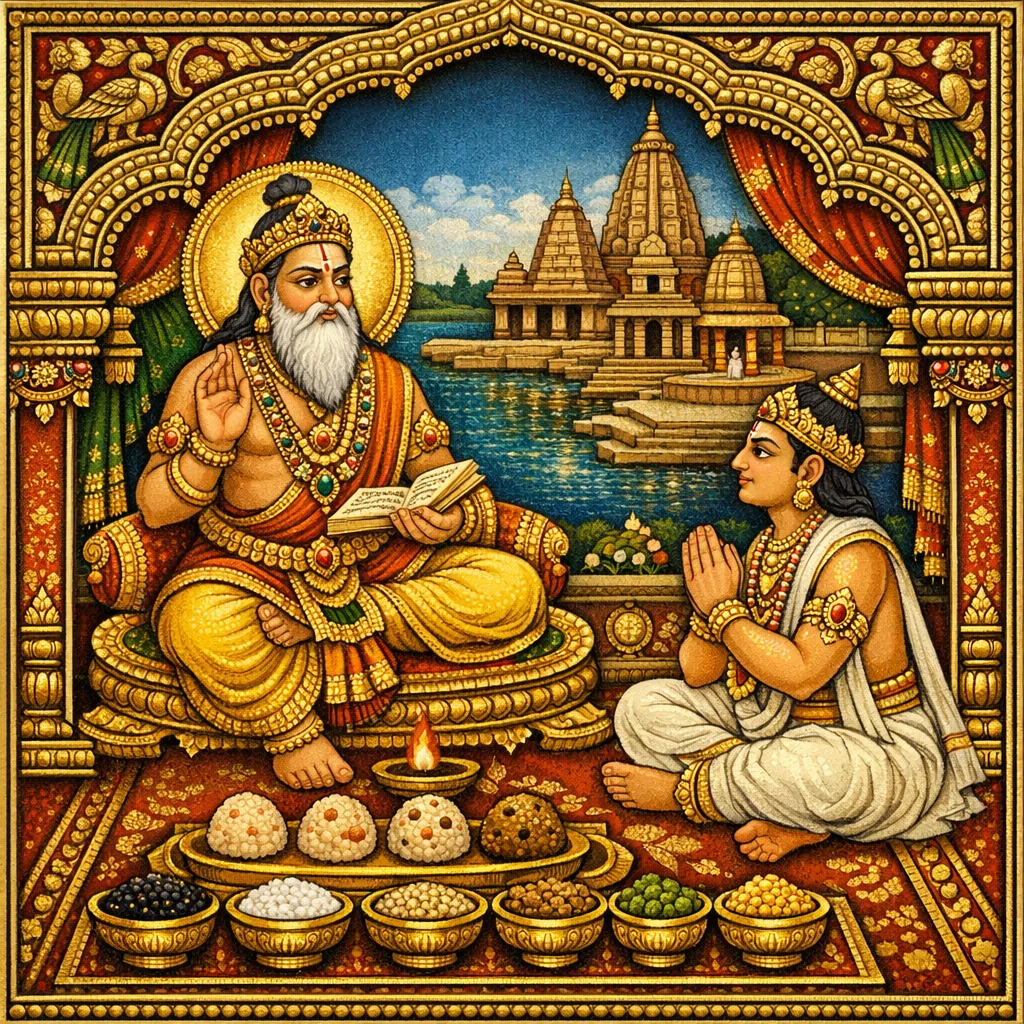
This Adhyāya unfolds as a guru–disciple inquiry: Śaṃyu asks Bṛhaspati which śrāddha offerings most satisfy the Pitṛs, which yield long-lasting results, and which bestow ‘ānanta’ (endless, imperishable) merit. Bṛhaspati answers by listing śrāddha-havis accepted by ritual authorities and assigning each substance a corresponding duration of ancestral satisfaction—beginning with staples such as tila (sesame), vrīhi (rice), yava (barley), and māṣa (beans), then water and fruits, moving on to stronger foods like fish and various meats, and culminating in items said to grant exceptional or enduring fruit. The teaching also weaves in pitṛ-gītā–style admonitions that stress the need for progeny and commend acts such as pilgrimage to Gayā, observance of trayodaśī, and releasing a bull as means of ancestral welfare. The chapter is thus chiefly ritual and calendrical rather than genealogical, presenting a graded economy of offerings and a theology of akṣaya (non-decaying merit), especially in connection with Gayā-śrāddha.
Shlokas
Verse 1
इति श्री ब्रहामाण्डे महापुराणे वायुप्रोक्ते मध्यभागे तृतीय उपोद्धातपादे श्राद्धकल्पे नक्षत्रश्राद्धं नाम अष्टादशो ऽध्यायः // १८// शंयुरुवाच किं स्विद्दत्तं पितॄणां तु तृप्तिदं वदतां वर / किंस्वित्स्याच्चिररात्राय किं वानन्त्याय कल्पते
Thus, in the holy Brahmāṇḍa Mahāpurāṇa, proclaimed by Vāyu, in the middle section—within the third Upoddhāta-pāda of the Śrāddha-kalpa—stands the eighteenth chapter, called “Nakṣatra-Śrāddha.” Śaṃyu said: “O best of speakers, what gift truly satisfies the Pitṛs? What yields lasting fruit, and what leads to merit without end?”
Verse 2
बृहस्पतिरुवाच हवीषि श्राद्धकल्पे तु यानि श्राद्धविदो विदुः / तानि मे शृणु सर्वाणि फलं चैषां यथातथम्
Bṛhaspati said: “In the Śrāddha-kalpa, the havis—offerings known to those skilled in śrāddha—hear them all from me, and I shall also tell their fruits exactly as they are.”
Verse 3
तिलैर्व्रीहियवैमाषैरद्भिर्मूलफलैस्तथा / दत्तेन मासं प्रीयन्ते श्राद्धेन हि पितामहाः
When śrāddha is offered with sesame, rice, barley, māṣa beans, water, and also roots and fruits, the Pitṛs—the forefathers—remain pleased for a full month.
Verse 4
मत्स्यैः प्रीणन्ति द्वौ मासौ त्रीन्मासान्हारिणेन तु / शाशेन चतुरो मासान्पञ्च प्रीणाति शाकुनैः
With fish they are pleased for two months; with venison for three months; with hare (śaśa) for four months; and with the flesh of birds they are pleased for five months.
Verse 5
वाराहेण तु षण्मासाञ्छागलं सप्तमासिकम् / अष्टमासिकमित्युक्तं यच्च पार्वतकं भवेत्
By the flesh of Varāha (the boar) the Pitṛs are pleased for six months; by goat’s flesh for seven months. And the meat called pārvataka (of the mountains) is said to grant satisfaction for eight months.
Verse 6
रौरवेण तु प्रीयन्ते नव मासान्पितामहाः / गवयस्य तु मांसेन तृप्तिः स्याद्दशमासिकी
By raurava flesh the Pitāmahas are pleased for nine months; and by the flesh of the gavaya (wild ox) there is satisfaction for ten months.
Verse 7
औरभ्रेण च मांसेन मासानेकादशैव तु / श्राद्धे च तृप्तिदं गव्यं पयः संवत्सरं द्विजाः
By aurabhra flesh there is satisfaction for eleven months; and, O dvijas, in the śrāddha, cow’s milk grants satisfaction for a full year.
Verse 8
आनन्त्याय भवेत्तद्वत्खड्गमांसं पितृक्षये / पायसं मधुसर्पिर्भ्यां छायायां कुञ्जरस्य च
At the time of pitṛkṣaya, the flesh of the khaḍga (rhinoceros) likewise is said to yield endless merit. Pāyasa sweetened with honey and ghee, and (śrāddha) performed in the shade of an elephant, are also declared to bestow satisfaction.
Verse 9
कृष्णच्छागस्य मासेन तृप्तिर्भवति शाश्वती / अत्र गाथाः पितृगीताः कीर्तयन्ति पुराविदः
By the flesh of the black goat (kṛṣṇa-chāga) satisfaction becomes everlasting. Here the lore-knowers recount the gāthās—hymns sung by the Pitṛs of old.
Verse 10
तास्ते ऽहं कीर्त्तयिष्यामि यथावत्सन्निबोध मे / अपि नः स कुले यायाद्यो नो दद्यात् त्रयोदशीम्
I shall recount all of these in due order; listen well to my words. Let him who does not grant us the gift on Trayodaśī not be born into our lineage.
Verse 11
आजेन सर्वलोहेन वर्षासु च मघासु च / एष्टव्या बहवः पुत्रा यद्येको ऽपि गयां व्रजेत् / गौरीं वाप्युद्वहेद्भार्यां नालं वा वृषमुत्सृजेत्
With the offering of a goat and gifts of all metals, in the rainy season and under the Maghā asterism, one should desire many sons—for if even one goes to Gayā, it suffices. Or one should wed a wife pure as Gaurī, or release the bull called Nālaṃ.
Verse 12
शंयुरुवाच गयादीनां फलं तात ब्रूहि मे परिपृच्छतः / दातॄणां चैव यत्पुण्यं निखिलेन प्रवीहि मे
Śaṃyu said: “Dear father, tell me—since I ask—the fruit of Gayā and the other sacred places. And explain to me in full the merit gained by those who give.”
Verse 13
बृहस्पतिरुवाच गयायामक्षयं श्राद्धञ्जपहोमतपांसि च / पितृक्षये हि तत्पुत्र तस्मात्तत्राक्षयं स्मृतम्
Bṛhaspati said: “My son, in Gayā, śrāddha, japa, homa, and austerity all yield imperishable fruit. For there the affliction of the ancestors is brought to an end; therefore that place is remembered as ‘Akṣaya’.”
Verse 14
पूर्णायामेकविंशं तु गौर्यामुत्पादितः सुतः / महामहांश्च जुहुयादिति तस्य फलं स्मृतम् / फलं वृषस्य वक्ष्यामि गदतो मे निबोधत
A son born of Pūrṇā brings benefit through twenty-one generations; and a son born of Gaurī performs homa for the ancestors such as the Mahāmaha—such is the fruit remembered. Now I shall declare the fruit of gifting a bull; attend carefully to my words.
Verse 15
वृषोत्स्रष्टा पुनात्येव दशातीतान्दशावरान्
He who performs the vṛṣotsarga truly purifies ten generations above and ten generations below.
Verse 16
यत्किञ्चित्स्पृशते तोयमवतीर्णो नदीजले / वृषोत्सर्ग्गत्पितॄणां तु ह्यक्षयं समुदाहृतम्
Whatever water he touches when he descends into the river, through vṛṣotsarga is declared to be imperishable merit for the Pitṛs.
Verse 17
येनयेन स्पृशेत्तोयं लाङ्गूलादिभिरङ्गशः / सर्वं तदक्षयं तस्य पितॄणां नात्र संशयः
Whatever water he touches with his tail and other limbs—all of it becomes imperishable for his Pitṛs; of this there is no doubt.
Verse 18
शृङ्गैः खुरैर्वा भूमिं यामुल्लिखत्यनिशं वृषः / मधुकुल्याः पितॄंस्तस्य ह्यक्षयाश्च भवन्ति वै
The ground that the bull ceaselessly scratches with his horns or hooves brings to his Pitṛs the ‘madhukulyā’—an imperishable satisfaction.
Verse 19
सहस्रनल्वमात्रेण तडागेन यथास्रुतिः / तृप्तिस्तु या पितॄणां वै सा वृषेणेह कल्पते
As the Śruti declares, the satisfaction the Pitṛs gain from a pond of a thousand nalvas is here likewise attained through the bull.
Verse 20
यो ददाति गुडोन्मिश्रतिलानि श्राद्धकर्मणि / मधु वामधुमिश्रं वा सर्वमेवाक्षयं भवेत्
Whoever, in the śrāddha rite, gives sesame mixed with jaggery, or gives honey or an offering mixed with honey—everything so given becomes imperishable in merit (akṣaya).
Verse 21
न ब्राह्मणं परिक्षेत सदा देयं हि मानवैः / दैवेकर्मणि पित्र्ये च श्रूयते वै परीक्षणम्
One should not test a brāhmaṇa; people ought always to give. Testing is spoken of only in rites for the Devas and in rites for the Pitṛs (ancestors).
Verse 22
सर्ववेदव्रतस्नाताः पङ्क्तीनां पावना द्विजाः / ये च भाषाविदः केचिद्ये च व्याकरणे रताः
Those purified by the vows of all the Vedas are dvijas who sanctify the dining row; some are masters of language, and some delight in grammar (vyākaraṇa).
Verse 23
अधीयते पुराणं वै धर्मशास्त्रमथापि च / त्रिणाचिकेतः पञ्चाग्निः स सौपर्णः षडङ्गवित्
He studies the Purāṇas and also the Dharmaśāstras; he is one who performs the triṇāciketa rite, practices the discipline of the five fires (pañcāgni), follows the sauparṇa tradition, and knows the six Vedāṅgas (ṣaḍaṅga).
Verse 24
ब्रह्मदेवसुतश्चैव च्छन्दोगो ज्येष्ठसामगः / पुण्येषु यश्च तीर्थेषु कृतस्नानः कृतव्रतः
He is also a son of Brahmadeva, a chāndoga, the foremost chanter of the Sāma; one who has bathed at holy tīrthas and fulfilled his sacred vows (vrata).
Verse 25
मखेषु ये च सर्वेषु भवन्त्यवभृथाप्लुताः / ये च सत्यव्रता नित्यं स्वधर्मनिरताश्च ये
Those who, in all sacrifices, have bathed in the avabhṛtha rite, and those who ever keep the vow of truth and remain devoted to their own dharma.
Verse 26
अक्रोधना लोभपरास्ताञ्छ्राद्धेषु निमन्त्रयेत् / एतेभ्यो दत्तमक्षय्यमेते वै पङ्क्तिपावनाः
In the śrāddha rites one should invite those free from anger and greed; what is given to them becomes imperishable—for they truly purify the sacred row.
Verse 27
श्राद्धीया ब्रह्मणा ये तु योगव्रतसुनिष्ठिताः / त्रयो ऽपि पूजितास्तेन ब्रह्मविष्णुमहेश्वराः
But those brāhmaṇas fit for śrāddha, firmly established in the vows of yoga—by honoring them, Brahmā, Viṣṇu, and Maheśvara, all three, are honored.
Verse 28
पितृभिः सह लोकाश्च यो ह्येतान्पूजयेन्नरः / पवित्राणां पवित्रं च मङ्गलानां च मङ्गलम्
Whoever worships these worlds together with the Pitṛs attains the purest among the pure and the most auspicious among all auspiciousness.
Verse 29
प्रथमः सर्वधर्माणां योगधर्मो निगद्यते / अपाङ्क्तेयान्प्रवक्ष्यमि गदतो मे निबोधत
Among all dharmas, yoga-dharma is declared the foremost; now I shall describe the apāṅkteyas (those unfit for the sacred row)—listen carefully to my words.
Verse 30
कितवो मद्यपो यश्च पशुपालो निराकृतः / ग्रामप्रेष्यो वार्धुषिको ह्यापणो वणिजस्तथा
The gambler, the drunkard, the despised herdsman, the village messenger, the usurer, the shopkeeper, and the merchant as well.
Verse 31
अगार दाही गरदो वृषलो ग्रामयाजकः / काण्डपृष्ठो ऽथ कुण्डाशी मधुपः सोमविक्रयी
The burner of houses, the poisoner, the base-born, the village priest, the one scarred upon the back, the eater from the ritual pit, the drinker of honey, and the seller of Soma.
Verse 32
समुद्रान्तरितो भृत्यः पिशुनः कूटसाक्षिकः / पित्रा विवदमानश्च यस्य चोपपतिर्गृहे
The servant dwelling beyond the sea, the slanderer, the false witness, the one who quarrels with his father, and he in whose house another man (upapati) is found.
Verse 33
अभिशस्तस्तथा स्तेनः शिल्पं यश्चोपजीवति / स्तवकः सूपकारश्च यश्च मित्राणि निन्दति
The condemned and accused, the thief, the one who lives by craft, the flatterer, the cook, and he who reviles his friends.
Verse 34
काणश्च खञ्जकश्चैव नास्तिको वेदवर्जितः / उन्मत्तो ऽप्यथ षण्ढश्च भ्रूणहा गुरुतल्पगः
The one-eyed and the lame, the atheist who has forsaken the Veda, the madman, the ṣaṇḍha, the slayer of the unborn, and he who violates the bed of the guru (the teacher’s wife).
Verse 35
भिषग्जीवी प्राशनिकः परस्त्रीं यश्च सेवते / विक्रीणाति च यो ब्रह्मव्रतानि नियमांस्तथा
He who lives by the trade of a physician, he who feeds on another’s food, and he who serves another man’s wife; and he who sells the Brahmanic vows and sacred disciplines.
Verse 36
नष्टं स्यान्नास्तिके दत्तं व्रतघ्ने चापवर्जितम् / यच्चवाणिजके दत्तं नेह नामुत्र संभवेत्
A gift given to an unbeliever is lost; and what is given to a breaker of vows is devoid of merit. And whatever is given to one of a merchant’s mind bears fruit neither here nor hereafter.
Verse 37
निक्षेपहारके चैव कृतघ्ने विदवर्जिते / तथा पाणविके वै च कारुके धर्मवर्जिते
So too, to one who steals a deposit, to the ungrateful who is bereft of learning and dharma; likewise to the gambler and to the craftsman who has abandoned dharma (a gift becomes fruitless).
Verse 38
क्रीणाति यो ह्यपण्यानि विक्रीणाति प्रशंसति / अन्यत्रास्य समाधानं न वणिकूछ्राद्धमर्हति
He who buys, sells, and praises goods unfit for trade—though some other atonement may exist for him—does not deserve the śrāddha befitting a merchant (vaiśya).
Verse 39
भस्मनीव हुतं हव्यं दत्तं पौनर्भवे द्विजः / षष्टिं काणः शतं षण्ढः श्वित्री पञ्चशतान्यपि
O dvija, a gift given to a paunarbhava (one remarried) is like an oblation poured into ashes. The one-eyed destroys the fruit sixtyfold, the ṣaṇḍha a hundredfold, and the śvitrī even five hundredfold.
Verse 40
पापरोगी सहस्रं वै दातुर्नाशयते फलम् / भ्रश्येद्धि स फलात्तस्मात्प्रदाता यस्तु बालिशः
A thousand afflicted with the sickness of sin destroy the giver’s meritorious fruit; therefore the foolish donor falls away from that reward.
Verse 41
यद्विष्टितशिरा भुङ्क्ते यद्भुङ्क्ते दक्षिणामुखः / सोपानत्कश्च यद्भुङ्क्ते यच्च दत्तमसत्कृतम्
Eating with the head covered, eating facing south, eating while wearing footwear, and a gift given without honor—these are all deemed blameworthy.
Verse 42
सर्वं तदसुरेद्राय ब्रह्मा भागमकल्पयत् / श्वा चैव ब्रह्महा चैव नावेक्षेत कथञ्चन
Brahmā assigned all of that as the share of the lord of the Asuras; and one should not look upon a dog or a slayer of a brāhmaṇa in any manner.
Verse 43
तस्मात्परिवृतैर्दद्यात्तिलैश्चान्नं विकीर्य च / राक्षसानां तिलाः प्रोक्ताः शुनां परिवृतास्तथा
Therefore one should give (the offering) with a boundary made around it, and scatter sesame upon the food; sesame is said to be for the Rākṣasas, and what is enclosed likewise for dogs.
Verse 44
दर्शनात्सूकरो हन्ति पक्षवातेन कुक्कुटः / रजस्वलायाः स्पर्शेन क्रुद्धोयश्च प्रयच्छति
A boar destroys (merit) by mere sight, a cock by the wind of its wings; so too by touching a menstruating woman, and one who gives while angry also ruins (the fruit).
Verse 45
नदीतीरेषु रम्येषु सरित्सु च सरस्सु च / विविक्तेषु च प्रीयन्ते दत्तेनेह पितामहाः
On lovely riverbanks, in rivers and lakes, and in secluded places too, the Pitāmahas (ancestral Fathers) are pleased by the gift offered here.
Verse 46
नासव्यंपातयेज्जानु न युक्तो वाचमीरयेत् / तस्मात्परिवृतेनेह विधिवद्दर्भपाणिना
Let him not drop the left knee, nor utter words when unfit; therefore, here he should proceed according to rite, with darbha grass in hand and properly covered.
Verse 47
पित्रोराराधनं कार्यमेवं प्रीणयते पितॄन् / अनुमान्य द्विजान्पूर्वमर्गौं कुर्याद्यथाविधि
Worship of the Pitris should be performed; thus the ancestors are satisfied. First honoring the dvijas, one should then offer arghya in due rite.
Verse 48
पितॄणां निर्वपेद्भूमौ सूर्ये वा दर्भसंस्तरे / शुक्लपक्षे च पूर्वाङ्णे श्राद्धं कुर्याद्यथाविधि
For the Pitris, one should place the piṇḍa upon the ground, or before Surya on a darbha mat; and in the bright fortnight, in the forenoon, perform śrāddha according to rule.
Verse 49
कृष्णपक्षे ऽपरङ्णे तु रौहिणं वै न लङ्घयेत् / एवमेते महात्मानो महायोगा महौजसः
In the dark fortnight, in the afternoon, one should not overstep Rauhiṇa (the nakṣatra/time); thus are they—Mahātmās, great yogins, mighty in spiritual splendor.
Verse 50
सदा वै पितरः पूज्याः सं प्राप्तौ देशकालयोः / पितृभक्त्यैव तु नरो योगं प्राप्नोति दुर्ल्लभम्
When place and time are duly attained, the Pitṛs (ancestors) are ever worthy of worship; by devotion to the ancestors alone, a man attains the rare and difficult Yoga.
Verse 51
ध्यानेन मोक्षं गच्छेद्धि हित्वा कर्म शुभाशुभम् / यज्ञहेतोस्तदुद्धृत्य मोहयित्वा जगत्तथा
By meditation indeed one goes to liberation, abandoning deeds both auspicious and inauspicious; for the sake of sacrifice (yajña) that is drawn forth, and thus the world is also deluded.
Verse 52
गुहायां निहितं ब्रह्म कश्यपेन महात्मना / अमृतं गुह्यमुद्धृत्य योगे योगविदां वराः
The great-souled Kaśyapa hid Brahman within a cave; the foremost among the knowers of Yoga drew forth that secret nectar and became established in Yoga.
Verse 53
प्रोक्तः सनत्कुमारेण महातो ब्रह्मणः पदम् / देवानां परमं गुह्यमृषीणां च परायणम्
Sanatkumāra declared the station of the great Brahman; it is the supreme secret of the gods and the ultimate refuge of the ṛṣis.
Verse 54
पितृभक्त्या प्रयत्नेन प्राप्य ते तन्मनीषिभिः / पितृभक्तः समासेन पितृपूर्वपरश्च यः
That (state) is attained by the wise through effort and devotion to the Pitṛs; in brief, a pitṛ-bhakta is one who honors the ancestors, those before and those after.
Verse 55
अयत्नात्प्राप्नुयादेव सर्वमेतन्न संशयः
Even without effort, one surely attains all this; there is no doubt.
Verse 56
बृहस्पतिरुवाच यस्मैश्राद्धानि देयानि यच्च दत्तं महत्फलम् / येषु चाप्यक्षयं श्राद्धं तीर्थेषु च गुहासु च
Bṛhaspati said: to whom śrāddha offerings should be given, and where what is given yields great fruit; and in which tīrthas and sacred caves śrāddha becomes imperishable.
Verse 57
येषु स्वर्गमवाप्नोति तत्ते प्रोक्तं ससंग्रहम् / श्रुत्वेमं श्राद्धकल्पं च न कुर्याद्यस्तु मानवः
That by which one attains heaven I have told you in brief; yet the man who, having heard this śrāddha ordinance, does not perform it—
Verse 58
स मज्जेन्नरके घोरे नास्तिकस्तमसावृते / परिवादो न कर्त्तव्यो योगिनां तु विशेषतः
That unbeliever will sink into a dreadful hell, veiled in darkness; and slander must not be done—especially of yogins.
Verse 59
परिवादात्क्रिमिर्भूत्वा तत्रैव परिवर्त्तते / योगान्परिवदेद्यस्तु ध्यानिनो मोक्षकाङ्क्षिणः
Through slander he becomes a worm and revolves there alone; such is the one who reviles yogins—meditators who yearn for mokṣa.
Verse 60
स गच्छेन्नरकं घोरं श्रोताप्यस्य न संशयः / आवृतं तमसः सर्वं नरकं घोरदर्शनम् / योगीश्वरपरीवादान्न स्वर्गं याति मानवः
He who reviles the lords of Yoga goes to a terrible hell, and the listener too, without doubt. That hell is enveloped in darkness and is terrible to behold. By speaking ill of the Yogis, a man does not attain Heaven.
Verse 61
योगेश्वराणामा क्रोशं शृणुयाद्यो यतात्मनाम् / सहि कालं चिरं मज्जेन्नरके नात्र संशयः / कुंभीपाकेषु पच्यन्ते जिह्वाच्छेदे पुनः पुनः
He who listens to the abuse of self-controlled Yogis sinks into hell for a long time; there is no doubt about this. They are cooked in the Kumbhipaka hell and their tongues are cut again and again.
Verse 62
समुद्रे च यथा लोषटस्तद्बत्सीदन्ति ते नराः / मनसा कर्मणा वाचा द्वेषं योगेषु वर्जयेत् / प्रोत्यानन्तं फलं भुङ्क्त इह वापि न संशयः
Just as a clod of earth sinks in the ocean, so do those men sink. One should avoid hatred towards Yoga in thought, deed, and speech. By pleasing them, one enjoys infinite fruit here and hereafter, without doubt.
Verse 63
न पारगो विन्दति परमात्मनस्त्रिलोकमध्ये चरति स्वकर्ममिः / ऋचो यजुः साम तदङ्गपारगे ऽविकारमेतं ह्यनवाप्य सीदति
A mere scholar does not find the Supreme Soul; he wanders in the three worlds according to his karma. Even one who has mastered Rig, Yajur, Sama and their Angas suffers if he does not attain that immutable state.
Verse 64
विकारपारं प्रकृतेश्च पारगस्त्रयीगुणाना त्रिगुणस्य पारगः / यः स्याच्चतुर्विशतितत्त्वपारगः स पारगो नाध्ययनस्य पारगः
He who has crossed beyond modifications, beyond Nature (Prakriti), beyond the three Gunas, and who has mastered the twenty-four Tattvas — he is the true master (Paraga), not the one who is merely a master of study.
Verse 65
कृत्स्नं यथावत्समुपैति तत्परस्तथैव भूयः प्रलयत्वमात्मनः / प्रत्याहरेद्योगपथं न यो द्विजो न सर्वपार क्रमपारगोचरः
The twice-born who is wholly intent attains the whole in due order, and likewise again reaches within himself the state of pralaya. But the brahmin who does not practice pratyāhāra on the path of yoga cannot reach the far shore, nor the goal beyond all stages.
Verse 66
वेदस्य वेदितव्यं च वेद्यं विन्दति योगवित् / तं वै वेदविदः प्राहुस्तमाहुर्वेदपारगम्
The knower of yoga discovers in the Veda both what is to be known and that which is to be known. The seers of the Veda call him vedavid, and they call him vedapāraga—one who has crossed beyond the Veda.
Verse 67
वेदं च वेदितव्यं च विदित्वा वै यथास्थितः / एवं वेदविदः प्राहुरन्यं वै वेदपारगम्
He who has known the Veda and what is to be known, and abides steadfast in his own true state—thus the knowers of the Veda speak of him as another, distinct from the mere title of vedapāraga.
Verse 68
यज्ञान्वेदांस्तथा कामांस्तपांसि विविधानि च / प्राप्नोत्यायुः प्रजाश्चैव पितृभक्तो न सशयः
Sacrifices, the Vedas, desired aims, and austerities of many kinds—the devotee of the Pitṛs attains their fruits. He gains long life and progeny as well; of this there is no doubt.
Verse 69
श्रद्धया श्राद्धकल्पं तु यस्त्विमं नियतः पठेत् / सर्वाण्येतानि वाप्नोति तीर्थदानफलानि च
Whoever, disciplined and with śraddhā, recites this Śrāddhakalpa attains all these things, and also the fruits of gifts bestowed at sacred tīrthas.
Verse 70
स पङ्क्तिपावनश्चैव द्विजानामग्रभुग्भवेत् / आश्राव्य च द्विजान्सो ऽथ सर्वकामानवाप्नुयात्
He becomes the purifier of the sacred dining line and is entitled to the foremost share among the twice-born. Having caused the twice-born to hear it, he then attains all desires.
Verse 71
यश्चैतच्छृणुयान्नित्यम न्यांश्च श्रावयेद्द्विजः / अनसूयुर्जितक्रोधो लोभमोहविवर्जितः
The twice-born who hears this daily and also causes other twice-born to hear it—free from malice, having conquered anger, and devoid of greed and delusion.
Verse 72
तीर्थादीनां फलं प्राप्य दानादीनां च सर्वशः / मोक्षोपायं लभेच्छ्रेष्ठं स्वर्गोपायं न संशयः / इह चापि परा पुष्ठिस्तस्मात्कुर्वीत नित्यशः
He gains the fruits of pilgrimages to sacred tīrthas and, in every way, the fruits of gifts and other pious acts. He obtains the finest means to liberation and, without doubt, the means to heaven. Even here he attains supreme nourishment and prosperity; therefore one should do this daily.
Verse 73
इमं विधिं यो हि पठेदतन्द्रितः समाहितः संसदि पर्वसंधिषु / अपत्यभागी च परेण तेजसा दिवौकसां स व्रजते सलोकताम्
Whoever recites this ordinance without sloth, with a collected mind, in the assembly and at the junctures of sacred festivals—shining with higher splendor—gains the blessing of offspring and attains salokatā, dwelling in the same realm as the denizens of heaven.
Verse 74
येन प्रोक्तस्त्वयं कल्पो नमस्तस्मै स्वयंभुवे / महायोगेश्वरेभ्यश्च सदा च प्रणतो ऽस्म्यहम्
Homage to Svayambhū, by whom this kalpa was proclaimed. And to the great Lords of Yoga as well, I remain ever bowed in reverence.
Frequently Asked Questions
A graded list of śrāddha offerings (havis) and their stated durations of Pitṛ-satisfaction—moving from grains/tila and water to fish and meats—culminating in items described as yielding exceptionally long or ‘endless’ (ānanta/akṣaya) results.
Gayā is presented as an akṣaya-field: śrāddha, japa, homa, and tapas performed there are said to become ‘imperishable’ because they are linked to ‘pitṛ-kṣaya’ (decisive ancestral fulfillment), hence the designation akṣaya.
It is primarily ritualistic (śrāddha-kalpa). For cosmological mapping, it supplies the ‘human-scale’ interface to cosmic time: nakṣatra awareness, tithi observance, and akṣaya-merit logic connect celestial order to household dharma and intergenerational continuity.