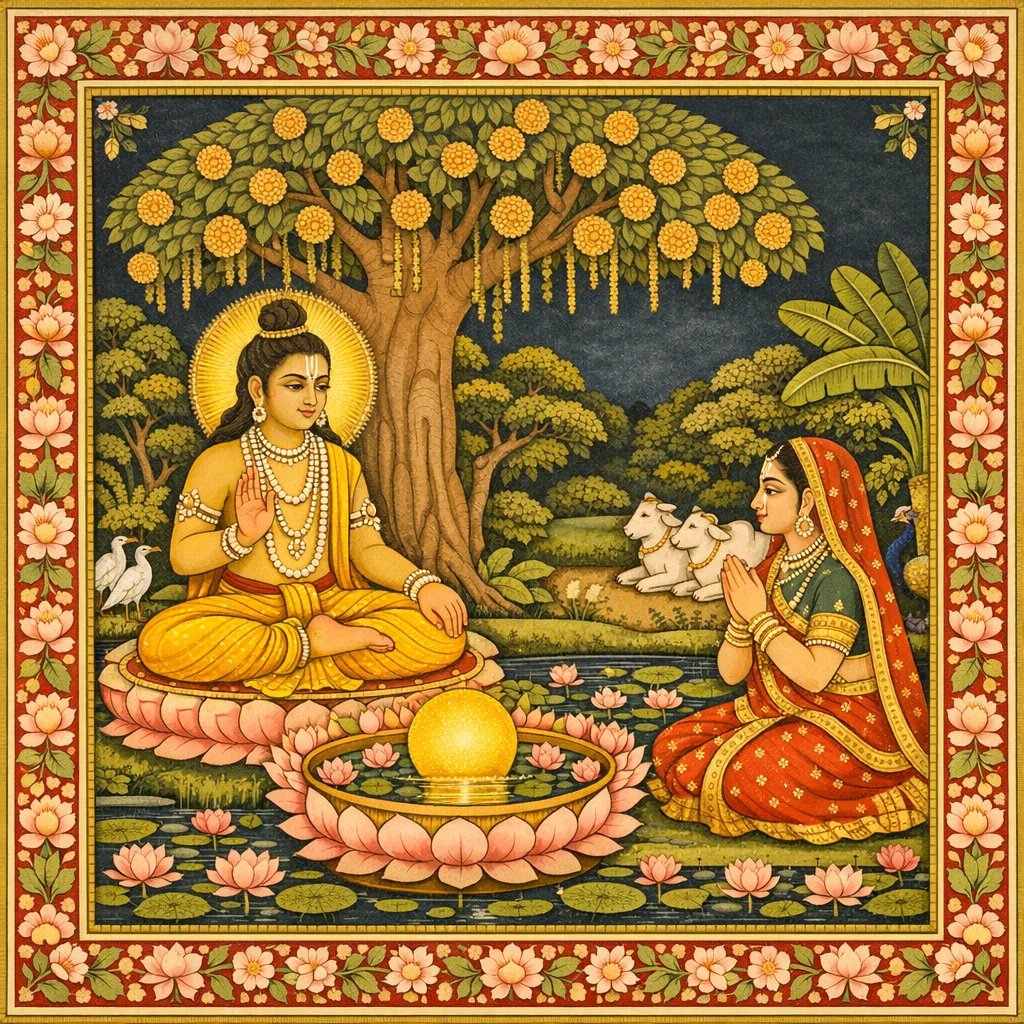
Adhyaya 27
Kapila on Liberation: Detachment, Devotional Discipline, and the Soul’s Aloofness from the Guṇas
Continuing Kapila’s Sāṅkhya-bhakti teaching to Devahūti, this chapter clarifies that the jīva transcends prakṛti, yet false ego (ahaṅkāra) and the sense of proprietorship bind the soul to guṇa-driven action and transmigration. Through repeated analogies of the sun’s reflection and the imagery of sleep and dream, Kapila shows that consciousness seems entangled while the self remains the witnessing seer. He then prescribes the sādhaka’s discipline—equanimity toward all beings, regulated living, celibacy, simplicity, seclusion, and offering results to Bhagavān—culminating in hearing and chanting (śravaṇa-kīrtana) as the power that lifts one from yogic discipline to pure bhakti. Devahūti’s doubt about whether prakṛti ever releases the soul is answered: liberation arises from sustained devotional service that burns the very causes of bondage, like fire consuming its fuel, purifying the devotee and assuring return to the Lord’s protected spiritual abode.
Shlokas
Verse 1
श्रीभगवानुवाच प्रकृतिस्थोऽपि पुरुषो नाज्यते प्राकृतैर्गुणै: । अविकारादकर्तृत्वान्निर्गुणत्वाज्जलार्कवत् ॥ १ ॥
The Supreme Lord Kapila said: Although dwelling within material nature, the purusha is not tainted by material modes, for he is unchanging, not the doer, and beyond the gunas—like the sun, which remains aloof from its reflection upon water.
Verse 2
स एष यर्हि प्रकृतेर्गुणेष्वभिविषज्जते । अहंक्रियाविमूढात्मा कर्तास्मीत्यभिमन्यते ॥ २ ॥
When the soul becomes attached to the modes of material nature, he is bewildered by the workings of false ego, identifies the body as the self, and imagines, “I am the doer.”
Verse 3
तेन संसारपदवीमवशोऽभ्येत्यनिर्वृत: । प्रासङ्गिकै: कर्मदोषै: सदसन्मिश्रयोनिषु ॥ ३ ॥
Thus the conditioned soul, helpless and without peace, enters the path of samsara and, because of karmic faults born of association with the modes, transmigrates into higher and lower species—wombs mixed with virtue and vice.
Verse 4
अर्थे ह्यविद्यमानेऽपि संसृतिर्न निवर्तते । ध्यायतो विषयानस्य स्वप्नेऽनर्थागमो यथा ॥ ४ ॥
In truth, even when sense objects have no real substance, samsara does not cease for one who dwells on them; just as in a dream, the dreamer is afflicted by many misfortunes.
Verse 5
अत एव शनैश्चित्तं प्रसक्तमसतां पथि । भक्तियोगेन तीव्रेण विरक्त्या च नयेद्वशम् ॥ ५ ॥
Therefore, the mind attached to the path of the unreal should be brought, step by step, under control by intense bhakti-yoga and by detachment.
Verse 6
यमादिभिर्योगपथैरभ्यसन्श्रद्धयान्वित: । मयि भावेन सत्येन मत्कथाश्रवणेन च ॥ ६ ॥
By practicing the yoga paths beginning with yama and the like, endowed with faith, and by a truthful loving mood toward Me—through hearing and chanting My narrations—one rises to pure devotional service.
Verse 7
सर्वभूतसमत्वेन निर्वैरेणाप्रसङ्गत: । ब्रह्मचर्येण मौनेन स्वधर्मेण बलीयसा ॥ ७ ॥
In devotional service one should see all beings equally, without enmity toward anyone and without intimate entanglement; one should observe brahmacarya, maintain grave restraint, and firmly perform one’s svadharma.
Verse 8
यदृच्छयोपलब्धेन सन्तुष्टो मितभुङ्मुनि: । विविक्तशरण: शान्तो मैत्र: करुण आत्मवान् ॥ ८ ॥
A devotee should be satisfied with what comes without great struggle, and eat only in moderation; dwelling in seclusion, he should be thoughtful, peaceful, friendly, compassionate, and self-controlled.
Verse 9
सानुबन्धे च देहेऽस्मिन्नकुर्वन्नसदाग्रहम् । ज्ञानेन दृष्टतत्त्वेन प्रकृते: पुरुषस्य च ॥ ९ ॥
Without clinging to this body and its attendant ties, one should, through the vision of knowledge, behold the truth of prakriti (matter) and purusha (the soul).
Verse 10
निवृत्तबुद्ध्यवस्थानो दूरीभूतान्यदर्शन: । उपलभ्यात्मनात्मानं चक्षुषेवार्कमात्मदृक् ॥ १० ॥
One should abide in the transcendental state, beyond the stages of material consciousness, remaining aloof from all other conceptions of life. Freed from false ego, one should behold the self as clearly as one sees the sun in the sky.
Verse 11
मुक्तलिङ्गं सदाभासमसति प्रतिपद्यते । सतो बन्धुमसच्चक्षु: सर्वानुस्यूतमद्वयम् ॥ ११ ॥
The liberated soul realizes the Absolute Personality of Godhead, transcendental, who appears as a reflection even within the false ego. He is the support of the material cause and enters into all things; He is absolute, without a second, and He governs the illusory vision of māyā.
Verse 12
यथा जलस्थ आभास: स्थलस्थेनावदृश्यते । स्वाभासेन तथा सूर्यो जलस्थेन दिवि स्थित: ॥ १२ ॥
The presence of the Supreme Lord is realized as the sun is realized—first as a reflection upon water, and again as a second reflection upon a wall—though the sun itself remains situated in the sky.
Verse 13
एवं त्रिवृदहङ्कारो भूतेन्द्रियमनोमयै: । स्वाभासैर्लक्षितोऽनेन सदाभासेन सत्यदृक् ॥ १३ ॥
Thus the self-realized soul is reflected first within the threefold ego, and then again within the body, the senses, and the mind as their respective reflections.
Verse 14
भूतसूक्ष्मेन्द्रियमनोबुद्ध्यादिष्विह निद्रया । लीनेष्वसति यस्तत्र विनिद्रो निरहंक्रिय: ॥ १४ ॥
Though a devotee may appear, by the influence of sleep, to be merged in the five elements, the objects of enjoyment, and the material senses, mind, and intelligence, he is understood to be inwardly awake and freed from false ego.
Verse 15
मन्यमानस्तदात्मानमनष्टो नष्टवन्मृषा । नष्टेऽहङ्करणे द्रष्टा नष्टवित्त इवातुर: ॥ १५ ॥
The living being vividly knows himself as the seer, yet in deep sleep, when false ego subsides, he wrongly thinks himself lost—like a man bereft of wealth who, distressed, imagines himself ruined.
Verse 16
एवं प्रत्यवमृश्यासावात्मानं प्रतिपद्यते । साहङ्कारस्य द्रव्यस्य योऽवस्थानमनुग्रह: ॥ १६ ॥
Thus, by mature reflection, he realizes his own self; and the condition he had accepted under false ego in material existence becomes clearly manifest to him.
Verse 17
देवहूतिरुवाच पुरुषं प्रकृतिर्ब्रह्मन्न विमुञ्चति कर्हिचित् । अन्योन्यापाश्रयत्वाच्च नित्यत्वादनयो: प्रभो ॥ १७ ॥
Śrī Devahūti asked: “O brāhmaṇa, does material nature ever release the puruṣa, the spirit soul? O Lord, since the two are mutually dependent and eternally connected, how can their separation be possible?”
Verse 18
यथा गन्धस्य भूमेश्च न भावो व्यतिरेकत: । अपां रसस्य च यथा तथा बुद्धे: परस्य च ॥ १८ ॥
As earth has no existence apart from its fragrance, and water none apart from its taste, so intelligence (buddhi) cannot have a separate existence from consciousness (caitanya).
Verse 19
अकर्तु: कर्मबन्धोऽयं पुरुषस्य यदाश्रय: । गुणेषु सत्सु प्रकृते: कैवल्यं तेष्वत: कथम् ॥ १९ ॥
Therefore, although the puruṣa is truly a non-doer, this bondage of karma appears to rest upon him; as long as the guṇas of material nature act and bind, how can the soul attain freedom—kaivalya?
Verse 20
क्वचित्तत्त्वावमर्शेन निवृत्तं भयमुल्बणम् । अनिवृत्तनिमित्तत्वात्पुन: प्रत्यवतिष्ठते ॥ २० ॥
Even if the terrible fear of bondage is dispelled by inquiry into the tattvas, it can arise again, for its cause has not been ended.
Verse 21
श्रीभगवानुवाच अनिमित्तनिमित्तेन स्वधर्मेणामलात्मना । तीव्रया मयि भक्त्या च श्रुतसम्भृतया चिरम् ॥ २१ ॥
The Supreme Lord said: Perform your prescribed duty with a pure heart, without selfish motive; and with intense devotion to Me, hear about Me for a long time.
Verse 22
ज्ञानेन दृष्टतत्त्वेन वैराग्येण बलीयसा । तपोयुक्तेन योगेन तीव्रेणात्मसमाधिना ॥ २२ ॥
This devotional service must be practiced with firm knowledge and true vision of the tattvas, with strong renunciation, austerity, yoga, and intense absorption in the Self.
Verse 23
प्रकृति: पुरुषस्येह दह्यमाना त्वहर्निशम् । तिरोभवित्री शनकैरग्नेर्योनिरिवारणि: ॥ २३ ॥
Material nature covers the living being and burns him day and night as if in a blazing fire; yet by earnest devotional service this covering is removed, just as the fire consumes the very sticks that kindle it.
Verse 24
भुक्तभोगा परित्यक्ता दृष्टदोषा च नित्यश: । नेश्वरस्याशुभं धत्ते स्वे महिम्नि स्थितस्य च ॥ २४ ॥
Having tasted sense enjoyments and ever seeing their faults, the living being renounces them; he no longer bears the inauspicious urge to lord over matter, and he stands in his own true glory.
Verse 25
यथा ह्यप्रतिबुद्धस्य प्रस्वापो बह्वनर्थभृत् । स एव प्रतिबुद्धस्य न वै मोहाय कल्पते ॥ २५ ॥
As in the dream-state the unawakened consciousness is almost covered and beholds many inauspicious things, so when one is awakened and fully aware, those inauspicious visions can no longer bewilder him.
Verse 26
एवं विदिततत्त्वस्य प्रकृतिर्मयि मानसम् । युञ्जतो नापकुरुत आत्मारामस्य कर्हिचित् ॥ २६ ॥
Thus, one who knows the truth and yokes his mind to Me—the self-satisfied soul—cannot be harmed by material nature, even while engaged in material activities.
Verse 27
यदैवमध्यात्मरत: कालेन बहुजन्मना । सर्वत्र जातवैराग्य आब्रह्मभुवनान्मुनि: ॥ २७ ॥
When one thus engages in bhakti and self-realization through long time and many births, the sage develops complete detachment everywhere—even from the enjoyments of all planets up to Brahmaloka—and his consciousness becomes fully mature.
Verse 28
मद्भक्त: प्रतिबुद्धार्थो मत्प्रसादेन भूयसा । नि:श्रेयसं स्वसंस्थानं कैवल्याख्यं मदाश्रयम् ॥ २८ ॥ प्राप्नोतीहाञ्जसा धीर: स्वदृशाच्छिन्नसंशय: । यद्गत्वा न निवर्तेत योगी लिङ्गाद्विनिर्गमे ॥ २९ ॥
My devotee, by My boundless causeless mercy, truly awakens to self-realization; by his spiritual vision all doubts are cut away. Steady and sober, he easily advances toward his destined abode—the supreme good, called kaivalya—sheltered under My own spiritual energy of pure bliss. When he leaves this material body, the yogic devotee reaches that transcendental home and never returns.
Verse 29
मद्भक्त: प्रतिबुद्धार्थो मत्प्रसादेन भूयसा । नि:श्रेयसं स्वसंस्थानं कैवल्याख्यं मदाश्रयम् ॥ २८ ॥ प्राप्नोतीहाञ्जसा धीर: स्वदृशाच्छिन्नसंशय: । यद्गत्वा न निवर्तेत योगी लिङ्गाद्विनिर्गमे ॥ २९ ॥
My devotee, by My boundless causeless mercy, truly awakens to self-realization; by his spiritual vision all doubts are cut away. Steady and sober, he easily advances toward his destined abode—the supreme good, called kaivalya—sheltered under My own spiritual energy of pure bliss. When he leaves this material body, the yogic devotee reaches that transcendental home and never returns.
Verse 30
यदा न योगोपचितासु चेतो मायासु सिद्धस्य विषज्जतेऽङ्ग । अनन्यहेतुष्वथ मे गति: स्याद् आत्यन्तिकी यत्र न मृत्युहास: ॥ ३० ॥
When the perfected yogī’s mind is no longer entangled in the by-products of mystic powers, which arise from the external māyā, his advance toward Me becomes limitless, and the force of death cannot conquer him.
Frequently Asked Questions
The analogy teaches that the ātmā remains unchanged and aloof, even when consciousness appears reflected through ego, mind, senses, and body. Just as the sun is not affected by distortions in its reflection, the self is not intrinsically touched by the guṇas; bondage is due to identification (ahaṅkāra) and proprietorship, not the soul’s true nature.
Kapila answers Devahūti that liberation occurs when devotional service is performed steadily—especially hearing and chanting—so that the root causes of bondage (desire to lord over prakṛti, karmic reaction, and false ego) are removed. Bhakti is described as self-purifying: like fire consuming the wood that fuels it, devotion consumes the contaminations that sustain conditioned life.
A liberated soul is one who realizes Bhagavān as the Absolute support of all causes, perceives the self beyond bodily identification, and remains unharmed by material engagement because the mind is fixed on the Supreme. Such a person is awake within the elements—externally functioning, internally free from false ego.
Kapila prescribes equal vision, non-enmity, avoidance of intimate entanglements, celibacy, gravity, simplicity, satisfaction with modest income, moderation in eating, seclusion, thoughtfulness, peace, friendliness, compassion, and self-realization—along with offering all results to Bhagavān and advancing through chanting and hearing.
Mystic siddhis and higher planetary attainments remain within the jurisdiction of external energy and can re-attract attention to subtle enjoyment and prestige. Kapila emphasizes that mature devotion makes one reluctant to enjoy any material planet, even Brahmaloka, because the devotee’s aim is the Lord’s protected spiritual abode beyond return.