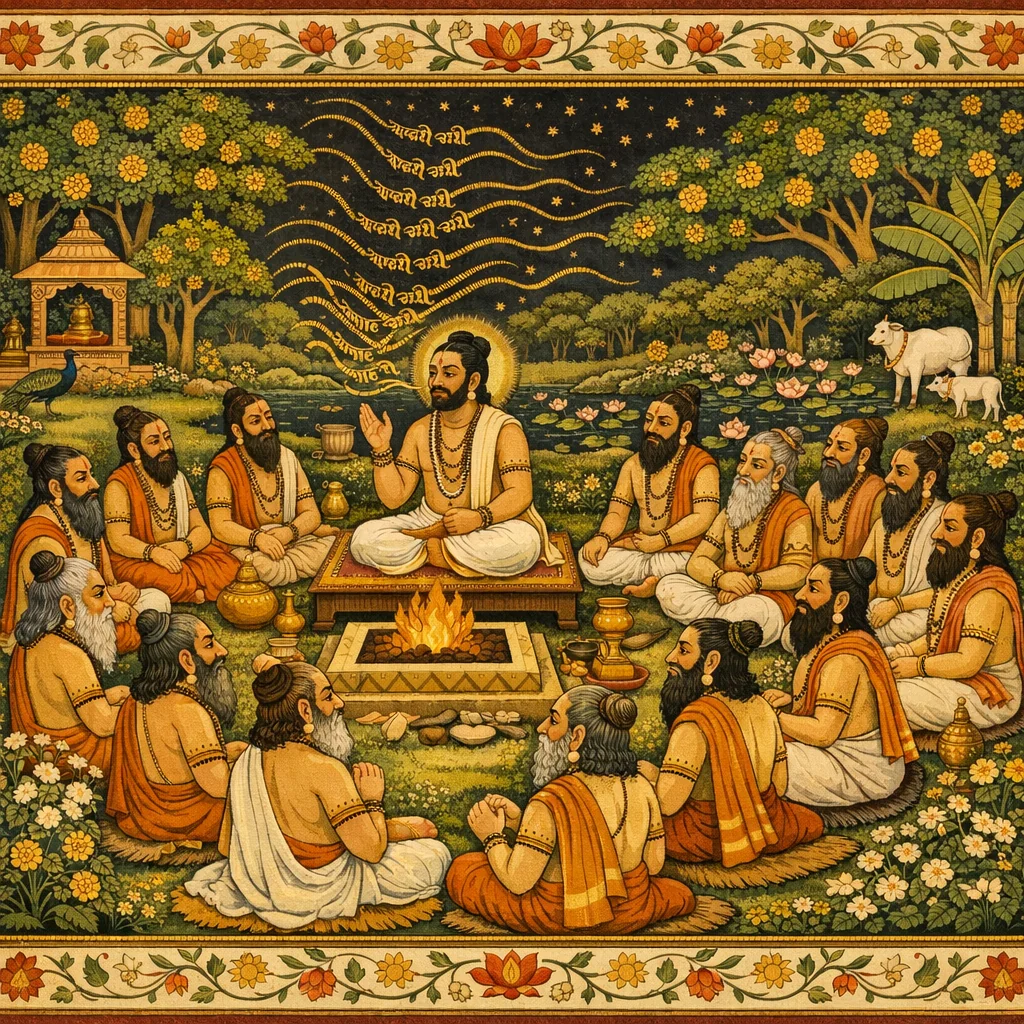
Adhyaya 2
Divinity and Divine Service (Bhagavān and Bhakti as the Supreme Dharma)
In reply to the sages’ exemplary questions at Naimiṣāraṇya, Sūta Gosvāmī opens with maṅgalācaraṇa, offering reverence to Śukadeva, Nārāyaṇa, Nara-Nārāyaṇa Ṛṣi, Sarasvatī, and Vyāsa, thus grounding the teaching in paramparā and sacred purpose. He then states the Bhāgavata’s central thesis: the supreme dharma is unmotivated, uninterrupted bhakti to the transcendent Lord, which at once yields jñāna and vairāgya. All duties and rituals are judged by one measure—whether they awaken attraction to Hari-kathā—and human desire is redirected from sense enjoyment to inquiry into the Absolute Truth. Sūta defines the nondual Absolute as realized in three aspects—Brahman, Paramātmā, and Bhagavān—and prescribes realization through śravaṇa-centered devotion rooted in Vedānta. The chapter traces bhakti’s purifying sequence: service to pure devotees → taste for hearing → cleansing of the heart → establishment in sattva → direct, “scientific” knowledge of the Lord. It concludes by contrasting guṇa-based worship with exclusive Viṣṇu-bhakti and introduces cosmological theology—the Lord’s entry into creation as Supersoul—preparing for the coming accounts of His energies, avatāras, and the unfolding Bhāgavata history.
Shlokas
Verse 1
व्यास उवाच इति सम्प्रश्नसंहृष्टो विप्राणां रौमहर्षणि: । प्रतिपूज्य वचस्तेषां प्रवक्तुमुपचक्रमे ॥ १ ॥
Vyāsa said: Delighted by the brāhmaṇas’ perfect questions, Ugraśravā (Sūta Gosvāmī), son of Romaharṣaṇa, honored their words and began to speak in reply.
Verse 2
सूत उवाच यं प्रव्रजन्तमनुपेतमपेतकृत्यं द्वैपायनो विरहकातर आजुहाव । पुत्रेति तन्मयतया तरवोऽभिनेदु- स्तं सर्वभूतहृदयं मुनिमानतोऽस्मि ॥ २ ॥
Sūta said: I offer my obeisances to that great sage (Śukadeva Gosvāmī) who can enter the hearts of all beings. When he left home to embrace renunciation (sannyāsa), without undergoing the sacred-thread initiation and other rites, his father Dvaipāyana (Vyāsa), anguished by separation, cried, “My son!”—and only the trees, absorbed in the same feeling, echoed back in reply.
Verse 3
य: स्वानुभावमखिलश्रुतिसारमेक- मध्यात्मदीपमतितितीर्षतां तमोऽन्धम् । संसारिणां करुणयाह पुराणगुह्यं तं व्याससूनुमुपयामि गुरुं मुनीनाम् ॥ ३ ॥
I offer my reverent obeisances to Śrī Śuka, son of Vyāsa and guru of the sages, who—having personally realized the essence of all śruti—out of compassion for those struggling to cross the blinding darkness of saṁsāra, spoke this most confidential Purāṇic mystery.
Verse 4
नारायणं नमस्कृत्य नरं चैव नरोत्तमम् । देवीं सरस्वतीं व्यासं ततो जयमुदीरयेत् ॥ ४ ॥
Before reciting the victory-bestowing Śrīmad-Bhāgavatam, one should bow to Bhagavān Nārāyaṇa, to Nara-Nārāyaṇa Ṛṣi the foremost of men, to Mother Sarasvatī the goddess of learning, and to Śrī Vyāsadeva the author; then one should utter “jaya”.
Verse 5
मुनय: साधु पृष्टोऽहं भवद्भिर्लोकमङ्गलम् । यत्कृत: कृष्णसम्प्रश्नो येनात्मा सुप्रसीदति ॥ ५ ॥
O sages, you have questioned me rightly, for your inquiry is auspicious for the world; it concerns Śrī Kṛṣṇa, and only such questions can fully satisfy the ātman.
Verse 6
स वै पुंसां परो धर्मो यतो भक्तिरधोक्षजे । अहैतुक्यप्रतिहता ययात्मा सुप्रसीदति ॥ ६ ॥
The supreme dharma for all humanity is that which awakens loving bhakti to the transcendent Lord, Adhokṣaja; such devotion must be without selfish motive and without interruption, for by it the ātman becomes fully satisfied.
Verse 7
वासुदेवे भगवति भक्तियोग: प्रयोजित: । जनयत्याशु वैराग्यं ज्ञानं च यदहैतुकम् ॥ ७ ॥
When bhakti-yoga is rendered to Bhagavān Vāsudeva, Śrī Kṛṣṇa, there quickly arise detachment (vairāgya) and causeless spiritual knowledge (jñāna), of their own accord.
Verse 8
धर्म: स्वनुष्ठित: पुंसां विष्वक्सेनकथासु य: । नोत्पादयेद्यदि रतिं श्रम एव हि केवलम् ॥ ८ ॥
A person’s duties, performed according to one’s station, are mere useless toil if they do not awaken loving attraction for the narrations of Viṣvaksena, the Supreme Lord.
Verse 9
धर्मस्य ह्यापवर्ग्यस्य नार्थोऽर्थायोपकल्पते । नार्थस्य धर्मैकान्तस्य कामो लाभाय हि स्मृत: ॥ ९ ॥
Dharma is meant solely for apavarga—liberation—and should never be performed for material profit. And one devoted to the highest dharmic service does not use gain to cultivate sense enjoyment.
Verse 10
कामस्य नेन्द्रियप्रीतिर्लाभो जीवेत यावता । जीवस्य तत्त्वजिज्ञासा नार्थो यश्चेह कर्मभि: ॥ १० ॥
Desires should never be aimed at sense gratification; gain should be only what sustains life. Human life is meant for inquiry into the Absolute Truth—no other goal should guide one’s work.
Verse 11
वदन्ति तत्तत्त्वविदस्तत्त्वं यज्ज्ञानमद्वयम् । ब्रह्मेति परमात्मेति भगवानिति शब्द्यते ॥ ११ ॥
Those who know the Absolute Truth declare that the nondual reality, whose very nature is pure knowledge, is spoken of as Brahman, Paramātmā, or Bhagavān.
Verse 12
तच्छ्रद्दधाना मुनयो ज्ञानवैराग्ययुक्तया । पश्यन्त्यात्मनि चात्मानं भक्त्या श्रुतगृहीतया ॥ १२ ॥
Sages who have firm faith, endowed with knowledge and detachment, realize that Absolute Truth by devotional service—bhakti—received through hearing the Vedānta-śruti, beholding Him within the self and knowing their own true nature.
Verse 13
अत: पुम्भिर्द्विजश्रेष्ठा वर्णाश्रमविभागश: । स्वनुष्ठितस्य धर्मस्य संसिद्धिर्हरितोषणम् ॥ १३ ॥
Therefore, O best among the twice-born, the highest perfection attained by properly performing one’s own duty according to varṇa and āśrama is to please Lord Hari, the Supreme Personality of Godhead.
Verse 14
तस्मादेकेन मनसा भगवान् सात्वतां पति: । श्रोतव्य: कीर्तितव्यश्च ध्येय: पूज्यश्च नित्यदा ॥ १४ ॥
Therefore, with one-pointed mind, one should always hear about Bhagavān, the protector of the devotees, glorify Him, remember Him in meditation, and worship Him.
Verse 15
यदनुध्यासिना युक्ता: कर्मग्रन्थिनिबन्धनम् । छिन्दन्ति कोविदास्तस्य को न कुर्यात्कथारतिम् ॥ १५ ॥
By constant remembrance of Him, the wise cut the binding knots of karma; therefore who would not take delight in His sacred message?
Verse 16
शुश्रूषो: श्रद्दधानस्य वासुदेवकथारुचि: । स्यान्महत्सेवया विप्रा: पुण्यतीर्थनिषेवणात् ॥ १६ ॥
O brāhmaṇas, one who desires to hear with faith and a spirit of service develops taste for the narrations of Vāsudeva by serving great devotees, who are like holy tīrthas.
Verse 17
शृण्वतां स्वकथा: कृष्ण: पुण्यश्रवणकीर्तन: । हृद्यन्त:स्थो ह्यभद्राणि विधुनोति सुहृत्सताम् ॥ १७ ॥
Śrī Kṛṣṇa, whose own narrations are pious when properly heard and chanted, dwells within the heart as Paramātmā; as the well-wisher of the truthful devotee, He cleanses the listener’s heart of all inauspicious desires.
Verse 18
नष्टप्रायेष्वभद्रेषु नित्यं भागवतसेवया । भगवत्युत्तमश्लोके भक्तिर्भवति नैष्ठिकी ॥ १८ ॥
By constant service to the Bhāgavatam and by serving the pure devotee, the heart’s inauspicious burdens are almost destroyed, and loving bhakti to Bhagavān, the Uttamaśloka, becomes firmly established.
Verse 19
तदा रजस्तमोभावा: कामलोभादयश्च ये । चेत एतैरनाविद्धं स्थितं सत्त्वे प्रसीदति ॥ १९ ॥
When steadfast bhakti is established in the heart, the influences of rajas and tamas—lust, greed, and the like—vanish; the mind, untouched by them, rests in sattva and becomes fully joyful.
Verse 20
एवं प्रसन्नमनसो भगवद्भक्तियोगत: । भगवत्तत्त्वविज्ञानं मुक्तसङ्गस्य जायते ॥ २० ॥
Thus, by bhakti-yoga to the Lord, the mind becomes serene and enlivened, and one freed from material association awakens clear knowledge of Bhagavān’s true nature.
Verse 21
भिद्यते हृदयग्रन्थिश्छिद्यन्ते सर्वसंशया: । क्षीयन्ते चास्य कर्माणि दृष्ट एवात्मनीश्वरे ॥ २१ ॥
When one beholds Īśvara, the Lord of the self, the knot in the heart is pierced, all doubts are cut away, and the chain of fruitive karma comes to an end.
Verse 22
अतो वै कवयो नित्यं भक्तिं परमया मुदा । वासुदेवे भगवति कुर्वन्त्यात्मप्रसादनीम् ॥ २२ ॥
Therefore, from time without beginning, all transcendental sages have joyfully rendered supreme bhakti to Vāsudeva, Bhagavān, for such devotion enlivens and delights the self.
Verse 23
सत्त्वं रजस्तम इति प्रकृतेर्गुणास्तै- र्युक्त: पर: पुरुष एक इहास्य धत्ते । स्थित्यादये हरिविरिञ्चिहरेति संज्ञा: श्रेयांसि तत्र खलु सत्त्वतनोर्नृणां स्यु: ॥ २३ ॥
Sattva, rajas, and tamas are the modes of material nature. Though the Supreme Person is one, for the creation, maintenance, and dissolution of the world He assumes the three qualitative forms known as Brahmā, Viṣṇu, and Śiva. Among these, the sattvic form of Viṣṇu bestows the highest good upon humankind.
Verse 24
पार्थिवाद्दारुणो धूमस्तस्मादग्निस्त्रयीमय: । तमसस्तु रजस्तस्मात्सत्त्वं यद्ब्रह्मदर्शनम् ॥ २४ ॥
Firewood is a transformation of earth, yet smoke is superior to raw wood; and fire, connected with the three Vedas, is better still, for through fire in sacrifice one gains the fruit of higher knowledge. In the same way, rajas is better than tamas, but sattva is best, for by sattva one attains vision of Brahman.
Verse 25
भेजिरे मुनयोऽथाग्रे भगवन्तमधोक्षजम् । सत्त्वं विशुद्धं क्षेमाय कल्पन्ते येऽनु तानिह ॥ २५ ॥
In former times the great sages rendered service and worship to Bhagavān Adhokṣaja, who stands beyond the three modes. Seeking the highest security, they took shelter of pure sattva. Whoever follows such exalted authorities is likewise fit to be freed from the bondage of the material world.
Verse 26
मुमुक्षवो घोररूपान् हित्वा भूतपतीनथ । नारायणकला: शान्ता भजन्ति ह्यनसूयव: ॥ २६ ॥
Those intent on liberation are surely free from envy and show respect to all. Yet they abandon the dreadful forms of the lords of spirits and worship only the peaceful, all-blissful forms of Nārāyaṇa—Lord Viṣṇu and His plenary portions.
Verse 27
रजस्तम:प्रकृतय: समशीला भजन्ति वै । पितृभूतप्रजेशादीन्श्रियैश्वर्यप्रजेप्सव: ॥ २७ ॥
Those situated in rajas and tamas worship beings of a similar kind—forefathers, other living entities, and the devas who preside over cosmic functions—because they are driven by the desire for material gain: women, wealth, power, and progeny.
Verse 28
वासुदेवपरा वेदा वासुदेवपरा मखा: । वासुदेवपरा योगा वासुदेवपरा: क्रिया: ॥ २८ ॥ वासुदेवपरं ज्ञानं वासुदेवपरं तप: । वासुदेवपरो धर्मो वासुदेवपरा गति: ॥ २९ ॥
The Vedas find their highest purport in Vāsudeva, Śrī Kṛṣṇa; sacrifices are meant to please Him. Yoga is for realizing Him, and the fruits of all works are ultimately bestowed by Him alone. Knowledge and austerity are directed to knowing Vāsudeva; dharma is loving devotional service to Him, and He is the supreme goal of life.
Verse 29
वासुदेवपरा वेदा वासुदेवपरा मखा: । वासुदेवपरा योगा वासुदेवपरा: क्रिया: ॥ २८ ॥ वासुदेवपरं ज्ञानं वासुदेवपरं तप: । वासुदेवपरो धर्मो वासुदेवपरा गति: ॥ २९ ॥
Supreme knowledge is centered on Vāsudeva, and the highest austerity is also for Vāsudeva. Dharma is loving bhakti-service to Vāsudeva, and Vāsudeva is the supreme destination of life.
Verse 30
स एवेदं ससर्जाग्रे भगवानात्ममायया । सदसद्रूपया चासौ गुणमयागुणो विभु: ॥ ३० ॥
In the beginning of creation, that very Bhagavān Vāsudeva, by His own ātma-māyā, manifested the energies of cause and effect and thus brought forth this universe; though He is beyond the guṇas, He is the all-pervading Lord of the guṇa-made potency.
Verse 31
तया विलसितेष्वेषु गुणेषु गुणवानिव । अन्त:प्रविष्ट आभाति विज्ञानेन विजृम्भित: ॥ ३१ ॥
Amid the guṇas displayed by that energy, He appears as if endowed with guṇas; yet even while entering within, He remains fully radiant, expanded in His own transcendental knowledge.
Verse 32
यथा ह्यवहितो वह्निर्दारुष्वेक: स्वयोनिषु । नानेव भाति विश्वात्मा भूतेषु च तथा पुमान् ॥ ३२ ॥
Just as one fire, resting within its own sources—the pieces of wood—appears in many forms, so the Supreme Person, the Soul of the universe, pervades all beings and seems manifold, though in truth He is the one without a second.
Verse 33
असौ गुणमयैर्भावैर्भूतसूक्ष्मेन्द्रियात्मभि: । स्वनिर्मितेषु निर्विष्टो भुङ्क्ते भूतेषु तद्गुणान् ॥ ३३ ॥
The Paramātmā enters the bodies of created beings influenced by the material modes; dwelling as the subtle mind and senses, He causes them to experience the fruits of those guṇas.
Verse 34
भावयत्येष सत्त्वेन लोकान् वै लोकभावन: । लीलावतारानुरतो देवतिर्यङ्नरादिषु ॥ ३४ ॥
The Lord who nourishes the worlds sustains all realms by sattva; delighting in His līlā-avatāras among devas, humans, and lower beings, He reclaims those established in pure goodness.
Frequently Asked Questions
Because devotion aimed at secondary gains (artha, kāma, prestige, even liberation as a primary motive) remains entangled with self-interest and thus cannot fully satisfy the ātmā. “Ahaitukī-apratihatā” indicates bhakti that arises for Bhagavān alone and continues regardless of circumstance; such bhakti directly connects the jīva with the āśraya (Kṛṣṇa), producing lasting fulfillment and dissolving bondage-producing karma.
SB 1.2 presents jñāna and vairāgya as natural byproducts of service to Bhagavān, not independent achievements. As one hears and serves sādhus, the Lord as Paramātmā cleanses material desire from the heart; when rajas and tamas subside, sattva becomes steady, enabling clear perception of the Lord and spontaneous detachment from sense gratification.
The chapter describes one nondual reality (advaya-jñāna-tattva) realized in three aspects: Brahman (all-pervading spiritual effulgence), Paramātmā (the Lord as indwelling witness and guide), and Bhagavān (the Supreme Person with full attributes and relationships). SB 1.2’s trajectory favors Bhagavān realization through bhakti as the most complete disclosure of the Absolute.
It functions as a diagnostic criterion: any occupational duty, ritual, or social dharma that does not awaken attraction to the Lord’s message is ultimately sterile labor—producing at best temporary results and at worst further bondage. The Bhāgavata standard is transformation of consciousness toward Hari-kathā and loving service.
Because the chapter links the guṇas to cosmic administration: Brahmā (rajas) for creation, Śiva (tamas) for dissolution, and Viṣṇu (sattva) for maintenance and spiritual uplift. Since sattva facilitates realization of the Absolute and Viṣṇu stands above the guṇas as the object of pure devotion, Viṣṇu-bhakti is presented as the sure path to liberation and prema.