Adhyaya 26
Purañjana Goes Hunting — The Chariot of the Body, Violence of Passion, and Return to Conjugal Bondage
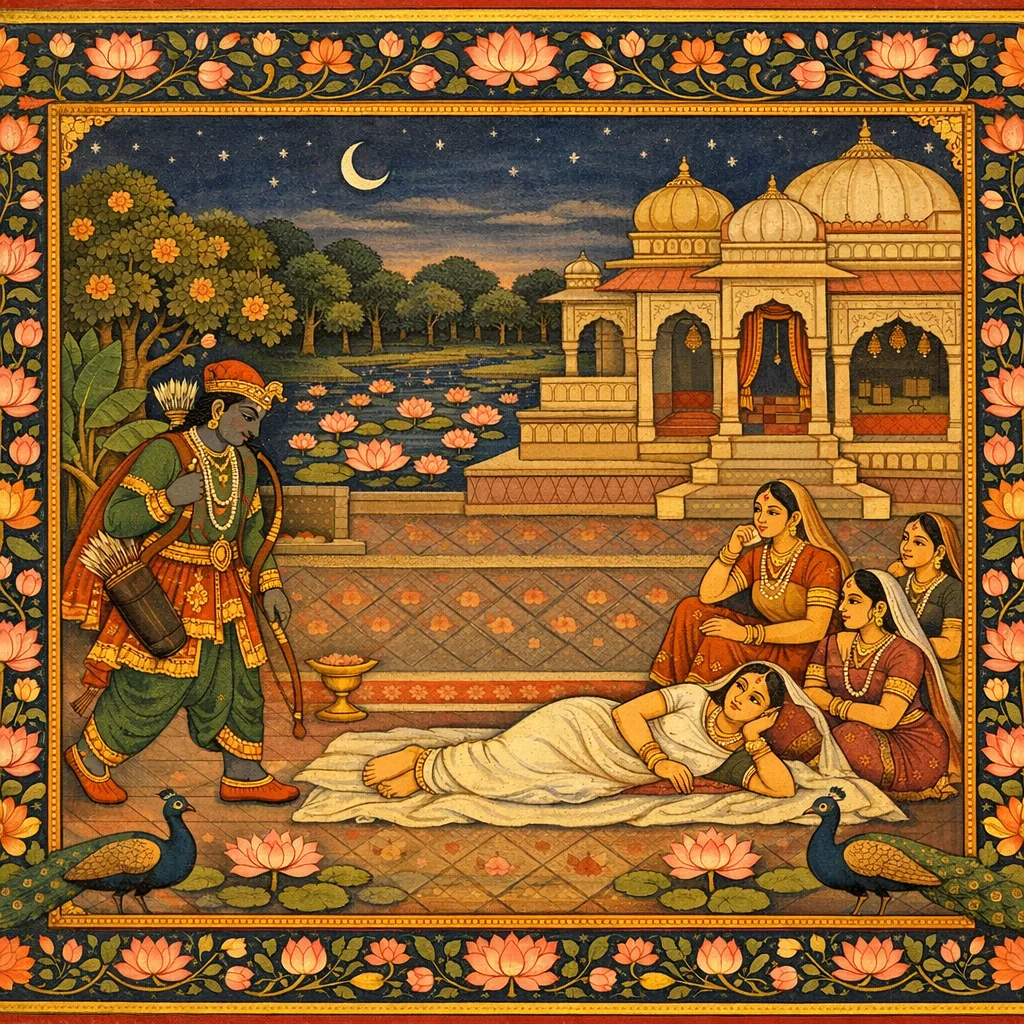
Continuing Nārada’s allegorical instruction to King Prācīnabarhiṣat, this chapter opens with a dense symbolic account of King Purañjana’s chariot-journey to the forest Pañca-prastha—an encoded portrait of embodied life: body, senses, mind, prāṇas, and the guṇic machinery that carries the jīva into experience. Overcome by rājasic-tāmasic impulse, Purañjana leaves his queen and hunts, killing animals mercilessly; Nārada clarifies dharma, noting that śāstra restricts animal-killing to sacrificial limits (yajña) to curb passion and ignorance, while whimsical violence binds one to karma and repeated birth. Exhausted, the king returns, refreshes himself, and, as if struck by Kāma, seeks his queen as the source of domestic satisfaction. Finding her lying like a mendicant, he is bewildered and tries to appease her—touching her feet, flattering, offering protection, and confessing his offense of hunting without her consent. The chapter thus bridges the allegory from outward sense-expansion (forest enjoyment/violence) to inward dependence on the “queen” (intelligence/attachment), preparing for the next unfolding of the meanings of queen, city, and bondage.
Shlokas
Verse 1
नारद उवाच स एकदा महेष्वासो रथं पञ्चाश्वमाशुगम् । द्वीषं द्विचक्रमेकाक्षं त्रिवेणुं पञ्चबन्धुरम् ॥ १ ॥ एकरश्म्येकदमनमेकनीडं द्विकूबरम् । पञ्चप्रहरणं सप्तवरूथं पञ्चविक्रमम् ॥ २ ॥ हैमोपस्करमारुह्य स्वर्णवर्माक्षयेषुधि: । एकादशचमूनाथ: पञ्चप्रस्थमगाद्वनम् ॥ ३ ॥
Nārada said: O King, once the mighty archer King Purañjana, clad in golden armor and bearing a quiver of inexhaustible arrows, mounted a chariot adorned with gold. Drawn by five swift horses and accompanied by eleven commanders, he went to the forest called Pañca-prastha. That chariot had two wheels and a single revolving axle; three flags, one rein, one charioteer, one seat, two poles for the harness, five weapons, and seven coverings. It moved in five ways, and before it lay five obstacles.
Verse 2
नारद उवाच स एकदा महेष्वासो रथं पञ्चाश्वमाशुगम् । द्वीषं द्विचक्रमेकाक्षं त्रिवेणुं पञ्चबन्धुरम् ॥ १ ॥ एकरश्म्येकदमनमेकनीडं द्विकूबरम् । पञ्चप्रहरणं सप्तवरूथं पञ्चविक्रमम् ॥ २ ॥ हैमोपस्करमारुह्य स्वर्णवर्माक्षयेषुधि: । एकादशचमूनाथ: पञ्चप्रस्थमगाद्वनम् ॥ ३ ॥
Nārada said: O King, once the mighty archer King Purañjana, clad in golden armor and bearing an inexhaustible quiver, accompanied by eleven commanders, mounted a gold-adorned chariot drawn by five swift horses and went to the forest called Pañca-prastha. That chariot had two wheels and a single axle, three banners, one rein, one charioteer, one seat, two yoke-poles, five weapons, seven coverings, five modes of movement, and five obstacles before it.
Verse 3
नारद उवाच स एकदा महेष्वासो रथं पञ्चाश्वमाशुगम् । द्वीषं द्विचक्रमेकाक्षं त्रिवेणुं पञ्चबन्धुरम् ॥ १ ॥ एकरश्म्येकदमनमेकनीडं द्विकूबरम् । पञ्चप्रहरणं सप्तवरूथं पञ्चविक्रमम् ॥ २ ॥ हैमोपस्करमारुह्य स्वर्णवर्माक्षयेषुधि: । एकादशचमूनाथ: पञ्चप्रस्थमगाद्वनम् ॥ ३ ॥
Nārada continued: O ruler, Purañjana mounted the gold-ornamented chariot drawn by five swift horses. Wearing golden armor and carrying an inexhaustible quiver, and accompanied by eleven commanders, he set out for the forest of Pañca-prastha; the chariot’s features—two wheels, one axle, three banners, one rein, and the rest—were as previously described.
Verse 4
चचार मृगयां तत्र दृप्त आत्तेषुकार्मुक: । विहाय जायामतदर्हां मृगव्यसनलालस: ॥ ४ ॥
There he proudly took up bow and arrows and roamed in pursuit of the hunt. Burning with craving for the pastime of killing game, he neglected his queen—whom he could scarcely bear to leave—and went into the forest without regard for her.
Verse 5
आसुरीं वृत्तिमाश्रित्य घोरात्मा निरनुग्रह: । न्यहनन्निशितैर्बाणैर्वनेषु वनगोचरान् ॥ ५ ॥
At that time, swayed by demoniac tendencies, he became fierce-hearted and devoid of mercy. With sharp arrows he slew many innocent animals that roamed the forest, showing no consideration at all.
Verse 6
तीर्थेषु प्रतिदृष्टेषु राजा मेध्यान् पशून् वने । यावदर्थमलं लुब्धो हन्यादिति नियम्यते ॥ ६ ॥
The scriptures lay down this rule: if a king is overly drawn to eating flesh, then, in accordance with the Vedic directions for sacrifice, after visiting holy places he may go to the forest and kill only such ‘medhya’ animals—fit for offering—as are required. Unnecessary or unrestricted slaughter is not permitted. The Vedas regulate animal-killing to curb the wasteful excess of the foolish, driven by passion and ignorance.
Verse 7
य एवं कर्म नियतं विद्वान् कुर्वीत मानव: । कर्मणा तेन राजेन्द्र ज्ञानेन न स लिप्यते ॥ ७ ॥
Nārada Muni continued to speak to King Prācīnabarhiṣat: My dear King, any person who works according to the directions of the Vedic scriptures does not become involved in fruitive activities.
Verse 8
अन्यथा कर्म कुर्वाणो मानारूढो निबध्यते । गुणप्रवाहपतितो नष्टप्रज्ञो व्रजत्यध: ॥ ८ ॥
Otherwise, a person who acts whimsically falls down due to false prestige. Thus he becomes involved in the laws of nature, which are composed of the three qualities. In this way a living entity becomes devoid of his real intelligence and becomes perpetually lost in the cycle of birth and death.
Verse 9
तत्र निर्भिन्नगात्राणां चित्रवाजै: शिलीमुखै: । विप्लवोऽभूद्दु:खितानां दु:सह: करुणात्मनाम् ॥ ९ ॥
When King Purañjana was hunting in this way, many animals within the forest lost their lives with great pain, being pierced by the sharp arrowheads. Upon seeing these devastating, ghastly activities performed by the King, all the people who were merciful by nature became very unhappy.
Verse 10
शशान् वराहान् महिषान् गवयान् रुरुशल्यकान् । मेध्यानन्यांश्च विविधान् विनिघ्नन् श्रममध्यगात् ॥ १० ॥
In this way King Purañjana killed many animals, including rabbits, boars, buffalo, bison, black deer, porcupines and other game animals. After killing and killing, the King became very tired.
Verse 11
तत: क्षुत्तृट्परिश्रान्तो निवृत्तो गृहमेयिवान् । कृतस्नानोचिताहार: संविवेश गतक्लम: ॥ ११ ॥
After this, the King, very much fatigued, hungry and thirsty, returned to his royal palace. After returning, he took a bath and had an appropriate dinner. Then he took rest and thus became freed from all restlessness.
Verse 12
आत्मानमर्हयां चक्रे धूपालेपस्रगादिभि: । साध्वलङ्कृतसर्वाङ्गो महिष्यामादधे मन: ॥ १२ ॥
Thereafter King Purañjana adorned his body with incense, fragrant sandal paste, and garlands of flowers. Thus refreshed and fully ornamented, he turned his mind to seeking his queen.
Verse 13
तृप्तो हृष्ट: सुदृप्तश्च कन्दर्पाकृष्टमानस: । न व्यचष्ट वरारोहां गृहिणीं गृहमेधिनीम् ॥ १३ ॥
Having eaten and become satisfied, King Purañjana felt joy and a touch of pride. Rather than rising to higher consciousness, his mind was drawn by Kandarpa (Cupid), and he longed to find his wife, who sustained his contentment in household life.
Verse 14
अन्त:पुरस्त्रियोऽपृच्छद्विमना इव वेदिषत् । अपि व: कुशलं रामा: सेश्वरीणां यथा पुरा ॥ १४ ॥
At that time King Purañjana, feeling somewhat anxious, inquired of the women of the inner palace: “O lovely ladies, are you and your mistress (the queen) well and happy, as before?”
Verse 15
न तथैतर्हि रोचन्ते गृहेषु गृहसम्पद: । यदि न स्याद्गृहे माता पत्नी वा पतिदेवता । व्यङ्गे रथ इव प्राज्ञ: को नामासीत दीनवत् ॥ १५ ॥
King Purañjana said: “Now the opulences of my home no longer please me as before. If there is neither a mother nor a devoted wife who honors her husband as pati-devatā, that home is like a chariot without wheels—what fool would sit upon such a useless chariot?”
Verse 16
क्व वर्तते सा ललना मज्जन्तं व्यसनार्णवे । या मामुद्धरते प्रज्ञां दीपयन्ती पदे पदे ॥ १६ ॥
Where is that lovely woman who always delivers me when I am drowning in the ocean of calamity? At every step she kindles my good intelligence and saves me—please tell me where she is.
Verse 17
रामा ऊचु: नरनाथ न जानीमस्त्वत्प्रिया यद्वयवस्यति । भूतले निरवस्तारे शयानां पश्य शत्रुहन् ॥ १७ ॥
All the women said: “O lord of the citizens, we do not know why your beloved queen has taken up such a condition. O slayer of enemies, please look—she lies upon the bare earth without any bedding. We cannot understand why she acts this way.”
Verse 18
नारद उवाच पुरञ्जन: स्वमहिषीं निरीक्ष्यावधुतां भुवि । तत्सङ्गोन्मथितज्ञानो वैक्लव्यं परमं ययौ ॥ १८ ॥
Nārada said: “O King Prācīnabarhi, as soon as Purañjana saw his queen lying on the ground like a renunciant mendicant, his understanding was shaken by attachment, and he fell into the deepest bewilderment.”
Verse 19
सान्त्वयन् श्लक्ष्णया वाचा हृदयेन विदूयता । प्रेयस्या: स्नेहसंरम्भलिङ्गमात्मनि नाभ्यगात् ॥ १९ ॥
With a heart pained by grief, the King spoke to his wife in very gentle, pleasing words to console her. Though filled with regret and trying to pacify her, he could not perceive in his beloved’s heart any sign of anger born of love.
Verse 20
अनुनिन्येऽथ शनकैर्वीरोऽनुनयकोविद: । पस्पर्श पादयुगलमाह चोत्सङ्गलालिताम् ॥ २० ॥
Then the heroic King, skilled in gentle persuasion, began to pacify his Queen very slowly. First he touched her two feet, then embraced her tenderly, seated her upon his lap, and began to speak as follows.
Verse 21
पुरञ्जन उवाच नूनं त्वकृतपुण्यास्ते भृत्या येष्वीश्वरा: शुभे । कृताग:स्वात्मसात्कृत्वा शिक्षादण्डं न युञ्जते ॥ २१ ॥
King Purañjana said: “My auspicious, beautiful wife, when a master accepts a servant as his own, yet does not administer a corrective punishment for the servant’s offenses, that servant must be deemed unfortunate—poor in merit.”
Verse 22
परमोऽनुग्रहो दण्डो भृत्येषु प्रभुणार्पित: । बालो न वेद तत्तन्वि बन्धुकृत्यममर्षण: ॥ २२ ॥
My slender maiden, when a master chastises his servant, the servant should accept it as the highest mercy. One who grows angry is foolish, not knowing that such correction is a friend’s duty.
Verse 23
सा त्वं मुखं सुदति सुभ्र्वनुरागभार व्रीडाविलम्बविलसद्धसितावलोकम् । नीलालकालिभिरुपस्कृतमुन्नसं न: स्वानां प्रदर्शय मनस्विनि वल्गुवाक्यम् ॥ २३ ॥
My wife of lovely teeth and brows, show me your face—your smiling glance, delayed by shyness and laden with love—adorned with blue-black hair and a lifted nose, and speak to me sweetly. Abandon your anger and be merciful to me.
Verse 24
तस्मिन्दधे दममहं तव वीरपत्नि योऽन्यत्र भूसुरकुलात्कृतकिल्बिषस्तम् । पश्ये न वीतभयमुन्मुदितं त्रिलोक्या- मन्यत्र वै मुररिपोरितरत्र दासात् ॥ २४ ॥
O hero’s wife, if anyone has offended you, tell me. So long as he is not of the brāhmaṇa caste, I am ready to punish him. But for one who dares against a servant of Muraripu, Śrī Kṛṣṇa, I forgive no one within or beyond the three worlds.
Verse 25
वक्त्रं न ते वितिलकं मलिनं विहर्षं संरम्भभीममविमृष्टमपेतरागम् । पश्ये स्तनावपि शुचोपहतौ सुजातौ बिम्बाधरं विगतकुङ्कुमपङ्करागम् ॥ २५ ॥
My dear wife, until today I have never seen your face without tilaka, nor have I seen it so dull and sorrowful—fearsome with anger, unadorned, and devoid of affection. Never before have I seen your lovely breasts wet with tears, nor your bimba-red lips bereft of their kumkum hue.
Verse 26
तन्मे प्रसीद सुहृद: कृतकिल्बिषस्य स्वैरं गतस्य मृगयां व्यसनातुरस्य । का देवरं वशगतं कुसुमास्त्रवेग विस्रस्तपौंस्नमुशती न भजेत कृत्ये ॥ २६ ॥
My Queen, driven by sinful desire I went to the forest to hunt without asking you; thus I admit I have offended you. Still, please be pleased with me, considering me your most intimate subordinate. I am truly bereft, yet pierced by Kāma’s flower-arrow I burn with lust—what beautiful woman would refuse union with her passion-stricken husband who is under her sway?
Frequently Asked Questions
The chariot functions as an allegorical schematic of embodied existence: the living entity rides within a constructed vehicle of body and subtle faculties, moved by the life-airs and guided by internal governance (mind/intelligence), while the senses (often indicated by “five” motifs) pull toward their objects. The ornate, detailed inventory signals that bondage is not random but systematized—experience is engineered through the guṇas and the psycho-physical apparatus, which, without devotion, carries the jīva into repeated karmic trajectories.
The chapter distinguishes śāstra-regulated violence within sacrificial frameworks from impulsive killing driven by passion and ignorance. Vedic regulation is portrayed as a restraining pedagogy: it limits and ritualizes tendencies so that the performer gradually becomes purified and less attracted to cruelty and flesh-eating. Whimsical hunting, however, is condemned as guṇa-driven indulgence that hardens the heart, entangles one in karma, and perpetuates saṁsāra.