Adhyaya 23
Gāndhārī’s Battlefield Survey: The Fallen and the Onset of Funeral Rites (शल्य-भगीरथ-भीष्म-द्रोणादि-दर्शनम्)
Upa-parva: Strī-parva — Kurukṣetra-śmaśāna-darśana (Battlefield Viewing and Lamentation Episode)
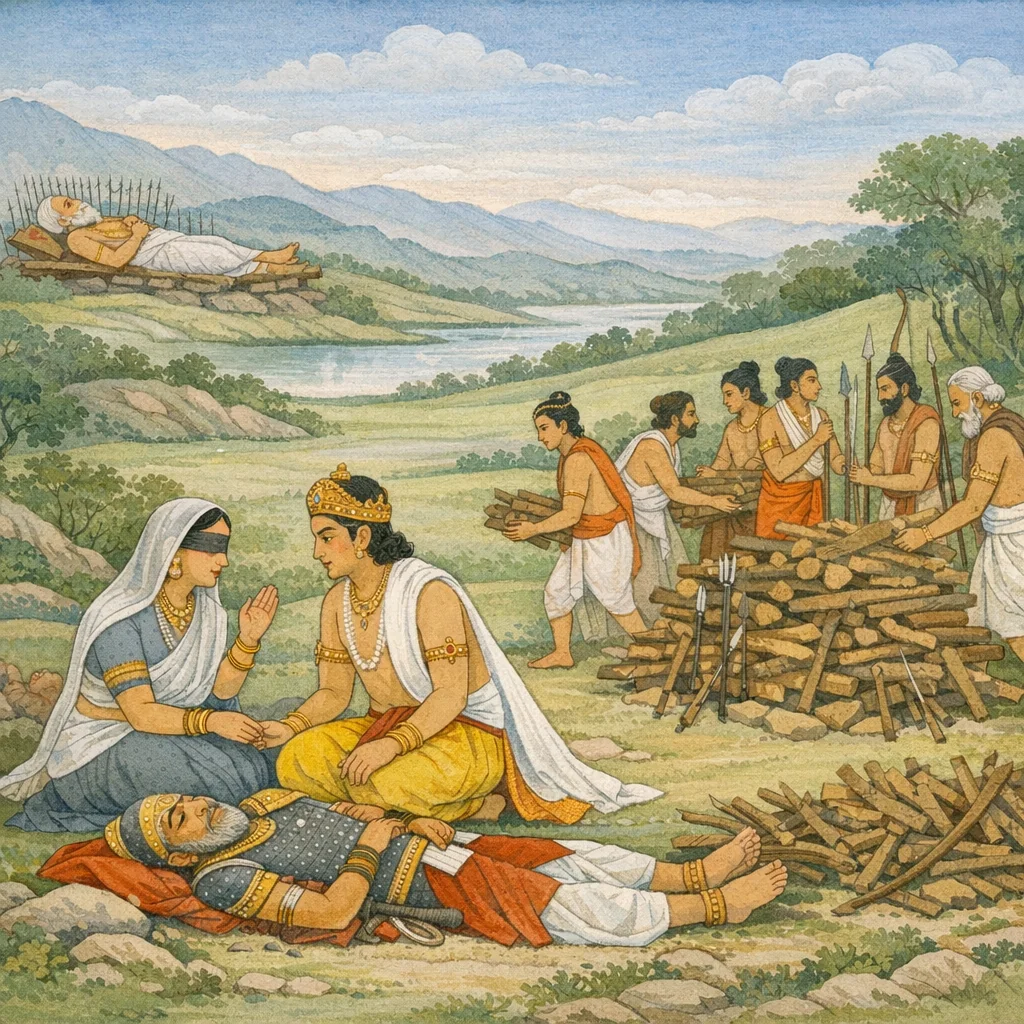
Chapter 23 presents Gāndhārī’s addressed speech (gāndhāryuvāca) to Kṛṣṇa in a scene of battlefield inspection. She points to Śalya—identified as Madrarāja and Nakula’s maternal uncle—lying slain by Yudhiṣṭhira, and notes the lamentation of the women of Madra. The discourse then shifts to other prominent fallen figures: Bhagadatta, described with royal insignia and elephant-war associations, and then Bhīṣma (Śāṃtanava), portrayed on his arrow-bed with imagery of solar radiance and end-of-age descent, including references to Arjuna’s arrangement of supports and arrows. The chapter proceeds to Droṇa’s fall, emphasizing his mastery of weapons and Vedic knowledge, the incongruity of his body being disturbed, and Kṛpī’s grief as she attends her husband. The narrative closes with procedural details of funerary preparation: bringing fire, constructing the pyre, chanting Sāman hymns, and disciples proceeding toward the Gaṅgā after rites, foregrounding ritual order as the immediate response to collective loss.
Chapter Arc: विलाप की धूल में गान्धारी युधिष्ठिर को दिखाती हैं—मद्रराज शल्य का शव, और कटु वाणी में स्मरण कराती हैं कि ‘धर्मराज’ ने ही उसे रण में गिराया। → गान्धारी शल्य के पराक्रम और कर्ण के रथ-सारथ्य का उल्लेख कर युधिष्ठिर के मन में अपराध-बोध को और तीखा करती हैं; फिर भीष्म के शर-शय्या पर पड़े होने का स्मरण कर युद्ध-धर्म की समूची विडम्बना सामने रखती हैं—जहाँ भीष्म जैसे महाबली भी निहत पड़े हों, वहाँ किसे ‘कृती’ या ‘अपराजेय’ कहा जाए? → भीष्म के स्वर्गगमन का संकेत आते ही प्रश्न उठता है—देवव्रत के चले जाने पर कौरव अब धर्म किससे पूछेंगे? इसी क्षण युद्ध की ‘अग्नि-गति’ वाले महावीरों के बुझ जाने का बिम्ब (शान्तार्चि पावक) शोक को चरम पर पहुँचा देता है। → विलाप से कर्मकाण्ड की ओर कथा मुड़ती है: जटाधारी ब्रह्मचारी/द्विजाति द्रोण के लिए चिता सजाते हैं—धनुष, शक्ति, रथ-नीड, विविध शर आदि रखकर; कृपी को अग्र में रखकर द्रोण-शिष्यों द्वारा अग्निहोत्र सहित अन्त्येष्टि की तैयारी/सम्पादन का वर्णन होता है। → चिताओं की अग्नि उठती है, पर शोक का प्रश्न खुला रह जाता है—इतने महापुरुषों के पतन के बाद ‘धर्म’ का उत्तर किसके पास है?
Shlokas
Verse 1
गान्धारी बोलीं--तात! देखो, ये नकुलके सगे मामा शल्य मरे पड़े हैं। इन्हें धर्मके ज्ञाता धर्मराज युधिष्ठिरने युद्धमें मारा है
Gandhārī said, “My child, look—Śalya, Nakula’s maternal uncle, lies here slain. It was Yudhiṣṭhira, the Dharma-king famed for knowing righteousness, who killed him in battle.” The line underscores the bitter irony of war: even those celebrated for dharma become agents of death when bound to the duties and compulsions of the battlefield.
Verse 2
यस्त्वया स्पर्धते नित्य सर्वत्र पुरुषर्षभ । स एष निहतः शेते मद्रराजो महाबल:,पुरुषोत्तम! जो सदा और सर्वत्र तुम्हारे साथ होड़ लगाये रहते थे, वे ही ये महाबली मद्रराज शल्य यहाँ मारे जाकर चिरनिद्रामें सो रहे हैं
Vaiśampāyana said: “O bull among men, he who used to contend with you constantly and in every arena—he, the mighty king of Madra, Śalya, now lies here slain, stretched in the sleep of death.”
Verse 3
येन संगृह्लता तात रथमाधिरथेर्युधि । जयार्थ पाण्डुपुत्राणां तथा तेजोवध: कृत:,तात! ये वे ही शल्य हैं, जिन्होंने युद्धमें सूतपुत्र कर्णके रथकी बागडोर सँभालते समय पाण्डवोंकी विजयके लिये उसके तेज और उत्साहको नष्ट किया था
Vaiśampāyana said: “Dear one, it was he who, in the battle, held the reins of the chariot of the son of a charioteer (Karna). For the sake of the Pāṇḍavas’ victory, he also brought about the destruction of Karna’s ardour and fighting spirit.”
Verse 4
अहो धिक्पश्य शल्यस्य पूर्णचन्द्रसुदर्शनम् । मुखं पद्मपलाशाक्ष काकैरादष्टमव्रणम्,अहो! धिक्कार है। देखो न, शल्यके पूर्ण चन्द्रमाकी भाँति दर्शनीय तथा कमलदलके सदृश नेत्रोंवाले त्रणरहित मुखको कौओंने कुछ-कुछ काट दिया है
Vaiśampāyana said: “Alas, shame! Look—Śalya’s face, once lovely as the full moon, with eyes like lotus petals, unscarred and noble, has now been pecked and torn in places by crows.”
Verse 5
अस्य चामीकराभस्य तप्तकाञउ्चनसप्रभा । आस्याद् विनि:सूृता जिद्दा भक्ष्यते कृष्ण पक्षिभि:,श्रीकृष्ण! सुवर्णके समान कान्तिमान् शल्यके मुखसे तपाये हुए सोनेके समान कान्तिवाली जीभ बाहर निकल आयी है और पक्षी उसे नोच-नोचकर खा रहे हैं
Vaiśampāyana said: “From the mouth of this man, whose body gleams like gold, a tongue—shining like heated, refined gold—has protruded; and dark birds are tearing at it and devouring it.” In the ethical frame of the Strī-parvan’s lament and reckoning after war, the image underscores the moral consequence of speech: words used for deceit, cruelty, or incitement return as suffering, making the tongue itself the site of retribution.
Verse 6
युधिष्ठिरेण निहतं शल्यं समितिशो भनम् । रुदत्य: पर्युपासन्ते मद्रराजं कुलाज्ना:,युधिष्ठिरके द्वारा मारे गये तथा युद्धमें शोभा पानेवाले मद्रराज शल्यको ये कुलांगनाएँ चारों ओरसे घेरकर बैठी हैं और रो रही हैं
Vaiśampāyana said: The women of the Madra clan, weeping, sat all around King Śalya—slain by Yudhiṣṭhira, yet renowned for his splendor in battle—keeping vigil over their fallen lord. The scene underscores the human cost of righteous war: even a king celebrated for martial glory becomes the center of grief when dharma’s conflict reaches its tragic end.
Verse 7
एता: सुसूक्ष्मवसना मद्रराजं॑ नरर्षभम् | क्रोशन्त्यो5थ समासाद्य क्षत्रिया: क्षत्रियर्षभम्,अत्यन्त महीन वस्त्र पहने हुए ये क्षत्राणियाँ क्षत्रिय-शिरोमणि नरश्रेष्ठ मद्रराजके पास आकर कैसा करुण क्रन्दन कर रही हैं
Vaiśampāyana said: Then those Kṣatriya women, clad in exceedingly fine garments, came up to the Madra king—the best of men—and, reaching that foremost of Kṣatriyas, began to cry out in piercing lamentation. The scene underscores the human cost of war: royal status and refined attire cannot shield one from grief, and the duty of rulers is tested amid the suffering of their own people.
Verse 8
शल्यं निपतितं नार्य: परिवार्याभित: स्थिता: । वासिता गृष्टय: पड़के परिमग्नमिव द्विपम्,रणभूमिमें गिरे हुए राजा शल्यको उनकी स्त्रियाँ उसी तरह सब ओरसे घेरे हुए हैं, जैसे एक बारकी ब्यायी हुई हथिनियाँ कीचड़में फँसे हुए गजराजको घेरकर खड़ी हों
Vaiśampāyana said: When King Śalya had fallen on the battlefield, his women stood all around him, enclosing him on every side—like elephants that have recently calved, gathering around their lord who has sunk into the mire. The image underscores the helplessness of the slain hero and the fierce, instinctive loyalty of those bound to him by love and duty, even amid the moral wreckage of war.
Verse 9
शल्यं शरणदं शूरं पश्येमं वृष्णिनन्दन । शयानं वीरशयने शरैविशकलीकृतम्,वृष्णिनन्दन! देखो, ये दूसरोंको शरण देनेवाले शूरवीर शल्य बाणोंसे छिन्न-भिन्न होकर वीरशय्यापर सो रहे हैं
Vaiśaṃpāyana said: “O descendant of the Vṛṣṇis, behold this Śalya—heroic and famed as a giver of refuge—now lying upon the warrior’s bed, his body torn and mangled by arrows.” The line underscores the moral irony of war: even those known for protecting others are reduced to helplessness when adharma-driven violence reaches its end.
Verse 10
एष शैलालयो राजा भगदत्त: प्रतापवान् | गजाड्कुशधर: श्रीमान् शेते भुवि निपातित:,ये पर्वतीय, तेजस्वी एवं प्रतापी राजा भगदत्त हाथमें हाथीका अंकुश लिये पृथ्वीपर सो रहे हैं। इन्हें अर्जुनने मार गिराया था
Vaiśampāyana said: “Here lies King Bhagadatta, the mighty lord of the hill-country—illustrious, renowned for valor, and bearing the elephant-goad in his hand—now struck down and stretched upon the earth. Thus the war’s glory is shown to be fragile: even a celebrated ruler, once a protector of his people, is reduced to a lifeless body, reminding the listener of the terrible cost that adharma-driven conflict exacts from all sides.”
Verse 11
यस्य रुक्ममयी माला शिरस्थेषा विराजते । श्वापदेर्भक्ष्य्माणस्य शोभयन्तीव मूर्थजान्,इन्हें हिंसक जीव-जन्तु खा रहे हैं। इनके सिरपर यह सोनेकी माला विराज रही है, जो केशोंकी शोभा बढ़ाती-सी जान पड़ती है
Vaiśampāyana said: “Upon his head there gleams a garland wrought of gold, as though it were adorning his hair—yet he lies being devoured by wild beasts.”
Verse 12
एतेन किल पार्थस्य युद्धमासीत् सुदारुणम् । रोमहर्षणमत्युग्रं शक्रस्य त्वहिना यथा,जैसे वृत्रासुरके साथ इन्द्रका अत्यन्त भयंकर संग्राम हुआ था, उसी प्रकार इन भगदत्तके साथ कुन्तीकुमार अर्जुनका अत्यन्त दारुण एवं रोमांचकारी युद्ध हुआ था
Vaiśampāyana said: “Indeed, with this man, Pārtha’s battle was exceedingly dreadful—hair-raising and fiercely intense—just as Indra’s most terrible combat once was with the serpent-like foe (Vṛtra).”
Verse 13
योधयित्वा महाबाहुरेष पार्थ धनंजयम् | संशयं गमयित्वा च कुन्तीपुत्रेण पातित:,उन महाबाहुने कुन्तीकुमार धनंजयके साथ युद्ध करके उन्हें संशयमें डाल दिया था; परंतु अन्तमें ये उन कुन्तीकुमारके ही हाथसे मारे गये
Vaiśampāyana said: Having fought with Pārtha Dhanañjaya (Arjuna), this mighty-armed warrior threw him into doubt and uncertainty; yet in the end he was struck down by that very son of Kuntī. The verse underscores a grim ethical irony of war: even when a combatant can unsettle a righteous hero’s resolve, the moral order of the battlefield still culminates in the inevitable consequence of one’s chosen hostility.
Verse 14
यस्य नास्ति समो लोके शौर्ये वीर्ये च कश्नन । स एष निहत:ः शेते भीष्मो भीष्मकृताहवे,संसारमें शौर्य और बलमें जिनकी समानता करनेवाला दूसरा कोई नहीं है, वे ही ये युद्धमें भयंकर कर्म करनेवाले भीष्मजी घायल हो बाणशय्यापर सो रहे हैं
Vaiśaṃpāyana said: “In this world there is none equal to him in valor and strength. Yet that very Bhīṣma—whose deeds in battle were terrible—now lies struck down, resting upon a bed of arrows.” The verse underscores the moral gravity of war: even the greatest warrior, renowned for unmatched prowess, is brought low by the inexorable consequences of conflict and fate.
Verse 15
पश्य शान्तनवं कृष्ण शयान सूर्यवर्चसम् । युगान्त इव कालेन पतितं सूर्यमम्बरात्,श्रीकृष्ण! देखो, ये सूर्यके समान तेजस्वी शान्तनुनन्दन भीष्म कैसे सो रहे हैं, ऐसा जान पड़ता है, मानो प्रलयकालमें कालसे प्रेरित हो सूर्यदेव आकाशसे भूमिपर गिर पड़े हैं
Vaiśampāyana said: “Behold, O Kṛṣṇa, Śāntanu’s son lying there, radiant like the sun. He appears like the sun itself fallen from the sky, as if at the end of an age, hurled down by Time.” The image underscores the moral shock of war: even the most venerable and luminous upholder of dharma can be brought low when the wheel of kāla turns, inviting reflection on impermanence, duty, and the cost of violence.
Verse 16
एष तप्त्वा रणे शत्रून् शस्त्रतापेन वीर्यवान् । नरसूर्यो5स्तमभ्येति सूर्योडस्तमिव केशव,केशव! जैसे सूर्य सारे जगत्को ताप देकर अस्ताचलको चले जाते हैं, उसी तरह ये पराक्रमी मानवसूर्य रणभूमिमें अपने शस्त्रोंके प्रतापसे शत्रुओंकी संतप्त करके अस्त हो रहे हैं
Verse 17
शरतल्पगतं भीष्ममूर्थ्वरेतसमच्युतम् । शयानं वीरशयने पश्य शूरनिषेविते,जो ऊध्वरेता ब्रह्मचारी रहकर कभी मर्यादासे च्युत नहीं हुए हैं, उन भीष्मको शूरसेवित वीरोचित शयन बाणशय्यापर सोते हुए देख लो
Vaiśampāyana said: “Behold Bhīṣma lying upon the bed of arrows—one who has remained steadfast in brahmacarya, his vital energy held upward, never swerving from his vowed restraint—resting on a hero’s couch, attended and honored by warriors.”
Verse 18
कर्णिनालीकनाराचैरास्तीर्य शयनोत्तमम् | आविश्य शेते भगवान् स्कन्द: शरवर्ण यथा,जैसे भगवान् स्कन्द सरकण्डोंके समूहपर सोये थे, उसी प्रकार ये भीष्मजी कर्णी, नालीक और नाराच आदि बाणोंकी उत्तम शय्या बिछाकर उसीका आश्रय ले सो रहे हैं
Vaiśampāyana said: Having spread out an excellent bed made of karṇin, nālīka, and nārāca arrows, he lies upon it and rests—just as the divine Skanda once slept upon a bed of reeds. The image underscores a warrior’s endurance and the austere dignity of suffering borne without complaint amid the aftermath of war.
Verse 19
अतूलपूर्ण गाड़्नेयस्त्रिभि्बाणै: समन्वितम् | उपधायोपधानाग्रयं दत्तं गाण्डीवधन्चना,इन गंगानन्दन भीष्मने रुई भरा हुआ तकिया नहीं लिया है। इन्होंने तो गाण्डीवधारी अर्जुनके दिये हुए तीन बाणोंद्वारा निर्मित श्रेष्ठ उपधान (तकिये)-को ही स्वीकार किया है
Vaiśampāyana said: Bhīṣma did not accept a pillow stuffed with cotton. Instead, he accepted as his headrest the finest support fashioned from three arrows, given by Arjuna, the wielder of the Gāṇḍīva. The scene underscores austere acceptance and warrior-dharma even amid suffering: comfort is not sought through luxury, but through what accords with one’s station and the solemnity of the moment.
Verse 20
पालयान: पितु: शास्त्रमूर्ध्वरेता महायशा: । एष शान्तनव: शेते माधवाप्रतिमो युधि,माधव! पिताकी आज्ञाका पालन करते हुए महायशस्वी नैछ्लिक ब्रह्मचारी ये शान्तनुनन्दन भीष्म जिनकी युद्धमें कहीं तुलना नहीं है, यहाँ सो रहे हैं
Vaiśaṃpāyana said: “Upholding his father’s command, a lifelong celibate of great renown—this son of Śāntanu, Bhīṣma, unrivalled in battle—now lies here.” The line underscores the ethical weight of filial obedience and vowed self-restraint, even as the warrior who embodied them has fallen on the battlefield.
Verse 21
धर्मात्मा तात सर्वज्ञ: पारावर्येण निर्णये । अमर्त्य इव मर्त्य: सन्नेष प्राणानधारयत्,तात! ये धर्मात्मा और सर्वज्ञ हैं। परलोक और इहलोकसम्बन्धी ज्ञानद्वारा सभी आध्यात्मिक प्रश्नोंका निर्णय करनेमें समर्थ हैं तथा मनुष्य होनेपर भी देवताके तुल्य हैं; इन्होंने अभीतक अपने प्राण धारण कर रखे हैं
Vaiśampāyana said: “Dear child, this man is righteous in spirit and all-knowing. By his discernment of both ‘this shore and the far shore’—the matters of this world and the next—he is capable of settling spiritual questions. Though human, he is like an immortal; and even now, dear one, he has continued to sustain his life-breath.”
Verse 22
नास्ति युद्धे कृती कश्रिन्न विद्वान् न पराक्रमी | यत्र शान्तनवो भीष्म: शेतेडद्य निहत: शरै:,जब ये शान्तनुनन्दन भीष्म भी आज शत्रुओंके बाणोंसे मारे जाकर सो रहे हैं तो यही कहना पड़ता है कि 'युद्धमें न कोई कुशल है, न विद्वान् है और न पराक्रमी ही है”
Vaiśampāyana said: In war there is no one who can truly be called skilled, learned, or even genuinely heroic—when Bhīṣma, the son of Śāntanu, lies today brought down by arrows. The scene itself condemns the pride of warfare: if such a righteous and mighty elder can be reduced to a bed of shafts, then victory and prowess appear hollow, and the moral cost of battle stands exposed.
Verse 23
स्वयमेतेन शूरेण पृच्छयमानेन पाण्डवै: । धर्मज्ञेनाहवे मृत्युरादिष्ट: सत्यवादिना,पाण्डवोंके पूछनेपर इन धर्मज्ञ एवं सत्यवादी शूरवीरने स्वयं ही अपनी मृत्युका उपाय बता दिया था इति श्रीमहाभारते स्त्रीपर्वणि स्त्रीविलापपर्वणि गान्धारीवचने त्रयोविंशो 5ध्याय: ।। २३ || इस प्रकार श्रीमह्याभारत स्त्रीपर्वके अन्तर्गत स्त्रीविलापपर्वमें गान्धारीवचनविषयक तेईसवाँ अध्याय पूरा हुआ
Vaiśaṃpāyana said: When the Pāṇḍavas questioned him, this heroic man—steadfast in truth and skilled in dharma—himself declared the means by which his death was to occur in battle. (Thus ends the twenty-third chapter, ‘Gāndhārī’s Speech’, in the Strīvilāpa-parvan of the Strī-parvan of the Mahābhārata.)
Verse 24
प्रणष्ट: कुरुवंशश्न॒ पुनर्येन समुद्धृत: । स गत: कुरुभि: सार्ध महाबुद्धि: पराभवम्,जिन्होंने नष्ट हुए कुरुवंशका पुनः उद्धार किया था, वे ही परम बुद्धिमान् भीष्म इन कौरवोंके साथ परास्त हो गये
Vaiśampāyana said: He by whom the Kuru lineage, once ruined, had been raised up again—he, the great-minded and supremely wise Bhīṣma—has now met defeat together with the Kurus. The verse underscores the tragic irony of war: even the most discerning elder, who once preserved the dynasty, is brought low when bound to a failing cause and collective adharma.
Verse 25
धर्मेषु कुरव: क॑ नु परिप्रक्ष्यन्ति माधव । गते देवब्ते स्वर्ग देवकल्पे नरर्षभे,माधव! इन देवतुल्य नरश्रेष्ठ देवव्रतके स्वर्गलोकमें चले जानेपर अब कौरव किसके पास जाकर धर्मविषयक प्रश्न करेंगे
Vaiśampāyana said: “O Mādhava, now that Devavrata—Bhīṣma, that bull among men, godlike in stature—has departed for heaven, to whom will the Kauravas go to inquire about dharma?”
Verse 26
अर्जुनस्य विनेतारमाचार्य सात्यकेस्तथा | त॑ं पश्य पतितं द्रोणं कुरूणां गुरुमुत्तमम्,जो अर्जुनके शिक्षक, सात्यकिके आचार्य तथा कौरवोंके श्रेष्ठ गुरु थे, वे द्रोणाचार्य रणभूमिमें गिरे हुए हैं, उन्हें भी देख लो
Vaiśaṃpāyana said: “Behold Droṇa fallen on the battlefield—he who was Arjuna’s disciplinarian and teacher, and likewise the preceptor of Sātyaki; the foremost guru of the Kurus. Look upon him as well.”
Verse 27
अस्त्रं चतुर्विधं वेद यथैव त्रिदशेश्वर: । भार्गवो वा महावीर्यस्तथा द्रोणो5पि माधव,माधव! जैसे देवराज इन्द्र अथवा महापराक्रमी परशुरामजी चार प्रकारकी अस्त्रविद्याको जानते हैं, उसी प्रकार द्रोणाचार्य भी जानते थे
Vaiśampāyana said: “Just as the lord of the gods, Indra, knows the fourfold science of weapons—or as the mighty Bhārgava (Paraśurāma) knows it—so too did Droṇācārya, O Mādhava.” In the grief-laden aftermath of war, this remark underscores how immense martial mastery existed on the battlefield, yet such power, when yoked to conflict and partiality, becomes a cause of vast suffering rather than protection of dharma.
Verse 28
यस्य प्रसादाद् वीभत्सु: पाण्डव: कर्म दुष्करम् | चकार स हत:ः शेते नैनमस्त्राण्यपालयन्,जिनके प्रसादसे पाण्डुनन्दन अर्जुनने दुष्कर कर्म किया है, वे ही आचार्य यहाँ मरे पड़े हैं। उन अस्त्रोंने इनकी रक्षा नहीं की
Vaiśampāyana said: “By whose favor Vībhatsu (Arjuna), the son of Pāṇḍu, accomplished deeds that were nearly impossible—he, that very teacher, now lies here slain. Not even his weapons protected him.”
Verse 29
यं पुरोधाय कुरव आह्वयन्ति सम पाण्डवान् | सो<यं शस्त्रभतां श्रेष्ठो द्रोण: शस्त्रै: परिक्षत:,जिनको आगे रखकर कौरव पाण्डवोंको ललकारा करते थे, वे ही शस्त्रधारियोंमें श्रेष्ठ द्रोणाचार्य शस्त्रोंसे क्षत-विक्षत हो गये हैं
Vaiśampāyana said: “He whom the Kurus placed at their forefront to challenge the Pāṇḍavas—Drona himself, the foremost among weapon-bearers—now lies torn and wounded by weapons.” The verse underscores the moral reversal of war: even the greatest masters of arms are brought low, revealing the fragility of worldly power and the tragic cost of adharma-driven conflict.
Verse 30
यस्य निर्दहतः सेनां गतिरग्नेरिवाभवत् | स भूमौ निहतः शेते शान्तार्चिरिव पावक:,शत्रुओंकी सेनाको दग्ध करते समय जिनकी गति अग्निके समान होती थी, वे ही बुझी हुई लपटोंवाली आगके समान मरकर पृथ्वीपर पड़े हैं
Vaiśampāyana said: “He whose onrush, while burning the enemy host, was like the very course of fire—he now lies slain upon the earth, like a fire whose flames have been quenched.” The verse underscores the moral reversal of war: even the most formidable power, once used to consume armies, ends in silence and stillness, inviting reflection on the futility of pride and the inevitability of death.
Verse 31
धनुर्मष्टिरशीर्णश्व हस्तावापश्च माधव । द्रोणस्य निहतस्याजौ दृश्यते जीवतो यथा,माधव! युद्धमें मारे जानेपर भी द्रोणाचार्यके धनुषके साथ जुड़ी हुई मुट्ठी ढीली नहीं हुई है। दस्ताना भी ज्यों-का-त्यों दिखायी देता है, मानो वह जीवित पुरुषके हाथमें हो
Vaiśampāyana said: “O Mādhava, even though Droṇa has been slain on the battlefield, the bow-grip in his hand has not slackened; the glove and the hand-guard appear exactly as they were—so that it looks as if they were still on the hand of a living man.” The line underscores the grim dignity of a warrior’s end and the unsettling persistence of martial resolve even after death, intensifying the ethical sorrow that pervades the aftermath of war.
Verse 32
वेदा यस्माच्च चत्वार: सर्वाण्यस्त्राणि केशव । अनपेतानि वै शूराद् यथैवादौ प्रजापते:,केशव! जैसे पूर्वकालसे ही प्रजापति ब्रह्मासे वेद कभी अलग नहीं हुए, उसी प्रकार जिन शूरवीर द्रोणसे चारों वेद और सम्पूर्ण अस्त्र-शस्त्र कभी दूर नहीं हुए, उन्हींके बन्दीजनोंद्वारा वन्दित इन दोनों सुन्दर एवं वन्दनीय चरणारविन्दोंको जिनकी सैकड़ों शिष्य पूजा कर चुके हैं, गीदड़ घसीट रहे हैं
Vaiśampāyana said: “O Keśava, just as in the beginning the Vedas never became separated from Prajāpati (Brahmā), so too from that heroic Droṇa the four Vedas and all weapons and martial sciences never departed. Yet those very feet—beautiful as lotuses, worthy of reverence, praised by bards and worshipped by hundreds of disciples—are now being dragged about by jackals.”
Verse 33
वन्दनाहाविमौ तस्य बन्दिभिव्वन्दितो शुभौ | गोमायवो विकर्षन्ति पादौ शिष्यशतार्चितौ,केशव! जैसे पूर्वकालसे ही प्रजापति ब्रह्मासे वेद कभी अलग नहीं हुए, उसी प्रकार जिन शूरवीर द्रोणसे चारों वेद और सम्पूर्ण अस्त्र-शस्त्र कभी दूर नहीं हुए, उन्हींके बन्दीजनोंद्वारा वन्दित इन दोनों सुन्दर एवं वन्दनीय चरणारविन्दोंको जिनकी सैकड़ों शिष्य पूजा कर चुके हैं, गीदड़ घसीट रहे हैं
Vaiśampāyana said: O Keśava, these two auspicious feet—worthy of reverence—once praised by bards and worshipped by hundreds of disciples, are now being dragged by jackals. Just as in ancient times the Vedas were never separated from Prajāpati Brahmā, so too the four Vedas and the complete science of weapons were never apart from that heroic Droṇa; yet even such a teacher’s revered feet have fallen to this pitiful fate. The passage underscores the moral shock of war’s aftermath: learning, sanctity, and honor are rendered helpless before the violence and desecration that follow adharma and slaughter.
Verse 34
द्रोणं द्रपदपुत्रेण निहत॑ं मधुसूदन । कृपी कृपणमन्वास्ते दुःखोपहतचेतना,मधुसूदन! द्रुपदपुत्रके द्वारा मारे गये द्रोणाचार्यके पास उनकी पत्नी कृपी बड़े दीनभावसे बैठी है। दुःखसे उसकी चेतना लुप्त-सी हो गयी है
Vaiśampāyana said: “O Madhusūdana, Droṇa has been slain by Drupada’s son. His wife Kṛpī sits beside him in utter wretchedness, her mind struck down and nearly insensible with grief.” The verse underscores the human cost of war: even the fall of a mighty teacher culminates in the private devastation of those bound by love and duty.
Verse 35
तां पश्य रुदतीमार्ता मुक्तकेशीमधोमुखीम् । हतं पतिमुपासन्तीं द्रोणं शस्त्रभृतां वरम्,देखो, कृपी केश खोले नीचे मुँह किये रोती हुई अपने मारे गये पति शस्त्रधारियोंमें श्रेष्ठ द्रोणाचार्यकी उपासना कर रही है
Behold her—Kṛpī—overwhelmed with anguish, weeping with her hair unbound and her face cast down, keeping vigil beside her slain husband, Droṇa, the foremost among weapon-bearers. The scene underscores the human cost of war: even the greatest warrior is reduced to a lifeless body, and the living are left to mourn, honor, and endure the consequences of violence.
Verse 36
बाणैभिन्नतनुत्राणं धृष्टद्युम्नेन केशव । उपास्ते वै मृथे द्रोणं जटिला ब्रह्मबचारिणी,केशव! धृष्टद्युम्नने अपने बाणोंसे जिन आचार्य द्रोणका कवच छिजन्न-भिन्न कर दिया है, उन्हींके पास युद्धस्थलमें वह जटाधारिणी ब्रह्मचारिणी कृपी बैठी हुई है
Vaiśampāyana said: O Keśava, on the battlefield the ascetic lady Kṛpī—wearing matted locks and observing brahmacarya—sits close by Droṇa, whose armour has been torn and shattered by Dhṛṣṭadyumna’s arrows. The scene underscores the human cost of war: even the most renowned teacher, brought down in combat, becomes the object of a grieving wife’s austere vigil amid the carnage.
Verse 37
प्रेतकृत्यं च यतते कृपी कृपणमातुरा । हतस्य समरे भर्तु: सुकुमारी यशस्विनी,शोकसे दीन और आतुर हुई यशस्विनी सुकुमारी कृपी समरमें मारे गये पतिदेवका प्रेतकर्म करनेकी चेष्टा कर रही है
Vaiśaṃpāyana said: Grief-stricken and distressed, the gentle and renowned Kṛpī strove to perform the funerary rites for her husband, who had been slain in battle. In the aftermath of war, her effort embodies the dharmic duty of honoring the dead even amid overwhelming sorrow.
Verse 38
अग्नीनाधाय विधिवच्चितां प्रज्वाल्य सर्वतः । द्रोणमाधाय गायन्ति त्रीणि सामानि सामगा:,विधिपूर्वक अग्निकी स्थापना करके चिताको सब ओरसे प्रज्वलित कर दिया गया है और उसपर द्रोणाचार्यके शरीरको रखकर सामगान करनेवाले ब्राह्मण त्रिविध सामका गान करते हैं
Vaiśampāyana said: “Having ritually established the sacred fires according to rule, they kindled the funeral pyre on every side. Then, placing Droṇa upon it, the chanters of the Sāman hymns sang the threefold Sāman—performing the rites in due order.”
Verse 39
कुर्वन्ति च चितामेते जटिला ब्रह्म॒चारिण: । भनुर्भि: शक्तिभिश्वैव रथनीडैश्व माधव
Vaiśampāyana said: “These ascetic, matted-haired brahmacārins are also preparing the funeral pyre—equipped with bows, with spears, and even with chariots, O Mādhava.” The line underscores how, in the aftermath of war, even those devoted to restraint and religious discipline are drawn into the grim duties of death-rites, and how the instruments of battle remain present amid acts meant to restore order and dignity to the fallen.
Verse 40
शरैश्न विविधैरन्यैर्थक्ष्यते भूरितेजसम् । इति द्रोणं समाधाय शंसन्ति च रुदन्ति च
Vaiśampāyana said: “With many other kinds of arrows as well, the mighty one of great splendor is being cut down.” Saying this, they laid Drona out (for the final rites), speaking of him and lamenting—praising his greatness even as they wept over the ruin that war brings upon the noble.
Verse 41
सामभिस्त्रिभिरन्तस्थैरनुशंसन्ति चापरे । माधव! इन जटाधारी ब्रह्मचारियोंने धनुष, शक्ति, रथकी बैठक और नाना प्रकारके बाण तथा अन्य आवश्यक वस्तुओंसे उस चिताका निर्माण किया है। वे उसीपर महातेजस्वी ट्रोणको जलाना चाहते थे; इसलिये द्रोणको चितापर रखकर वे वेदमन्त्र पढ़ते और रोते हैं, कुछ लोग अन्त समयमें उपयोगी त्रिविध सामोंका गान करते हैं || ३९-४० ई ।। अग्नावग्निं समाधाय द्रोणं हुत्वा हुताशने,चिताकी अग्निमें अग्निहोत्रसहित द्रोणाचार्यको रखकर उनकी आहुति दे उन्हींके शिष्य द्विजातिगण कृपीको आगे और चिताको दायें करके गंगाजीके तटकी ओर जा रहे हैं
Vaiśampāyana said: Some recite and praise with three inner Sāman-chants. O Mādhava, these matted-haired brahmacārins have built the funeral pyre with bows, spears, the fittings of chariots, many kinds of arrows, and other necessary materials. They wish to burn the radiant Droṇa upon that pyre; therefore, placing Droṇa on the pyre, they chant Vedic mantras and weep, while some sing the threefold Sāmans used at the final rites. Having kindled fire within the pyre-fire and offered Droṇa into the blazing flame, his twice-born disciples proceed toward the bank of the Gaṅgā, keeping Kṛpī in front and the pyre to their right, in the manner of a solemn funeral procession.
Verse 42
गच्छन्त्यभिमुखा गड़्ां द्रोणशिष्या द्विजातय: । अपय्व्यां चितिं कृत्वा पुरस्कृत्य कृपी च ते,चिताकी अग्निमें अग्निहोत्रसहित द्रोणाचार्यको रखकर उनकी आहुति दे उन्हींके शिष्य द्विजातिगण कृपीको आगे और चिताको दायें करके गंगाजीके तटकी ओर जा रहे हैं
Vaiśampāyana said: Drona’s twice-born disciples proceeded toward the Gaṅgā. Keeping the funeral pyre to their right in reverential circumambulation and placing Kṛpī in front, they went on—bearing the sacred fire and the rites due to their teacher. The scene underscores the dharmic duty of students to honor the guru through proper funerary observances, even amid the devastation of war.
Frequently Asked Questions
The dilemma is how to interpret “victory” when the visible outcome is kin-saturated loss: Gāndhārī’s catalog of the fallen forces an ethical reckoning that balances martial duty against the human and social costs now demanding ritual response.
The chapter implies that power and prowess are impermanent and must be subordinated to dharma: truthful acknowledgment of harm, compassion in witnessing, and adherence to ritual obligations become the stabilizing practices after political violence.
No explicit phalaśruti is presented in the provided passage; the chapter’s meta-function is archival and transitional—moving from heroic narrative to rites and remembrance, thereby preparing the ethical ground for later instruction-oriented books.