Adhyaya 89
धृतराष्ट्र-संजय-संवादः — सैन्यप्रशंसा, भेदनवृत्तान्त-प्रश्नः (Dhṛtarāṣṭra–Sañjaya Dialogue: Praise of the Host and Inquiry after the Breach)
Upa-parva: Sātyaki–Arjuna Penetration of the Kaurava Host (Jayadratha-focused episode context)
Dhṛtarāṣṭra addresses Sañjaya with a detailed characterization of the Kaurava forces as properly arrayed, diverse, and administratively well-ordered. He enumerates qualities expected of retained warriors: appropriate age and physique, health, equipment, mastery of weapons, and proficiency in mounted and chariot maneuvers, including advance, withdrawal, and disciplined striking. He stresses that soldiers were not retained through favoritism, kinship, or casual association, but after testing, with wages and respectful treatment, supported by allied rulers and capable administrators. Against this background, he expresses alarm that Kṛṣṇa and Arjuna, along with the Sātvata warrior Sātyaki, have penetrated the army and that resistance appears ineffective; morale is depicted as deteriorating through flight, abandoned chariots, and disordered ranks. Dhṛtarāṣṭra then asks what the Kauravas did when Jayadratha came within Arjuna’s arrow-range, and requests a fuller account of the fighting under Droṇa’s containment of the Pāṇḍavas and the Pāñcālas’ engagement with Droṇa—thus transitioning from administrative self-justification to urgent operational inquiry.
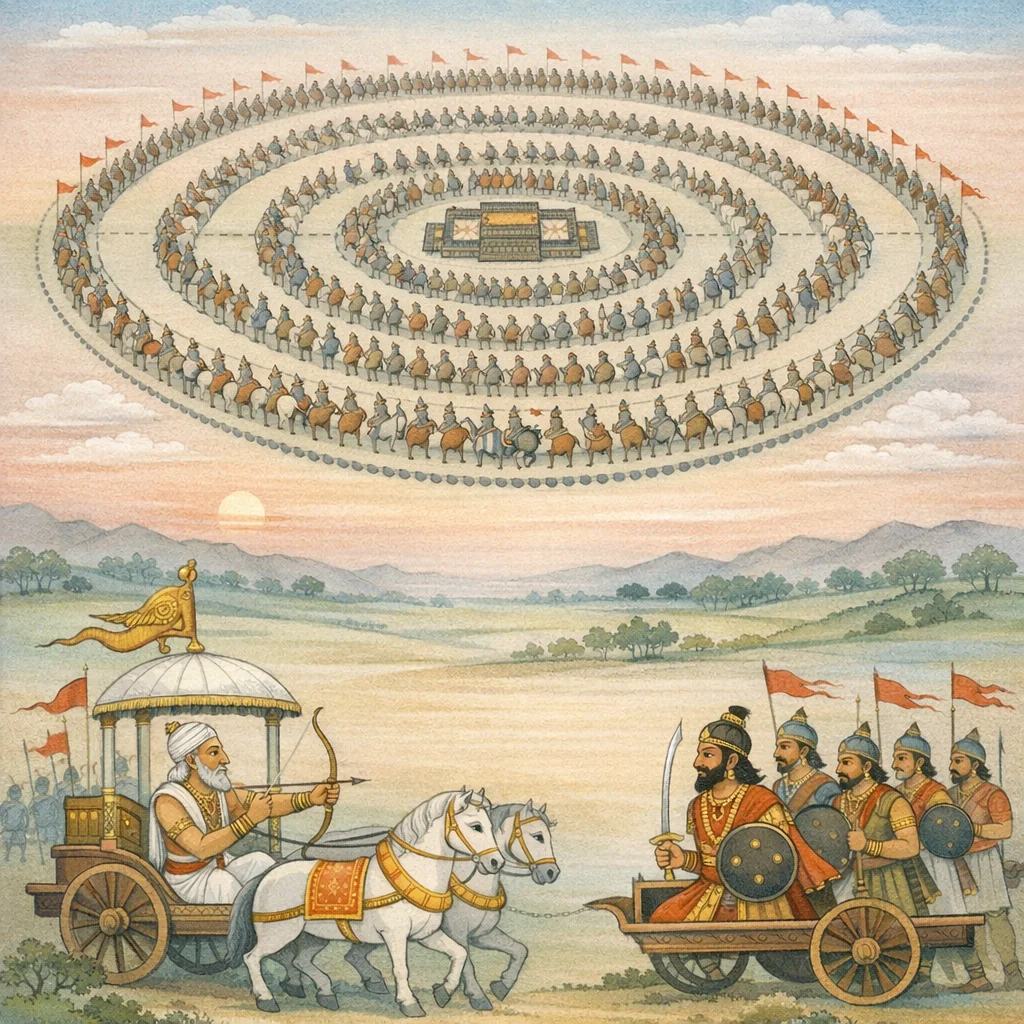
Chapter Arc: रात्रि बीतते ही रणभूमि में शंख-नाद और गर्जन उठता है—क्रोध से भरे शूरवीर एक-दूसरे के वध की प्रतिज्ञा-सी करते हैं, और कौरव-सेना ‘अब धनंजय कहाँ है?’ कहकर चुनौती देती है। → आचार्य द्रोण युद्ध को ‘शस्त्रभूत’ बनाकर कौरवों का उत्साह बढ़ाते हैं और एक विशेष, विशाल तथा भय-उत्पादक चक्र-शकट व्यूह की रचना करते हैं—लंबाई-चौड़ाई, अंग-रचना और परतों का वर्णन सेना में आत्मविश्वास भर देता है। जयद्रथ को केंद्र/रक्षा-व्यवस्था में प्रतिष्ठित कर गान्धार आदि महारथियों से घेरकर सुरक्षित किया जाता है। → द्रोण के ध्वज-चिह्नों से युक्त रथ के दर्शन मात्र से कौरव हर्षित हो उठते हैं; चक्र-शकट व्यूह का विराट रूप—रथ, गज, अश्व, पदाति से भरा—मानो स्वयं ‘अहितहृदयभेदन’ यंत्र बनकर सामने खड़ा होता है, और जयद्रथ को आश्वासन देकर युद्ध हेतु अग्रसर किया जाता है। → कौरव-पक्ष की संरचना पूर्ण होती है: द्रोण के नेतृत्व में व्यूह स्थिर, जयद्रथ को पार्श्व/रक्षा-भाग में महाबल सहित व्यवस्थित किया जाता है; सेना संगठित होकर दिन के निर्णायक संघर्ष के लिए तैयार हो जाती है। → व्यूह की अभेद्यता का गर्व और ‘धनंजय’ को ललकारती गर्जना—अगले अध्याय में पाण्डवों का प्रत्युत्तर और व्यूह-भेदन का प्रयास अनिवार्य टकराव बनकर सामने आता है।
Shlokas
Verse 1
सप्ताशीतितमोब ध्याय: कौरव-सैनिकोंका उत्साह तथा आचार्य द्रोणके द्वारा चक्रशकटवब्यूहका निर्माण संजय उवाच तस्यां निशायां व्युष्टायां द्रोण: शस्त्रभूतां वर: । स्वान्यनीकानि सर्वाणि प्राक्रामद् व्यूहितुं ततः,संजय कहते हैं--राजन्! वह रात बीतनेपर प्रात:काल शणस्त्रधारियोंमें श्रेष्ठ द्रोणाचार्यने अपनी सारी सेनाओंका व्यूह बनाना आरम्भ किया
Sanjaya said: O King, when that night had passed and morning came, Droṇa—foremost among those who are as weapons in war—set about arranging all his own divisions into battle formation. The verse marks the deliberate, disciplined beginning of a new phase of combat, where strategy and command are marshalled to direct collective violence toward a chosen end.
Verse 2
शूराणां गर्जतां राजन संक्रुद्धानाममर्षिणाम् | श्रूयन्ते सम गिरक्षित्रा: परस्परवधैषिणाम्,राजन! उस समय अत्यन्त क्रोधमें भरकर एक-दूसरेके वधकी इच्छासे गर्जना करनेवाले अमर्षशील शूरवीरोंकी विचित्र बातें सुनायी देती थीं
Sañjaya said: “O King, from those heroic warriors—roaring in fury, intolerant of restraint, and intent on one another’s death—there arose a tumult of many voices, strange and varied, that could be heard on all sides.”
Verse 3
विस्फार्य च धरनूंष्यन्ये ज्या: परे परिमृज्य च । विनिःश्वसन्तः प्राक्रोशन् क्वेदानीं स धनंजय:,कोई धनुष खींचकर और कोई प्रत्यंचापर हाथ फेरकर रोषपूर्ण उच्छवास लेते हुए चिल्ला-चिल्लाकर कहते थे कि इस समय वह अर्जुन कहाँ है?
Sañjaya said: Some warriors drew their bows taut, while others rubbed and adjusted the bowstrings. Breathing out in anger, they shouted aloud, “Where is that Dhanañjaya (Arjuna) now?”—a taunt born of battlefield pride and the moral tension of seeking to break an opponent’s resolve through intimidation.
Verse 4
विकोशान् सुत्सरूनन्ये कृतथारान् समाहितान् | पीतानाकाशसंकाशानसीन् केचिच्च चिक्षिपु:,कितने ही योद्धा आकाशके समान निर्मल पानीदार, सँभालकर रखी हुई, सुन्दर मूठ और तेजधारवाली तलवारोंको म्यानसे निकालकर चलाने लगे
Sañjaya said: Others, fully composed and intent, drew from their scabbards swords with well-fashioned hilts and keen edges—bright and clear like the sky—and began to brandish them, signaling readiness for the grim duties of battle.
Verse 5
चरन्तस्त्वसिमार्गाश्व धरनुर्मार्गाश्न॒ शिक्षया । संग्राममनस: शूरा दृश्यन्ते सम सहस्रश:,मनमें संग्रामके लिये पूर्ण उत्साह रखनेवाले सहस्रों शूरवीर अपनी शिक्षाके अनुसार खड्गयुद्ध और धरनुर्युद्धके मार्गों (पैतरों)-का प्रदर्शन करते दिखायी देते थे
Sañjaya said: “Moving about in disciplined formations, thousands upon thousands of valiant warriors—minds wholly set on battle—were seen demonstrating, according to their training, the methods and footwork of sword-fighting and archery. The scene reveals not only martial readiness but also the sobering reality that skill and zeal, when yoked to war, can magnify destruction unless restrained by dharma.”
Verse 6
सघण्टाश्वन्दनादिग्धा: स्वर्णवज्विभूषिता: । समुत्क्षिप्य गदा श्षान्ये पर्यपृच्छन्त पाण्डवम्,दूसरे बहुत-से योद्धा घंटानादसे युक्त, चन्दनचर्चित तथा सुवर्ण एवं हीरोंसे विभूषित गदाएँ ऊपर उठाकर पूछते थे कि पाण्डुपुत्र अर्जुन कहाँ है?
Sañjaya said: Many warriors, bearing maces adorned with gold and diamonds, their bodies anointed with sandal-paste and their horses fitted with sounding bells, lifted their maces aloft and kept asking about the Pāṇḍava—where Arjuna, the son of Pāṇḍu, was. The scene underscores how, amid the pageantry of war and displays of power, the combatants’ attention narrows to a single moral and strategic focal point: the presence of the foremost archer whose dharma-bound resolve shapes the battle’s course.
Verse 7
अन्ये बलमदोन्मत्ता: परिघैर्बाहुशालिन: । चक्र: सम्बाधमाकाशमुच्छितेन्द्रध्वजोपमै:,अपनी भुजाओंसे सुशोभित होनेवाले कितने ही योद्धा अपने बलके मदसे उन्मत्त हो ऊँचे फहराते हुए इन्द्र-ध्वजके समान उठे हुए परिघोंसे सम्पूर्ण आकाशको व्याप्त कर रहे थे
Sañjaya said: Many other warriors, their arms well-formed and powerful, were intoxicated with pride in their strength. Wielding iron clubs raised high like Indra’s banner, they seemed to fill and crowd the very sky—an image of martial arrogance swelling amid the chaos of war.
Verse 8
नानाप्रहरणैश्नान्ये विचित्रस्रगलड्कृता: । संग्राममनस: शूरास्तत्र तत्र व्यवस्थिता:,दूसरे शूरवीर योद्धा विचित्र मालाओंसे अलंकृत हो नाना प्रकारके अस्त्र-शस्त्र लिये मनमें युद्धके लिये उत्साहित होकर जहाँ-तहाँ खड़े थे
Sañjaya said: Other heroes too, adorned with variegated garlands and equipped with many kinds of weapons, stood stationed here and there—minds set on battle, eager for the clash. The scene underscores the collective resolve of warriors who, having accepted the code of the battlefield, present themselves fully prepared for the duties and consequences of war.
Verse 9
क्वार्जुन: क्व स गोविन्द: क्व च मानी वृकोदर: । क्व च ते सुद्ददस्तेषामाह्नयन्ते रणे तदा,वे उस समय रफक्षेत्रमें शत्रुओंको ललकारते हुए इस प्रकार कहते थे, कहाँ है अर्जुन? कहाँ हैं श्रीकृष्ण? कहाँ है घमंडी भीमसेन? और कहाँ हैं उनके सारे सुहृद
Sañjaya said: “At that time, on the battlefield, they were challenging the enemy, calling out: ‘Where is Arjuna? Where is that Govinda (Kṛṣṇa)? Where is the proud Vṛkodara (Bhīma)? And where are all their friends?’” The verse underscores the taunting, morale-testing rhetoric of war, where names of revered allies are invoked to provoke confrontation and measure resolve.
Verse 10
तत: शड्खमुपाध्माय त्वरयन् वाजिन: स्वयम् | इतस्ततस्तान् रचयन् द्रोणश्चरति वेगित:,तदनन्तर द्रोणाचार्य शंख बजाकर स्वयं ही अपने घोड़ोंको उतावलीके साथ हाँकते और उन सैनिकोंका व्यूह-निर्माण करते हुए इधर-उधर बड़े वेगसे विचर रहे थे
Sañjaya said: Then, having sounded his conch, Droṇa himself hurriedly urged on his horses; moving swiftly here and there, he kept arranging those troops into formation. The scene underscores the disciplined, strategic face of war—where a commander’s urgency and control over men and mounts drives the battle’s momentum, even as the larger conflict remains morally fraught.
Verse 11
तेष्वनीकेषु सर्वेषु स्थितेष्वाहवनन्दिषु । भारद्वाजो महाराज जयद्रथमथाब्रवीत्,महाराज! युद्धसे प्रसन्न होनेवाले उन समस्त सैनिकोंके व्यूहबद्ध हो जानेपर द्रोणाचार्यने जयद्रथसे कहा--
Sanjaya said: When all those battle-formations had taken their positions—those troops exulting in the prospect of combat—Drona, the son of Bharadvāja, addressed Jayadratha: “O King …” (thus beginning his instruction in the midst of the arrayed armies).
Verse 12
त्वं चैव सौमदत्तिश्ष कर्णश्षैव महारथ: । अश्र॒त्थामा च शल्यश्न वृषसेन: कृपस्तथा
Sañjaya said: “And you too—Saumadatti (Bhūriśravas)—and Karṇa, that great chariot-warrior; Aśvatthāmā and Śalya as well; Vṛṣasena, and Kṛpa likewise.” In the grim calculus of war, Sañjaya enumerates the foremost Kaurava champions, underscoring how many eminent warriors stand committed to a cause whose moral foundations are already strained—where prowess and loyalty contend with dharma and the consequences of adharma.
Verse 13
शतं चाश्वसहस्राणां रथानामयुतानि षट् । द्विरदानां प्रभिन्नानां सहस्राणि चतुर्दश
Sañjaya said: “There were a hundred thousand horses, sixty thousand chariots, and fourteen thousand rut-maddened, fully charging elephants.”
Verse 14
पदातीनां सहस्राणि दंशितान्येकविंशति: । गव्यूतिषु त्रिमात्रासु मामनासाद्य तिष्ठत
Sañjaya said: “Twenty-one thousand foot-soldiers, fully armed and ready, are standing at a distance of three gavyūtis, without coming into contact with me.”
Verse 15
“राजन! तुम, भूरिश्रवा, महारथी कर्ण, अश्व॒त्थामा, शल्य, वृषसेन तथा कृपाचार्य, एक लाख घुड़सवार, साठ हजार रथ, चौदह हजार मदस्रावी गजराज तथा इकक््कीस हजार कवचधारी पैदल सैनिकोंको साथ लेकर मुझसे छ: कोसकी दूरीपर जाकर डटे रहो ।। १२ -१४ || तत्रस्थं त्वां न संसोदुं शक्ता देवा: सवासवा: | कि पुन: पाण्डवा: सर्वे समाश्वसिहि सैन्धव,'सिंधुराज! वहाँ रहनेपर इन्द्र आदि सम्पूर्ण देवता भी तुम्हारा सामना नहीं कर सकते; फिर समस्त पाण्डव तो कर ही कैसे सकते हैं? अतः तुम धैर्य धारण करो”
Sanjaya said: “O King! You—Bhūrishravā, the great chariot-warrior Karṇa, Aśvatthāmā, Śalya, Vṛṣasena, and Kṛpācārya—together with one hundred thousand horsemen, sixty thousand chariots, fourteen thousand rut-maddened lordly elephants, and twenty-one thousand armoured foot-soldiers, go with me to a distance of six krośas and hold your ground there. Stationed there, even the gods with Indra at their head are not able to withstand you—how much less all the Pāṇḍavas! Therefore, take heart, O Saindhava, king of Sindhu.”
Verse 16
एवमुक्तः समाश्वस्त: सिन्धुराजो जयद्रथः । सम्प्रायात् सह गान्धारैरवृतस्तैश्व महारथै:
Sañjaya said: Thus addressed and reassured, Jayadratha, the king of Sindhu, set out for battle together with the Gāndhāras, protected and surrounded by those great chariot-warriors. The verse underscores how counsel and encouragement can steady a wavering mind, yet in the moral atmosphere of the war it also shows how renewed confidence, when backed by powerful allies, can propel one toward further violence and fateful consequences.
Verse 17
चामरापीडिन: सर्वे जाम्बूनदविभूषिता:,राजेन्द्र! जयद्रथके घोड़े सवारीमें बहुत अच्छा काम देते थे। वे सब-के-सब चवँरकी कलँगीसे सुशोभित और सुवर्णमय आभूषणोंसे विभूषित थे। उन सिंधुदेशीय अश्वोंकी संख्या दस हजार थी
Sañjaya said: O king, all those horses assigned to Jayadratha’s chariot-service performed excellently. They were adorned with yak-tail fans and crests, and were richly decorated with ornaments of gold. The number of those Sindhu-bred horses was ten thousand—an image of royal power and martial display set amid the moral darkness of war.
Verse 18
जयद्रथस्य राजेन्द्र हया: साधुप्रवाहिन: । ते चैव सप्तसाहस्रास्त्रिसाहस्राक्ष सैन्धवा:,राजेन्द्र! जयद्रथके घोड़े सवारीमें बहुत अच्छा काम देते थे। वे सब-के-सब चवँरकी कलँगीसे सुशोभित और सुवर्णमय आभूषणोंसे विभूषित थे। उन सिंधुदेशीय अश्वोंकी संख्या दस हजार थी
Sañjaya said: “O king, Jayadratha’s horses were excellent in their pace and movement. Those Sindhu-bred steeds—seven thousand and three thousand more—served superbly in his riding and were splendidly adorned.”
Verse 19
मत्तानां सुविरूढानां हस्त्यारोहैरविशारदै: । नागानां भीमरूपाणां वर्मिणां रौद्रकर्मिणाम्,जिनपर युद्धकुशल हाथीसवार आरूढ थे, ऐसे भयंकर रूप तथा पराक्रमवाले डेढ़ हजार कवचधारी मतवाले गजराजोंके साथ आकर आपका पुत्र दुर्मर्षण युद्धके लिये उद्यत हो सम्पूर्ण सेनाओंके आगे खड़ा हुआ
Sañjaya said: “Mounted by elephant-riders who were not fully adept, there advanced a force of mighty, well-trained, rut-maddened elephants—terrible in form, clad in armor, and fierce in their deeds.”
Verse 20
अध्यर्थेन सहस्रेण पुत्रो दुर्मर्षणस्तव । अग्रतः सर्वसैन्यानां युध्यमानो व्यवस्थित:,जिनपर युद्धकुशल हाथीसवार आरूढ थे, ऐसे भयंकर रूप तथा पराक्रमवाले डेढ़ हजार कवचधारी मतवाले गजराजोंके साथ आकर आपका पुत्र दुर्मर्षण युद्धके लिये उद्यत हो सम्पूर्ण सेनाओंके आगे खड़ा हुआ
Sañjaya said: With a force numbering a thousand and a half, your son Durmarṣaṇa, set for battle, took his stand in the very front of all the armies, fighting resolutely. The scene underscores the Kaurava resolve to press the war forward through displays of massed strength and personal valor, even as the conflict continues to deepen the moral burden of fratricidal combat.
Verse 21
ततो दुःशासनश्वैव विकर्णश्र॒ तवात्मजौ । सिन्धुराजार्थसिद्धयर्थमग्रानीके व्यवस्थितौ,तत्पश्चात् आपके दो पुत्र दःशासन और विकर्ण सिन्धुराज जयद्रथके अभीष्ट अर्थकी सिद्धिके लिये सेनाके अग्रभागमें खड़े हुए
Sañjaya said: Then your two sons, Duḥśāsana and Vikarṇa, took their stand at the very front of the army, intent on securing the desired objective of the Sindhu-king Jayadratha. The scene underscores how familial loyalty and strategic urgency in war can drive men to place themselves in the most perilous position for the sake of an ally’s cause.
Verse 22
दीर्घो द्वादश गव्यूति: पश्चार्थे पज्च विस्तृत: । व्यूहस्तु चक्रशकटो भारद्वाजेन निर्मित:
Sañjaya said: “That battle-formation was twelve gavyūtis in length, and in its rear it spread to five (gavyūtis) in breadth. It was the ‘wheel-and-cart’ array, devised by Bhāradvāja (Droṇa).”
Verse 23
आचार्य द्रोणने चक्रगर्भ शकटव्यूहका निर्माण किया था, जिसकी लम्बाई बारह गव्यूति (चौबीस कोस) थी और पिछले भागकी चौड़ाई पाँच गव्यूति (दस कोस) थी ।। नानानृपतिभिवीरिस्तत्र तत्र व्यवस्थितै: । रथाश्चवगजपत्त्योघैद्रोणेन विहित: स्वयम्,यत्र-तत्र खड़े हुए अनेक नरपतियों तथा हाथीसवार, घुड़सवार, रथी और पैदल सैनिकोंद्वारा द्रोणाचार्यने स्वयं उस व्यूहकी रचना की थी
Sañjaya said: With many heroic kings stationed at various points, and with dense masses of chariots, cavalry, elephants, and infantry, Droṇa himself arranged that battle-formation. The description underscores deliberate military order—power organized through hierarchy and strategy—intensifying the ethical tension of war, where skill and command are employed in service of a contested cause.
Verse 24
पश्चार्थे तस्य पद्मस्तु गर्भव्यूह: सुदुर्भिद: । सूची पद्मस्य गर्भस्थो गूढो व्यूह: कृत: पुन:,उस चक्रशकटव्यूहके पिछले भागमें पद्म नामक एक गर्भव्यूह बनाया गया था, जो अत्यन्त दुर्भद्य था। उस पद्यव्यूहके मध्यभागमें सूची नामक एक गूढ़ व्यूह और बनाया गया था
Sañjaya said: “In the rear of that formation, a ‘Lotus’ inner-array was set, exceedingly hard to break. And within the very core of the Lotus, yet another concealed array—called the ‘Needle’—was fashioned again.”
Verse 25
एवमेतं महाव्यूहं व्यूह[ द्रोणो व्यवस्थित: । सूचीमुखे महेष्वास: कृतवर्मा व्यवस्थित:,इस प्रकार इस महाव्यूहकी रचना करके द्रोणाचार्य युद्धके लिये तैयार खड़े थे। सूचीमुख व्यूहके प्रमुख भागमें महाधनुर्धर कृतवर्मा खड़ा किया गया था
Sañjaya said: “Having thus arrayed that great battle-formation, Droṇa stood ready for combat. And in the foremost ‘Needle-point’ sector of the formation, the mighty archer Kṛtavarmā was stationed.”
Verse 26
अनन्तरं च काम्बोजो जलसंधश्ष् मारिष । दुर्योधनश्न कर्णश्व तदनन्तरमेव च,आर्य! कृतवर्मके पीछे काम्बोजराज और जलसंध खड़े हुए, तदनन्तर दुर्योधन और कर्ण स्थित हुए
Sañjaya said: “And next, O venerable one, the king of Kāmboja and Jalasandha took their positions; immediately after them, Duryodhana and Karṇa also stood in array.” The verse underscores the deliberate ordering of warriors in battle—an outward display of strength and loyalty that, in the Mahābhārata’s ethical frame, also reflects the Kaurava camp’s reliance on formidable allies to sustain an unrighteous cause.
Verse 27
ततः शतसहस््राणि योधानामनिवर्तिनाम् । व्यवस्थितानि सर्वाणि शकटे मुखरक्षिणाम्,तत्पश्चात् युद्धमें पीठ न दिखानेवाले एक लाख योद्धा खड़े हुए थे। वे सबके सब शकटणव्यूहके प्रमुख भागकी रक्षाके लिये नियुक्त थे
Sañjaya said: Then a hundred thousand warriors, resolute and unwilling to retreat, were all drawn up in formation to guard the foremost face of the Śakaṭa (cart-shaped) battle-array. Their stationing underscores the Kaurava emphasis on disciplined defense and steadfastness in war, where turning one’s back is treated as both tactical failure and a lapse of martial duty.
Verse 28
तेषां च पृष्ठतो राजा बलेन महता वृतः । जयद्रथस्ततो राजा सूचीपाशश्वे व्यवस्थित:,उनके पीछे विशाल सेनाके साथ स्वयं राजा जयद्रथ सूचीव्यूहके पार्श्रभागमें खड़ा था
Sañjaya said: Behind them, King Jayadratha—surrounded by a great force—took his position on the flank of the Sūcī (needle) formation. The arrangement shows deliberate tactical intent: power is placed not merely at the front but in supporting positions, where it can obstruct, reinforce, and control the flow of battle—an ethically charged reminder that in war, outcomes often hinge on calculated placement and collective backing rather than solitary valor.
Verse 29
शकटस्य तु राजेन्द्र भारद्वाजो मुखे स्थित: । अनु तस्याभवद् भोजो जुगोपैनं ततः स्वयम्,राजेन्द्र! उस शकटव्यूहके मुहानेपर भरद्वाजनन्दन द्रोणाचार्य थे और उनके पीछे भोज था, जो स्वयं आचार्यकी रक्षा करता था
Sañjaya said: “O king, at the very front of the Śakaṭa (cart-shaped) battle-formation stood Bhāradvāja’s son, Droṇa. Close behind him was Bhoja, who personally guarded the preceptor.”
Verse 30
श्वेतवर्माम्बरोष्णीषो व्यूढोरस्को महाभुज: । भधनुर्विस्फारयन् द्रोणस्तस्थौ क्रुद्ध इवान्तक:,ट्रोणाचार्यका कवच श्वेत रंगका था। उनके वस्त्र और उष्णीष (पगड़ी) भी श्वेत ही थे। छाती चौड़ी और भुजाएँ विशाल थीं। उस समय धनुष खींचते हुए द्रोणाचार्य वहाँ क्रोधमें भरे हुए यमराजके समान खड़े थे
Sanjaya said: Clad in white armor, with white garments and a white turban, broad-chested and mighty-armed, Droṇa stood there drawing and twanging his bow—wrathful like Antaka, the bringer of death. The scene underscores how, in the heat of war, even a revered teacher assumes the terrifying aspect of death itself, as duty and fury converge on the battlefield.
Verse 31
पताकिनं शोणहयं वेदिकृष्णाजिन ध्वजम् । द्रोणस्यप रथमालोक्य प्रहृष्टा: कुरवो5भवन्,उस समय वेदी और काले मृगचर्मके चिह्नसे युक्त ध्वजवाले, पताकासे सुशोभित और लाल घोड़ोंसे जुते हुए द्रोणाचार्यके रथको देखकर समस्त कौरव बड़े प्रसन्न हुए
Sañjaya said: Seeing Droṇa’s chariot—adorned with banners, yoked to red horses, and bearing a standard marked with the sacrificial altar and a black antelope-skin—the Kauravas were filled with delight. In the moral atmosphere of the war, their joy reflects renewed confidence in martial prowess and command, even as the conflict continues to exact a grave ethical cost.
Verse 32
सिद्धचारणसंघानां विस्मय: सुमहानभूत् । द्रोणेन विहितं दृष्ट्वा व्यूहं क्षुब्धार्णवोपमम्,द्रोणाचार्यद्वारा रचित वह महाव्यूह क्षुब्ध महासागरके समान जान पड़ता था। उसे देखकर सिद्धों और चारणोंके समुदायोंको महान् विस्मय हुआ
Sañjaya said: A very great wonder arose among the hosts of Siddhas and Cāraṇas when they beheld the battle-formation arranged by Droṇa—like a heaving, storm-tossed ocean. The scene underscores how strategic power in war can appear awe-inspiring even to celestial witnesses, while also hinting at the fearful, destabilizing force that such mastery unleashes on the battlefield.
Verse 33
सशैलसागरवनां नानाजनपदाकुलाम् । ग्रसेद् व्यूह: क्षितिं सर्वामिति भूतानि मेनिरे,उस समय समस्त प्राणी ऐसा मानने लगे कि वह व्यूह पर्वत, समुद्र और काननोंसहित अनेकानेक जनपदोंसे भरी हुई इस सारी पृथ्वीको अपना ग्रास बना लेगा
Sanjaya said: At that moment all beings came to believe that the battle-formation would swallow up the entire earth—crowded with many kingdoms and peoples, together with its mountains, oceans, and forests—as though it were its very prey. The image conveys the terrifying, all-consuming scale of the war-machine, before which ordinary life and the natural world seem powerless.
Verse 34
बहुरथमनुजाश्चपत्तिनागं कम प् । अहितह्ृदयभेदनं महद् शकटमवेक्ष्य कृतं ननन्द राजा,बहुत-से रथ, पैदल मनुष्य, घोड़े और हाथियोंसे परिपूर्ण, भयंकर कोलाहलसे युक्त एवं शत्रुओंके हृदयको विदीर्ण करनेमें समर्थ, अद्भुत और समयके अनुरूप बने हुए उस महान् शकटव्यूहको देखकर राजा दुर्योधन बहुत प्रसन्न हुआ
Sañjaya said: Seeing that great Śakaṭa (cart-shaped) battle-formation—made in a timely and fitting manner, crowded with many chariots, infantry, horses, and elephants, filled with dreadful tumult, and capable of rending the hearts of the enemy—King Duryodhana was greatly delighted. The verse highlights how strategic ingenuity and sheer martial display can intoxicate a ruler’s mind, even as it deepens the violence and hardens hostility on the battlefield.
Verse 87
इति श्रीमहाभारते द्रोणपर्वणि जयद्रथवधपर्वणि कौरवव्यूहनिर्माणे सप्ताशीतितमो<5ध्याय:
Thus ends the eighty-seventh chapter in the Droṇa Parva of the Śrī Mahābhārata, within the section concerning the slaying of Jayadratha, describing the formation and arrangement of the Kauravas’ battle formation. The colophon marks a transition in the narrative, emphasizing the strategic organization of war that frames the moral and human consequences of the coming confrontation.
Verse 166
वर्मिभि: सादिभिययत्तै: प्रासपाणिभिरास्थितै: । उनके ऐसा कहनेपर सिंधुराज जयद्रथको बड़ा आश्वासन मिला। वह गान्धार महारथियोंसे घिरा हुआ युद्धके लिये चल दिया। कवचधारी घुड़सवार हाथोंमें प्रास लिये पूरी सावधानीके साथ उन्हें घेरे हुए चल रहे थे
Sañjaya said: Armoured horsemen, alert and well-positioned, surrounded him with spears in hand. Hearing those words, the king of Sindhu, Jayadratha, felt greatly reassured; encircled by the Gandhāra mahārathas, he set out for battle—protected on all sides by vigilant, mail-clad riders bearing lances.
Frequently Asked Questions
The implicit dilemma is the tension between proclaimed fairness in recruitment, pay, and honor (administrative dharma) and the apparent failure to protect the force and its objectives when confronted by superior tactical action.
Competent institutions and proper patronage are necessary but not sufficient: outcomes also depend on situational awareness, morale, and adaptive leadership; legitimacy claims are tested by performance under stress.
No explicit phalaśruti is stated; the chapter functions as a narrative hinge, using Dhṛtarāṣṭra’s audit-like description to frame Sañjaya’s forthcoming operational report within the larger ethical and strategic arc.