Adhyaya 32
Ananta-Śeṣa Tapas and the Bearing of the Earth (अनन्त-शेष-तपस् तथा महीधारणम्)
Upa-parva: Āstīka Parva (Nāga-janma and Ananta-Śeṣa episode context)
Chapter 32 records a framed inquiry and response: Śaunaka asks what the newly born, powerful serpents did after learning of a curse (1.0). Sūta narrates that Bhagavān Śeṣa abandons Kadrū and undertakes extensive austerities, subsisting on air, practicing restraint across sacred sites (2.0–4.0). Brahmā observes Śeṣa’s severe tapas and questions its purpose, noting its impact on beings (5.0–7.0). Śeṣa explains his withdrawal: his brothers are hostile and envious, intolerant toward Vinatā and her son; they also hate Vainateya (Garuḍa), empowered by Kaśyapa’s boon, and Śeṣa seeks release from bodily existence and even post-mortem association with them (8.0–12.0). Brahmā acknowledges the situation, offers a boon, praises Śeṣa’s dharmic orientation, and grants the wish that Śeṣa’s mind remain fixed in dharma, śama, and tapas (13.0–17.0). Brahmā then issues a directive for prajā-hita: Śeṣa must stabilize the earth—mountains, forests, oceans, and cities—by holding it steady (18.0–21.0). Śeṣa consents, enters below the earth, and bears it upon his head; Brahmā extols him as nāgottama with infinite coils, and Sūta concludes that Ananta resides beneath the earth sustaining it by Brahmā’s command; Brahmā also assigns Suparṇa/Vainateya as Ananta’s companion (22.0–25.0).
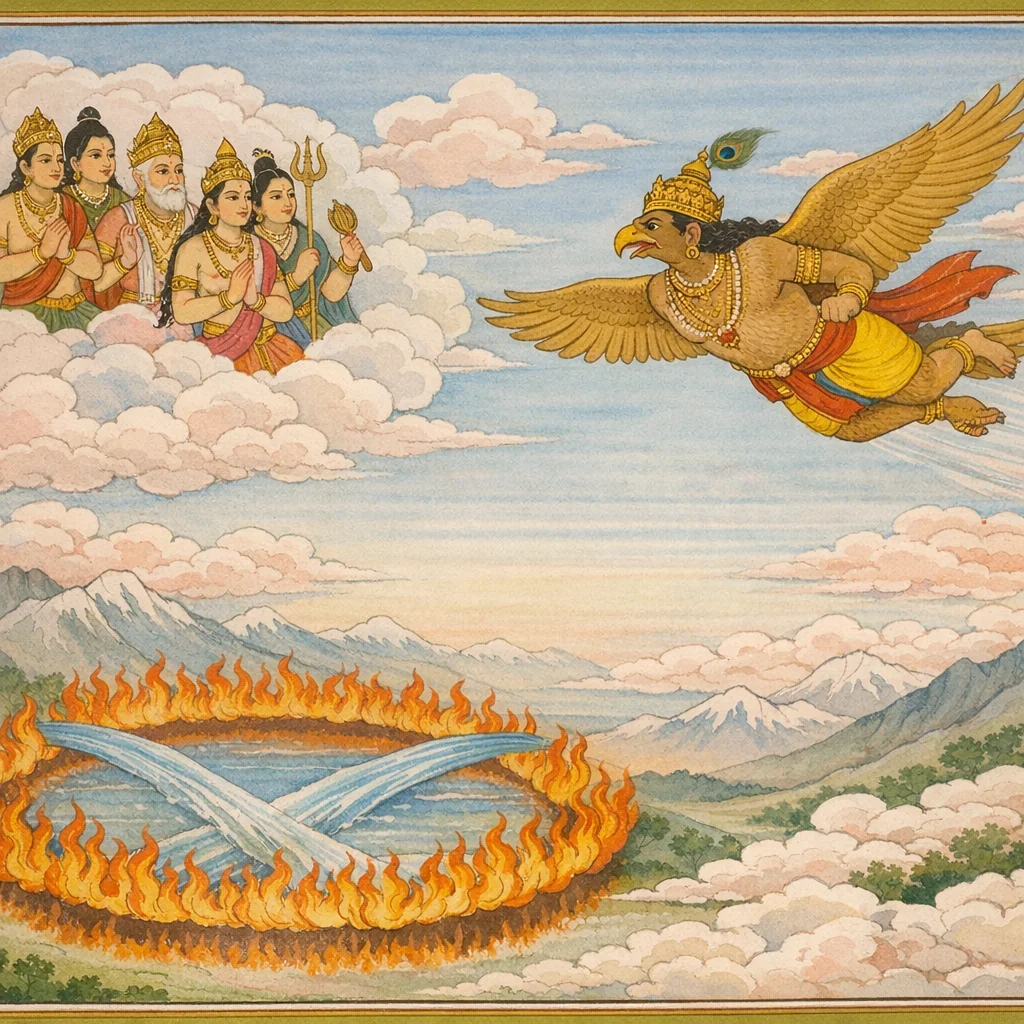
Chapter Arc: उग्रश्रवा सूति उस अद्भुत क्षण का वर्णन करते हैं जब गरुड़—पक्षिराज, परवीरहा—देवताओं के रक्षित अमृत-प्रदेश की ओर बढ़ता है और स्वर्ग की सेनाएँ उसके तेज से डगमगाने लगती हैं। → देवगण गरुड़ की अतिबल-प्रकृति देखकर भयाक्रान्त होते हैं और परस्पर संकेत कर सर्वप्रहरणों से आक्रमण करते हैं। आकाश में विद्युत्-अग्नि-सा प्रकाश, दिशाओं में देव-गणों की व्यूह-रचना, और सोम-रक्षा में नियुक्त भौमन जैसे महावीरों की उपस्थिति संघर्ष को तीव्र करती है। → गरुड़ महावेग से उछलकर अन्तरिक्ष में देवताओं के ऊपर स्थित हो जाता है और एक-एक कर अनेक देववीरों (अभश्वक्रन्द, रेणुक, क्रथन, तपन, उलूक, सनाभि, निमेष, प्ररुज, पुलिन आदि) से संग्राम कर उन्हें परास्त करता है; साध्य, गन्धर्व, वसु, रुद्र आदि दिशाओं में तितर-बितर हो जाते हैं। → अग्नि-रूप बाधा के सामने गरुड़ अपनी देह को सूक्ष्म/अन्य रूप में ढालकर प्रवेश-उपाय करता है और जल-प्रवाहों/नदी-तुल्य धाराओं से ज्वलन्त अग्नि को शान्त कर मार्ग बनाता है—देव-रक्षा की दीवारें टूटती हैं और अमृत-प्राप्ति का पथ खुलता है। → अमृत के निकट पहुँचकर भी कथा अगले चरण पर ठहरती है—अब प्रश्न यह है कि गरुड़ अमृत को कैसे उठाएगा और देवताओं की शेष प्रतिरोध-शक्ति/रणनीति क्या होगी।
Shlokas
Verse 1
पम्प छा अर: अं द्वात्रिेशोड्थध्याय: गरुडका देवताओंके साथ युद्ध और देवताओंकी पराजय सौतिरुवाच ततस्तस्मिन् द्विजश्रेष्ठ समुदीर्णे तथाविधे । गरुड: पक्षिराट् तूर्ण सम्प्राप्तो विबुधान् प्रति,उग्रश्रवाजी कहते हैं--द्विजश्रेष्ठ!] देवताओंका समुदाय जब इस प्रकार भाँति-भाँतिके अस्त्र-शस्त्रोंसे सम्पन्न हो युद्धके लिये उद्यत हो गया, उसी समय पक्षिराज गरुड तुरंत ही देवताओंके पास जा पहुँचे। उन अत्यन्त बलवान् गरुडको देखकर सम्पूर्ण देवता काँप उठे। उनके सभी आयुध आपसमें ही आघात-प्रत्याघात करने लगे
Sauti said: O best of twice-born sages, when the host of the gods had thus been roused and arrayed for battle with weapons of many kinds, the king of birds, Garuḍa, swiftly arrived before the celestials. At the sight of that exceedingly mighty Garuḍa, the gods trembled, and their weapons, as if thrown into confusion by fear, struck and counterstruck among themselves—signaling the futility of mere armament when confronted by overwhelming power and resolve.
Verse 2
त॑ दृष्टवातिबलं चैव प्राकम्पन्त सुरास्तत: । परस्परं च प्रत्यघ्नन् सर्वप्रहरणान्युत,उग्रश्रवाजी कहते हैं--द्विजश्रेष्ठ!] देवताओंका समुदाय जब इस प्रकार भाँति-भाँतिके अस्त्र-शस्त्रोंसे सम्पन्न हो युद्धके लिये उद्यत हो गया, उसी समय पक्षिराज गरुड तुरंत ही देवताओंके पास जा पहुँचे। उन अत्यन्त बलवान् गरुडको देखकर सम्पूर्ण देवता काँप उठे। उनके सभी आयुध आपसमें ही आघात-प्रत्याघात करने लगे
Seeing him—Garuda, of extraordinary might—the gods at once began to tremble. In that moment, their weapons, as if seized by panic and confusion, struck and clashed against one another. The scene underscores how sheer spiritual and physical power can unnerve even the celestial order, and how fear can turn one’s own instruments of protection into sources of disorder.
Verse 3
तत्र चासीदमेयात्मा विद्युदग्निसमप्रभ: । भौमन: सुमहावीर्य: सोमस्य परिरक्षिता,वहाँ विद्युत् एवं अग्निके समान तेजस्वी और महापराक्रमी अमेयात्मा भौमन (विश्वकर्मा) अमृतकी रक्षा कर रहे थे
There stood Bhāumana—of immeasurable spirit, blazing like lightning and fire, and possessed of immense prowess—appointed as the guardian of Soma’s treasure (the amṛta). The passage underscores that extraordinary power is here bound to a duty of protection: strength is portrayed not as license, but as a charge to safeguard what is held sacred and life-giving.
Verse 4
स तेन पतगेन्द्रेण पक्षतुण्डनखक्षत: । मुहूर्तमतुलं युद्ध कृत्वा विनिहतो युधि,वे पक्षिराजके साथ दो घड़ीतक अनुपम युद्ध करके उनके पंख, चोंच और नखोंसे घायल हो उस रणांगणमें मृतकतुल्य हो गये
Wounded by that lord of birds—torn by wings, beak, and talons—he fought an incomparable battle for a brief while; then, on the field of combat, he was struck down and left as good as dead. The verse underscores the stark moral gravity of violence: even valor and endurance in battle culminate in suffering and near-destruction when driven by hostile encounter.
Verse 5
रजश्नलोद्धूय सुमहत् पक्षवातेन खेचर: । कृत्वा लोकान् निरालोकांस्तेन देवानवाकिरत्,तदनन्तर पक्षिराजने अपने पंखोंकी प्रचण्ड वायुसे बहुत धूल उड़ाकर समस्त लोकोंमें अन्धकार फैला दिया और उसी धूलसे देवताओंको ढक दिया
Śaunaka said: The sky-ranging king of birds, beating his mighty wings, stirred up a vast cloud of dust. He plunged the worlds into darkness and, with that dust, covered the gods—an act of overwhelming force meant to confound and overpower even the celestial order.
Verse 6
तेनावकीर्णा रजसा देवा मोहमुपागमन् । न चैवं ददृशुश्छन्ना रजसामृतरक्षिण:,उस धूलसे आच्छादित होकर देवता मोहित हो गये। अमृतकी रक्षा करनेवाले देवता भी इसी प्रकार धूलसे ढक जानेके कारण कुछ देख नहीं पाते थे
Covered and overwhelmed by that dust, the gods fell into delusion. Even the guardians of the nectar of immortality, being veiled by the dust, could not see anything clearly.
Verse 7
एवं संलोडयामास गरुडस्त्रिदिवालयम् । पक्षतुण्डप्रहारैस्तु देवान् स विददार ह,इस तरह गरुडने स्वर्गलोकको व्याकुल कर दिया और पंखों तथा चोंचोंकी मारसे देवताओंका अंग-अंग विदीर्ण कर डाला
Śaunaka said: Thus Garuḍa threw the heavenly realm into turmoil; striking with his wings and beak, he tore the gods limb from limb. The episode underscores the overwhelming force of a divinely empowered being driven by a vowed purpose, and it frames a moral tension: even in pursuit of a righteous end, violence against the divine order brings disruption and fear, demanding later restoration of balance.
Verse 8
ततो देव: सहस्राक्षस्तूर्ण वायुमचोदयत् । विक्षिपेमां रजोवृष्टिं तवेदं कर्म मारुत,तब सहस नेत्रोंवाले इन्द्रदेवने तुरंत ही वायुको आज्ञा दी--“मारुत! तुम इस धूलकी वृष्टिको दूर हटा दो; क्योंकि यह काम तुम्हारे ही वशका है”
Then the god Indra, the thousand-eyed, swiftly urged the Wind-god: “Marut, disperse this shower of dust at once. This task lies within your power.” The scene underscores a moral order in which each divine force is expected to act according to its proper function, restoring clarity and right conditions when confusion and obstruction arise.
Verse 9
अथ वायुरपोवाह तद् रजस्तरसा बली । ततो वितिमिरे जाते देवा: शकुनिमार्दयन्,तब बलवान वायुदेवने बड़े वेगसे उस धूलको दूर उड़ा दिया। इससे वहाँ फैला हुआ अन्धकार दूर हो गया। अब देवता अपने अस्त्र-शस्त्रोंद्वारा पक्षी गरुडको पीडित करने लगे
Then the mighty Wind-god swiftly drove away that dust. When the gloom had cleared, the gods began to assail the bird (Garuḍa), pressing him hard with their weapons. The episode underscores how clarity returns when obscuring forces are dispelled, yet conflict can still intensify when opposing powers refuse to yield.
Verse 10
ननादोच्चै: स बलवान् महामेघ इवाम्बरे | वध्यमान: सुरगणै: सर्वभूतानि भीषयन्,देवताओंके प्रहारको सहते हुए महाबली गरुड आकाशमें छाये हुए महामेघकी भाँति समस्त प्राणियोंको डराते हुए जोर-जोरसे गर्जना करने लगे
Śaunaka said: Though struck by the hosts of gods, the mighty Garuḍa roared aloud in the sky like a great cloud. As he endured the divine blows, he terrified all living beings with his thunderous cry—an image of indomitable resolve in the face of superior force.
Verse 11
उत्पपात महावीर्य: पक्षिराट् परवीरहा । समुत्पत्यान्तरिक्षस्थं देवानामुपरि स्थितम्,शत्रुवीरोंका संहार करनेवाले पक्षिराज बड़े पराक्रमी थे। वे आकाशमें बहुत ऊँचे उड़ गये। उड़कर अन्तरिक्षमें देवताओंके ऊपर (ठीक सिरकी सीधमें) खड़े हो गये। उस समय कवच धारण किये इन्द्र आदि सम्पूर्ण देवता उनपर पट्टिश, परिघ, शूल और गदा आदि नाना प्रकारके अस्त्र-शस्त्रोंद्वारा प्रहार करने लगे
Śaunaka said: The king of birds, of mighty valor and a slayer of enemy-heroes, suddenly sprang upward. Soaring into the mid-air, he positioned himself above the gods. Thereupon Indra and the other gods, armored and resolute, struck at him with many kinds of weapons—pattiśas, iron clubs, spears, and maces—seeking to check his daring ascent. The episode highlights fearless resolve in pursuit of a chosen aim, even when confronted by overwhelming divine force.
Verse 12
वर्मिणो विबुधा: सर्वे नानाशस्त्रैरवाकिरन् । पट्टिशै: परिघै: शूलैर्गदाभिश्व सवासवा:,शत्रुवीरोंका संहार करनेवाले पक्षिराज बड़े पराक्रमी थे। वे आकाशमें बहुत ऊँचे उड़ गये। उड़कर अन्तरिक्षमें देवताओंके ऊपर (ठीक सिरकी सीधमें) खड़े हो गये। उस समय कवच धारण किये इन्द्र आदि सम्पूर्ण देवता उनपर पट्टिश, परिघ, शूल और गदा आदि नाना प्रकारके अस्त्र-शस्त्रोंद्वारा प्रहार करने लगे
Śaunaka said: All the gods, clad in armor and led by Vāsava (Indra), showered him with many kinds of weapons—battle-axes, iron clubs, tridents, and maces. The scene underscores how even the divine, when threatened, may resort to force, setting the stage for a moral tension between might and rightful conduct in the unfolding narrative.
Verse 13
क्षुरप्रैज्वलितैश्वापि चक्रैरादित्यरूपिभि: । नानाशस्त्रविसर्गैस्तैर्वध्यमान: समन्ततः,अग्निके समान प्रज्वलित क्षुरप्र, सूर्यके समान उद्धासित होनेवाले चक्र तथा नाना प्रकारके दूसरे-दूसरे शस्त्रोंके प्रहारद्वारा उनपर सब ओरसे मार पड़ रही थी
Śaunaka said: “He was being assailed from every side—struck down by blazing, razor-edged discus-weapons that shone like the sun, and by volleys of many other kinds of missiles. The scene conveys the overwhelming, inescapable force of weaponry in battle, where violence multiplies and a single being is hemmed in by relentless attacks.”
Verse 14
कुर्वन् सुतुमुलं युद्ध पक्षिराण्न व्यकम्पत । निर्दह॒न्निव चाकाशे वैनतेय: प्रतापवान् । पक्षाभ्यामुरसा चैव समन्ताद् व्याक्षिपत् सुरान्,तो भी पक्षिराज गरुड देवताओंके साथ तुमुल युद्ध करते हुए तनिक भी विचलित न हुए। परम प्रतापी विनतानन्दन गरुडने, मानो देवताओंको दग्ध कर डालेंगे, इस प्रकार रोषमें भरकर आकाशमें खड़े-खड़े ही पंखों और छातीके धक्केसे उन सबको चारों ओर मार गिराया
Śaunaka said: While waging a most tumultuous battle, the king of birds did not waver in the least. The mighty Vainateya (Garuḍa), as though he would burn them up, stood in the sky blazing with wrath; and with the blows of his wings and his chest he hurled the gods down on every side. The passage underscores unwavering resolve and overwhelming force, while also hinting at the ethical tension of power used against even divine opponents when driven by a higher purpose.
Verse 15
ते विक्षिप्तास्ततो देवा दुद्र॒ुव॒र्गरुडार्दिता: । नखतुण्डक्षताश्वैव सुख्ुवु: शोणितं बहु,गरुडसे पीड़ित और दूर फेंके गये देवता इधर-उधर भागने लगे। उनके नखों और चोंचसे क्षत-विक्षत हो वे अपने अंगोंसे बहुत-सा रक्त बहाने लगे
Śaunaka said: Then the gods, hurled away and grievously tormented by Garuḍa, fled in all directions. Torn by his talons and beak, they bled profusely from their bodies—an image of overwhelming force before which even the mighty are compelled to retreat.
Verse 16
साध्या: प्राचीं सगन्धर्वा वसवो दक्षिणां दिशम् । प्रजग्मु: सहिता रुद्रा: पतगेन्द्रप्रधर्षिता:,पक्षिराजसे पराजित हो साध्य और गन्धर्व पूर्व दिशाकी ओर भाग चले। वसुओं तथा रुद्रोंने दक्षिण दिशाकी शरण ली
Śaunaka said: Harried and routed by the lord of birds, the Sādhyas together with the Gandharvas fled toward the eastern quarter, while the Vasus sought refuge in the southern direction; the Rudras too, moving in a body, were driven to retreat. The passage underscores how even exalted celestial hosts can be compelled to withdraw when overpowered, reminding the listener that pride yields to superior force and that survival often requires timely retreat rather than futile resistance.
Verse 17
दिशं प्रतीचीमादित्या नासत्यावुत्तरां दिशम् । मुहर्मुहुः प्रेक्षमाणा युध्यमाना महौजस:,आदित्यगण पश्चिम दिशाकी ओर भागे तथा अश्विनीकुमारोंने उत्तर दिशाका आश्रय लिया। ये महा-पराक्रमी योद्धा बार-बार पीछेकी ओर देखते हुए भाग रहे थे
Śaunaka said: The Ādityas withdrew toward the western quarter, while the Nāsatyas (the Aśvinīkumāras) took refuge in the northern direction. Though mighty in prowess and still engaged in combat, they repeatedly looked back as they retreated—showing the tense moral texture of battle, where even powerful warriors may be driven to strategic withdrawal when the tide turns.
Verse 18
अभश्रक्रन्देन वीरेण रेणुकेन च पक्षिराट् । क्रथनेन च शूरेण तपनेन च खेचर:,इसके बाद आकाशचारी पक्षिराज गरुडने वीर अभश्वक्रन्द, रेणुक, शूरवीर क्रथन, तपन, उलूक, श्वसन, निमेष, प्ररुज तथा पुलिन--इन नौ यक्षोंके साथ युद्ध किया
Śaunaka said: The sky-ranging king of birds, Garuḍa, fought with the heroic Abhaśrakanda and Reṇuka, and also with the valiant Krathana and Tapana. The passage situates Garuḍa’s struggle against powerful beings as part of his resolute, duty-driven quest—an episode that highlights steadfastness and courage in the face of obstructive forces.
Verse 19
उलूकश्चसनाभ्यां च निमेषेण च पक्षिराट् । प्ररुजेन च संग्रामं चकार पुलिनेन च,इसके बाद आकाशचारी पक्षिराज गरुडने वीर अभश्वक्रन्द, रेणुक, शूरवीर क्रथन, तपन, उलूक, श्वसन, निमेष, प्ररुज तथा पुलिन--इन नौ यक्षोंके साथ युद्ध किया
Śaunaka said: The king of birds (Garuḍa) engaged in battle with Ulūka and Śasanābhyām, with Nimeṣa, and also with Praruja and Pulina. The passage portrays Garuḍa’s fearless advance against multiple opponents at once, underscoring the epic motif that extraordinary power, when directed with resolve, can overcome clustered resistance in a righteous contest.
Verse 20
तान् पक्षनखतुण्डाग्रैरभिनद् विनतासुतः । युगान्तकाले संक़्रुद्ध/ पिनाकीव परंतप:,शत्रुओंका दमन करनेवाले विनताकुमारने प्रलय-कालमें कुपित हुए पिनाकधारी रुद्रकी भाँति क्रोधमें भरकर उन सबको पंखों, नखों और चोंचके अग्रभागसे विदीर्ण कर डाला
Śaunaka said: Vinatā’s son (Garuḍa), the subduer of foes, tore them apart with the tips of his wings, claws, and beak—like Pināka-bearing Rudra enraged at the end of an age. The scene underscores how overwhelming power, when roused in righteous wrath, becomes a force of cosmic-scale retribution against hostile aggressors.
Verse 21
महाबला महोत्साहास्तेन ते बहुधा क्षता: । रेजुर भ्रधनप्रख्या रुधिरौघप्रवर्षिण:,वे सभी यक्ष बड़े बलवान् और अत्यन्त उत्साही थे; उस युद्धमें गरुडद्वारा बार-बार क्षत-विक्षत होकर वे सूनकी धारा बहाते हुए बादलोंकी भाँति शोभा पा रहे थे
Śaunaka said: Those Yakṣas were of great strength and high ardour; yet, in that battle, repeatedly wounded and torn by Garuḍa, they shone like rain-bearing clouds, pouring forth torrents of blood. The verse underscores the grim splendour of martial prowess while hinting at the moral asymmetry of the encounter: even the mighty, when driven by hostility, become subject to overwhelming force and the consequences of violence.
Verse 22
तान् कृत्वा पतगश्रेष्ठ: सर्वनित्क्रान्तजीवितान् | अतिक्रान्तो$मृतस्यार्थे सर्वतो5$ग्निमपश्यत,पक्षिराज उन सबके प्राण लेकर जब अमृत उठानेके लिये आगे बढ़े, तब उसके चारों ओर उन्होंने आग जलती देखी
Śaunaka said: Having rendered them all lifeless, the foremost of birds advanced with the aim of obtaining amṛta. As he moved forward, he saw fire blazing all around him—an ominous barrier set to test and restrain even the mighty when desire presses beyond rightful bounds.
Verse 23
आवृण्वानं महाज्वालमर्चिर्भि: सर्वतो<5म्बरम् । दहन्तमिव तीक्ष्णांशुं चण्डवायुसमीरितम्,वह आग अपनी लपटोंसे वहाँके समस्त आकाशको आवृत किये हुए थी। उससे बड़ी ऊँची ज्वालाएँ उठ रही थीं। वह सूर्यमण्डलकी भाँति दाह उत्पन्न करती और प्रचण्ड वायुसे प्रेरित हो अधिकाधिक प्रज्वलित होती रहती थी
Śaunaka said: “That great fire, wreathed in vast flames, seemed to cover the entire sky on every side. Like the scorching orb of the sun it appeared to burn everything, and, driven by fierce winds, it kept flaring up ever more intensely.”
Verse 24
ततो नवत्या नवतीर्मुखानां कृत्वा महात्मा गरुडस्तरस्वी । नदी: समापीय मुखैस्ततस्तै: सुशीघ्रमागम्य पुनर्जवेन,तब वेगशाली महात्मा गरुडने अपने शरीरमें आठ हजार एक सौ मुख प्रकट करके उनके द्वारा नदियोंका जल पी लिया और पुनः बड़े वेगसे शीघ्रतापूर्वक वहाँ आकर उस जलती हुई आगपर वह सब जल उड़ेल दिया। इस प्रकार शत्रुओंको ताप देनेवाले पक्षवाहन गरुडने नदियोंके जलसे उस आगको बुझाकर अमृतके पास पहुँचनेकी इच्छासे एक दूसरा बहुत छोटा रूप धारण कर लिया
Then the mighty and swift Garuḍa, that great-souled one, manifested ninety times ninety mouths. With those mouths he drank up the waters of the rivers, and returning again with great speed, he poured that water upon the blazing fire. Thus Garuḍa—scorcher of foes—quenched the flames with river-water; and, intent on reaching the nectar, he assumed yet another, much smaller form.
Verse 25
ज्वलन्तमग्निं तममित्रतापन: समास्तरत्पत्ररथो नदीभि: | ततः प्रचक्रे वपुरन्यदल्पं प्रवेष्ठकामो 5ग्निमभिप्रशाम्य,तब वेगशाली महात्मा गरुडने अपने शरीरमें आठ हजार एक सौ मुख प्रकट करके उनके द्वारा नदियोंका जल पी लिया और पुनः बड़े वेगसे शीघ्रतापूर्वक वहाँ आकर उस जलती हुई आगपर वह सब जल उड़ेल दिया। इस प्रकार शत्रुओंको ताप देनेवाले पक्षवाहन गरुडने नदियोंके जलसे उस आगको बुझाकर अमृतके पास पहुँचनेकी इच्छासे एक दूसरा बहुत छोटा रूप धारण कर लिया
Śaunaka said: Garuḍa, the tormentor of foes, whose chariot is formed of wings, drew upon the waters of the rivers and poured them over that blazing fire, quenching it. Then, intent on entering further to reach the nectar, he assumed another form—very small—so that his purpose could be fulfilled without obstruction. The episode highlights resolute effort guided by a clear aim, and the disciplined use of power to remove obstacles rather than to indulge in destruction.
Verse 31
इस प्रकार श्रीमह्या भारत आदिपव॑के अन्तर्गत आस्तीकपवर्में गरुडचरित्र विषयक इकतीसवाँ अध्याय पूरा हुआ
Thus, in the revered Mahābhārata, within the Ādi Parva—specifically in the Āstīka Parva—the thirty-first chapter, dealing with the narrative of Garuḍa, is concluded. The closing note signals a transition in the frame-narration, reminding the listener that Garuḍa’s story is being presented as part of the larger ethical and genealogical foundations of the epic, where themes of duty, deliverance, and the consequences of vows and enmity are prepared for what follows.
Verse 32
इति श्रीमहाभारते आदिपर्वणि आस्तीकपर्वणि सौपर्णे द्वात्रिंशो5ध्याय:
Thus ends the thirty-second chapter of the Sauparṇa section within the Āstīka sub-parvan of the Ādi Parva of the sacred Mahābhārata. This is a colophon marking the close of a narrative unit, situating the listener within the text’s structure and affirming the continuity of the tradition of transmission.
Frequently Asked Questions
Śeṣa faces an ethical-psychological dilemma: whether to remain amid destructive sibling envy and intolerance or to seek separation; the narrative resolves it by transforming his withdrawal into a socially and cosmically constructive duty.
Tapas and power are not ends in themselves; they attain dharmic legitimacy when governed by restraint (dama/śama) and directed toward prajā-hita—stabilizing rather than inflaming the conditions of life.
No explicit phalaśruti is stated; the meta-commentary is functional and etiological: the episode explains the cosmological role of Ananta and implicitly frames dharmic merit as alignment with divine injunction and world-stabilizing service.