Adhyaya 225
खाण्डवदाहोत्तर-वरप्रदानम् (Boons after the Khāṇḍava Burning)
Upa-parva: Khāṇḍava-dāha (Khāṇḍava Forest Burning Episode)
The chapter closes the Khāṇḍava cycle by coordinating three narrative functions: (1) ethical reassurance, (2) divine reward, and (3) transition to onward movement. Mandapāla explains that Agni had been formally petitioned to protect the young birds and that he (Mandapāla) acted only after understanding Agni’s assurance, the mother’s dharmic competence, and the offspring’s exceptional vitality; he instructs them not to grieve, presenting knowledge of ṛṣis and brahman as stabilizing authority. Vaiśaṃpāyana then reports Mandapāla’s departure with his family. Agni, having consumed the ignited Khāṇḍava, attains satiation (including vivid alimentary imagery of channels carrying fat and marrow), and Indra descends with the Maruts to commend Kṛṣṇa and Arjuna for a deed difficult even for immortals. Indra invites them to choose boons; Arjuna requests comprehensive astras. Indra schedules the grant for the appropriate time, specifying the prerequisite of Mahādeva’s favor and promising both Pāṇḍava-associated and elemental (āgneya, vāyavya) weapons, with ascetic effort as the enabling discipline. Agni then releases them to proceed as desired; Arjuna, Vāsudeva, and the dānava Maya depart and settle by a pleasant riverside, marking narrative closure and mobility.
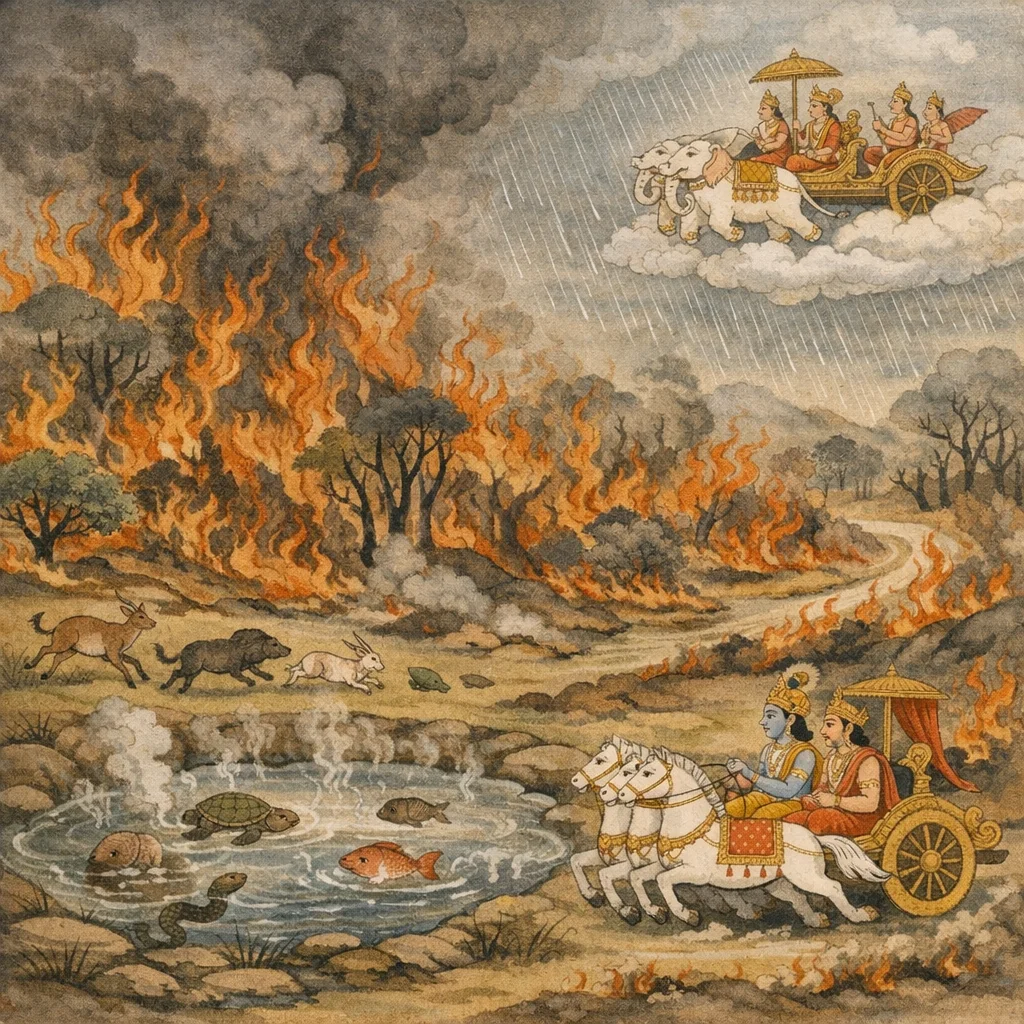
Chapter Arc: खाण्डववन धधक रहा है; भीतर के प्राणी जहाँ-जहाँ प्राण बचाने को भागते हैं, वहाँ-वहाँ अर्जुन और कृष्ण अपने तीव्र रथों से पहुँचकर मार्ग रोक देते हैं—वन अब अग्नि नहीं, एक बंद होता हुआ भाग्य बन जाता है। → जलाशय तक उबलने लगते हैं; कूर्म-मीन निर्जीव होकर तैरते दिखते हैं, पक्षी ऊपर उड़कर भी बाणों से छिदकर फिर उसी ज्वाला में गिर पड़ते हैं। इसी बीच इन्द्र, विशाल देव-रथों के साथ आकाश भरकर, वर्षा से अग्नि बुझाने का प्रयत्न करते हैं। → अग्नि की अर्चि-धाराएँ और इन्द्र की जल-धाराएँ एक साथ टकराती हैं—धुआँ, बिजली, गर्जन और लपटें मिलकर वन को ‘घोर’ बना देती हैं; पर रथों की गति और बाणों की दीवार के कारण प्राणियों के लिए कोई ‘छिद्र’—कोई निकास—नहीं बचता। → अध्याय का अंत इस बिंब पर टिकता है कि इन्द्र की वर्षा भी उस संहार-यंत्र को तुरंत रोक नहीं पाती; खाण्डव के भीतर जीवों की दुर्दशा चरम पर है और देव-मानव शक्तियाँ आमने-सामने खड़ी हैं। → इन्द्र का अग्नि-दाह रोकने का प्रयास आगे किस रूप में ‘क्रोध’ और प्रतिरोध में बदलता है—और कृष्ण-अर्जुन की प्रतिज्ञा कितनी दूर तक जाएगी?
Shlokas
Verse 1
अकाल पज्चविशर्त्याधिकद्विशततमो< ध्याय: खाण्डववनमें जलते हुए प्राणियोंकी दुर्दशा और इन्द्रके द्वारा जल बरसाकर आग बुझानेकी चेष्टा वैशम्पायन उवाच तौ रथाभ्यां रथश्रेष्ठी दावस्योभयत: स्थितौ । दिक्षु सर्वासु भूतानां चक्राते कदनं महत्,वैशम्पायनजी कहते हैं--जनमेजय! वे दोनों रथियोंमें श्रेष्ठ वीर दो रथोंपर बैठकर खाण्डववनके दोनों ओर खड़े हो गये और सब दिशाओंमें घूम-घूमकर प्राणियोंका महान् संहार करने लगे
Vaiśampāyana said: O Janamejaya, those two foremost warriors, mounted on their chariots, took positions on both sides of the blazing Khāṇḍava forest. Moving through all directions, they wrought a great slaughter of the living beings there—an episode that starkly frames the moral tension between martial prowess and the suffering of creatures caught in a conflagration.
Verse 2
यत्र यत्र च दृश्यन्ते प्राणिन: खाण्डवालया: । पलायन्त: प्रवीरौ तौ तत्र तत्राभ्यधावताम्,खाण्डववनमें रहनेवाले प्राणी जहाँ-जहाँ भागते दिखायी देते, वहीं-वहीं वे दोनों प्रमुख वीर उनका पीछा करते
Vaiśampāyana said: Wherever the living beings dwelling in the Khāṇḍava forest were seen fleeing, there and there those two foremost heroes rushed in pursuit. In the grim momentum of the Khāṇḍava burning, even the instinct to escape is met by relentless force, underscoring how violence in a sanctioned enterprise can still fall heavily upon the vulnerable.
Verse 3
छिद्रं न सम प्रपश्यन्ति रथयोराशुचारिणो: । आविद्धावेव दृश्येते रथिनौ तौ रथोत्तमौ,(खाण्डववनके प्राणियोंको) शीघ्रतापूर्वक सब ओर दौड़नेवाले उन दोनों महारथियोंका छिद्र नहीं दिखायी देता था, जिससे वे भाग सकें। रथियोंमें श्रेष्ठ वे दोनों रथारूढ़ वीर अलातचक्रकी भाँति सब ओर घूमते हुए ही दीख पड़ते थे
Vaiśampāyana said: The swiftly moving creatures saw no gap at all between the two chariots—no opening through which they might escape. Those two foremost of chariot-warriors appeared only as whirling figures, like a spinning firebrand’s circle, as they swept around on their chariots, hemming the beings in on every side.
Verse 4
खाण्डवे दहामाने तु भूता: शतसहसत्रश: । उत्पेतुर्भरवान् नादान् विनदन्तः समन्ततः,जब खाण्डववनमें आग फैल गयी और वह अच्छी तरह जलने लगा, उस समय लाखों प्राणी भयानक चीत्कार करते हुए चारों ओर उछलने-कूदने लगे
Vaiśaṃpāyana said: When the Khāṇḍava forest was burning and had caught fully, hundreds of thousands of living beings sprang up on every side, crying out with terrifying sounds. The scene underscores the vast, indiscriminate suffering that accompanies acts of destruction, even when driven by larger designs and alliances.
Verse 5
दग्वैकदेशा बहवो निष्टप्ताक्ष॒ तथापरे । स्फुटिताक्षा विशीर्णाश्व विप्लुताश्न तथापरे,बहुत-से प्राणियोंके शरीरका एक हिस्सा जल गया था, बहुतेरे आँचमें झुलस गये थे, कितनोंकी आँखें फूट गयी थीं और कितनोंके शरीर फट गये थे। ऐसी अवस्थामें भी सब भाग रहे थे
Vaiśampāyana said: Many creatures had parts of their bodies burned away; others had their eyes scorched by the heat. Some had their eyes burst, others were torn and shattered, and still others were disfigured and swollen—yet, even in such a condition, they kept fleeing in panic. The passage underscores the ethical horror of mass violence: when adharma prevails, suffering spreads indiscriminately, and living beings are reduced to mere victims of terror.
Verse 6
समालिज्जडय सुतानन्ये पितृन् भ्रातृनथापरे । त्यक्त न शेकुः स्नेहेन तत्रेव निधनं गता:,कोई अपने पुत्रोंकोी छातीसे चिपकाये हुए थे, कुछ प्राणी अपने पिता और भाइयोंसे सटे हुए थे। वे स्नेहवश एक-दूसरेको छोड़ न सके और वहीं कालके गालमें समा गये
Vaiśampāyana said: Some, clasping their sons tightly to their chests, and others clinging to their fathers and brothers, could not bring themselves to part out of overpowering affection; and so, right there, they met their end. The passage underscores how attachment, even to the dearest bonds, can bind beings to ruin when danger demands discernment and timely separation.
Verse 7
संदष्टदशनाश्षान्ये समुत्पेतुरनेकश: । ततस्ते$तीव घूर्णन्त: पुनरग्नौ प्रपेदिरे,कुछ जानवर दाँत कटकटाते, बार-बार उछलते-कूदते और अत्यन्त चक्कर काटते हुए फिर आगमें ही पड़ जाते थे
Vaiśampāyana said: Some creatures, their teeth clenched tight, leapt up again and again. Then, spinning in extreme disorientation, they fell back into the very fire—an image of helpless panic and the cruel inevitability of destruction once one is trapped in a consuming blaze.
Verse 8
दग्धपक्षाक्षिचरणा विचेष्टन्तो महीतले । तत्र तत्र सम दृश्यन्ते विनश्यन्त: शरीरिण:,कितने ही पक्षी पाँख, आँख और पंजोंके जल जानेसे धरतीपर गिरकर छटपटा रहे थे। स्थान-स्थानपर मरणोन्मुख जीव-जन्तु दृष्टिगोचर हो रहे थे
Vaiśampāyana said: With their wings, eyes, and feet scorched, they lay writhing upon the earth. Here and there, living creatures could be seen alike—bodies failing, on the verge of death. The scene underscores the moral weight of uncontrolled destruction: when fire and violence spread beyond restraint, the innocent and voiceless suffer first, and the world’s order is shaken.
Verse 9
जलाशयेषु तप्तेषु क्वाथ्यमानेषु वह्विना । गतसत्त्वा: सम दृश्यन्ते कूर्ममत्स्या: समन््तत:,जलाशय आगसे तपकर काढ़ेकी भाँति खौल रहे थे। उनमें रहनेवाले कछुए और मछली आदि जीव सब ओर निर्जीव दिखायी देते थे
Vaiśampāyana said: When the ponds and reservoirs had grown scorching hot and were boiling under the fire’s heat, the creatures dwelling in them—tortoises, fish, and the like—appeared lifeless everywhere. The scene underscores how unchecked destructive force consumes even the innocent and voiceless, turning habitats into death-traps and revealing the ethical cost of violence that spreads beyond its intended targets.
Verse 10
शरीरैरपरे दीप्तैर्देहवन्त इवाग्नय: । अदृश्यन्त वने तत्र प्राणिन: प्राणिसंक्षये,प्राणियोंके संहारस्थल बने हुए उस वनमें कितने ही प्राणी अपने जलते हुए अंगोंसे मूर्तिमान् अग्निके समान दीख पड़ते थे
Vaiśampāyana said: In that forest—turned into a place of slaughter—many creatures were seen with their bodies aflame, appearing like living fires. The scene underscores the moral horror of indiscriminate destruction, where life itself becomes a spectacle of suffering and the natural order is violently overturned.
Verse 11
कांश्रिदुत्पततः पार्थ: शरै: संछिद्य खण्डश: । पातयामास विहगान् प्रदीप्ते वसुरेतसि,अर्जुनने कितने ही उड़ते हुए पक्षियोंको अपने बाणोंसे टुकड़े-टुकड़े करके प्रज्वलित आगमें झोंक दिया
Vaiśampāyana said: Arjuna, the son of Pṛthā, cut down many birds as they flew, slicing them into pieces with his arrows, and caused them to fall into the blazing fire. The scene underscores the irresistible precision of his martial skill, while also hinting at the ethical tension of power used upon vulnerable creatures in the midst of a fiery rite or ordeal.
Verse 12
ते शराचितसर्वाड्रा निनदन्तो महारवान् | ऊर्ध्वमुत्पत्य वेगेन निपेतु: खाण्डवे पुन:,पहले तो पक्षी बड़े वेगसे ऊपरको उड़ते, परंतु बाणोंसे सारा अंग छिद जानेपर जोर- जोरसे आर्तनाद करते हुए पुनः खाण्डववनमें ही गिर पड़ते थे
Vaiśampāyana said: “Those birds, their bodies completely riddled with arrows, cried out with terrible, loud screams. Though they sprang upward with great speed, they fell back again into the Khāṇḍava forest.”
Verse 13
शरैरभ्याहतानां च संघश: सम वनौकसाम् | विराव: शुश्रुवे घोर: समुद्रस्येव मथ्यत:,बाणोंसे घायल हुए झुंड-के-झुंड वनवासी जीवोंका भयानक चीत्कार समुद्र-मन्थनके समय होनेवाले जल-जन्तुओंके करुण-क्रन्दनके समान जान पड़ता था
Vaiśampāyana said: “From the forest-dwelling creatures struck by arrows in whole groups, a dreadful clamour was heard—like the anguished cries of sea-beings when the ocean is churned.” The verse underscores how violence, even when part of a larger conflict, spreads terror through the innocent and turns the natural world into a witness of suffering.
Verse 14
वहनेश्चापि प्रदीप्तस्य खमुत्पेतुर्महार्चिष: । जनयामासुरुद्वेगं सुमहान्तं दिवौकसाम्,प्रज्वयलित अग्निकी बड़ी-बड़ी लपटें आकाशमें ऊपरकी ओर उठने और देवताओंके मनमें बड़ा भारी भय उत्पन्न करने लगीं
Vaiśampāyana said: From the blazing fire, great tongues of flame leapt upward into the sky, and they stirred an immense alarm in the hearts of the dwellers of heaven. The scene underscores how uncontrolled destructive energy—even when arising from a single source—can unsettle the cosmic order and provoke fear among even the mighty.
Verse 15
तेनार्चिषा सुसंतप्ता देवा: सर्षिपुरोगमा: । ततो जम्मुर्महात्मान: सर्व एव दिवौकस: । शतक्रतुं सहस्राक्षं देवेशमसुरार्दनम्,उस लपटसे संतप्त हुए देवता और महर्षि आदि सभी देवलोकवासी महात्मा असुरोंका नाश करनेवाले देवेश्वर सहस्राक्ष इन्द्रके पास गये
Vaiśampāyana said: Scorched and distressed by that blazing radiance, the gods—led by the ṛṣis—set out together. All the great-souled inhabitants of heaven then went to Śatakratu, the thousand-eyed Indra, lord of the gods and destroyer of the asuras, seeking refuge and decisive protection against the threat that had overwhelmed them.
Verse 16
देवा ऊचु कि न्विमे मानवा: सर्वे दहाुन्ते चित्रभानुना | कच्चिन्न संक्षय: प्राप्तो लोकानाममरेश्वर,देवता बोले--अमरेश्वर! अग्निदेव इन सब मनुष्योंको क्यों जला रहे हैं? कहीं संसारका प्रलय तो नहीं आ गया
The gods said: “Why indeed are all these human beings being burned by Citrabhānu (Agni)? O lord of the immortals, has the destruction of the worlds come to pass—has a cosmic dissolution begun?”
Verse 17
वैशम्पायन उवाच तच्छुत्वा वृत्रहा तेभ्यः स्वयमेवान्ववेक्ष्य च । खाण्डवस्य विमोक्षार्थ प्रयया हरिवाहन:,वैशम्पायनजी कहते हैं-जनमेजय! देवताओंसे यह सुनकर वृत्रासुरका नाश करनेवाले इन्द्र स्वयं वह घटना देखकर खाण्डववनको आगके भयसे छुड़ानेके लिये चले
Vaiśampāyana said: Hearing this from them, Indra—the slayer of Vṛtra—went forth, and, having himself looked into the matter, set out to free the Khāṇḍava forest from the peril of fire. Thus the lord who rides the tawny steeds moved to intervene, acting as a protector in response to what he had learned and verified.
Verse 18
महता रथवृन्देन नानारूपेण वासव: । आकाशं समवाकीर्य प्रववर्ष सुरेश्वर:,उन्होंने अपने साथ अनेक प्रकारके विशाल रथ ले लिये और आकाशमें स्थित हो देवताओंके स्वामी वे इन्द्र जलकी वर्षा करने लगे
Vaiśampāyana said: Accompanied by a great host of chariots of many kinds, Vāsava (Indra), the lord of the gods, filled the sky and began to pour down rain. The scene underscores divine sovereignty expressed not merely through force, but through the life-giving, order-restoring act of rainfall.
Verse 19
ततो$क्षमात्रा व्यसूजन् धारा: शतसहसख्रश: । चोदिता देवराजेन जलदा: खाण्डवं प्रति,देवराज इन्द्रसे प्रेरित होकर मेघ रथके धुरेके समान मोटी-मोटी असंख्य धाराएँ खाण्डववनमें गिराने लगे
Then, urged on by the king of the gods, the clouds poured forth countless streams—each as thick as an axle—sending torrents down upon the Khāṇḍava forest. In the narrative’s moral tension, divine power is shown intervening forcefully in a human conflict, attempting to obstruct the burning of the forest and protect its inhabitants, even as other divine forces support the opposite outcome.
Verse 20
असप्प्राप्तास्तु ता धारास्तेजसा जातवेदस: । ख एव समशुष्यन्त न काश्चित् पावकं गता:,परंतु अग्निके तेजसे वे धाराएँ वहाँ पहुँचनेसे पहले आकाशमें ही सूख जाती थीं। अग्नितक कोई धारा पहुँची ही नहीं
Vaiśampāyana said: Those streams of water, unable to reach the Fire, were dried up in mid-sky by the blazing energy of Jātavedas. Not a single current succeeded in arriving at the flame. The scene underscores the overwhelming, unassailable power of the divine fire—where ordinary remedies fail before superior tejas.
Verse 21
ततो नमुचिहा क्रुद्धों भृशमर्चिष्मतस्तदा । पुनरेव महामेघैरम्भांसि व्यसूजद् बहु,तब नमुचिनाशक इन्द्रदेव अग्निपर अत्यन्त कुपित हो पुनः बड़े-बड़े मेघोंद्वारा बहुत जलकी वर्षा कराने लगे
Then Namuci’s slayer, Indra, enraged at the blazing Agni, once again caused a heavy downpour—releasing abundant waters through great clouds. In the narrative frame, the gods’ response to Agni’s fierce energy is not direct violence but restraint through countervailing forces, suggesting an ethical preference for containment and balance over escalation.
Verse 22
अर्चिर्धाराभिसम्बद्ध॑ धूमविद्युत्ममाकुलम् । बभूव तद्ू वन॑ घोरं स्तनयित्नुसमाकुलम्,आगकी लपटों और जलकी धाराओंसे संयुक्त होनेपर उस वनमें धुआँ उठने लगा। सब ओर बिजली चमकने लगी और चारों ओर मेघोंकी गड़गड़ाहटका शब्द गूँज उठा। इस प्रकार खाण्डववनकी दशा बड़ी भयंकर हो गयी
Vaiśampāyana said: Bound together with streams of flame and torrents of water, that forest became choked with smoke and flashing with lightning. Filled with the roar of thunder, the woodland turned dreadful on every side—thus the Khāṇḍava forest fell into a terrifying state, showing how violence and counter-violence in nature can rapidly magnify into overwhelming destruction.
Verse 224
इस प्रकार श्रीमहाभारत आदिपव॑ीके अन्तर्गत खाण्डवदाहपर्वमें गाण्डीवादिदानविषयक दो सौ चौबीसवाँ अध्याय पूरा हुआ
Thus ends the two-hundred-and-twenty-fourth chapter of the Gāṇḍīva and related gifts, within the Khāṇḍava-burning section of the Ādi Parva of the sacred Mahābhārata. The narrator marks the close of this unit, signaling a transition in the unfolding account and framing the episode as a completed narrative segment.
Verse 225
इति श्रीमहाभारते आदिपर्वणि खाण्डवदाहपर्वणि इन्द्रक्रो थे पजञ्चविंशत्यधिकद्धिशततमो 5 ध्याय:,इस प्रकार श्रीमह्याभारत आदिपव॑के अन्तर्गत खाण्डवदाहपर्वमें इन्द्रकोपविषयक दो सौ पचीसवाँ अध्याय पूरा हुआ
Thus, in the Śrī Mahābhārata, within the Ādi Parva, in the section on the Burning of the Khāṇḍava forest, the two-hundred-and-twenty-fifth chapter—concerning Indra’s wrath—comes to an end. The colophon marks the closure of this narrative unit, emphasizing how divine anger and its consequences frame the ethical tensions around violence, protection, and the costs of extraordinary deeds.
Frequently Asked Questions
The dilemma concerns grief and responsibility in the face of threatened mortality: Mandapāla reframes fear of death through prior assurance (Agni’s promise), maternal dharma, and the children’s capability, directing them toward composure rather than lamentation.
Action is portrayed as ethically stable when it is authorized, timed, and disciplined: even extraordinary outcomes (like receiving astras) require proper conditions—legitimate sanction, readiness (tapas), and alignment with higher approval (Śiva-prasāda).
No explicit phalaśruti appears; the meta-function is structural—divine commendation and conditional boon-granting serve as narrative certification of the deed and as a forward link to Arjuna’s later acquisition of weapons.