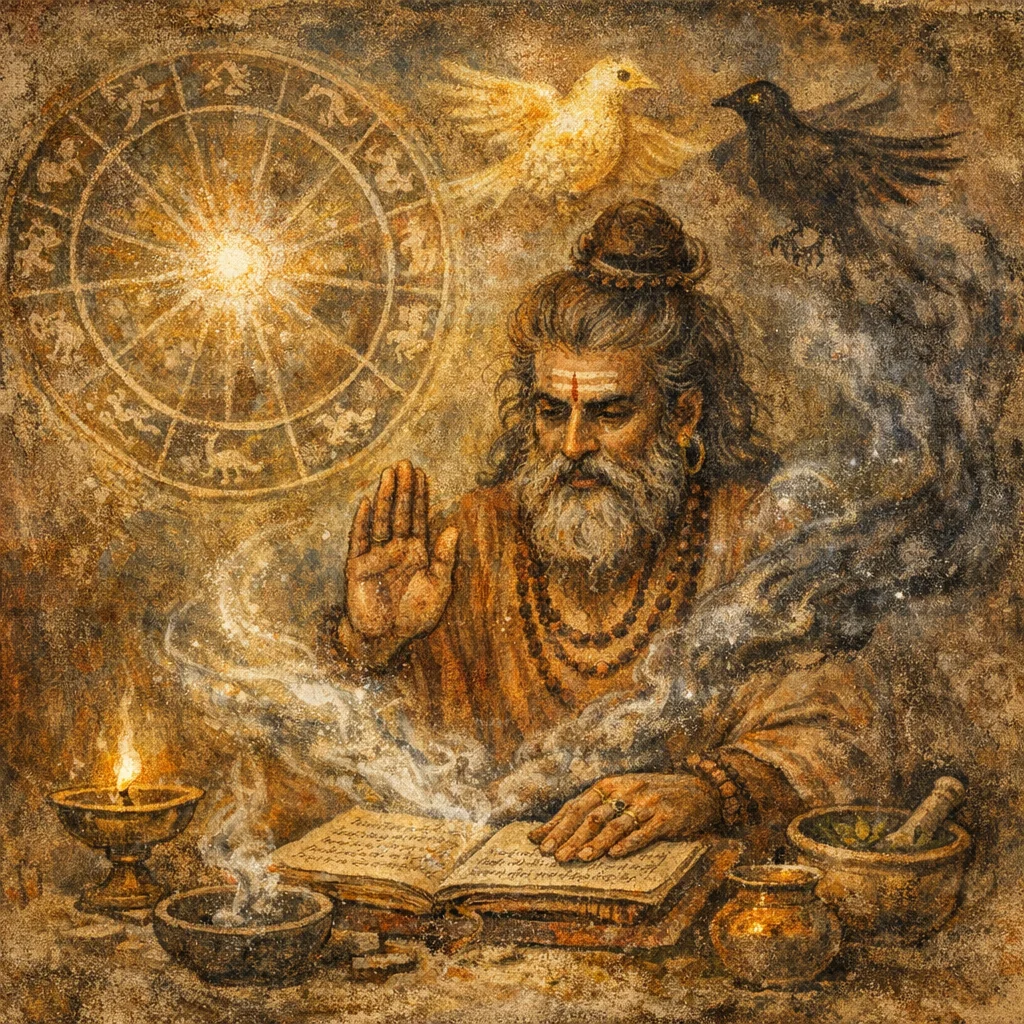
Sukta 9
Rishi: Traditionally associated with cosmological seers in AV Book 9 (often Atharvanic/Angirasic attribution in ancillary lists).
Devata: Agni; and implicitly Ṛta/Time (kāla/saṃvatsara) as cosmic principle.
Chandas: Triṣṭubh (11-syllable cadence typical of such cosmological stanzas).
Mantras
Mantra 1
आत्मा। अस्य वामस्य पलितस्य होतुस्तस्य भ्राता मध्यमो अस्त्यश्नः । तृतीयो भ्राता घृतपृष्ठो अस्यात्रापश्यं विश्पतिं सप्तपुत्रम्
The Self—of this gracious, grey-haired Hotṛ—his middle brother is the Stone; the third brother is ghee-backed. Here have I beheld the Lord of the folk, the Seven-soned.
Mantra 2
सप्त युञ्जन्ति रथमेकचक्रमेको अश्वो वहति सप्तनामा । त्रिनाभि चक्रमजरमनर्वं यत्रेमा विश्वा भुवनाधि तस्थुः
Seven yoke the one-wheeled chariot; one horse, seven-named, bears it. A wheel, three-naved, unaging, unfailing—whereon these all worlds are set and stand.
Mantra 3
इमं रथमधि ये सप्त तस्थुः सप्तचक्रं सप्त वहन्त्यश्वाः । सप्त स्वसारो अभि सं नवन्त यत्र गवां निहिता सप्त नामा
Upon this chariot stand the Seven; seven-wheeled it is, and seven are the horses that bear it. Seven Sisters bow together toward it, where are laid away the Seven Names of the kine.
Mantra 4
को ददर्श प्रथमं जायमानमस्थन्वन्तं यदनस्था बिभर्ति । भूम्या असुरसृगात्मा क्वऽस्वित् को विद्वांसमुप गात् प्रष्टुमेतत्
Who hath beheld the first-born as he is born—him that hath bones, when that which is boneless beareth him? The earth’s vital self, of asuric sap—where, pray, is it? To what wise man shall one go near to ask of this?
Mantra 5
इह ब्रवीतु य ईमङ्ग वेदास्य वामस्य निहितं पदं वेः । शीर्ष्णः क्षीरं दुह्रते गावो अस्य वव्रिं वसाना उदकं पदापुः
Let him speak here—who, pray, knoweth the hidden station of this wondrous Bird. From his head the cows draw milk; clothing the udder, they have won the water at the track.
Mantra 6
पाकः पृच्छामि मनसाविजानन् देवानामेना निहिता पदानि । वत्से बष्कयेऽधि सप्त तन्तून् वि तत्निरे कवय ओतवा उ
As one unknowing, with my mind I ask of these—the gods’ hidden stations. Upon the calf, upon the strong bull, the Seven threads the seers, the weavers, have stretched forth.
Mantra 7
अचिकित्वांस्चिकितुषश्चिदत्र कवीन् पृच्छामि विद्वनो न विद्वान्। वि यस्तस्तम्भ षडिमा रजांस्यजस्य रूपे किमपि स्विदेकम्
Unknowing, I question here the seers—even the discerning—one who would know, yet is no knower: Who hath set apart and propped these six regions—in the Unborn’s form—what single thing, pray, is it?
Mantra 8
माता पितरमृत आ बभाज धीत्यग्रे मनसा सं हि जग्मे। सा बीभत्सुर्गर्भरसा निविद्धा नमस्वन्त इदुपवाकमीयुः
The Mother, in accordance with Order, assigned the Father; with inspired thought, in the beginning, with mind she verily came into full conjunction. She, the dread one, rich in the embryo’s sap, firmly implanted—unto the act of invocation the reverent indeed drew near.
Mantra 9
युक्ता मातासिद्धुरि दक्षिणाया अतिष्ठद् गर्भो वृजनीष्वन्तः । अमीमेद् वत्सो अनु गामपश्यद् विश्वरूप्यंऽ त्रिषु योजनेषु
Yoked art thou, O Mother, on the right-hand shaft: within the homestead-enclosures the embryo took its stand. The calf lowed; following after the cow it found her—its manifold form displayed through the three measured regions.
Mantra 10
तिस्रो मातॄस्त्रीन् पितॄन् बिभ्रदेक ऊर्ध्वस्तस्थौ नेमव ग्लापयन्त । मन्त्रयन्ते दिवो अमुष्य पृष्ठे विश्वविदो वाचमविश्वविन्नाम्
Bearing three Mothers and three Fathers, One stood upright, firm; they would make the felly sink and slacken. Upon the back of yonder Heaven the all-knowing take counsel—(they set in motion) Speech, named ‘the not-all-knowing,’ to baffle the unwise.
Mantra 11
पञ्चारे चक्रे परिवर्तमाने यस्मिन्नातस्थुर्भुवनानि विश्वा । तस्य नाक्षस्तप्यते भूरिभारः सनादेव न च्छिद्यते सनाभिः
In the five-spoked wheel that turns about, wherein all the worlds are set and stand—its axle is not worn though heavily laden; from of old it is not broken, its hub unshattered.
Mantra 12
पञ्चपादं पितरं द्वादशाकृतिं दिव आहुः परे अर्धे पुरीषिणम्। अथेमे अन्य उपरे विचक्षणे सप्तचक्रे षडर आहुरर्पितम्
A five-footed Father, of twelve forms, of Heaven—so they call him—in the farther half, rich in plenitude. Then these others, the discerning, in another doctrine, declare him set fast in the seven-wheeled (frame), as six-spoked.
Mantra 13
द्वादशारं नहि तज्जराय वर्वर्ति चक्रं परि द्यामृतस्य । आ पुत्रा अग्ने मिथुनासो अत्र सप्त शतानि विंशतिश्च तस्थुः
Twelve-spoked—verily that wheel is not worn by age: it rolleth on, encompassing the heaven of Ṛta. Hither, O Agni, thy sons in paired conjunctions stand established here—seven hundred, and twenty besides.
Mantra 14
सनेमि चक्रमजरं वि वावृत उत्तानायां दश युक्ता वहन्ति । सूर्यस्य चक्षू रजसैत्यावृतं यस्मिन्नातस्थुर्भुवनानि विश्वा
The rimmed wheel, unaging, hath rolled forth; upon the outspread expanse ten yoked ones draw it on. The Sun’s eye goeth, wrapped about with rajas; therein all worlds have taken their firm station.
Mantra 15
स्त्रियः सतीस्ताँ उ मे पुंसः आहुः पश्यदक्षण्वान् न वि चेतदन्धः । कविर्यः पुत्रः स ईमा चिकेत यस्ता विजानात् स पितुष्पितासत्
Women they are in sooth—yet them, for me, men call they: the blind one, though he see and hath eyes, discerned it not aright. The seer, the son—he hath perceived these; who knoweth them distinctly, he were father of the father.
Mantra 16
साकंजानां सप्तथमाहुरेकजं षडिद् यमा ऋषयो देवजा इति । तेषामिष्टानि विहितानि धामश स्थात्रे रेजन्ते विकृतानि रूपशः
Of those co-born they call one the seventh, single-born: six, forsooth, are twin-paired seers, god-begotten—so they say. Their wished-for portions, duly set in stations, within the fixed support shine forth, transformed in manifold of form.
Mantra 17
अवः परेण पर एनावरेण पदा वत्सं बिभ्रती गौरुदस्थात्। सा कद्रीची कं स्विदर्धं परागात् क्वऽस्वित्सूते नहि यूथे अस्मिन्
Downward—by the farther foot, and then by the nearer—bearing her calf, the Cow hath risen up. Whither, pray, to what half hath she departed? Where, pray, doth she bring forth? for not within this herd is she.
Mantra 18
अवः परेण पितरं यो अस्य वेदावः परेण पर एना वरेण । कवीयमानः क इह प्र वोचद् देवं मनः कुतो अधि प्रजातम्
Aid from beyond—he who knoweth the Father of this (All); aid from beyond, beyond these, by the excellent boon. In seerly inspiration, who here hath proclaimed the divine Mind—whence, and from what height, it was brought to birth?
Mantra 19
ये अर्वाञ्चस्ताँ उ पराच आहुर्ये पराञ्चस्ताँ उ अर्वाच आहुः । इन्द्रश्च या चक्रथुः सोम तानि धुरा न युक्ता रजसो वहन्ति
What face toward us, those verily they call ‘turned away’; what face away, those verily they call ‘turned hither’. Those ordinances which thou, O Soma, and Indra have wrought—like yokes well-harnessed they bear the airy regions.
Mantra 20
द्वा सुपर्णा सयुजा सखाया समानं वृक्षं परि षस्वजाते । तयोरन्यः पिप्पलं स्वाद्वत्त्यनश्नन्नन्यो अभि चाकशीति
Two fair-winged, yoked together, companions, cling round the self-same tree. Of the twain, the one eateth the sweet pippala fruit; the other, eating not, looketh on in contemplation.
Mantra 21
यस्मिन् वृक्षे मध्वदः सुपर्णा निविशन्ते सुवते चाधि विश्वे । तस्य यदाहुः पिप्पलं स्वाद्वग्रे तन्नोन्नशद् यः पितरं न वेद
In which tree the honey-eating fair-winged settle them, and it bringeth forth all beings thereupon—when they speak of its sweet pippala at the top, let him not partake thereof who knoweth not the Father.
Mantra 22
यत्रा सुपर्णा अमृतस्य भक्षमनिमेषं विदथाभिस्वरन्ति । एना विश्वस्य भुवनस्य गोपाः स मा धीरः पाकमत्रा विवेश
Where the fair-winged chant, by sacred sessions, the unwinking portion of immortality—thereby the guardians of the whole world: may the wise one enter me here; may the unripe (simple) not enter.
Frequently Asked Questions
It is the year/time-order (saṃvatsara, ṛta) pictured as an unaging wheel with measures like spokes and naves—showing how the worlds and life-events remain stable through regular sequence.
Agni is the ritual form of cosmic order that people can actually approach; by placing the rite in Agni, the performer aligns personal life with Ṛta’s regulated course.
In Atharvanic practice, correct knowledge of cosmic correspondences (bandhu) is protective: reciting the time-wheel’s order is meant to produce steadiness—fertility, continuity, and freedom from disruptive ‘untimely’ events.