Adhyaya 26
रुक्मिणी-हरणम्, विरोधि-राजगणः, रुक्मी-प्रतिज्ञा-पराजयः, प्रद्युम्न-जन्म
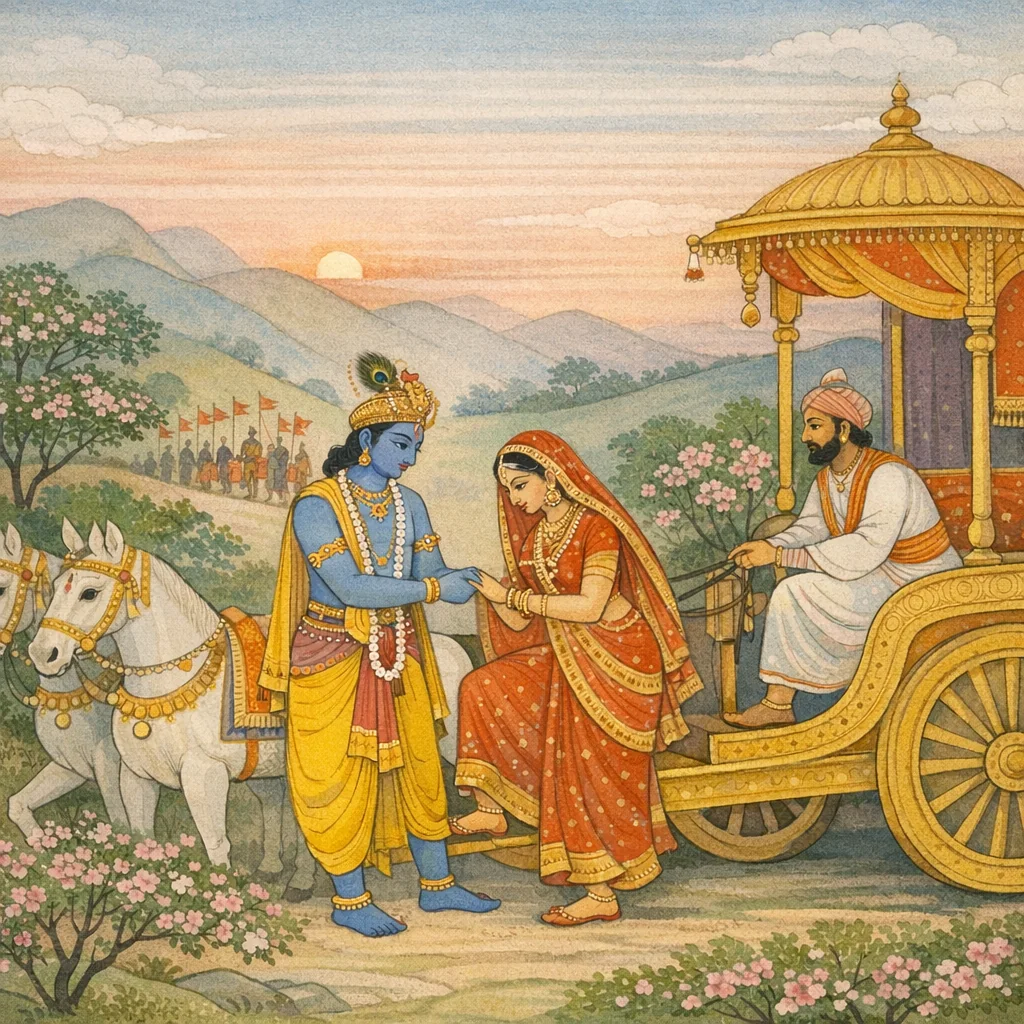
Parāśara relates: In Vidarbha, at Kundina, ruled King Bhīṣmaka, whose son was Rukmī and daughter Rukmiṇī. Śrī Kṛṣṇa longed for Rukmiṇī and she for Him, yet Rukmī, hating the Disc-bearer, would not consent to the match. Urged by Jarāsandha, Bhīṣmaka fixed Rukmiṇī’s marriage to Śiśupāla, and many kings led by Jarāsandha came to Kundina. Kṛṣṇa arrived with Balarāma and the Yādavas; on the day before the wedding, Hari carried off the maiden, placing the burden of battle upon Rāma and His kinsmen. Pauṇḍraka, Dantavakra, Vidūratha, Śiśupāla, Jarāsandha, Śālva and others, enraged, fought but were defeated by the foremost Yādava heroes. Rukmī vowed, “Only after slaying Keśava will I enter Kundina,” and charged, but the Cakrī effortlessly shattered his strength and cast him down. Then Madhusūdana took Rukmiṇī by the rākṣasa-vivāha rite; from her was born Pradyumna—an aspect of Kāma—who became the seed of the later Śambara episode.
Shlokas
Verse 1
भीष्मकः कुण्डिने राजा विदर्भविषये ऽभवत् रुक्मी तस्याभवत् पुत्रो रुक्मिणी च वराङ्गना
In the land of Vidarbha, at Kuṇḍina, there ruled a king named Bhīṣmaka. Of him were born a son, Rukmī, and also Rukmiṇī, a maiden of exquisite beauty.
Verse 2
रुक्मिणीं चकमे कृष्णः सा च तं चारुहासिनी न ददौ याचते चैनां रुक्मी द्वेषेण चक्रिणे
Kṛṣṇa longed for Rukmiṇī, and she—smiling with gentle grace—longed for Him as well. Yet when the Lord sought her hand, Rukmī, out of hatred for Kṛṣṇa the Discus-bearer, refused to give her to Him.
Verse 3
ददौ च शिशुपालाय जरासंधप्रचोदितः भीष्मको रुक्मिणा सार्धं रुक्मिणीम् उरुविक्रमः
Urged on by Jarāsandha, mighty Bhīṣmaka, together with Rukmī, gave Rukmiṇī in marriage to Śiśupāla.
Verse 4
विवाहार्थं ततः सर्वे जरासंधमुखा नृपाः भीष्मकस्य पुरीं जग्मुः शिशुपालप्रियैषिणः
Then, intent upon the wedding, all those kings—led by Jarāsandha—went to Bhīṣmaka’s city, seeking to secure what was dear to Śiśupāla and to fulfill his desire.
Verse 5
कृष्णो ऽपि बलभद्राद्यैर् यादवैर् बहुभिर् वृतः प्रययौ कुण्डिनं द्रष्टुं विवाहं चेदिभूभृतः
Kṛṣṇa too, surrounded by many Yādavas led by Balabhadra, set out for Kuṇḍina to witness the wedding of the Cedi king.
Verse 6
श्वोभाविनि विवाहे तु तां कन्यां हृतवान् हरिः विपक्षभारम् आसज्य रामाद्येष्व् अथ बन्धुषु
But when the marriage was to take place on the morrow, Hari carried away that maiden, shifting the crushing burden of opposition onto Rāma and the other kinsmen, so that the contest would fall upon their side.
Verse 7
ततश् च पौण्ड्रकः श्रीमान् दन्तवक्रो विदूरथः शिशुपालजरासंधशाल्वाद्याश् च महीभृतः
Thereafter the illustrious Pauṇḍraka, Dantavakra, Vidūratha, and the earth‑bearing kings—Śiśupāla, Jarāsandha, Śālva and others—gathered their royal might and rose in opposition to the Lord’s ordained sovereignty.
Verse 8
कुपितास् ते हरिं हन्तुं चक्रुर् उद्योगम् उत्तमम् निर्जिताश् च समागम्य रामाद्यैर् यदुपुंगवैः
Enraged, they made their finest preparations to slay Hari; yet, defeated, they returned and gathered before the foremost of the Yadus—Balarāma and the others.
Verse 9
कुण्डिनं न प्रवेक्ष्यामि अहत्वा युधि केशवम् कृत्वा प्रतिज्ञां रुक्मी च हन्तुं कृष्णम् अभिद्रुतः
Rukmī made a fierce vow: “I shall not enter Kundina again until I have slain Keśava in battle.” Thus resolved to kill Kṛṣṇa, he rushed forward in pursuit.
Verse 10
हत्वा बलं सनागाश्वं पत्तिस्यन्दनसंकुलम् निर्जितः पातितश् चोर्व्यां लीलयैव स चक्रिणा
Though the host—thronged with infantry and chariots, upheld by elephants and horses—was cut down, he himself was effortlessly conquered and cast upon the earth by the Discus‑bearing Lord, as if it were mere sport to Him.
Verse 11
निर्जित्य रुक्मिणं सम्यग् उपयेमे स रुक्मिणीम् राक्षसेन विवाहेन संप्राप्तां मधुसूदनः
Having decisively subdued Rukmin, Madhusūdana duly took Rukmiṇī as his wife—she who had been obtained by the rākṣasa mode of marriage, by forceful carrying away.
Verse 12
तस्यां जज्ञे ऽथ प्रद्युम्नो मदनांशः स वीर्यवान् जहार शम्बरो यं वै यो जघान च शम्बरम्
From her, Pradyumna was born—valiant, bearing a portion of Kāma. Though Śambara carried him off, Pradyumna later became the slayer of Śambara.
Frequently Asked Questions
It classifies the mode as ‘carrying away by force’ in dharmaśāstra taxonomy, while the Purana simultaneously presents it as divinely ordained restoration of mutual consent (Kṛṣṇa–Rukmiṇī) against adharma-backed political coercion.
To emphasize the asymmetry between human/royal power and Bhagavān’s aiśvarya: the Lord’s actions are effortless, revealing His sovereignty over outcomes while remaining within narrative history.