Sukta 21
Sukta 4.21
Vāmadeva Gautama (traditional)
Indra
Triṣṭubh (probable)
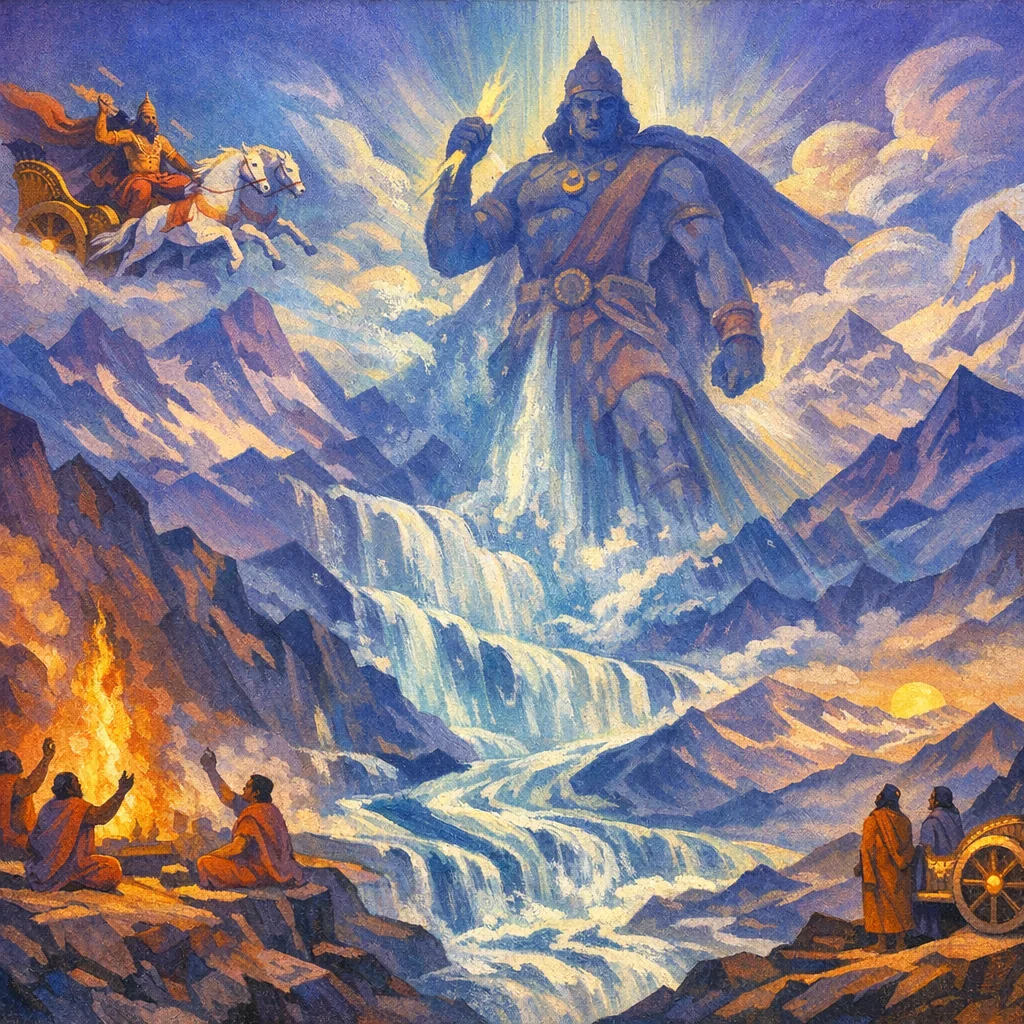
This hymn is an invocation to Indra to come near, sit with the worshippers in the shared rite (sadhamāda), and enlarge their strength, sovereignty, and victorious mastery. It weaves outer yajña imagery—pressing, paths, and the Hotṛ-flame—into an inner psychology of dhiṣā (inspired intelligence) that discovers “go” (light/cows) and receives Indra’s rushing impulse like swelling rivers.
Mantras
Mantra 1
आ यात्विन्द्रोऽवस उप न इह स्तुतः सधमादस्तु शूरः । वावृधानस्तविषीर्यस्य पूर्वीर्द्यौर्न क्षत्रमभिभूति पुष्यात् ॥
Let Indra come near to us here for our protection; praised, may the Hero be present in the common session. Ever increasing the powers of force (taviṣīḥ), whose many mights nourish sovereignty like heaven itself, may his victorious mastery grow in us.
Mantra 2
तस्येदिह स्तवथ वृष्ण्यानि तुविद्युम्नस्य तुविराधसो नॄन् । यस्य क्रतुर्विदथ्यो न सम्राट् साह्वान्तरुत्रो अभ्यस्ति कृष्टीः ॥
Here praise the virile powers of him of vast radiance and vast plenitude, the leader among men; whose will (kratu) in the assemblies is like an emperor—overcoming, far-bearing, he stands over the peoples, mastering them toward the right order.
Mantra 3
आ यात्विन्द्रो दिव आ पृथिव्या मक्षू समुद्रादुत वा पुरीषात् । स्वर्णरादवसे नो मरुत्वान्परावतो वा सदनादृतस्य ॥
Let Indra come from heaven, from earth, swiftly from the ocean-depth or from the rich fullness (purīṣa). From the luminous man-strength (svar-narā), for our protection, with the Maruts, let him come—whether from the far beyond or from the seat of the Truth (ṛta).
Mantra 4
स्थूरस्य रायो बृहतो य ईशे तमु ष्टवाम विदथेष्विन्द्रम् । यो वायुना जयति गोमतीषु प्र धृष्णुया नयति वस्यो अच्छ ॥
Indra who rules the massive and the vast plenitude—him let us praise in the assemblies. He who by the breath-force (vāyu) conquers in the fields rich in Light (gomatī), and by daring energy leads us forward to the better and the desirable.
Mantra 5
उप यो नमो नमसि स्तभायन्नियर्ति वाचं जनयन्यजध्यै । ऋञ्जसानः पुरुवार उक्थैरेन्द्रं कृण्वीत सदनेषु होता ॥
He who, drawing near with reverence, steadies homage by homage, sets in motion the word and brings it to birth for the act of worship—straightening himself, rich in many openings, with hymns he makes Indra present in the seats as the priest of the offering.
Mantra 6
धिषा यदि धिषण्यन्तः सरण्यान्त्सदन्तो अद्रिमौशिजस्य गोहे । आ दुरोषाः पास्त्यस्य होता यो नो महान्त्संवरणेषु वह्निः ॥
When by the inspired intelligence (dhiṣā) the seekers become capable, taking their seat in the swift-moving paths, they press the stone of the Ushij (the eager striving) for the finding of the Light (go). Then comes the Hotṛ of the home, wide in his habitation, the great bearer-flame (vahni) for us in the enclosing fields.
Mantra 7
सत्रा यदीं भार्वरस्य वृष्णः सिषक्ति शुष्मः स्तुवते भराय । गुहा यदीमौशिजस्य गोहे प्र यद्धिये प्रायसे मदाय ॥
When, unfailingly, the impetuous force of the Bull (Indra) is yoked for Bhārvara, for the bearer who praises, then—when he is hidden in the cave of the Auśija’s cow-pen—he comes forth for the thought, for the forward drive, for the ecstasy of fulfilment.
Mantra 8
वि यद्वरांसि पर्वतस्य वृण्वे पयोभिर्जिन्वे अपां जवांसि । विदद्गौरस्य गवयस्य गोहे यदी वाजाय सुध्यो वहन्ति ॥
When he opens the doors of the mountain and with the streams of plenitude quickens the rush of the waters, then he finds, in the cow-pen, the shining light and its companion lights—when the powers of right discernment bear the plenitude of force toward the goal.
Mantra 9
भद्रा ते हस्ता सुकृतोत पाणी प्रयन्तारा स्तुवते राध इन्द्र । का ते निषत्तिः किमु नो ममत्सि किं नोदुदु हर्षसे दातवा उ ॥
Auspicious are your hands, well-skilled are your palms, O Indra—givers of delight to the one who praises. What is your resting-place? How will you take joy in us? By what uplift do you exult, to give to us?
Mantra 10
एवा वस्व इन्द्रः सत्यः सम्राड्ढन्ता वृत्रं वरिवः पूरवे कः । पुरुष्टुत क्रत्वा नः शग्धि रायो भक्षीय तेऽवसो दैव्यस्य ॥
Thus, O Indra the Good, the True, the sovereign king, slayer of Vṛtra, maker of wide room for Pūru—O much-praised—by your will and power help us, that we may partake of your divine protection and the fullness of being.
Mantra 11
नू ष्टुत इन्द्र नू गृणान इषं जरित्रे नद्यो न पीपेः । अकारि ते हरिवो ब्रह्म नव्यं धिया स्याम रथ्यः सदासाः ॥
Now praised, O Indra, now sung, you swell the stream of impulse for the singer as rivers swell. For you, O lord of the bays, a new word of power has been fashioned; by inspired thought may we be fit for the chariot-path, constant companions.
Frequently Asked Questions
The hymn asks Indra to come near, sit with the worshippers in the ritual gathering, and grant protection, victory, and the increase of strength and sovereign power.
Dhiṣā means inspired intelligence. The hymn says that when seekers act with dhiṣā, they reach the swift paths of the rite and find “go,” a Vedic symbol for light, increase, and the recovered riches of truth.
It ends by saying Indra swells the singer’s impulse like rivers and that a “new brahman” has been fashioned—meaning a fresh, potent formulation of sacred speech offered to Indra for continued guidance and companionship.