Sarga 70
वंशवर्णनम् तथा विवाहप्रार्थना — Genealogy of the Ikshvaku Line and the Proposal for Marriage
बालकाण्ड
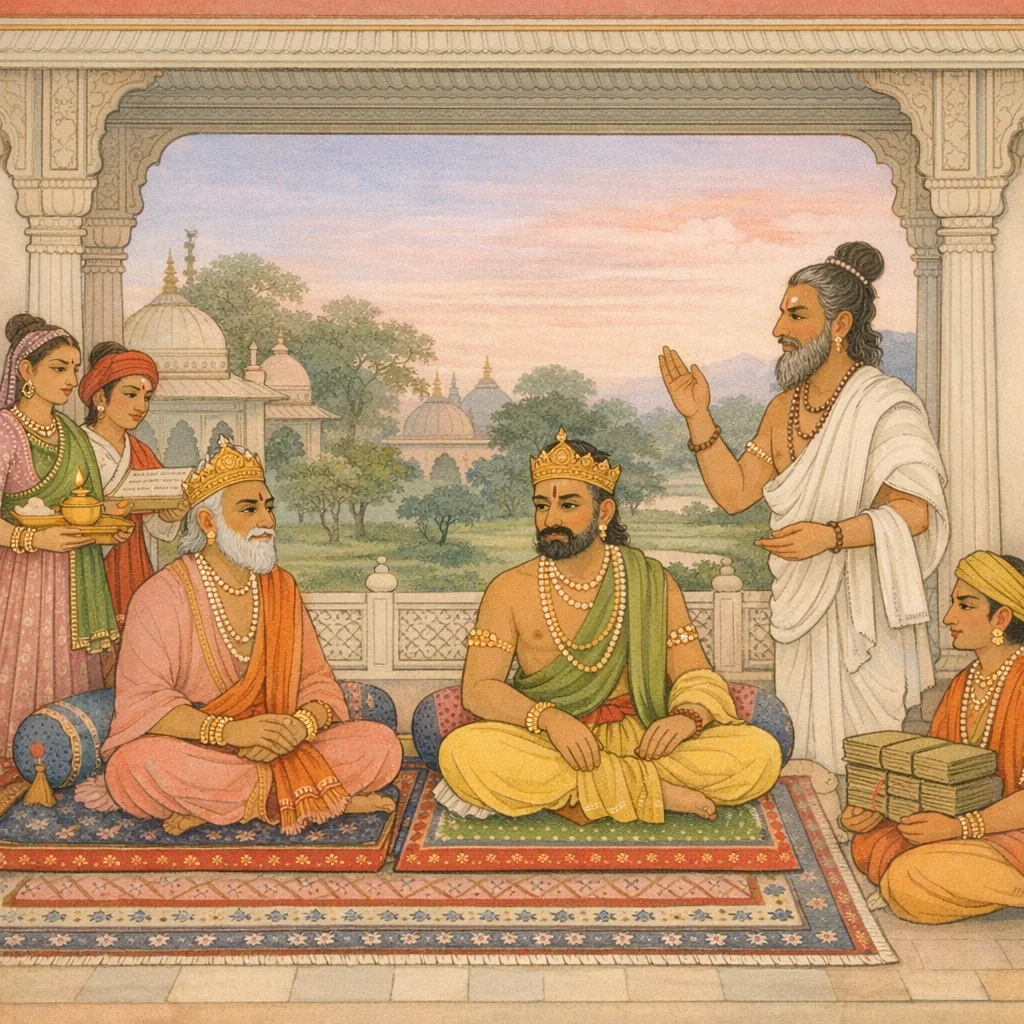
In Sarga 70 at Mithilā, at dawn after the daily sacrificial rites, King Janaka speaks with his chief priest Śatānanda and sets diplomatic arrangements in motion. Messengers are sent to summon Janaka’s younger brother Kuśadhvaja from Sāṅkāśyā on the bank of the river Ikṣumatī; Kuśadhvaja arrives, offers respects, and is seated with royal honor. At the same time Mithilā invites Daśaratha: the chief minister Sudāman is dispatched, and Daśaratha comes with rishis, preceptors, priests, ministers, and kinsmen. Daśaratha formally appoints Vasiṣṭha as the authoritative spokesman for ceremonial matters, with Viśvāmitra’s assent. Vasiṣṭha then recites the sacred genealogy from Brahmā through Marīci, Kaśyapa, Vivasvān, Manu, and the Ikṣvāku dynasty down to Daśaratha and his sons, establishing purity of descent, truthfulness, and royal virtue. The sarga concludes with Vasiṣṭha’s explicit request that Janaka bestow his two daughters in marriage upon Rāma and Lakṣmaṇa, presenting the union as fitting in merit and proper to both dynasties.
Shlokas
Verse 1
तत: प्रभाते जनक: कृतकर्मा महर्षिभि:।उवाच वाक्यं वाक्यज्ञ श्शतानन्दं पुरोहितम्।।1.70.1।।
Then, at dawn—when the great sages had completed their rites—Janaka, skilled in speech, addressed Śatānanda, his chief priest.
Verse 2
भ्राता मम महातेजा यवीयानतिधार्मिक:।कुशध्वज इति ख्यात: पुरीमध्यवसच्छुभाम्।।1.70.2।।वार्याफलकपर्यन्तां पिबन्निक्षुमतीं नदीम्।साङ्काश्यां पुण्यसङ्काशां विमानमिव पुष्पकम्।।1.70.3।।
My younger brother, the renowned Kuśadhvaja—brilliant and exceedingly righteous in dharma—dwells in the auspicious city of Sāṅkāśyā, holy in appearance and likened to the Puṣpaka aerial car, on the bank of the Ikṣumatī river, whose waters mark the city’s boundary.
Verse 3
भ्राता मम महातेजा यवीयानतिधार्मिक:।कुशध्वज इति ख्यात: पुरीमध्यवसच्छुभाम्।।1.70.2।।वार्याफलकपर्यन्तां पिबन्निक्षुमतीं नदीम्।साङ्काश्यां पुण्यसङ्काशां विमानमिव पुष्पकम्।।1.70.3।।
My younger brother, the renowned Kuśadhvaja—brilliant and exceedingly righteous in dharma—dwells in the auspicious city of Sāṅkāśyā, holy in appearance and likened to the Puṣpaka aerial car, on the bank of the Ikṣumatī river, whose waters mark the city’s boundary.
Verse 4
तमहं द्रष्टुमिच्छामि यज्ञगोप्ता स मे मत:।प्रीतिं सोऽपि महातेजा इमां भोक्ता मया सह।।1.70.4।।
I wish to see him; I have chosen him as the protector of the sacrifice. Let that great and radiant one also partake of this joy together with me.
Verse 5
एवमुक्ते तु वचने शतानन्दस्य सन्निधौ।आगता: केचिदव्यग्रा जनकस्तान् समादिशत्।।1.70.5।।
When these words had been spoken in Śatānanda’s presence, some attentive attendants arrived; and Janaka gave them his instructions.
Verse 6
शासनात्तु नरेन्द्रस्य प्रययुश्शीघ्रवाजिभि:।समानेतुं नरव्याघ्रं विष्णुमिन्द्राज्ञया यथा।।1.70.6।।
At the king’s command, they set out on swift horses to bring that tiger among men—just as Viṣṇu might be summoned by Indra’s order.
Verse 7
साङ्काश्यां ते समागत्य ददृशुश्च कुशध्वजम्।न्यवेदयन्यथावृत्तं जनकस्य च चिन्तितम्।।1.70.7।।
Reaching Sāṅkāśyā, they met Kuśadhvaja and reported what had occurred, as well as Janaka’s intention.
Verse 8
तद्वृत्तं नृपति श्शृत्वा दूतश्रेष्ठैर्महाबलै:।अज्ञायाऽथ नरेन्द्रस्य आजगाम कुशध्वज:।।1.70.8।।
Having heard those events from the best of messengers—men of great strength—Kuśadhvaja, understanding the king’s command, set out to go to him.
Verse 9
स ददर्श महात्मानं जनकं धर्मवत्सलम्।सोऽभिवाद्य शतानन्दं राजानं चापि धार्मिकम्।।1.70.9।।राजार्हं परमं दिव्यमासनं चाऽध्यरोहत।
He beheld the great-souled Janaka, devoted to dharma. After respectfully greeting Śatānanda and the righteous king, he took his seat upon a splendid throne worthy of royalty.
Verse 10
उपविष्टावुभौ तौ तु भ्रातरावतितेजसौ।।1.70.10।।प्रेषयामासतुर्वीरौ मन्त्रिश्रेष्ठं सुदामनम्।
Seated together, the two radiant heroic brothers dispatched Sudāmāna, the foremost of ministers.
Verse 11
गच्छ मन्त्रिपते शीघ्रमैक्ष्वाकुममितप्रभम्।।1.70.11।।आत्मजैस्सह दुर्धर्षमानयस्व समन्त्रिणम्।
“O leader among ministers, go quickly and bring the Ikṣvāku king, the invincible Daśaratha—of immeasurable splendour—together with his sons and his ministers.”
Verse 12
औपकार्यां स गत्वा तु रघूणां कुलवर्धनम्।।1.70.12।।ददर्श शिरसा चैनमभिवाद्येदमब्रवीत्।
Having gone to the pavilion, he saw Daśaratha, the increaser of the Raghu line; and bowing his head in salutation, he spoke these words.
Verse 13
अयोध्याधिपते वीर वैदेहो मिथिलाधिप:।।1.70.13।।स त्वां द्रष्टुं व्यवसितस्सोपाध्यायपुरोहितम्।
“O heroic lord of Ayodhyā, Janaka of Videha—the ruler of Mithilā—has resolved to see you, together with your teachers and your chief priest.”
Verse 14
मंत्रिश्रेष्ठवच श्शृत्वा राजा सर्षिगणस्तदा।।1.70.14।।सबंधुरगमत्तत्र जनको यत्र वर्तते।
Hearing the words of the foremost minister, the king then went—together with groups of ṛṣis and with his kinsmen—to where Janaka was waiting.
Verse 15
स राजा मन्त्रिसहित स्सोपाध्याय: सबान्धव:।।1.70.15।।वाक्यं वाक्यविदां श्रेष्ठो वैदेहमिदमब्रवीत्।
That king, accompanied by his ministers, preceptors, and kinsmen—foremost among those skilled in speech—addressed Janaka of Videha with these words.
Verse 16
विदितं ते महाराज इक्ष्वाकुकुलदैवतम्।।1.70.16।।वक्ता सर्वेषु कृत्येषु वसिष्ठो भगवानृषि:।
O great king, it is well known to you that the venerable sage Vasiṣṭha is the divine guardian of the Ikṣvāku dynasty, and that in all ritual duties he serves as its authorized spokesman.
Verse 17
विश्वामित्राभ्यनुज्ञातस्सह सर्वैर्महर्षिभि:।।1.70.17।।एष वक्ष्यति धर्मात्मा वसिष्ठो मे यथाक्रमम्।
With Viśvāmitra’s permission, and with the assent of all the great seers, this righteous-souled Vasiṣṭha will recount my dynasty to you in due sequence.
Verse 18
एवमुक्त्वा नरश्रेष्ठे राज्ञां मध्ये महात्मनाम्।।1.70.18।।तूष्णींभूते दशरथे वसिष्ठो भगवानृषि:।उवाच वाक्यं वाक्यज्ञो वैदेहं सपुरोधसम्।।1.70.19।।
Having spoken thus amidst the assembly of high-souled kings, the best among men, Dasharatha, fell silent. Then the venerable sage Vasistha, master of eloquent speech, addressed the King of Videha, who was accompanied by his priests.
Verse 19
एवमुक्त्वा नरश्रेष्ठे राज्ञां मध्ये महात्मनाम्।।1.70.18।।तूष्णींभूते दशरथे वसिष्ठो भगवानृषि:।उवाच वाक्यं वाक्यज्ञो वैदेहं सपुरोधसम्।।1.70.19।।
Having spoken thus amidst the assembly of high-souled kings, the best among men, Dasharatha, fell silent. Then the venerable sage Vasistha, master of eloquent speech, addressed the King of Videha, who was accompanied by his priests.
Verse 20
अव्यक्तप्रभवो ब्रह्मा शाश्वतो नित्य अव्यय:।तस्मान्मरीचि स्संजज्ञे मरीचे: काश्यप: सुत:।।1.70.20।।
From the Unmanifest arose Brahmā—eternal, constant, and imperishable. From him was born Marīci; and from Marīci was born his son Kaśyapa.
Verse 21
विवस्वान् काश्यपाज्जज्ञे मनुर्वैवस्वत स्स्मृत:।मनु: प्रजापति: पूर्वमिक्ष्वाकुस्तु मनोस्सुत:।।1.70.21।।
From Kaśyapa was born Vivasvān; from Vivasvān came Manu, remembered as Vaivasvata and formerly known as Prajāpati; and Ikṣvāku was the son of Manu.
Verse 22
तमिक्ष्वाकुमयोध्यायां राजानं विद्धि पूर्वकम्।इक्ष्वाकोस्तु सुतश्श्रीमान् कुक्षिरित्येव विश्रुत:।।1.70.22।।
Know Ikṣvāku as the earliest ancestral king in Ayodhyā. Ikṣvāku’s son, the illustrious one, was famed by the name Kukṣi.
Verse 23
कुक्षेरथात्मज: श्रीमान् विकुक्षिरुदपद्यत।विकुक्षेस्तु महातेजा बाण: पुत्र: प्रतापवान्।।1.70.23।।
Thereafter, Kukṣi’s illustrious son Vikukṣi was born; and to Vikukṣi was born the mighty and radiant son Bāṇa, renowned for his valor.
Verse 24
बाणस्य तु महातेजा अनरण्य: प्रतापवान्।अनरण्यात्पृथुर्जज्ञे त्रिशङ्कुस्तु पृथोस्सुत:।।1.70.24।।
To Bāṇa was born Anaraṇya, greatly radiant and mighty in valor. From Anaraṇya was born Pṛthu, and Pṛthu’s son was Triśaṅku.
Verse 25
त्रिशङ्कोरभवत्पुत्रो दुन्दुमारो महायशा:।युवनाश्वसुतस्त्वासीन्मान्धाता पृथिवीपति:।।1.70.25।।
From Triśaṅku was born the greatly renowned son Dundumāra; and from Yuvanāśva was born Māndhātā, lord of the earth.
Verse 26
मान्धातुस्तु सुत श्श्रीमान् सुसन्धिरुदपद्यत।सुसन्धेरपि पुत्रौ द्वौ ध्रुवसन्धि: प्रसेनजित्।।1.70.26।।
To Māndhātā was born the illustrious son Susandhi; and to Susandhi were born two sons—Dhruvasandhi and Prasēnajit.
Verse 27
यशस्वी ध्रुवसन्धेस्तु भरतो नाम नामत:।भरतात्तु महातेजा असितो नाम जातवान्।।1.70.27।।
To Dhruvasandhi was born the celebrated son named Bharata; and from Bharata was born Asita, mighty and radiant.
Verse 28
यस्यैते प्रतिराजान उदपद्यन्त शत्रव:।हैहयास्तालजंघाश्च शूराश्च शशिबिन्दव:।।1.70.28।।
Against him (Asita) arose rival kings as enemies—valiant warriors of the Haihaya, Tālajaṅgha, and Śaśibindu lines.
Verse 29
तांस्तु स प्रतियुध्यन् वै युद्धे राजा प्रवासित:।हिमवन्तमुपागम्य भृगुप्रस्रवणेऽवसत्।।1.70.29।।असितोऽल्पबलो राजा मन्त्रिभिस्सहितस्तदा।
Fighting them in battle, the king was driven into exile. Reaching Himavān, King Asita—his strength diminished—then dwelt at Bhṛguprasravaṇa together with his ministers.
Verse 30
द्वे चास्य भार्ये गर्भिण्यौ बभूवतुरिति श्रुतम्।।1.70.30।। एका गर्भविनाशाय सपत्न्यै सगरं ददौ।
It is heard that his two wives became pregnant. One, seeking to destroy the embryo, gave poison to her co-wife.
Verse 31
तत श्शैलवरं रम्यं बभूवाभिरतो मुनि:।।1.70.31।।भार्गवश्च्यवनो नाम हिमवन्तमुपाश्रित:।
Thereafter the sage—Chyavana of the Bhṛgu lineage—took refuge in Himavān and delighted in that lovely, best of mountains.
Verse 32
तत्रैका तु महाभागा भार्गवं देववर्चसम्।।1.70.32।।ववन्दे पद्मपत्राक्षी काङ्क्षन्ती सुतमात्मन:।
There, one of them—fortunate and lotus-eyed—bowed in reverence to the Bhārgava, radiant like a god, desiring a son for herself.
Verse 33
तमृषिं साऽभ्युपागम्य कालिंदी चाभ्यवादयत्।।1.70.33।।स तामभ्यवदद्विप्र: पुत्रेप्सुं पुत्रजन्मनि।
Approaching that sage, Kāliṅdī offered him reverent salutations. The brahmin then spoke to her, for she longed for a son and for the birth of a son.
Verse 34
तव कुक्षौ महाभागे सुपुत्रस्सुमहाबल:।।1.70.34।।महावीर्यो महातेजा अचिरात्सञ्जनिष्यति।गरेण सहित श्श्रीमान् मा शुच: कमलेक्षणे।।1.70.35।।
O fortunate lady, within your womb a virtuous son of very great strength is being formed.
Verse 35
तव कुक्षौ महाभागे सुपुत्रस्सुमहाबल:।।1.70.34।।महावीर्यो महातेजा अचिरात्सञ्जनिष्यति।गरेण सहित श्श्रीमान् मा शुच: कमलेक्षणे।।1.70.35।।
He will soon be born—heroic and radiant; and though accompanied by the poison, he will be glorious. O lotus-eyed one, do not grieve.
Verse 36
च्यवनं तु नमस्कृत्य राजपुत्री पतिव्रता।पतिशोकातुरा तस्मात्पुत्रं देवी व्यजायत।।1.70.36।।
Having bowed to Cyavana, the princess—faithful to her husband—though afflicted by sorrow for her lord, gave birth to a son.
Verse 37
सपत्न्या तु गरस्तस्यै दत्तो गर्भजिघांसया।सह तेन गरेणैव जात: स सगरोऽभवत्।।1.70.37।।
But her rival queen gave her poison, intending to destroy the embryo; and the child was born with that very poison—thus he became known as Sagara.
Verse 38
सगरस्यासमञ्जस्तु असमञ्जात्तथांऽशुमान्।दिलीपोंऽशुमत: पुत्रो दिलीपस्य भगीरथ:।।1.70.38।।
Sagara’s son was Asamañja; from Asamañja was born Aṃśumān. Dilīpa was the son of Aṃśumān, and Bhagiratha was Dilīpa’s son.
Verse 39
भगीरथात्ककुत्स्थश्च ककुत्स्थस्य रघुस्सुत:।रघोस्तु पुत्रस्तेजस्वी प्रवृद्ध: पुरुषादक:।।1.70.39।।कल्माषपादो ह्यभवत्तस्माज्जातस्तु शंखण:।
From Bhagiratha came Kakutstha, and Kakutstha’s son was Raghu. Raghu’s powerful son was Pravṛddha, known as Puruṣādaka; indeed he became Kalmāṣapāda, and from him was born Śaṅkhaṇa.
Verse 40
सुदर्शन: शङ्घणस्य अग्निवर्ण स्सुदर्शनात्।।1.70.40।।शीघ्रगस्त्वग्निवर्णस्य शीघ्रगस्य मरु स्सुत:।मरो: प्रशुश्रुकस्त्वासीदम्बरीष: प्रशुश्रृकात्।।1.70.41।।
Sudarśana was the son of Śaṅkhaṇa, and from Sudarśana was born Agnivarṇa.
Verse 41
सुदर्शन: शङ्घणस्य अग्निवर्ण स्सुदर्शनात्।।1.70.40।।शीघ्रगस्त्वग्निवर्णस्य शीघ्रगस्य मरु स्सुत:।मरो: प्रशुश्रुकस्त्वासीदम्बरीष: प्रशुश्रृकात्।।1.70.41।।
Śīghraga was the son of Agnivarṇa; Maru was Śīghraga’s son. To Maru was born Praśuśruka, and from Praśuśruka was born Ambarīṣa.
Verse 42
अम्बरीषस्य पुत्रोऽभून्नहुष: पृथिवीपति:।नहुषस्य ययातिस्तु नाभागस्तु ययातिज:।।1.70.42।।
Ambarīṣa’s son was King Nahuṣa, ruler of the earth. Nahuṣa’s son was Yayāti, and Yayāti’s son was Nābhāga.
Verse 43
नाभागस्य बभूवाज: अजाद्दशरथोऽभवत्।अस्माद्दशरथाज्जातौ भ्रातरौ रामलक्ष्मणौ।।1.70.43।।
From Nābhāga was born Aja; from Aja was born Daśaratha; and from that Daśaratha were born the two brothers, Rāma and Lakṣmaṇa.
Verse 44
O best of kings, O ruler—these heroes of the Ikṣvāku line are pure in ancestry from the very beginning, supremely devoted to dharma, and steadfast in truth. For Rāma and Lakṣmaṇa I seek your two daughters in marriage; since both sides are equally worthy, it is fitting that you bestow the two matching brides.
Frequently Asked Questions
The pivotal action is a protocol-driven marriage request grounded in dharma: Janaka and Daśaratha proceed through priests, ministers, and rishis, ensuring that alliance-making (marriage) is validated by lineage, consent of spiritual authorities, and ritual propriety rather than mere political expediency.
The sarga teaches that legitimate sovereignty and social unions are anchored in accountable speech and sanctioned tradition: Vasiṣṭha’s genealogy is not ornamental, but a moral-legal instrument linking personal virtue, dynastic continuity, and the authority of dharmic institutions (guru, priesthood, and yajña).
Key landmarks include Mithilā (the diplomatic-ritual court), Sāṅkāśyā on the Ikṣumatī River (Kuśadhvaja’s domain), and Himavat with Bhṛguprasravaṇa (in the Sagara lineage episode). Culturally, the sarga emphasizes dawn rites, priestly mediation, and formal seating/hospitality as markers of royal-ritual civilization.