Sarga 59
विश्वामित्रस्य शरणागति-प्रशंसा तथा वासिष्ठपुत्र-शापः (Visvamitra grants refuge; the curse upon Vasishta’s sons)
बालकाण्ड
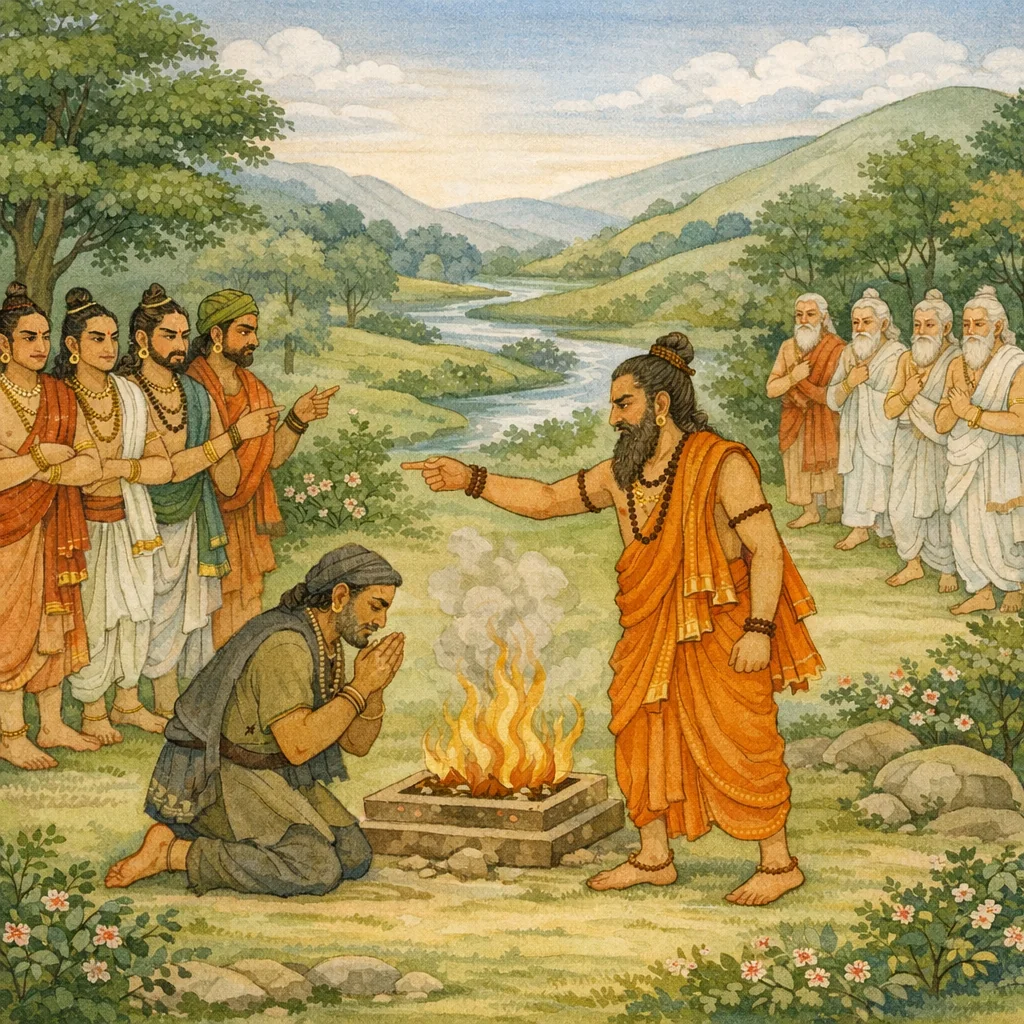
Sarga 59 sets forth a disciplined teaching on refuge (śaraṇa), ritual propriety, and the punitive power of an ascetic’s speech. Moved by compassion, Viśvāmitra addresses the king whose chandāla-form confirms the reality of his curse, reassures him, and explicitly grants him protection and refuge. Viśvāmitra then commands his disciples to summon many ṛṣis and brahmavādins to assist in the coming sacrifice (yajña), instructing that any disrespect toward his order be reported in full. The disciples return saying that brāhmaṇas have arrived from many regions, though there is an exception or complication concerning Mahodaya. They also convey the furious objections of Vasiṣṭha’s hundred sons, who challenge the legitimacy of a kṣatriya serving as priest—especially for a chandāla—and fear the ritual consequence of consuming offerings tied to such a patron. Hearing this, Viśvāmitra’s anger becomes a curse: the offenders are condemned to degrading rebirths and harsh livelihoods, while Mahodaya is singled out for a long, miserable destiny as a niṣāda. The chapter ends with Viśvāmitra’s silence in the ṛṣi assembly, underscoring dharma, social boundaries, and the peril of scorning a tapasvin.
Shlokas
Verse 1
उक्तवाक्यं तु राजानं कृपया कुशिकात्मज:।अब्रवीन्मधुरं वाक्यं साक्षाच्चण्डालरूपिणम्।।1.59.1।।
Then Kuśika’s son, Viśvāmitra, moved by compassion, spoke gentle, sweet words to the king, whose caṇḍāla form now stood plainly before all eyes.
Verse 2
ऐक्ष्वाक स्वागतं वत्स जानामि त्वां सुधार्मिकम् ।शरणं ते भविष्यामि मा भैषीर्नृपपुङ्गव।।1.59.2।।
O scion of Ikṣvāku, welcome, my child. I know you to be truly righteous. O best of kings, do not fear—I shall be your refuge.
Verse 3
अहमामन्त्रये सर्वान्महर्षीन्पुण्यकर्मण:।यज्ञसाह्यकरान् राजन् ततो यक्ष्यसि निर्वृत:।।1.59.3।।
O King, I shall invite all the great sages of holy deeds who can assist in the sacrifice; then you will be able to perform the rite with peace of mind.
Verse 4
गुरुशापकृतं रूपं यदिदं त्वयि वर्तते ।अनेन सह रूपेण सशरीरो गमिष्यसि।।1.59.4।।
The bodily form that now abides in you—shaped by your teacher’s curse—along with that very form, you shall depart to heaven, still embodied.
Verse 5
हस्तप्राप्तमहं मन्ये स्वर्गं तव नराधिप।यस्त्वं कौशिकमागम्य शरण्यं शरणागत:।।1.59.5।।
O King, I deem heaven already within your grasp—because you have come to Kauśika (Viśvāmitra), the true refuge for those who seek protection.
Verse 6
एवमुक्त्वा महातेजा: पुत्रान् परमधार्मिकान्।व्यादिदेश महाप्राज्ञान् यज्ञसम्भारकारणात्।।1.59.6।।
Having spoken thus, the radiant Viśvāmitra instructed his sons—wise and deeply devoted to dharma—to make the needed preparations for the sacrifice.
Verse 7
सर्वान् शिष्यान् समाहूय वाक्यमेतदुवाच ह।सर्वानृषिगणान्वत्सा आनयध्वं ममाज्ञया।सशिष्यसुहृदश्चैव सर्त्विज स्सबहुश्रुतान्।।1.59.7।।
Summoning all his disciples, he spoke: “My children, by my command bring here all the companies of seers—together with their disciples and friends, with the officiating priests, and with those learned in the sacred tradition.”
Verse 8
यदन्यो वचनं ब्रूयान्मद्वाक्यबलचोदित:।तत्सर्वमखिलेनोक्तं ममाख्येयमनादृतम्।।1.59.8।।
“If anyone, compelled by the force of my command, speaks words of disrespect, report the entire matter to me in full, exactly as it occurred.”
Verse 9
तस्य तद्वचनं श्रुत्वा दिशो जग्मुस्तदाज्ञया।आजग्मुरथ देशेभ्य स्सर्वेभ्यो ब्रह्मवादिन:।।1.59.9।।
Hearing his words, they went forth in all directions by his command; and then, from every region, the expounders of the Veda began to arrive.
Verse 10
ते च शिष्या: समागम्य मुनिं ज्वलिततेजसम्।ऊचुश्चवचनं सर्वे सर्वेषां ब्रह्मवादिनाम्।।1.59.10।।
And those disciples, assembling before the sage blazing with spiritual splendor, conveyed to him the message of all the Veda-expounding brahmins.
Verse 11
श्रुत्वा ते वचनं सर्वे समायान्ति द्विजातय:।सर्वदेशेषु चागच्छन् वर्जयित्वा महोदयम्।।1.59.11।।
Having heard your message, all the twice-born are coming; they have arrived from every region—except Mahodaya.
Verse 12
वासिष्ठं तच्छतं सर्वं क्रोधपर्याकुलाक्षरम्।यदाह वचनं सर्वं शृणु त्वं मुनिपुङ्गव।।1.59.12।।
O foremost of sages, listen to all the words spoken by that full hundred of Vasiṣṭha’s sons—words whose very syllables were thrown into confusion by anger.
Verse 13
क्षत्रियो याजको यस्य चण्डालस्य विशेषत:।कथं सदसि भोक्तारो हविस्तस्य सुरर्षय:।।1.59.13।।
If a kṣatriya serves as the officiating priest—especially for a caṇḍāla—how could the gods and the holy ṛṣis partake of that oblation in the sacrificial assembly?
Verse 14
ब्राह्मणा वा महात्मानो भुक्त्वा चण्डालभोजनम्।कथं स्वर्गं गमिष्यन्ति विश्वामित्रेण पालिता:।।1.59.14।।
Or even if they are great-souled brāhmaṇas, having eaten food from a caṇḍāla, how will those who follow and are guided by Viśvāmitra ever reach heaven?
Verse 15
एतद्वचननैष्ठुर्यमूचु स्संरक्तलोचना:।वासिष्ठा मुनिशार्दूल सर्वे ते समहोदया:।।1.59.15।।
O tiger among sages, all the sons of Vasiṣṭha—together with Mahodaya—uttered those harsh words, their eyes reddened with anger.
Verse 16
तेषां तद्वचनं श्रुत्वा सर्वेषां मुनिपुङ्गव:।क्रोधसंरक्तनयन स्सरोषमिदमब्रवीत्।।1.59.16।।
Hearing the words of them all, the foremost of sages—his eyes reddened with anger—spoke these words in fury.
Verse 17
ये दूषयन्त्यदुष्टं मां तप उग्रं समास्थितम्।भस्मीभूता दुरात्मानो भविष्यन्ति न संशय:।।1.59.17।।
I am without fault, established in severe tapas; those wicked-minded who revile me will be reduced to ashes—of this there is no doubt.
Verse 18
अद्य ते कालपाशेन नीता वैवस्वतक्षयम्।सप्तजातिशतान्येव मृतपस्सन्तु सर्वश:।।1.59.18।।
Today, seized by the noose of Death, let them be carried to the abode of Vaivasvata (Yama); and for seven hundred births, in every way, let them live as feeders on the dead.
Verse 19
श्वमांसनियताहारा मुष्टिका नाम निर्घृणा:।विकृताश्च विरूपाश्च लोकाननुचरन्त्विमान्।।1.59.19।।
Let them be born as the merciless Muṣṭikas, bound to a diet of dog-flesh—hideous and deformed—and let them wander through these worlds.
Verse 20
महोदयस्तु दुर्बुद्धिर्मामदूष्यं ह्यदूषयत्।दूषित स्सर्वलोकेषु निषादत्वं गमिष्यति।।1.59.20।।
But Mahodaya, of perverse understanding, blamed me though I was blameless; thus, branded in all worlds, he shall go into the state of a Niṣāda.
Verse 21
प्राणातिपातनिरतो निरनुक्रोशतां गत:।दीर्घकालं मम क्रोधाद्दुर्गतिं वर्तयिष्यति।।1.59.21।।
Addicted to taking life and fallen into mercilessness, he will—because of my anger—endure a wretched condition for a long time.
Verse 22
एतावदुक्त्वा वचनं विश्वामित्रो महातपा:।विरराम महातेजा ऋषिमध्ये महामुनि:।।1.59.22।।
Having spoken only this much, the great ascetic Viśvāmitra—radiant with power—fell silent in the midst of the sages.
Frequently Asked Questions
The dilemma centers on ritual authority and social legitimacy: Vasiṣṭha’s sons challenge whether a kṣatriya may function as a yajña-priest, especially in a sacrifice connected to a chandāla, while Viśvāmitra asserts protective refuge and responds to insult with punitive ascetic speech.
The chapter teaches that refuge offered by a protector entails moral responsibility, and that contempt toward a disciplined tapasvin is portrayed as spiritually perilous; speech (vāk) is shown as a force that can restore order or inflict lasting karmic consequences.
Cultural landmarks include the yajña setting (ritual assembly with ṛtviks and brahmavādins), the concept of Vaivasvata’s realm (Yama’s abode) as a post-mortem destination, and community identities (chandāla, niṣāda, muṣṭikā) used to articulate social-ethical outcomes of the curse.