Sarga 26
ताटकावधः (The Slaying of Tāṭakā)
बालकाण्ड
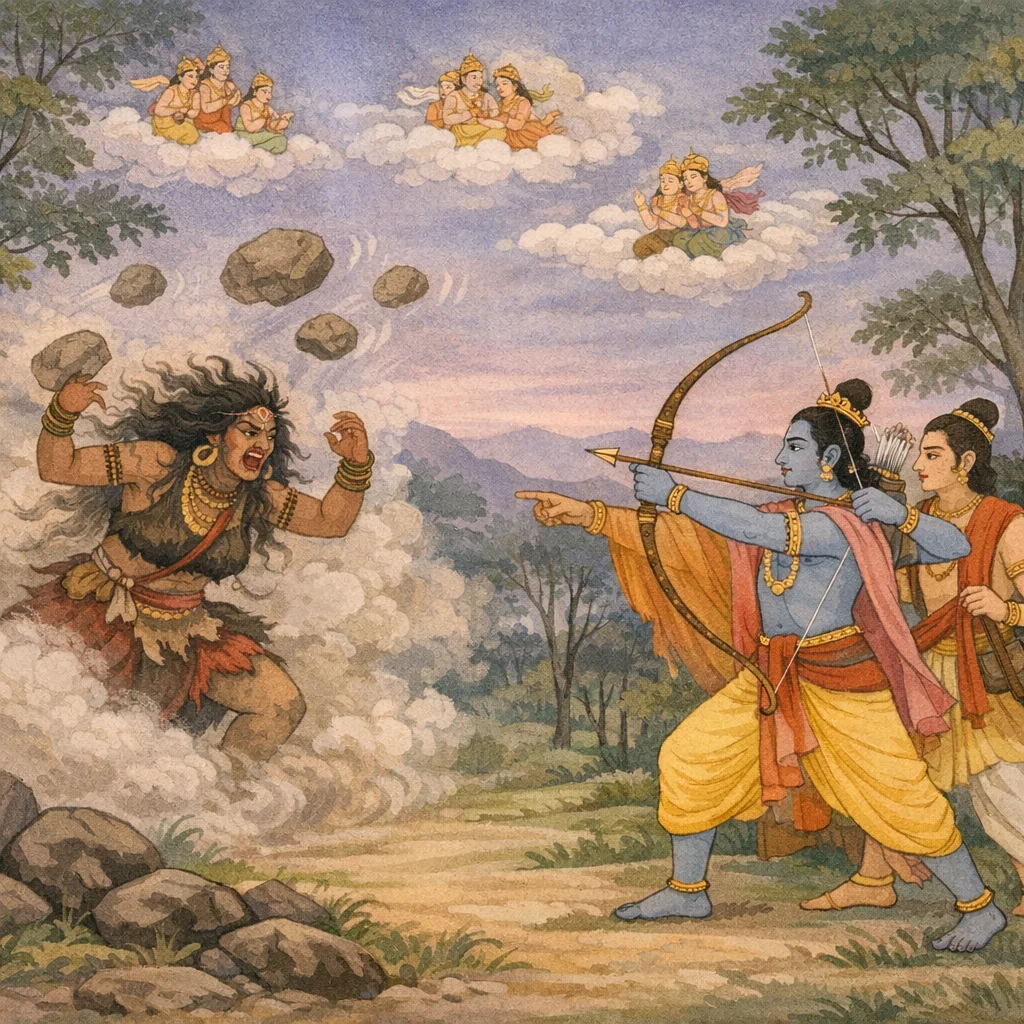
In Sarga 26, after receiving Viśvāmitra’s command, Rāma states why he will comply: to honor Daśaratha’s charge, to heed Kauśika’s instruction, and to act for the public good—protecting cows and brāhmaṇas and securing the realm’s welfare. The scene then turns to battle: the twang of Rāma’s bowstring proclaims his readiness, shakes the forest, and draws Tāṭakā forth. Seeing her dreadful form, Rāma first proposes a restrained course—disabling rather than killing—citing that she is “protected by virtue of being a woman,” and aiming to break her strength and mobility. But Tāṭakā escalates with rākṣasic magic: blinding dust-clouds, showers of boulders, disappearance, and shape-shifting. Viśvāmitra rebukes misplaced compassion and warns that dusk empowers such beings. Rāma displays the skill of striking by sound, checks her assault, and finally slays her with a chest-piercing arrow as she charges like a thunderbolt. The devatās led by Indra praise Rāma and urge Viśvāmitra to bestow divine weapons upon so worthy a prince. With evening fallen, the party camps in the forest now freed from its curse, and Viśvāmitra lovingly blesses Rāma, planning to depart for his āśrama at dawn.
Shlokas
Verse 1
मुनेर्वचनमक्लीबं श्रुत्वा नरवरात्मज:।राघव: प्राञ्जलिर्भूत्वा प्रत्युवाच दृढव्रत:।।1.26.1।।
Having heard the sage’s manly and unflinching words, Raghava—son of the foremost of men—stood with folded palms and replied, steadfast in his vow.
Verse 2
पितुर्वचननिर्देशात्पितुर्वचनगौरवात्। वचनं कौशिकस्येति कर्तव्यमविशङ्कया।।1.26.2।।
Because it is my father's command, out of reverence for his word, and because it is the instruction of Kausika, this must be done without hesitation.
Verse 3
अनुशिष्टोऽस्म्ययोध्यायां गुरुमध्ये महात्मना।पित्रा दशरथेनाहं नावज्ञेयं हि तद्वच:।।1.26.3।।
In Ayodhyā, in the presence of elders and teachers, I was instructed by my great-souled father Daśaratha; truly, his word must not be disregarded.
Verse 4
सोऽहं पितुर्वचश्श्रुत्वा शासनाद्ब्रह्मवादिन:।करिष्यामि न सन्देहस्ताटकावधमुत्तमम्।।1.26.4।।
“Having heard my father’s words, and in obedience to the command of the brahman-knowing sage, I will indeed slay Tāṭakā—there is no doubt.”
Verse 5
गोब्राह्मणहितार्थाय देशस्यास्य सुखाय च।तव चैवाप्रमेयस्य वचनं कर्तुमुद्यत:।।1.26.5।।
“For the welfare of cows and brāhmaṇas, and for the happiness of this land, I stand ready to carry out your word, O one of immeasurable power.”
Verse 6
एवमुक्त्वा धनुर्मध्ये बध्वा मुष्टिमरिन्दम:।ज्याशब्दमकरोत्तीव्रं दिशश्शब्देन नादयन्।।1.26.6।।
Having spoken thus, the foe-destroyer clenched his fist upon the middle of the bow and made a fierce twang of the bowstring, making the directions resound with that sound.
Verse 7
तेन शब्देन वित्रस्तास्ताटकावनवासिन:।ताटका च सुसंक्रुद्धा तेन शब्देन मोहिता।।1.26.7।।
At that sound the dwellers of Tāṭakā’s forest were terrified; and Tāṭakā herself, enraged, was also thrown into agitation by that sound.
Verse 8
तं शब्दमभिनिध्याय राक्षसी क्रोधमूर्छिता।श्रुत्वा चाभ्यद्रवद्वेगाद्यतश्शब्दो विनिस्सृत:।।1.26.8।।
Reflecting on that sound, the rākṣasī—overcome by fury—hearing it, rushed swiftly toward the direction from which the sound had arisen.
Verse 9
तां दृष्ट्वा राघव: क्रुद्धां विकृतां विकृताननाम्।प्रमाणेनातिवृद्धां च लक्ष्मणं सोऽभ्यभाषत।।1.26.9।।
Seeing her—wrathful, disfigured, with a distorted face, and enormous in stature—Rāghava addressed Lakṣmaṇa.
Verse 10
पश्य लक्ष्मण यक्षिण्या भैरवं दारुणं वपु:।भिद्येरन् दर्शनादस्या भीरूणां हृदयानि च।।1.26.10।।
Look, Lakshmana—see the terrifying, dreadful form of this Yakshi; at the very sight of her, even the hearts of the timid would split in fear.
Verse 11
एनां पश्य दुराधर्षां मायाबलसमन्विताम्।विनिवृत्तां करोम्यद्य हृतकर्णाग्रनासिकाम्।।1.26.11।।
See her—hard to assail, empowered by the strength of sorcery. Today I will make her turn back, cutting off her ears and the tip of her nose.
Verse 12
न ह्येनामुत्सहे हन्तुं स्त्रीस्वभावेन रक्षिताम्।वीर्यं चास्यां गतिं चापि हनिष्यामीति मे मति:।।1.26.12।।
For I do not wish to slay her—she is shielded by the very condition of being a woman. My judgment is this: I shall destroy her prowess and her power of movement.
Verse 13
एवं ब्रुवाणे रामे तु ताटका क्रोधमूर्छिता।उद्यम्य बाहू गर्जन्ती राममेवाभ्यधावत।।1.26.13।।
As Rāma spoke thus, Tāṭakā—overwhelmed by rage—raised her arms and, roaring, rushed straight at Rāma.
Verse 14
विश्वामित्रस्तु ब्रह्मर्षिर्हुङ्कारेणाभिभर्त्स्यताम्।स्वस्ति राघवयोरस्तु जयं चैवाभ्यभाषत।।1.26.14।।
Brahmarṣi Viśvāmitra menaced her with a fierce hunkāra and declared, “May auspiciousness and victory attend the two Rāghavas.”
Verse 15
उद्धून्वाना रजो घोरं ताटका राघवावुभौ।रजोमोहेन महता मुहूर्तं सा व्यमोहयत्।।1.26.15।।
Whirling up a dreadful cloud of dust, Tāṭakā bewildered both Rāghavas for a brief moment with that great dust-born delusion.
Verse 16
ततो मायां समास्थाय शिलावर्षेण राघवौ।अवाकिरत्सुमहता ततश्चुक्रोध राघव:।।1.26.16।।
Then, resorting to magic, she showered the two Rāghavas with a massive rain of stones; seeing this, Rāma blazed with anger.
Verse 17
शिलावर्षं महत्तस्याश्शरवर्षेण राघव:।प्रतिहत्योपधावन्त्या: करौ चिच्छेद पत्रिभि: ।।1.26.17।।
Rāghava repelled her mighty rain of stones with a rain of arrows; and as she rushed toward him, he severed both her hands with sharp shafts.
Verse 18
ततश्छिन्नभुजां श्रान्तामभ्याशे परिगर्जतीम्।सौमित्रिरकरोत्क्रोधाद्धृतकर्णाग्रनासिकाम्।।1.26.18।।
Then, as she stood nearby roaring, exhausted with her arms severed, Saumitri in anger sliced off the tips of her ears and nose.
Verse 19
कामरूपधरा सद्य: कृत्वा रूपाण्यनेकश: ।अन्तर्धानं गता यक्षी मोहयन्तीव मायया ।।1.26.19।।अश्मवर्षं विमुञ्चन्ती भैरवं विचचार ह ।
That Yakshi, capable of assuming any form, instantly changed shapes and vanished, deluding them with magic, and roamed about casting a terrifying rain of stones.
Verse 20
ततस्तावश्मवर्षेण कीर्यमाणौ समन्तत:।।1.26.20।।दृष्ट्वा गाधिसुतश्श्रीमानिदं वचनमब्रवीत्।
Then, seeing those two being covered on all sides by the rain of stones, the illustrious son of Gadhi spoke these words.
Verse 21
अलं ते घृणया राम पापैषा दुष्टचारिणी।।1.26.21।।यज्ञविघ्नकरी यक्षी पुरावर्धति मायया।
"Enough of compassion, O Rama. This Yakshi is sinful and wicked; she obstructs sacrifices and will only grow stronger through her magic."
Verse 22
वध्यतां तावदेवैषा पुरा सन्ध्या प्रवर्तते।।1.26.22।।रक्षांसि सन्ध्याकालेषु दुर्धर्षाणि भवन्ति वै।
Let her be slain immediately before the twilight sets in, for demons become invincible during the dusk.
Verse 23
इत्युक्तस्तु तदा यक्षी अश्मवृष्ट्याभिवर्षतीम्।।1.26.23।।दर्शयन् शब्दवेधित्वं तां रुरोध स सायकै:।
Thus addressed, Rama displayed his skill of aiming by sound alone, and with his arrows, he obstructed the Yakshi as she rained down a shower of stones.
Verse 24
सा रुद्धा शरजालेन मायाबलसमन्विता।।1.26.24।।अभिदुद्राव काकुत्स्थं लक्ष्मणं च विनेदुषी।
Obstructed by the net of arrows, that demoness, possessed of magical powers, rushed roaring towards Rama and Lakshmana.
Verse 25
तामापतन्तीं वेगेन विक्रान्तामशनीमिव।।1.26.25।।शरेणोरसि विव्याथ सा पपात ममार च।
As she attacked with speed, advancing like a thunderbolt, Rama pierced her chest with an arrow; she fell down and died.
Verse 26
तां हतां भीमसङ्काशां दृष्ट्वा सुरपतिस्तदा।।1.26.26।।साधु साध्विति काकुत्स्थं सुराश्च समपूजयन्।
Seeing that terrifying demoness slain, Indra, the lord of gods, and other celestials honored Rama, exclaiming "Well done! Well done!"
Verse 27
उवाच परमप्रीत स्सहस्राक्ष: पुरन्दर:।।1.26.27।।सुराश्च सर्वे संहृष्टा विश्वामित्रमथाब्रुवन्।
Then Purandara—Indra of the thousand eyes—exceedingly delighted, and all the gods rejoicing, spoke to Viśvāmitra.
Verse 28
मुने कौशिक भद्रं ते सेन्द्रास्सर्वे मरुद्गणा:।।1.26.28।।तोषिता: कर्मणाऽनेन स्नेहं दर्शय राघवे।
“O sage Kauśika, may auspiciousness be yours. All the gods—together with Indra and the hosts of the Maruts—are gratified by this deed; show your affection and favor toward Rāghava.”
Verse 29
प्रजापतेर्भृशाश्वस्य पुत्रान् सत्यपराक्रमान्।।1.26.29।।तपोबलभृतो ब्रह्मन् राघवाय निवेदय।
“O Brahmarṣi, present to Rāghava the sons of Prajāpati Bhṛśāśva—the weapons whose might is grounded in truth and sustained by ascetic power.”
Verse 30
पात्रभूतश्च ते ब्रह्मंस्तवानुगमने धृत:।।1.26.30।।कर्तव्यं च महत्कर्म सुराणां राजसूनुना।
“O Brahmarṣi, he is a worthy recipient, steadfast in following you; and a great work for the welfare of the gods must be accomplished by this prince.”
Verse 31
एवमुक्त्वा सुरास्सर्वे हृष्टा जग्मुर्यथागतम्।।1.26.31।।विश्वामित्रं पुरस्कृत्य ततस्सन्ध्या प्रवर्तते।
Thus having spoken, all the gods, delighted, returned as they had come; honoring Viśvāmitra and placing him foremost, then twilight (sandhyā) set in.
Verse 32
ततो मुनिवर: प्रीतस्ताटकावधतोषित:।।1.26.32।।मूर्ध्नि राममुपाघ्राय इदं वचनमब्रवीत्।
Then the excellent sage, pleased and satisfied by the slaying of Tāṭakā, affectionately kissed Rāma upon the head and spoke these words.
Verse 33
इहाद्य रजनीं राम वसेम शुभदर्शन।।1.26.33।।श्व: प्रभाते गमिष्यामस्तदाश्रमपदं मम।
“Here tonight, O Rāma, fair and auspicious to behold, let us stay; tomorrow at dawn we shall go to the place of my hermitage (āśrama).”
Verse 34
विश्वामित्रवच: श्रुत्वा हृष्टो दशरथात्मज:।।1.26.34।।उवास रजनीं तत्र ताटकाया वने सुखम्।
Hearing Viśvāmitra’s words, Daśaratha’s son rejoiced and spent the night there happily in Tāṭakā’s forest.
Verse 35
मुक्तशापं वनं तच्च तस्मिन्नेव तदाहनि।।1.26.35।।रमणीयं विबभ्राज यथा चैत्ररथं वनम्।
That very day, the forest too—freed from its curse—became delightful and shone like the Caitraratha grove.
Verse 36
निहत्य तां यक्षसुतां स राम:प्रशस्यमानस्सुरसिद्धसङ्घै:।उवास तस्मिन्मुनिना सहैवप्रभातवेलां प्रतिबोध्यमान:।।1.26.36।।
Having slain the Yakṣa’s daughter, Rāma—praised by hosts of gods and siddhas—remained there with the sage, and at the hour of dawn was awakened to continue the journey.
Frequently Asked Questions
Rāma confronts the dharma-tension between compassion and protective duty: he initially hesitates to kill Tāṭakā because she is a woman, proposing instead to disable her, but accepts that yajña-protection and public safety require decisive action before dusk.
The chapter teaches calibrated ethics in governance: compassion must be guided by discernment, and kṣātra power is justified when exercised to prevent harm to ritual-social order, under legitimate instruction and with restraint until escalation makes force unavoidable.
The narrative centers on Tāṭakā-vana (a cursed, fearsome forest later described as transformed and charming) and references sandhyā (dusk) as a culturally charged liminal period when hostile forces are believed to intensify.