Sarga 31
अकम्पनवृत्तान्तः — Akampana Reports Janasthana; Ravana Plans Sita’s Abduction
अरण्यकाण्ड
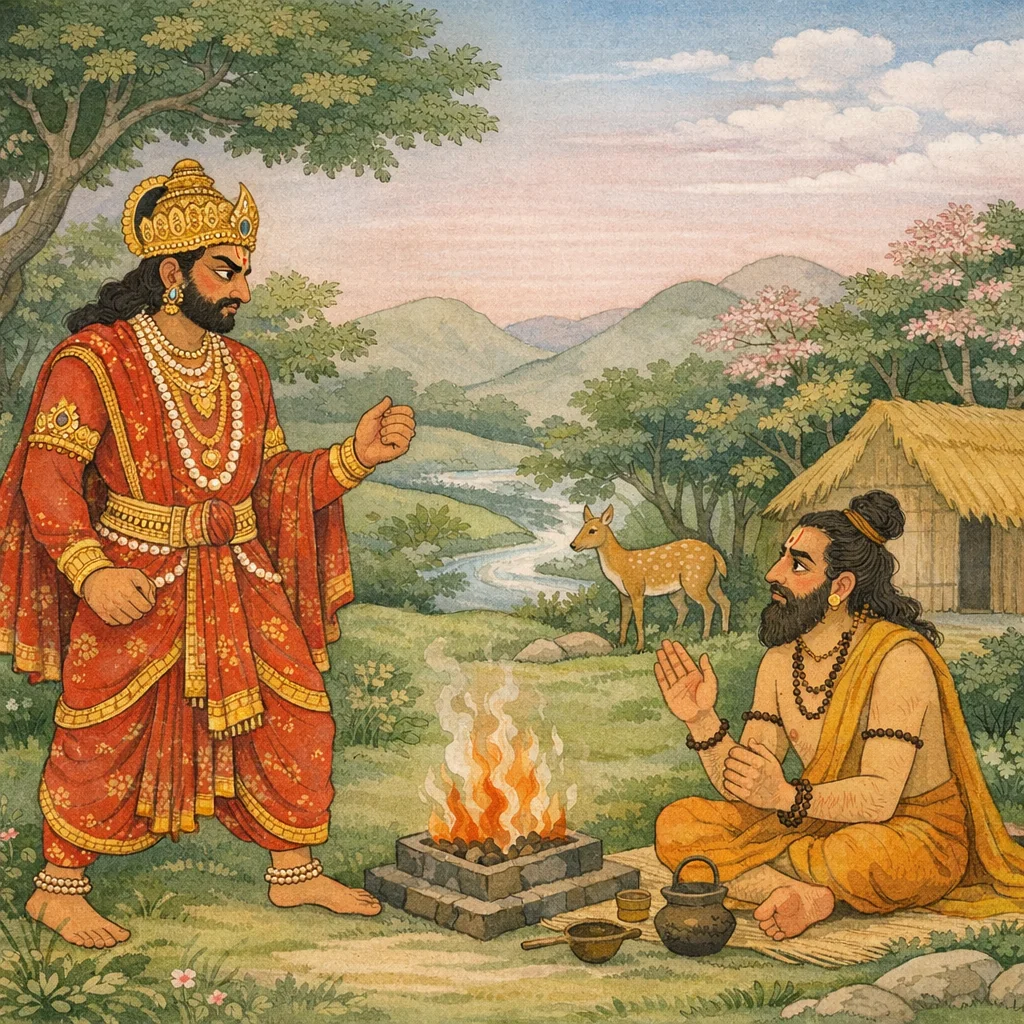
This sarga moves swiftly from intelligence to decision. Akampana flees Janasthāna and enters Laṅkā to report to Rāvaṇa: the rākṣasas have been routed, Khara and Dūṣaṇa slain, and Rāma’s martial greatness revealed—his arrows described as golden-feathered and even transforming into five-hooded serpents. Rāvaṇa first answers with wrathful disbelief and sharp questioning, then demands fuller detail. Akampana magnifies Rāma’s prowess with cosmic hyperbole: able to arrest rivers, wind, and sea, to shake the sky and stars, even to destroy and recreate the world. He proposes an upāya, a stratagem: Sītā is the vulnerability by which Rāma’s resolve may be broken. Rāvaṇa accepts the counsel, resolves to act at dawn, and departs in a sun-bright chariot to consult Mārīca. At Mārīca’s āśrama, hospitality is exchanged; Rāvaṇa seeks aid in abducting Sītā, while Mārīca warns at length—through animal and battlefield metaphors—that to provoke Rāma is certain death. The chapter ends with Rāvaṇa’s temporary return to Laṅkā, as the abduction plot is consolidated.
Shlokas
Verse 1
त्वरमाणस्ततो गत्वा जनस्थानादकम्पनः।प्रविश्य लङ्कां वेगेन रावणं वाक्यमब्रवीत्।।3.31.1।।
Then Akampana, hastening from Janasthana, entered Lanka with speed and addressed Ravana in these words.
Verse 2
जनस्थानस्थिता राजन्राक्षसा बहवो हताः।खरश्च निहतस्सङ्ख्ये कथञ्चिदहमागतः।।3.31.2।।
O king, many rākṣasas stationed at Janasthāna have been slain—Khara too fell in battle. I have come here with difficulty, having barely escaped.
Verse 3
एवमुक्तो दशग्रीवः क्रुद्ध स्संरक्तलोचनः।अकम्पनमुवाचेदं निर्दहन्निव चक्षुषा।।3.31.3।।
Thus addressed, the ten-necked Ravana—angered, his eyes reddened—spoke these words to Akampana, as though scorching him with his gaze.
Verse 4
केन रम्यं जनस्थानं हतं मम परासुना।को हि सर्वेषु लोकेषु गतिं चाधिगमिष्यति।।3.31.4।।
“By whom has my fair Janasthāna been destroyed—as though my life were already in an enemy’s grasp? Who, having done this, could possibly escape death anywhere in the worlds?”
Verse 5
न हि मे विप्रियं कृत्वा शक्यं मघवता सुखम्।प्राप्तुं वैश्रवणेनापि न यमेन न विष्णुना।।3.31.5।।
For having incurred my displeasure, none can attain happiness—not Maghavat (Indra), nor Vaiśravaṇa (Kubera), nor Yama, nor even Viṣṇu.
Verse 6
कालस्य चाप्यहं कालो दहेयमपि पावकम्।मृत्युं मरणधर्मेण संयोजयितुमुत्सहे।।3.31.6।।
I am the Time that destroys even Kāla; I could burn even fire itself. I am able to bind Death (Mṛtyu) to the very law of dying.
Verse 7
दहेयमपि सङ्कृद्धस्तेजसाऽदित्यपावकौ।वातस्य तरसा वेगं निहन्तुमहमुत्सहे।।3.31.7।।
If I am roused to wrath, by my own radiance I could burn even the Sun and fire; and by sheer force I could instantly check the speed of the wind.
Verse 8
तथा क्रुद्धं दशग्रीवं कृताञ्जलिरकम्पनः।भयात्सन्दिग्धया वाचा रावणं याचतेऽभयम्।।3.31.8।।
Seeing Daśagrīva thus enraged, Akampana, with hands folded in añjali, begged Rāvaṇa for safety, speaking in a fear-struck and wavering voice.
Verse 9
दशग्रीवोऽभयं तस्मै प्रददौ रक्षसां वरः।स विस्रब्धोऽब्रवीद्वाक्यमसन्दिग्धमकम्पनः।।3.31.9।।
Daśagrīva, foremost among the rākṣasas, granted him safety. Then Akampana, reassured, spoke clearly and without hesitation.
Verse 10
पुत्रो दशरथस्यास्ति सिंहसंहननो युवा।रामो नाम वृषस्कन्धो वृत्तायतमहाभुजः।।3.31.10।।
Dasaratha has a young son, lion-built in frame; his name is Rama—bull-shouldered, with mighty arms, long and well-rounded.
Verse 11
वीरः पृथुयशाश्श्रीमानतुल्यबलविक्रमः।हतं तेन जनस्थानं खरश्च सह दूषणः।।3.31.11।।
He is a hero of far-spread renown, radiant and blessed, with strength and valor beyond compare. By him Janasthana has been laid waste—and Khara too was slain, along with Dushana.
Verse 12
अकम्पनवच श्रुत्वा रावणो राक्षसाधिपः।नागेन्द्र इव निश्वस्य वचनं चेदमब्रवीत्।।3.31.12।।
Hearing Akampana’s words, Ravana, lord of the rakshasas, sighed like the king of serpents and then spoke these words.
Verse 13
स सुरेन्द्रेण संयुक्तो रामस्सर्वामरैस्सह।उपयातो जनस्थानं ब्रूहि कच्चिदकम्पन।।3.31.13।।
Tell me, Akampana—did Rama come to Janasthana united with Indra, together with all the gods?
Verse 14
रावणस्य पुनर्वाक्यं निशम्य तदकम्पनः।आचचक्षे बलं तस्य विक्रमं च महात्मनः।।3.31.14।।
Hearing Ravana’s further question, Akampana went on to describe the strength and valorous feats of the great-souled Rama.
Verse 15
रामो नाम महातेजा श्रेष्ठस्सर्वधनुष्मताम्।दिव्यास्त्रगुणसम्पन्नः पुरन्दरसमो युधि।।3.31.15।।
Rama is his name—of great radiance, foremost among all archers; endowed with the virtues of divine weapons, he is Indra’s equal in battle.
Verse 16
तस्यानुरूपो बलवान्रक्ताक्षो दन्दुभिस्वनः।कनीयान्लक्ष्मणो नाम भ्राता शशिनिभाननः।।3.31.16।।
Like him in form is his younger brother named Lakshmana—strong, red-eyed, with a voice deep as a drum, and a face bright like the moon.
Verse 17
स तेन सह संयुक्तः पावकेनानिलो यथा।श्रीमान्राजवरस्तेन जनस्थानं निपातितम्।।3.31.17।।
United with him, Rama—prosperous and best among kings—was like wind joined to fire; by him Janasthana was brought down.
Verse 18
नैव देवा महात्मानो नात्र कार्या विचारणा।शरा रामेण तूत्सृष्टा रुक्मपुङ्खाः पतत्रिणः।।3.31.18।।सर्पाः पञ्चानना भूत्वा भक्षयन्ति स्म राक्षसान्।
No gods came there—no further inquiry is needed. The winged arrows released by Rama, with golden feathers, became five-hooded serpents and devoured the rakshasas.
Verse 19
येन येन च गच्छन्ति राक्षसा भयकर्शिताः।3.31.19।।तेन तेन स्म पश्यन्ति राममेवाग्रतः स्थितम्।इत्थं विनाशितं तेन जनस्थानं तवानघ।।3.31.20।।
Whichever way the rākṣasas fled, gripped by fear, that very way they saw only Rāma standing before them. Thus, O sinless lord, your Janasthāna was destroyed by him.
Verse 20
येन येन च गच्छन्ति राक्षसा भयकर्शिताः।3.31.19।।तेन तेन स्म पश्यन्ति राममेवाग्रतः स्थितम्।इत्थं विनाशितं तेन जनस्थानं तवानघ।।3.31.20।।
Hearing Akampana’s words, Rāvaṇa said: “I will go to Janasthāna and kill Rāma—together with Lakṣmaṇa.”
Verse 21
अकम्पनवचश्रुत्वा रावणो वाक्यमब्रवीत्।जनस्थानं गमिष्यामि हन्तुं रामं सलक्ष्मणम्।।3.31.21।।
Hearing Akampana’s words, Rāvaṇa said: “I will go to Janasthāna and kill Rāma—together with Lakṣmaṇa.”
Verse 22
अथैवमुक्ते वचने प्रोवाचेदमकम्पनः।शृणु राजन्यथावृत्तं रामस्य बलपौरुषम्।।3.31.22।।
When Rāvaṇa spoke thus, Akampana replied: “Listen, O king, to what truly happened—and to Rāma’s strength and manly prowess.”
Verse 23
असाध्यः कुपितो रामो विक्रमेण महायशाः।आपगायास्सुपूर्णाया वेगं परिहरेच्छरैः।।3.31.23।।
Rāma, famed far and wide, becomes irresistible when angered; by his arrows he could check even the rushing force of a river in full flood.
Verse 24
सतारग्रहनक्षत्रं नभश्चाप्यवसादयेत्।असौ रामस्तु सीदन्तीं श्रीमानभ्युद्धरेन्महीम्।।3.31.24।।
That splendid Rāma could bring down the very sky with its stars, planets, and constellations; and he could lift up the earth itself, even if it were sinking into the sea.
Verse 25
भित्त्वा वेलां समुद्रस्य लोकानाप्लावयेद्विभुः।वेगं वापि समुद्रस्य वायुं वा विधमेच्छरैः।।3.31.25।।
He is so mighty that, by breaking the ocean’s boundary, he could flood the worlds. With his arrows he could even check the sea’s surge—or the very wind.
Verse 26
संहृत्य वा पुनर्लोकान्विक्रमेण महायशाः।शक्तस्सपुरुषव्याघ्रः स्रष्टुं पुनरपि प्रजाः।।3.31.26।।
That greatly renowned tiger among men has the power—by his valor—to dissolve the worlds and then create beings anew once more.
Verse 27
न हि रामो दशग्रीव शक्यो जेतुं त्वया युधि।रक्षसां वापि लोकेन स्वर्गः पापजनैरिव।।3.31.27।।
O Ten-necked one, you cannot conquer Rāma in battle—nor even with the entire world of rākṣasas—just as heaven cannot be attained by sinners.
Verse 28
न तं वध्यमहं मन्ये सर्वैर्देवासुरैरपि।अयं तस्य वधोपायस्तन्ममैकमनाश्शृणु।।3.31.28।।
I do not think he can be slain even by all the gods and asuras together. Yet there is a means for his destruction—listen to me with undivided attention.
Verse 29
भार्या तस्योत्तमा लोके सीता नाम सुमध्यमा।श्यामा समविभक्ताङ्गी स्त्रीरत्नं रत्नभूषिता।।3.31.29।।
In this world his foremost wife is Sita by name—slender-waisted, darkly radiant, well-proportioned in limb—adorned with jewels, a jewel among women.
Verse 30
नैव देवी न गन्धर्वी नाप्सरा नापि दानवी।तुल्या सीमन्तिनी तस्या मानुषीषु कुतो भवेत्।।3.31.30।।
No goddess, no gandharva-woman, no apsaras, nor even a dānava-woman is her equal; how then could any human woman compare to her?
Verse 31
तस्यापहर भार्यांत्वं प्रमथ्य तु महावने।सीतया रहितः कामी रामो हास्यति जीवितम्।।3.31.31।।
Abduct his wife by force in that great forest; once deprived of Sita, Rama—burning with desire—will abandon his life.
Verse 32
अरोचयत तद्वाक्यं रावणो राक्षसाधिपः।चिन्तयित्वा महाबाहुरकम्पनमुवाच ह।।3.31.32।।
Rāvaṇa, lord of the rākṣasas, took delight in those words; then the mighty-armed one, having reflected, spoke to Akampana.
Verse 33
बाढं काल्यं गमिष्यामि ह्येकस्सारथिना सह।आनयिष्यामि वैदेहीमिमां हृष्टो महापुरीम्।।3.31.33।।
Indeed—early tomorrow—I shall go alone with my charioteer, and gladly bring Vaidehī to this great city.
Verse 34
अथैवमुक्त्वा प्रययौ खरयुक्तेन रावणः।रथेनादित्यवर्णेन दिशस्सर्वाः प्रकाशयन्।।3.31.34।।
Having spoken thus, Rāvaṇa departed in a chariot yoked with donkeys, radiant as the sun, casting light upon all directions as he went.
Verse 35
स रथो राक्षसेन्द्रस्य नक्षत्रपथगो महान्।सञ्चार्यमाणश्शुशुभे जलदे चन्द्रमा इव।।3.31.35।।
That great chariot of the lord of the rākṣasas, moving along the star-strewn path of the sky, shone like the moon amid clouds.
Verse 36
स मारीचाश्रमं प्राप्य ताटकेयमुपागमत्।मारीचेनार्चितो राजा भक्ष्यभोज्यैरमानुषैः।।3.31.36।।
Reaching Mārīca’s hermitage, he approached Tāṭakeya (Mārīca). The king was honored by Mārīca with inhuman fare—foods to chew and foods to eat.
Verse 37
तं स्वयं पूजयित्वा तु आसनेनोदकेन च।अर्थोपहितया वाचा मारीचो वाक्यमब्रवीत्।।3.31.37।।
After honoring him himself with a seat and water, Mārīca spoke words laden with purpose and meaning.
Verse 38
कच्चित्सुकुशलं राजन्लोकानां राक्षसेश्वर।आशङ्के नाथ जाने त्वं यतस्तूर्णमिहागतः।।3.31.38।।
“O king, lord of the rākṣasas—does all go well among your people? Yet, my lord, I suspect some trouble, for you have come here with such haste.”
Verse 39
एवमुक्तो महातेजा मारीचेन स रावणः।ततः पश्चादिदं वाक्यमब्रवीद्वाक्यकोविदः।।3.31.39।।
Thus addressed by Mārīca, the radiant Rāvaṇa—skilled in speech—then replied with these words.
Verse 40
आरक्षो मे हतस्तात रामेणाक्लिष्टकर्मणा।जनस्थानमवध्य तत्सर्वं युधि निपातितम्।।3.31.40।।तस्य मे कुरु साचिव्यं तस्य भार्यापहारणे।
“Dear one, Rāma—unyielding in arduous deeds—has slain my guards; that ‘impregnable’ Janasthāna has been utterly brought down in battle. Therefore, aid me as a counselor in the abduction of his wife.”
Verse 41
राक्षसेन्द्रवचश्श्रुत्वा मारीचो वाक्यमब्रवीत्।।3.31.41।।आख्याता केन सीता सा मित्ररूपेण शत्रुणा।त्वया राक्षसशार्दूल को न नन्दति नन्दितः।।3.31.42।।
Hearing the words of the rākṣasa-king, Mārīca replied: “By whom was that Sītā reported to you—by what enemy wearing the guise of a friend? O tiger among rākṣasas, who, after being favored by you, would not rejoice—unless he wished you harm?”
Verse 42
राक्षसेन्द्रवचश्श्रुत्वा मारीचो वाक्यमब्रवीत्।।3.31.41।।आख्याता केन सीता सा मित्ररूपेण शत्रुणा।त्वया राक्षसशार्दूल को न नन्दति नन्दितः।।3.31.42।।
Who was it—an enemy disguised as a friend—who reported that lady Sītā to you? O tiger among rākṣasas, who, though favored by you, would not rejoice in you?
Verse 43
सीतामिहानयस्वेति को ब्रवीति ब्रवीहि मे।रक्षोलोकस्य सर्वस्य कश्शृङ्गं छेत्तुमिच्छति।।3.31.43।।
Tell me plainly—who is it that says to you, ‘Bring Sītā here’? Speak clearly. Who is so intent on cutting off the very pinnacle of the entire rākṣasa race?
Verse 44
प्रोत्साहयति कश्च त्वां स च शत्रुरसंशयः।अशीविषमुखाद्दंष्ट्रामुद्धर्तुं चेच्छति त्वया।।3.31.44।।
Whoever is urging you on—he is surely your enemy. He wants you to try to pull out the fangs from the mouth of a venomous serpent.
Verse 45
कर्मणा केन केनासि कापथं प्रतिपादितः।सुखसुप्तस्य ते राजन् प्रहृतं केन मूर्धनि।।3.31.45।।
By whose deed have you been steered onto this ruinous path? O king, who has struck your head while you were sleeping in comfort?
Verse 46
विशुद्धवंशाभिजनाग्रहस्त स्तेजोमदस्संस्थितदोर्विषाणः।उदीक्षितुं रावण नेह युक्तः स संयुगे राघवगन्धहस्ती।।3.31.46।।
O Rāvaṇa, it is not right to face in battle that war-elephant, Rāghava: his pure lineage is his mighty trunk, the radiance of his prowess is his musth, and his steadfast arms are his tusks, poised for war.
Verse 47
असौ रणान्तः स्थितिसंधिवालो विदग्धरक्षोमृगहा नृसिंहः।सुप्तस्त्वया बोधयितुं न युक्तः शराङ्गपूर्णो निशितासिदंष्ट्रः।।3.31.47।।
He is a man-lion on the battlefield, a slayer of the ‘deer’ that are crafty rākṣasas, fierce in war. It is not fitting for you to rouse him while he sleeps—his body bristles with arrows, and his fangs are keen swords.
Verse 48
चापापहारे भुजवेगपङ्के शरोर्मिमाले सुमहाहवौघे।न रामपातालमुखेऽतिघोरे प्रस्कन्दितुं राक्षसराज युक्तम्।।3.31.48।।
O king of rākṣasas, it is not proper to leap into that dread mouth of the netherworld—Rāma—where the war-flood is immense, his arm-force is a mire of whirlpools, and his arrows form unbroken lines of waves.
Verse 49
प्रसीद लङ्केश्वर राक्षसेन्द्र लङ्कां प्रसन्नो भव साधु गच्छ।त्वं स्वेषु दारेषु रमस्व नित्यं रामस्सभार्यो रमतां वनेषु।।3.31.49।।
Be appeased, O lord of Laṅkā, chief of rākṣasas; return to Laṅkā in a gracious spirit—this is best. Delight always in your own wives; let Rāma, together with his wife, delight in the forests.
Verse 50
एवमुक्तो दशग्रीवो मारीचेन स रावणः।न्यवर्तत पुरीं लङ्कां विवेश च गृहोत्तमम्।।3.31.50।।
Thus addressed by Mārīca, Rāvaṇa of the ten heads turned back, returned to the city of Laṅkā, and entered his finest mansion.
Frequently Asked Questions
The pivotal action is the deliberate shift from direct combat to an indirect strategy: Akampana frames Sītā as the “upāya” for defeating Rāma, introducing a morally fraught plan (abduction) that replaces battlefield contest with coercion and deception.
The dialogue contrasts hubris with prudent counsel: Rāvaṇa’s self-magnifying claims of invincibility are countered by descriptions of a dharmic warrior’s overwhelming capability, while Mārīca’s warnings emphasize that power without discernment (viveka) leads to self-destruction.
Key mapped locations are Janasthāna (the contested forest stronghold), Laṅkā (the rākṣasa capital and decision center), and Mārīca’s āśrama (a counsel-and-plot node). The chariot’s sky-route (nakṣatra-patha) functions as a poetic marker of rākṣasa mobility and imperial reach.