Sarga 26
दूषणवधः (The Slaying of Dūṣaṇa and the Rout of Khara’s Host)
अरण्यकाण्ड
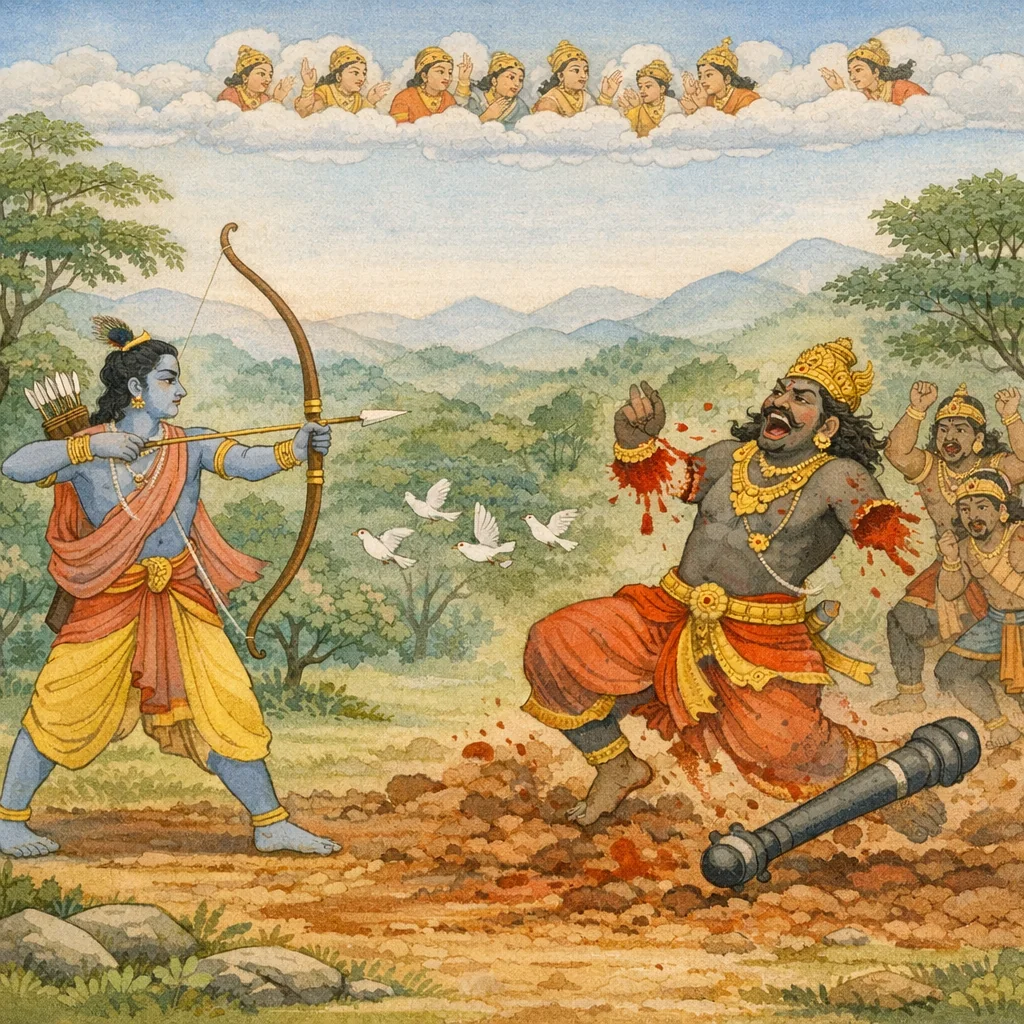
This sarga presents a concentrated battle sequence in which Dūṣaṇa, witnessing his vanguard being decimated, commits five thousand rākṣasas to the fight. The demons unleash a relentless barrage of spears, swords, stones, and trees, yet Rama stands firm, countering the assault with disciplined archery and lethal precision. Rama systematically dismantles Dūṣaṇa’s defenses, shattering his bow and slaying his charioteer. When Dūṣaṇa, now chariotless, charges with a terrifying iron-studded bludgeon (parigha), Rama severs both his arms, causing the demon to collapse like a tusk-shattered elephant, drawing cosmic acclamation from the celestial beings. Three rākṣasa commanders—Mahākapāla, Sthūlākṣa, and Pramāthī—rush to avenge their leader, but Rama swiftly dispatches them, beheading one and blinding another with a storm of arrows. The remaining five thousand warriors are annihilated, turning the forest floor into a gruesome mire of blood and flesh. The sarga culminates in the quantitative assertion of Rama’s single-handed destruction of fourteen thousand rākṣasas and the dramatic approach of the enraged Khara in a great chariot, likened to Lord Indra advancing with his uplifted thunderbolt.
Shlokas
Verse 1
दूषणस्तु स्वकं सैन्यं हन्यमानं निरीक्ष्य सः।सन्दिदेश महाबाहुर्भीमवेगान्दुरासदान्।।।।राक्षसान्पञ्चसहस्रान्समरेष्वनिवर्तिनः।
But Dūṣaṇa, seeing his own army being cut down, deployed five thousand rākṣasas—mighty in speed, hard to face, and unwilling to retreat in battle.
Verse 2
ते शूलैः पट्टिशैः खङ्गै शिलावर्षैर्द्रुमैरपि।।।।शरवर्षैरविच्छिन्नं ववर्षुस्तं समन्ततः।
From every side, without pause, they showered him with spears, paṭṭisas, swords, torrents of stones, even trees, and an unbroken rain of arrows.
Verse 3
स दृमाणां शिलानां च वर्षं प्राणहरं महत्।।।।प्रतिजग्राह धर्मात्मा राघवस्तीक्ष्णसायकैः।
Righteous Rāghava met that massive, life-taking shower of trees and stones, countering it with his keen arrows.
Verse 4
प्रतिगृह्य च तद्वर्षं निमीलित इवर्षभः।।।।रामः क्रोधं परं भेजे वधार्थं सर्वरक्षसाम्।
Enduring and answering that shower of weapons, Rāma—like a bull that closes its eyes and presses forward—entered a fierce wrath, resolved to destroy all the rākṣasas.
Verse 5
ततः क्रोधसमाविष्टः प्रदीप्त इव तेजसा।।।।शरैरवाकिरत्सैन्यं सर्वतस्सहदूषणम्।
Then, possessed by wrath and blazing with tejas, Rāma flooded the army—Dūṣaṇa along with it—from every side with arrows.
Verse 6
ततस्सेनापतिः क्रुद्धो दूषणश्शत्रुदूषणः।।।।शरैरशनिकल्पैस्तं राघवं समवाकिरत्।
Then Dūṣaṇa, the enraged commander—true to his name as a harrier of foes—showered Rāghava on all sides with thunderbolt-like arrows.
Verse 7
ततो रामस्सुसङ्कृद्धः क्षुरेणास्य महद्धनुः।।।।चिच्छेद समरे वीरश्चतुर्भिश्चतुरो हयान्।
Then Rāma, thoroughly provoked, cut down Dūṣaṇa’s great bow in battle with a razor-edged arrow; and with four more arrows the hero struck down his four horses.
Verse 8
हत्वा चाश्वान्शरैस्तीक्ष्णैरर्धचन्द्रेण सारथेः।।।।शिरो जहार तद्रक्षस्त्रिभिर्विव्याध वक्षसि।
Having slain the horses with sharp arrows, he then severed the charioteer’s head with a crescent-shaped shaft, and pierced that rākṣasa (Dūṣaṇa) in the chest with three arrows.
Verse 9
स च्छिन्नधन्वा विरथो हताश्वो हतसारथिः।।।।जग्राह गिरिशृङ्गाभं परिघं रोमहर्षणम्।वेष्टितं काञ्चनैः पट्टैर्देवसैन्यप्रमर्दनम्।।।।आयसैश्शङ्कुभिस्तीक्ष्णैः कीर्णं परवसोक्षितम्।वज्राशनिसमस्पर्शं परगोपुरदारणम्।।।।
With his bow cut down, his chariot made useless, and his horses and charioteer slain, Dūṣaṇa seized a terrifying iron club like a mountain peak—bound with golden bands, studded with sharp iron spikes, as though smeared with the enemy’s marrow; harsh to the touch like a thunderbolt, and able to shatter an enemy’s gate-towers.
Verse 10
स च्छिन्नधन्वा विरथो हताश्वो हतसारथिः।।3.26.9।।जग्राह गिरिशृङ्गाभं परिघं रोमहर्षणम्।वेष्टितं काञ्चनैः पट्टैर्देवसैन्यप्रमर्दनम्।।3.26.10।।आयसैश्शङ्कुभिस्तीक्ष्णैः कीर्णं परवसोक्षितम्।वज्राशनिसमस्पर्शं परगोपुरदारणम्।।3.26.11।।
With his bow cut, his chariot disabled, and his horses and charioteer slain, he seized a terrifying iron club (parigha) like a mountain-peak—bound with golden bands, studded with sharp iron spikes, smeared with the foe’s gore; it felt like a thunderbolt’s touch and could shatter an enemy’s gateway.
Verse 11
स च्छिन्नधन्वा विरथो हताश्वो हतसारथिः।।3.26.9।।जग्राह गिरिशृङ्गाभं परिघं रोमहर्षणम्।वेष्टितं काञ्चनैः पट्टैर्देवसैन्यप्रमर्दनम्।।3.26.10।।आयसैश्शङ्कुभिस्तीक्ष्णैः कीर्णं परवसोक्षितम्।वज्राशनिसमस्पर्शं परगोपुरदारणम्।।3.26.11।।
With his bow cut down, his chariot made useless, and his horses and charioteer slain, Dūṣaṇa seized a terrifying iron club like a mountain peak—bound with golden bands, studded with sharp iron spikes, as though smeared with the enemy’s marrow; harsh to the touch like a thunderbolt, and able to shatter an enemy’s gate-towers.
Verse 12
तं महोरगसङ्काशं प्रगृह्य परिघं रणे।दूषणोऽभ्यद्रवद्रामं क्रूरकर्मा निशाचरः।।।।
Grasping that parigha which looked like a mighty serpent, Dūṣaṇa—the cruel-doing night-wanderer—charged at Rāma in battle.
Verse 13
तस्याभिपतमानस्य दूषणस्य स राघवः।द्वाभ्यां शराभ्यां चिच्छेद सहस्ताभरणौ भुजौ।।।।
As Dūṣaṇa sprang forward to strike, Rāghava (Rāma) severed with two arrows both his arms, adorned with armlets.
Verse 14
भ्रष्टस्तस्य महाकायः पपात रणमूर्धनि।परिघश्छिन्नहस्तस्य शक्रध्वज इवाग्रतः।।।।
On the battle-front, his massive iron club slipped from the handless Dūṣaṇa and crashed down before him, like Indra’s banner fallen forward.
Verse 15
स कराभ्यां विकीर्णाभ्यां पपात भुवि दूषणः।विषाणाभ्यां विशीर्णाभ्यां मनस्वीव महागजः।।।।
Dūṣaṇa fell to the ground with his hands shattered and scattered—like a proud great elephant whose two tusks are broken.
Verse 16
तं दृष्ट्वा पतितं भूमौ दूषणं निहतं रणे।साधुसाध्विति काकुत्स्थं सर्वभूतान्यपूजयन्।।।।
Seeing Dūṣaṇa slain in battle and fallen upon the earth, all beings praised Kakutstha (Rāma), crying, “Well done! Well done!”
Verse 17
एतस्मिन्नन्तरे क्रुद्धास्त्रयः सेनाग्रयायिनः।संहृत्याभ्यद्रवन् रामं मृत्युपाशावपाशिताः।।।।महाकपालः स्थूलाक्षः प्रमाथी च महाबलः।
Just then, three enraged leaders of the vanguard—Mahākapāla, Sthūlākṣa, and the mighty Pramāthī—rushed together at Rāma, as if already bound in death’s noose.
Verse 18
महाकपालो विपुलं शूलमुद्यम्य राक्षसः।।।।स्थूलाक्षः पट्टिसं गृह्य प्रमाथी च परश्वधम्।
The rākṣasa Mahākapāla raised a massive spear; Sthūlākṣa took up a sharp paṭṭisa; and Pramāthī seized a battle-axe.
Verse 19
दृष्ट्वैवापततस्तूर्णं राघवस्सायकैश्शितैः।।।।तीक्ष्णाग्रैः प्रतिजग्राह सम्प्राप्तानतिथीनिव।
Seeing them rush in swiftly, Rāghava met them at once with sharp, keen-pointed arrows—‘receiving’ the attackers as though they were arriving guests.
Verse 20
महाकपालस्य शिरश्चिच्छेद परमेषुभिः।।।।असङ्ख्येयैस्तु बाणौघैः प्रममाथ प्रमाथिनम्।स पपात हतो भूमौ विटपीव महाद्रुमः।।।।
With supreme arrows he severed Mahākapāla’s head; and with an innumerable flood of shafts he crushed Pramāthī. Slain, he fell upon the earth like a great tree with spreading branches.
Verse 21
महाकपालस्य शिरश्चिच्छेद परमेषुभिः।।3.26.20।।असङ्ख्येयैस्तु बाणौघैः प्रममाथ प्रमाथिनम्।स पपात हतो भूमौ विटपीव महाद्रुमः।।3.26.21।।
Then, with an innumerable torrent of arrows, he struck down Pramāthin. Slain, Pramāthin fell upon the ground like a great tree with many branches.
Verse 22
स्थूलाक्षस्याक्षिणी तीक्ष्णैः पूरयामास सायकैः।दूषणस्यानुगान्पञ्चसहस्रान्कुपितः क्षणात्।।।।बाणौघैः पञ्चसाहस्रैरनयद्यमसादनम्।
He pierced Sthūlākṣa’s eyes with sharp arrows; then, in a flash of righteous fury, he felled the five thousand followers of Dūṣaṇa with torrents of shafts, sending them to Yama’s abode.
Verse 23
दूषणं निहतं दृष्ट्वा तस्य चैव पदानुगान्।।।।व्यादिदेश खरः क्रुद्धः सेनाध्यक्षान्महाबलान्।
Seeing Dūṣaṇa slain, along with those who followed in his steps, Khara—angered—issued orders to his mighty commanders.
Verse 24
अयं विनिहतस्संख्ये दूषणस्सपदानुगः।।।।महत्या सेनया सार्धं युद्ध्वा रामं कुमानुषम्।शस्त्रैर्नानाविधाकारैर्हनध्वं सर्वराक्षसाः।।।।
This Dūṣaṇa has been slain in battle along with his followers. Therefore, all you rākṣasas—fight with your great host, and with weapons of many kinds, kill that vile human, Rāma!
Verse 25
अयं विनिहतस्संख्ये दूषणस्सपदानुगः।।3.26.24।।महत्या सेनया सार्धं युद्ध्वा रामं कुमानुषम्।शस्त्रैर्नानाविधाकारैर्हनध्वं सर्वराक्षसाः।।3.26.25।।
This Dūṣaṇa has been slain in battle along with his followers. Therefore, all you rākṣasas—fight with your great host, and with weapons of many kinds, kill that vile human, Rāma!
Verse 26
एवमुक्त्वा खरः क्रुद्धो राममेवाभिदुद्रुवे।श्येनगामी पृथुग्रीवो यज्ञशत्रुर्विहङ्गमः।।।।दुर्जयः करवीराक्षः परुषः कालकार्मुकः।मेघमाली महामाली सर्पास्यो रुधिराशनः।।।।द्वादशैते महावीर्या बलाध्यक्षास्ससैनिकाः।राममेवाभ्यधावन्त विसृजन्तश्शरोत्तमान्।।।।
Having spoken thus, Khara, enraged, charged straight at Rāma. With him rushed twelve mighty commanders with their troops—Śyenagāmī, Pṛthugrīva, Yajñaśatru, Vihaṅgama, Durjaya, Karavīrākṣa, Paruṣa, Kālakārmuka, Meghamālī, Mahāmālī, Sarpāsya, and Rudhirāśana—hurling volleys of excellent arrows at Rāma alone.
Verse 27
एवमुक्त्वा खरः क्रुद्धो राममेवाभिदुद्रुवे।श्येनगामी पृथुग्रीवो यज्ञशत्रुर्विहङ्गमः।।3.26.26।।दुर्जयः करवीराक्षः परुषः कालकार्मुकः।मेघमाली महामाली सर्पास्यो रुधिराशनः।।3.26.27।।द्वादशैते महावीर्या बलाध्यक्षास्ससैनिकाः।राममेवाभ्यधावन्त विसृजन्तश्शरोत्तमान्।।3.26.28।।
Then the radiant hero struck down what remained of that army with arrows gleaming like fire and adorned with gold and diamond-like hardness.
Verse 28
एवमुक्त्वा खरः क्रुद्धो राममेवाभिदुद्रुवे।श्येनगामी पृथुग्रीवो यज्ञशत्रुर्विहङ्गमः।।3.26.26।।दुर्जयः करवीराक्षः परुषः कालकार्मुकः।मेघमाली महामाली सर्पास्यो रुधिराशनः।।3.26.27।।द्वादशैते महावीर्या बलाध्यक्षास्ससैनिकाः।राममेवाभ्यधावन्त विसृजन्तश्शरोत्तमान्।।3.26.28।।
Those arrows with golden fletching—like fire wreathed in smoke—shattered those rākṣasas, as thunderbolts fell great trees.
Verse 29
ततः पावकसङ्काशैर्हेमवज्रविभूषितैः।जघान शेषं तेजस्वी तस्य सैन्यस्य सायकैः।।।।
Then the radiant hero struck down what remained of that army with arrows gleaming like fire and adorned with gold and diamond-like hardness.
Verse 30
ते रुक्मपुङ्खा विशिखास्सधूमा इव पावकाः।निजघ्नुस्तानि रक्षांसि वज्रा इव महाद्रुमान्।।।।
Those arrows with golden fletching—like fire wreathed in smoke—shattered those rākṣasas, as thunderbolts fell great trees.
Verse 31
रक्षसां तु शतं रामश्शतेनैकेन कर्णिना।सहस्रं च सहस्रेण जघान रणमूर्धनि।।।।
On the very front of battle, Rāma struck down a hundred rākṣasas with a hundred arrows in a single, unbroken volley; likewise, he felled a thousand with a thousand.
Verse 32
तैर्भिन्नवर्माभरणाश्छिन्नभिन्नशरासनाः।निपेतुश्शोणितादिग्धा धरण्यां रजनीचराः।।।।
Smitten by those arrows, the night-roamers fell to the earth—armor and ornaments shattered, bows broken apart, their bodies smeared with blood.
Verse 33
तैर्मुक्तकेशैस्समरे पतितैश्शोणितोक्षितैः।आस्तीर्णा वसुधा कृत्स्ना महावेदिः कुशैरिव।।।।
With those fallen in battle—hair loosened and drenched in blood—the whole earth lay strewn, like a great sacrificial altar spread over with kuśa grass.
Verse 34
क्षणेन तु महाघोरं वनं निहतराक्षसम्।बभूव निरयप्रख्यं मांसशोणितकर्दमम्।।।।
In an instant that forest—filled with slain rākṣasas—became terribly dreadful, like hell itself, its ground churned into mire of flesh and blood.
Verse 35
चतुर्दश सहस्राणि रक्षसां भीमकर्मणाम्।हतान्येकेन रामेण मानुषेण पदातिना।।।।
Fourteen thousand rākṣasas—men of dreadful deeds—were slain by Rama alone, a human warrior fighting on foot.
Verse 36
तस्य सैन्यस्य सर्वस्य खरश्शेषो महारथः।राक्षसस्त्रिशिराश्चैव रामश्च रिपुसूदनः।।।।
Of that entire army, only the great chariot-warrior Khara remained—along with the rākṣasa Triśiras—and Rama, the slayer of foes.
Verse 37
शेषा हता महासत्वा राक्षसा रणमूर्धनि।घोरा दुर्विषहाः सर्वे लक्ष्मणस्याग्रजेन ते।।।।
The remaining rākṣasas—mighty, dreadful, and hard to withstand—were all slain at the battle’s forefront by Lakṣmaṇa’s elder brother, Rāma.
Verse 38
ततस्तु तद्भीमबलं महाहवे समीक्ष्य रामेण हतं बलीयसा।रथेन रामं महता खरस्तदा समाससादेन्द्र इवोद्यताशनिः।।।।
Then, seeing in that great battle his formidable host slain by the mightier Rāma, Khara advanced toward Rāma in a huge chariot—like Indra approaching with thunderbolt raised.
Frequently Asked Questions
The pivotal action is Rama’s escalation from defense to decisive neutralization of an organized rākṣasa force: he meets indiscriminate weapon-rain with proportionate but final force, fulfilling protective kṣātra-dharma in a lawless battlefield environment.
Even amid extreme violence, the text frames righteous action as disciplined, purposive, and publicly accountable: Rama’s precision and restraint culminate in cosmic/social affirmation (“sādhu”), implying that dharma is measured by intent, duty, and calibrated means rather than by setting alone.
The forest (vana) itself becomes the principal landmark—transformed into a ritual-visual metaphor (ground like a great altar strewn with kuśa) and then into a hell-like scene—signaling how wilderness space reflects the moral temperature of conflict.